Review
Solubility Measurement Method and Mathematical
Modeling in Supercritical Fluids
Hooi Sim Yeoh
1,a, Gun Hean Chong
2,b, Norazinan Mohd Azahan
2, Russly Abdul Rahman
2,
and Thomas Shean Yaw Choong
11 Department of Chemical and Environmental, Faculty of Engineering, Universiti Putra Malaysia, 43400
UPM, Serdang, Selangor, Malaysia
2 Department of Food Technology, Faculty of Food Science and Technology, Universiti Putra Malaysia,
43400 UPM, Serdang, Selangor, Malaysia
E-mail: a[email protected], b[email protected] (Corresponding author)
Abstract. Supercritical fluids technology (SFT) is gaining significance application in the field of food and drug processing. Since supercritical fluid possess dual characteristic of gas and liquid, it exhibits outstanding extraction features such as high penetration ability and able to dissolve materials. To aid the design of processes including extraction, separation, purification, and synthesis, solubility data of compound of interest is required. In addition, with the solubility data, a more environmental friendly and productive operating condition can be resulted. However, there is lack of review that summarizes the method and correlation to gain this data. Thus, the review is accomplished to give concise discussion on the fundamental knowledge of solubility. This review will discuss the solubility measurement method, quantification method and mathematical correlation models for explaining the thermodynamic relationship of solubility.
Keywords: Supercritical fluid, Solubility measurement, quantification, mathematical correlation, semiempirical model, equation of state.
ENGINEERING JOURNAL Volume 17 Issue 3
Received 7 October 2012 Accepted 24 January 2013 Published 1 July 2013
1.
Introduction
In recent years, the interest on applying supercritical fluid technology in various industries such as pharmaceutical [1-4] and food industries [5-7] is increasing. A supercritical fluid is a substance that its temperature and pressure is above the critical point, which liquid and gas phase can coexist. At this stage, liquid density becomes lesser due to thermal expansion while gas becomes denser due to rising of pressure. These two densities are converging and ultimately, at the critical point of fluid, densities of two phases become identical. At this point, both gas and liquid phases become indistinguishable as the interphase that made two phases clearly visible will be disappeared. Therefore, supercritical fluid is penetrable and able to dissolve materials, which offering both gaseous and liquid property.
A near critical region fluid is either an expanded liquid or highly compressed gas. Supercritical fluids exhibit a unique density-related property that its dissolving power is strongly dependent on pressure. At higher pressure, the dissolving power of the supercritical fluid is higher, thus a better solvent [8]. This unique property of supercritical fluid realizes many processes such as extraction [9-11], purification [12, 13], fractionation [13-16], crystallization [17] and particle design [18-23]. Other than these, there are still many advantages using supercritical fluid technology including less energy consumed, lower mass transfer resistance, high selectivity of supercritical fluid, clean and recyclable process, and easy to separate extracted materials by simply varying temperature and pressure. Supercritical fluid is also being used as solvent to initiate new reaction processes for hydrolysis or partial oxidation because of its excellent transportability and dissolving power, as well as good solubility control. For instance, Kobe Steel recycles Tolylene diisocyanate (TDI) by hydrolyzing it into process raw material Toluenediamine (TDA) in supercritical water and chemical recycling of polyethylene terephthalate (PET) containers [24]. Other than this, Wahyudiono et al. [25] also uses supercritical fluid technology to convert organic waste into useful chemical compound and oxidize harmful waste to an inoffensive and simpler form. This technology is useful because sub and supercritical condition of water treatment can promote oxidation, hydrolysis and dehydration reaction of organic waste. In supercritical state, properties of water such as density and dielectric constant can be easily controlled over different temperature and pressure to increase solubility of organic waste. In addition, in terms of protecting the environment and reducing industry impact on nature, transesterification reaction that produces biodiesel can become greener by replacing the conventional catalytic process with sub and supercritical process [26]. Biodiesel produced by non-catalytic reaction can reduce the problem of recovering and treating catalyst, reduce wastewater, decrease in processing cost and reaction time, and have simpler downstream purification procedures.
Of many supercritical fluids, carbon dioxide is widely chosen in many studies due to its outstanding features. Firstly, carbon dioxide has mild critical temperature and pressure (31.3 °C and 71.9 bar), thus it is easy and convenient to separate heat-liable substances. Carbon dioxide offers small and linear molecular structure which causes diffusivity activity faster than other conventional liquid solvents. Besides, due to this characteristic, it is a good solvent for solutes that are sensitive to extreme condition. Also, carbon dioxide is cheap compared to other fluids and high purity of carbon dioxide is easy obtainable, and it is non-toxic and non-flammable. In supercritical state, carbon dioxide behaves as hydrophobic solvent, thus it is miscible with various kinds of organic solvents and thus able to extract most nonpolar materials. Furthermore, supercritical carbon dioxide will not leave any solvent residue in the extract and thus will not pollute the extract or making the separation process even harder. Supercritical carbon dioxide is widely used to replace certain organic solvents and toxic freons for some sensitive application, for instance, food and pharmaceutical sectors.
volatile substances, more difficulties gained when carry out the phase equilibrium experiment due to more number of components involved, low vapor pressures and great differences in compound properties [30].
It is not necessary that high solubility of solute in certain solvent is a good option. Different process requires different magnitude of solubility; in supercritical extraction processes, high solubility is desired, while low solubility is prefer for carbon dioxide or organic solvent mixtures used in the process of supercritical anti-solvent precipitation to synthesis particles [31].
Although many solubility studies had done on different compounds, there is still lacking of reviews that summarize and discuss the common solubility measurement method, including the experimental running and quantification method to determine amount of solute solubilized in supercritical fluids. Also, a condensed form of model list that use to correlate solubility with thermodynamic data is also scarce. Thus, in this review paper, the mentioned affairs will be discussed and compared briefly.
2.
Solubility Measurement Method
Solubility of solute in supercritical solvent is determined by measuring the amount of solute in the solution, giving the result in terms of mass fraction or mole fraction. In supercritical condition, the solute can archive a metastable equilibrium with the solvent. An addition of cosolvent or seed crystal can even create an influence to the system which will significantly bring up the solubility [8]. Generally, there are two main methods to determine the solubility of a compound, static and dynamic method. In static method, equilibrium state between the solute and the solvent is achieved before any sample is taken out to analyze the solubility. Static method carries out the equilibrium process in many ways which include recirculation of the solvent, agitation by magnetic stirrer, or simply trap the solvent in the equilibrium cell for some time. Three categories of static method can be concluded based on type of the vessel: analytic, synthetic and gravimetric.
In the case of static-analytic method, the vessel volume is constant, and the solute is contacted with a known volume of supercritical fluid. The sample of fluid is removed to determine the solubility of solute in the fluid. The key for static-analytical method is the sampling procedure as only a small volume of equilibrium solution should be drawn from the cell but deliver quantitatively to sample flask. This is to ensure that the cell is always remained at equilibrium state. However, this is very difficult to achieve in reality, thus some careful practices are taken to have approach that near to ideality. For instance, only remove small quantities by opening valves slowly and carefully, maintain the sample lines which include valves and sample flask clean and air tight, take average reading of few samples, take the samples with least effect on pressure drop [30]. In static-analytic approach, sample is drawn through a thin capillary as this can ensure only small quantity is taken out, then the sample is let to expand into a sample flask to separate as two phases: condensed and gaseous phase. The gaseous phase quantity is determined by measuring its volume or evaluating the pressure in a known expansion volume, while the condensed phase quantity is weighed or subjected to detailed analysis such as gas chromatography when multicomponent system involved.
Static-synthetic method is good in determining binary phase equilibria as well as phases encountered in multicomponent systems. In this method, the vessel temperature is controlled, and the volume can be changed by liquid mercury or movable piston inside the cell to adjust pressure for the experiment. Same as the static-analytical method, solute is mixed well with supercritical solvent, particularly stirrer. With this method, the operating condition is changed with known quantities and concentration of system components. Pressure is varied with constant temperature or temperature is varied with constant pressure so that a change of phase is detected. Therefore, in this method, the vessel is fit with sapphire window to visual detect the cloud point [32]. In most cases, pressure is varied as it is easier than to vary temperature, also it is more convenient to monitor volume and pressure change.
Static-gravimetric method involves keeping the solute in a small vial where it is subjected to pressure vessel that contains supercritical fluid. The vial is designed such that only the dissolved solute can permeate through the lid to the pressure vessel, but not the solute particles. This method is carried out in a way that known amount of solute is first placed in the vial, and pressure vessel is filled with supercritical fluid. The supercritical fluid dissolves the solute in the vial, and brings the dissolved material out from the vial. Eventually, equilibrium state is achieved. Then the vessel is depressurized, and the remaining solute is weighed gravimetrically.
solute and achieved equilibrium during the residence time of supercritical fluid in the equilibrium cell. Then, the equilibrated solution is extracted and analyzed its equilibrium concentration. However, the supercritical fluid is not giving adequate time to fully contact with the solute and it is not mixed thoroughly with solute, the outlet flow can only be assumed to reach equilibrium. Operating conditions are carefully chosen so that the assumption can be more justifiable. This is the drawback of dynamic method, and recirculation of solvent flow can enhance the solubility equilibrium before discharge. Supercritical solvent is continuously flow through the equilibrium cell that filled with solute at low flow rate. Low flow rate of supercritical solvent allows the outlet stream to reach equilibrium due to sufficient retention time. Thus, before carrying out the experiment, optimization works should be done to find the best flow rate of supercritical fluid. A suitable flow rate can be determined via trial and error method at same operating conditions for the experiment until a fixed and constant value of solubility is obtained.
Both static and dynamic methods have their benefits as well as shortcomings. Static method although is rather simple and high direct applicability, it is more expensive, slower and more prone to inaccuracies that caused by leaks arose from large quantities of valves and fittings. The result from static method is very much dependent on skill of sampling, and the expertise. Also, errors may occur from multiple samplings, especially when data at multiple pressure and temperature are collected from a single solute or solvent loading. Another disadvantage that using static method is removing a small amount of equilibrated fluid phase from the equilibrium cell may cause pressure drop or change in temperature, thus disturbs the equilibrium phase significantly, which solute may be lost by precipitation in the valves or sampling lines in static method due to volume change [31]. Besides, this can also cause changes in composition of the equilibrated solution and inadequate separation of phases, which eventually causing it has limitations in critical region. Furthermore, this method is not applicable for low equilibrium concentration of solute. As for the case of static-synthetic method, pressure is changed until phase change is detected by vision. This means that equilibrium pressure cannot be determined accurately. Static-gravimetric method, on the other hand, only effective for solute that presents mole fraction solubility greater than 10-3. Other limitations do apply for static-gravimetric method such as the solid should not melt under experimental conditions, and absorb negligible amount of supercritical fluid.
Dynamic method has several advantages such as sampling procedure is easy, faster process, large amount of solubility data can be obtained fast, the apparatus can be assembled easily from available parts, fractionation data can be obtained other than just equilibrium data, and carbon dioxide flow measurement can be done with a simple gas flow meter at the exit [31]. However, in dynamic method, mass transfer rate between the supercritical solvent and solute may be an issue as the solute concentration may not reach its equilibrium value. Thus, sufficient solute is needed to saturate the supercritical solvent that flows enough slow. The solute amount is predicted by referring the available solubility value of other compounds with similar characteristic. In brief, there is no one best method as it is chosen according different problem. Static-analytical method is suitable for multicomponent systems with low volatile compounds; however it is not appropriate for systems in critical region. Dynamic method is applicable for determining the solubility of low volatile compound in supercritical fluid, even though the compound has very low solubilities. On the other hand, static-synthetic method is more useful on measuring the phase equilibrium and screening for phase region.
3.
Quantification Method
After the equilibrium process, quantification of sample plays important role as well to determine the amount of solute in the supercritical solvent accurately. Similarly, there are two main methods, off-line and on-line quantification. In the off-line method, a small volume of sample is removed by solvent trap, and then analyzed by various chemical analyses such as gravimetric method, UV-spectrophotometry, High Performance Liquid Chromatography, Gas chromatography and dielectric constant techniques. In the solvent trap, the amount of solvent, kind of solvent and cooling temperature of the solvent will result diverse solute removal efficiency [33]. Off-line measurements take more time and require additional processing step such as dilution, concentration or change of solvent type which can lead to errors [29].
by high solubility compound [34]. Also, if complicated compound is encountered, on-line analysis may not be useful as the response will be chaotic. Although the on-line analysis has more advantages over an off-line method, if static method is used, on-line analysis is not recommended because reduction of analysis time is not significant comparing the total time taken for the system to equilibrate in static method. Furthermore, the presence of carbon dioxide gas in the mobile phase makes the analysis more complicated [29].
4.
Mathematical Correlation Models
Mathematical models are used to correlate the solubility data in order to determine the equilibrium solubility of solute in a supercritical fluid at different condition. This is because determination of solid solubility in every different point of temperature and pressure experimentally is difficult and not possible.
4.1. Empirical Fit
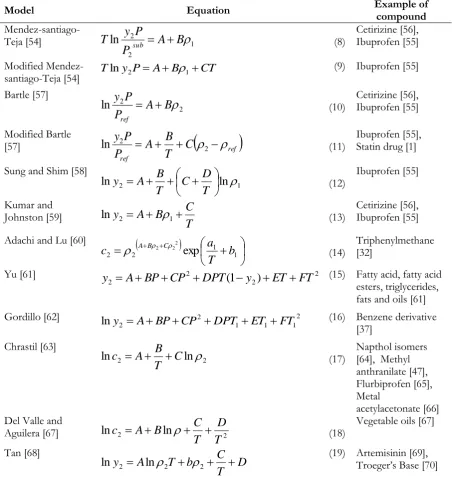
The most straight-forward and easiest way of correlating data is empirical fit, where relationship of solubility data to thermodynamic property, say pressure or density, is fitted directly, either linearly or other best-represented form. Li et al. [35] fitted solubility data of 2-naphthol and anthracene to pressure and density in form of curvilinear while linear fit model can be seen in Hybertson [36] work, in which sesquiterpene alcohol patchoulol is dealt. On the other hand, other more accurate and sophisticated models can also be used to predict the solubility behavior of solute, generally there are three types of models, namely solubility parameter model or solution model, density based semiempirical model and chemical association based semiempirical model [37].
4.2. Solubility Parameter Model
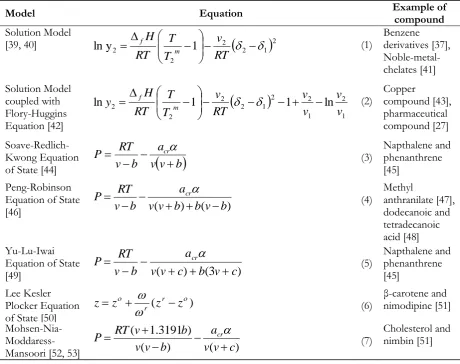
Solubility parameter model uses some solubility parameters and information of heat of fusion, sublimation pressure of solute, melting temperature, critical temperature, critical pressure, acentric factor and molar volume of solute and supercritical fluid to predict equilibrium solubility. In this model, supercritical fluid is treated as expanded liquid rather than gas [27]. Through this model, a lot of information is taken from literature or estimated by various assumptions and equation of states, therefore its accuracy is relatively lower than semiempirical model. Another drawback of this model is that solute properties are normally not available for complex structural compounds, in which complicated computational prediction and group contribution method need to involve [38]. Some common used equation of states that aid the modeling of solubility parameter model are Soave-Redlich-Kwong equation of state, Peng-Robinson equation of state, Yu-Lu-Iwai equation of state, Lee-Kesler-Plocker equation of state and Mohsen-Nia-Moddaress-Mansoori equation of state. Comparatively, these equations of state are more complicated than empirical or semiempirical model, because it requires more efforts to figure out the unknown constant in the model. Some solubility parameter models were listed in Table 1.
4.3. Semiempirical Model
Table 1. Equation of State based models.
Model Equation Example of compound
Solution Model
[39, 40]
21 2 2 2 2
1
y
ln
RT
v
T
T
RT
H
mf (1) Benzene derivatives [37],
Noble-metal-chelates [41] Solution Model coupled with Flory-Huggins Equation [42]
1 2 1 2 2 1 2 2 22
1
1
ln
ln
v
v
v
v
RT
v
T
T
RT
H
y
f m
(2) Copper compound [43], pharmaceutical compound [27]Soave-Redlich-Kwong Equation
of State [44]
v
v
b
a
b
v
RT
P
cr
(3) Napthalene and phenanthrene[45] Peng-Robinson
Equation of State
[46]
v
(
v
b
)
b
(
v
b
)
a
b
v
RT
P
cr
(4) Methyl anthranilate [47],dodecanoic and tetradecanoic acid [48] Yu-Lu-Iwai
Equation of State
[49]
v
(
v
c
)
b
(
3
v
c
)
a
b
v
RT
P
cr
(5) Napthalene and phenanthrene [45]Lee Kesler Plocker Equation of State [50]
)
(
z
z
z
z
r r
(6) β-carotene and nimodipine [51]Mohsen-Nia-
Moddaress-Mansoori [52, 53]
(
)
(
)
)
3191
.
1
(
c
v
v
a
b
v
v
b
v
RT
P
cr
(7) Cholesterol and nimbin [51]4.3.1. Density Based Semiempirical Model
Table 2. Common used semi-empirical models.
Model Equation Example of compound
Mendez-santiago-Teja [54] 1
2 2
ln
A
B
P
P
y
T
sub
(8) Cetirizine [56], Ibuprofen [55]Modified
Mendez-santiago-Teja [54] Tlny2PAB
1CT (9) Ibuprofen [55] Bartle [57]2 2
ln
A
B
P
P
y
ref
(10) Cetirizine [56], Ibuprofen [55]Modified Bartle
[57]
ref
ref
C
T
B
A
P
P
y
2 2
ln
(11) Ibuprofen [55], Statin drug [1]Sung and Shim [58]
1
2
ln
ln
T
D
C
T
B
A
y
(12) Ibuprofen [55]Kumar and Johnston [59]
T
C
B
A
y
2
1
ln
(13) Cetirizine [56], Ibuprofen [55]Adachi and Lu [60]
1 1 2 2exp
2 2 2b
T
a
c
A B C (14) Triphenylmethane [32]Yu [61] 2
2 2
2
A
BP
CP
DPT
(
1
y
)
ET
FT
y
(15) Fatty acid, fatty acidesters, triglycerides, fats and oils [61]
Gordillo [62] 2
1 1 1 2
2
lny ABPCP DPT ET FT (16) Benzene derivative
[37] Chrastil [63]
2
2
ln
ln
C
T
B
A
c
(17) Napthol isomers [64], Methylanthranilate [47], Flurbiprofen [65], Metal
acetylacetonate [66] Del Valle and
Aguilera [67]
ln
2ln
2T
D
T
C
B
A
c
(18) Vegetable oils [67]Tan [68]
D
T
C
b
T
A
y
2
ln
2
2
ln
(19) Artemisinin [69], Troeger’s Base [70]4.3.2. Chemical Association Based Semiempirical Model
Association theory is used to develop chemical association based semiempirical model, where fugacity calculation involves the solvate complex (ABk). The solvate complex is a cluster that formed by a molecule
of solute A associated with several (k) molecules of solvent B [71]. The solvent molecules, solute molecules and solvent-solute clusters are then in equilibrium with supercritical fluid system. Law of mass action is then used to calculate the equilibrium concentration [63].
new chemical association based semiempirical model that involves four parameters in the equation. Rajasekhar’s model is formed based on the association of interest solute with the supercritical fluid and correlates solubility with temperature, pressure, and density. As this model considers four parameters in correlating the solubility, and together with the association number of solute (k) in supercritical fluid, it has been reported that this model is generally more accurate than other existing models for drug case [37]. The developed chemical association model was shown:
C
B
T
A
P
P
y
k
sub 1
) 1 (
2
2
exp
(20)Similar to other common semiempirical models as discussed earlier, the constants in the equation (20) are determined by regression method; while the density is calculated from Span and Wagner equation of state [73]. This model is an alternative to existing semiempirical models because it offers better accuracy especially to cases that drug solubility are studied, and it is superior to equation of states as it involves less parameters that are difficult to obtain or not available. Example of solutes suitable with this model are antipyrine, aspirin, benzoin, acetanilide, cholesterol, flurbiprofen and other common pharmaceutical compounds that contained steroids, antioxidants, statins, antibiotics and anti-inflammatory.
5.
Conclusion
Supercritical fluid technology offers wide variety of advantages in industrial physical processes. Therefore, researchers raised their interest and study more about the supercritical fluid technology in recent years, to eventually replace the organic fluid used in conventional processes which is environmentally and economically infeasible. However, different types of supercritical fluid present different range of solubility value on many kinds of solutes. In other words, solubility data is subjective to specific solvent and solute. In order to realize the industrial physical processes, solubility data plays an important role because processes can be optimized by modifying the process working condition. Solubility data can be developed by static or dynamic experimental method, followed by different type of quantification methods and then mathematical modeling for prediction and scale up. Fitting the experimental solubility data with a mathematical model is tedious, especially involving equation of states. Thus, further advances are needed to develop a common model to fit different categories of solute.
Nomenclature
2
y Solubility (Mole fraction)
2
c Solubility (g L-1)
T Absolute temperature (K)
1
T Temperature (oC)
1
Molar density of fluid (mol L-1 or mol mL-1)2
Density (g L-1)
Density (g mL-1)ref
Reference density (700 g L-1)P Pressure (bar)
ref
P Reference Pressure (1 bar)
sub
P2 Sublimation pressure (bar)
cr
a Attraction parameter at critical temperature
Dimensionless function of reduce temperature and acentric factor, unity at critical temperature1
a Constant depending on enthalpy of solvatation
1
b Constant depending on molar mass of solvent and solute
k Association number of solute R Gas constant (J mol-1 K-1)
H
f
Heat of fusion (J mol-1)
m
T2 Melting temperature of solute (K)
1
Solubility constant of supercritical fluid (J1/2 m-3/2 or MPa1/2)2
Solubility constant of solute (J1/2 m-3/2 or MPa1/2)v Molar volume (m3 mol-1 or dm3 mol-1)
1
v Molar volume of supercritical fluid (m3 mol-1 or dm3 mol-1)
2
v Molar volume of solute (m3 mol-1 or dm3 mol-1) z Compressibility factor
z Compressibility factor at standard state
r
z Compressibility factor of reference fluid
Acentric factorr
Acentric factor of reference fluidF
E
D
C
B
A
,
,
,
,
,
Adjustable parameterAcknowledgement
The information source of UPM (Serdang, Malaysia) and the cooperation of research team members are gratefully acknowledged. Financial support from grant FRGS (Vot. No. 5524154) is much appreciated.
References
[1] M. Hojjati, Y. Yamini, M. Khajeh, and A. Vatanara, “Solubility of some statin drugs in supercritical carbon dioxide and representing the solute solubility data with several density-based correlations,” Journal of Supercritical Fluids, vol. 41, pp. 187-194, 2007.
[2] J. Fages, H. Lochard, J. J. Letourneau, M. Saucceau, and E. Rodier, “Particle generation for pharmaceutical applications using supercritical fluid technology,” Powder Technology, vol. 141, pp. 219-226, 2004.
[3] E. Reverchon, R. Adami, S. Cardea, and G. D. Porta, “Supercritical fluids processing of polymers for phamaceutical and medical applications,” Journal of Supercritical Fluids, vol. 47, pp. 484-492, 2009. [4] P. Pathak, M. J. Meziani. T. Desai, Y. P. Sun, “Formation and stabilization of ibuprofen nanoparticles
in supercritical fluid processing,” Journal of Supercritical Fluids, vol. 37, pp. 279-286, 2006.
[5] G. Brunner, “Supercritical fluids: technology and application to food processing,” Journal of Food Engineering, vol. 67, pp. 21-33, 2005.
[6] K. Ruttarattanamongkol, M. E. Wagner, and S. S. H. Rizvi, “Properties of yeast free bread produced by supercritical fluid extrusion (SCFX) and vacuum baking,” Innovative Food Science and Emerging Technologies, vol. 12, pp. 542-559, 2011.
[7] S. V. Yolanda, A. Cabanas, J. A. R. Renuncio, and C. Pando, “Supercritical fluid extraction of peach (Prunus persica) seed oil using carbon dioxide and ethanol,” Journal of Supercritical Fluids, vol. 49, pp. 167-173, 2009.
[8] G. T. Hefter and R. P. T. Tomkins, The Experimental Determination of Solubilities, vol. 6. England: Wiley, 2003, pp. 20-22.
[9] P. F. de Oliveira, R. A. F. Machado, A. Bolzan, and D. Barth, “Supercritical fluid extraction of hernandulcin from Lippia dulcis Trev.,” Journal of Supercritical Fluids, vol. 63, pp. 161-168, 2012.
[11] S. Mazzutti, S. R. S. Ferreira, C. A. S. Riehl, A. Smania Jr., and F. A. Smania, “Supercritical fluid extraction of Agaricus brasiliensis: Antioxidant and antimicrobial activities,” Journal of Supercritical Fluids, vol. 70, pp. 48-56, 2012.
[12] F. Montanes, T. Fornari, A. Olano, and E. Ibanez, “Supercritical fluid purification of complex carbohydrate mixtures produced by enzimatic transglycosilation and isomerized with complexating reagents,” Journal of Supercritical Fluids, vol. 53, pp. 25-33, 2010.
[13] I. Yilgor and J. E. McGrath, “Novel supercritical fluid techniques for polymer fractionation and purification,” Polymer Bulletin, vol. 12, pp. 491-497, 1984.
[14] F. P. Schmitz and E. Klesper, “Separation of oligomers and polymers by supercritical fluid chromatography,” Journal of Supercritical Fluids, vol. 3, pp. 29-48, 1990.
[15] G. P. Blanch, M. M. Caja, M. L. R. del Castillo, G. S. Maria, and M. Herraiz, “Fractionation of plant extracts by supercritical fluid extraction and direct introduction in capillary gas chromatography using a programmable temperature vaporizer,” Journal of Chromatographic Science, vol. 37, pp. 407-410, 1999. [16] M. Palma and L. T. Taylor, “Fractional extraction of compounds from grape seeds by supercritical
fluid extraction and analysis for antimicrobial and agrochemical activities,” Journal of Agricultural and Food Chemistry, vol. 47, pp. 5044-5048, 1999.
[17] I. Pasquali, R. Bettini, and F. Giordano, “Supercritical fluid technologies: An innovative approach for manipulating the solid-state of pharmaceuticals,” Advanced Drug Delivery Reviews, vol. 60, pp. 399-410, 2008.
[18] A. Shariati and C. J. Peters, “Recent developments in particle design using supercritical fluids,” Current Opinion in Solid State and Materials Science, vol. 7, pp. 371-383, 2003.
[19] J. Jung and M. Perrut, “Particle design using supercritical fluids: Literature and patent survey,” Journal of Supercritical Fluids, vol. 20, pp. 179-219, 2001.
[20] Y. Hakuta, H. Hayashi, and K. Arai, “Fine particle formation using supercritical fluids,” Current Opinion in Solid State and Materials Science, vol. 7, pp. 341-351, 2003.
[21] S. D. Yeo and E. Kiran, “Formation of polymer particles with supercritical fluids: A review,” Journal of Supercritical Fluids, vol. 34, pp. 287-308, 2005.
[22] Z. Knez and E. Weidner, “Particles formation and particle design using supercritical fluids,” Current Opinion in Solid State and Materials Science, vol. 7, pp. 353-361, 2003.
[23] K. Moribe, Y. Tozuka, and K. Yamamoto, “Supercritical carbon dioxide processing of active pharmaceutical ingredients for polymorphic control and for complex formation,” Advanced Drug Delivery Reviews, vol. 60, pp. 328-338, 2008.
[24] N. Yoshiyuki, “Supercritical fluid techniques in the 21st century. chemical recycling for waste using supercritical water,” Review of High Pressure Science and Technology, vol. 12, pp. 217-223, 2002.
[25] Wahyudiono, S. Machmudah, and M. Goto, “Utilization of sub and supercritical water reactions in resource recovery of biomass wastes,” Engineering Journal, vol. 17, no. 1, pp. 1-12, 2013.
[26] N. Jomtib, C. Prommuak, M. Goto, M. Sasaki, and A. Shotipruk, “Effect of co-solvents on transesterification of refined palm oil in supercritical methanol,” Engineering Journal, vol. 15, no. 3, pp. 49-58. 2011.
[27] C. S. Su and Y. P. Chen, “Correlation for the solubilities of pharmaceutical compounds in supercritical carbon dioxide,” Fluid Phase Equilibria, vol. 254, pp. 167-173, 2007.
[28] E. Reverchon, G. D. Porta, and M. G. Falivene, “Process parameters and morphology in amoxicillin micro and submicro particles generation by supercritical antisolvent precipitation,” Journal of Supercritical Fluids, vol. 17, pp. 239-248, 2000.
[29] S. Bristow, B. Y. Shekunov, and P. York, “Solubility analysis of drug compounds in supercritical carbon dioxide using static and dynamic extraction systems,” Industrial and Engineering Chemistry Research, vol. 40, pp. 1732-1739, 2001.
[30] G. Brunner, Gas Extraction: An Introduction to Fundamentals of Supercritical Fluids and the Application to Separation Processes, vol. 4. Germany, Springer, 1994, pp. 117-127.
[31] R. B. Gupta and J. J. Shim, Solubility in Supercritical Carbon Dioxide. United States: CRC Press, 2007, pp. 5-11.
[32] V. Pauchon, Z. Cisse, M. Chavret, and J. Jose, “A new apparatus for the dynamic determination of solid compounds solubility in supercritical carbon dioxide: Solubility determination of triphenylmethane,” Journal of Supercritical Fluids, vol. 32, pp. 115-121, 2004.
[34] R. L. Mendes, B. P. Nobre, J. P. Coelho, and A. F. Palavra, “Solubility of β-carotene in supercritical carbon dioxide and ethane,” Journal of Supercritical Fluids, vol. 16, pp. 99-106, 1999.
[35] Q. S. Li, Z. T. Zhang, C. L. Zhong, Y. C. Liu, and Q. R. Zhou, “Solubility of solid solutes in supercritical carbon dioxide with and without cosolvents,” Fluid Phase Equilibria, vol. 207, pp. 183-192, 2003.
[36] B. M. Hybertson, “Solubility of the sesquiterpene alcohol patchoulol in supercritical carbon dioxide,” Journal of Chemical and Engineering Data, vol. 52, pp. 235-238, 2007.
[37] S. N. Reddy and G. Madras, “Solubilities of benzene derivatives in supercritical carbon dioxide,” Journal of Chemical and Engineering Data, vol. 56, pp. 1695-1699, 2011.
[38] Z. Tang, J. S. Jin, Z. T. Zhang, H. T. Liu, “New experimental data and modeling of the solubility of compounds in supercritical carbon dioxide,” Industrial and Engineering Chemistry Research, vol. 51, pp. 5515-5526, 2012.
[39] J. H. Hildebrand, J. M. Prausnitz, and R. L. Scott, Regular and Related Solutions: The Solubility of Gases, Liquids, and Solids. Van Nostrand Reinhold Co., 1970.
[40] S. E. Guigard and W. H. Stiver, “A density-dependent solute solubility parameter for correlating solubilities in supercritical fluids,” Industrial and Engineering Chemistry Research, vol. 37, pp. 3786-3792, 1998.
[41] N. Tsuruta, S. Yoda, A. Hasegawa, T. Sugeta, Y. Takebayashi, T. Tsuji, and K. Otake, “Solubility measurement of noble-metal-chelates in supercritical CO2,” in the Proceedings of 6th International
Symposium on Supercritical Fluids, Versailles, 2003, pp. 765.
[42] P. J. Flory, “Thermodynamic of high polymer solutions,” Journal of Chemical Physics, vol. 10, pp. 51-61, 1942.
[43] Y. Takeshita and Y. Sato, “Measurement of copper compound solubility in supercritical carbon dioxide and correlation using a solution model,” Journal of Supercritical Fluids, vol. 24, pp. 91-101, 2002. [44] G. Soave, “Equilibrium constants from a modified Redlich-Kwong equation of state,” Chemical
Engineering Science, vol. 27, pp. 1197-1203, 1972.
[45] G. T. Liu and K. Nagahama, “Solubility of organic solid mixture in supercritical fluids,” Journal of Supercritical Fluids, vol. 9, pp. 152-160, 1996.
[46] D. Y. Peng and D. B. Robinson, “A new two-constant equation of state,” Industrial and Engineering Chemistry Fundamentals, vol. 15, pp. 59-64, 1976.
[47] W. C. Tsai, Y. H. Ruan, and S. S. H. Rizvi, “Solubility measurement of methyl anthranilate in supercritical carbon dioxide using dynamic and static equilibrium systems,” Journal of the Science of Food and Agriculture, vol. 86, pp. 2083-2091, 2006.
[48] C. Garlapati and G. Madras, “Solubilities of dodecanoic and tetradecanoic acids in supercritical CO2
with and without entrainers,” Journal of Chemical and Engineering Data, vol. 53, pp. 2637-2641, 2008. [49] J. M. Yu and B. C. Y. Lu, “A three-parameter cubic equation of state for asymmetric mixture density
calculations,” Fluid Phase Equilibria, vol. 34, pp. 1-19, 1987.
[50] U. Plocker, H. Knapp, and J. Prausnitz, “Calculation of high-pressure vapor-liquid equilibria from a corresponding-states correlation with emphasis on asymmetric mixtures,” Industrial and Engineering Chemistry Process Design and Development, vol. 17, pp. 324-332, 1978.
[51] A. Ajehariyapagorn, P. L. Douglas, S. Douglas, S. Pongamphai, and W. Teppaitoon, “Predicion of solubility of solid biomolecules in supercritical solvents using group contribution methods and equations of state,” American Journal of Food Technology, vol. 3, pp. 275-293, 2008.
[52] M. Mohsen-Nia, H. Moddaress, and G. A. Mansoori, “A cubic equation of state based on a simplified hard-core model,” Chemical Engineering Communications, vol. 131, pp. 15-31, 1995.
[53] A. H. Farrokh-Niae, H. Moddarress, and M. Mohsen-Nia, “A three-parameter cubin equation of state for prediction of thermodynamic properties of fluids,” The Journal of Chemical Thermodynamics, vol. 40, pp. 84-95, 2008.
[54] J. M. Santiago and A. S. Teja, “The solubility of solids in supercritical fluids,” Fluid Phase Equilibria, vol. 158-160, pp. 501-510, 1999.
[55] L. Vafajoo, M. Mirzajanzadeh, and F. Zabihi, “Determining correlations for prediction of the solubility behavior of Ibuprofen in supercritical carbon dioxide utilizing density-based models,” in World Academy of Science, Engineering and Technology, 2011, pp. 790-792.
[57] K. D. Bartle, A. A. Clifford, S. A. Jafar, and G. F. Shilstone, “Solubilities of solids and liquids of low volatility in supercritical carbon dioxide,” Journal of Physical and Chemical Reference Data, vol. 20, 1991. [58] H. D. Sung and J. J. Shim, “Solubility of C. I. disperse red 60 and C. I. disperse blue 60 in supercritical
carbon dioxide,” Journal of Chemical and Engineering Data, vol. 44, pp. 985-989, 1999.
[59] S. K. Kumar and K. P. Johnston, “Modelling the solubility of solids in supercritical fluids with density as the independent variable,” Journal of Supercritical Fluids, vol. 1, pp. 15-22, 1988.
[60] Y. Adachi and B. C. Y. Lu, “Supercritical fluid extraction with carbon dioxide and ethylene,” Fluid Phase Equilibria, vol. 14, pp. 147-156, 1983.
[61] Z. R. Yu, B. Singh, and S. S. H. Rizvi, “Solubilities of fatty acids, fatty acid esters, triglycerides, and fats and oils in supercritical carbon dioxide,” Journal of Supercritical Fluids, vol. 7, pp. 51-59, 1994. [62] M. D. Gordillo, M. A. Blanco, A. Molero, and E. M. de la Ossa, “Solubility of the antibiotic Penicillin
G in supercritical carbon doxide,” Journal of Supercritical Fluids, vol. 15, pp. 183-190, 1999.
[63] J. Chrastil, “Solubility of solids and liquids in supercritical gases,” The Journal of Physical Chemistry, vol. 86, pp. 3016-3021, 1982.
[64] C. S. Tan and J. Y. Weng, “Solubility measurements of naphthol isomers in supercritical carbon dioxide by a recycle technique,” Fluid Phase Equilibria, vol. 34, pp. 37-47, 1987.
[65] A. R. C. Duarte, P. Coimbra, H. C. de sousa, and C. M. M. Duarte, “Solubility of flurbiprofen in supercritical carbon dioxide,” Journal of Chemical and Engineering Data, vol. 49, pp. 449-452, 2004. [66] S. Yoda, Y. Mizuno, T. Furuya, Y. Takebayashi, K. Otake, T. Tsuji, and T. Hiaki, “Solubility
measurements of noble metal acetylacetonates in supercritical carbon dioxide by high performance liquid chromatography (HPLC),” Journal of Supercritical Fluids, vol. 44, pp. 139-147, 2008.
[67] J. M. del Valle and J. M. Aguilera, “An improved equation for predicting the solubility of vegetable oils in supercritical CO2,” Industrial and Engineering Chemistry Research, vol. 27, pp. 1551-1553, 1988.
[68] F. Tan, J. C. Yang, H. Y. Shen, and J. D. Wang, “Study on the solubility of substances in supercritical fluids,” Journal of Chemical Industry and Engineering (China), vol. 7, pp. 402-409, 1989.
[69] H. B. Xing, Y. W. Yang, B. G. Su, M. Huang, and Q. L. Ren, “Solubility of artemisinin in supercritical carbon dioxide,” Journal of Chemical and Engineering Data, vol. 48, pp. 330-332, 2003.
[70] Q. L. Ren, M. Huang, B. G. Su, and P. D. Wu, “Enhancement of solubility of troeger's base in supercritical carbon dioxide by methanol,” Chinese Chemical Letters, vol. 11, pp. 823-826, 2000.
[71] R. Ch and G. Madras, “An association model for the solubilities of pharmaceuticals in supercritical carbon dioxide,” Thermochimica Acta, vol. 507-508, pp. 99-105, 2010.
[72] Q. L. Ren, B. G. Su, M. Huang, and P. D. Wu, “Solubility of troeger’s base in supercritical carbon dioxide,” Journal of Chemical and Engineering Data, vol. 45, pp. 464-466, 2000.