This is a repository copy of
Customer views on service delivery in the Child Support
Agency
.
White Rose Research Online URL for this paper:
http://eprints.whiterose.ac.uk/73401/
Monograph:
Hutton, S, Carlisle, J and Corden, A (1998) Customer views on service delivery in the Child
Support Agency. Research Report. Department of Social Security Research Report, No.
74 . The Stationery Office , London.
[email protected] https://eprints.whiterose.ac.uk/ Reuse
Items deposited in White Rose Research Online are protected by copyright, with all rights reserved unless indicated otherwise. They may be downloaded and/or printed for private study, or other acts as permitted by national copyright laws. The publisher or other rights holders may allow further reproduction and re-use of the full text version. This is indicated by the licence information on the White Rose Research Online record for the item.
Takedown
If you consider content in White Rose Research Online to be in breach of UK law, please notify us by
DEPARTMENT OF SOCIAL SECURITY
RESEARCH REPORT No . 14
CUSTIMER
T S
E
E
IN THE
Sandra Hutton, Jane Carlisle and Anne Corden
A report of research carried out
by the Social Policy Research Unit at the University of York on behalf of the Department of Social Security
© Crown copyright 1998 . Published for the Department of Social Security under licence from the Controller of Her Majesty ' s Stationery
Office.
Applications for reproduction should be made in writing to The Copyright Unit, Her Majesty 's Stationery Office, St . Clements House, 2-16 Colegate, Norwich NR3 1BQ.
First published 1998
ISBN 0 11 762583 3
ISSN 0961 5695
Views expressed in this report are not necessarily those of the Department or any other government department.
Standing Order Service
Are you making full use of The Stationery Office's Standing Order Service?
The Standing Order Service is a free monitoring of the publications of your choice from over 4,000 classifications in 30 major subject areas . We send you your books as they are published along with an invoice.
The benefits to you are:
• automatic supply of your choice of classification on publication
• no need for time consuming and costly research, telephone calls and scanning of daily publication lists
• saving on the need and the costs of placing individual orders.
We can supply a wide range of publications on standing order, from individual annual publications to all publications on a selected subject . If you do not already use this free service, or think you are not using it to its full capability, why not contact us and discuss your requirements?
You can contact us at:
The Stationery Office Standing Order Department PO Box 276
London SW8 5DT
Tel 0171 873 8466 ; fax 0171 873 8222
CONTENTS
Acknowledgements vii
Summary
1 Introduction 1
Introduction 1
Objectives 1
Background 2
Research method 4
Fieldwork locations 5
The interviews 5
Structure of the report 7
Group discussion 7
Summary 7
2 Client Understanding of the Role of the
Child Support Agency 8
Introduction 8
Absent parents 8
Perceptions of the task of the CSA 8
Knowledge of the requirements of the other parent 10 Knowledge of how the assessment is calculated 10
Parents with care 12
Perceptions of the task of the CSA 12
Knowledge of the requirements of the other parent 12 Knowledge of how the assessment is calculated 13
Summary 14
3 Experience of the Process of Maintenance
Payment through the Child Support Agency 16
Introduction 16
Absent parents 16
First contact and previous arrangements 16
The Maintenance Enquiry Form 17
A ssessment and the amount to be paid 18
Time taken 20 Complaints 20 Overall 21
Parents with care 22
First contact 22
Maintenance A ssessment Form 23
A ssessment and payment 24
Time taken 26
Overall view of the process 26
Summary 27
4 Communications 29
Introduction 29
Absent parents 29
Leaflets 29
Letters 29
Telephone 30
Face-to-face 32
Parents with care 33
Leaflets 33
Letters 33
Telephone 34
Face-to-face 35
Summary 35
5 Outcomes 37
Introduction 37
Absent parents 37
Effects on children 37
Effects on partners and ex partners 38
Effects on finances and employment 38
Parents with care 39
Effects on children 39
Effects on partners and ex-partners 40
Effects on finances and employment 40
Summary 42
6 Overall Satisfaction and Dissatisfaction 44
Introduction 44
Illustrations of dissatisfied and satisfied cases : Absent parents 47
Mixed 47
Dissatisfied 48 Satisfied/miixed 50
Illustrations of dissatisfied and satisfied cases : Parents with care 51
Mixed 51
Dissatisfied 53
Satisfied 54
Summary 55
7 Discussion and Issues to Improve Satisfaction 56
Measuring satisfaction 56
A good service 56
Short-term measures 57
A bsent parents 57 Parents with care 58
Longer-term, broader issues 58
A bsent parents 58 Parents with care 59
Joint issues 59
Short term 59
Longer-term, broader issues 59
References 62
Approach letter 66
Topic Guide for Absent Parents 67
Topic Guide for Parents with Care 78
The group discussion : Methodology 89 Appendices
I
II
III
IV
ACKNOWLEDGEMENTS
A number of researchers worked together on this project, which was supervised by Roy Sainsbury. Thanks go to those who completed the fieldwork interviews : Anne Corden, Jude England and Christine Skinner. Carol Stimson was also part of the fieldwork team but sadly died before the publication of this report.
The research was commissioned by the Department of Social Security . We are grateful to Dan Murphy and Lynette Chapman from the Department of Social Security and to Valerie Walton and Gillian Brear from the Child Support Agency who gave support and advice throughout.
Special thanks go to the parents, who gave up their time to talk about their experiences .
On behalf of the Child Support Agency (CSA) the Department of Social Security (DSS) commissioned the Social Policy Research Unit at the University of York to undertake qualitative research to investigate further a range of issues identified in the CSA National Client Satisfaction Survey
1995 (Speed and Kent, 1996).
The study aimed to improve the Agency's understanding of the reasons for
clients ' satisfaction or dissatisfaction with the service offered by the Agency. The key areas investigated were : clients ' understanding of the role of the CSA ; their experience of CSA procedures ; communications with the Agency ; outcomes of their involvement with the CSA ; and overall satisfaction with the service . The study also aimed to provide some suggestions which might improve the service offered.
A further aim was to explore the use of a qualitative methodology in the investigation of client satisfaction . The study is based on a series 4 40 depth interviews with parents with care and absent parents, 20 in each group including parents with differing employment and family circumstances, and from urban and rural locations . The sample was drawn by the DSS from the CSA administrative records in two areas which are dealt with by different CSA Centres . A group discussion with eight parents with care was also included as a methodological study . The material findings are incorporated into the relevant sections of this report.
In the qualitative interviews clients commented on a wide range of issues, including policy and in so far as policy and administration are linked such comments have been reported here . However, the report does not profess to offer a comprehensive policy analysis.
Absent parents accepted the principle of joint responsibility of both parents for their children, and acknowledged that one role for the CSA was to save money on benefits.
However, this principle of joint responsibility was not accepted if absent parents had problems with access, or if they felt they had nothing more than
a biological relationship with the children . Some felt that the simple joint responsibility of the two biological parents did not reflect their more complex family relationship which might include adopted and step children.
Absent parents did not fully understand how the formula worked for calculating the amount of maintenance due, although they would have liked to . They understood that the amount they had to pay depended on the
parent with care's income but were suspicious that the parent with care was not giving correct information to the CSA.
Parents with care accepted the principle of joint responsibility between the two parents for their children . One of the things parents with care valued most about the CSA was the recognition of the fathers' responsibilities.
However, some parents with care had reservations if payment by the absent parent led to demands for access . Some women were prepared to do without the support of the absent parent if they did not want the father to have access to the children, or if they themselves wished to have no further contact with a violent or angry man . They also understood that one function of the CSA was to help to reduce the cost of benefit payments.
Many parents with care considered that the function of the CSA was to obtain money from the absent parent . Hence they said that the job of the CSA was to trace absent parents and police their employment and living standards.
Suspicion about information given by the absent parent to the CSA emerged clearly as an issue for parents with care in discussions of the role of the CSA. They felt that part of the role of the Agency was to make sure that the information it received was correct.
The group discussion revealed that mothers did not expect to understand fully all the details of the assessment process, but needed to feel confident that their own assessment was properly dealt with . To feel that they understood the rules, parents with care needed to understand the justification of the rules . Knowing why decisions had been made helped them feel a correct assessment had been made in their own case, and helped them to come to terms with principles they disagreed with.
Absent parents ' expectations of the CSA depended partly on their previous arrangements for the payment of maintenance . Their view changed according to whether CSA increased or decreased their payments. Sometimes they felt the CSA was being used as a tool to punish them . Some said they knew of media stories and experiences of friends but none said that these had directly influenced their expectations of the GSA.
In completing the Maintenance Enquiry Form (MEF), absent parents raised
objections to giving information about a new partner ' s income, and to other debts and commitments not being treated in the same way as housing costs.
Many felt that their assessment was too high and more than they were able
to pay, and hence believed it must be inaccurate . This led to appeals and reviews and a great deal of communication with the Agency.
A number of respondents said that they had thought about complaining about the process of maintenance payment but found no clear, routine way
to do so . As a result the CSA was only hearing a proportion of complaints.
Comments by absent parents on their overall experience of CSA procedures highlighted the following issues related to the assessment of maintenance : the
treatment of overtime earnings ; the inclusion of partners ' incomes as part of the assessable resources ; the treatment of debts other than housing costs ; the level of allowances for travel and pension contributions ; and the rules
relating to adopted and step children.
Delays and the associated accumulation of arrears were the aspects of the process of assessment and payment most often mentioned, though some respondents admitted they had adopted a head-in-the-sand approach, and
had welcomed delays . A further issue was lack of information on the progress of changes in the assessment throughout the process of appeals, reviews and
changes in circumstances . No absent parent was interviewed for whom the whole process was straightforward, that is for whom the MEF was easy to
complete ; the information required was unproblematic ; no delays were experienced ; the assessment was as expected ; and progress was properly reported.
A number of absent parents mentioned that their assessment had been processed quickly, and that they had received a speedy response to a change in circumstances . Some felt they had been properly informed of the progress of their case and some were satisfied because the amount to be paid was as
expected.
At the start of their involvement, parents with care expressed two different expectations of the GSA . One group expected that contact with the Agency would improve the reliability of payment and they had approached the CSA for this reason . Others, however, were reluctant to disturb previous satisfactory arrangements for the payment of maintenance, and expected that
contact with the CSA would have such an effect.
Parents with care in the study had mixed reactions to completing the
Maintenance Assessment Form (MAF) . Some found it straightforward; others found it complicated, although use of the help notes was minimal . In
commenting about completing the form, concerns mentioned were about demands for access, and about the anger of their ex-partner.
Three-quarters of the parents with care in the study had full assessments and more than half gave the amounts of their assessments . There was considerable confusion, however, with some not knowing if it was an interim assessment, and others not knowing if the money had been paid. Dissatisfaction with the level of payment was also mentioned, often linked with suspicions of absent parents under-reporting their income to the CSA, and of benefit fraud.
Most parents with care said they were being paid maintenance, but some were concerned that their ex-partner was changing to self-employment and thus avoiding or delaying payment . They also mentioned problems with the reliability of payments and delays in assessment reviews . Unreliable maintenance payments caused complications in benefit payments and student grants . Increased maintenance payments can take parents with care above the level for means-tested benefits, then if maintenance is reduced, it takes time to reapply for and receive benefit.
Most respondents felt that the time taken to receive payment was too long, although it ranged from three weeks to three years . Reactions clearly depended on their circumstances and whether or not other resources were available.
In reflecting on the overall process of assessment and payment, parents with care commented that they did not receive enough money, and this combined with delays in payment, lack of information from, and poor communications with, the Agency.
One parent with care said she had been in receipt of a full assessment and regular payment from the beginning of her involvement with the CSA . This seems to typify what parents with care require of the process of assessment
and payment . In addition some respondents commented that it was better to deal with the CSA than with an absent parent with whom they wanted to have as little contact as possible.
hi general the issues relating to communications with the Agency were similar for both absent parents and parents with care, but some points emerged more strongly among one group than the other.
Absent parents had generally used the leaflets and some found them straightforward, although some absent parents had found them difficult to understand, in particular one Asian absent parent.
The most common plea was for the Agency to acknowledge letters which could avert a sequence of sending a further letter followed by one or more telephone calls to check if the letter had been received.
Standard letters were not always appropriate, and the Agency ' s practice of filling in gaps in the form to take account of a client's circumstances sometimes meant that the overall content was difficult to understand.
Respondents, both in the interviews and the group discussion, described the same problems of waiting for a reply on the telephone as had been highlighted in the Satisfaction Survey . When the call was answered they objected to having to repeat their story to different members of staff . This led to speculation that there was high staff turnover . People wanted to have just one person to deal with their case or, better still, a face-to-face interview.
If more CSA work is moved to local offices, the frustrations of discovering from responses to letters and telephone calls that different teams deal with different parts of their case may be removed.
The reactions of absent parents to telephone calls received from the CSA were mixed : some welcomed evening calls at home, particularly if problems were resolved, but others found them intrusive . All objected to telephone calls at work and some were anxious about people at work knowing their family circumstances.
In the group discussion, parents with care identified problems with communications and delays as being the worst aspects of dealing with the
Agency . They said they needed to know, throughout the process of dealing with the Agency, what progress was being made on their case . They also wanted better access to personal interviews with staff.
Overall, both parents with care and absent parents were left with the impression of an impersonal system consisting of forms, letters and, increasingly, telephone calls, with little or no face-to-face contact.
Absent parents had a number of concerns about the effect their involvement with CSA might have on their children, both in their current families if they
had re-partnered, and with the children from the previous family . They mentioned the reduction in the living standards of their current families as a
Absent fathers commented upon the impact of the Agency on their relationships with current and ex-partners . For example, the amount of money paid, and the time and energy absorbed by dealing with the CSA, placed a strain on a current relationship . Also the extra maintenance required by the CSA could mean that a new partner felt she was paying for the ex-wife . Difficulties arose in relationships with ex-partners because of suspicions that they were working while claiming benefit . Some absent parents took exception to having to pay maintenance for the ex-partner although they did
not object to supporting their children.
Involvement with the CSA had little overt effect on the work incentives of absent parents although there were suggestions that it might . At the time of the interview, none of the absent parents interviewed had given up work although some had thought about it, and one was sick and unlikely to return to his job . Other respondents said there was no point in doing extra overtime, trying to earn more or seeking promotion, all of which would be taken into account at the next CSA review . Some respondents expressed concerns about their relationship with employers, once the employers had been contacted by the GSA.
One other financial impact noted was that the Agency formula meant that the assessed maintenance payments for those with low housing costs were so high that it would be impossible for an absent parent, having returned to his/her parental home, to save enough for a deposit to move into independent accommodation.
di/ ;t,, Parents with care reported that their involvement with the CSA had less
impact on their children than that noted by absent parents . Some, however, used the threat of withdrawing access as a weapon to encourage payment of maintenance which, if implemented, would affect the children . Children were also used as informants about absent parents . Parents with care said that the children's relationships with the absent parent were affected by whether the children knew if the absent parent was paying maintenance or not . This was particularly the case with older children . It was reported that children were upset by arguments between their parents about the payment of maintenance, and that children were made to feel guilty by the absent parent about the amount of maintenance having to be paid.
The main point made about relationships with ex-partners was that involvement with the CSA meant contact had to be maintained with an ex-partner which was sometimes not wanted.
Involvement with the CSA did not mean such a clear cut financial gain as might be expected, given that the Agency aims to improve the receipt of maintenance for parents with care . Unreliability of maintenance payments threatened the package of low-paid work, Family Credit and maintenance which has to be managed to secure a real gain for parents with care relative
to Income Support . A sudden increase and subsequent fall in the
maintenance paid as the result of a short period of high overtime payments,
for example, could take the parent with care above Income Support levels,
leading to a loss of access to direct payments, help with school meals and
other passported benefits . In one case this had led to debt, and another
respondent was threatened with repossession . Some had to live on very little
money because of unreliability of maintenance payments ; Income Support
was reduced by the amount of the assessed maintenance, but if the
maintenance was not paid, the parent with care had to survive on an income
lower than the Income Support level.
Concerns were expressed that if demands for maintenance were too high,
the absent parent would give up paying altogether, and that the CSA was
unsuccessful if the absent parent became self-employed.
Some parents with care, however, had experienced a substantially greater
income with few negative results.
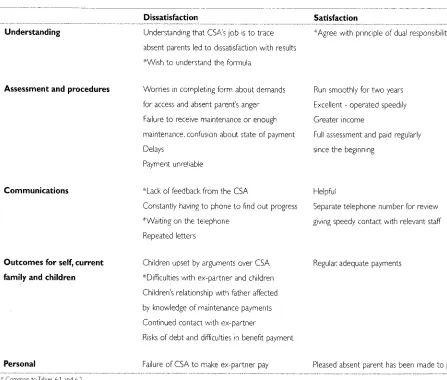
,111 ua toxt Case studies were used to indicate how the different aspects of the
experiences of CSA clients interact to create a satisfied or dissatisfied
customer.
The final chapter lists what is required to provide a good service for both
absent parents and parents with care . Some issues emerging from the study
which might help to achieve a good service are discussed . The
recommendations listed below are set out according to whether they can be
implemented within a short or longer time scale.
Short term
information on what to expect
• acknowledgement of letters
• initial contact letters to be less demanding and threatening and based more on the assumption that absent parents will pay maintenance
• range of leaflets depending on the level of information required
absent parents to be informed that they might be telephoned at home
early in their contact with the Agency
Longer term
• encouragement to pay and pay regularly, for example, by offering
incentives
clearer and fuller explanation of the regulations related to the calculation
of maintenance .
Short term
ensure that parents with care understand that maintenance payment may be unreliable which may have an impact on benefit payments
Longer term
to reduce the risk attached to unreliable maintenance payments, the CSA could underwrite payment, or a better result might be achieved if a lower amount of maintenance were demanded but paid regularly.
Short term
improved communications would create a better impression of the Agency
a clear, easy route for making complaints
Longer term
understanding of parents ' three-way sharing of responsibilities with the state might reduce the reluctance to comply with the requirements of the Agency
in circumstances where suspicion between partners is a particular problem it might be cost effective for the CSA to offer a mediation service
a simpler formula for calculation of maintenance liability would be easier to explain and administer yet not result in much rougher justice than the present formula
reduce the target for the completion of new assessments to 16 weeks
reorganise the caseload so that small teams are responsible for a group of clients
more opportunity for face-to-face contact
greater focus on the whole process of persuading the absent parent to pay and pay regularly, and delivery of the payment to the parent with care causing as little disruption to their lives as possible.
I INTRODUCTION
Introduction On behalf of the Child Support Agency (CSA) the Department of Social Security (DSS) commissioned the Social Policy Research Unit to undertake qualitative research to investigate further a range of issues identified in the CSA National Client Satisfaction Survey 1995 (Speed and Kent, 1996) . This first chapter includes a presentation of the research objectives, background and method and details the structure of the report.
Objectives The aim of this research is to enable the Agency to understand in greater depth the reasons for satisfaction and dissatisfaction and be better able to take remedial action where appropriate . It aims to identify client satisfaction and dissatisfaction arising specifically from operational or staff activities, since views of the service may be influenced by, for example, favourable or unfavourable outcomes, CSA policy and media reports.
The key areas of the investigation were:
• clients ' understanding of the CSA:
- in terms of its overall role to assess, collect and enforce child support,
its responsibilities in respect of both parents in each case, and the significance of the formula in the determination of child support
- of the procedural steps involved in each case
• clients ' experience of the various procedural stages including:
the information required by the Agency
- the assessment process and continuing reviews
- the payments made and received
- the timeliness of the payments and communications
• communications with the Agency:
- the information, advice and help provided by the Agency
- oral, written and telephone communications
• clients ' views of the effects of the assessment and involvement with the CSA on:
- the children involved, in current and previous families, both financially and in terms of relationships
- relationships with current and ex-partners
In each of the above areas, the aim was to discover what the expectations of CSA clients were, how these matched the experiences described, and the causes of any dissatisfaction . Where people had specific dissatisfaction, for example with perceived delays or inefficiencies of staff, their views were sought about the source of the problem, and what might be done to avoid such problems in the future . Those people who sought help from the Agency about problems, (for example difficulties in demonstrating income levels or non-receipt of maintenance after assessment) were asked about the timeliness and effectiveness of the solutions suggested or adopted by the CSA.
Background The Child Support Act, 1991, aimed to increase both the number of lone parents receiving maintenance and the average amount that they received. The Act removed the responsibility of the courts to determine the extent of any financial obligation of parents living apart from their children and to enforce payment . It was argued that fixing maintenance on an individual basis, with courts having wide discretion to decide appropriate amounts, had led to inequity in the amounts of maintenance, and the enforcement procedures had been unsuccessful (DSS, 1990) . The CSA was established as a Next Steps Agency of the DSS in 1993, with powers to assess maintenance on the basis of a standard formula laid down in the Act, and to collect and enforce child support.
The principle underlying the Child Support Act is that both parents have a legal responsibility to maintain their children whenever they can afford to do so . The terms used in the legislation when describing the clients of the CSA are parents with care and absent parents and these terms are adopted for purposes of this report.
Since its introduction, the operation of the CSA has attracted considerable attention and criticism. There have now been four Parliamentary Social Security Committee reports, all of which have drawn attention to operational issues giving cause for concern (HC 983, 1993;.HC 470, 1994; HC 50, 1996 ; HC 440, 1996) . In particular, the third report (HC 50, 1996) suggested that service improvements were still needed in the accuracy of assessments, the prevention of arrears, enforcement, service for self-employed people, reviews, appeals and changes of circumstances, customer service, privacy and confidentiality, and relations between the Benefits Agency and the CSA.
Two reports from the National Audit Office (NAO, 1994 ; 1995) have made critical observations about operational procedures and activities . The Committee of Public Accounts (HC 31, 1995) expressed concern about inaccuracies in assessments made during the first year of Agency operations, and about staffing levels . The Parliamentary Commissioner for Administration (1995) identified maladministration in terms of inadequate procedures, poor correspondence, inaccurate advice and delays in
assessments . A year later, the Commissioner identified some improvements in these areas, but drew attention to further issues such as breaches of confidentiality, delays in passing on maintenance to parents with care and failure to resolve complaints (Parliamentary Commissioner for Administration, 1996) . He was specially concerned about the number of people who had taken up their grievances with CSA in a constructive way, without apparently getting satisfaction, and repeated his recommendation made in the previous report, for the appointment of an independent
complaints adjudicator . The Government subsequently announced the recruitment of an Independent Complaints Examiner later in 1996.
Organisations representing the interests of absent parents and parents with care, including the National Association of Citizens Advice Bureaux (NACAB, 1994) and the Child Poverty Action Group (Garnham and Knights, 1996) have pointed to perceived problems in operationalising the Child Support Act, drawing on case studies of parents who had met problems in dealing with the CSA . A number of independent research studies have thrown further light on some of the early problems in implementation and difficulties that still remain for some parents with care and absent parents (Clarke, Craig and Glendinning, 1994, 1996 ; NCOPF, 1994) and Boden and Corden, (1996a, 1996b) looked in detail at the assessment of self-employed absent parents . Other current work which will inform issues relevant to this project is a study of `Fathers Apart in Britain ' (Bradshaw and Stimson, 1994) based on a national survey . It focuses on fathers ' experiences of the CSA : the assessment, the outcome and work incentives . Qualitative interviews explore issues of contact with children, and the process of payment of maintenance through the CSA.
The operation of the CSA has been subject to a number of operational and policy developments since 1993, including new primary legislation encapsulated in The Child Support Act, 1995 . The Agency ' s Annual Reports (CSA, 1994, 1995a) and Business Plans (CSA, 1995b) and the annual reports published by the Chief Child Support Officer (CAS, 1994, 1995, 1996) all refer to efforts to improve the service provided by the Agency and initiatives to reduce client dissatisfaction.
Since its inception, the Agency has commissioned a Client Satisfaction Survey each year (see Speed, Roberts and Rudat, 1993 ; Speed, Crane and Rudat, 1994 ; Speed and Seddon, 1995) . These surveys are designed to provide comparable data, which enable assessment of the extent to which the
Secretary of State's targets for quality of service are being met . The surveys are designed to investigate views about the service provided by the Agency,
rather than issues related to policy concerning child support . The areas of interest thus include clients ' experience of contacting offices, personal contacts with staff, using the National Enquiry Line, experience of the assessment procedure and collection of fees, and reviews and complaints. The latest Client Satisfaction Survey (Speed and Kent, 1996) achieved
interviews with 1,526 parents with care and 1,537 absent parents in the
quantitative stage, and went on to pursue issues in greater detail with 31 of
these clients.
The Client Satisfaction Survey has consistently shown that the following
areas are important in achieving client satisfaction:
• perceptions of staff
• quality of communication
• timescales
• ease of access
• application forms.
Conversely, the main sources of client dissatisfaction with the service
provided by the CSA have been:
• problems in telephone access
• problems in access to a person who can respond appropriately to individual queries
• failure or delay in replying to letters
• mistakes in letters
• delays and inaccuracies in assessment procedures
• delays and inaccuracies in conducting reviews.
The Secretary of State set a service satisfaction target in the CSA Business
Plan, and for 1993, 1994 and 1995 this target was set as `65 per cent of clients
to regard the service as satisfactory' . The overall composite satisfaction percentage for the 1995 Client Satisfaction Survey was 45 per cent . Looking at client groups separately, the overall satisfaction percentage for parents with
care was 53 per cent, and for absent parents, 34 per cent.
Measures of overall satisfaction must, however, be treated with caution.
Non-service issues can probably never be completely eliminated from any
measurement of satisfaction with services . Despite all efforts made to ask respondents to focus on service issues, some are bound to be influenced to
some extent by non-service factors such as their views on overall child
support policy, the level of their personal maintenance assessment and/or the
influence of media representations of CSA activities . This point will continue to be of importance in interpretation of the findings from the
Satisfaction Survey, and is of key importance in the research design and
interpretation of the results of this study.
Research method A qualitative approach was chosen to explore the understandings,
expectations, perceptions and views on procedures experienced that give rise
to client dissatisfaction . The study is therefore based on a series of 40 depth interviews with parents with care and absent parents, 20 in each group . We included parents from differing employment circumstances, with incomes mainly from employee earnings, from self-employment and from benefits. The range of clients in the study had to be broad enough to capture the potential diversity of client experience so that it also included people who had undergone one or more reviews, as well as people who were in their first assessment period . The study group also included clients from different locations (urban/rural) as this may be an important factor for issues of communication (such as ease of access to local offices, public telephone facilities) and information dissemination.
Fieldwork locations Interviews were conducted in two geographical areas : the North West ; and north-eastern London and into Essex . The sample in the North West was drawn in the Birkenhead CSA Centre (CSAC) for all the offices in the North West division except Manchester City and Liverpool City, so that it covered suburban and rural areas . Addresses in London and Essex were provided by the Hastings CSAC . No samples were drawn from local offices
directly.
North-eastern London represents an inner city/conurbation location, while the North West and Essex offered the opportunity of including clients in small towns, rural and seaside localities . The contrasting labour markets in the localities supported different kinds of employment and self-employment, and different employment opportunities for parents currently not working. The labour market in both geographical areas offers opportunities for both men and women in small manufacturing industry, the commercial and retail sectors, and service industries . There are ethnic minorities in both areas so there were opportunities to interview people from these groups.
Our choice of the North West and north-eastern London and Essex meant that the study group included clients whose assessments have been dealt with at two CSACs - Birkenhead and Hastings . The study does not, therefore, provide a full picture of any minor differences in client service due to different operational and administrative practices across the six CSACs
(which may lead to different client dissatisfactions) . The timetable did not allow the inclusion of clients receiving service from all six CSACs . There is already some information available to the DSS about the experience of assessment of self-employed absent parents living in areas dealt with by the Falkirk and Dudley CSACs (Baden and Corden, 1996a, 1996b) . Hastings CSAC piloted the CAST (Complete Action Service Team) system which allocates a case consisting of both parents of a child or children to a team which will have responsibility for all aspects of the case : assessment, payment, arrears, enforcement . All CSACs will be implementing this system by 1997.
appropriate areas . Letters from the DSS (see Appendix I) to these clients
provided an opportunity for those people who did not want to be involved
to opt out . After two weeks, names and addresses of those clients who had
not withdrawn were passed to the researchers, who contacted clients directly
and built up a study group according to the criteria discussed . Some contact
was made by telephone but it was considered important to make contact
with and include in the study both parents with care and absent parents who
were not on the telephone or who were ex-directory.
The interviewers used topic guides (see Appendices II and III) for
semi-structured discussions, ranging across the issues to be addressed . The
interviews were tape-recorded, and transcribed for analysis . The topic guide
was tested in a series of four pilot interviews in the North West including
two absent parents and two parents with care, one of each with their main
source of income from employee earnings, and one of each with their main
source of income from benefits . The pilot interviews suggested some minor
alterations to the topic guide, but it was felt that the interviews provided
sufficient valid information to be included as part of the main stage sample.
Although we had experienced some concerns at the pilot stage in achieving
interviews with parents with care, this was not a problem at the main stage.
In the North West we achieved 22 interviews : 11 with parents with care;
and 11 with absent parents . The parents with care included: lone mothers on
benefit ; lone mothers working and receiving Family Credit ; women who
had re-partnered, and were working with no benefit ; and a student who had
re-partnered, and was not on benefit . The absent parents included : men who
had remarried some time ago with a new family living on earnings only ; one
who had remarried with a new family and was on sick pay ; men who had
gone back to living with their parents although they were in work ; and
others who had repartnered, but had no children living with them . In
north-eastern London and Essex we achieved 18 interviews : nine with parents with
care, and nine with absent parents . There was a range of circumstances for
the parents with care similar to the North West, but there were some who
were unemployed and self-employed among the absent parents in the
London-Essex area.
The transcripts of the interviews were the basis of the analysis . The themes
for the analysis were in the main taken from the topic guide covering issues
concerning understanding of the role of the CSA, experiences of the
assessment and payment procedures, communicating with the Agency,
outcomes for the respondent, their children and relationships with previous
partners . From each transcript, responses relating to each of these areas was
charted in such a way that the individual experience of each case was not
lost . Early in the interview each respondent was asked without prompting
about their experience with the CSA . The aim of this question was to
highlight what was uppermost in respondents ' minds about their experience
of the CSA . These responses have not been analysed separately but have
been used particularly to illuminate the views expressed about overall satisfaction and dissatisfaction with the work of the CSA.
Structure of the report Chapter Two investigates peoples ' understanding of the role of the CSA and what it is aiming to achieve . Experience of the assessment and subsequent procedures are described in the third chapter which is closely linked to issues of communications between the clients and the Agency discussed in the fourth chapter. The fifth chapter reports the outcomes of involvement with the CSA for the clients at a personal and financial level, any consequences for the children and relationships with current families and ex-partners.
Chapter Six identifies the main sources of dissatisfaction and examples of good practice using cases studies as illustrations for absent parents and for parents with care . The final chapter discusses the measurement of satisfaction and presents some suggestions for improving the service offered by the CSA.
Group discussion One group discussion with eight parents with care was also included as part of this research . The main purpose of including a group discussion was to explore the feasibility, and methodology of this approach . The issues chosen for discussion at the group were discussed with the DSS . The focus was the parents ' expectations of good service from the CSA, especially in relation to building their understanding, and enabling communication with the Agency. A description of the methodology is included in Appendix IV.
In reflecting on the overall process of assessment and payment, parents with care commented that they did not receive enough money, and this combined with delays in payment, lack of information and poor communications . (Findings from the group discussion are reported in the relevant sections in Chapters Two and Four .)
Summary This follow-up study of clients ' satisfaction with their experience of the CSA has used depth interviews with 20 absent parents and 20 parents with care.
The aim was to understand more clearly what aspects of the work of the CSA provoked feelings of dissatisfaction or satisfaction . To do this we explored clients ' understanding of the work of the CSA, their experiences of the procedures involved, their communications with the CSA and the outcomes for their employment and for their families .
2 CLIENT UNDERSTANDING OF THE ROLE OF THE CHILD SUPPORT
AGENCY
Introduction Parents in the study were asked what they believed the purpose of the CSA was, and who they thought should be responsible for their children's maintenance . Each parent was also asked what information they believed the other parent had to provide, and to what extent, if any, each parent should be responsible for supporting their children . Respondents were asked about their knowledge of what is taken into account when calculating the assessment, and their awareness of their liability to future contact with the Agency. Parents ' views about the performance of the CSA in providing information, and suggestions about how the service could be improved, are also described in this chapter.
Analysis of the transcripts showed that the experiences of parents with care and absent parents in relation to the CSA were quite different . This is, to some extent, to be expected, since the relationships between the CSA and absent parents and the CSA and parents with care are opposite and complementary elements of the process of paying for the support of their children : absent parents are required by the CSA to pay out money, while parents with care receive money . It is, therefore, appropriate to discuss the parent groups separately throughout the report.
Absent parents Respondents not only talked about the perceived tasks of the CSA, but also
Perceptions of the went on to give their opinion of the Agency ' s performance . Absent parents
task of the CSA tended to agree, in principle, with what they believed to be the aims of the CSA . They described these as:
i) to ensure that absent parents assume their share of responsibility in supporting their children
ii) calculation of the assessment
iii) reducing the Income Support bill.
Some absent parents thought CSA tasks did, or should, also include:
iv) ensuring that all absent parents pay maintenance
v) ensuring a right of access to absent parents who paid maintenance
vi) a policing role regarding parents with care in undeclared employment.
Although respondents said they were prepared to accept some responsibility for their children, many of the absent parents in the study insisted that the amount for which they had been assessed was unreasonably high . One (API) commented that the CSA was ` too one-sided ' , because it left absent parents struggling to survive, while the parents with care did not have to work, yet
enjoyed a comfortable lifestyle because of perceived high maintenance
payments . Calculation of the assessment was seen as a further task of the
Agency.
The focus of a few absent parents occasionally differed sharply from the
views of parents with care . These absent parents believed the parent with
care should be wholly responsible for the child 's financial support . This view
was held by one parent (AP9) who, in his previous relationship, had adopted
his ex-partner's child, for whom he now denied any responsibility, and with
whom he wanted no further contact . However, more commonly this view
tended to be accompanied by the belief that an absent parent should not be
liable for the maintenance of children to whom he was not permitted access.
One Asian absent parent (AP7) wanted to have both custody and sole
responsibility for his children . He described his wife as `shameful ' because,
according to his culture, it was a sign of disgrace to claim money from the
state . He believed that it was, or certainly should be, an integral part of the
task of the CSA to ensure a right of access to absent parents who paid
maintenance . He could not understand the idea of paying for children he
could not see . He would have preferred to have custody of the children, and
said there would be no need for benefit payment if the children were with
him.
A role for the CSA which may be characterised as one of policing the
employment and income of parents with care was mentioned . Absent
parents who held this belief did not understand why Agency staff had not
checked out information supplied by them about their ex-partner ' s activities
relating to employment . They thought their ex-partners were claiming
benefit at the same time as working and, these absent parents believed, the
parents with care were not declaring their employment or earnings to the
CSA . Absent parents in this situation felt cheated because their previous
partners were receiving what they perceived as an unreasonably large income
as a result of deception . The absent parents thought their maintenance
assessment would be reduced once the Agency had seen that the parent with
care was working . These absent parents had reported their ex-partners '
activities to the CSA, and had been disappointed when the Agency had
displayed no interest in following up such information . They were unhappy
because they felt they were supporting their ex-partners . A comment from
one absent parent (API) summed up the overall feeling : `I don ' t mind
supporting my children, but I certainly don ' t want to be supporting my
ex-wife ' .
The role of the CSA was also seen as ensuring that all absent parents paid
maintenance for their children . A number of respondents demonstrated an
awareness, which had been heightened by media reports, that some absent
parents had successfully evaded assessment by the CSA . Such parents were,
for the most part, seen as well off and, often, self employed . Thus assessments
were seen as ` hitting people who work ' , employees whose earnings, and
proof of earnings, were transparent . These were compared with self-employed absent parents whose declared incomes were open to deception because the father could appear to be an employee in his own company, or because of imprecise elements such as expenses . There was a perception that high earners were not penalised as greatly as ` ordinary working people ' (AP2 ; AP18) . The CSA was seen as targeting employees because they were easy prey.
The CSA was also seen as a government tool for reducing the Income Support bill, and one absent parent (AP18) therefore saw the job of the CSA as being to cut down on benefit fraud . Another (AP19) described the CSA as a tax collection Agency and, in addition, voiced another common complaint, which was that their child gained no benefit from the father's maintenance payment since it was withdrawn, pound for pound, from the household ' s benefit payments . Thus, while some fathers were happy to pay towards their children's upkeep, they wanted the children to gain from their money, rather than seeing it used as a replacement for state benefits . Others, however, felt that the Agency had simply provided a very effective means of enabling their ex-partners to punish them ; they felt that parents with care did well out of the system, as they did not have to work to support the children.
Knowledge of the requirements Absent parents' knowledge of the requirements made upon parents with care
ofthe other parent in relation to calculating the maintenance assessment tended to be vague and,
in some cases, inaccurate . Some respondents were aware that parents with care had to provide details of their income . Approximately half the absent parents in the study knew that a claim for benefit automatically triggered the involvement of the CSA, and that refusal to cooperate could result in the parent with care losing benefit.
Strong feelings were aroused by the belief that ex-partners had approached the CSA from spite, in order to penalise the absent parent financially . This view was most often expressed by absent parents who had been unaware that the CSA automatically became involved when a parent with care claimed
benefit . However, one absent parent (API) believed his former wife had left her employment purposely to subject him to the CSA and maintenance payments . There was, overall, little awareness that the parent with care ' s income was also taken into account in calculating the assessment.
Knowledge of how the Respondents ' knowledge of how the assessment is calculated was patchy.
assessment is calculated However, some absent parents had a detailed knowledge of the elements which are considered in the assessment of their maintenance . An absent parent (AP2) who had made a capital transfer of the family home when the relationship ended had assumed that this would be taken into account when assessing maintenance . Several absent parents explained that they must be left with a minimum amount of money equivalent to Income Support, after paying maintenance, for their own living expenses . Some absent parents thought the amount of money they had to pay was based on the number of
children for whom they were responsible, others that it was based solely on their income . One absent parent (AP8) thought that 33 per cent was the maximum proportion of income the CSA could enforce as maintenance. The travel and pension allowances were mentioned, but there was uncertainty as to exactly how pension allowances were assessed . One absent parent (AP10) said that he had understood the calculation at the time of his own assessment, and that he could find the leaflet in which he had found the information . He had, however, been unable to describe in the interview how the CSA had arrived at the amount to be paid . It was difficult for respondents to judge the accuracy or otherwise of their assessment because the actual formula is not provided.
Those absent parents who were paying a large amount in maintenance tended to have a much greater knowledge of how the assessment was calculated than respondents who were paying little, or no, maintenance. Even the parents who paid a lot did not fully understand how the amount was reached . The amount of their assessment was a matter of concern, together with a lack of complete understanding as to how the amount was reached . This was despite knowing about the elements used in the calculation, and partly the result of thinking their own assessment would match that of work colleagues on a similar income . One absent parent (AP17) compared the amount of money paid to support his child with the amount on which he himself would be expected to live if he were dependent on Income Support . The child had no housing costs as he lived with his mother, and yet support for the child amounted to approximately double the level of Income Support for an adult . High assessments for maintenance fuelled a belief that absent parents support not only their children but also their ex-partners.
Absent parents knew that their housing costs were taken into consideration when the calculation for maintenance was made . There was a belief that items of debt and expenditure, such as hire purchase agreements and council tax, should also be taken into account when assessing maintenance, and one respondent (AP6) thought that an allowance was made for council tax. Respondents who did overtime could not understand the way in which it was treated as normal income, when it was not regular income . Absent parents who regularly had their children to stay felt that insufficient account was taken of the times when their children stayed with them overnight ; one (AP18) commented that no adjustment in the amount of maintenance received by the parent with care was made when he also had his step son to stay. This was another area in which understanding was poor . One parent (AP18) also commented that the CSA was unable to cope with cases which did not fit into their system . Others did not understand why the income of their new partner was included in the calculation of their assessment.
Overall, absent parents had a good grasp of the basic elements which were included in calculating the assessment . The most common misconceptions were that it would be a lower proportion of their income than it actually was
and, in a few cases, that an allowance would be made for outgoings such as council tax and hire purchase.
Parents with care The majority of parents with care thought that both parents should share
Perceptions of the task equally the responsibility for supporting their children . They believed that
of the CSA the aims of the CSA were to:
i) ensure a shared responsibility between both parents
ii) physically find absent parents to enforce payment of maintenance
iii) collect maintenance payments from absent parents.
The views of parents with care on the task of the CSA tended to vary to reflect their own situations . A quarter of parents with care saw actually
finding absent parents as a major part of the GSA ' s role, as they had never
progressed beyond this stage . Several parents with care expressed dissatisfaction because the CSA had failed either to find, or to enforce payment from, the absent parent . These mothers felt that the CSA was not carrying out the task for which it had been created.
The task of the CSA was described by some parents with care as that of a collecting agency, which resembled an absent parent ' s description of it as a tax collection agency . Parents with care believed the task included passing on maintenance payments where necessary. Some parents with care had been
disappointed in the CSA : for example one parent with care (PWC1) said that she had originally thought the Agency would oblige all absent parents to pay their share of maintenance, while experience had shown that it simply demanded more from those absent parents who were already paying maintenance . The Agency was perceived as lacking even-handedness by its failure to ensure that all absent parents were tracked down and made to pay an amount of maintenance appropriate to their income.
One parent with care (PWC1) did not understand why the CSA had no role in their affairs while they were in receipt of Income Support, but a claim for Family Credit had initiated contact . The majority of parents with care believed the assessment for maintenance was guided by the absent parent ' s income . A minority held the view that, by replacing benefit with maintenance, the CSA helps the state rather than parents with care or their children.
Knowledge of the requirements Parents with care generally knew that a claim for benefit initiated contact
of the other parent with the CSA, although one respondent (PWC15) had not known this. Several parents with care believed that the assessment was calculated primarily on the basis of the absent parent 's earnings . A few said that 30 per cent of the absent parent ' s income was deducted in maintenance after other
stoppages . Most parents with care demonstrated some knowledge of the
information required from the absent parent by the CSA before the
assessment of maintenance could be calculated . This knowledge included the
absent parents ' obligation to provide information about their incomes, and some knew that payment could be enforced through an attachment of
earnings at source.
There was concern from some parents with care who suspected that their
ex-partners had not declared all of their income to the CSA . These parents
thought that it was a part of the Agency ' s role to act as investigators in these
cases, and felt that the Agency was failing in its main task by not performing
these investigations . One parent with care (PWC11) said that both parents
are asked to provide the same information.
Several of the respondents were preoccupied with wanting to know what
their ex-partner had told the CSA in respect of their income . Several parents
with care said that the absent parent ' s income was demonstrably higher than
the absent parent had said, because they saw him living an extravagant
lifestyle, some with swimming pools in their gardens and frequent holidays
to exotic locations, while the parents with care received very little
maintenance.
Respondents were eager to offer an opinion about how the Agency should
operate . One (PWC4) thought that a detachment of earnings order' should
be made as a matter of course, in all cases, to ensure that payments arrived
in full and on time . Another respondent (PWC3) thought that absent parents
should pay a certain minimum amount whatever their income . There was
also a view that, if the absent parent was in full time work, he should be
wholly responsible for the financial maintenance of his children . These views were offered by lone parents with care . However, some parents with care had been influenced while living with an (other) absent parent, and so were more inclined to see the implications for both partners, rather than just for parents with care.
Knowledge of how the A few parents with care said they knew nothing about how the assessment assessment is calculated was calculated, although those on Income Support frequently explained that they would not benefit from the payment unless it exceeded the amount of state benefit they received . A few did not know whether or not maintenance was being paid by the absent parent, as the amount of money they received was unchanged . A number of parents with care were aware that the assessment was calculated from a formula . These mothers would have liked to know the details of the formula so that they could themselves confirm that the calculation was accurate.
Payments to the CSA are deducted at source by the employer under a detachment of
earnings order.
One parent (PWC17) stressed the importance of calculating the amount correctly so that parents with care had sufficient money with which to pay their bills . A number of parents with care were unclear about whether or not the joint income of their ex-partner and the ex-partner ' s new partner was taken into account when assessing the amount of maintenance to be paid.
In the group discussion it was found that mothers did not expect to understand fully all the details of the assessment process, but needed to feel confident that their own assessment was properly dealt with . To feel that they understood the rules, parents with care needed to understand the justification of the rules . Knowing why decisions had been made helped them feel a correct assessment had been made in their own case, and helped them come to terms with principles they disagreed with.
In the group discussion parents with care identified problems with communications and delays among the worst aspects of dealing with the Agency. They said they needed to know, throughout the process of dealing with the Agency, what progress was being made on their case . They felt that better access to personal interviews with staff were required.
Summary Overall, the parents who participated in the study showed an awareness of the Agency's aim of ensuring that both parents should share responsibility for their children. In addition, some of the parents said that an integral part of this aim was to save the taxpayer money by replacing Income Support, paid out to parents with care, with maintenance received from the absent parents.
Several absent parents agreed with this principle of the CSA but thought it had been incorrectly implemented in so far as the Agency pursued soft targets, and that self-employed people could be very high earners and yet escape having to make payments.
Suspicions abounded, from both parents with care and absent parents, that ex-partners were deceiving the CSA about their income, and as a result relationships between them tended to deteriorate . Some parents would have liked the CSA to pass on information about their ex-partner 's income so that the respondents could check the accuracy of the information for themselves.
Parents were generally unaware of the detail of the information required from the other parent . Some expressed the wish to have access to information about the other parent held by the CSA, especially regarding income, so that they could be satisfied that the information was accurate. Several parents believed their partner's income had been incorrectly declared to the CSA.
Parents in the study expressed a desire to have access to more detailed information to help their understanding of their own case ; they also would have liked more information about the details of the formula and the
calculation of the assessment so that they could check for themselves whether or not their assessment was correct . Many of the parents demonstrated a grasp of the various categories of money, such as exempt income, protected income and assessable income, in relation to the calculation . However, none of the parents was able to explain fully how their assessment had been calculated.
Some absent parents had made extensive use of the information provided so that they felt they had knowledge of what was included in the assessment. This was a cause for some satisfaction, although the omission of the actual formula was a cause for dissatisfaction.
The CSA was perceived by many parents in the study as effective at obtaining maintenance from absent parents who were willing to cooperate, but apparently ineffective at coping with those who refused to comply . This was a cause of dissatisfaction for both those absent parents who were paying maintenance and for the parents with care whose ex-partners had not, as yet, made any payment . It was felt that the Agency should have increased powers to enforce payment in those cases .
3 EXPERIENCE OF THE PROCESS OF MAINTENANCE PAYMENT
THROUGH THE CHILD SUPPORT AGENCY
Introduction In exploring parents ' reactions to the process of maintenance payment through the CSA it is relevant to consider what previous arrangements they had for the payment of maintenance . Views of assessments and payments through the CSA are likely to be coloured by whether or not previous arrangements had been successful . First impressions of contact with the CSA are also likely to be important in forming a view of the service . The process for both absent parents and parents with care is outlined in Appendix V. Respondents commented on the amount of the payment, and the rules governing the calculation, with regard to the administrative procedures of the CSA . Respondents ' reactions to the work of the Agency were clearly influenced by such factors and it would have been artificial to remove or separate such comments . Although on a day-to-day basis these issues are beyond the control of the Agency, they are relevant on a longer-term basis to its success.
This chapter presents clients ' experiences of the process of paying child support and maintenance through the CSA for absent parents, and of applying for child support through the Agency for parents with care. People's experiences of the process are discussed in relation to any difficulties in completing the Maintenance Application Form (MAF) or the Maintenance Enquiry Form (MEF) . The elements of timeliness, accuracy and clients ' understanding of the process are examined . An understanding of the continuing process of involvement with the CSA is explored together with a discussion of bi-annual and change-in-circumstances reviews. Previous arrangements for the payment of maintenance for absent parents are discussed in the first section, followed by a section on parents with care.
Absent Parents Whether or not absent parents had arrangements for child support before
First contact and previous their involvement with the CSA depended on how long it was since they arrangements had separated from their partners . Some people in the sample had been
divorced many years earlier and had established patterns of payment, either as a result of a court order or on a voluntary basis . Five of the absent parents had court orders in place before the CSA became involved, two of which decreed that no maintenance should be paid, in the first case because of low income and in the second because he had handed over the marital home. Two others had paid J50 per week on court orders . Voluntary payments ranged from half of wages, to one father who bought clothes and toys for his child when he was in work . Two respondents said that they had given the marital home to the ex-partner ; one of these was suing for his share.
Previous arrangements sometimes affected the respondents ' views of the work of the Agency. For example, one man (AP8) who had been paying half
of his wages was satisfied with the CSA assessment of 33 per cent of his wages . Another (AP9) had been paying L50 per week on a court order for three years, but had been dissatisfied when he was assessed at L70 per week, with arrears of L1,700 . He claimed that his ex-partner had wanted L80 per week and had therefore involved the Agency . A similar case (AP15) of an ex-partner who had wanted more than she received under a voluntary agreement had involved the CSA . In that case the absent parent ceased payment until the Agency had completed the assessment process . Fortunately the process had been fairly quick so the delay had little impact for the absent parent.
The first impression of the CSA is likely to be influenced by expectations as well as by previous arrangements . Ideas gleaned from a variety of sources, including other absent parents, newspaper reports and radio and television
programmes may colour subsequent dealings with the organisation . If absent parents are to be encouraged to pay the assessed amount, first impressions are
likely to be important.
The first contact between absent parents and the CSA was mainly by letter from the Agency . Some respondents talked about receiving the Maintenance Enquiry Form (MEF), while others mentioned the assessment and notification of arrears as their first contact from the CSA . Two (AP16 ; AP2) mentioned a prior letter asking about paternity . Two absent parents (AP11; API) described the first letter as threatening or demanding, one (AP14) said it was `arrogant' and another (AP13) said it was `officious' . A further respondent (AP4) was upset by the language used, and yet another (AP7) talked about his dislike of the implied ` force ' in the letter informing him of the amount to be paid . One (AP18) was worried when he received a ` huge ' application form and angry because he had already made a voluntary arrangement . Memories of receiving the MEF and the assessment were sometimes elided in respondents ' views of their first contact with the Agency.
Three men, however, had taken the initiative . One absent parent (API2) had set aside an amount of money each week until the CSA assessed his liability . The other two contacted the National Enquiry Line for an estimate of what they would have to pay, one (AP13) as soon as his wife thought of leaving, and the other (AP12) as soon as they had separated . Taking the initiative may become more common as the CSA becomes a more
established part of the process of separation and divorce.
The Maintenance The concerns about the MEF mentioned in the Satisfaction Survey were
Enquiry Fornithat itwas difficult to understand, that the information required was difficult to provide and that some questions were intrusive.
Half of the respondents had found the MEF easy to complete and half had not . A number had had help in completing the form from a variety of