,VMG;PORTIYPOERIUTE
JLZXKDJFOERYTHFKDSJ
RGK.EAJDHF,XCMBNGHL
82983YIJHSAGFMNDXBG
254HOIUYERHALKJHSAK
JDF.G
THE
XKJFHDSVNLO
XLFKJ
CODE
QSKJFH,MN,
;LDLK
BOOK
CLVNSEL;RI
FLZKXDNFMLZXX.C,VNZ
FP’SEOJRLGIZDS7ER50
=WPH[GFOKBOLHJZXGFY
1EDFUJ4GHEBGKAJSNC.
PRTOYIEP5ROTKGH;SDL
YRHIKSUHFIUEWYTOISE
SRTIY458WT028YHTGLD
R9TOY[PRTLKG;’OSEI[
TLKDJFG.DF,MGPFGSOU
UWP4KJT,DF,KSEJHR’O
HOW TO
MAKE IT,
BREAK IT,
HACK IT,
CRACK IT
Delacorte Press an imprint of Random House Children’s Books a division of Random House, Inc. 1540 Broadway New York, New York 10036
Copyright © 2001 by Simon Singh
All rights reserved. No part of this book may be reproduced or transmitted in any form or by any means, electronic or mechanical, including photocopying, recording, or by any information storage and retrieval system, without the written permission of the Publisher, except where permitted by law.
The trademark Delacorte Press® is registered in the U.S. Patent and Trademark Office and in other countries.
Visit us on the Web! www.randomhouse.com/teens
Educators and librarians, for a variety of teaching tools, visit us at www.randomhouse.com/teachers
Library of Congress Cataloging-in-Publication Data Singh, Simon. The code book : how to make it, break it, hack it, crack it / Simon Singh. p. cm. Includes bibliographical references and index. 1. Coding theory. 2. Cryptography. I. Title. TK5102.92.S56 2002 652'.8—dc21 2001042131
eISBN 0-375-89012-2
Book design by Ericka O’Rourke
March 2002
nature; even the least curious mind is roused by the promise of sharing knowledge withheld from others. Some are fortu-nate enough to find a job which consists in the solution of mysteries, but most of us are driven to sublimate this urge by the solving of artificial puzzles devised for our entertain-ment. Detective stories or crossword puzzles cater for the majority; the solution of secret codes may be the pursuit of a few.
Introduction 1
1 The Cipher of Mary Queen of Scots 5
The birth of cryptography, the substitution cipher and the invention of codebreaking by frequency analysis
2 The Anonymous Codebreaker 51
The Vigenère cipher, why cryptographers seldom get credit for their breakthroughs and a tale of buried treasure
3 The Mechanization of Secrecy 95
The Zimmermann telegram, the Enigma machine and how cryptography changed the courses of World Wars I and II
4 The Language Barrier 152
The impenetrability of unknown languages, the Navajo code talkers of World War II and the decipherment of Egyptian hieroglyphs
5 Alice and Bob Go Public 180
Modern cryptography, the solution to the so-called key-distribution problem and the secret history of nonsecret encryption
6 Pretty Good Privacy 221
The politics of privacy, the future of cryptography and the quest for an uncrackable code
The Codebreaker’s Challenge 243
Appendices 245
Acknowledgments 253
Further Reading 255
Picture Credits 260
For centuries, kings, queens and generals have relied on effi-cient communication in order to govern their countries and command their armies. At the same time, they have all been aware of the consequences of their messages falling into the wrong hands, revealing precious secrets to rival nations and be-traying vital information to opposing forces. It was the threat of enemy interception that motivated the development of codes and ciphers: techniques for disguising a message so that only the intended recipient can read it.
The desire for secrecy has meant that nations have operated codemaking departments, which were responsible for ensuring the security of communications by inventing and implement-ing the best possible codes. At the same time, enemy code-breakers have attempted to break these codes and steal secrets. Codebreakers are linguistic alchemists, a mystical tribe at-tempting to conjure sensible words out of meaningless sym-bols. The history of codes and ciphers is the story of the centuries-old battle between codemakers and codebreakers, an intellectual arms race that has had a dramatic impact on the course of history.
under attack from codebreakers. When the codebreakers have developed a new weapon that reveals a code’s weakness, then the code is no longer useful. It either becomes extinct or it evolves into a new, stronger code. In turn, this new code thrives only until the codebreakers identify its weakness, and so on. This is similar to the situation facing, for example, a strain of infectious bacteria. The bacteria live, thrive and survive until doctors discover an antibiotic that exposes a weakness in the bacteria and kills them. The bacteria are forced to evolve and outwit the antibiotic, and if successful, they will thrive once again and reestablish themselves.
History is punctuated with codes. They have decided the outcomes of battles and led to the deaths of kings and queens. I have therefore been able to call upon stories of political in-trigue and tales of life and death to illustrate the key turning points in the evolutionary development of codes. The history of codes is so inordinately rich that I have been forced to leave out many fascinating stories, which in turn means that my ac-count is not definitive. If you would like to find out more about your favorite tale or your favorite codebreaker, then I would re-fer you to the list of further reading.
to protect companies and their clients. Encryption is the only way to protect our privacy and guarantee the success of the dig-ital marketplace. The art of secret communication, otherwise known as cryptography, will provide the locks and keys of the Information Age.
However, the public’s growing demand for cryptography conflicts with the needs of law enforcement and national se-curity. For decades, the police and the intelligence services have used wiretaps to gather evidence against terrorists and organized crime syndicates, but the recent development of ul-trastrong codes threatens to undermine the value of wiretaps. The forces of law and order are lobbying governments to re-strict the use of cryptography, while civil libertarians and busi-nesses are arguing for the widespread use of encryption to protect privacy. Who wins the argument depends on which we value more, our privacy or an effective police force. Or is there a compromise?
The Cipher of
Mary Queen of Scots
On the morning of Saturday, October 15, 1586, Queen Mary entered the crowded courtroom at Fotheringhay Castle. Years of imprisonment and the onset of rheumatism had taken their toll, yet she remained dignified, composed and indisputably re-gal. Assisted by her physician, she made her way past the judges, officials and spectators, and approached the throne that stood halfway along the long, narrow chamber. Mary had assumed that the throne was a gesture of respect toward her, but she was mistaken. The throne symbolized the absent Queen Elizabeth, Mary’s enemy and prosecutor. Mary was gently guided away from the throne and toward the opposite side of the room, to the defendant’s seat, a crimson velvet chair. Mary Queen of Scots was on trial for treason. She had been accused of plotting to assassinate Queen Elizabeth in order to take the English crown for herself. Sir Francis Walsingham, Elizabeth’s principal secretary, had already arrested the other conspirators, extracted confessions and executed them. Now he
1
planned to prove that Mary was at the heart of the plot, and was therefore equally to blame and equally deserving of death. Walsingham knew that before he could have Mary executed, he would have to convince Queen Elizabeth of her guilt. Al-though Elizabeth despised Mary, she had several reasons for being reluctant to see her put to death. First, Mary was a Scot-tish queen, and many questioned whether an English court had the authority to execute a foreign head of state. Second, exe-cuting Mary might establish an awkward precedent—if the state is allowed to kill one queen, then perhaps rebels might have fewer reservations about killing another, namely Eliza-beth. Third, Elizabeth and Mary were cousins, and their blood tie made Elizabeth all the more squeamish about ordering the execution. In short, Elizabeth would sanction Mary’s execution only if Walsingham could prove beyond any hint of doubt that she had been part of the assassination plot.
The conspirators were a group of young English Catholic noblemen intent on removing Elizabeth, a Protestant, and re-placing her with Mary, a fellow Catholic. It was apparent to the court that Mary was a figurehead for the conspirators, but it was not clear that she had given her blessing to the conspiracy. In fact, Mary had authorized the plot. The challenge for Wal-singham was to demonstrate a clear link between Mary and the plotters.
letters, he could have no idea of the meaning of the words within them. If their contents were a mystery, then the letters could not be used as evidence against her. However, this all de-pended on the assumption that her cipher had not been broken.
Unfortunately for Mary, Walsingham was not merely prin-cipal secretary, but also England’s spymaster. He had inter-cepted Mary’s letters to the plotters, and he knew exactly who might be capable of deciphering them. Thomas Phelippes was the nation’s foremost expert on breaking codes, and for years he had been deciphering the messages of those who plotted against Queen Elizabeth, thereby providing the evidence needed to condemn them. If he could decipher the incriminat-ing letters between Mary and the conspirators, then her death would be inevitable. On the other hand, if Mary’s cipher was strong enough to conceal her secrets, then there was a chance that she might survive. Not for the first time, a life hung on the strength of a cipher.
THE EVOLUTION OF SECRET WRITING
Some of the earliest accounts of secret writing date back to Herodotus—“the father of history,” according to the Roman philosopher and statesman Cicero. In The Histories,Herodotus chronicled the conflicts between Greece and Persia in the fifth century B.C., which he viewed as a confrontation between free-dom and slavery, between the independent Greek states and the oppressive Persians. According to Herodotus, it was the art of secret writing that saved Greece from being conquered by Xerxes, the despotic leader of the Persians.
all over the empire and neighboring states, with the notable ex-ceptions of Athens and Sparta. Determined to avenge this in-solence, Xerxes began mobilizing a force, declaring that “we shall extend the empire of Persia such that its boundaries will be God’s own sky, so the sun will not look down upon any land be-yond the boundaries of what is our own.” He spent the next five years secretly assembling the greatest fighting force in history, and then, in 480 B.C., he was ready to launch a surprise attack.
However, the Persian military buildup had been witnessed by Demaratus, a Greek who had been expelled from his home-land and who lived in the Persian city of Susa. Despite being exiled, he still felt some loyalty to Greece, so he decided to send a message to warn the Spartans of Xerxes’ invasion plan. The challenge was how to dispatch the message without it being in-tercepted by the Persian guards. Herodotus wrote:
As the danger of discovery was great, there was only one way in which he could contrive to get the message through: this was by scraping the wax off a pair of wooden folding tablets, writ-ing on the wood underneath what Xerxes intended to do, and then covering the message over with wax again. In this way the tablets, being apparently blank, would cause no trouble with the guards along the road. When the message reached its destina-tion, no one was able to guess the secret, until, as I understand, Cleomenes’ daughter Gorgo, who was the wife of Leonidas, di-vined and told the others that if they scraped the wax off, they would find something written on the wood underneath. This was done; the message was revealed and read, and afterward passed on to the other Greeks.
Xerxes had lost the vital element of surprise, and on Septem-ber 23, 480 B.C., when the Persian fleet approached the Bay of Salamis near Athens, the Greeks were prepared. Although Xerxes believed he had trapped the Greek navy, the Greeks were deliberately enticing the Persian ships to enter the bay. The Greeks knew that their ships, smaller and fewer in number, would have been destroyed in the open sea, but they realized that within the confines of the bay they might outmaneuver the Persians. As the wind changed direction the Persians found themselves being blown into the bay, forced into an engage-ment on Greek terms. The Persian princess Artemisia became surrounded on three sides and attempted to head back out to sea, only to ram one of her own ships. Panic ensued, more Per-sian ships collided and the Greeks launched a full-blooded on-slaught. Within a day, the formidable forces of Persia had been humbled.
Demaratus’ strategy for secret communication relied on simply hiding the message. Herodotus also recounted another incident in which concealment was sufficient to secure the safe passage of a message. He chronicled the story of Histaiaeus, who wanted to encourage Aristagoras of Miletus to revolt against the Persian king. To convey his instructions securely, Histaiaeus shaved the head of his messenger, wrote the mes-sage on his scalp, and then waited for the hair to regrow. This was clearly not an urgent message. The messenger, apparently carrying nothing contentious, could travel without being ha-rassed. Upon arriving at his destination, he then shaved his head and pointed it at the intended recipient.
For example, the ancient Chinese wrote messages on fine silk, which was scrunched into a tiny ball and covered in wax. The messenger would then swallow the ball of wax. Steganography also includes the practice of writing in invisible ink. As far back as the first century A.D., Pliny the Elder explained how the “milk” of the tithymalus plant could be used as an invisible ink. Although the ink is transparent after drying, gentle heating chars it and turns it brown. Many organic fluids behave in a similar way, because they are rich in carbon and therefore char easily. Indeed, it is not unknown for modern spies who have run out of standard-issue invisible ink to improvise by using their own urine.
The longevity of steganography illustrates that it certainly offers some degree of security, but it suffers from a fundamen-tal weakness: If the messenger is searched and the message is discovered, then the contents of the secret communication are revealed at once. Interception of the message immediately compromises all security. A thorough guard might routinely search any person crossing a border, scraping any wax tablets, heating blank sheets of paper, shaving people’s heads, and so on, and inevitably there will be occasions when a message is uncovered.
the scrambling protocol, the enemy should find it difficult, if not impossible, to re-create the original message from the en-crypted text.
Cryptography itself can be divided into two branches, known as transposition and substitution. In transposition, the letters of the message are simply rearranged, effectively generating an anagram. For very short messages, such as a single word, this method is relatively insecure because there are only a limited number of ways of rearranging a handful of letters. For example, three letters can be arranged in only six different ways, e.g.,cow,cwo,ocw,owc,wco,woc. However, as the num-ber of letters gradually increases, the numnum-ber of possible arrangements rapidly explodes, making it impossible to get back to the original message unless the exact scrambling pro-cess is known. For example, consider this short sentence. It contains just thirty-five letters, and yet there are more than 50,000,000,000,000,000,000,000,000,000,000 distinct ar-rangements of them. If one person could check one arrange-ment per second, and if all the people in the world worked night and day, it would still take more than a thousand times the life-time of the universe to check all the arrangements.
which the message is written with alternating letters on sepa-rate upper and lower lines. The sequence of letters on the lower line is then tagged on at the end of the sequence on the upper line to create the final encrypted message. For example:
Another form of transposition is embodied in the first-ever military cryptographic device, the Spartan scytale, dating back to the fifth century B.C. The scytale is a wooden staff around which a strip of leather or parchment is wound, as shown in Figure 2. The sender writes the message along the length of the scytale and then unwinds the strip, which now appears to carry a list of meaningless letters. The message has been scrambled. The messenger would take the leather strip, and, as a stegano-graphic twist, he would sometimes disguise it as a belt with the letters hidden on the inside. To recover the message, the re-ceiver simply wraps the leather strip around a scytale of the same diameter as the one used by the sender. In 404 B.C.
S E N DM O R E
T R OO P S T O
S O U TH E R N F L A NK A N D
Figure 2 When it is unwound from the sender’s scytale (wooden staff ), the leather strip appears to carry a list of random letters:S,T,S,F, . . . Only by rewinding the strip around another scytale of the correct diameter will the message reappear.
THY SECRET IS THY PRISONER; IF THOU LET IT GO, THOU ART A PRISONER TO IT
f
T
HYSECRETISTHYPRISONERIFTHOULETITGOTHOUARTAPRISONERTOIT
f
Lysander of Sparta was confronted by a messenger, bloody and battered, the only one of five to have survived the diffi-cult journey from Persia. The messenger handed his belt to Lysander, who wound it around his scytale to learn that Pharn-abazus of Persia was planning to attack him. Thanks to the scy-tale, Lysander was prepared for the attack and successfully resisted it.
The alternative to transposition is substitution. One of the earliest descriptions of encryption by substitution appears in the K¯ama-s¯utra,a text written in the fourth century A.D. by the Brahmin scholar V¯atsy¯ayana, but based on manuscripts dating back to the fourth century B.C. The K¯ama-s¯utra recommends that women should study sixty-four arts, such as cooking, dressing, massage and the preparation of perfumes. The list also includes some less obvious arts, including conjuring, chess, bookbinding and carpentry. Number forty-five on the list is
mlecchita-vikalp ¯a, the art of secret writing, recommended in order to help women conceal the details of their liaisons. One of the recommended techniques is to pair letters of the alpha-bet at random, and then substitute each letter in the original message with its partner. If we apply the principle to the Eng-lish alphabet, we could pair letters as follows:
Then, instead of meet at midnight, the sender would write CUUZ VZ CGXSGIBZ.This form of secret writing is called a substitution
ci-pherbecause each letter in the plaintext (the message before en-cryption) is substituted for a different letter to produce the
ciphertext(the message after encryption), thus acting in a com-plementary way to the transposition cipher. In transposition each
A D H I K M O R S U W Y Z
] ] ] ] ] ] ] ] ] ] ] ] ]
letter retains its identity but changes its position, whereas in sub-stitution each letter changes its identity but retains its position.
The first documented use of a substitution cipher for military purposes appears in Julius Caesar’s Gallic Wars.Caesar describes how he sent a message to Cicero, who was besieged and on the verge of surrendering. The substitution replaced Roman letters with Greek letters, making the message unintelligible to the en-emy. Caesar described the dramatic delivery of the message:
The messenger was instructed, if he could not approach, to hurl a spear, with the letter fastened to the thong, inside the en-trenchment of the camp. Fearing danger, the Gaul discharged the spear, as he had been instructed. By chance it stuck fast in the tower, and for two days was not sighted by our troops; on the third day it was sighted by a soldier, taken down, and deliv-ered to Cicero. He read it through and then recited it at a pa-rade of the troops, bringing the greatest rejoicing to all.
cryp-tographic substitution in which each letter is replaced by an-other letter or symbol.
Although Suetonius mentions only a Caesar shift of three places, it is clear that by using any shift between one and twenty-five places, it is possible to generate twenty-five distinct ciphers. In fact, if we do not restrict ourselves to shifting the alphabet and permit the cipher alphabet to be any re-arrangement of the plain alphabet, then we can generate an even greater number of distinct ciphers. There are over 400,000,000,000,000,000,000,000,000 such rearrangements, and therefore the same number of distinct ciphers.
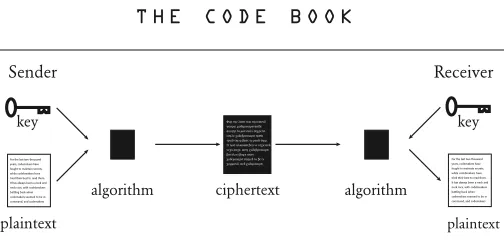
Each distinct cipher can be considered in terms of a general encrypting method, known as the algorithm,and a key, which specifies the exact details of a particular encryption. In this case, the algorithm involves substituting each letter in the plain alphabet with a letter from a cipher alphabet, and the cipher al-phabet is allowed to consist of any rearrangement of the plain alphabet. The key defines the exact cipher alphabet to be used for a particular encryption. The relationship between the algo-rithm and the key is illustrated in Figure 4.
An enemy studying an intercepted scrambled message may have a strong suspicion of the algorithm but would not know
Plain alphabet a b c d e f g h i j k l m n o p q r s t u v w x y z
Cipher alphabet D E F G H I J K L M N O P Q R S T U V W X Y Z A B C
Plaintext i came, i saw, i co n q u e r e d
Ciphertext L FDPH, L VDZ, L FRQTXHUHG
the exact key. For example, they may well suspect that each let-ter in the plaintext has been replaced by a different letlet-ter ac-cording to a particular cipher alphabet, but they are unlikely to know which cipher alphabet has been used. If the cipher al-phabet, the key, is kept a closely guarded secret between the sender and the receiver, then the enemy cannot decipher the intercepted message. The significance of the key, as opposed to the algorithm, is an enduring principle of cryptography. It was definitively stated in 1883 by the Dutch linguist Auguste Kerckhoffs von Nieuwenhof in his book La Cryptographie mil-itaire: “Kerckhoffs’ Principle: The security of a cryptosystem must not depend on keeping secret the crypto-algorithm. The security depends only on keeping secret the key.”
In addition to keeping the key secret, a secure cipher system must also have a wide range of potential keys. For example, if the sender uses the Caesar shift cipher to encrypt a message, then encryption is relatively weak because there are only twenty-five potential keys. From the enemy’s point of view, if
Sender Receiver
For the last two thousand years, codemakers have fought to maintain secrets, while codebreakers have tried their best to read them. It has always been a neck and neck race, with codebreakers battling back when codemakers seemed to be in command, and codemakers
For the last two thousand years, codemakers have fought to maintain secrets, while codebreakers have tried their best to read them. It has always been a neck and neck race, with codebreakers battling back when codemakers seemed to be in command, and codemakers
Φορ τηε λαστ τωο τηουσανδ ψεαρσ, χοδεµακερσ ηαϖε φουγητ το µαινταιν σεχρετσ, ωηιλε χοδεβρεακερσ ηαϖε τριεδ τηειρ βεστ το ρεαδ τηεµ. Ιτ ηασ αλωαψσ βεεν α νεχκ ανδ νεχκ ραχε, ωιτη χοδεβρεακερσ βαττλινγ βαχκ ωηεν χοδεµακερσ σεεµεδ το βε ιν χοµµανδ, ανδ χοδεµακερσ
algorithm ciphertext algorithm
plaintext plaintext
[image:25.396.78.330.43.163.2]key key
they intercept the message and suspect that the algorithm being used is the Caesar shift, then they merely have to check the twenty-five possible keys. However, if the sender uses the more general substitution algorithm, which permits the cipher alpha-bet to be any rearrangement of the plain alphaalpha-bet, then there are 400,000,000,000,000,000,000,000,000 possible keys from which to choose. One such is shown in Figure 5. From the en-emy’s point of view, even if the message is intercepted and the algorithm is known, there is still the horrendous task of check-ing all possible keys. If an enemy agent were able to check one of the 400,000,000,000,000,000,000,000,000 possible keys every second, it would take roughly a billion times the lifetime of the universe to check all of them and decipher the message.
The beauty of this type of cipher is that it is easy to imple-ment but provides a high level of security. It is easy for the sender to define the key, which consists merely of stating the order of the 26 letters in the rearranged cipher alphabet, and yet it is effectively impossible for the enemy to check all possi-ble keys by the so-called brute-force attack. The simplicity of the key is important, because the sender and receiver have to share knowledge of the key, and the simpler the key, the less the chance of a misunderstanding.
In fact, an even simpler key is possible if the sender is pre-pared to accept a slight reduction in the number of potential keys. Instead of randomly rearranging the plain alphabet to
Plain alphabet a b c d e f g h i j k l m n o p q r s t u v w x y z
Cipher alphabet J L P A W I Q B C T R Z Y D S K E G F X H U O N V M
Plaintext b e w a r e t h e i d e s o f m a r c h
Ciphertext L W O J G W X B W C A W F S I Y J G P B
achieve the cipher alphabet, the sender chooses a keyword or
keyphrase. For example, to use JULIUS CAESARas a keyphrase, be-gin by removing any spaces and repeated letters (JULISCAER),
and then use this as the beginning of the jumbled cipher al-phabet. The remainder of the cipher alphabet is merely the re-maining letters of the alphabet, in their correct order, starting where the keyphrase ends. Hence, the cipher alphabet would read as follows.
The advantage of building a cipher alphabet in this way is that it is easy to memorize the keyword or keyphrase, and hence the cipher alphabet. This is important, because if the sender has to keep the cipher alphabet on a piece of paper, the enemy can capture the paper, discover the key and read any commu-nications that have been encrypted with it. However, if the key can be committed to memory, it is less likely to fall into enemy hands.
This simplicity and strength meant that the substitution ci-pher dominated the art of secret writing throughout the first millennium A.D. Codemakers had evolved a system for guar-anteeing secure communication, so there was no need for fur-ther development—without necessity, fur-there was no need for invention. The onus had fallen upon the codebreakers, those who were attempting to crack the substitution cipher. Was there any way for an enemy interceptor to unravel an encrypted message? Many ancient scholars considered that the substitu-tion cipher was unbreakable, thanks to the gigantic number of possible keys, and for centuries this seemed to be true. How-ever, codebreakers would eventually find a shortcut to the
Plain alphabet a b c d e f g h i j k l m n o p q r s t u v w x y z
process of exhaustively searching through all the keys. Instead of taking billions of years to crack a cipher, the shortcut could reveal the message in a matter of minutes. The breakthrough occurred in the East and required a brilliant combination of linguistics, statistics and religious devotion.
THE ARAB CRYPTANALYSTS
At the age of about forty, Muhammad began regularly visiting an isolated cave on Mount Hira just outside Mecca. This was a retreat, a place for prayer, meditation and contemplation. It was during a period of deep reflection, around A.D. 610, that he was visited by the archangel Gabriel, who proclaimed that Muhammad was to be the messenger of God. This was the first of a series of revelations that continued until Muhammad died some twenty years later. The revelations were recorded by var-ious scribes during the Prophet’s life, but only as fragments, and it was left to Ab ¯u Bakr, the first caliph of Islam, to gather them together into a single text. The work was continued by Umar, the second caliph, and his daughter Hafsa, and was eventually completed by Uthma¯n, the third caliph. Each reve-lation became one of the 114 chapters of the Koran.
legacy of Islamic scientists is evident from the number of Ara-bic words that pepper the language of modern science, such as
algebra, alkaliand zenith.
The richness of Islamic culture was in large part the result of a wealthy and peaceful society. The Abbasid caliphs were less interested than their predecessors in conquest, and instead concentrated on establishing an organized and affluent society. Lower taxes encouraged businesses to grow and gave rise to greater commerce and industry, while strict laws reduced cor-ruption and protected the citizens. All of this relied on an ef-fective system of administration, and in turn the administrators relied on secure communication achieved through the use of encryption. As well as encrypting sensitive affairs of state, it is documented that officials protected tax records, demonstrating a widespread and routine use of cryptography. Further evidence comes from the many administrative manuals, such as the tenth-century Adab al-Kutt¯ab (The Secretaries’ Manual), that include sections devoted to cryptography.
The administrators usually employed a cipher alphabet that was simply a rearrangement of the plain alphabet, as described earlier, but they also used cipher alphabets that contained other types of symbols. For example,ain the plain alphabet might be replaced by #in the cipher alphabet,bmight be replaced by +, and so on. The monoalphabetic substitution cipheris the general name given to any substitution cipher in which the cipher al-phabet consists of letters, symbols or a mix of both. All the substitution ciphers that we have met so far come within this general category.
the science of unscrambling a message without knowledge of the key. While the cryptographer develops new methods of se-cret writing, it is the cryptanalyst who struggles to find weak-nesses in these methods in order to break into secret messages. Arabian cryptanalysts succeeded in finding a method for break-ing the monoalphabetic substitution cipher, a cipher that had remained unbreakable for several centuries.
Cryptanalysis could not be invented until a civilization had reached a sufficiently sophisticated level of education in several disciplines, including mathematics, statistics and linguistics. The Muslim civilization provided an ideal birthplace for crypt-analysis, because Islam demands justice in all spheres of human activity, and achieving this requires knowledge, or ilm. Every Muslim is obliged to pursue knowledge in all its forms, and the economic success of the Abbasid caliphate meant that scholars had the time, money and materials required to fulfill their duty. They endeavored to acquire the knowledge of previous civi-lizations by obtaining Egyptian, Babylonian, Indian, Chinese, Farsi, Syriac, Armenian, Hebrew and Roman texts and trans-lating them into Arabic. In 815, the Caliph al-Ma‘m¯un estab-lished in Baghdad the Bait al-Hikmah (House of Wisdom), a library and center for translation.
Had¯ıth, which consists of the Prophet’s daily utterances. They tried to demonstrate that each statement was indeed attributa-ble to Muhammad. This was done by studying the etymology of words and the structure of sentences, to test whether particular texts were consistent with the linguistic patterns of the Prophet. Significantly, the religious scholars did not stop their inves-tigation at the level of words. They also analyzed individual let-ters, and in particular they discovered that some letters are more common than others. The letters a and l are the most common in Arabic, partly because of the definite article al-, whereas the letter j appears only a tenth as frequently. This ap-parently minor observation would lead to the first great break-through in cryptanalysis.
The earliest known description of the technique is by the ninth-century scientist Abu¯ Yu¯su¯f Ya‘qu¯b ibn Is-ha¯q ibn as-Sabba¯h ibn ‘omra¯n ibn Ismaı¯l al-Kindı¯. Known as “the philosopher of the Arabs,” al-Kindı¯ was the author of 290 books on medicine, astronomy, mathematics, linguistics and music. His greatest treatise, which was rediscovered only in 1987 in the Sulaimaniyyah Ottoman Archive in Istanbul, is entitled A Manuscript on Deciphering Cryptographic Messages.
Although it contains detailed discussions on statistics, Arabic phonetics and Arabic syntax, al-Kindı¯’s revolutionary system of cryptanalysis is summarized in two short paragraphs:
One way to solve an encrypted message, if we know its lan-guage, is to find a different plaintext of the same language long enough to fill one sheet or so, and then we count the occur-rences of each letter. We call the most frequently occurring let-ter the “first,” the next most occurring letlet-ter the “second,” the following most occurring letter the “third,” and so on, until we account for all the different letters in the plaintext sample.
change it to the form of the “first” letter of the plaintext sam-ple, the next most common symbol is changed to the form of the “second” letter, and the third most common symbol is changed to the form of the “third” letter, and so on, until we ac-count for all symbols of the cryptogram we want to solve.
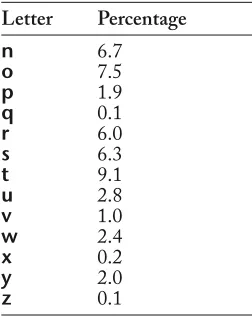
[image:32.396.214.340.366.526.2]Al-Kindı¯’s explanation is easier to explain in terms of the En-glish alphabet. First of all, it is necessary to study a lengthy piece of normal English text, perhaps several, in order to es-tablish the frequency of each letter of the alphabet. In English, eis the most common letter, followed by t, then a, and so on, as given in Table 1. Next, examine the ciphertext in question, and work out the frequency of each letter. If the most common let-ter in the ciphertext is, for example,J, then it would seem likely that this is a substitute for e. And if the second most common letter in the ciphertext is P, then this is probably a substitute for t, and so on. Al-Kindı¯’s technique, known as frequency analysis,
Table 1 This table of relative frequencies is based on passages taken from newspapers and novels, and the total sample was 100,362 alphabetic characters. The table was compiled by H. Beker and F. Piper, and originally published in Cipher Systems: The Protection of Communication.
shows that it is unnecessary to check each of the billions of po-tential keys. Instead, it is possible to reveal the contents of a scrambled message simply by analyzing the frequency of the characters in the ciphertext.
cryptanalytic tool. Furthermore, the example that follows pro-vides insight into the method of the cryptanalyst. Although frequency analysis requires logical thinking, you will see that it also demands cunning, intuition, flexibility and guesswork.
CRYPTANALYZING A CIPHERTEXT
PCQ VMJYPD LBYK LYSO KBXBJXWXV BXV ZCJPO EYPD KBXBJYUXJ LBJOO KCPK. CP LBO LBCMKXPV XPV IYJKL PYDBL, QBOP KBO BXV OPVOV LBO LXRO CI SX’XJMI, KBO JCKO XPV EYKKOV LBO DJCMPV ZOICJO BYS, KXUYPD: “DJOXL EYPD, ICJ X LBCMKXPV XPV CPO PYDBLK Y BXNO ZOOP JOACMPLYPD LC UCM LBO IXZROK CI FXKL XDOK XPV LBO RODOPVK CI XPAYOPL EYPDK. SXU Y SXEO KC ZCRV XK LC AJXNO X IXNCMJ CI UCMJ SXGOKLU?”
OFYRCDMO, LXROK IJCS LBO LBCMKXPV XPV CPO PYDBLK
Imagine that we have intercepted this scrambled message. The challenge is to decipher it. We know that the text is in English, and that it has been scrambled according to a monoalphabetic substitution cipher, but we have no idea of the key. Searching all possible keys is impractical, so we must apply frequency analy-sis. What follows is a step-by-step guide to cryptanalyzing the ciphertext, but if you feel confident, then you might prefer to ignore this and attempt your own independent cryptanalysis.
unquestioning application of frequency analysis would lead to gibberish. For example, the first word, PCQ, would be deci-phered as aov.
However, we can begin by focusing attention on the only three letters that appear more than thirty times in the cipher-text, namely O,Xand P. Let us assume that the commonest let-ters in the ciphertext probably represent the commonest letlet-ters in the English alphabet, but not necessarily in the right order. In other words, we cannot be sure that O = e,X = tand P = a, but we can make the tentative assumption that
O =e,t ora, X =e,t ora, P =e,tor a
In order to proceed with confidence and pin down the identity of the three most common letters,O,Xand P, we need a more subtle form of frequency analysis. Instead of simply counting the frequency of the three letters, we can focus on how often they appear next to all the other letters. For example, does the letter O appear before or after several other letters, or does it Table 2 Frequency analysis of enciphered message.
Letter Frequency Letter Frequency
Occurrences Percentage Occurrences Percentage
A 3 0.9 N 3 0.9
B 25 7.4 O 38 11.2
C 27 8.0 P 31 9.2
D 14 4.1 Q 2 0.6
E 5 1.5 R 6 1.8
F 2 0.6 S 7 2.1
G 1 0.3 T 0 0.0
H 0 0.0 U 6 1.8
I 11 3.3 V 18 5.3
J 18 5.3 W 1 0.3
K 26 7.7 X 34 10.1
L 25 7.4 Y 19 5.6
tend to neighbor just a few special letters? Answering this question will be a good indication of whether O represents a vowel or a consonant. If Orepresents a vowel, it should appear before and after most of the other letters, whereas if it repre-sents a consonant, it will tend to avoid many of the other let-ters. For example, the vowel e can appear before and after virtually every other letter, but the consonant t is rarely seen before or after b,d,g,j,k,m,qor v.
The table below takes the three most common letters in the ciphertext,O, X and P, and lists how frequently each appears before or after every letter. For example,Oappears before Aon one occasion but never appears immediately after it, giving a total of one in the first box. The letter Oneighbors the major-ity of letters, and there are only seven that it avoids completely, represented by the seven zeroes in the O row. The letter X is equally sociable, because it too neighbors most of the letters and avoids only eight of them. However, the letter P is much less friendly. It tends to lurk around just a few letters and avoids fifteen of them. This evidence suggests that Oand Xrepresent vowels, while P represents a consonant.
A B C D E F G H I J K L M N O P Q R S T U V W X Y Z O 1 9 0 3 1 1 1 0 1 4 6 0 1 2 2 8 0 4 1 0 0 3 0 1 1 2 X 0 7 0 1 1 1 1 0 2 4 6 3 0 3 1 9 0 2 4 0 3 3 2 0 0 1 P 1 0 5 6 0 0 0 0 0 1 1 2 2 0 8 0 0 0 0 0 0 11 0 9 9 0
Now we must ask ourselves which vowels are represented by O and X. They are probably eand a, the two most popular vowels in the English language, but does O = eand X = a, or does O = a and X = e? An interesting feature in the ciphertext is that the combination OOappears twice, whereas XXdoes not appear at all. Since the letters eeappear far more often than aain plain-text English, it is likely that O = eand X = a.
let-ters in the ciphertext. Our conclusion that X = ais supported by the fact that Xappears on its own in the ciphertext, and ais one of only two English words that consist of a single letter. The only other letter that appears on its own in the ciphertext is Y, and it seems highly likely that this represents the only other one-letter English word, which is i. Focusing on words with only one letter is a standard cryptanalytic trick, and I have in-cluded it among a list of cryptanalytic tips in Appendix B. This particular trick works only because this ciphertext still has spaces between the words. Often, a cryptographer will remove all the spaces to make it harder for an enemy interceptor to un-scramble the message.
Although we have spaces between words, the following trick would also work where the ciphertext has been merged into a single string of characters. The trick allows us to spot the let-ter honce we have already identified the letter e. In the English language, the letterhfrequently goes before the letter e (as in the,then,they, etc.), but rarely after e. The table below shows how frequently the O, which we think represents e, goes before and after all the other letters in the ciphertext. The table sug-gests that B represents h, because it appears before Oon nine occasions but never goes after it. No other letter in the table has such an asymmetric relationship with O.
Each letter in the English language has its own unique per-sonality, which includes its frequency and its relation to other letters. It is this personality that allows us to establish the true identity of a letter, even when it has been disguised by mono-alphabetic substitution.
Y = iand B = h, and we can begin to replace some of the letters in the ciphertext with their plaintext equivalents. I shall stick to the convention of keeping ciphertext letters in uppercase, while putting plaintext letters in lowercase. This will help to distinguish between those letters we still have to identify and those that have already been established.
This simple step helps us to identify several other letters, be-cause we can guess some of the words in the ciphertext. For ex-ample, the most common three-letter words in English are the and and, and these are relatively easy to spot—Lhe, which ap-pears six times, and aPV, which appears five times. Hence, L probably represents t,P probably represents n and V probably represents d. We can now replace these letters in the ciphertext with their true values:
n C Q d M J i n D t h i K t i S e K h a h J a Wa d h a d Z C J n e E i n D KhahJiUaJ thJee KCnK. Cn the thCMKand and liJKt niDht, Qhen Khe had ended the taRe CI Sa’aJMI, Khe JCKe and EiKKed the DJCMnd ZelCJe hiS, KaUinD: “DJeat EinD, ICJ a thCMKand and Cne niDhtK i haNe Zeen JeACMntinD tC UCM the IaZReK CI FaKt aDeK and the ReDendK CI anAient EinDK. SaU i SaEe KC ZCRd aK tC AJaNe a IaNCMJ CI UCMJ SaGeKtU?”
eFiRCDMe, taReK IJCS the thCMKand and Cne niDhtK
Once a few letters have been established, cryptanalysis pro-gresses very rapidly. For example, the word at the beginning of PCQ VMJiPD LhiK LiSe KhahJaWaV haV ZCJPe EiPD KhahJiUaJ LhJee KCPK. CP Lhe LhCMKaPV aPV IiJKL PiDhL, QheP Khe haV ePVeV Lhe LaRe CI Sa’aJMI, Khe JCKe aPV EiKKev Lhe DJCMPV ZeICJe hiS, KaUiPD: “DJeaL EiPD, ICJ a LhCMKaPV aPV CPe PiDhLK i haNe ZeeP JeACMPLiPD LC UCM Lhe IaZReK CI FaKL aDeK aPV Lhe ReDePVK CI aPAiePL EiPDK. SaU i SaEe KC ZCRV aK LC AJaNe a IaNCMJ CI UCMJ SaGeKLU?”
the second sentence is Cn. Every word has a vowel in it, so C must be a vowel. There are only two vowels that remain to be identified, u and o; u does not fit, so C must represent o. We also have the word Khe, which implies thatKrepresents either tor s. But we already know thatL = t, so it becomes clear that K = s. Having identified these two letters, we insert them into the ciphertext, and there appears the phrase thoMsand and one niDhts. A sensible guess for this would be thousand and one nights, and it seems likely that the final line is telling us that this is a passage from Tales from the Thousand and One Nights.
This implies that M = u,I = f,J = r,D = g,R = l and S = m. We could continue trying to establish other letters by guess-ing other words, but instead let us have a look at what we know about the plain alphabet and cipher alphabet. These two al-phabets form the key, and they were used by the cryptographer to perform the substitution that scrambled the message. Al-ready, by identifying the true values of letters in the ciphertext, we have effectively been working out the details of the cipher alphabet. A summary of our achievements, so far, is given in the plain and cipher alphabets below.
phabet, but rather starting it three letters in. This is possibly because the keyphrase begins with the letter A, and the cryp-tographer wanted to avoid encrypting aas A. At last, having es-tablished the complete cipher alphabet, we can unscramble the entire ciphertext, and the cryptanalysis is complete.
Now during this time Shahrazad had borne King Shahriyar three sons. On the thousand and first night, when she had ended the tale of Ma’aruf, she rose and kissed the ground before him, saying: “Great King, for a thousand and one nights I have been recounting to you the fables of past ages and the legends of ancient kings. May I make so bold as to crave a favour of your majesty?”
Epilogue,Tales from the Thousand and One Nights
RENAISSANCE IN THE WEST
Between A.D. 800 and 1200 Arab scholars enjoyed a vigorous period of intellectual achievement. At the same time, Europe was firmly stuck in the Dark Ages. While al-Kindı¯ was de-scribing the invention of cryptanalysis, Europeans were still struggling with the basics of cryptography. The only European institutions to encourage the study of secret writing were the monasteries, where monks would study the Bible in search of hidden meanings, a fascination that has persisted through to modern times (see Appendix C).
ample motivation for secret communication. Italy, in particular, provided the ideal environment for cryptography. As well as being at the heart of the Renaissance, it consisted of inde-pendent city-states, each trying to outsmart the others. Diplo-macy flourished, and each state would send ambassadors to the courts of the others. Each ambassador received messages from his respective head of state, describing details of the foreign policy he was to implement. In response, each ambassador would send back any information that he had gathered. Clearly there was a great incentive to encrypt communications in both directions, so each state established a cipher office, and each ambassador had a cipher secretary.
At the same time that cryptography was becoming a routine diplomatic tool, the science of cryptanalysis was beginning to emerge in the West. Diplomats had only just familiarized themselves with the skills required to establish secure commu-nications, and already there were individuals attempting to de-stroy this security. It is quite probable that cryptanalysis was independently discovered in Europe, but there is also the pos-sibility that it was introduced from the Arab world. Islamic discoveries in science and mathematics strongly influenced the rebirth of science in Europe, and cryptanalysis might have been among the imported knowledge.
Arguably the first great European cryptanalyst was Gio-vanni Soro, appointed as Venetian cipher secretary in 1506. Soro’s reputation was known throughout Italy, and friendly states would send intercepted messages to Venice for crypt-analysis. Even the Vatican, probably the second most active center of cryptanalysis, would send Soro seemingly impenetra-ble messages that had fallen into its hands.
yet to discover the power of frequency analysis continued to trust monoalphabetic substitution, ignorant of the extent to which cryptanalysts such as Soro were able to read their messages.
Meanwhile, countries that were alert to the weakness of the straightforward monoalphabetic substitution cipher were anx-ious to develop a better cipher, something that would protect their own nation’s messages from being unscrambled by enemy cryptanalysts. One of the simplest improvements to the secu-rity of the monoalphabetic substitution cipher was the intro-duction of nulls,symbols or letters that were not substitutes for actual letters, merely blanks that represented nothing. For ex-ample, one could substitute each plain letter with a number be-tween 1 and 99, which would leave 73 numbers that represent nothing, and these could be randomly sprinkled throughout the ciphertext with varying frequencies. The nulls would pose no problem to the intended recipient, who would know that they were to be ignored. However, the nulls would baffle an en-emy interceptor because they would confuse an attack by fre-quency analysis.
Another attempt to strengthen the monoalphabetic substi-tution cipher involved the introduction of codewords. The term codehas a very broad meaning in everyday language, and it is often used to describe any method for communicating in secret. However, it actually has a very specific meaning, and ap-plies only to a certain form of substitution. So far we have con-centrated on the idea of a substitution cipher, whereby each letter is replaced by a different letter, number or symbol. How-ever, it is also possible to have substitution at a much higher level, whereby each word is represented by another word or symbol—this would be a code. For example,
assassinate = D general = immediately = 08 blackmail = P king = today = 73 capture = J minister =W tonight = 28
Using this very limited set of coded words, we can encode a simple message as follows:
Plain message = assassinate the king tonight
Encoded message= D- -28
Technically, a code is defined as substitution at the level of words or phrases, whereas a cipher is defined as substitution at the level of letters. Hence the term enciphermeans to scramble a message using a cipher, while encode means to scramble a message using a code. Similarly, the term decipher applies to unscrambling an enciphered message, and decode to unscram-bling an encoded message. The terms encrypt and decrypt are more general, and cover scrambling and unscrambling with re-spect to both codes and ciphers. Figure 6 presents a brief sum-mary of these definitions. In general, I shall keep to these definitions, but when the sense is clear, I might use a term such as codebreakingto describe a process that is really cipher break-ing—the latter phrase might be technically accurate, but the former phrase is widely accepted.
At first sight, codes seem to offer more security than ciphers, because words are much less vulnerable to frequency analysis than letters. To decipher a monoalphabetic cipher you need only identify the true value of each of the twenty-six charac-ters, whereas to decipher a code you need to identify the true value of hundreds or even thousands of codewords. However, if we examine codes in more detail, we see that they suffer from two major practical failings when compared with ciphers. First, once the sender and receiver have agreed upon the twenty-six letters in the cipher alphabet (the key), they can encipher any message, but to achieve the same level of flexibility using a code they would need to go through the painstaking task of defining a codeword for every one of the thousands of possible
plaintext words. The codebook would consist of hundreds of pages, and would look something like a dictionary. In other words, compiling a codebook is a major task, and carrying it around is a major inconvenience.
Second, the consequences of having a codebook captured by the enemy are devastating. Immediately, all the encoded com-munications would become transparent to the enemy. The senders and receivers would have to go through the process of having to compile an entirely new codebook, and then this hefty new book would have to be distributed to everyone in the communications network, which might mean securely trans-porting it to every ambassador in every state. In comparison, if the enemy succeeds in capturing a cipher key, then it is rela-tively easy to compile a new cipher alphabet of twenty-six let-ters, which can be memorized and easily distributed.
Even in the sixteenth century, cryptographers appreciated the inherent weaknesses of codes and instead relied largely on ciphers, or sometimes nomenclators. A nomenclator is a system of encryption that relies on a cipher alphabet, which is used to encrypt the majority of a message, and a limited list of code-words. For example, a nomenclator book might consist of a front page containing the cipher alphabet, and then a second page containing a list of codewords. Despite the addition of codewords, a nomenclator is not much more secure than a straightforward cipher, because the bulk of a message can be
SECRET WRITING
STEGANOGRAPHY (hidden)
CRYPTOGRAPHY (scrambled)
SUBSTITUTION
TRANSPOSITION CODE (replace words)
[image:44.396.66.337.434.516.2]CIPHER (replace letters)
deciphered using frequency analysis, and the remaining en-coded words can be guessed from the context.
As well as coping with the introduction of the nomenclator, the best cryptanalysts were also capable of dealing with the presence of nulls. In short, they were able to break the major-ity of encrypted messages. Their skills provided a steady flow of uncovered secrets, which influenced the decisions of their masters and mistresses, thereby affecting Europe’s history at critical moments.
Nowhere is the impact of cryptanalysis more dramatically il-lustrated than in the case of Mary Queen of Scots. The out-come of her trial depended wholly on the battle between her codemakers and Queen Elizabeth’s codebreakers. Mary was one of the most significant figures of the sixteenth century— queen of Scotland, queen of France, pretender to the English throne—yet her fate would be decided by a slip of paper, the message it bore, and whether or not that message could be deciphered.
THE BABINGTON PLOT
Mary was born prematurely, and initially there was consid-erable concern that she would not survive. Rumors in England suggested that the baby had died, but this was merely wishful thinking at the English court, which was anxious to learn of anything that might destabilize Scotland. In fact, Mary soon grew strong and healthy, and at the age of nine months, on September 9, 1543, she was crowned in the chapel of Stirling Castle, surrounded by three earls, bearing on her behalf the royal crown, scepter and sword.
The fact that Queen Mary was so young offered Scotland a break from English attacks. It would have been considered unchivalrous had Henry VIII attempted to invade the country of a recently dead king, now under the rule of an infant queen. Instead, the English king decided on a policy of wooing Mary in the hope of arranging a marriage between her and his son Edward, thereby uniting the two nations under a Tudor ruler. He began his maneuvering by releasing the Scottish nobles captured at Solway Moss, on the condition that they campaign in favor of a union with England.
However, after considering Henry’s offer, the Scottish court rejected it in favor of a marriage to Francis, the dauphin of France. Scotland was choosing to ally itself with a fellow Ro-man Catholic nation, a decision that pleased Mary’s mother, Mary of Guise, whose own marriage with James V had been intended to cement the relationship between Scotland and France. Mary and Francis were still children, but the plan for the future was that they would eventually marry, and Francis would ascend the throne of France with Mary as his queen, thereby uniting Scotland and France. In the meantime, France would defend Scotland against any English onslaught.
worthy groom for Mary Queen of Scots. His forces committed acts of piracy, destroyed crops, burned villages and attacked towns and cities along the border. The “rough wooing,” as it is known, continued even after Henry’s death in 1547. On the orders of his son, King Edward VI (the would-be suitor), the attacks culminated in the Battle of Pinkie Cleugh, in which the Scottish army was crushed. As a result of this slaughter, it was decided that, for her own safety, Mary should leave for France, beyond the reach of the English threat, where she could prepare for her marriage to Francis. On August 7, 1548, at the age of six, she set sail for the port of Roscoff.
Mary’s first few years in the French court would be the most idyllic time of her life. She was surrounded by luxury and pro-tected from harm, and she grew to love her future husband, the dauphin. At the age of sixteen they married, and the following year Francis and Mary became king and queen of France. Everything seemed set for her triumphant return to Scotland, until her husband, who had always suffered from poor health, fell gravely ill. An ear infection that he had nursed since he was a child had worsened, the inflammation spread toward his brain and an abscess began to develop. In 1560, within a year of being crowned, Francis was dead and Mary was widowed.
no-bles. The following year Mary witnessed for herself the full horror of her husband’s barbaric nature when he murdered David Riccio, her secretary, in front of her. It became clear to everyone that for the sake of Scotland it was necessary to get rid of Darnley. Historians debate whether it was Mary or the Scottish nobles who instigated the plot, but on the night of February 9, 1567, Darnley’s house was blown up, and as he at-tempted to escape, he was strangled. The only good to come from the marriage was a son and heir, James.
Mary’s next marriage, to James Hepburn, the fourth Earl of Bothwell, was hardly more successful. By the summer of 1567, the Protestant Scottish nobles had become completely disillu-sioned with their Catholic queen, and they exiled Bothwell and imprisoned Mary, forcing her to give up the throne in favor of her fourteen-month-old son, James VI, while her half-brother, the Earl of Moray, acted as regent, ruling until the young king came of age. The next year, Mary escaped from her prison, gathered an army of six thousand royalists and made a final at-tempt to regain her crown. Her soldiers confronted the regent’s army at the small village of Langside, near Glasgow, and Mary witnessed the battle from a nearby hilltop. Although her troops were greater in number, they lacked discipline, and Mary watched as they were torn apart. When defeat was inevitable, she fled. Ideally she would have headed east to the coast and then on to France, but this would have meant crossing territory loyal to her half-brother, so instead she headed south to En-gland, where she hoped that her cousin Queen Elizabeth I would provide refuge.
because English Catholics considered Mary to be the true queen of England. Through her grandmother, Margaret Tudor, the elder sister of Henry VIII, Mary did indeed have a claim to the throne, but Henry’s last surviving offspring, Elizabeth I, would seem to have had a prior claim. However, according to Catholics, Elizabeth was illegitimate because she was the daughter of Anne Boleyn, Henry’s second wife after he had di-vorced Catherine of Aragon in defiance of the Pope. English Catholics did not recognize Henry VIII’s divorce, they did not acknowledge his next marriage, to Anne Boleyn, and they cer-tainly did not accept the resulting daughter, Elizabeth, as queen. Catholics saw Elizabeth as a “bastard usurper.”
Mary was imprisoned in a series of castles and manors. Although Elizabeth thought of her as one of the most danger-ous figures in England, many Englishmen admitted that they admired her gracious manner, her obvious intelligence and her great beauty. William Cecil, Elizabeth’s Great Minister, com-mented on “her cunning and sugared entertainment of all men,” and Nicholas White, Cecil’s emissary, made a similar observation: “She hath withal an alluring grace, a pretty Scotch accent, and a searching wit, clouded with mildness.” But as each year passed, her appearance waned, her health deterio-rated and she began to lose hope. Her jailer, Sir Amyas Paulet, a Puritan, was immune to her charms, and treated her with in-creasing harshness.
about to lose what little freedom she had. Mary’s growing sor-row was worsened by the actions of her nineteen-year-old son, King James VI of Scotland. She had always hoped that one day she would escape and return to Scotland to share power with her son, whom she had not seen since he was one year old. However, James felt no such affection for his mother. He had been brought up by Mary’s enemies, who had taught James that his mother had murdered his father in order to marry her lover. James despised her and feared that if she returned, then she might seize his crown. His hatred toward Mary was demonstrated by the fact that he had no qualms in seeking a marriage with Elizabeth I, the woman responsible for his mother’s imprisonment (and who was also thirty years his se-nior). Elizabeth declined the offer.
Mary wrote to her son in an attempt to win him over, but her letters never reached the Scottish border. By this stage, Mary was more isolated then ever before: All her outgoing let-ters were confiscated, and any incoming correspondence was kept by her jailer. Mary’s morale was at its lowest, and it seemed that all hope was lost. It was under these severe and desperate circumstances that, on January 6, 1586, she received an astonishing package of letters.
Gifford began a career as a courier, not only passing messages to Mary but also collecting her replies. He had a rather cun-ning way of sneaking letters into Chartley Hall. He took the messages to a local brewer, who wrapped them in a leather packet, which was then hidden inside a hollow bung used to seal a barrel of beer. The brewer would deliver the barrel to Chartley Hall, whereupon one of Mary’s maids would open the bung and take the contents to her mistress. The process worked equally well for getting messages out of Chartley Hall.
Meanwhile, unknown to Mary, a plan to rescue her was be-ing hatched in the taverns of London. At the center of the plot was Anthony Babington, only twenty-four years old but al-ready well known in the city as a handsome, charming and witty man about town. What his many admirers and close friends failed to appreciate was that Babington deeply resented the government, which had persecuted him, his family and his faith. The state’s anti-Catholic policies had reached new heights of horror, with priests being accused of treason, and anybody caught harboring them punished by the rack, mutila-tion and disemboweling while still alive. The Catholic mass was officially banned, and families who remained loyal to the Pope were forced to pay extremely high taxes. Babington’s re-sentment was fueled by the death of Lord Darcy, his great-grandfather, who was beheaded for his involvement in the Pilgrimage of Grace, a Catholic uprising against Henry VIII.
whatsoever that might advance the common Catholic cause.” Over the next few months an ambitious plan emerged to free Mary Queen of Scots, assassinate Queen Elizabeth and incite a rebellion supported by an invasion from abroad.
The conspirators were agreed that the Babington Plot, as it became known, could not proceed without the blessing of Mary, but there was no apparent way to communicate with her. Then, on July 6, 1586, Gifford arrived on Babington’s doorstep. He delivered a letter from Mary, explaining that she had heard about Babington via her supporters in Paris and looked forward to hearing from him. In reply, Babington compiled a detailed letter in which he outlined his scheme, including a reference to the excommunication of Elizabeth by Pope Pius V in 1570, which he believed legitimized her assassination.
Myself with ten gentlemen and a hundred of our followers will undertake the delivery of your royal person from the hands of your enemies. For the dispatch of the usurper, from the obedi-ence of whom we are by the excommunication of her made free, there be six noble gentlemen, all my private friends, who for the zeal they bear to the Catholic cause and your Majesty’s service will undertake that tragical execution.
along with thirty-five symbols representing words or phrases. In addition, there were four nulls ( , , , ) and a symbol ( ) signifying that the next symbol represents a double letter (“dowbleth”).
Gifford was still a youth, even younger than Babington, and yet he conducted his deliveries with confidence and cleverness. His aliases, such as Mr. Colerdin, Pietro and Cornelys, enabled him to travel the country without suspicion, and his contacts within the Catholic community provided him with a series of safe houses between London and Chartley Hall. However, each time Gifford traveled to or from Chartley Hall, he would make a detour. Although Gifford was apparently acting as an agent for Mary, he was actually a double agent. Back in 1585, before his return to England, Gifford had written to Sir Francis Wal-singham, principal secretary to Queen Elizabeth, offering his services. Gifford realized that his Catholic background would act as a perfect mask for infiltrating plots against Queen Eliza-beth. In the letter to Walsingham, he wrote, “I have heard of the
a b c d e f g h i k l m n o p q r s t u x y z
Nulles
and for with that if but where as of the from by
so not when there this in wich is what say me my wyrt
send lre receave bearer I pray you Mte your name myne Dowbleth
~
work you do and I want to serve you. I have no scruples and no fear of danger. Whatever you order me to do I will accomplish.” Walsingham was Elizabeth’s most ruthless minister, a spy-master who was responsible for the security of the monarch. He had inherited a small network of spies, which he rapidly ex-panded into the Continent, where many of the plots against Elizabeth were being hatched. After his death it was discov-ered that he had been receiving regular reports from twelve lo-cations in France, nine in Germany, four in Italy and four in Spain, as well as having informants in Constantinople, Algiers and Tripoli.
Walsingham recruited Gifford as a spy, and in fact it was Walsingham who ordered Gifford to approach the French em-bassy and offer himself as a courier. Each time Gifford col-lected a message to or from Mary, he would first take it to Walsingham. The vigilant spymaster would then pass it to his counterfeiters, who would break the seal on each letter, make a copy, and reseal the original letter with an identical stamp be-fore handing it back to Gifford. The apparently untouched let-ter could then be delivered to Mary or her correspondents, who remained oblivious to what was going on.
When Gifford handed Walsingham a letter from Babington to Mary, the first objective was to decipher it. Walsingham em-ployed Thomas Phelippes as his cipher secretary, a man “of low stature, slender every way, dark yellow haired on the head, and clear yellow bearded, eaten in the face with smallpox, of short sight, thirty years of age by appearance.” Phelippes was a lin-guist who could speak French, Italian, Spanish, Latin and Ger-man, and, more importantly, he was one of Europe’s finest cryptanalysts.
established the frequency of each character, and tentatively proposed values for those that appeared most often. When a particular approach hinted at absurdity, he would backtrack and try alternative substitutions. Gradually he would identify the nulls, the cryptographic red herrings, and put them to one side. Eventually all that remained were the handful of code-words, whose meaning could be guessed from the context.
When Phelippes deciphered Babington’s message to Mary, which clearly proposed the assassination of Elizabeth, he im-mediately forwarded the damning text to his master. At this point Walsingham could have pounced on Babington, but he wanted more than the execution of a handful of rebels. He bided his time in the hope that Mary would reply and authorize the plot, thereby incriminating herself. Walsingham had long wished for the death of Mary Queen of Scots, but he was aware of Elizabeth’s reluctance to execute her cousin. However, if he could prove that Mary was endorsing an attempt on the life of Elizabeth, then surely his queen would permit the execution of her Catholic rival. Walsingham’s hopes were soon fulfilled.
On July 17, Mary replied to Babington, effectively signing her own death warrant. She explicitly wrote about the “design,” showing particular concern that she should be released simul-taneously with, or before, Elizabeth’s assassination, otherwise news might reach her jailer, who might then murder her. Be-fore reaching Babington, the letter made the usual detour to Phelippes. Having cryptanalyzed the earlier message, he deci-phered this one with ease, read its contents and marked it with a —the sign of the gallows.
Phelippes’s additional talents was forgery, and it was said that he had the ability “to write any man’s hand, if he had once seen it, as if the man himself had writ it.” Figure 8 shows the post-script that was added at the end of Mary’s letter to Babington. It can be deciphered using Mary’s nomenclator, as shown in Figure 7, to reveal the following plaintext:
I would be glad to know the names and qualities of the six gen-tlemen which are to accomplish the designment; for it may be that I shall be able, upon knowledge of the parties, to give you some further advice necessary to be followed therein, as also from time to time particularly how you proceed: and as soon as you may, for the same purpose, who be already, and how far everyone is privy hereunto.
Soon after receiving the message and its postscript, Babington needed to go abroad to organize the invasion, and had to regis-ter at Walsingham’s department in order to acquire a passport. This would have been an ideal time to capture the traitor, but the bureaucrat who was manning the office, John Scudamore, was not expecting the most wanted traitor in England to turn up at his door. Scudamore, with no support to hand, took the