w w w . s y n g r e s s . c o m
Syngress is committed to publishing high-quality books for IT Professionals and delivering those books in media and formats that fit the demands of our cus-tomers. We are also committed to extending the utility of the book you purchase via additional materials available from our Web site.
SOLUTIONS WEB SITE
To register your book, visit www.syngress.com/solutions. Once registered, you can access our [email protected] Web pages. There you will find an assortment of value-added features such as free e-books related to the topic of this book, URLs of related Web site, FAQs from the book, corrections, and any updates from the author(s).
ULTIMATE CDs
Our Ultimate CD product line offers our readers budget-conscious compilations of some of our best-selling backlist titles in Adobe PDF form. These CDs are the perfect way to extend your reference library on key topics pertaining to your area of exper-tise, including Cisco Engineering, Microsoft Windows System Administration, CyberCrime Investigation, Open Source Security, and Firewall Configuration, to name a few.
DOWNLOADABLE E-BOOKS
For readers who can’t wait for hard copy, we offer most of our titles in download-able Adobe PDF form. These eBooks are often availdownload-able weeks before hard copies, and are priced affordably.
SYNGRESS OUTLET
Our outlet store at syngress.com features overstocked, out-of-print, or slightly hurt books at significant savings.
SITE LICENSING
Syngress has a well-established program for site licensing our e-books onto servers in corporations, educational institutions, and large organizations. Contact us at [email protected] for more information.
CUSTOM PUBLISHING
Many organizations welcome the ability to combine parts of multiple Syngress books, as well as their own content, into a single volume for their own internal use. Contact us at [email protected] for more information.
Visit us at
Hack
the
Stack
U S I N G S N O RT A N D E T H E R E A L T O M A S T E R
T H E 8 L AY E R S O F A N I N S E C U R E N E T W O R K
Michael Gregg
Stephen Watkins
Technical EditorGeorge Mays
Chris Ries
Ron Bandes
Brandon Franklin
Hack
the
Stack
U S I N G S N O RT A N D E T H E R E A L T O M A S T E R
T H E 8 L AY E R S O F A N I N S E C U R E N E T W O R K
Syngress Publishing, Inc., the author(s), and any person or firm involved in the writing, editing, or produc-tion (collectively “Makers”) of this book (“the Work”) do not guarantee or warrant the results to be obtained from the Work.
There is no guarantee of any kind, expressed or implied, regarding the Work or its contents.The Work is sold AS IS and WITHOUT WARRANTY.You may have other legal rights, which vary from state to state.
In no event will Makers be liable to you for damages, including any loss of profits, lost savings, or other incidental or consequential damages arising out from the Work or its contents. Because some states do not allow the exclusion or limitation of liability for consequential or incidental damages, the above limitation may not apply to you.
You should always use reasonable care, including backup and other appropriate precautions, when working with computers, networks, data, and files.
Syngress Media®, Syngress®, “Career Advancement Through Skill Enhancement®,” “Ask the Author UPDATE®,” and “Hack Proofing®,” are registered trademarks of Syngress Publishing, Inc. “Syngress:The Definition of a Serious Security Library”™, “Mission Critical™,” and “The Only Way to Stop a Hacker is to Think Like One™”are trademarks of Syngress Publishing, Inc. Brands and product names mentioned in this book are trademarks or service marks of their respective companies.
KEY SERIAL NUMBER 001 HJIRTCV764 002 PO9873D5FG 003 829KM8NJH2 004 HEATHTANER 005 CVPLQ6WQ23 006 VBP965T5T5 007 HJJJ863WD3E 008 2987GVTWMK 009 629MP5SDJT 010 IMWQ295T6T PUBLISHED BY Syngress Publishing, Inc. 800 Hingham Street Rockland, MA 02370
Hack the Stack: Using Snort and Ethereal to Master the 8 Layers of an Insecure Netork
Copyright © 2006 by Syngress Publishing, Inc. All rights reserved. Printed in the United States of America. Except as permitted under the Copyright Act of 1976, no part of this publication may be repro-duced or distributed in any form or by any means, or stored in a database or retrieval system, without the prior written permission of the publisher, with the exception that the program listings may be entered, stored, and executed in a computer system, but they may not be reproduced for publication.
Printed in the Canada 1 2 3 4 5 6 7 8 9 0 ISBN: 1-59749-109-8
Publisher: Andrew Williams Page Layout and Art: Patricia Lupien Acquisitions Editor: Gary Byrne Copy Editor: Judy Eby
Technical Editor: Stephen Watkins Indexer: Odessa&Cie Cover Designer: Michael Kavish
Distributed by O’Reilly Media, Inc. in the United States and Canada.
For information on rights, translations, and bulk sales, contact Matt Pedersen, Director of Sales and Rights, at Syngress Publishing; email [email protected] fax to 781-681-3585.
Acknowledgments
vii
Syngress would like to acknowledge the following people for their kindness
and support in making this book possible.
Syngress books are now distributed in the United States and Canada by
O’Reilly Media, Inc.The enthusiasm and work ethic at O’Reilly are incredible,
and we would like to thank everyone there for their time and efforts to bring
Syngress books to market:Tim O’Reilly, Laura Baldwin, Mark Brokering, Mike
Leonard, Donna Selenko, Bonnie Sheehan, Cindy Davis, Grant Kikkert, Opol
Matsutaro, Steve Hazelwood, Mark Wilson, Rick Brown,Tim Hinton, Kyle
Hart, Sara Winge, Peter Pardo, Leslie Crandell, Regina Aggio Wilkinson, Pascal
Honscher, Preston Paull, Susan Thompson, Bruce Stewart, Laura Schmier, Sue
Willing, Mark Jacobsen, Betsy Waliszewski, Kathryn Barrett, John Chodacki,
Rob Bullington, Kerry Beck, Karen Montgomery, and Patrick Dirden.
The incredibly hardworking team at Elsevier Science, including Jonathan
Bunkell, Ian Seager, Duncan Enright, David Burton, Rosanna Ramacciotti,
Robert Fairbrother, Miguel Sanchez, Klaus Beran, Emma Wyatt, Krista
Leppiko, Marcel Koppes, Judy Chappell, Radek Janousek, Rosie Moss, David
Lockley, Nicola Haden, Bill Kennedy, Martina Morris, Kai Wuerfl-Davidek,
Christiane Leipersberger,Yvonne Grueneklee, Nadia Balavoine, and Chris
Reinders for making certain that our vision remains worldwide in scope.
David Buckland, Marie Chieng, Lucy Chong, Leslie Lim, Audrey Gan, Pang Ai
Hua, Joseph Chan, June Lim, and Siti Zuraidah Ahmad of Pansing Distributors
for the enthusiasm with which they receive our books.
David Scott, Tricia Wilden, Marilla Burgess, Annette Scott, Andrew Swaffer,
Stephen O’Donoghue, Bec Lowe, Mark Langley, and Anyo Geddes of Woodslane
for distributing our books throughout Australia, New Zealand, Papua New
Guinea, Fiji,Tonga, Solomon Islands, and the Cook Islands.
ix
Lead Author
Michael Gregg
is the President of Superior Solutions, Inc.
and has more than 20 years’ experience in the IT field. He
holds two associate’s degrees, a bachelor’s degree, and a master’s
degree and is certified as CISSP, MCSE, MCT, CTT+, A+,
N+, Security+, CNA, CCNA, CIW Security Analyst, CCE,
CEH, CHFI, CEI, DCNP, ES Dragon IDS, ES Advanced
Dragon IDS, and TICSA.
Michael’s primary duties are to serve as project lead for
security assessments helping businesses and state agencies
secure their IT resources and assets. Michael has authored four
books, including
Inside Network Security Assessment
,
CISSP Prep
Questions
,
CISSP Exam Cram2
, and
Certified Ethical Hacker
Exam Prep2
. He has developed four high-level security classes,
including Global Knowledge’s Advanced Security Boot Camp,
Intense School’s Professional Hacking Lab Guide, ASPE’s
Network Security Essentials, and Assessing Network
Vulnerabilities. He has created over 50 articles featured in
mag-azines and Web sites, including
Certification Magazine
,
GoCertify,
The El Paso Times
, and SearchSecurity.
Michael is also a faculty member of Villanova University
and creator of Villanova’s college-level security classes,
including Essentials of IS Security, Mastering IS Security, and
Advanced Security Management. He also serves as a site expert
for four TechTarget sites, including SearchNetworking,
SearchSecurity, SearchMobileNetworking, and SearchSmallBiz.
He is a member of the TechTarget Editorial Board.
xx
Ronald T. Bandes
(CISSP, CCNA, MCSE, Security+) is an
independent security consultant. Before becoming an
indepen-dent consultant, he performed security duties for Fortune 100
companies such as JP Morgan, Dun and Bradstreet, and EDS.
Ron holds a B.A. in Computer Science.
Brandon Franklin
(GCIA, MCSA, Security+) is a network
administrator with KIT Solutions. KIT Solutions, Inc. (KIT
stands for Knowledge Based Information Technology) creates
intelligent systems for the health and human services industry
that monitor and measure impact and performance outcomes
and provides knowledge for improved decision making. A KIT
system enables policy makers, government agencies, private
foundations, researchers, and field practitioners to implement
best practices and science-based programs, demonstrate
impacts, and continuously improve outcomes.
Brandon formerly served as the Team Lead of Intrusion
Analysis at VigilantMinds, a Pittsburgh-based managed security
services provider.
Brandon cowrote Chapter 3 and wrote Chapter 6.
Contributing Authors
xi
George Mays
(CISSP, CCNA, A+, Network+, Security+,
I-Net+) is an independent consultant who has 35 years’
experi-ence in computing, data communications, and network
security. He holds a B.S. in Systems Analysis. He is a member
of the IEEE, CompTIA, and Internet Society.
Chris Ries
is a Security Research Engineer for VigilantMinds
Inc., a managed security services provider and professional
consulting organization based in Pittsburgh. His research
focuses on the discovery, exploitation, and remediation of
soft-ware vulnerabilities, analysis of malicious code, and evaluation
of security software. Chris has published a number of
advi-sories and technical whitepapers based on his research and has
contributed to several books on information security.
Chris holds a bachelor’s degree in Computer Science with
a Mathematics Minor from Colby College, where he
com-pleted research involving automated malicious code detection.
Chris has also worked as an analyst at the National
Cyber-Forensics & Training Alliance (NCFTA) where he conducted
technical research to support law enforcement.
Chris wrote Chapter 8.
xii xii
Stephen Watkins
(CISSP) is an Information Security
Professional with more than 10 years of relevant technology
experience, devoting eight of these years to the security field.
He currently serves as Information Assurance Analyst at
Regent University in southeastern Virginia. Before coming to
Regent, he led a team of security professionals providing
in-depth analysis for a global-scale government network. Over the
last eight years, he has cultivated his expertise with regard to
perimeter security and multilevel security architecture. His
Check Point experience dates back to 1998 with FireWall-1
version 3.0b. He has earned his B.S. in Computer Science from
Old Dominion University and M.S. in Computer Science,
with Concentration in Infosec, from James Madison University.
He is nearly a life-long resident of Virginia Beach, where he
and his family remain active in their Church and the local
Little League.
Stephen wrote Chapter 7.
Technical Editor
Foreword. . . xxv
Chapter 1 Extending OSI to Network Security . . . 1
Introduction . . . .2
Our Approach to This Book . . . .2
Tools of the Trade . . . .2
Protocol Analyzers . . . .2
Intrusion Detection Systems . . . .3
Organization of This Book . . . .4
The People Layer . . . .5
The Application Layer . . . .6
The Presentation Layer . . . .6
The Session Layer . . . .6
The Transport Layer . . . .6
The Network Layer . . . .7
The Data Link Layer . . . .7
The Physical Layer . . . .7
Common Stack Attacks . . . .8
The People Layer . . . .8
The Application Layer . . . .8
The Session Layer . . . .10
The Transport Layer . . . .10
The Data Link Layer . . . .11
The Physical Layer . . . .11
Mapping OSI to TCP/IP . . . .13
Countermeasures Found in Each Layer . . . .14
The Current State of IT Security . . . .16
Physical Security . . . .17
Communications Security . . . .17
xiiiContents
xiv Contents
Signal Security . . . .17
Computer Security . . . .18
Network Security . . . .18
Information Security . . . .19
Using the Information in This Book . . . .19
Vulnerability Testing . . . .20
Security Testing . . . .20
Finding and Reporting Vulnerabilities . . . .21
Summary . . . .23
Solutions Fast Track . . . .23
Frequently Asked Questions . . . .25
Chapter 2 The Physical Layer . . . 27
Introduction . . . .28
Defending the Physical Layer . . . .28
Design Security . . . .29
Perimeter Security . . . .30
Fencing . . . .31
Gates, Guards, and Grounds Design . . . .32
Facility Security . . . .33
Entry Points . . . .34
Access Control . . . .36
Device Security . . . .38
Identification and Authentication . . . .39
Computer Controls . . . .41
Mobile Devices and Media . . . .41
Communications Security . . . .44
Bluetooth . . . .44
802.11 Wireless Protocols . . . .46
Attacking the Physical Layer . . . .47
Stealing Data . . . .48
Data Slurping . . . .48
Lock Picks . . . .49
Wiretapping . . . .54
Scanning and Sniffing . . . .54
The Early History of Scanning and Sniffing . . . .54
Modern Wireless Vulnerabilities . . . .55
Contents xv
Hardware Hacking . . . .57
Bypassing Physical Controls . . . .58
Modifying Hardware . . . .59
Layer 1 Security Project . . . .64
One-Way Data Cable . . . .64
Summary . . . .65
Solutions Fast Track . . . .66
Frequently Asked Questions . . . .67
Chapter 3 Layer 2: The Data Link Layer. . . 69
Introduction . . . .70
Ethernet and the Data Link Layer . . . .70
The Ethernet Frame Structure . . . .71
Understanding MAC Addressing . . . .72
Identifying Vendor Information . . . .72
Performing Broadcast and Multicast . . . .73
Examining the EtherType . . . .73
Understanding PPP and SLIP . . . .73
Examining SLIP . . . .73
Examining PPP . . . .74
Working with a Protocol Analyzer . . . .75
Writing BPFs . . . .77
Examining Live Traffic . . . .78
Filtering Traffic, Part Two . . . .79
Understanding How ARP Works . . . .82
Examining ARP Packet Structure . . . .82
Attacking the Data Link Layer . . . .84
Passive versus Active Sniffing . . . .85
ARP Poisoning . . . .85
ARP Flooding . . . .87
Routing Games . . . .87
Sniffing Wireless . . . .88
Netstumbler . . . .88
Kismet . . . .88
Cracking WEP . . . .89
Wireless Vulnerabilities . . . .90
Conducting Active Wireless Attacks . . . .90
Jamming Attacks . . . .91
xvi Contents
MITM Attacks . . . .91
Defending the Data Link Layer . . . .91
Securing Your Network from Sniffers . . . .91
Using Encryption . . . .91
Secure Shell (SSH) . . . .92
Secure Sockets Layers (SSL) . . . .92
PGP and S/MIME . . . .92
Switching . . . .93
Employing Detection Techniques . . . .93
Local Detection . . . .93
Network Detection . . . .94
DNS Lookups . . . .94
Latency . . . .94
Driver Bugs . . . .94
Network Monitor . . . .95
Using Honeytokens . . . .95
Data Link Layer Security Project . . . .95
Using the Auditor Security Collection to Crack WEP . . . . .95
Cracking WEP with the Aircrack Suite . . . .96
Cracking WPA with CoWPAtty . . . .98
Summary . . . .99
Solutions Fast Track . . . .99
Frequently Asked Questions . . . .101
Chapter 4 Layer 3: The Network Layer . . . 103
Introduction . . . .104
The IP Packet Structure . . . .104
Identifying IP’s Version . . . .106
Type of Service . . . .107
Total Length . . . .110
Datagram ID Number . . . .110
Fragmentation . . . .111
Time to Live (TTL) . . . .112
Protocol Field . . . .115
Checksum . . . .116
IP Address . . . .116
IP Options . . . .116
Contents xvii
The ICMP Packet Structure . . . .118
ICMP Basics . . . .118
ICMP Message Types and Format . . . .118
Common ICMP Messages . . . .119
Destination Unreachable . . . .120
Traceroute . . . .121
Path MTU Discovery . . . .122
Redirects . . . .122
Attacking the Network Layer . . . .123
IP Attacks . . . .124
Spoofing . . . .124
Fragmentation . . . .124
Passive Fingerprinting . . . .126
p0f—a Passive Fingerprinting Tool . . . .129
IP’s Role in Port Scanning . . . .131
ICMP Attacks . . . .133
Covert Channels . . . .133
ICMP Echo Attacks . . . .136
Port Scanning . . . .136
OS Fingerprinting . . . .137
DoS Attacks and Redirects . . . .137
Router and Routing Attacks . . . .138
Network Spoofing . . . .139
Defending the Network Layer . . . .140
Securing IP . . . .140
Securing ICMP . . . .140
Securing Routers and Routing Protocols . . . .141
Address Spoofing . . . .142
Network Layer Security Project . . . .143
Ptunnel . . . .143
ACKCMD . . . .145
Summary . . . .146
Solutions Fast Track . . . .146
Frequently Asked Questions . . . .149
xviii Contents
Chapter 5 Layer 4: The Transport Layer. . . 151
Introduction . . . .152
Connection-Oriented versus Connectionless Protocols . . . .152
Connection-Oriented Protocols . . . .152
Connectionless Protocols . . . .153
Why Have Both Kinds of Protocols? . . . .153
Protocols at the Transport Layer . . . .153
UDP . . . .154
TCP . . . .155
Source and Destination Ports . . . .156
Source Sequence Number
and Acknowledgment Sequence Number . . . .157
Data Offset . . . .158
Control Bits . . . .158
Window Size . . . .159
Checksum . . . .159
Urgent Pointer . . . .160
How TCP Sessions Begin and End . . . .160
TCP Session Startup . . . .160
TCP Session Teardown . . . .161
The Hacker’s Perspective . . . .162
Some Common Attacks . . . .163
Scanning the Network . . . .163
Port Scanning Overview . . . .164
TCP Scan Variations . . . .165
Nmap Basics . . . .165
Nmap:The Most Well Known Scanning Tool . . . .167
Amap . . . .170
Scanrand . . . .172
Operating System Fingerprinting . . . .173
How OS Discovery Works . . . .174
Xprobe2 . . . .176
OS Fingerprinting with Nmap . . . .179
Detecting Scans on Your Network . . . .181
Snort Rules . . . .182
Contents xix
The Snort User Interface—
Basic Analysis and Security Engine . . . .182
Defending the Transport Layer . . . .183
How the SSL Protocol Operates . . . .184
Phase 1 . . . .184
Phase 2 . . . .185
Phase 3 . . . .185
How SSL Appears on the Network . . . .185
SSL/TLS Summary . . . .187
Transport Layer Project—Setting Up Snort . . . .187
Getting Started . . . .188
Install Fedora Core 4 . . . .188
Install Supporting Software . . . .190
Summary . . . .200
Solutions Fast Track . . . .200
Frequently Asked Questions . . . .202
Chapter 6 Layer 5: The Session Layer . . . 205
Introduction . . . .206
Attacking the Session Layer . . . .206
Observing a SYN Attack . . . .206
Session Hijacking . . . .209
Session Hijacking Tools . . . .213
Domain Name System (DNS) Poisoning . . . .216
Sniffing the Session Startup . . . .218
Authentication . . . .219
Authenticating with Password
Authentication Protocol . . . .219
Authenticating with the Challenge Handshake
Authentication Protocol . . . .219
Authenticating with Local
Area Network Manager and NT LAN Manager . . .220
Authenticating with NTLMv2 . . . .220
Authenticating with Kerberos . . . .220
Tools Used for Sniffing the Session Startup . . . .221
Observing a RST Attack . . . .223
Defeating Snort at the Session Layer . . . .224
xx Contents
Defending the Session Layer . . . .227
Mitigating DoS Attacks . . . .227
Preventing Session Hijacking . . . .228
Selecting Authentication Protocols . . . .229
Defending Against RST Attacks . . . .231
Detecting Session Layer Attacks . . . .232
Port Knocking . . . .232
Session Layer Security Project . . . .232
Using Snort to Detect Malicious Traffic . . . .233
Summary . . . .237
Solutions Fast Track . . . .237
Frequently Asked Questions . . . .239
Chapter 7 Layer 6: The Presentation Layer . . . 241
Introduction . . . .242
The Structure of NetBIOS and SMB . . . .242
Attacking the Presentation Layer . . . .245
NetBIOS and Enumeration . . . .245
Exploiting the IPC$ Share . . . .247
Sniffing Encrypted Traffic . . . .250
Attacking Kerberos . . . .253
Tools to Intercept Traffic . . . .257
Defending the Presentation Layer . . . .266
Encryption . . . .266
The Role of IPSec . . . .268
Protecting E-mail . . . .272
Secure/Multipurpose Internet Mail Extensions . . . .272
Tightening NetBIOS Protections . . . .273
Presentation Layer Security Project . . . .274
Subverting Encryption and Authentication . . . .274
Summary . . . .280
Solutions Fast Track . . . .280
Frequently Asked Questions . . . .282
Notes . . . .283
Contents xxi
Chapter 8 Layer 7: The Application Layer . . . 285
Introduction . . . .286
The Structure of FTP . . . .286
FTP Protocol Overview . . . .286
FTP Example . . . .288
FTP Security Issues . . . .291
Analyzing Domain Name System and Its Weaknesses . . . . .292
DNS Message Format . . . .292
The DNS Lookup Process . . . .295
The DNS Hierarchy . . . .296
Caching . . . .296
Zones and Zone Transfers . . . .297
DNS Utilities . . . .297
DNS Security Issues . . . .298
Other Insecure Application Layer Protocols . . . .299
Simple Mail Transfer Protocol . . . .299
SMTP Protocol Overview . . . .299
SMTP Security Issues . . . .300
Telnet . . . .301
Protocol Overview . . . .302
Security Issues . . . .302
Other Protocols . . . .302
Attacking the Application Layer . . . .303
Attacking Web Applications . . . .303
SQL Injection . . . .303
Code Injection . . . .304
Cross-Site Scripting . . . .305
Directory Traversal Attacks . . . .307
Information Disclosure . . . .307
Authentication and Access Control Vulnerabilities . .308
CGI Vulnerabilities . . . .308
Attacking DNS . . . .308
Information Gathering . . . .309
DNS Cache Poisoning . . . .309
DNS Cache Snooping . . . .310
MITM Attacks . . . .311
xxii Contents
Buffer Overflows . . . .313
Stack Overflows . . . .314
Heap Overflows . . . .320
Integer Overflows . . . .320
Exploiting Buffer Overflows . . . .321
Reverse Engineering Code . . . .324
Executable File Formats . . . .325
Black-Box Analysis . . . .327
White-Box Analysis . . . .329
Application Attack Platforms . . . .332
Metasploit Exploitation Framework . . . .333
Other Application Attack Tools . . . .336
Defending the Application Layer . . . .336
SSH . . . .336
SSH Protocol Architecture . . . .336
Common Applications of SSH . . . .338
Pretty Good Privacy . . . .339
How PGP Works . . . .339
Key Distribution . . . .340
Securing Software . . . .340
Building Secure Software . . . .340
Security Testing Software . . . .341
Hardening Systems . . . .343
Vulnerability Scanners . . . .346
Nessus . . . .346
Application-Layer Security Project:
Using Nessus to Secure the Stack . . . .347
Analyzing the Results . . . .348
Summary . . . .350
Solutions Fast Track . . . .350
Frequently Asked Questions . . . .352
Chapter 9 Layer 8: The People Layer . . . 353
Introduction . . . .354
Attacking the People Layer . . . .354
Social Engineering . . . .355
In Person . . . .355
Contents xxiii
Phone . . . .365
Fax . . . .366
Internet . . . .367
Phreaking . . . .367
Phreak Boxes . . . .367
Wiretapping . . . .369
Stealing . . . .369
Cell Phones . . . .369
World Wide Web, E-mail, and Instant Messaging . . . . .371
Trojan Horses and Backdoors . . . .372
Disguising Programs . . . .372
Phishing . . . .372
Domain Name Spoofing . . . .373
Secure Web Sites . . . .374
Defending the People Layer . . . .375
Policies, Procedures, and Guidelines . . . .375
Person-to-Person Authentication . . . .377
Data Classification and Handling . . . .377
Education,Training, and Awareness Programs . . . .378
Education . . . .379
Training . . . .381
Security Awareness Programs . . . .381
Evaluating . . . .382
Testing . . . .382
Monitoring and Enforcement . . . .383
Periodic Update of Assessment and Controls . . . .383
Regulatory Requirements . . . .383
Privacy Laws . . . .383
Corporate Governance Laws . . . .386
Making the Case for Stronger Security . . . .390
Risk Management . . . .390
Asset Identification and Valuation . . . .390
Threat Assessment . . . .392
Impact Definition and Quantification . . . .394
Control Design and Evaluation . . . .395
Residual Risk Management . . . .395
xxiv Contents
People Layer Security Project . . . .395
Orangebox Phreaking . . . .396
Summary . . . .398
Solutions Fast Track . . . .398
Frequently Asked Questions . . . .399
Appendix A Risk Mitigation: Securing the Stack. . . 401
Introduction . . . .402
Physical . . . .402
Data Link . . . .403
Network . . . .404
Transport . . . .405
Session . . . .405
Presentation . . . .406
Application . . . .406
People . . . .420
Summary . . . .422
Index . . . 423
The first thing many people think of when they hear the word
hack
is some
type of malicious activity. I have always thought of the term in a somewhat
broader sense. Although some hacks are malicious, many others are not.
Nonmalicious hacks are about exploring the details of programmable systems
and learning how they really work.They are explored by those who want to
understand every minute detail of a system and how to stretch the capabilities
of these systems beyond what they were originally designed to do.The
nonma-licious hacker is different from the average user or even the script kiddie who
prefers to learn only the minimum necessary knowledge.
Hack the Stack
was
written for those who seek to better understand and to gain a deeper
knowl-edge of how TCP/IP systems really work. Such knowlknowl-edge enables security
professionals to make systems and networks more secure and to meet the
chal-lenges that they face each day.
In Chapter 1, we provide you with information on how to extend OSI to
network security. In subsequent chapters, we unpeel the OSI onion layer by
layer, including a chapter on Layer 8 (the people layer).We conclude the book
with an appendix on risk mitigation.
Let’s talk about the writing of this book. Dedicated professionals like
George Mays, Stephen Watkins, Chris Ries, Ron Bandes, and Brandon Franklin
helped make this book possible. It takes a significant amount of time to
com-plete this type of task, and I am thankful to them for taking time out of their
daily work in the trenches to contribute to such an effort. After going through
this process more than once, my friends and family often ask how I have time
to work, travel, and then reserve time needed to write.Well, it takes time
xxv
Foreword
management and a desire to get it done. But as Dale Carnegie said, “If you
believe in what you are doing, then let nothing hold you up in your work.
Much of the best work of the world has been done against seeming
impossibil-ities.The thing is to get the work done.”
I hope that this book empowers you to get your own work done while
facing seemingly impossible challenges.
—Michael Gregg
Chief Technology Officer
Superior Solutions, Inc.
xxvi Foreword
Extending OSI to
Network Security
Solutions in this chapter:
■
Our Approach to This Book
■
Common Stack Attacks
■
Mapping the OSI Model to the TCP/IP Model
■
The Current State of IT Security
■
Using the Information in this Book
Chapter 1
1
Summary
Solutions Fast Track
Frequently Asked Questions
Introduction
“Everything old becomes new again.”The goal of this chapter is to take the well-known Open Systems Interconnect (OSI) model and use it to present security topics in a new and unique way. While each of the subsequent chapters focuses on one individual layer, this chapter offers a high-level overview of the entire book.
Our Approach to This Book
This book is compiled of issues and concerns that security professionals must deal with on a daily basis. We look at common attack patterns and how they are made possible. Many attacks occur because of poor protocol design; others occur because of poor programming or lack of forethought when designing code. Finally, the tools that are useful for identifying and analyzing exploits and exposures are discussed—the tools you will return to time and time again.
WARNING
Many of the tools discussed in this book can be used by both security profes-sionals andhackers. Always make sure you have the network owner’s permis-sion before using any of these tools, which will save you from many headaches and potential legal problems.
Tools of the Trade
The following sections examine “protocol analyzers” and the Intrusion Detection Systems (IDSes), which are the two main tools used throughout this book.
Protocol Analyzers
Protocol analyzers(or sniffers) are powerful programs that work by placing the host system’s network card into promiscuous mode, thereby allowing it to receive all of the data it sees in that particular collision domain.Passive sniffingis performed when a user is on a hub. When using a hub, all traffic is sent to all ports; thus, all a security professional or attacker has to do is start the sniffer and wait for someone on the same collision domain to begin transmitting data. A collision domainis a network segment that is shared but not bridged or switched; packets collide because users are sharing the same bandwidth.
Sniffing performed on a switched network is known as active sniffing, because it switches segment traffic and knows which particular port to send traffic to. While this feature adds much needed performance, it also raises a barrier when attempting to sniff all potential 2 Chapter 1 • Extending OSI to Network Security
switched ports. One way to overcome this impediment is to configure the switch to mirror a port. Attackers may not have this capability, so their best hope of bypassing the functionality of the switch is through poisoningand flooding(discussed in subsequent chapters).
Sniffers operate at the data link layer of the OSI model, which means they do not have to play by the same rules as the applications and services that reside further up the stack. Sniffers can capture everything on the wire and record it for later review.They allow user’s to see all of the data contained in the packet. While sniffers are still a powerful tool in the hands of an attacker, they have lost some of their mystical status as many more people are using encryption.
The sniffer used in this book is called Ethereal, which is free and works well in both a Windows and a Linux environment. (Chapter 3 provides a more in-depth review of how to install and use Ethereal.) If you’re eager to start using Ethereal, more details about the pro-gram can be found at www.ethereal.com. (Ethereal’s name has been changed to Wireshark.)
Intrusion Detection Systems
Intrusion detection systems (IDSes) play a critical role in protecting the Information Technology (IT) infrastructure. Intrusion detection involves monitoring network traffic, detecting attempts to gain unauthorized access to a system or resource, and notifying the appropriate individuals so that counteractions can be taken.The ability to analyze vulnerabili-ties and attacks with a sniffer and then craft a defense with an IDS is a powerful combination. The IDS system used in this book is Snort, which can be used with both Linux and Windows and has industry wide support.
NOTE
Intrusion detection has a short history. In 1983, Dr. Dorothy Denning began developing the first IDS, which would be used by the U.S. government to ana-lyze the audit trails of government mainframe systems.
Snort is a freeware IDS developed by Martin Roesch and Brian Caswell. It’s a
lightweight, network-based IDS that can be set up on a Linux or Windows host. While the core program uses a Command Line Interface (CLI), graphical user interfaces (GUIs) can also be used. Snort operates as a network sniffer and logs activity that matches predefined signatures. Signatures can be designed for a wide range of traffic, including Internet Protocol (IP),Transmission Control Protocol (TCP), User Datagram Protocol (UDP), and Internet Control Message Protocol (ICMP).
Snort consists of two basic parts:
■ Header Where the rules “actions” are identified
■ Options Where the rules “alert messages” are identified
To learn more about Snort, go to www.Snort.org.
Extending OSI to Network Security • Chapter 1 3
Organization of This Book
This book is arranged in the same manner as the layers of the OSI model, which was devel-oped to provide organization and structure to the world of networking. In 1983, the International Organization for Standardization (ISO) and the International Telegraph and Telephone Consultative Committee (CCITT) merged documents and developed the OSI model, which is based on a specific hierarchy where each layer builds on the output of each adjacent layer (see ISO 7498).Today, it is widely used as a guide for describing the operation of a networking environment, and also serves as a teaching model for hacks, attacks, and defenses.
The OSI model is a protocol stack where the lower layers deal primarily with hardware, and the upper layers deal primarily with software.The OSI model’s seven layers are designed so that control is passed down from layer to layer.The seven layers of the OSI model are shown in Table 1.1
Table 1.1
The Seven-Layer OSI ModelLayer Responsibility
Application Application support such as File Transfer Protocol (FTP), Telnet, and Hypertext Transfer Protocol (HTTP)
Presentation Encryption, Server Message Block (SMB), American Standard Code for Information Interchange (ASCII), and formatting
Session Data flow control, startup, shutdown, and error detection/ correction
Transport End-to-end communications, UDP and TCP services
Network Routing and routable protocols such as IP and Open Shortest Path First (OSPF). Path control and best effort at delivery
Data link Network interface cards, Media Access Control (MAC) addresses, framing, formatting, and organizing data
Physical Transmission media such as twisted-pair cabling, wireless systems, and fiber-optic cable
The OSI model functions as follows:
1. Information is introduced into the application layer and passed down until it ends up at the physical layer.
2. Next, it is transmitted over the physical medium (i.e., wire, coax, or wireless) and sent to the target device.
3. Once at the target device, it proceeds back up the stack to the application layer.
For this book, an eighth layer has been added to the OSI model that is called the “people” layer (or “social” layer). Figure 1.1 shows the eight layers and interprets the services of each.
4 Chapter 1 • Extending OSI to Network Security
N
OTEWhile the OSI model is officially seven layers, for the purposes of this book an additional layer (layer 8 [the “people” layer]) has been added to better address the different hacks and attacks that can occur in a networked environment.
Figure 1.1
Hack the Stack’s Eight LayersThe People Layer
Layer 8 is known as the people layer, and while not an official layer of the OSI model, it is an important consideration; therefore, it has been added to the OSI model for this book. People are often the weakest link. We can implement the best security solutions known at the lower layers of the OSI model and still be vulnerable through people and employees. Social engi-neering, phishing, phreaking, and dumpster diving are a few of the ways these attacks can be carried out.
Notes from the Underground…
Phreaking in the Early Years
Hacking phone systems (or phreaking) predates computer hacking by many years. Phreakers used to use a variety of techniques to manipulate the phone system in order to make free phone calls. One early technique was called “blue boxing,” which worked by replicating the tones used to switch long distance
Extending OSI to Network Security • Chapter 1 5
Continued
phone calls. In those days, the phone company used the same channel for switching that it used for voice communication. Blue boxing received its name because the first of these illegal devices recovered by the phone company were in blue plastic cases. One key element of the blue box was its ability to produce a 2600 hertz tone, which could be used to bypass the phone company’s billing system and allow users to make free long distance phone calls.
Even if the phreaker lacked the ability to construct a blue box, all was not lost. In the early 1970s, it was discovered that the toy whistles given away in Capt-n-Crunch cereal could produce the same frequency tone. Anyone could use the whistle to signal a new call and then dial anywhere in the world for free.
The Application Layer
Layer 7 is known as the application layer. Recognized as the official top layer of the OSI model, this layer serves as the window for application services. Layer 7 is not the actual application, but rather the channel through which applications communicate.
The Presentation Layer
Layer 6 is known as the presentation layer.The main purpose of the presentation layer is to deliver and present data to the application layer.This data must be formatted so that the application layer can understand and interpret it.The presentation layer is responsible for items such as:
■ Encryption and decryption of messages
■ Compression and expansion of messages, format translation
■ Handling protocol conversion
The Session Layer
Layer 5 is known as the session layer. Its purpose is to allow two applications on different computers to establish and coordinate a session. It is also responsible for managing the sion while information and data are being moved. When a data transfer is complete, the ses-sion layer tears down the sesses-sion. Sesses-sion-layer protocols include:
■ Remote Procedure Call (RPC)
■ Structured Query Language (SQL)
The Transport Layer
Layer 4 is known as the transport layer. Whereas the application, presentation, and session layers are primarily concerned with data, the transport layer is focused on segments. 6 Chapter 1 • Extending OSI to Network Security
Depending on the application protocol being used, the transport layer can send data either quickly orreliably.Transport layer responsibilities include end-to-end error recovery and flow control.The two primary protocols found on this layer include:
■ TCP A connection-oriented protocol; provides reliable communication using handshaking, acknowledgments, error detection, and session teardown
■ UDP A connectionless protocol; offers speed and low overhead as its primary advantage
The Network Layer
Layer 3 is known as the network layer, which is tied to software and deals with packets.The network layer is the home of the IP, which offers best effort at delivery and seeks to find the best route from the source to the target network. Network-layer components include:
■ Routers
■ Stateless inspection/packet filters
The Data Link Layer
Layer 2 is known as the data link layerand is focused on traffic within a single local area net-work (LAN).The data link layer formats and organizes the data before sending it to the physical layer. Because it is a physical scheme, hard-coded Mandatory Access Control (MAC) addresses are typically used.The data link layer organizes the data into frames. When a frame reaches the target device, the data link layer strips off the data frame and passes the data packet up to the network layer. Data-link-layer components include:
■ Bridges
■ Switches
■ Network Interface Card (NIC)
■ MAC addresses
The Physical Layer
Layer 1 of the OSI model is known as the physical layer. Bit-level communication takes place at layer 1. Bits have no defined meaning on the wire; however, the physical layer defines how long each bit lasts and how it is transmitted and received. Physical layer components include copper cabling, fiber cabling, wireless system components, and Ethernet hubs.The physical layer in this book has been extended to include:
Extending OSI to Network Security • Chapter 1 7
■ Perimeter security
■ Device Security
■ Identification and authentication
Common Stack Attacks
A range of exploits can be launched in any stack-based system. For this book, we followed the stack-based approach of arranging the various attacks into a logical order for discussion of the risks and potential solutions. Let’s look at some of the attacks and the layers where they can be found.
The People Layer
One of the biggest threats at this layer is social engineering, because it targets people. Some organizations spend a fortune on technical controls but next to nothing on training and edu-cating employees on security processes and procedures. Attackers use various techniques (e.g., trust) to trick individuals into complying with their wishes. As with other types of attacks, the bulk of the work of a social engineering attack is doing the reconnaissance and laying the groundwork.The attack itself usually takes on one of the following angles:
■ Diffusion of Responsibility I know the policy is not to give out passwords, but I will take responsibility for this.
■ Identification We both work for the same company; this benefits everyone.
■ Chance for Ingratiation This is a win-win situation.The company is going to reward you for helping me in this difficult situation.
■ Trust Relationships Although I am new here, I am sure I have seen you in the break room.
■ Cooperation Together we can get this done.
■ Authority I know what the policy is; I drafted those policies and I have the right to change them.
Another threat at the people layer is dumpster diving. Many companies throw out an amazing amount of stuff (e.g., old hardware, software, post-it pads, organizational charts, printouts of names and passwords, source code, memos and policy manuals). All of these items offer a wealth of information to an attacker.
The Application Layer
Most of the applications listed in this section are totally insecure because they were written for a different time. At the beginning of the networked world, most systems were mainframes 8 Chapter 1 • Extending OSI to Network Security
that were locked in government and business buildings.There were no Category 5 cables interconnecting every office in the building, and no open wireless access points were being broadcast from the apartment next door. Suppressing passwords and other critical informa-tion on the monitor was considered robust enough to protect informainforma-tion and data. Here’s a short list of some of the insecure applications and high-level protocols:
■ FTP FTP is a TCP service that operates on ports 20 and 21 and is used to move files from one computer to another. Port 20 is used for the data stream, and trans-fers the data between the client and the server. Port 21 is the control stream, and is used to pass commands between the client and the FTP server. Attacks on FTP target misconfigured directory permissions and compromised or sniffed cleartext passwords. FTP is one of the most commonly hacked services.
■ Telnet Telnet is a TCP shell service that operates on port 23.Telnet enables a client at one site to establish a session with a host at another site.The program passes the information typed at the client’s keyboard to the host computer system. While Telnet can be configured to allow anonymous connections, it should also be configured to require usernames and passwords. Unfortunately, even then,Telnet sends them in cleartext. When a user is logged in, he or she can perform any allowed task.
■ Simple Mail Transfer Protocol (SMTP) This application is a TCP service that operates on port 25, and is designed to exchange electronic mail between net-worked systems. Messages sent through SMTP have two parts: an address header and the message text. All types of computers can exchange messages with SMTP. Spoofingand spammingare two of the vulnerabilities associated with SMTP.
■ Domain Name Service (DNS) This application operates on port 53, and per-forms address translation. DNS converts fully qualified domain names (FQDNs) into a numeric IP address and converts IP addresses into FQDNs. DNS uses UDP for DNS queries and TCP for zone transfers. DNS is subject to poisoning and if misconfigured, can be solicited to perform a full zone transfer.
■ Trivial File Transfer Protocol (TFTP) TFTP operates on port 69, and is a connectionless version of FTP that uses UDP to reduce overhead and reliability. It does so without TCP session management or authentication, which can pose a big security risk. It is used to transfer router configuration files and to configure cable modems. People hacking those cable modems are known as uncappers.
■ Hypertext Transfer Protocol (HTTP) HTTP is a TCP service that operates on port 80. HTTP helped make the Web the popular service that it is today.The HTTP connection model is known as a stateless connection. HTTP uses a request response protocol where a client sends a request and a server sends a response. Attacks that exploit HTTP can target the server, browser, or scripts that run on the browser. Nimda is an example of the code that targeted a Web server.
Extending OSI to Network Security • Chapter 1 9
■ Simple Network Management Protocol (SNMP) SNMP is a UDP service that operates on ports 161 and 162, and was designed to be an efficient and inex-pensive way to monitor networks.The SNMP protocol allows agents to gather information (e.g., network statistics) and report back to their management stations. Some of the security problems that plague SNMP are caused by the fact that com-munity strings are passed as cleartext and the default comcom-munity strings
(public/private) are well known. SNMP version 3 is the most current and offers encryption for more robust security.
The Session Layer
There is a weakness in the security controls at the presentation and session layers. Let’s look at the Windows NT LanMan (NTLM) authentication system. Originally developed for Windows systems and then revised for Windows NT post service pack 2 systems, this secu-rity control proved to be an example of weak encryption (i.e., many passwords encrypted with this system could be cracked in less than 1 second because of the way Microsoft stored the hashed passwords). An NTLM password is uppercase, padded to 14 characters, and divided into seven character parts.The two hashed results are concatenated and stored as a LAN Manager (LM) hash, which is stored in the SAM.The session layer is also vulnerable to attacks such as session hijacking. Network Basic Input/Output System (NetBIOS) is another service located in this area of the stack. (Subsequent chapters go into greater detail regarding the various types of encryption (e.g., hashing).
NetBIOS was developed for IBM and adopted by Microsoft, and has become and industry standard. It allows applications on different systems to communicate through the LAN. On LANs, hosts using NetBIOS systems identify themselves using a 15-character unique name. Since NetBIOS is non-routable, Microsoft adapted it to run over Transmission Control Protocol/Internet Protocol (TCP/IP). NetBIOS is used in conjunction with SMB, which allows for the remote access of shared directories and files.This key feature of Windows makes file and print sharing and the Network Neighborhood possible. It also introduced other potential vulnerabilities into the stack by giving attackers the ability to enumerate systems and gather user names and accounts, and share information. Almost every script kiddie and junior league hacker has exploited the net usecommand.
The Transport Layer
The transport layeris rife with vulnerabilities, because it is the home of UDP and TCP. Because UDP is connectionless, it’s open for attackers to use for a host of denial of service (DoS) attacks. It’s also easy to spoof and requires no confirmation.TCP is another used and abused protocol. Port scanning and TCP make the hacker trade possible. Before a hacker can launch an attack, he or she must know what is running and what to target.TCP makes this possible. From illegal flag settings, NULL, and XMAS, to more common synchronous (SYN) and reset (RST) scans,TCP helps attackers identify services and operating systems.
10 Chapter 1 • Extending OSI to Network Security
At the network level are services such as IP and ICMP. IPv4 has no security services built in, which is why Secure Internet Protocol (IPSec) (a component of IPv6) was devel-oped. Without IPSec, IP can be targeted for many types of attacks (e.g., DOS), abused through source routing, and tricked into zombie scanning “IPID Scan.” While ICMP was developed for diagnostics and to help with logical errors, it is also the target of misuse. ICMP can be used to launch Smurf DoS attacks or can be subverted to become a covert channel with programs such as Loki.
The Data Link Layer
The dangers are real at the data link layer. Conversion from logical to physical addressing must be done between the network and data link layers. Address Resolution Protocol (ARP) resolves logical to physical addresses. While critical for communication, it is also used by attackers to bypass switches and monitor traffic, which is known as ARP poisoning. Even without ARP poisoning, passive sniffing can be a powerful tool if the attacker positions him-self or herhim-self in the right place on the network.
The Physical Layer
An attacker gaining access to the telecommunications closet, an open port in the conference room, or an unused office, could be the foothold needed to breach the network or, even worse, gain physical access to a server or piece of equipment. It’s a generally accepted fact that if someone gains physical access to an item, they can control it.The Cisco site provides a page that explains how to reset the password and gain entry into a Cisco device
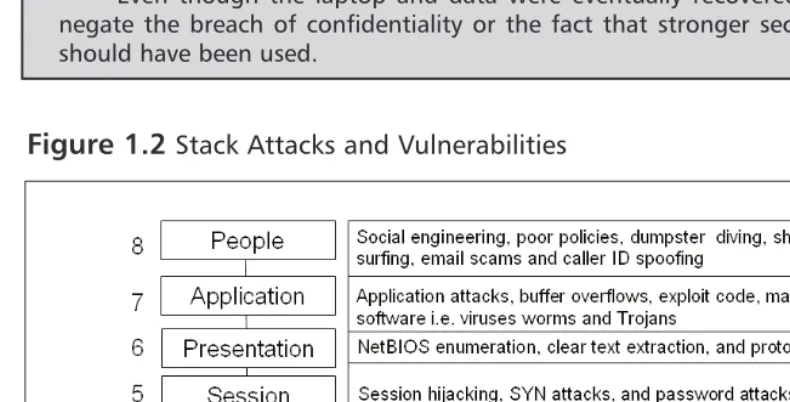
(www.cisco.com/warp/public/474/pswdrec_2500.html). Figure 1.2 lists each layer of the stack and many of the common attacks and vulnerabilities found at those layers.
WARNING
Logical controls are of little value if no physical controls are put in place (i.e., the best logical controls are of little value if an attacker can walk in and reboot a server or gain physical access of the SAM and its passwords).
Extending OSI to Network Security • Chapter 1 11
Notes from the Underground…
The Importance of Physical Controls
Current and past U.S. military veterans recently learned the value of physical security controls when it was revealed that the personal details of as many as 26.5 million veterans were lost, even though the Department of Veterans Affairs had security measures in place.
On May 3, 2006, several items were stolen from a Veterans Affairs informa-tion security specialist’s home. Among hte items stolen were a laptop and a small external hard drive containing the unencrypted names, birthdates, and social security numbers of almost 26.5 million veterans. While the theft was reported that same day, what remains unclear is why the security specialist took such sen-sitive data home, which was in clear violation of existing policy.
[image:38.612.46.441.347.548.2]Even though the laptop and data were eventually recovered, it does not negate the breach of confidentiality or the fact that stronger security controls should have been used.
Figure 1.2
Stack Attacks and Vulnerabilities12 Chapter 1 • Extending OSI to Network Security
Mapping OSI to TCP/IP
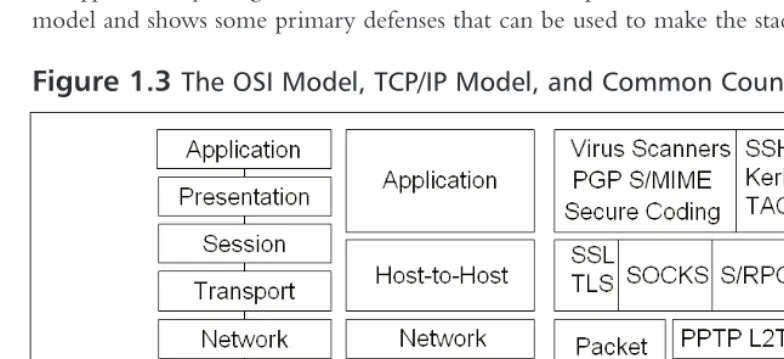
[image:39.612.64.456.186.365.2]Although the OSI model proved itself as a teaching model, it was never fully adopted.The Department of Defense (DoD), funder of the original Advanced Research Projects Agency Network (ARPANET) research, implemented the TCP/IP model, which became the foun-dation of the Internet as we know it today.TCP/IP is similar to the OSI model, but consists of only four layers, which include the physical layer, the network layer, the host-to-host layer, and the application layer. Figure 1.3 illustrates the relationship of the OSI model to the TCP/IP model and shows some primary defenses that can be used to make the stack more secure.
Figure 1.3
The OSI Model, TCP/IP Model, and Common CountermeasuresA wide range of protective mechanisms are shown at the various layers.The reason why so many countermeasures were developed can be traced to the early development of TCP/IP, which was originally developed as a flexible, fault tolerant network; security was not the driving concern.The network was designed to these specifications to withstand a nuclear strike that might destroy key routing nodes.The designers of this original network never envisioned the Internet used today; therefore, many TCP/IP protocols and applications are insecure. Security controls like IPSec are add-ons to the original protocol suite.
NOTE
Layering defensive techniques on top of one another is known as defense in depth. This technique seeks to delay and deter attackers by buying time and delaying the ultimate succession of the attack. It is designed so that if one secu-rity control fails, it is unlikely that the same attack will penetrate the next layer.
Extending OSI to Network Security • Chapter 1 13
Countermeasures Found in Each Layer
Security countermeasures are the controls used to protect the confidentiality, integrity, and availability of data and information systems.There is a wide array of security controls avail-able at every layer of the stack. Overall security can be greatly enhanced by adding additional security measures, removing unneeded services, hardening systems, and limiting access (dis-cussed in greater detail throughout the book and introduced in this section).
■ Virus Scanners Antivirus programs can use one or more techniques to check files and applications for viruses. While virus programs didn’t exist as a concept until 1984, they are now a persistent and perennial problem, which makes main-taining antivirus software a requirement.These programs use a variety of tech-niques to scan and detect viruses, including signature scanning, heuristic scanning, integrity checks, and activity blocking.
■ Pretty Good Privacy (PGP) In 1991, Phil Zimmerman initially developed PGP as a free e-mail security application, which also made it possible to encrypt files and folders. PGP works by using a public-private key system that uses the International Data Encryption Algorithm (IDEA) algorithm to encrypt files and e-mail messages.
■ Secure Multipurpose Internet Mail Extensions (S/MIME) S/MME secures e-mail by using X.509 certificates for authentication.The Public Key
Cryptographic Standard is used to provide encryption, and can work in one of two modes:signedand enveloped. Signing provides integrity and authentication. Enveloped provides confidentiality, authentication, and integrity.
■ Privacy Enhanced Mail (PEM) PEM is an older e-mail security standard that provides encryption, authentication, and X.509 certificate-based key management.
■ Secure Shell (SSH) SSH is a secure application layer program with different security capabilities than FTP and Telnet. Like the two aforementioned programs, SSH allows users to remotely log into computers and access and move files.The design of SSH means that no cleartext usernames/passwords can be sent across the wire. All of the information flowing between the client and the server is
encrypted, which means network security is greatly enhanced. Packets can still be sniffed but the information within the packets is encrypted.
■ Secure Electronic Transmission (SET) SET is a protocol standard that was developed by MasterCard, VISA, and others to allow users to make secure transac-tions over the Internet. It features digital certificates and digital signatures, and uses of Secure Sockets Layer (SSL).
■ Terminal Access Controller Access Control System (TACACS) Available in several variations, including TACACS, Extended TACACS (XTACACS), and 14 Chapter 1 • Extending OSI to Network Security
TACACS+.TACACS is a centralized access control system that provides authenti-cation, authorization, and auditing (AAA) functions.
■ Kerberos Kerberos is a network authentication protocol created by the
Massachusetts Institute of Technology (MIT) that uses secret-key cryptography and facilitates single sign-on. Kerberos has three parts: a client, a server, and a trusted third party (Key Distribution Center [KDC] or AS) to mediate between them.
■ SSL Netscape Communications Corp. initially developed SSL to provide security and privacy between clients and servers over the Internet. It’s application-indepen-dent and can be used with HTTP, FTP, and Telnet. SSL uses Rivest, Shamir, & Adleman (RSA) public key cryptography and is capable of client authentication, server authentication, and encrypted SSL connection.
■ Transport Layer Security (TLS) TLS is similar to SSL in that it is application-independent. It consists of two sublayers: the TLS record protocoland the TLS hand-shake protocol.
■ Windows Sockets (SOCKS) SOCKS is a security protocol developed and established by Internet standard RFC 1928. It allows client-server applications to work behind a firewall and utilize their security features.
■ Secure RPC (S/RPC) S/RPC adds an additional layer of security to the RPC process by adding Data Encryption Standard (DES) encryption.
■ IPSec IPSec is the most widely used standard for protecting IP datagrams. Since IPSec can be applied below the application layer, it can be used by any or all appli-cations and is transparent to end users. It can be used in tunnel modeor transport mode.
■ Point-to-point Tunneling Protocol (PPTP) Developed by a group of ven-dors including Microsoft, 3Com, and Ascend, PPTP is comprised of two compo-nents: the transportthat maintains the virtual connection and the encryptionthat insures confidentiality. PPTP is widely used for virtual private networks (VPNs).
■ Challenge Handshake Authentication Protocol (CHAP) CHAP is an improvement over previous authentication protocols such as Password
Authentication Protocol (PAP) where passwords are sent in cleartext. CHAP uses a predefined secret and a pseudo random value that is used only once (i.e., a hash is generated and transmitted from client to server).This facilitates security because the value is not reused and the hash cannot be reversed-engineered.
■ Wired Equivalent Privacy (WEP) While not perfect, WEP attempts to add some measure of security to wireless networking. It is based on the RC4 sym-metric encryption standard and uses either 64-bit or 128-bit keys. A 24-bit Initialization Vector (IV) is used to provide randomness; therefore, the “real key”
Extending OSI to Network Security • Chapter 1 15
may be no more than 40 bits long.There have been many proven attacks based on the weaknesses of WEP.
■ Wi-Fi Protected Access (WPA) WPA was developed as a replacement for WEP. It delivers a more robust level of security. WPA uses Temporal Key Integrity Protocol (TKIP), which scrambles the keys using a hashing algorithm and adds an integrity-checking feature that verifies that the keys haven’t been tampered with. Next, WPA improves on WEP by increasing the IV from 24 bits to 48 bits. WPA also prevents rollover (i.e., key reuse is less likely to occur). Finally, WPA uses a dif-ferent secret key for each packet.
■ Packet Filters Packet filtering is configured through access control lists (ACLs). ACL’s allow rule sets to be built that will allow or block traffic based on header information. As traffic passes through the router, each packet is compared to the rule set and a decision is made whether the packet will be permitted or denied.
■ Network Address Translation (NAT) Originally developed to address the growing need for intrusion detection (ID) addresses, NAT is discussed in RFC 1631. NAT can be used to translate between private and public addresses. Private IP addresses are those considered non-routable (i.e., public Internet routers will not route traffic to or from addresses in these ranges).
■ Fiber Cable The type of transmission media used can make a difference in secu-rity. Fiber is much more secure than wired alternatives and unsecured wireless transmission methods.
■ Secure Coding It is more cost-effective to build secure code up front than to try and go back and fix it later. Just making the change from C to a language such as .NET or CSharp can have a big security impact.The drive for profits and the additional time that QA for security would introduce, causes many companies to not invest in secure code.
The Current State of IT Security
According to www.Cert.org, in the year 2000 there were 1,090 vulnerabilities reported, in 2001 there were 2,437, and in 2005 that number climbed to 5,990. With such an increase in the number of known vulnerabilities, it’s important to consider how we got to this current state.There is also real value in studying the past to try and learn from our mistakes and pre-vent them in the future. What follows is a somewhat ordered look at the history of security. 16 Chapter 1 • Extending OSI to Network Security