Ames Laboratory Publications
Ames Laboratory
4-15-1987
A study on the effect of dislocation on the magnetic
properties of nickel using magnetic NDE methods
R. Ranjan
Iowa State University
O. Buck
Iowa State University
R. Bruce Thompson
Iowa State University
Follow this and additional works at:
http://lib.dr.iastate.edu/ameslab_pubs
Part of the
Engineering Mechanics Commons
,
Materials Science and Engineering Commons
,
and the
Structures and Materials Commons
The complete bibliographic information for this item can be found at
http://lib.dr.iastate.edu/
ameslab_pubs/6
. For information on how to cite this item, please visit
http://lib.dr.iastate.edu/
howtocite.html
.
A study on the effect of dislocation on the magnetic properties of nickel
using magnetic NDE methods
Abstract
Dislocations affect the magnetic properties of ferromagnetic materials by pinning the domain walls. The
primary mechanism is interaction between the stress fields of dislocation and domain walls. Using magnetic
nondestructive methods, namely the acoustic Barkhausen noise (AB), magnetic Barkhausen noise (MB), and
the hysteresis curves, we have studied these interactions. The three measurements give different types of
information. AB provides information about non‐180° type domain wall interaction, MB primarily provides
information about 180° domain wall interaction, and the hysteresis curve about both these interactions as well
as about rotation of domain walls. The paper presents results obtained on polycrystalline nickel which was first
deformed and then annealed at different temperatures in order to achieve different dislocation densities. The
results show that AB and hysteresis loss follow the same trend as hardness. MB results, however, change in a
more complex fashion which is sensitive to grain recrystallization as well as dislocation structure. Interesting
features of these results will be discussed in detail.
Keywords
nickel, magnetoacoustic effects, barkhausen effect, magnetic properties, magnetic testing, annealing, domain
wall, wall pinning, hysteresis
Disciplines
Engineering Mechanics | Engineering Science and Materials | Materials Science and Engineering | Structures
and Materials
Comments
The following article appeared in
Journal of Applied Physics
61, no. 8 (1987): 3196–3198 and may be found at
http://dx.doi.org/10.1063/1.338899.
Rights
Copyright 1987 American Institute of Physics. This article may be downloaded for personal use only. Any
other use requires prior permission of the author and the American Institute of Physics.
A study on the effect of dislocation on the magnetic properties of nickel
using magnetic NDE methods
R. Ranjan, O. Buck, and R. B. Thompson
Citation: J. Appl. Phys. 61, 3196 (1987); doi: 10.1063/1.338899 View online: http://dx.doi.org/10.1063/1.338899
View Table of Contents: http://jap.aip.org/resource/1/JAPIAU/v61/i8
Published by the American Institute of Physics.
Related Articles
Real-time observation of electrical vortex core switching
Appl. Phys. Lett. 102, 072405 (2013)
Transport of perpendicular spin in a semiconductor channel via a fully electrical method
Appl. Phys. Lett. 102, 062412 (2013)
Oxygen stoichiometry and magnetic properties of LuFe2O4+δ
J. Appl. Phys. 113, 063909 (2013)
Correlation between structural parameters and the magnetocaloric effect in epitaxial La0.8Ca0.2MnO3/LaAlO3 thin film
J. Appl. Phys. 113, 063508 (2013)
Increasing Curie temperature in tetragonal Mn2RhSn Heusler compound through substitution of Rh by Co and Mn by Rh
J. Appl. Phys. 113, 063904 (2013)
Additional information on J. Appl. Phys.
Journal Homepage: http://jap.aip.org/
Journal Information: http://jap.aip.org/about/about_the_journal
Top downloads: http://jap.aip.org/features/most_downloaded
Information for Authors: http://jap.aip.org/authors
A study on the effect of dislocation on the magnetic properties
of nickel using magnetic NDE methods
R. Ranjan, O. Buck, and R. B. Thompson
Ames Laboratory-u.s. Department of Energy, Iowa State University, Ames. Iowa 50011
Dislocations affect the magnetic properties of ferromagnetic materials by pinning the domain walls. The primary mechanism is interaction between the stress fields of dislocation and domain walls. Using magnetic nondestructive methods, namely the acoustic Barkhausen noise
(AB), magnetic Barkhausen noise (MB), and the hysteresis curves, we have studied these interactions. The three measurements give different types of information. AB provides information about non-180· type domain wall interaction, MB primarily provides information about 180· domain wall interaction, and the hysteresis curve about both these interactions as well as about rotation of domain walls. The paper presents results obtained on polycrystalline nickel which was first deformed and then annealed at different temperatures in order to achieve different dislocation densitieso The results show that AB and hysteresis loss follow the same trend as hardness. MB results, however, change in a more complex fashion which is sensitive to grain recrystallization as well as dislocation structure. Interesting features of these results will be discussed in detail.
INTRODUCTION EXPERIMENTAL DETAILS AND RESULTS
Magnetic domain walls carry a stress field (due to the exchange energy, magnetocrystalline energy and magnetoe-lastic coupling) which interacts with the strain fields of dif~
ferent structural defects such as dislocations, precipitates, etc. It is the magnetostrictive coupling (and also the magne-tostatic coupling if the defects are larger than the thickness of domain wans) between the structural defects and the do-main walls that affect the movement of the dodo-main walls and, therefore, the ferromagnetic properties. I The
discontin-uous motion of domain walls in ferromagnetic materials due to the interaction with defects generates bursts of magnetic induction, called magnetic Barkhausen noise (ME) and are detected by a coil surrounding the sample. In addition, bursts of acoustic emission, called acoustic Barkhausen noise CAB) are produced and are detected by a piezoelectric transducer. The defects not only interact with the domain walls, but also change the magnetic structure within the do-mains. The effect of short-range and long-range stresses on the fluctuations of the direction of spontaneous magnetiza-tion can be obtained from the micromagnetic equamagnetiza-tions us-ing the minimization of total magnetic Gibbs free energy.2.3 These fluctuations of the spontaneous magnetization affect the domain structure and thus the dynamics of domain walls generating MB and AB during magnetization.
The experimental system used has been discussed in de-tail elsewhere:5
The hysteresis curves were measured using a modified Walker MH-lO hysteresisgraph. The output from a search coil was connected to an MF-3A integrating volt-meter to determine B, while the output from a Hall probe was connected to a MG-3A Gaussmeter to measure H. The magnetic field was controlled from an IBM PC personal computer via a Kepco SN-121 digital to analog converter and a Kepco BOP 72-5M programmable bipolar power sup-ply. This experimental system has been described else-where.6
Simultaneous measurements of the residual magnetiza-tion and the Barkhausenjumps in polycrystals show that the two are linearly related to one another and strongly in-fluenced by defect structure:~ In the present work, deformed nickel samples were annealed at different temperatures in order to vary the dislocation density. However, the grain size also changes due to recrystallization, as will be discussed subsequently. The samples were then studied using the aforementioned magnetic NDE methods.
Pure nickel samples were swaged (- 70% reduction in area) to a final diameter of 1/2 in. and a length to diameter ratio
=
12.0. These samples were then annealed at different temperatures for the same lengths of time. The hysteresis(B-H) curves, and the MB and AB signals were recorded for
AflneQ!i~g tIme;; 3 hrs.
500 600
Annealing Temp. (OC) _ _
[image:4.612.300.521.563.722.2]--~~ - 2.00oJC Annealed ~~.-.-.-350cC Anneoied 425"C Annc13~f!d _ .. , -- 500°C Annoo'ed
- -- scooe Anne-o:ed
FIG. 2. Hysteresis curves of the samples.
a 0.1 Hz magnetic field (H max
=
±
110 Oe) with atriangu-lar waveform; In these experiments, the samples were initial-ly fulinitial-ly demagnetized and then the actual measurements were carried out.
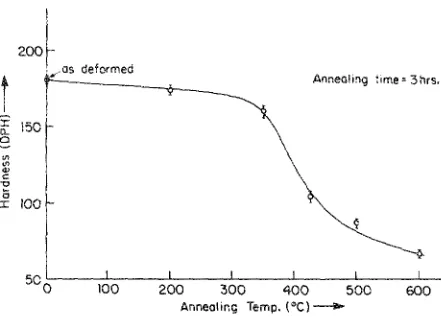
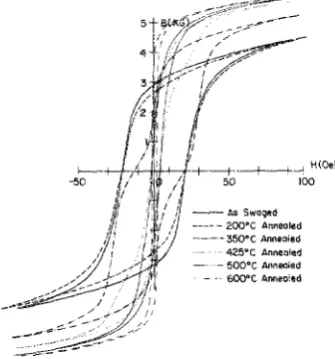
Hardness of all the samples was measured and is plotted in Fig. 1. The optical micrographs ofthese samples showed that the 350 and 425 ·C annealed samples underwent differ-ent extdiffer-ents of recrystallization. The 500 ·C annealed sample was almost fully recrystallized and 600 ·C annealed sample showed some grain growth. The hysteresis curves for the samples are shown in Fig. 2. The hysteresis loss, area under
the B-H curves derived from Fig. 2, has been plotted inFig. 3
as a function of annealing temperature. The total number of counts of MB and AB signals over a predetermined thresh-old has been shown in Figs. 4 and 5, respectively.
DISCUSSION
During early stages of annealing (corresponding to the low annealing temperature in this case), dislocations rear-range themselves in a low-energy configuration called poly-gonization. As the annealing temperature is increased, re-crystallization of new strain-free grains in the prior coid-worked matrix begins and the dislocation density starts
to drop. As shown in Fig. 1, in 350, 425, and 5oo·C annealed
samples, dislocation density, as sensed by hardness, has a
Annealinq time=3hrs.
Freque""y of lhe Magnetic F,.td 20.; Hz
AH2±1I0 Oe
Annealing Temp.
('C)-FIG. 3. Hysteresis loss as a function of annealing temperature.
3197 J. Appl. Phys., Vol. 61, No.8, 15 April 1987
100
I 1
Annealing fime ~:3 hrs. Frequency of the Magr.etic Field
~o.l Kz C.H",,,1I0 O.
200 300 400 500 600 Annealing Temp. I'G) .•.
-FIG. 4. Total number of counts of MB signals as Ii function of annealing
temperature.
decreasing trend due to an increasing extent of recrystalliza-tion. Thus the changes in magnetic properties and MB and
AB signals can be mostly attributed to the change in
[image:5.611.80.248.40.220.2]disloca-tion density.
Figure 2 shows that the hysteresis curves become nar-rower with increasing annealing temperature. The partially recrystallized samples (350 and 425°C annealed) show "wasp waist" shaped hysteresis curves and have been
inves-tigated earlier using AB and MB signals.5 In that study,
it
was concluded that this unusual shape was caused by the superimposition of the hysteretic response of two micro-structurally different materials corresponding to the strain-free recrystallized grains and the prior deformed grains.
Re-sults of the major loops of these samples for different f:JI,
seem to support this. Figures 1, 3, and 5 show that the total number of counts of AB signals and the hysteresis loss follow the same trend as hardness. However, the total number of MB signals count in Fig. 4 does not follow the hardness curve, as indicated by the slope at low temperature and the high-temperature maximum. Since the AB signa! is mainly due to the sudden local change in magnetostrictive strain associated with the irreversible translation of non-I 80· do-main walls, the results imply that the non-180· dodo-main walls interact strongly with dislocations. On the other hand, 180·
domain walls do not seem to show such Ii strong interaction
with dislocations. Theoretical calculations 7 of
magnetoelas-tic interaction between dislocation domain walls indicate a stronger interaction with non-180· domain walls than with
AnntQ!ing: hme!'!'. 3 hrs.
Freq. of Magn,tic field ,,0.1 Kz 1'111,,,,110 O.
FIG. 5. Total number of counts of AB signals as a function of annealing temperature.
Ranjan, Buck, and Thompson 3197
[image:5.611.348.567.42.181.2] [image:5.611.346.547.585.722.2] [image:5.611.78.300.588.729.2]1800
domain walls, consistent with our experimental results. Figure 4 shows a "vaHey" in the 300-500 ·C annealing temperature region which is the recrystallization region.
This has also been observed in iron.s Two competitive
pro-cesses occur during recrystallization, namely the drop in dis-location density and the nucleation of small recrystallized
grains. As the dislocation density decreases, the number of
pinning points for 1800
domain walls decreases and therefore the MB signal decreases. With the nucleation of small re-crystallized grains, the average grain size decreases and the
density of 1800
domain walls increases.9 It has also been
ob-served5 that the ME signals increase with decreasing grain
size in nickel. Thus the two above mentioned processes have an opposite effect on the MB signal and thereby results into a "valley" in the recrystallization region, as shown in Fig. 4. However, this is not observed in the AB signals as the grain size change does not affect AB signals as strongly as it does to ME signals.:1 The "valley" in ME signal of nickel might be used for nondestructive estimation of the extent ofrecrystal-lization in ferromagnetic materials by attaching the MB sen-sor directly to the material undergoing annealing and run-ning real time experiments.
CONCLUSIONS
Results show that AB signals and hysteresis loss in
nick-el follow the same trend as hardness. Thus they can be used
to nondestructively measure the extent of deformation in nickel. Results ofMS signais show a "valley" in a
recrystalli-zation region. This is due to a combined effect of change in grain size and dislocation density during recrystallization. The difference in the sensitivities of AB and MB signals to
change in dislocation density is due to the difference in inter~
action of 1800
and non-I 80° walls with dislocations. Results
support the theoretical calculations7 which show that
non-1800
domain walls interact more strongly with dislocations
than 1800
domain walls.
ACKNOWLEDGMENT
This work was supported by the U. S. Department of Energy, Office of Basic Energy Sciences, Division of Materi-als Sciences under contract no. W-7405-Eng-82.
lB.. Kriinmullcr, Int. J. Nondestr. Test. 3, 315 (1972).
2B.. Kronmuller, 5th Riso International Symposium on Metallurgy and
Materials Science, p. 79 (1984).
'R. Ranjan, O. Buck, and R. B. Thompson (unpublished). ·V. M. Rudyak, Sov. Phys. Usp. 13,461 (1971).
'R. Ranjan, O. Buck, and R. B. Thompson, in Review afProgress in
Quanti-tatilJe NDE (Plenum, New York, 1986), Va!. 5B, p. 1335.
6S. Habermehl and D. C. Jiles, in Review of Progress in Quantitative NDE (Plenum, New York, 1986), Vol. 5B, p. 843.
7D. E. Scherpereel, L. L. Kazmerski, and C. W. Allen, Metall. Trans. 1, 517
(1970).
"D. J. Buttle, C. R. Scruby, J. P. Jakabovics, and G. A. D. Briggs (private communication) .