Abstract: Micro EDM Drill is variant EDM processes in a situation where it employs water as a dielectric fluid, with pressure flushing and rotating nanotube electrode. This paper brings out the relative features of work pieces i.e., H.S.S and Titanium 31 about their surface roughness with Talysurf, as well as Surfaces Texture with Scanning Electronic Microscope (SEM analysis).Thus the results are evaluated for Ra (Surface Roughness), Rsk (Surface Skewness) and Rku (Surface Kutosis).
Keywords: Titanium 31, (H.S.S) High Speed Steel, Micro Electro Discharge Machining Drill (Micro EDMD), SEM, Ra, Rsk, Rku
I. INTRODUCTION
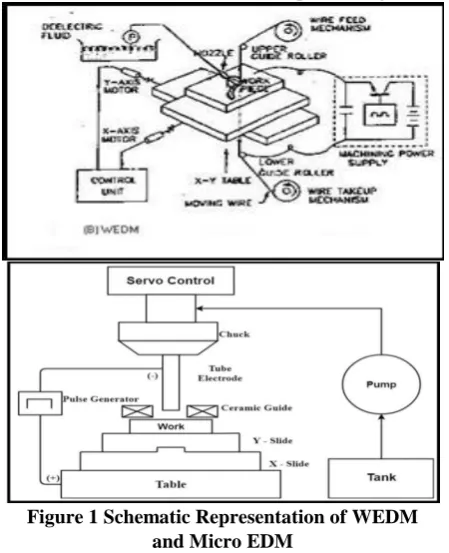
[image:1.595.62.287.422.699.2]The EDM is widely applied for machining unusual materials and intricate shape. In wire cut EDM etc drilling micro holes of 0.3 to 3.0 mm, run away holes in die and pneumatic valves are difficult. In the variant EDM process it consists of a low energy pulse, water dielectric and a spark gap, flushing with pressure through a nano pipe electrode which is assisted by Taylor coquette flow the dielectric from rotation of the electrode. This shows setup in the Figure 1.
Figure 1 Schematic Representation of WEDM and Micro EDM
Revised Manuscript Received on July 05, 2019.
Mr. Jush Kumar, Research Scholar, Acharya Nagarjuna University, Guntur, Andhra Pradesh, India
Dr. C. Srinivas, Department of Mechanical Engineering, RVR & JC College of Engineering, Guntur, Andhra Pradesh, India.
Dr. N. N. Ramesh, Department of Mechanical Engineering, Anurag Group of Institutions, Hyderabad, Telanganga, India.
Assembly of ceramic guide is mounted as electrode. The nano - tube Tool and workpiece form a pair of electrodes with electrode negative with uniform gap of few scores of microns. Therefore wearing away occurs by elevated frequency sparks trigger by square pulse generator. Dielectric medium as distilled water is employed in place of customary kerosene pulse generator.In conventional EDM it is diverse designed for machining small holes due to reduced erosion rates, get thinner and massive are typical harms [1, 2]. At common short circuits as of spark gap contamination by wearing down debris. [3] Water as dielectric medium is used efficiently which results in smallest spark gaps [4], fastest solidification of eroded particles before they combine to form larger size debris [5, 6]. The viscosity is superior due to flushing action. The key benefit of micro EDM drill is to machine small holes by way of very small forces. The forces are small due to tool and workpiece interface which perform keen approach in contact throughout the machining process. This provides advantage to both tool and workpiece. Additional return of micro EDM drill includes low down - elevated feature ratio, setup cost and enhanced precision with great plan freedom. In addition micro EDM drill is contactless MRR thereby eliminate mechanical pressure vibration and chatter troubles during machining. Micro EDM is extremely efficient to machine any kind of micro holes by means of elevated aspect ratio.
II. EXPERIMENTPLAN
Narrative assessment has been performed in the direction to discover but not in machining parameters which affect the surface roughness of WEDM process. While machining parameters wire feed. Speed, pulse on time, wire tension, delay time and ignition current strengthen be chosen for testing. The experiment be intended according to Taguchi’s L16 (4)4. Trial is conduct with WEDM machine manufactured by charmilles technologies. A 0.25mm diameter zinc coated brass wire is selected as tool electrode. Titanium 31 and H S S material of 10 mm width are taken as work material. A talysurf on 0.8 mm cut off significance considered the surface roughness of every specimen. Table 1 illustrates the chosen machining parameter for the testing. The Work pieces are prepared on the Electron Discharge Machine Rapid drill and Wire EDM.
Surface Texture of Titanium 31 and H.S.S using
Micro EDM Drill and Wire EDM
A. Input factors
Work piece materials of Titanium 31 and H.S.S, electrode brass tube of 1mm and 3mm diameter, pulse current 3 Amps and 6 Amps, pulse on times 6 and 10, pulse off times 4 and 7 (dial positions with increasing order) pulse voltage (100 V) and flush pressure (100 bar) were kept uniform [4]. B. Output factors and Inference mode
Roundness error of 3D-cmm, are observed at the top and base of the hole and the taper. Surface finishes using Talysurf, Topological surface and SEM. Scanning Electron Microscope
III. RESULTSANDDISCUSSION A. Surface Characteristics
[image:2.595.309.543.246.715.2]The outcome of surface roughness are planned in Table 1
Table I Surface Roughness (Ra) (m) range in Micro EDM Drill and WEDM
Process
Materials Titanium 31 H.S.S Speed
(Low)
Speed (High)
Speed (Low)
Speed (High) Micro
EDM 0.936 1.640 1.807 1.962
WEDM 1.609 1.728 2.109 2.781
The finding are predictable but demonstrative surface roughness in titanium 31 compare to H.S.S, and sizeable fluctuations of Ra values were observed along Titanium 31 surface. The attributed of non-uniform attrition occurring to spark discharge is due to short circuit current surge. The eroded surfaces in Titanium 31 were very smooth with good appearance compared to H.S.S, The surface finish and geometric accuracy of Titanium 31 surfaces have significant advantage and lower to H.S.S surfaces.
It is high energy of spark discharge produce melt on the spot of its impingement and atomization of fluid metal by flash forces and growing gas. However erosion rates within Titanium 31 are so high that elevated energy pulses and flash unaided might not be the cause other than short circuits among electrode and work peace by means of current surge. The usual spark discharge key quantity of melt metal is retained and a minute part is detached since atomized droplet.While the unstable forces of short circuits give a good deal of higher removal and lesser preservation of melt metal. The mark wants further explosion in the wearing down mechanism of Titanium 31 and H.S.S. using micro EDM drill. B. Textural study
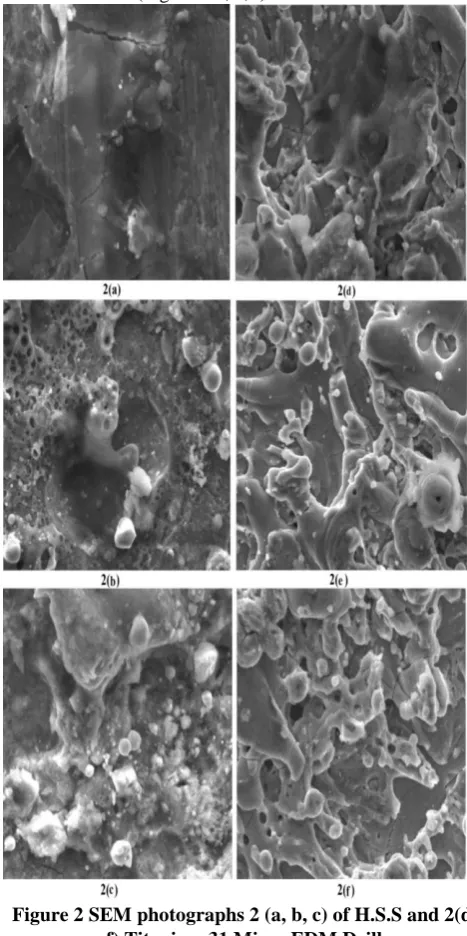
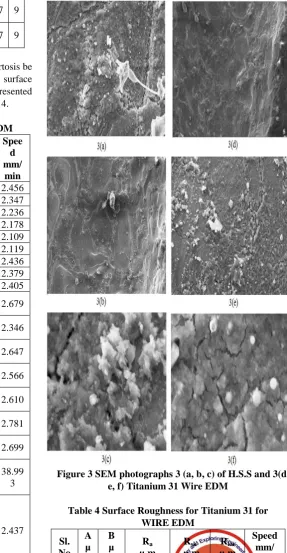
The worn surface of work materials H.S.S besides Titanium 31 from Micro EDM and WEDM are revealed in the SEM photographs of Figure 2 and 3.
Therefore erosive effect of sparks is considerable in similarity of Sparking is a continuous local spark discharges; hence fourth articulate sparks will be employed. The tool electrodes are anode within Micro EDM drill. The
emblematic occurrence of passivating film pattern on anode and evaluation of hydrogen on cathode are in favour of gaseous bridge of spark gap and also ionization for sparks channel formation involve the type of polarity.
It is the erosion in each case appears elevated quenching effect of circulate fluid prevent vaporization. There is sizeable retained metal which appear to contain resoldified at spark zone. The reduction is extensive in Micro EDM Drill owing is soaring quench result in water based electrolyte.
[image:2.595.52.286.276.401.2]This gives eroded surface of Titinium31and H.S.S show distinctive form associated along with EDM [4] like burst blisters from dissolve gas, pock marks plus craters after expulsion of melt metal since spark energy. This removal to be superior in Micro EDM Drill owing to superior since water based electrolyte which also promote the oxidation tendency of Titanium 31 in (Figure 2 d, e, f).
Figure 2 SEM photographs 2 (a, b, c) of H.S.S and 2(d, e, f) Titanium 31 Micro EDM Drill
Unlike precipitation of H S S which remains hard after quenching and hardened, this
visualizes more carbon content at various speeds. In Fig. 2 (d) that is titanium 31 carbon content is more and shows wide spread of grain structure but in Fig. 2 (e) and (f) the carbon content is less and the grain structure is closely packed.
[image:3.595.52.285.178.267.2]The SEM analysis show schematically within Fig. 3 (a) (b) and (c) and Fig. 3 (d) (e) and (f) results are arbitrarily “high” and “low” speed. In practice, intermediate speed usually permits and result is good in Fig. 3 (a) (b) of H S S and 3 (d) (e) in Titanium 31, whereas in Fig 3 (c) and 3 (f) shows cracks and white layer deposit
.
Table 2 Machining Parameters, range and levels. Sl.
No Parameters Symbol Range
Level (Pass) 1 2 3 4
1 Pulse on
time A 1-9 1 3 7 9
2 Pulse off
time B 1-9 1 3 7 9
[image:3.595.258.546.217.771.2]The Ra surface roughness Rsk Skewness, Rku Kurtosis be obtain by means of Talysurf Instrument with surface roughness (Ra) graphs are taken, the best results are presented in this paper, of Titanium 31 and H S S in Table 3 & 4.
Table 3 Surface Roughness for H SS Wire EDM Sl
. N
o A µ sec
B µ sec
Ra µ m
Rsk µ m
Rku µ m
Spee d mm/
min
1 1 1 3.2678 0.2133 2.8718 2.456
2 3 1 3.2976 0.2436 2.8691 2.347
3 7 1 3.2764 0.2314 2.8115 2.236
4 9 1 3.2981 0.2174 2.8016 2.178
5 1 3 3.1064 0.2186 2.7341 2.109
6 3 3 3.1578 0.2256 2.6542 2.119
7 7 3 3.2679 0.2387 2.5616 2.436
8 9 3 3.2198 0.2468 2.5781 2.379
9 1 7 4.0118 0.2369 2.5014 2.405
1
0 3 7 4.1268 0.2101 2.6718 2.679
1
1 7 7 3.5213 0.2618 2.8179 2.346
1
2 9 7 3.5116 0.2676 2.8201 2.647
1
3 1 9 3.5078 0.2610 2.7541 2.566
1
4 3 9 3.4798 0.2578 2.7871 2.610
1
5 7 9 3.2768 0.2416 2.8178 2.781
1
6 9 9 3.2579 0.2478 2.8068 2.699
T ot al
80 80 54.5856 3.8200 43.8590 38.99
3 A
v e ra g e
5 5 3.4116 0.2388 2.7412 2.437
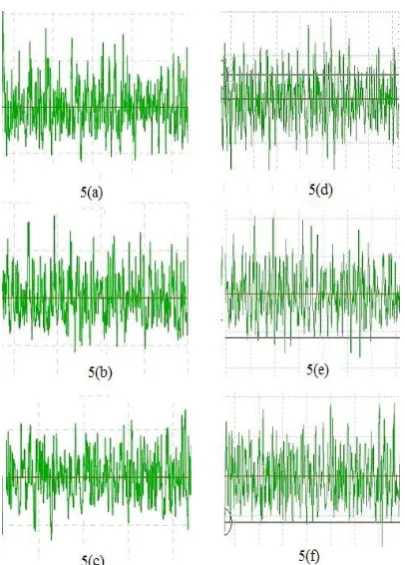
Erosion rates and roughness Ra are listed in Table 3 and Table 4 and roughness profiles of Titanium 31 and H S S are exposed within Figure 2(a), 1(b) and 1(c) and Fig 3(a), 2(b) & 2(c) respectively. The result is since likely but show considerately elevated erosion rates and surface roughness as revealed in Figure 2 compared to Figure 3 Considerable fluctuations in choice of Ra was observed surfaces. The results are attributed to non-uniform erosion owing to arc discharges as well as short circuit current surge. The preceding section explained the reasons of the theory. The worn surfaces in H S S were extremely uneven amid poor look, compare to Titanium which are extremely rough with extensive burrs. It is the surface finish and geometric accuracy of WEDM surfaces.
[image:3.595.48.290.343.791.2]Figure 3 SEM photographs 3 (a, b, c) of H.S.S and 3(d, e, f) Titanium 31 Wire EDM
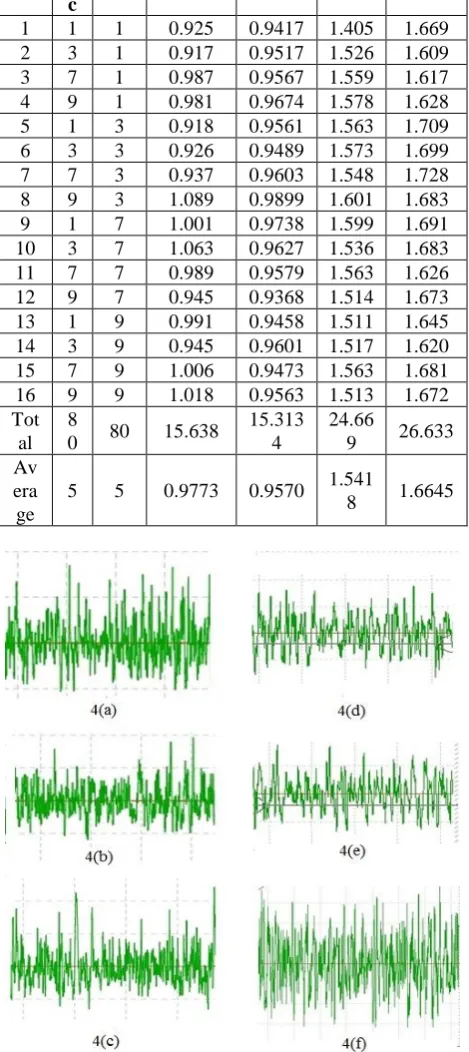
Table 4 Surface Roughness for Titanium 31 for WIRE EDM
Sl. No
A µ se
B µ sec
Ra µ m
Rsk µ m
Rku µ m
Speed mm/
c
1 1 1 0.925 0.9417 1.405 1.669
2 3 1 0.917 0.9517 1.526 1.609
3 7 1 0.987 0.9567 1.559 1.617
4 9 1 0.981 0.9674 1.578 1.628
5 1 3 0.918 0.9561 1.563 1.709
6 3 3 0.926 0.9489 1.573 1.699
7 7 3 0.937 0.9603 1.548 1.728
8 9 3 1.089 0.9899 1.601 1.683
9 1 7 1.001 0.9738 1.599 1.691
10 3 7 1.063 0.9627 1.536 1.683
11 7 7 0.989 0.9579 1.563 1.626
12 9 7 0.945 0.9368 1.514 1.673
13 1 9 0.991 0.9458 1.511 1.645
14 3 9 0.945 0.9601 1.517 1.620
15 7 9 1.006 0.9473 1.563 1.681
16 9 9 1.018 0.9563 1.513 1.672
Tot al
8
0 80 15.638
15.313 4
24.66
9 26.633
Av era ge
5 5 0.9773 0.9570 1.541
[image:4.595.306.550.47.649.2]8 1.6645
Figure 4 Surface Profile Ra 4 (a, b, c) of H.S.S and 4(d, e, f) Titanium 31 Wire EDM
[image:4.595.52.287.55.582.2]The method of wearing away bears considerable similarity of EDM. The wearing down rates in WEDM that low energy pulses and arcing unaided may not be cause but also short circuits among electrode and work with current surge. The normal arc discharge chief quantity of melt metal is retained and only minute parts get detached when atomized droplets.
Table 5 Experimental design for H.S.S for MICRO EDM DRILL
Sl. No
A µ se
c B µ sec
Ra µ m
Rsk µ m
Rku µ m
Speed mm/
min
1 1 1 2.660 0.2356 2.8418 1.845
2 3 1 2.745 0.2643 2.8521 1.946
3 7 1 2.008 0.2458 2.8551 1.866
4 9 1 1.895 0.2254 2.8201 1.807
5 1 3 2.454 0.2239 2.7526 1.908
6 3 3 2.324 0.2245 2.6252 1.962
7 7 3 1.466 0.2658 2.5542 1.833
8 9 3 1.108 0.2478 2.5418 1.834
9 1 7 1.245 0.2486 2.5015 1.844
10 3 7 1.306 0.2125 2.6451 1.856
11 7 7 1.346 0.2548 2.8428 1.840
12 9 7 1.464 0.2264 2.8284 1.843
13 1 9 2.100 0.26
32 2.7251 1.836
14 3 9 2.147 0.2556 2.8171 1.932
15 7 9 1.955 0.2256 2.8278 1.944
16 9 9 1.986 0.2588 2.8543 1.868
Tot
al 80 80
30.20
9 3.8786 43.8850 29.964
Av era ge
5 5 1.888 0.2424 2.7428 1.873
Table 6: Experimental design for Titanium 31 for MICRO EDM DRILL
Sl . N
o A µ sec
B µ sec
Ra
µ m
Rsk
µ m
Rku
µ m
Speed mm/
min
1 1 1 1.804 0.9354 1.452 1.640
2 3 1 1.665 0.9586 1.425 1.543
3 7 1 1.060 0.9765 1.562 1.548
4 9 1 1.006 0.9548 1.575 1.499
5 1 3 1.768 0.9625 1.545 1.467
6 3 3 1.456 0.9842 1.585 1.489
7 7 3 1.398 0.9702 1.532 1.463
8 9 3 1.387 0.9844 1.652 0.987
9 1 7 0.946 0.9789 1.611 0.948
10 3 7 0.956 0.9782 1.545 0.936
11 7 7 0.988 0.9648 1.536 0.944
12 9 7 0.974 0.9246 1.541 0.942
13 1 9 1.179 0.9325 1.521 0.952
14 3 9 1.180 0.9562 1.548 1.400
15 7 9 1.199 0.9745 1.525 1.501
16 9 9 1.204 0.9325 1.524 1.581
T ot al
80 80 20.170 15.3688 24.679 20.840
A ve ra ge
5 5 1.260 0.9605 1.5424 1.302
The short circuits give to a large extent poorer expulsion and lesser retention of melt metal. The wearing away method in WEDM wants more exploration.
[image:4.595.44.293.713.785.2]erosion rates in H S S compare to Titanium 31 in of WEDM. Therefore reason, lesser thermal and electrical conductivity of Titanium 31 ensuing in lesser energy concentration. Therefore past possibilities can act on minor share of pulse energy and reduced compatibility among the electrode. The lesser wearing away rates through declining pulse current have the noticeable cause of lesser pulse energies.
Figure 5 Surface Profile Ra 5(a, b, c) of H.S.S and 5(d, e, f) Titanium 31 Micro EDM Drill
IV. CONCLUSIONS
Micro EDM Drill has considerably lower erosion charge for drilling micro holes.
The H.S.S and Titanium 31 leads erosion rates of high thermal and also electrical conductive.
Surface indiscretions follow normal pattern alike near that of erosion rates.
Significant reserved metal which resoldified exhibits typical features of spark erosion in the form of gas pockets. The quenching effect of water as working fluid of Micro EDM Drill on Titanium 31 result irregular debris which sticks together and appears in sludge form. H S S by means of elevated thermal and electrical conductivity show lower wearing away rates compare to Titanium 31.
Lower wearing away rate with declining current is compliance to assumption of electrical method of machining.
Surface roughness’s too have alike inclination as wearing away rate within the two material H S S and Titanium 31.
REFERENCES
1. K.H. Ho and S.T. Newman, “State of the Art Electrical Discharge Machining (EDM)”, Int.J. Of Machine tools & Manufacture Vol. 43, (2003), pp 1287-1300
2. V.S.R. Murti and P.K. Philip, “A comparative analysis of machining characteristics in ultrasonic assisted EDM by response function modeling”, Int. J. Prod.Res, Vol. 25, (1986), PP 259-272
3. N.Nagabhushana Ramesh, A. Neeraja, P. Chaitanya Krishna Chowdary, A. AshwiniShanthi “Gap in the Knowledge Base of Electro Discharge Machining” International Journal of Science and Research
6 (2017) 1346 – 1349
4. Kalley Harinarayana, N. Nagabhushana Ramesh, B. Balu Naik Experimental Investigations of Process Parameters of Electrodischarge Sawing, A Modified EDM Using Taguchi Approach International Journal of Emerging Technology and Advanced Engineering, 2 (2012), 620-626.
5. Paulo Carlos Kaminski, and Marcelo Neublum Capuano “Microhole Machining by Conventional Electrical Discharge Machine”,
Int.Jl.Mach.Tools & manufacture. (2003) 43.1143-1149
6. Yeole.Shivraj Narayan, Dr. N.N.Ramesh, Dr.B. Balu Naik “Effect of Process Parameters on Tool Wear Rate in Micro Drilling of Maraging steel 300 Alloy” 4th
International and 25th (AIMTDR) Conference, Jabalpur University.( 2012)
AUTHORSPROFILE
Jush Kumar Siddani is Research Scholar in the Acharya Nagarjuna University – Guntur, Andhra Pradesh, India. Completed Bachelor of Engineering at SRKREC- Bhimavaram and completed M.Tech (Advanced Manufacturing Systems) at UCE – JNTUK, Kakinada, Andhra Pradesh and India. Doing Research in the field of Electric Discharge Machining and Design of Experiments.
Dr C. Srinivas is working as Associate Professor in the Mechanical Engineering Department of R.V.R & J. C. College of Engineering, Guntur, Andhra Pradesh and India. He has published many research papers in reputed journals. His area of interest include Facility layouts, Flexible Manufacturing Systems, automated guided Vehicles (AGV), Genetic Algorithms and ant colony optimization.(E-mail:[email protected])