R E S E A R C H A R T I C L E
Open Access
Latent variable modeling and its implications
for institutional review board review: variables
that delay the reviewing process
Dong-Sheng Tzeng
1,2*, Yi-Chang Wu
3and Jane-Yi Hsu
4Abstract
Background:To investigate the factors related to approval after review by an Institutional Review Board (IRB), the structure equation model was used to analyze the latent variables‘investigators’,‘vulnerability’and‘review process’ for 221 proposals submitted to our IRB.
Methods:The vulnerability factor included vulnerable cases, and studies that involved drug tests and genetic analyses. The principal investigator (PI) factor included the license level of the PI and whether they belonged to our institution. The review factor included administration time, total review time, and revision frequency. The revision frequency and total review time influenced the efficiency of review.
Results:The latent variable of reviewing was the most important factor mediating the PIs and vulnerability to IRB review approval. The local PIs moderated with genetic study and revision frequency had an impact on the review process and mediated non-approval.
Conclusions:Better guidance of the investigators and reviewers might improve the efficiency with which IRBs function.
Background
Institutional Review Boards (IRBs) assess research pro-posals to ensure that they adhere to research regulations, adequately protect the rights and welfare of study partici-pants, and are ethically sound. Accreditation of an IRB by the National Health Institute ensures that human safety is not compromised during the conduct of approved medical research. An IRB should assess the adequacy of structural, procedural, and performance-related aspects of all studies brought before it. Performance problems related to the ab-sence of systematic assessment of the outcomes of this system of oversight have not been addressed [1]. There is no mechanism at the national level to gather systematic evidence on the intersection between research and IRB review [2].
Many investigators have expressed dissatisfaction with the IRB system, characterizing it as being dysfunctional [3], overburdened [2, 4], and over-reaching [5]. Principal investigators (PIs) complain that the problems of the re-view process conducted by IRBs include the inefficiency with which it identifies irrational decisions [6] and its in-consistency [7]. Research sponsors object that IRB re-view is time consuming, and that the associated delays can significantly increase the costs of research. The current IRB system has also been described as outdated and inappropriate for the scope and type of research be-ing conducted in the 21st century [8]. Proposals to im-prove the performance of IRBs include increasing the efficiency of the review process and reducing the amount of time devoted to administrative tasks prior to board review [1].
The significant demands on the time and resources of PIs that are associated with addressing the various chal-lenges associated with IRB approval reduce the willing-ness of PIs to participate in future research projects [9]. The greatest delay in approval is seen early in the IRB process, with PIs requiring an average of 45.1 ± 31.8 days * Correspondence:[email protected]
Yi-Chang Wu and Jane-Yi Hsu are co-authors.
1Kaohsiung Armed Forces General Hospital, No. 2, Chung-Cheng 1st Road,
Kaohsiung City, Taiwan
2Tri-Service General Hospital Beitou Branch, Taipei City, Taiwan
Full list of author information is available at the end of the article
to submit their study to the IRB [10]. The U.S. National Institutes of Health has suggested training programs for junior PIs and research staff to educate them more about the importance of the protection of human research sub-jects and the IRB review process [11]. However, there are no reports of the extent to which better appreciation by PIs of patient rights and the IRB process affects the likeli-hood of a positive outcome of the IRB process.
With regard to vulnerability, vulnerable groups are commonly understood to include pregnant women, pris-oners, children, and incompetent adults. Who is a re-search object? [12] have highlighted the challenges associated with trying to protect such vulnerable groups during studies that involve new drugs. Reporting of ser-ious adverse drug events to IRB helps to promote the safe use of pharmaceuticals [13]. A study by [14] indi-cated that descriptions of adverse events associated with 15 drugs and reported in clinical practice as structured event descriptions were 2- to 10-fold more complete than the descriptions of the same events in the FDA safety databases. Another important issue relates to obtaining informed consent from vulnerable groups in studies that involve genetic research; members of these groups can pose challenging questions related to ethical and regulatory standards. The complexity and controver-sial nature of many ethical issues in genome research re-flects the limited common ground between genetic researchers and IRB professionals [15] and differences between these two communities in disclosing contradict-ory research findings [16]. However, we do not know how these variables affect vulnerable groups and the likelihood of IRB approval.
Despite recognition of the need to evaluate the effect-iveness of IRB review, no published study has evaluated the effectiveness of the complicated IRB structural model. Several studies that evaluated the structure, process and outcome of IRB review have documented inconsistencies and inefficiencies [7]. Reports on the most important issues concerned with IRB approval have focused on three areas: (1) the total time of review and the rejection frequency; (2) the license level and institu-tion of the PI; and (3) the use of vulnerable groups in drug and genetic studies. Little is known about the com-plicated relationships between PIs, IRBs, and vulnerable groups. To investigate the factors involved in IRB review and approval, we analyzed research reviewed by our IRB over a 5-year period, using the structure equation model (SEM) for assessment of the latent variables of IRB re-view, PIs, and vulnerable groups.
Methods
Study design
In December 2012, we administered a retrospective sur-vey of the proposals submitted for review by our IRB
between January 2008 and December 2012. The study design met the requirements of the Helsinki Declaration and the design was approved by the IRB of the Armed Forces Kaohsiung General Hospital. The proposals were decoded for the names of the PIs and reviewers. We established whether the researchers belonged to our organization and collected details regarding their license level. The four license levels included medical ethics credit from the organization for 6 h per year, >6 h per year, credit from the Department of Health, and credit from a collaborative institutional training initiative (CITI) program qualification. We defined the vulnerabil-ity of the population (vulnerable/non-vulnerable), type of risk (drug/non-drug), and need to protect the confi-dentiality of the information collected (genome/non-genome). The review included: (1) administration time required by the Secretary of the IRB to check on in-formed consent and proposal documents; (2) total review time for informed consent, comparison of risks and benefits, and recruitment of the test population by scientific and non-scientific reviewers; and (3) the fre-quencies of revisions and resubmissions by the PIs after the primary and secondary reviews.
Study data
We surveyed 221 proposals, including human studies, which were submitted to our IRB over a 5-year period. Proposals for which the application was withdrawn be-fore completion of the review were excluded. The secre-tary of our IRB checked the documents against the checklist. The documents included details related to the study method and materials, the recruitment plan, levels of risk and benefit in the study population, inclusion of vulnerable cases (our definition of vulnerable cases in-cluded children, pregnant women, patients with mental illness, prisoners, students, and patients with disability), payment and compensation plan, informed consent, the license held by the PIs and their assistants, whether the PIs worked in our organization, protection of human subjects, and privacy and data confidentiality. If the pro-posal involved a genetic study, the PIs were required to have a qualification in the ethics of genetic research by Human Research Act of Taiwan. We asked for a full-board review for drug studies, such as phase-one through to phase-four clinical trials. The clinical trials were assigned to full board review. If these documents were complete, the proposal was sent to the Chair of the IRB within 3 days. If not, it was returned to the PIs. The revision frequency was recorded to assess the perform-ance of the PIs.
members receive annual accreditation in research ethics and undertake this work on a voluntary basis.
Before discussion by the IRB, one non-scientific and one scientific reviewer were assigned by the Chair of the IRB to review the proposal. The total review time was limited to 2 weeks and the duration of the review was recorded for further analysis. There were four outcomes of the review: ‘agree’,‘agree with revision’,‘review again after revision’, and ‘not recommended’. These outcomes were forwarded to the full board for further discussion every month. We classified the board review outcome as approval or not; whereas‘agree’and‘agree with revision’ were assigned to the approval group, the other two out-comes were assigned to the control group.
Statistical analysis
We used the SPSS version 20 statistical software package with the analysis of moment structure (AMOS). The SEM was applied to test the mediating variables between the review outcome and the observed variables. The SEM clarified the extent of the relationships between the variables as well as the chain of cause and effect. In other words, SEM results did not merely show the em-pirical relationships between the variables when defining the practical situation. For this reason, SEM was used to test the hypotheses. This study also used several indices to evaluate overall model fitness, including theχ2test of absolute fit (p> 0.05), test of relative fit by the goodness-of-fit index (GFI > 0.90), the adjusted goodness-goodness-of-fit index (AGFI > 0.90), the Tucker–Lewis index (TLI > 0.95), the comparative fit index (CFI > 0.90), and the root mean square error of approximation (RMSEA < 0.05). The mod-eling of latent variables was designed to consider three categories: PIs, review process by reviewers, and the vul-nerability of subjects or assessment of risks associated with drug-related and genetic tests. The latent variable of the PI factor included observed variables, such as the li-cense level of the investigators and whether they belonged to our institution. The latent variable of the reviewing process included observed variables, such as administra-tion and secretarial time, board-member review time, and revision frequency. The latent variable of vulnerability in-cluded observed variables, such as the involvement of vul-nerable cases, and drug and genetic studies. The descriptive analysis involved comparison between the ap-proval group and control group using a cross table and Student’st-test.
Results
We reviewed 221 proposals submitted to our IRB over a 5-year period. Of these, 159 proposals were approved, 56 were not approved, and six were exempt from a deci-sion. The six exempt reviews were excluded. The type of review (expedited/full board), involvement of vulnerable
subjects, involvement of drug use, involvement of gen-etic analysis, and the duration of PI training did not dif-fer significantly between the group of applications that were approved and those that failed to receive approval. There were significantly more non-approvals for tions from PIs within our organization than for applica-tions from PIs from outside our institution (p= 0.014). The administration time required for checking by the secretary of our IRB was longer in the group of applica-tions that were not approved (p= 0.008) than in the group that received approval. The revision frequency in the group of applications that were not approved was significantly higher than in the group of applications that were approved (p< 0.001). The total review time was sig-nificantly longer in the group of applications that were not approved than in the group of applications that were approved (p= 0.002) (Table 1).
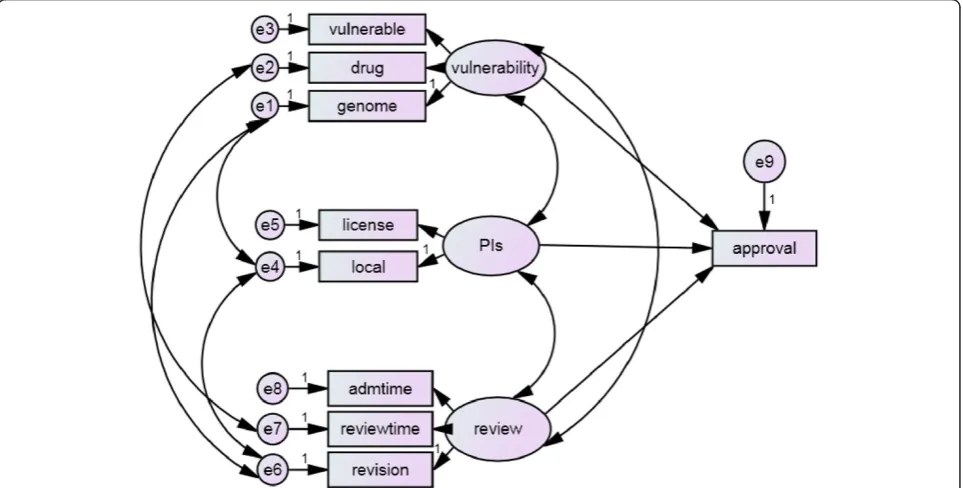
The non-standardized structure equation revealed the interactions between the latent variable of vulnerability and PIs and review (χ2= 25.706, degrees of freedom = 18, p= 0.107); between the duration of drug study and the duration of review; between the involvement of a genetic study and the revision frequency; between the involve-ment of a genome study and whether the PIs belonged to our organization; and between the revision frequency and whether the PIs belonged to our organization (Fig. 1).
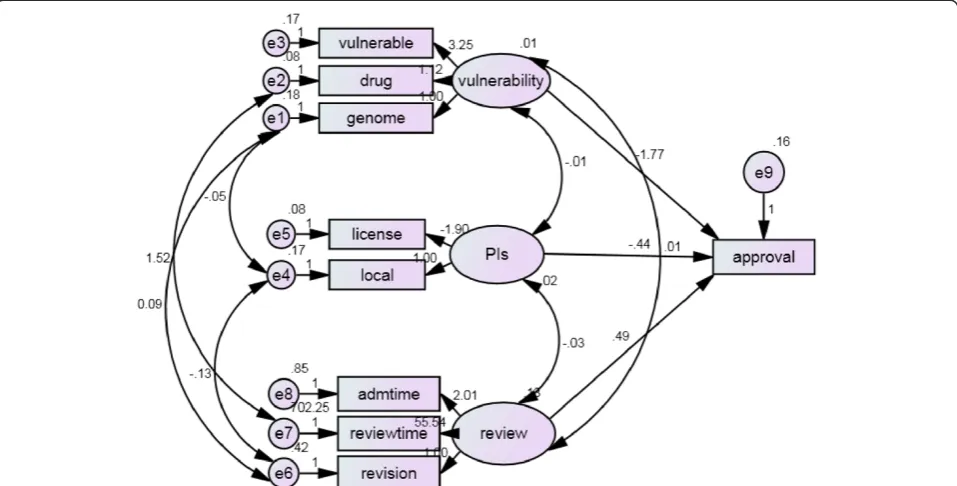
When estimates covariance among exogenous vari-ables (Fig. 2 and Table 2) revealed the significant rela-tionship between PIs and review time (estimate =−0.031, p= 0.04), drug study and review time (estimate = 1.515, p= 0.014), genome study and revision frequency (esti-mate = 0.093,p< 0.0001); genome study and whether the PIs belonged to our organization (estimate =−0.047, p< 0.0001); and revision frequency and whether the PIs belonged to our organization (estimate =−0.126,p= 0.04). When estimates of regression weight, the drug study and vulnerable case revealed no significant (estimate 1.12,p= 0.127; estimate 3.25,p= 0.117 respectively) to latent vari-able of vulnerability in genome study set to zero. The li-cense is significant to PI (estimate−1.90,p= 0.011) when set the local variable to zero. The total review time and administers time is significant to review (estimate 55.54, p< 0.001; estimate 2.01, p< 0.001 respectively) when set revision to zero. To approval, review (estimate 0.49,p= 0.011) is significant than PI and vulnerability (es-timate−0.44,p= 0.379; estimate−1.77,p= 0.244 respect-ively). When estimate of variances of exogenous variables, the e1, e2, e3, e4, e5, e6, e7, e8 and d1 (estimate 0.18, 0.08, 0.17, 0.18, 0.08, 0.42, 702.25, 0.85, 0.16;p< 0.001, <0.001, <0.001, <0.001, =0.020, <0.001, <0.001, <0.001, <0.001 respectively).
Discussion
This study revealed that revision frequency and total re-view time influenced rere-viewing, and that the latent vari-able of reviewing was the most important factor in mediating the PIs and vulnerability to IRB review ap-proval. And this study is the first application of the AMOS to test the systemic pathway for the hypothesis on the relative delay variables of the reviewing process.
AMOS revealed the reviewing process to be the medi-ator, which is not the only role with the responsibility of non-approval. The latent variables ‘vulnerability’ and
‘PIs’played a significant role in approval. Many authors have expressed dissatisfaction with the IRB system [2–6]. This is the first use of SEM to provide a more compre-hensive assessment of the factors that influence the suc-cess of applications brought before IRBs. The SEM
Table 1Demographic data of the proposals reviewed within the past 5 years by our IRB
Non-approval Approval X2∕t P
n = 56 n = 159
Type
Expedited 50 (89.3 %) 125 (78.6 %) 3.113 0.109
Full-board 6 (10.7 %) 34 (21.4 %)
Vulnerable case 18 (32.1 %) 59 (37.1 %) 1.154 0.338
Drug study 8 (14.3 %) 13 (8.2 %) 1.754 0.196
Genetic study 16 (28.6 %) 38 (23.9 %) 0.481 0.480
PI training 3.996 0.262
6 h 0 1 (0.63 %)
> 6 h 2 (3.6 %) 13 (8.2 %)
DOH 50 (89.3 %) 141 (88.7 %)
CITI program 4 (7.1 %) 4 (2.5 %)
Within organization 49 (87.5 %) 108 (67.9 %) 8.565 0.014
Administration time (day) 1. 27 ± 1.51 0. 78 ± 1.03 2.676 0.008
Revision frequency 1. 82 ± 0.57 1. 40 ± 0.76 3.744 0.000
Total review time (day) 47. 8 ± 50.5 31. 4 ± 24.1 3.203 0.002
N = 221, excluded 6 exempt review
DOHcredits from Department of Health,CITIcollaborative institutional training initiative
found that both the IRB review process and PI factors af-fected the likelihood of approval of a request. Most of the literature related to the value of IRBs has focused on is-sues related to their structure and operational processes instead of the measurement of outcomes [1, 9, 10]. In this study, our use of dichotomy approval and non-approval to reflect the effectiveness and efficiency of the IRB meant that other functions of the IRB were ignored. The func-tions of the IRB include the protection of human subjects and the education of participants in the research. The ap-proval process might be of interest to PIs. Revisions and recommendations from the reviewers need the compli-ance of the PIs. For the purpose of safety, [1] have out-lined an accreditation process and a standardized system for collecting and disseminating data on adverse events
and the performance assessment of IRBs. Appropriate ar-rangements for prospective independent scientific and ethical review are required, as are measures to establish whether the IRB is satisfying federal regulations for re-search studies that involve human rere-search subjects [7].
Local IRBs like ours, the drug relative study was dir-ectly measured as the observed variable for the latent variable of vulnerability. The reason for patient safety is that adverse drug events are monitored regularly [13]. Most common serious adverse events in a clinical setting are related to drugs that are administered in our general hospital. The risk level for consideration of institutional responsibility about drug studies is higher than minimal injury [12]. Indeed, in this study, we found the total re-view time to be associated with the nature of the drug study. As the path analysis indicated, the total review time acted as a mediator between drug studies and ap-proval. For genome studies, vulnerability was regarded as a latent variable because of the large number of
Fig. 2Maximal likelihood estimates of the following model parameters for regression weights, covariance and variance and the theoretical framework on structural models between vulnerability, PIs, and review process on the approval outcome
Table 2Estimates of observed and latent variables in the measurement and structural model
Estimates S.E. C.R. P
PIs↔Review −0.031 0.015 −2.054 0.040
Vulnerability↔Review 0.014 0.010 1.399 0.162
Vulnerability↔PIs −0.006 0.005 −1.273 0.203
Genome↔Revision frequency 0.093 0.021 4.428 ***
Drug↔Review time 1.515 0.616 2.460 0.014
Genome↔Local PIs −0.047 0.013 −3.666 ***
Local PIs↔Revision frequency −0.126 0.022 −5.645 ***
S.E.standard error,C.R.critical ratios *** < 0.0001
Table 3Model identification post modification and test by GFI, AGFI, TLI, CFI, and RMSEA for model fitness
Model GFI AGFI TLI CFI RMSEA
Default model 0.975 0.937 0.933 0.967 0.044
Saturated model 1.000 1.000
Independence model 0.743 0.677 0.000 0.000 0.171
GFIgoodness-of-fit index,AGFIadjusted goodness-of-fit index,TLITucker-Lewis index,CFIcomparative fit index,RMSEAroot mean square error
genetic studies conducted worldwide in recent years, even in developing countries. There are no consistent standards in IRB review concerning new technology, specimen storage, disclosure of individual research re-sults, and ethical problems [16]. In the present study, SEM found that PIs in our organization who were in-volved in genetic studies submitted a larger number of revised research proposals than people who did not con-duct genetic research and who concon-ducted genetic re-search but were not affiliated with our organization. One study found that, compared with IRB members, more genetic researchers trusted the confidentiality of coded data, fewer expected harm from re-identification, and fewer considering re-consent necessary in certain sce-narios [15]. Another report suggests that IRB members might inflate the vulnerability of research subjects and their inability to make decisions regarding the relative risks and benefits of research [17]. Regardless of ethical, scientific, or regulatory considerations, drug and genetic studies pose particular challenges to the review process. IRB members and reviewers need regular training about issues common to multiple types of studies, as well as those that are unique to certain fields.
With regard to PIs, those within our organization who submitted requests for genetic studies were frequently asked to revise their proposals. In this public hospital, tired physicians follow the rule of official provision. The re-tired age is 48 to 52 years old. The reason for this might be that more junior PIs and less experienced research teams were not familiar with the routine checklist for their pro-posal [1] or that the regulations surrounding genetic stud-ies were complex and thus delayed resubmission [10]. It has been suggested that difficulties and delays with the local IRB approval process sometimes result in investiga-tors deciding to abandon research [9, 18]. The function of any IRB is to not only protect human research subjects, but also to educate researchers about the safe conduct of research that involves human subjects [7]. We found the latent variable of PIs moderated the other latent variable of review, and thus affected approval. Many studies have fo-cused on the review process and have demanded reform of the IRB [1, 7]. Multiple revisions are often associated with different interpretations; however, full review by an IRB is recommended even for the initial review [7, 10]. Ineffi-ciency is the most common complaint about the IRB [6, 7]. In our SEM, the total review time and revision frequency played mediating roles in the review process. The latent variables of vulnerability and PIs interacted with review and acted as moderators of approval. Guidance of the PIs and reviewers would improve the function of the IRB.
Limitations
There were several limitations to the present study. First, we could not guarantee the use of consistent standards
amongst every scientific/non-scientific, affiliated/non-af-filiated reviewer who reviewed the proposals. The process or the review system provides reviews to the same standard is a source of concern. Second, we did not make reason analysis about the revision frequency which could not clarify the role of PIs before reviewing process. It needs advanced investigation. Third, the local IRB data and conclusions reported here might not be generalized to apply to other IRBs.
Conclusions
The revision frequency and total review time influenced the review process, and the latent variable of reviewing was the most important factor responsible for mediating the PIs and vulnerability to IRB review approval. The local PIs moderated with genetic study and revision frequency affected the review process and mediated non-approval. The drug study prolonged the total review time and medi-ated non-approval. The review process is the mediator be-tween vulnerability, PIs and approval. Guidance of the investigators and reviewers involved in genetic and drug studies would improve the function of the IRB.
Abbreviations
IRB:Institute review board; PI: Principal investigator; SEM: Structure equation model; AMOS: Analysis of moment structure; GFI: Goodness-of-fit index; AGFI: Adjusted goodness-of-fit index; TLI: Tucker–Lewis index;
CFI: Comparative fit index; RMSEA: Root mean square error of approximation.
Competing interests
The authors declare that they have no competing interests.
Authors’contributions
DS carried out the study design, review and analysis the data; JY drafting after present and collect the data; YC gave revision and the final approval of the publishing manuscript. All authors read and approved the final manuscript.
Authors’information
*DS, director at department of psychiatry, Kaohsiung Armed Forces General Hospital, IRB chair since 2007 to 2013; teaching faculty at Tri-service General Hospital and National Defence Medical Center, Fooyin university, Tajen university since 2009 to now; the deputy director of medical readiness and healthcare division, medical affairs bureau, ministry of national defense, ROC since 2014 to now; JY, surgeon at department of surgery, Kaohsiung Armed Forces General Hospital since 1997 to now, the cochair of IRB since 2007 to now; YC, associate professor at Institute of Aviation and Space Medicine, National Defense Medical Center since 1992 to now; affiliated at Taoyuan Armed Force General hospital.
Acknowledgements
All authors thanks the Ms Hsie YY, Mr Lai JH and Ms Huang YaYa who work at Kaohsiung Armed Force General Hospital to assist the contact, typing and supports.
Author details 1
Kaohsiung Armed Forces General Hospital, No. 2, Chung-Cheng 1st Road, Kaohsiung City, Taiwan.2Tri-Service General Hospital Beitou Branch, Taipei City, Taiwan.3Institute of Aviation and Space Medicine, National Defense Medical Center, Taipei, Taiwan.4Department of Surgery, Kaohsiung Armed Forces General Hospital, Kaohsiung City, Taiwan.
References
1. Emanuel EJ, Wood A, Fleischman A, Bowen A, Getz KA, Grady C, et al. Oversight of human participants research: identifying problems to evaluate reform proposals. Ann Intern Med. 2004;141(4):282–91.
2. Silberman G, Kahn KL. Burdens on research imposed by institutional review boards: the state of the evidence and its implications for regulatory reform. Milbank Q. 2011;89(4):599–627.
3. Fost N, Levine R. The dysregulation of human subjects research. JAMA. 2007;298(18):2196–8.
4. Burman WJ, Reves RR, Cohn DL, Schooley RT. Breaking the camel’s back: multicenter clinical trials and local institutional review boards. Ann Intern Med. 2001;134(2):152–7.
5. Gunsalus CK, Bruner EM, Burbules NC, Dash L, Finkin M, Goldberg JP, et al. Mission creep in the IRB world. Science. 2006;312(5779):1441.
6. Whitney ER, Kemper TL, Rosene DL, Bauman ML, Blatt GJ. Density of cerebellar basket and stellate cells in autism: evidence for a late developmental loss of purkinje cells. J Neurosci Res. 2009;87(10):2245–54. 7. Abbott L, Grady C. A systematic review of the empirical literature evaluating
IRBs: what we know and what we still need to learn. J Empir Res Hum Res Ethics. 2011;6(1):3–19.
8. Maschke KJ. Human research protections: time for regulatory reform. Hastings Cent Rep. 2008;38(2):19–22.
9. Maclaughlin EJ, Ardery G, Jackson EA, Ives TJ, Young RB, Fike DS, et al. Institutional review board barriers and solutions encountered in the collaboration among pharmacists and physicians to improve outcomes now study: a national multicenter practice-based implementation trial. Pharmacotherapy. 2013;33(9):902–11.
10. Patel DI, Stevens KR, Puga F. Variations in institutional review board approval in the implementation of an improvement research study. Nurs Res Pract. 2013;2013:548591.
11. National Institutes of Health (NIH). National conference on alternative IRB models: Optimizing human subjects protection. Paper presented at the National Conference on Alternative IRB Models: optimizing human subjects protection. 2006.
12. Weijer C, Grimshaw JM, Taljaard M, Binik A, Boruch R, Brehaut JC, et al. Ethical issues posed by cluster randomized trials in health research. Trials. 2011;12:100.
13. Dorr DA, Burdon R, West DP, Lagman J, Georgopoulos C, Belknap SM, et al. Quality of reporting of serious adverse drug events to an institutional review board: a case study with the novel cancer agent, Imatinib mesylate. Clin Cancer Res. 2009;15(11):3850–5.
14. Bennett CL, Nebeker JR, Yarnold PR, Tigue CC, Dorr DA, McKoy JM, et al. Evaluation of serious adverse drug reactions: a proactive pharmacovigilance program (RADAR) vs. safety activities conducted by the Food and Drug Administration and pharmaceutical manufacturers. Arch Intern Med. 2007;167:1041–9.
15. Edwards KL, Lemke AA, Trinidad SB, Lewis SM, Starks H, Snapinn KW, et al. Genetics researchers’and IRB professionals’attitudes toward genetic research review: a comparative analysis. Genet Med. 2012;14(2):236–42. 16. Simon C, Shinkunas LA, Brandt D. Individual genetic and genomic research
results and the tradition of informed consent: exploring US review board guidance. J Med Ethics. 2012;38(7):417–22.
17. Luebbert JJ, Lee FA, Rosenfeld LE. Pacemaker therapy for early and late sinus node dysfunction in orthotopic heart transplant recipients: a single-center experience. Pacing Clin Electrophysiol. 2008;31(9):1108–11. 18. Mansbach J, Acholonu U, Clark S, Camargo Jr CA. Variation in institutional
review board responses to a standard, observational, pediatric research protocol. Acad Emerg Med. 2007;14(4):377–80.
Submit your next manuscript to BioMed Central and take full advantage of:
• Convenient online submission
• Thorough peer review
• No space constraints or color figure charges
• Immediate publication on acceptance
• Inclusion in PubMed, CAS, Scopus and Google Scholar
• Research which is freely available for redistribution