International Journal of Innovative Technology and Exploring Engineering (IJITEE) ISSN: 2278-3075, Volume-8 Issue-11, September 2019
Effects of the Accidental Eccentricity on Regular
and Irregular Buildings
Atif Zakaria, M. Shiva Rama Krishna, T.G.N.C.Vamsi Krishna, Mirza Mahaboob Baig
Abstract: The response of any building during seismic loading conditions might be affected by several factors, the horizontal torsion effect which generated by the eccentricity between centre of mass and centre of rigidity has conspicuous impact on the total response of building however, in many of the modern codes this influence is introduced by adopting the accidental eccentricity (AE) concept. In this paper analytical evaluation was done to assess the impact of the accidental torsion on high-rise structures with asymmetrical and symmetrical plan configurations in order to estimate the horizontal torsion effects for both regular and irregular structures during a high-intensity earthquake. The linear-static method, linear-dynamic (RS) method and time history method are the followed procedures for analysing the models, whilst the provisions of the considered codes are the Indian standard provisions and uniform building code 97 provisions, three different conditions were applied the first applying the seismic later load without accidental-eccentricity (AE), the second case is assuming %5 of (AE) which is worldwide presupposed value in many of seismic codes, where the third condition is adapting an accidental-eccentricity (AE) calculated according to the selected seismic codes. ETABS 2016 Software was utilized for analysing all models.
KEYWORDS: Accidental eccentricity, horizontal torsion, irregular buildings, regular buildings, Torsional Moment, seismic response.
I. INTRODUCTION
1.1 Problem statement:
The lateral load or more particularly earthquake loads are the main threats or obstacle for the high-rise structures, which makes the research regarding the construction of safer structures or a building would withstand the seismic excitations trending recently however, the response of the building to the vibrations of nondeterministic nature like the seismic actions depends on diverse parameters such as the structure stiffness, mass of the building and also the plan configurations. According to architectural perspective there is need of constructing buildings with irregularity occasionally [1]; building with irregular plan undergoes earthquake acceleration and threat from seismic vibration than building without irregularity as per clause 7.1 in IS-1893.
Revised Manuscript Received on September 03, 2019
Atif Zakaria, Structural Engineer in Amma Engineers Consultancy, Guntur, Andhra Pradesh, 522201.
M Shiva Rama Krishna, Asst. Professor in VFSTR University, Vadlamudi, Guntur, Andhra Pradesh, 522213.
T.G.N.C.Vamsi Krishna, Structural Engineer in Amma Engineers Consultancy, Guntur, Andhra Pradesh, 522201.
Mirza Mahaboob Baig, Asst. Professor in Priyadarshini Institute of Technology & Management, Pulladigunta, Guntur, Andhra Pradesh, 522017.
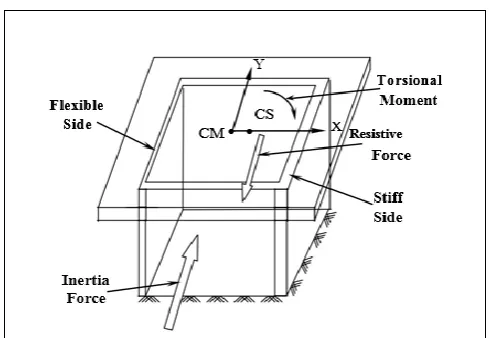
[image:1.595.307.550.303.418.2]The horizontal-torsion effect is occurs in structures under seismic excitations because of different reasons, predominantly due to mass or stiffness inequality in the apportionment, the concept of centre of mass which can be defined as to the average position of all the elements of the building, weighted based upon to their respective masses, whilst centre of rigid element can be defined as the centroid location of the storey stiffness from column, shear wall and other elements contributing in lateral load resistance, if the distance separating between centre of mass in specific storey at building and the respective storey centre of rigidity higher than 20% then the building considered to have torsion irregularity the fig(1) illustrate the horizontal torsion concept.
Fig. 1: The schematic representation of centre of mass and the centre of rigidity.
Fig. 2: The schematic representation of of the horizontal torsion.
1.2 Torsional effect:
The accidental Eccentricity (e) or the static eccentricity is characterized in several international codes as the separation between the centre of mass (CM) and centre of rigidity (CR). Several seismic codes were adopting a similar procedure for analysing accidental eccentricities. The asymmetric framed building structures are almost
inevitable with
flourishment in the
[image:1.595.303.548.453.622.2]also due to various types of functional and architectural requirements for the structures. The lateral-torsional moment caused by eccentricity between the centre of mass and centre of resistance in irregular buildings produces torsional vibration even under completely translational ground excitations. During seismic shaking of the structural systems. Hence, it's been historically needed by all earthquake-resistant building design codes worldwide to contemplate the result of associate accidental torsion moment within the design of structures with non-flexible diaphragms. The recent seismic standards and codes have provided provisions to anticipate these torsional impacts by giving expressions and equations to consider the effect at the time of analysis and design. Moreover, special care and attention have to be considered, to assure that, torsional effects do not avert the ductile behaviour of the building [4]. Additionally, the accidental eccentricities predominantly include an allowance for accidental torsion effect which has to induced by the rotational component of earthquake excitation by considering the possible deviation of the ECR (elastic centre of resistance) and centre of mass (CM) from their determined positions or by the unfavourable live loads distribution.
The torsion effect provisions of Indian seismic code (IS-1893:2002-Part1) specify the employment of accidental eccentricity expressions in clause 7.1. However, in order to satisfy the seismic code recommendations, the building should be analysed multiple time considering all potential combination of the centre of mass locations. To deal with this downside it's vital to understand however completely different a code-designed uneven building behaves from the same building designed while not considering the code provision. Moreover, the Indian seismic Standard does not allow any decreases in lateral strength resulting due to the negative shear caused by the effect of eccentricity. Furthermore, the Indian Standard recommended that dynamic-analysis is required to perform for the buildings with irregularities or buildings have a height higher than 12m in the seismic Zones (IV, V) (PGA= 0.24g and 0.36g respectively) and height higher 40m in Zone III and Zone II (PGA= 0.16g and 0.1g respectively) [5].
On the other hand, the in uniform building code 97 the accidental eccentricity coefficients specified in UBC 97 made to modify the eccentricity by introducing AX as the modification factor [5].
The irregularities were As per IS code 1893:2002, the irregularities are classified in two types:
Plan Irregularity
It contains the Torsion Irregularity, Re-entrant Corners, Diaphragm Discontinuity, Out-of-Plane Offsets, and Non Parallel Systems.
Vertical Irregularity
Stiffness Irregularity – Soft Storey Extreme Soft Storey, Mass Irregularity, Vertical Geometric Irregularity, and In-plane Discontinuity.
II. OBJECTIVES
To study the impact of the horizontal torsion and the accidental eccentricity on the regular and asymmetric buildings.
To compare the response of the building with an asymmetrical and symmetrical plan configuration as per IS 1893:2002 (Part1) code considering and UBC 97 provisions on the horizontal torsion moment concept. To reassess and check the 5% prevalent utzied value of
accidental eccentricty in the sesmic analysis and design.
III. LITERATURE REVIEW
Shaik Muneer and Sunil Kumar (2018) have investigated the effects and response patterns of asymmetric multi-storied buildings against various forces acting on it during the seismic excitation by utilizing ETABS for analysing the structures .the researchers concluded that the L-shaped structures displacement and stress would increase with the increment in the total building height as well as the architectural relief was found to be the appropriate strategy to be adopted on the re-entrant corner on where earthquake damage is maximized.
Salunkhe and Kanase (2017) have conducted a study on the effect mass irregularity on the seismic response structure the study was done on RCC buildings with and without the mass irregularity adopting different analysis procedure. The research was concluded that the absence of the mass irregularity in the structure enhances the seismic response of the RCC buildings.
Sagar et al (2015) analysed the response of a multi-storied RCC frames with the presence of various sort of irregularity such as the horizontal irregularity, plan irregularity, vertical irregularity the analysis was carried out adopting the non-linear dynamic analysis & the linear-dynamic analysis as analysis method for all the models, the study has shown that the irregular structural system undergoes more damage than the regular system during the seismic loading conditions.
Bansal and Gagandeep (2014) have assessed the ductility-based design the study was carried out considering vertical irregular structure adopting response-spectrum (RSA) and time history analysis (THA) as the analysis strategies. The different types of irregularities such as stiffness irregularity and geometry irregularity were considered.
O.M.O. Ramada, and A. Mostafa (2014) have performed study about revisiting the assumed value for the accidental eccentricity the analysis was performed using open sees analysis platform RCC frames with various heights the plan was assumed to symmetric plan with an assigned rigid diaphragm. The study results were epitomized that the calculated accidental eccentricities were extremely influenced by the number of stories above the floor of interest and the demands of accidental eccentricity were often lower than the assumed in seismic codes especially for the buildings with a larger number of stories (45) above.
IV. MODELLING AND ANALYSIS
In this research, an existing symmetric and asymmetric plans were considered with regard to evaluate the effects of the accidental eccentricity
on building regular and
irregular buildings
International Journal of Innovative Technology and Exploring Engineering (IJITEE) ISSN: 2278-3075, Volume-8 Issue-11, September 2019
models were of multi-storey RCC structure were developed with constant building heights of 30 Stories. The structures are modelled using ETABS software
.
1.3 Building specifications:
[image:3.595.307.541.54.389.2]The building is a RC moment resisting frames. The plans of the buildings are regular shape .The properties and building configurations in the present study are summarized below:
Table 1: The properties of buildings.
Specification Sort / Value
Structure type RCC
Structural system Regular & Irregular Number of Stories 30
Storey height 3.2 m
Grade of concrete M30 Grade of longitudinal rebar
Fe 415 N/mm2
Seismic zone IV
Importance factor 1
Soil condition Medium soil - type II Response reduction
factor
5 - (SMRF)
1.4 Details of the structure:
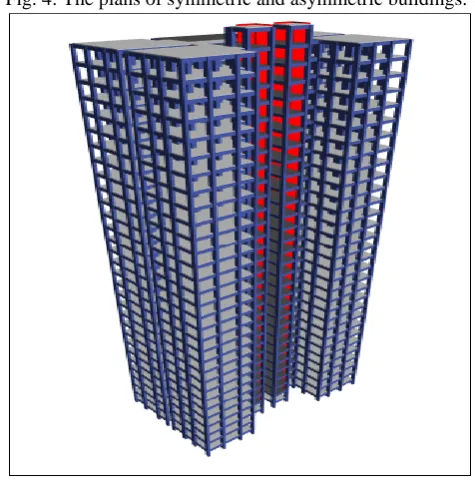
In this paper, two models of 30 storey buildings are considered, adopting M30 grade of concrete for columns, shear walls and beams. Likewise Fe 415 rebar is utilized as the longitudinal and confinement steel for all the structural elements for both the asymmetric and symmetric plan model. The overall length and width, of the regular building, is 35m X 23m respectively, where is 35.5m X 23.5m for the irregular model. The total height of plinth and the storey altitude is 2m, 3.2m respectively for the all considered models. The slab thicknesses are 0.2m, while shear walls have a thickness of 0.25m for both of the buildings. Additionally, for the irregular building, the sizes of the internal beams are 0.65 m X 0.3m depth and width respectively, whilst the external beams have the depth of 0.2m and width of 0.55m. On the other hand for the regular structure, the sizes of the internal and external beams are 0.2m X 0.6m and 0.6m X 0.3m respectively. The columns were divided into three different categories based upon the axial load acting on the column, the sizes of three categories 0.45m X 0.80m, 0.5m X 0.9m, and 0.65m X 1.3m, nevertheless, for the regular column, the chosen categories are 0.40m X 0.75m, 0.45m X 1m, and 0.6m X 1.3m. The dead loads, live loads, seismic loads are considered based upon the Indian standard and the American code. The seismic zone is taken from IS: 1893:2016. The modelled buildings are shown in Fig. 3 and Fig. 5.
[image:3.595.53.285.162.365.2]Fig. 3: ETABS model of the regular building.
Fig. 4: The plans of symmetric and asymmetric buildings.
Fig 5: ETABS model of the irregular building. 1.5 Endorsed analysis methods:
In this study, the structural analysis is carried out by the static and dynamic analysis procedures which are performed using three diverse analysis strategies i.e., linear-static analysis, linear-dynamic analysis, nonlinear-dynamic analysis. For the regular and irregular models the accidental eccentricity was adopted
[image:3.595.308.546.404.649.2]seismic load as centroid force at centre of mass, the second consideration is applying the lateral load using worldwide assumed eccentricity value as 5%, eventually setting the earthquake load with modified eccentricity value as per the UBC97 and IS: 1893:2000 recommendations.
1.5.1 Linear-static analysis:
The nature of earthquake loads is a dynamic force, however, in this method, the seismic loads assumed to be static more precisely the dynamic essence of seismic force should not be taken in the account furthermore using this strategy in the different codes predominantly permitted for regular buildings [6].
1.5.2 Linear-dynamic method:
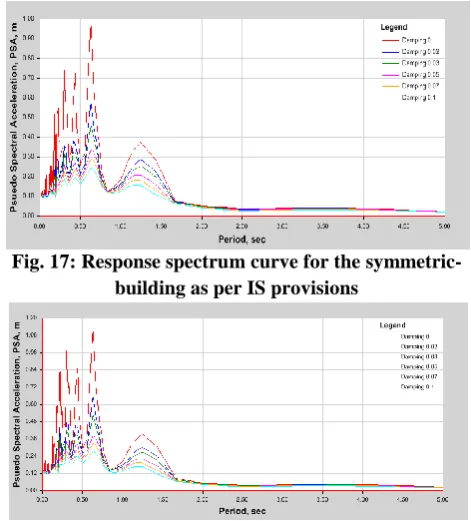
Whilst approaching this method the first assumption is the dynamic nature of loads. The linear-dynamic, in the design standers idealized graph of the structure maximum response vs time period for serval damping values.
1.5.3 Nonlinear-dynamic analysis:
In the nonlinear-dynamic analysis, the structural response is computed at a number of subsequent time instants. In other words, time histories of the structural sesmic preformance to a given input are obtained as a result. Whilst in response-spectrum analysis the time evolution of response could not be determined [6].
[image:4.595.315.535.116.392.2]The time history function which has been used for all models from the El Centro (1940) earthquake or Imperial Valley earthquake occurred at in southeastern Southern California. For more accurate and validate analysis results from the nonlinear-dynamic analysis a modification to the time-history function was done for marching TH function with RS function time-domain matching [6].
Fig 6: Modified time-history function.
V. RESULTS
Seismic analysis is performed for medium soil condition and higher seismic zone adopting static and dynamic methods. The results were addressed in tabular and graphs forms. The results are epitomized in structural responses results, overturning moment, storey forces, maximum storey displacements, maximum storey drifts for all the models. However, the results of the symmetric building are compared with asymmetric building and simultaneously the comparison is done based upon three hypotheses of the accidental eccentricity index. The performance of these buildings was identified for lateral loads.
1.6 Storey displacement:
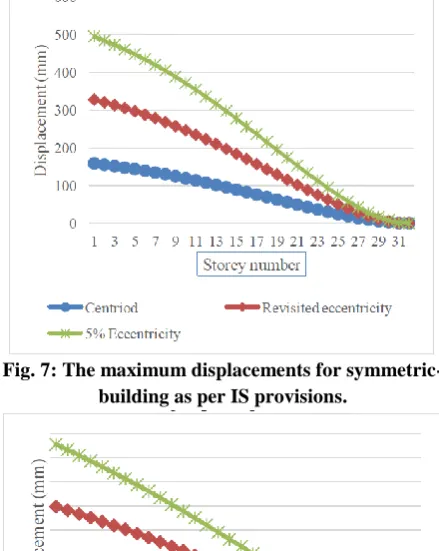
For all models, storey-displacement along Y-direction was greater due to the fact that the building’s configuration and
the selected location of the shear walls have an enormous influence on the resulted lateral displacement [6]. The influence on storey-displacement is shown in figures 7, 8, 9, and 10.
Fig. 7: The maximum displacements for symmetric-building as per IS provisions.
[image:4.595.49.285.465.556.2]Fig. 8: The maximum displacements for symmetric-building as per UBC97 provisions.
[image:4.595.313.539.475.705.2]International Journal of Innovative Technology and Exploring Engineering (IJITEE) ISSN: 2278-3075, Volume-8 Issue-11, September 2019
Fig. 10: The maximum displacements for asymmetric-building as per UBC97 provisions.
1.7 Storey drift:
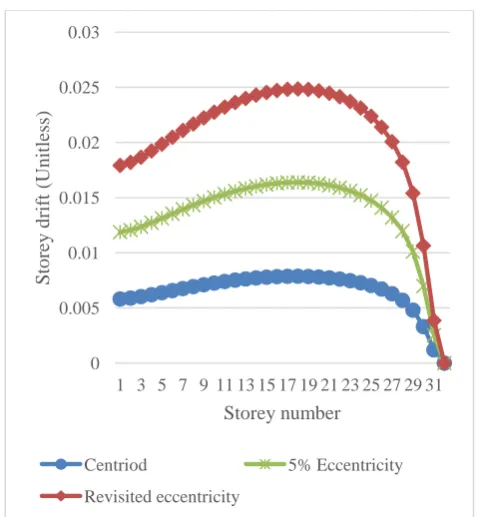
[image:5.595.49.276.48.251.2]After performing the static and dynamic analysis for the symmetric and asymmetric structures. The impact on the resulted Story-drift is represented in figures 11, 12, 13 and14.
Fig. 11: The maximum Storey-drift for symmetric-building as per IS provisions.
[image:5.595.307.546.299.558.2]Fig. 12: The maximum Storey-drift for symmetric-building as per UBC97 provisions.
Fig. 13: The maximum Storey-drift for asymmetric-building as per IS provisions.
Fig. 14: The maximum Storey-drift for the asymmetric-building as per UBC97 provisions.
1.8 Overturning moment and base shear:
For the seismic analysis, the concepts of base shear (B-S) and the overturning moment (O-M) have tremendous importance in the overall responses of a particular structure. In this study, the effect of the accidental eccentricity on the base shear (B-S) and the maximum overturning moment (O-M) was examined. The following table 2 and 3 shows the correlation between the accidental-eccentricity and O-M and B-S.
0 0.001 0.002 0.003 0.004 0.005 0.006
1 3 5 7 9 11 13 15 17 19 21 23 25 27 29 31
S
to
rey
d
rif
t
(Un
it
les
s)
Storey number
Centriod 5% Eccentricity
Revisited eccentricity
0 0.005 0.01 0.015 0.02 0.025 0.03
1 3 5 7 9 11 13 15 17 19 21 23 25 27 29 31
Sto
rey
d
rif
t
(Un
itles
s)
Storey number
Centriod 5% Eccentricity
[image:5.595.46.292.382.750.2] [image:5.595.53.282.385.552.2]Table 2: The impact on B-S and O-M for regular building.
Code Centroid 5% eccentricity Revisited
eccentricity O-M (kN/m) B-S kN) O-M (kN/m) B-S kN) O-M (kN/m) B-S kN)
IS 403970.4
226 5423.3 252 403970.4 227 5423.8 912 405810 .422 5435 .618 5
UBC 482432.0
337 5955.7 717 499183.5 325 6375.6 447 491233 .7355 6125 .234 3
Table 3: The impact on B-S and O-M for irregular building.
Code Centroid 5% eccentricity Revisited
eccentricity O-M (kN/m) B-S kN) O-M (kN/m) B-S kN) O-M (kN/m) B-S kN)
IS 403970.4
226 5423.3 252 403970.4 227 5423.8 912 405810 .422 5435 .618 5
UBC 482432.0
[image:6.595.308.544.50.311.2]337 5955.7 717 499183.5 325 6375.6 447 491233 .7355 6125 .234 3 1.9 Time-history analysis results:
Fig. 15: Response spectrum curve for the symmetric-building as per IS provisions.
Fig. 16: Response spectrum curve for the symmetric-building as per UBC97 provisions.
Fig. 17: Response spectrum curve for the symmetric-building as per IS provisions
Fig. 18: Response spectrum curve for the asymmetric-building as per UBC97 provision
VI. DELIBERATIONS OF RESULTS
After performing the static and dynamic analysis storey-displacement in the asymmetric and asymmetric building systems were within the allowable limits according to UBC79 code recommendations. On the other hand, as per IS1893-2002 part I the provisions for controlling the displacements are given in terms of storey-drift also were within allowable limits for the regular and regular building system.
Storey-displacement is significantly affected by the accidental eccentricity fluctuations, the centroid consideration of the lateral loads always gives fewer values for all model due, while the 5% eccentricity is given 7%-6% increment in the displacement values. However after revisiting the design eccentricity as per the Indian standard and the uniform building code 97 recommendations the displacement values are increased for the irregular building about 10% whilst for the symmetric building the lateral displacements have decreased about 5%.
The uniform building code torsional provisions have more impact on the structure as compared to the Indian standard provisions.
Storey-drift values were considerably affected by the torsional effect and the design eccentricity for the regular structural system the impact is around 4%-6%, however, for asymmetric buildings, the influence around 9% for the model designed by the Indian standard and 11% for structure analysed considering recommendations of UBC97 code.
The seismic design base shear and the overturning moment are noticeably influenced by the horizontal torsional moment which is resulted in increasing of the base-reactions values when the accidental eccentricity
values increased.
Additionally, the
[image:6.595.46.293.235.664.2]International Journal of Innovative Technology and Exploring Engineering (IJITEE) ISSN: 2278-3075, Volume-8 Issue-11, September 2019
loading case increased the base shear and the overturning moment in the irregular structure as compared to the values calculated while adopting %5 as eccentricity values, for the regular system the reduction of the base shear and the overturning moment are observed when the revisited eccentricity was adopted.
VII. CONCLUSION
The horizontal moment has a noticeable impact on the seismic behaviour of the building, the influence in terms of increasing of the moment and load subsequently the structural responses such as storey-drift and displacement would be significantly affected.
The accidental eccentricity influence on the asymmetric building is more severe as compared to the building with regularity.
The retrieved accidental eccentricity as IS and UBC97 provisions are highly affected by the total height of the structure, the distance between the centre of mass and centre of resistance.
The world-wise assumed value of 5% eccentricity can be adopted for low-raised building for where the demand of eccentricity is even less than the assumed value, however, in the high-raised asymmetric building the centricity demand shall be revisiting as per codes provisions.
REFERENCES
1.Subodh. S. Patil, Ajim G Mujawar, Pritam. A. Mali and Murugesh. R. Katti. (2017). Study of torsional effect on multi-storied building with plan-irregularity (IJAR).
2.Shaik Muneer Hussain, Sunil Kumar (2018). Study on torsional effects of irregular buildings under seismic loads (IJAER).
3.Salunkhe, Kanase, J.S., (2017). “Seismic demand of framed structure with mass irregularity (IJSETR)
4.Ramadan, O. M. O., Mehanny, S. S. F., & Mostafa, A. (2008). Revisiting the 5% accidental eccentricity provision in seismic design codes for multi-story buildings. In 14th World Conference on Earthquake Engineering, Beijing, China.
5.Balakrishan, B. B. (2012). Critical evaluation of torsional provision in IS-1893: 2002 (M.Tech dissertation).
6.Atif, M. Shiva, S.V.Surendhar. (2019). Comparative study of the seismic performance of rcc building with ribbed slab and grid slab (IJITEE). 7.HimanshuGaur, R.K.Goliya, Krishna Murari, Dr.A.K.Mullikh. (2014), A
parametric study of multi-storey r\c buildings with horizontal irregularity’’. IJRET Volume: 03.
AUTHORS PROFILE
Atif Zakaria from Khartoum, Sudan, did UG (Civil Engineering) from OIU, Khartoum, Sudan and received Post Graduation (Structural Engineering) in VFSTR University, Vadlamudi, Guntur, Andhra Pradesh, 522213. Working as Structural Engineer in Amma Engineers Consultancy, Guntur, Andhra Pradesh, 522201.
M Shiva Rama Krishna from Hyderabad, Telangana, received Post Graduation (Structural Engineering) from IIIT Hyderabad. Working as Asst. Professor in VFSTR University, Vadlamudi, Guntur, Andhra Pradesh, 522213.
T.G.N.C.Vamsi Krishna from Guntur, Andhra Pradesh, did UG (Civil Engineering) from JNTUK and received Post Graduation (Structural Engineering) from VFSTR University, Vadlamudi, Guntur, Andhra Pradesh, 522213. Working as Structural Engineer in Amma Engineers Consultancy, Guntur, Andhra Pradesh, 522201.
Mirza Mahaboob Baig from Guntur, Andhra Pradesh,did UG (Civil Engineering) from JNTUK and received Post Graduation (Structural Engineering) from VFSTR University. Working as Asst. Professor in Priyadarshini Institute of Technology & Management, Pulladigunta, Guntur, Andhra Pradesh, 522017.