201
Granules: A Lightweight
Runtime for Scalable
Computing with Support
for Map-Reduce
Shrideep Pallickara, Jaliya Ekanayake,
and Geoffrey Fox
Contents
9.1 Introduction ...202
9.2 NaradaBrokering ...203
9.3 Granules ...205
9.3.1 Computational Task ...205
9.3.2 Datasets and Collections ...206
9.3.3 Specifying a Scheduling Strategy ...206
9.3.4 Finite-State Machine for a Computational Task ...207
9.3.5 Interleaving Execution of Computational Tasks ...208
9.3.5.1 Sizing Thread-Pools ...208
9.1 Introduction
Cloud computing has gained significant traction in recent years. By facilitating access to an elastic (meaning the available resource pool that can expand or con-tract over time) set of resources, cloud computing has demonstrable applicability to a wide range of problems in several domains.
Appealing features within cloud computing include access to a vast number of computational resources and inherent resilience to failures. The latter feature arises, because in cloud computing the focus of execution is not a specific, well-known resource but rather the best available one. Another characteristic of a lot of programs that have been written for cloud computing is that they tend to be state-less. Thus, when failures do take place, the appropriate computations are simply relaunched with the corresponding datasets.
Among the forces that have driven the need for cloud computing are falling hardware costs and burgeoning data volumes. The ability to procure cheaper, more powerful CPUs coupled with improvements in the quality and capacity of networks have made it possible to assemble clusters at increasingly attractive prices. The pro-liferation of networked devices, Internet services, and simulations has resulted in
9.4 Support for Map-Reduce in Granules ...209
9.4.1 Two Sides of the Same Coin ...210
9.4.2 Setting Up Graphs ...211
9.4.3 Creating Computational Pipelines ...211
9.4.4 Observing the Life Cycle of a Pipeline ...212
9.5 Developing and Deploying Applications Using Granules ...212
9.5.1 Developing Applications ...212
9.5.1.1 Initialization ...213
9.5.1.2 Processing Logic ...213
9.5.1.3 Scheduling Strategy ...213
9.5.2 Deploying Applications Using Granules ...214
9.5.2.1 Initializing Communications and Resource Discovery...214
9.5.2.2 Initializing and Deploying Computational Tasks ...214
9.5.2.3 Tracking/Steering a Deployed Application ... 215
9.6 Related Work ... 215
9.7 Benchmarks ...217
9.7.1 Streaming Substrate ...217
9.7.2 Information Retrieval: Exactly-Once ...218
9.7.3 K-Means: Iterative ...219
9.7.4 Periodic Scheduling ...220
9.7.5 Data Driven ...221
9.7.6 Assembling mRNA Sequences ...222
9.8 Conclusions ...224
large volumes of data being produced. This, in turn, has fueled the need to process and store vast amounts of data. These data volumes cannot be processed by a single computer or a small cluster of computers. Furthermore, in most cases, this data can be processed in a pleasingly parallel fashion. The result has been the aggregation of a large number of commodity hardware components in vast data centers.
Map-Reduce [1], introduced by Dean and Ghemawat at Google, is the most dominant programming model for developing applications in cloud settings. Here, large datasets are split into smaller, more manageable sizes, which are then processed by multiple map instances. The results produced by individual map functions are then sent to reducers, which collate these partial results to produce the final output. A clear benefit of such concurrent processing is a speed-up that is proportional to the number of computational resources. Map-Reduce can be thought of as an instance of the SPMD [2] programming model for parallel computing introduced by Federica Darema. Applications that can benefit from Map-Reduce include data and/or task-parallel algorithms in domains such as information retrieval, machine learning, graph theory, and visualization, among others.
In this chapter, which is an extended version of our paper [21], we describe Granules [3], a lightweight streaming-based runtime for cloud computing. Granules allows processing tasks to be deployed on a single resource or a set of resources. Besides the basic support for Map-Reduce, we have incorporated sup-port for variants of the Map-Reduce framework that are particularly suitable for scientific applications. Unlike most Map-Reduce implementations, Granules uses streaming for disseminating intermediate results, as opposed to using file-based communications. This leads to demonstrably better performance (see benchmarks in Section 9.7).
This chapter is organized as follows. In Section 9.2, we provide a brief overview of the NaradaBrokering substrate that we use for streaming. We discuss some of the core elements of Granules in Section 9.3. Section 9.4 outlines our support for Map-Reduce and for the creation of complex computational pipelines. Section 9.5 describes the process of developing and deploying applications using Granules. In Section 9.6, we describe related work in this area. In Section 9.7, we profile several aspects of the Granules runtime, and where possible, contrast its performance with comparable systems, such as Hadoop, Dryad, and MPI (Message Passing Interface). In Section 9.8, we present our conclusions.
9.2 NaradaBrokering
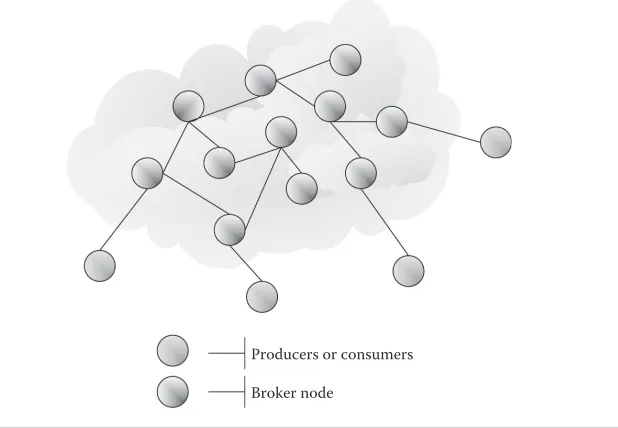
Granules uses the NaradaBrokering [4–6] streaming substrate (developed by us) for all its streams disseminations. The NaradaBrokering content distribution net-work (depicted in Figure 9.1) comprises a set of cooperating router nodes known as
brokers. Producers and consumers do not directly interact with each other. Entities,
which are connected to one of the brokers within the broker network, use their AQ2
AQ3
AQ4
hosting broker to funnel streams into the broker network and, from thereon, to other registered consumers of those streams.
NaradaBrokering is application independent and incorporates several services to mitigate network-induced problems as streams traverse domains during dissemi-nations. This system provisions easy-to-use guarantees while delivering consistent and predictable performance that is adequate for use in real-time settings.
Consumers of a given data stream can specify, very precisely, the portions of the data stream that they are interested in consuming. By preferentially deploying links during disseminations, the routing algorithm [4] in NaradaBrokering ensures that the underlying network is optimally utilized. This preferential routing ensures that consumers receive only those portions of streams that are of interest to them. Since a given consumer is typically interested in only a fraction of the streams present in the system, preferential routing ensures that a consumer is not deluged by streams that it will subsequently discard.
The system incorporates support for reliable streaming and secure streaming. In reliable streaming, the substrate copes with disconnects and process/link failures of different components within the system with the ability to fine-tune redundancies [5] for a specific stream. Secure streaming [6] enforces the authorization and con-fidentiality constraints associated with the generation and consumption of secure streams while coping with denial-of-service attacks.
Some of the domains that NaradaBrokering has been deployed in include earthquake science, particle physics, environmental monitoring, geosciences, GIS systems, and defense applications.
AQ6
Producers or consumers
[image:4.495.103.412.106.320.2]Broker node
9.3 Granules
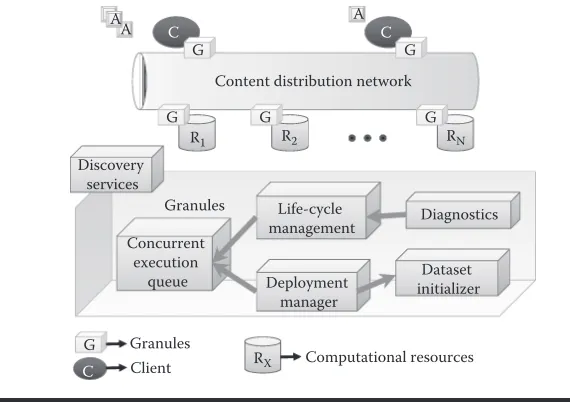
Granules orchestrates the concurrent execution of processing tasks on a distributed set of machines. Granules is itself distributed, and its components permeate not only the computational resources on which it interleaves processing, but also the desktop from where the applications are being deployed in the first place. The run-time manages the execution of a set of processing tasks through various stages of their life cycle: deployment, initialization, execution, and termination. Figure 9.2 depicts the various components that comprise Granules.
9.3.1 Computational Task
The most fundamental unit in Granules is the notion of a computational task. This computational task encapsulates processing functionality, specifies its scheduling strategy, and operates on different types of datasets. These computational tasks can take on additional interchangeable roles (such as map and reduce) and, when cascaded, can form complex execution pipelines.
Computational tasks require the domain specialists to specify processing func-tionality. This processing typically operates upon a collection of datasets encapsu-lated within the computational task.
The computational task encapsulates functionality for processing for a given fine-grained unit of data. This data granularity could be a packet, a file, a set of files, or a database record. For example, a computational task can be written to evaluate a regular expression query (grep) on a set of characters, a file, or a set of files. In some
R1 G
R2 G
RN G
C C
G A
G
Discovery services
Life-cycle
management Diagnostics
Deployment manager Concurrent
execution
queue initializerDataset
Content distribution network
A A
Granules G
[image:5.495.96.381.423.624.2]C Client RX Computational resources Granules
cases, there will not be a specific dataset; rather, each computational task instance initializes itself using a random-seed generator.
Computational tasks include several metadata, such as versioning information, time stamps, domain identifiers, and computation identifiers. Individual instances of the computational tasks include instance identifiers and task identifiers, which in turn allows us to group several related computational tasks together.
9.3.2 Datasets and Collections
In Granules, datasets are used to simplify access to the underlying data type. Datasets currently supported within Granules include streams and files; support for databases is being incorporated. For a given data type, besides managing the allocation and reclamation of assorted resources, Granules also mediates access to it. For example, Granules performs actions related to simplifying the production and consumption of streams, reading and writing of files, and transactional access to databases.
A data collection is associated with every computational task. A data collection represents a collection of datasets, and maintains information about the type, num-ber, and identifiers associated with every encapsulated dataset.
All that the domain specialist needs to specify is the number and type of datas-ets involved. The system imposes no limits on the number of datasdatas-ets within a data-set collection. During initializations of the datadata-set collection, depending on the type of the constituent datasets, Granules subscribes to the relevant streams, con-figures access to files on networked file systems, and sets up connections (JDBC) to the databases.
Dataset collections allow observers to be registered to track data availability, dataset initializations, and closure. This simplifies data processing, since it obviates the need to perform polling.
9.3.3 Specifying a Scheduling Strategy
Computational tasks specify a scheduling strategy, which in turn governs their lifetimes. Computational tasks can specify their
sched-uling strategy along three dimensions (see Figure 9.3). The counts axis specifies the number of times a compu-tational task needs to be executed. The data driven axis specifies that the computational task needs to be sched-uled for execution whenever data is available on any one of its constituent datasets. The periodicity axis spec-ifies that computational tasks be periodically scheduled for execution at predefined intervals (specified in ms).
Each of these axes can extend to infinity, in which case, it constitutes a stay-alive primitive. A domain AQ7
Counts
Data driven
Periodicity
specialist can also specify a custom scheduling strategy that permutes along these three dimensions. Thus, one can specify a scheduling strategy that limits a compu-tational task to be executed a maximum of 500 times either when data is available or at regular intervals.
A computational task can change its scheduling strategy during execution, and Granules will enforce the newly established scheduling strategy during the next
round of execution (Section 9.3.5). This scheduling change can be a significant
one—from data driven to periodic. The scheduling change could also be a minor one with changes to the number of times the computation needs to be executed, or with an update to the periodicity interval.
In addition to the aforementioned primitives, another primitive—stay alive
until termination condition reached—can be specified. In this case, the
computa-tional task continues to be “stay alive” until the computacomputa-tional task asserts that its termination condition has been reached. The termination condition overrides any other primitives that may have been specified and results in the garbage collection of the computational task.
9.3.4 Finite-State Machine for a Computational Task
At a given computational resource, Granules maintains a finite-state machine (FSM) for every computational task. This FSM, depicted in Figure 9.4, has four states: initialize, activated, dormant, and terminate.
The transition triggers for this FSM include external requests, elapsed time intervals, data availability, reset counters, and assertions of the termination condi-tion being reached.
When a computational task is first received in a deployment request, Granules proceeds to initialize the computational task. The FSM created for this computa-tional task starts off in the initialize state.
If, for some reason, the computational task cannot proceed in its execution, either because the datasets are not available or the start-up time has not yet elapsed, the computational task transitions into the dormant state. If there were problems in initialization, the computational task transitions into the terminate state.
Terminate
Initialize Dormant
Activated
If, on the other hand, the computational task was initialized successfully, and is ready for execution with accessible datasets, it transitions into the activated state.
9.3.5 Interleaving Execution of Computational Tasks
At each computational resource, Granules maintains a pool of worker threads to manage and interleave the concurrent execution of multiple computational tasks.
When a computational task is activated and ready for execution, it is moved into the activated queue. As and when worker threads become available, the com-putational tasks are pulled from the FIFO queue and executed in a separate thread. Upon completion of the computational task, the worker thread is returned back to the thread-pool, to be used to execute other pending computational tasks within the activated queue. The computational task is placed either in the dormant queue or scheduled for garbage collection depending on the state of its FSM.
After a computational task has finished its latest (or the first) round of execu-tion, checks are made to see if it should be terminated. To do so, the scheduling strategy associated with the computational task is retrieved. If a computational task needs to execute a fixed number of times, a check is made to see if the counter has reset. If the computational task specifies a stay-alive primitive based either on data availability or periodicity, checks are made to see if the datasets continue to be available or if the periodicity interval has elapsed. A check is also made to see if the computational task has asserted that its termination condition has been reached.
If none of these checks indicate that the computational task should be termi-nated, it is scheduled for another round of execution or it transitions into the dor-mant state. A computational task can continually toggle between the dordor-mant and the activated state till a termination condition has been reached.
9.3.5.1 Sizing Thread-Pools
The number of worker threads within the thread-pool is configurable. In general, the number of threads needs to be balanced so that the accrued concurrency gains are not offset by context-switching overheads among the threads. As a general rule, it is a good idea to set this number to be approximately equal to the number of execution pipelines available on a given machine. Thus, for a quad-core CPU with two execution pipelines per core, the thread-pool will be set up to have approxi-mately eight threads.
9.3.6 Diagnostics
CPU-bound time, the time it was memory-resident, and the total execution time. A computational task can also assert that diagnostic messages be sent back to the cli-ent during any (or some) of its state transitions. On the clicli-ent side, an observer can be registered for collections of computational tasks to track their progress without the need to actively poll individual computational tasks.
9.4 Support for Map-Reduce in Granules
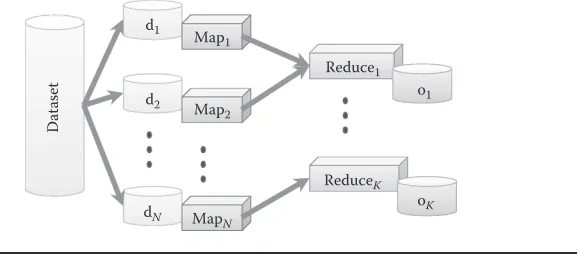
Map-Reduce is the dominant framework used in cloud computing settings. In Map-Reduce, a large dataset is broken up into smaller chunks that are concurrently operated upon by map function instances. The results from these map functions (usually, <key, value> pairs) are combined in the reducers, which collate the values for individual keys. Typically, there are multiple reducers, and the outputs from these reducers constitute the final result. This is depicted in Figure 9.5.
The Map-Reduce framework has several advantages. First, the domain scientist only needs to provide the Map-Reduce functionality and the datasets. Second, it is the responsibility of the framework to transparently scale as the number of available resources, and the problem size, increases. Finally, the orchestration of the concur-rent data-parallel execution is managed by the framework.
In traditional Map-Reduce, intermediate stages exchange results using a set of <key, value> pairs. We have incorporated support for this basic result type. But we have also incorporated support for exchange of primitive data types, such as int, short, boolean, char, long, float, and double. We have also incorpo-rated support for exchanging arrays ([]) and 2D arrays ([][]) of these primitive data types. There is also support for exchanging Objects that encapsulated compound data types, along with arrays and 2D arrays of these Objects.
The intermediate results in most Map-Reduce implementations utilize file IO for managing results produced by the intermediate stages. The framework then notifies appropriate reducers to pull or retrieve these results for further processing.
d1
d2
dN
Map1
Map2
MapN
Reduce1
ReduceK o1
oK
[image:9.495.127.417.496.623.2]Dataset
Depending on the application, the overheads introduced by performing such disk-IO can be quite high. In Granules, we use streaming to push these results onto appropriate reducers. Streaming, as validated by our benchmarks (described in Section 9.7), is significantly faster, and we think that there are several classes of applications that can benefit from this.
Additionally, since the results are being streamed as and when they have been computed, successive stages have access to partial results from preceding stages instead of waiting for the entire computation to complete. This is particularly use-ful in situations where one is interested in getting as many results as possible within a fixed amount of time.
9.4.1 Two Sides of the Same Coin
In Granules, map and reduce are two roles associated with the computational task. These roles inherit all the computational task functionality, while adding function-ality specific to their roles.
The map role adds functionality related to adding, removing, tracking, and enumerating the reducers associated with the map function. Typically, a map func-tion has one reducer associated with it. In Granules, we do not limit the number of reducers associated with a map function. This feature can be used to fine-tune redundancies within a computational pipeline.
The reduce role adds functionality related to adding, removing, tracking, and enumerating maps associated with it. The reducer has facilities to track output generated by the constituent maps. Specifically, a reducer can determine if par-tial or complete outputs have been received from the maps. The reduce role also incorporates support to detect and discard any duplicate outputs that may be received.
The map and reduce roles have facilities to create and publish results. The payloads for these results can be primitive data types that we discussed earlier, Objects encapsulating compound data types, <key, value> pairs, arrays, and 2D arrays of the same. In Granules, generated results include sequencing infor-mation and metadata specific to the generator. Additionally, an entity is allowed to assert if these results are partial results and/or if the processing has been completed.
Since map and reduce are two roles of the computational task in Granules, they inherit functionality related to scheduling strategy (and life-cycle management), diagnostic strategy, and dataset management.
9.4.2 Setting Up Graphs
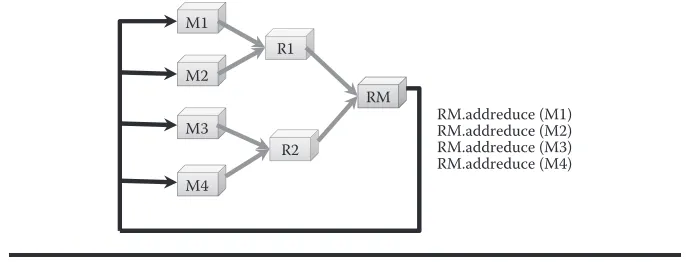
Granules supports a set of operations that allow graphs to be set up. Individual maps can add/remove reducers. Similarly, reducers are allowed to add/remove maps. The functions are functionally equivalent. Granules also allows the map and reduce roles to be interchangable: a map can act as a reducer, and vice versa. Figure 9.6 depicts how support for addition/removal of roles combined with role interchangeability can be used to create a graph with a feedback loop. In our benchmarks, involving the k-means machine learning algorithm, we have three stages with a feedback loop from the output of stage 2 to its input. Granules man-ages overheads related to ensuring that the outputs from the map are routed to the correct reducers.
Additionally, Granules can create execution graphs once the numbers of map and reduce instances in a pipeline have been specified. Granules ensures the appro-priate linkage of the Map-Reduce instances.
9.4.3 Creating Computational Pipelines
Typically, in Map-Reduce, the instances that comprise an execution pipeline are organized in a directed acyclic graph (DAG), with the execution proceeding in sequence through monotonically increasing stages.
In Granules, we have incorporated support for cycles to be present. This allows Granules to feedback the outputs of some stage, within a pipeline, to any of its pre-ceding stages. The system places no restrictions on the span length, or the number, of the feedback in the pipeline. In a sense it can be argued that Granules supports both data- and control-flow graphs. An example of such a computational graph in Granules is depicted in Figure 9.7.
One feature of the computational task plays a role in allowing these loops: the notion of the stay-alive computation. Furthermore, since this is available at the microlevel (computational task), individual stages, collection of stages, or the
AQ9
M1
M2
M3
M4
R1
R2
RM
[image:11.495.75.418.483.614.2]RM.addreduce (M1) RM.addreduce (M2) RM.addreduce (M3) RM.addreduce (M4)
computational pipeline itself can be dependent on iterative, periodic, data-driven, or termination conditions.
Granules manages the pipeline complexity. The domain scientist does not need to cope with fan-in complexity, which corresponds to the number of units that feed results into a given instance. Once a pipeline has been created, a domain specialist does not have to cope with IO, synchronization, or networking-related issues. The runtime includes facilities to track outputs from preceding stages.
9.4.4 Observing the Life Cycle of a Pipeline
At the client side, during the deployment process, Granules allows a life-cycle observer to be registered for an execution pipeline. This observer processes diag-nostic messages received from different computational resources running Granules. These diagnostic messages relate to state transitions associated with the different computational task instances (and the map and reduce roles) and the pertinent metrics associated with the computation task. The life-cycle observer reports to the client upon completion of an execution pipeline. The observer also reports errors in the execution of any of the units that comprise the pipeline.
9.5 Developing and Deploying
Applications Using Granules
In this section, we describe the process of developing and deploying applications using Granules. In both cases, Granules incorporates support for utility classes, whose behavior may be extended to suit specific needs.
9.5.1 Developing Applications
Granules simplifies the process of developing applications. Developers sim-ply extend the MapReduceBase class. This class implements functionality that encompasses both the map and reduce roles of a computation. One requirement is that the derived class has exactly one constructor, which does not take any argu-ments. Developers of the derived class only need to implement the execute()
[image:12.495.78.418.104.171.2]Stage 1 Stage 2 Stage 3
method. Typical steps involved in implementing this method include initialization of the datasets and data structures, processing logic, and specification of a schedul-ing strategy.
9.5.1.1 Initialization
Typically, depending on the type of the dataset, initialization of the datas-ets involved in the processing is performed automatically. The designer sim-ply specifies the identifiers for the dataset. Initializations of the data structures needed by the computation can be performed either in the null constructor or in the execute() method. In the latter case, care must be taken to ensure that the initializations are performed only once across successive invocations of the execute() method.
9.5.1.2 Processing Logic
The processing logic within the execute() method is domain specific. This pro-cessing would involve either the generation of results, or the management and col-lation of previously produced results. In the reduce role, it is also possible to check if outputs have been received from all the preceding maps in addition to discarding any duplicate results that were generated.
The generation of results is easy, and the system allows entities to attach differ-ent payloads to these results. The system currdiffer-ently allows for the payloads for these results to be <key, value> pairs, where the elements of these tuples could be objects that encapsulate compound data types. The system allows instances, arrays([]), and 2D arrays ([][]) of primitive data types such as int, short, long, double, float, and char to be attached as payloads of these results. The system handles the marshalling and un-marshalling of these payloads automatically.
The processing logic also needs to cope with exceptions that will be thrown as results of the processing. These exceptions could result from problems with the datasets, marshalling issues, and networking problems.
9.5.1.3 Scheduling Strategy
9.5.2 Deploying Applications Using Granules
Granules provides a helper class, the InstanceDeployer, to enable applications, and the computational tasks that comprise it, to be deployed on a set of resources. This class performs several operations related to initializing communications, resource discovery, and deployment of computations. It is recommended that a deployer be created for each application. This can be done by simply extending the
InstanceDeployer.
9.5.2.1 Initializing Communications and Resource Discovery
The first step that an application deployer needs to perform is to initialize com-munications with the content distribution network (NaradaBrokering). This can be performed by invoking the constructor for the base class (InstanceDeployer), which takes a set of properties as its argument. This is typically done by invoking the super(streamingProperties) in the derived class’s constructor. Some of the elements that are typically part of this set of properties include the hostname, the port, and the transport type for one of the router nodes within the content dissemination network. Depending on the transport over which communications take place, there would be additional elements that may need to be specified. For example, if the SSL communications are used, additional elements that need to be specified include the locations of the truststore and the keystore that would be used for secure communications.Once communications have been established, Granules automatically discov-ers resources that are currently available. This list could be periodically refreshed should the need arise.
9.5.2.2 Initializing and Deploying Computational Tasks
The developer then needs to provide a method that initializes the computational tasks. This involves one or more of the following:
1. Initializing the Processing Directives associated with an instance: These direc-tives are used to encode instance-specific information that is accessible only to the instance in question.
2. Specification of the datasets and collection associated with the computation: Granules is responsible for configuring access to these datasets.
3. Linking of the Map-Reduce roles: Granules ensures that once-linked results produced by the maps are automatically routed to the appropriate reducers. 4. Specifying the scheduling strategy for the computational tasks: By default, the
exactly-once scheduling strategy is used.
5. Distribution of datasets across these instances: Granules incorporates utilities that allow this distribution to be performed efficiently.
To deploy an application, the developer only needs to invoke the deploy() method in the InstanceDeployer. This method deploys the computational tasks on the set of resources that were discovered during the initialization phase.
9.5.2.3 Tracking/Steering a Deployed Application
The InstanceDeployer implements the JobLifecycleObserver interface, which
allows one to track the status of multiple jobs, and the computational tasks that comprise them. Classes that extend the InstanceDeployer have the option to over-ride methods specific to the JobLifecycleObserver interface. Specifically, for a given Job, Granules maintains its registered JobLifecycleObserver and invokes methods on this observer whenever there is an update to the deployment or execu-tion status of the computaexecu-tional tasks that comprise it.
Associated with each Job, Granules maintains a ProgressTracker that main-tains information about the execution state of each of the computational tasks that comprise the application. The LifecycleMetrics associated with every computa-tional task includes information about
1. The arrival time for the computational task 2. The queuing overhead for the computational task
3. The total CPU-bound time for the computational task across multiple itera-tions (if there are any)
4. The processing time for the computational task
5. The current status of the computational task {Awaiting Data, Queued for Execution, Executing, Terminated, Successful, FAILED}
The status of a Job is the cumulative status of the computational tasks that com-prise it.
The InstanceDeployer also incorporates methods for tracking/steering a
com-putation. There are methods to refresh the status of a specific computational task or the entire Job. These methods result in updates to the life-cycle metrics of the relevant computational tasks. Additionally, Granules also allows computational tasks to be aborted when they are in execution. The system allows either a specific computational task to be suspended or the entire Job.
9.6 Related Work
interpreted, procedural programming language used by Google to develop Map-Reduce applications.
Hadoop [8] was originally developed at Yahoo, and is now an Apache project. It is by far the most widely used implementation of the Map-Reduce framework. In addition to the vast number of applications at Yahoo, it is also part of the Google/ IBM initiative to support university courses in distributed computing. Hadoop is also hosted as a framework over Amazon’s EC2 [9] cloud. Unlike Granules, Hadoop supports only exactly-once semantics, meaning that there is direct support within the framework for map and reduce functions to maintain state.
Hadoop uses the Hadoop Distributed File System (HDFS) files for communi-cating intermediate results between the map and reduce functions, while Granules uses streaming for these disseminations, thus allowing access to partial results.
HDFS allows for replicated, robust access to files. During the data-staging phase, Hadoop allows the creation of replicas on the local file system; computa-tions are then spawned to exploit data locality. Hadoop supports automated recov-ery from failures. Currently, Granules does not incorporate support for automated recovery from failures; this will be the focus of our future work in this area. Here, we plan to harness the reliable streaming capabilities available in NaradaBrokering.
The most dominant model for developing parallel applications in the HPC community is the SPMD [2] model (first proposed by Federica Darema) in tandem with the MPI [10] library. The SPMD model is a powerful one, and Map-Reduce can in fact be thought of as an instance of the SPMD model. The use of MPI has, however, not been as widespread outside the scientific community.
Microsoft Research’s Dryad [11] is a system designed as a programming model for developing scalable parallel and distributed applications. Dryad is based on DAGs. In this model, sequential programs are connected using one-way channels. It is intended to be a super-set of the core Map-Reduce framework. Dryad pro-vides job management and autonomic capabilities, and makes use of the Microsoft Shared Directory Service. However, since Dryad is developed based on DAGs, it is not possible to develop systems that have cycles in them. For example, in our benchmarks, we were not able to implement the k-means machine learning algo-rithm [12] using the basic Dryad framework.
Phoenix [13] is an implementation of Map-Reduce for multi-core and multipro-cessor systems. A related effort is Qt Concurrent [14], which provides a simplified implementation of the Map-Reduce framework in C++. Qt Concurrent automati-cally optimizes thread utilizations on multi-core machines depending on core availability. Disco [15], from Nokia, is an open-source Map-Reduce runtime devel-oped using the Erlang functional programming language. Similar to the Hadoop architecture, Disco stores the intermediate results in local files and accesses them using HTTP connections from the appropriate reduce tasks.
Holumbus [16] includes an implementation of the Map-Reduce framework, developed in the Haskell functional programming language at the FH Wedel University of Applied Sciences, Germany.
Skynet [17] is an open-source Ruby-based implementation of the Map-Reduce framework. Skynet utilizes a peer-recovery system for tracking the constituent tasks. Peers track each other and, once failure is detected, can spawn a replica of the failed peer.
We had originally developed a prototype implementation of Map-Reduce, CGL-MapReduce [18], which implemented Map-Reduce using streaming (once again, using NaradaBrokering) with the ability to “keep alive” map instances. Granules represents an overhaul, and incorporates several new capabilities, such as built-in support for sophisticated life-cycle management (periodicity, data driven, and termination conditions), powerful creation and duplicate detection of results, and diagnostics in addition to the ability to create complex computational pipelines with feedback loops in multiple stages. The code base for the Granules (available for download) runtime has also been developed from scratch.
9.7 Benchmarks
In our benchmarks, we profile several aspects of the Granules’ performance. We are specifically interested in determining system performance for different life cycles associated with the computational tasks. The different life cycles we benchmark include exactly-once, iterative, periodic, and data-driven primitives. Where possible, we contrast the performance of Granules with comparable systems, such as Hadoop, Dryad, and MPI. It is expected that these bench-marks would be indicative of the performance that can be expected in different deployments.
All machines involved in these benchmarks have four dual-core CPUs, a 2.4 GHz clock, and an 8 GB RAM. These machines were hosted on a 100 Mbps LAN. The Operating System on these machines is Red Hat Enterprise Linux sion 4. All Java processes executed within version 1.6 of Sun’s JVM. We used ver-sion 3.4.6 of the gcc complier for C++, and for MPI we used verver-sion 7.1.4 of the Local Area Multicomputer (LAM) MPI [19].
9.7.1 Streaming Substrate
Since we use the NaradaBrokering streaming substrate for all communications between entities, we present a simple benchmark to give the reader an idea of the costs involved in streaming. Our results outline the communication latencies in a simplified setting involving one producer, one consumer, and one broker. The communication latencies are reported for stream fragments with different pay-load sizes. Additional NaradaBrokering benchmarks in distributed settings can be found in [4,5].
Two cluster machines were involved in this benchmark. The producer and con-sumer were hosted on the same machine to obviate the need to account for clock
AQ12 AQ13
drifts while measuring latencies for streams issued by the producer, and routed by the broker (hosted on the second machine) to the consumer.
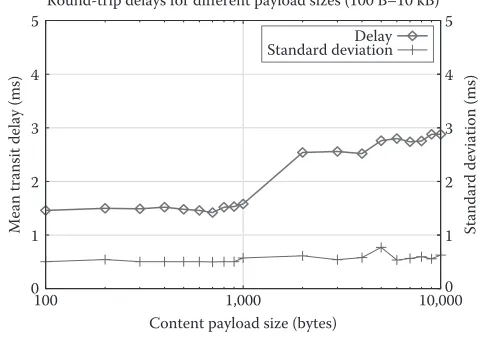
The reported delay, in the results depicted in Figure 9.8, is the average of 50 samples for a given payload size, the standard deviation for these samples also being reported. The Y-axis for the standard deviation is the axis on the right side (blue) of the graph. Streaming latencies vary from 750 μs/hop for 100 bytes to 1.5 ms/hop for a stream fragment of 10 KB in cluster settings.
9.7.2 Information Retrieval: Exactly-Once
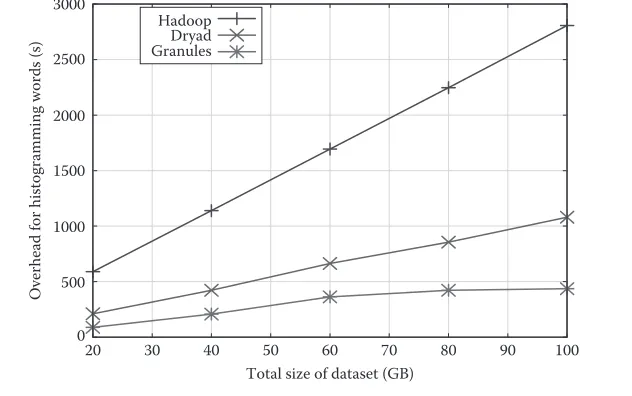
In this section, we present results from a simple information retrieval example. Given a set of text files, the objective is to histogram the counts associated with various words in these files. The performance of Granules is contrasted with that of Hadoop and Dryad. The Dryad version to which we have access uses C#, LINQ, and file-based communications using the Microsoft Shared Directory Service. The OS involved in the Dryad benchmarks is Windows XP.
For this benchmark, we vary the cumulative size of the datasets that need to be processed. The total amount of data that is processed is varied from 20 GB to 100 GB. There were a total of 128 map instances that were deployed on the five machines involved in the benchmark.
The results depicted in Figure 9.9 demonstrate the benefits of using stream-ing as opposed to file-based communications. As the size of the datasets increases, there is a concomitant increase in the number and size of the intermediate results (file based). This contributes to the slower performance of Hadoop and Dryad. We expect the performance of Dryad’s socket-based version to be faster than their file-based version.
0 1 2 3 4 5
100 1,000 10,0000 1 2 3 4 5
Mean transit delay (ms) Standard deviation (ms)
Content payload size (bytes)
[image:18.495.125.365.109.280.2]Round-trip delays for different payload sizes (100 B–10 kB) Delay Standard deviation
9.7.3 K-Means: Iterative
Machine learning provides a fertile ground for iterative algorithms. In our bench-nmarks, we considered a simple algorithm in the area of unsupervised machine learning: k-means. Given a set of n data points, the objective is to organize these points into k clusters.
The algorithm starts off by selecting k centroids, and then associates different data points within the dataset to one of the clusters based on their proximity to the centroids. For each of the clusters, new centroids are then computed. The algorithm is said to converge when the cumulative Euclidean distance between the centroids in successive iterations is less than a predefined threshold.
In k-means, the number of iterations depends on the initial choice of the cen-troids, the number of data points, and the specified error rate (signifying that the centroid movements are acceptable). The initial set of data points is loaded at each of the map functions. Each map is responsible for processing a portion of the entire dataset. What changes from iteration to iteration are the centroids. The output of each map function is a set of centroids.
The benchmarks, which were run on five machines, also contrast the per-formance of Granules with MPI using a C++ implementation of the k-means algorithm.
The graphs depicted in Figure 9.10 have been plotted on a log-log graph so that the trends can be visualized a little better. We varied the number of data points in the dataset from 105 to 4 × 10⁷. The results indicate that Hadoop’s
performance is orders of magnitude slower than Granules and MPI. In Hadoop,
0 500 1000 1500 2000 2500 3000
20 30 40 50 60 70 80 90 100
Overhead for histogramming words (s)
Total size of dataset (GB) Hadoop
[image:19.495.96.412.107.305.2]Dryad Granules
these centroids are transferred using files, while Granules uses streaming. Furthermore, since Hadoop does not support iterative semantics, map func-tions need to be initialized and the datasets need to be reloaded using HDFS. Though these file-system reads are being performed locally (thanks to HDFS and data collocation), these costs can still be prohibitive, as evidenced in our benchmarks. Additionally, as the size of the dataset increases, the performances of the MPI/C++ implementation of k-means and the Granules/Java implementa-tion of k-means start to converge.
9.7.4 Periodic Scheduling
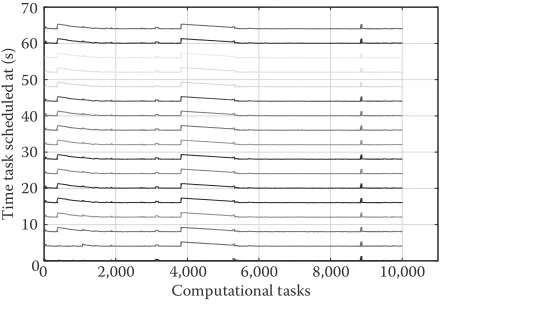
In this section, we benchmark the ability of Granules to periodically schedule tasks for execution. For this particular benchmark, we initialized 10,000 map functions that needed to be scheduled for execution every 4 s.
The objective of this benchmark is to show that a single Granules instance can indeed enforce periodicity for a reasonable number of map instances.
Figure 9.11 depicts the results of periodic executions of 10,000 maps for 17 iter-ations. The graph depicts the spacing in the times at which these maps are sched-uled for execution. The X-axis represents a specific map instance (assigned IDs from 1 to 10,000), and the Y-axis represents the spacing between the times at which a given instance was scheduled. Each map instance reports 17 values.
The first time a computational task is scheduled for execution, a base time, tb,
is recorded. Subsequent iterations report the difference between the base time, tb,
and the current time, tc. In almost all cases, the spacing between the successive
executions for any given instance was between 3.9–4.1 s. In some cases, there is a small notch; this reflects cases where the first execution was delayed by a small
Overhead (s)
0.1 0.1 10000
1000
100
10
1
1 10 100
[image:20.495.128.406.104.258.2]Number of 2D data points (millions) Hadoop Granules MPI
amount, the (constant) impact of which is reflected in subsequent iterations for that map instance.
9.7.5 Data Driven
In this section, we describe the performance of matrix multiplication using Granules. In this case, the object is to measure the product of two dense 16,000 × 16,000 matrices, that is, each matrix has 256 million elements with predominantly non-zero values.
The matrix multiplication example demonstrates how computational tasks can be “stay alive,” and be scheduled for execution when data is available. The maps are scheduled for execution as and when the data is available for the computations to proceed.
For this benchmark, we vary the number of machines involved in the experi-ment from 1 to 8. There are a total of 16,000 map instances. At a given time, each of these maps processes portions of the rows and columns that comprise the matrix. Each Granules instance copes with a fragment of more than 2000 concur-rent streams. In total, every Granules instance copes with 32,000 distinct streams. The results for the processing times (plotted on a log-log scale) can be seen in Figure 9.12. In general, as the number of available machines increases, there is a proportional improvement in the processing time. Our plots of the speed-up (Figure 9.13) in processing times with the availability of additional machines reflect this.
In general, these graphs demonstrate that Granules can bring substantial ben-efits to data-driven applications by amortizing the computational load on a set of machines. Domain scientists do not need to write a single line of networking code; Granules manages this in a transparent fashion for the applications.
0 10 20 30 40 50 60 70
0 2,000 4,000 6,000 8,000 10,000
Ti
m
e t
as
k
sc
he
du
le
d
at
(s
)
[image:21.495.138.416.105.261.2]Computational tasks
9.7.6 Assembling mRNA Sequences
This section describes the performance of Granules in orchestrating the execution of applications developed in languages other than Java. The application we consider is the CAP3 [20] messenger Ribonucleic acid (mRNA) sequence assembly applica-tion (C++) developed at Michigan Tech.
As Expressed Sequence Tag (EST) corresponds to mRNAs transcribed from genes residing on chromosomes, individual EST sequences represent a fragment of mRNA. CAP3 allows us to perform EST assembly to reconstruct full-length mRNA sequences for each expressed gene.
Our objective as part of this benchmark was also to see how Granules can be used to maximize core utilizations on a machine. CAP3 takes as input a set of files. In our benchmark, we need to process 256 files during the assembly.
AQ15
1024 2048 4096 8192 16384
1 2 4 8
Processing time (s)
[image:22.495.126.411.105.264.2]Number of machines Processing time
Figure 9.12 Processing time for matrix multiplication on different machines.
1 2 4 8
1 2 4 8
Sp
ee
d-up
Number of machines Speed-up
[image:22.495.144.413.302.444.2]On a given machine, we fine-tuned the concurrency by setting the number of worker threads within the thread-pool to different values. By restricting the num-ber of threads, we also restricted the amount of concurrency and the underlying core utilizations. We started off by setting the worker-pool size to 1, 2, 4, and 8 on 1 machine, and then used 8 worker threads on 2, 4, and 8 machines. This allowed us to report results for 1, 2, 4, 8, 16, 32, and 64 cores.
The results of our benchmark in terms of processing costs and the speed-ups achieved are depicted in Figures 9.14 and 9.15, respectively. In general, as the num-ber of available cores increases, there is a corresponding improvement in execution times.
8 16 32 64 128 256 512 1024
1 2 4 8 16 32 64
Pr
oc
es
sin
g
tim
e
(s
)
[image:23.495.130.394.253.410.2]Number of cores Processing time
Figure 9.14 Processing time for EST assembly on different cores using Granules and CAP3.
1 2 4 8 16 32 64
1 2 4 8 16 32 64
Sp
ee
d-up
Number of cores Speed-up
[image:23.495.123.416.461.621.2]The results demonstrate that, when configured correctly, Granules can maxi-mize core utilizations on a given machine. The graphs plotted on a log-log scale indicate that for every doubling of the available cores, the processing time for assembling the mRNA sequences reduces by half (approximately). Currently, the Granules runtime ready the thread-pool sizing information from a configuration file; we will be investigating mechanisms that will allow us to dynamically size these thread-pools.
9.8 Conclusions
In this chapter, we described the Granules runtime. Support for rich life-cycle sup-port within Granules allows computations to retain state, which in turn is particu-larly applicable for several classes for scientific applications.
Granules allows complex computational graphs to be created. As discussed, these graphs can encapsulate both control flow and data flow. Granules enforces the semantics of complex distributed computational graphs that have one or more feedback loops. The domain scientist does not have to cope with IO, threading, synchronization, or networking libraries while developing applications that span multiple stages, with multiple distributed instances comprising each stage. These computational pipelines can be dependent on iterative, periodic, data-driven, or termination conditions.
Demonstrable performance benefits have been accrued by Granules as a result of using streaming for disseminating intermediate results.
Granules’ rich life-cycle support, and its performance when contrasted with comparable systems, underscores the feasibility of using Granules in several set-tings. As part of our future work, we will be investigating support for autonomic error detection and recovery within Granules.
References
1. J. Dean and S. Ghemawat, Mapreduce: Simplified data processing on large clusters, Communications of the ACM, 51, 107–113, January 2008.
2. F. Darema, SPMD model: Past, present and future, Recent Advances in Parallel Virtual Machine and Message Passing Interface: Eighth European PVM/MPI Users’ Group Meeting, Santorini/Thera, Greece, 2001.
3. S. Pallickara, J. Ekanayake, and G. Fox, An overview of the granules runtime for cloud computing (Short Paper), Proceedings of the IEEE International Conference on e-Science, Indianapolis, IN, 2008.
4. S. Pallickara and G. Fox, Naradabrokering: A middleware framework and architec-ture for enabling durable peer-to-peer grids, Proceedings of the ACM/IFIP/USENIX International Middleware Conference Middleware-2003, Rio de Janeiro, Brazil, 2003, pp. 41–61.
AQ16
5. S. Pallickara et al., A framework for secure end-to-end delivery of messages in publish/ subscribe systems, Proceedings of the Seventh IEEE/ACM International Conference on Grid Computing (GRID 2006), Barcelona, Spain, 2006.
6. S. Pallickara, H. Bulut, and G. Fox, Fault-tolerant reliable delivery of messages in dis-tributed publish/subscribe systems, Fourth IEEE International Conference on Autonomic Computing, Jacksonville, FL, June 2007, p. 19.
7. R. Pike, S. Dorward, R. Griesemer, and S. Quinlan, Interpreting the data: Parallel anal-ysis with Sawzall, Scientific Programming Journal, Special Issue on Grids and Worldwide Computing Programming Models and Infrastructure, 13(4), 227–298, 2005. 8. Apache Hadoop, http://hadoop.apache.org/core/
9. S. Garfinkel, An evaluation of amazon’s grid computing services: EC2, S3 and SQS, Technical Report TR-08-07, Harvard University, Cambridge, MA, August 2007. 10. Message Passing Interface Forum, MPI: A message passing interface, Proceedings of
Supercomputing’93, Portland, OR, IEEE Computer Society Press, Washington, DC, November 1993, pp. 878–883.
11. M. Isard, M. Budiu, Y. Yu, A. Birrell, and D. Fetterly, Dryad: Distributed data-parallel programs from sequential building blocks, European Conference on Computer Systems, Lisbon, Portugal, March 2007.
12. J. B. MacQueen, Some methods for classification and analysis of multivariate observa-tions, Proceedings of Fifth Berkeley Symposium on Mathematical Statistics and Probability, Vol. 1, Berkeley, CA, University of California Press, Berkeley, CA, 1967, pp. 281–297. 13. C. Ranger, R. Raghuraman, A. Penmetsa, G. R. Bradski, and C. Kozyrakis, Evaluating
mapreduce for multi-core and multiprocessor systems, Proceedings of the International Symposium on High-Performance Computer Architecture (HPCA), Phoenix, AZ, 2007, pp. 13–24.
14. Qt Concurrent, Simplified mapreduce in C++ with support for multicores, April 2009, http://labs.trolltech.com/page/Projects/ Threads/ QtConcurrent
15. Disco project, http://discoproject.org/
16. S. Schlatt, T. Hübel, S. Schmidt, and U. Schmidt, The Holumbus distributed comput-ing framework and mapreduce in Haskell, 2009, http://holumbus.fh-wedel.de/trac 17. A. Pisoni, Skynet: A ruby mapreduce framework, April 2009, http://skynet.rubyforge.org/ 18. J. Ekanayake, S. Pallickara, and G. Fox, Map-reduce for scientific applications,
Proceedings of the IEEE International Conference on e-Science, Indianapolis, IN, 2008. 19. J. M. Squyres and A. Lumsdaine, A component architecture for LAM/MPI, Proceedings
of Euro PVM/MPI, Venice, Itlay, October 2003.
20. X. Huang and A. Madan, CAP3: A DNA sequence assembly program, Genome Research, 9, 868–877, 1999.
21. S. Pallickara, J. Ekanayake, and G. Fox, Granules: A lightweight, streaming runtime for cloud computing with support for map-reduce, Proceedings of the IEEE International Conference on Cluster Computing (CLUSTER 2009), New Orleans, LA, 2009.
[AQ2] In the text, “italics” has been used for emphasis. Please check whether this can be changed to bold.
[AQ3] Please expand “SPMD,” if appropriate.
[AQ4] Please check cross reference to section here and in other instances. [AQ5] Since an introduction to Section 9.5 was missing, one has been added here.
Please check if this is fine.
[AQ6] Please expand “GIS,” if appropriate. [AQ7] Please expand “JDBC,” if appropriate. [AQ8] Please expand “FIFO,” if appropriate.
[AQ9] Please check if the change made to the sentence starting “Granules sup-ports…” is okay.
[AQ10] Please expand “SSL,” if appropriate. [AQ11] Please expand “HPC,” if appropriate.
[AQ12] Please check if the edit of the sentence starting “We had originally…” is correct.
[AQ13] Please check whether MapReduce” should be changed to “CGL-Map-Reduce” as per other occurrences of Map-Reduce in this chapter. [AQ14] Please expand “JVM,” if appropriate.
[AQ15] Please check if the edit of the sentence: “As expressed… fragment of mRNA” is correct.
[AQ16] Please check if “ready” should be changed to “reads” in the sentence start-ing “Currently, the Granules…”
[AQ17] Please check whether the phrase “Support for rich life-cycle support” can be changed to “Rich life-cycle support” in the sentence starting “Support for …”