International Journal of Innovative Technology and Exploring Engineering (IJITEE) ISSN: 2278-3075, Volume-8 Issue-12, October 2019
Abstract: Mobile agent system is a satisfying solution for the implementation and maintenance of applications distributed over large-scale networks, this solution is very used in solving complex problems since they are autonomous, Intelligent, robust and fault- tolerant. Mobile agents have the capacity to migrate from one node to another all over the network allowing reduction in communication costs. Although they possess all these advantages, using them in distributed environment increases the threat to mobile agent security and during their mobility they can face different types of attacks such as of attacks like Replay attack, man-in-the-middle attack, Cookie theft attack, Offline password guessing attack, Stolen-verifier attack. In this paper we investigate the security of distributed mobile agent system. We propose a solution based on a secure Elliptic Curve Cryptography (ECC) protocol to ensure mutual authentication and protect the agent from different known attacks. The implementation of the proposed solution is obtained using Java Agent Development Framework (JADE). Also, Binary serialization is used to establish a flexible portability of the agent. Finally, we present security and performance analysis, for our solution to secure mobile agent in distributed systems.
Keywords: Binary Serialization, Elliptic Curve
Cryptography (ECC), JADE, Mobile Agent, Mutual
Authentication, Security.
I. INTRODUCTION
M
obile agent is a mobile object that moves from one host to another under the control of its own will to achieve tasks. It’s an emerging technology that simplify the design, implementation and maintain of distributed systems. Recently, mobile agent technology becomes one of the active areas of research, it’s widely used in several disciplines, like electronic commerce, industry, information retrieval, intrusion detection [4], and health care. With the evolution of intelligent and autonomous systems the mobile agent becomes a new way of communication over heterogonous network environment, with an important number of advantages. WeRevised Manuscript Received on October 05, 2019.
* Correspondence Author
Yousra Berguig*, Informatics Systems and Optimization Laboratory, Ibn Tofail University, Faculty of Science, kenitra, Morocco. Email: [email protected]
Jalal Laassiri, Informatics Systems and Optimization Laboratory, Ibn Tofail University, Faculty of Science, kenitra, Morocco. Email: [email protected]
Sanae Hanaoui, Informatics Systems and Optimization Laboratory, Ibn Tofail University, Faculty of Science, kenitra, Morocco. Email: [email protected]
Salah-ddine Krit, Informatics Systems and Optimization Laboratory, Polydisciplinary Faculty, Ouarzazate, Morocco. Email: [email protected]
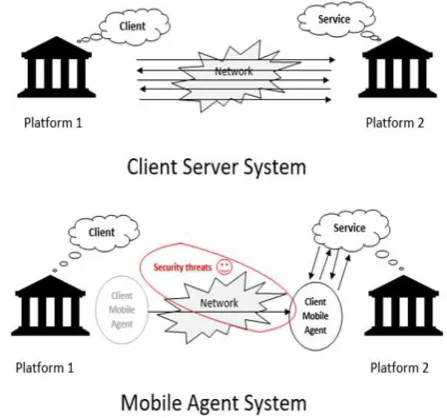
[image:1.595.316.540.379.588.2]notice that mobile agents reduce the network traffic, provide some effective means to overcome the network latency. Through their ability to operate asynchronously and autonomously of the process that created them, they help to construct more robust and fault-tolerant system, allow gather of information and accomplish tasks in an optimum way [10, 20, 6, 11]. However, we soon realized that behind all these qualities some deep serious security issues were hidden, that can be summed up in three main categories, Agent-to-Platform attack, Agent-to-Agent attack and Platform-to-Agent attack, (See Figure 1). Hence agents, hosts and data should be protected [5]. Some security researchers lean towards this problem, to secure mobile agent migration. Nonetheless There are a few security solutions that ensure mutual authentication and secure the agent against the four categories of risk mentioned above.
Fig. 1. Advantages and security problem in mobile agent system
Our main objective in this work is to elaborate a new secure scheme based on multi agent system and elliptic curve cryptography (ECC) [19]. Is a complex mathematical problem with a small key, which makes our solution autonomous, robust and powerful, as it’s something that was not done before. The rest of the paper is organized as follows. In Section 2 we investigate the security problematic in mobile agents. Subsequently, we mention some different possible threats that the agent can face during its mobility. Also, we present the preliminaries of elliptic curve cryptography. In Section 3, we enumerate some different countermeasure and related work that have been
proposed and considered by researchers. In section 4, we propose and discuss our
Mobile Agent Security Based on Mutual
Authentication and Elliptic Curve Cryptography
solution based on a secure Elliptic Curve Cryptography (ECC) protocol, to ensure mutual authentication. In section 5, we present our simulation results. Also, security and performance analysis will be shown in this section. Finally, section 6 concludes the paper.
II. MOBILEAGENTSECURITYANDECC OVERVIEW
A. Overview on Mobile Agent Security
During the mobility, threats to mobile agent security are classified into four cases [1],[28]. The first one is agent-to-agent threats, when a malicious mobile agent tends to attack another agent; such as Masquerade, Denial of Service, Repudiation and Unauthorized access [7]. The second one is agent-to-platform threats, when a mobile agent becomes a threat to the destination platform. Here the mobile agent is malicious and may launch an attack over the Execution Platform. Attacks such as Masquerading, Denial of Service and Unauthorized Access come under this trait [7]. Platform to-agent threats, when the Execution Platform compromises the security of the Mobile Agent. This includes attacks such as Masquerading, Denial of Service, Eavesdropping and Alteration [7]. Finally, others-to-agent platform threats, this attack specifies all attacks which a Mobile Agent may suffer during its travel through the network or visiting a host. This may include masquerading, denial of service, unauthorized access and copy and-replay [7]. Then the mobile agent faces very serious security threats, since all its code, data, and state are exposed to the destination platform. We present below some of possible risks.
Leak out or modify mobile agent’s code
Malicious platform can read and remember the instructions that are going to be executed by the arrived mobile agent to infer the rest of the program. By this process the platform knows the strategy and purpose of mobile agents [13]. Sometimes the malicious platform has a complete picture of mobile agent’s behavior and it might find out the physical address and then accesses its code memory to modify its code. It can even change code temporarily, execute it and finally resuming original code before the mobile agent leaves [8].
Leak out or modify mobile agent’s data
The malicious platform might get to know the original location of the data bit holed by the agent and then modify the data in accordance with the semantics of data [22], which might cause the leak of privacy or the loss of money that lead to severe consequences even if the data is not sensitive. Leak out or modify mobile agent’s execution flow The malicious platform can predict what will be set of instructions to be executed next and deduce the state of that mobile agent by knowing the mobile agent’s physical location of program counter, mobile agent’s code and data. Consequently, it can change the execution flow according to its will to achieve its goal [23]. It can even modify mobile agent’s execution to deliberately execute agent’s code in wrong way.
Denial of Service (DoS)
This attack is one of the most dangerous attacks that might causes mobile agent to miss some good chances if it can finish
its execution on that platform in time and travel to some other platform. It causes not to execute the mobile agent migration and put it in waiting list carrying delays [21].
Masquerading
Here malicious platform pretends as if it is the platform on which mobile agent must migrate and finally becomes home platform where mobile agent returns. By this mechanism, it can get secrets of mobile agents by masquerading and even hurts the reputation of the original platform [29].
Leak out or Modify the interaction between a mobile agent and other parties
Here the malicious platform eavesdrops on the interaction between a mobile agent and other parties (agent or platforms). This leads to extraction of secret information about mobile agent and third party. It can even alternate the contents of interaction and expose itself as part of interaction and direct the interaction to another unexpected third party. In this way, it might perform attacks on both mobile agent and third party. B. Overview on elliptic curve (ECC)
ECC Definition
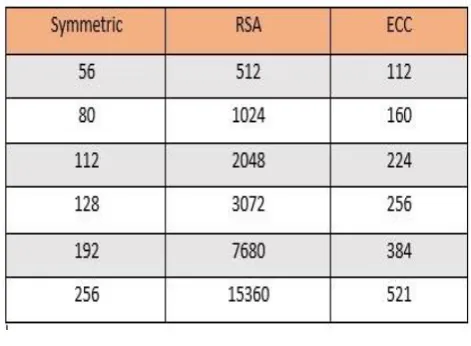
The ECC is an asymmetric algorithm it’s an alternative of RSA which is the most common used for SSL certificates [2]. These two types of master keys share the same important property of having a key to encrypt and other to decrypt. However, ECC can offer the same level of encryption power for much shorter keys, providing better security while reducing computing requirements.
The shorter keys make ECC a very interesting and attractive option for devices with limited storage and processing power. An elliptic curve E is curve given by a Weierstrass equation:
E:y2 + a1xy + a3y = x3 + a2x2 + a4x + a6 (1) We will consider in what follows an elliptic curve, is a curve that is drawn by the points that will solve the following equation:
E: (x, y) |y2 ≡ x3 + ax + b with a, b ∈K (2) a and b will have to fulfill the following condition
[image:2.595.308.544.500.673.2]4a3 +27b2 6= 0, K can be in the following sets (R, Q, C, Z/pZ).
Fig. 2. ECC vs. RSA key size Proposition
Let E be an elliptic curve defined on a field K, and two points
P, Q ∈E(K), L the line connecting P to Q (the tangent to E if
P = Q) and R the third intersection point of L on E. Let L be the vertical line passing through R. We define P + Q ∈E(K) as the second point of intersection
International Journal of Innovative Technology and Exploring Engineering (IJITEE) ISSN: 2278-3075, Volume-8 Issue-12, October 2019
abelian group whose neutral element is the point to infinity (O).
•
Point addition: With 2 distinct points, P and Q, the addition is defined as the negation of the point resulting from the intersection of the curve, E, and the line defined by the points P and Q, giving the point, R.
Fig. 3. Point addition
Point doubling: When the points P and Q are coincident, the addition is similar, except that there is no straight line defined by P and Q, so the operation is closed using the limit case, the tangent to the curve E, to P and Q. This is calculated as above but with:
Fig. 4. Point doubling
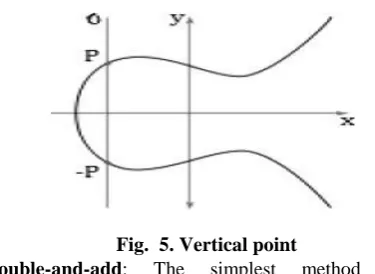
[image:3.595.82.288.131.294.2] [image:3.595.73.287.358.518.2] [image:3.595.65.253.582.719.2] Vertical point: The straight line joining any point P and its symmetrical relative to the horizontal axis, noted −P, is a vertical line, the third point of intersection with the curve is the point at infinity (which is its own symmetrical with respect to the abscissa axis) hence P + (−P) = 0.
Fig. 5. Vertical point
Double-and-add: The simplest method is the double-and-add method, similar to multiply-and-square in modular exponentiation. The algorithm works as follows: To compute DP, start with the binary representation for
d = d0 +2d1 +22d2 +...+2mdm with [d0...dm] ∈ [0,1] (5)
III. RELATEDWORKS
A. Mobile agent Security solutions
Nowadays Mobile-Agents are widely used in different distributed systems, smart devices and connected objects. Nevertheless, the security issue still represents significant constraints and the mobility of these entities needs to be secured. The field of Mobile-Agents security has many diverse research, approaches and ideas. Esfandi & Rahimabadi [9] proposed a multi agent-multi key approach where the encrypted private key and the message are broken into different parts carrying by different agents which makes it difficult for malicious entities to mine the private key for message encryption. To improve security, they used Advanced Encryption Standard (AES) for message encryption. X. Hong [14] presented threshold proxy signature protocol that uses a proxy signer to sign a digital signature. The proxy signing process uses RSA algorithm and it is shared using Lagrange Formula. Sabir et al. [26] proposed a new Authentication and load balancing scheme base on Json to answer the communication security problem in Multi-Agent environment. The presented model based on a Multi-Agent system takes advantage of JWT’s stateless functionality to ensure the integrity of the exchanged messages between agents, the authentication of the agents, and non-repudiation, based on the asymmetric cryptographic technology. Sampathkumar [17] proposed solutions based on public key authentication technique and cryptography to address some of security problems in Mobile agent technology, they present also an experimental application by using RSA algorithm to encryption and decryption. Idrissi et al. [16] introduce an approach based on Identity-Based Key Agreement Protocol to get a session key and to ensure authentication, an Advanced Standard Encryption (AES) for the confidentiality of data exchanged, as well as a Binary Serialization. Unfortunately, we noticed that in literature the most cryptographic approaches and solutions for Mobile-Agent security are based on the classical Cryptosystem like AES, RSA...
In our work we choose to use the elliptic curve for many reasons, one of the main reasons is the key size that is very small compared to other asymmetric cryptosystems, it requires less computational power, communication, bandwidth, and memory. Also, its complexity that is very difficult to calculate. For this we used Kumari et al. [5] algorithm that propose a mutual authentication to secure the communication between IoT devices and the Cloud. The proposed scheme is invincible to various attacks and they use HTTP cookies which make it very interesting.
B. Elliptic curve cryptography for system security X. Huang et al. [15] present an approach for protecting a system from man-in-middle attacks based on hidden generator point with elliptic curve cryptography (ECC), they designed a hidden generator point that offer a good protection from (MITM) attack and opted for multiagent system implementation. J R. Shaikh et al. [27] present an analysis of various types of curves recommended by different standards, by performing two ECC algorithms - ECDH and ECDSA. and offer a comparative table of selected curves that is arranged according to the computation
time taken by each curve to perform various operations (4)
when used for the ECC algorithms. N. Mehibel & M. Hamadouche [24], propose a new approach of elliptic curve to secure Diffie-Hellman key transport in public channel. D. Pritam Shah & P. Gajkumar Shah [25] propose a secured protocol based on elliptic curve for communication between IoT devices and server. In the proposed Elliptical Curve Internet of Things (ECIOT) protocol, the IoT device will establish secret session key with server by using Diffie-Hellman protocol based on NIST p-192 prime curve. The subsequent communication will be carried out with symmetric key cipher Ex-OR by using ECIOT derived key. Keerthi K & B.Surendiran [18] introduce a new mapping technique for encoding the message into affine points on the elliptic curve. Mapping technique convert the plain text into ASCII values and then convert this into hexadecimal. The converted Hex values are grouped together to form the x and y coordinates. The converted values are encrypted in reverse order to prevent security attacks.
IV. ELLIPTICCURVECRYPTOGRAPHYFOR
MOBILE-AGENTSECURITY
A. Model of our solution
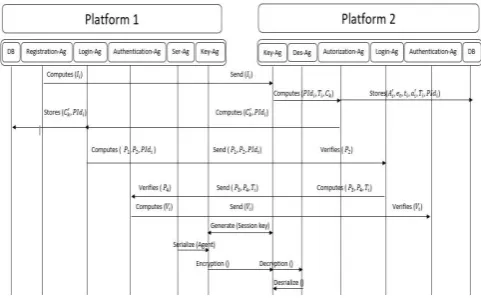
[image:4.595.48.289.429.578.2]Recently mobile agents are widely used in distributed systems in order to communicate, execute tasks and exchange information and sensible data between the interacting entities, nonetheless it is noted that mobile agent security has become progressively pronounced. This part gives a description of the proposed solution based on S. Kumari et al. ECC algorithm [19] to keep the mobile agent platform and the agent itself secure against different threats.
Fig. 6. Proposed solution Model
Initialization
First, RC chooses an elliptic curve (EC) equation
y2 = x3 + ax + b over Zp where Zp(p >2160) is the finite field group. Then selects two elements a, b ∈ Zp, where a and b satisfy the condition 4a3 + 27b2(mod p) ≠ 0. The EC base
point is G that has a prime order of n (n >2160). Let O be the point at infinity satisfying the equation n · G = O · a, random nonce XRC is selected by RC as its secret key.
Registration
Step 1. The Registration-Ag is the agent responsible of the registration with RC. The agent computes Ii = h(Idi‖Pwi) and sends Ii to the Key-Ag2 through a secure communication channel.
Step 2. After receiving the registration request. The Key-Ag2 generates a random number rs and computes
PIdi = h(rs‖IdRC‖Ii) ⊕IdRC and stores PIdi. Then, computes the cookie Ck = h(rs‖XRC‖Et‖PIdi) and Ti = rs ⊕ h(XRC‖PIdi) and send those parameters to Authorization-Ag.
Step 3. Authorization-Ag computes some other security
parameters Ck
'
=
et = Et ⊕XRC and a'i = A'i ⊕XRC. Then Ck' and PIdi are sent to Registration-Ag that stores theme in the database.
Login and authentication phase
Step 1. The Login-Ag1 selects random nonce r1 before each login. Then compute the ECC point P1 = r1 · G and
P2 = h (r1 · Ck' ), and, stores P1 in its memory and sends the login request P1 ,P2, PIdi to Login-Ag2.
Step 2. After receiving the login request, Login-Ag2 obtains P1, P2 and PIdi and computes rs = Ti ⊕h(XRC‖PIdi), then computes the cookie information
Ck = h (rs‖XRC‖Et‖PIdi) and P∗2 = h (P1 ·Ck).
Next, it verifies P ∗2 (? =) P2. If it’s true then Login-Ag2 selects a random nonce r2, computes the ECC point
P3 = r2 · G; P4 = r2 · A'i and sends P3, P4, Ti to Authentication-Ag1. Differently login-Ag2 rejects the login request of loginAg1.
Step 3. After receiving P3, P4, Ti Authentication-Ag1 compute
Ai = h (Ti ⊕Ii ⊕Ck' ) and the ECC point
P∗4 = P3 · Ai After that, it verifies P∗4(? =) P4 to authenticate the platform 2, if it’s true then Authentication-Ag1 authenticate platform 2 and computes the session key
SK = r1 · P3 = r1 ·r2 ·G and sends ) to Authentication-Ag2. Otherwise rejects the message P3, P4, Ti of the platform 2 and resume the login.
Step 4. Authentication-Ag2, compute the session key
SK∗= r2 · P1 = r2 · r1 · G and V ∗i = h ((P1 · Ck) ‖SK∗). Then, verifies V ∗i (? =) Vi to authenticate the sender platform SD. If it’s true then Authentication-Ag2 authenticates platform1, Differently, Vi is rejected.
Step 5. The key-Agents computes the session keys,
SK = r1 · P3 = r1 · r2 · G = r2 · P1 = SK ∗. Serialization and encryption
Step 1. To make mobile agent transportability easy and insistent we use the binary serialization mechanism that generates a readable and editable format. When the platform 2 is successfully authenticated, the platform 1 prepare its mobile agent to move. For this the Serialization-Ag is created to serialize the agent and sends the binary data flow to the key-Ag.
Step 2. After receiving the serialized agent Key-Ag1 XORed the binary data flow with the session key SK = r1 · P3 and send the result to the keyAg2.
Step 3. The Key-Ag2 decrypt the message and send it to the DeserializationAg that deserialize the agent and run it. List of notations
International Journal of Innovative Technology and Exploring Engineering (IJITEE) ISSN: 2278-3075, Volume-8 Issue-12, October 2019
Fig. 7. Table of notation used B. Algorithm presentation
In this part, we detail the different steps of the algorithm used to guarantee mutual authentication.
Algorithm 1: Initialization
Input: Ep: The elliptic curve equation, XRC: Reception platform secret key Output: PS: Reception platform public key, G: Generator point.
1. Ep ← E:y2 + a1xy + a3y = x3 + a2x2 + a4x + a6 2.Choose the generator point G.
3.Ps ← XRC · G
Algorithm 2: Registration
Input: IDi: Identity of the sender platform (SD), Pwi: password of SD.
IdRC: Identity of reception platform (RC) XRC: secret key of RC
Et: Expiration time of the cookie PIdi: pseudo Identity
Ck': The cookie information and a set of parameters Ti, Ai, ti,
a'i, et .
Output: Ii: The hashed identity of SD, G: Generator point. 1.Computes Ii ← h(IDi‖Pwi)
2.Selecta random number rs.
3.Computes PIdi ← h(rs‖IdRC‖Ii) ⊕IdRC 4.Computes Ck ← h(rs‖XRC‖Et‖PIdi) 5.Computes Ck' ← Ck · G
6.Computes Ti ← rs ⊕h(XRC‖PIdi) 7.Computes
8.Computes A'i ← Ai · G 9.Computes ti ← Ti ⊕XRC 10.Computes
11.Computes et = Et ⊕XRC
12.Stores ti,, a'i, et and PIdi in the data base 13.Sends PIdi and Ck' to the sender platform SD
14.The sender platform stores PIdi and Ck' in its data base
Algorithm 3: Login and Authentication
Input: r1, r2: Selected random number, XRC: secret key of RC
Et: Expiration time of the cookie, G: Generator point Output: P1,P2,P3,P4: ECC points, Ck: The cookie information, Sk: Session key and a set of parameters rs, Vi, V ∗i
1.Select a random number r1 2.Computes P1 ← r1 · G. 3.Computes P2 ← h (r1 · Ck
' )
4.Sends P1, P2, PIdi to the receiver platform 5.Computes rs ← Ti ⊕h(XRC‖PIdi)
6.Computes Ck ← h(rs‖XRC‖Et‖PIdi) 7.Computes P∗2 ← h (P1 · Ck) 8.Verifies P ∗2 (? =) P2
9.Computes P3 ← r2 · G and P4 ← r2 · A ’
i 10.Sends P3, P4 and Ti to the sender platform SD
11.SD Computes
12.SD computes P∗4 = P3 · Ai 13.Verifies P ∗4 (? =) P4 14.Computes SK ← r1 · P3.
15.Computes 16.Sends Vi to RC
17.Computes SK∗ ← r2 · P1 ← r2 · r1 · G. 18.Computes V ∗i ← h ((P1 · Ck) ‖SK∗). 19.Verifies V ∗i (? =) Vi
20.Generates the session key
SK ← r1 · P3 ← SK∗ ← r2 · P1 ← r2 · r1 · G.
Algorithm 4: Serialization and encryption
Input: MA: The instance of Mobile agent, SK: Session key,
MAS: Serialized mobile agent Output: MADS: Deserilized mobile agent, MAcf: encrypted Mobile agent.
1.MAS ← Serialize MA 2.SK ← r1 · P3
3.Computes MAcf ← MAS ⊕SK 4.Decrypt and desterilized MAcf
V. IMPLEMENTATIONANDRESULTS
In this section we present the results got through implementing the proposed solution. For that we used the test platform JADE (Java Agent development framework) [20, 30], a platform that meets the standard FIPA [3] specified for agents and uses the Java language it’s the most widespread and it’s offer more services inter-operability for facilitating the mobility of workers.
Table- I: The platforms characteristics
First, we have Registration-Ag which is responsible for the calculation and sending Ii, we find later Key-Agent1 which computes a set of parameters (PIDi, Ti, Ck) and store them in the database of the platform. Then we have Authorization-Ag
which computes ( ). We have also, Log-Ag
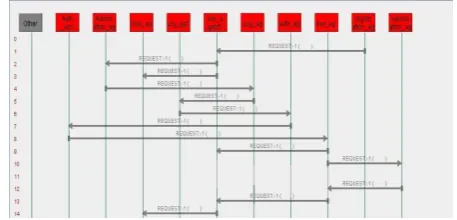
that computes (P1,P2) and sends it to Log-Ag1.This agent verifies (P2,P∗2), calculates (P3,P4) and send it to Auth-Ag, that verifies (P4,P∗4), calculates Vi and sends it to Auth-Ag1. Auth-Ag1 is responsible for checking the authentication. Also, we have Key-Ag and Key-Ag1 their roles are the keys generation, encryption and decryption. Finally, we have ser-Ag and des-Ag for serialization and deserialization of the agent. In figure ”6” we present all the agents used in our implementation and interactions between them.
In order to achieve the implementation of our solution, we used a main class “Scalar-Multiply” which generates the EC-point G and allows us to get scalar multiples. We used the curve P–192 which is given by the following parameters of Base point G: [31]
XG = 6020462823756886567582134805875261119166\ 98976636884684818
YG = 1740503322936220314048575522802194103640\ 23488927386650641
[image:6.595.311.540.121.231.2]For the creation, management, mobility and execution of the agents we. adopt JADE of version 4.5. SHA-256 [32] is used to generate hash values. our solution is based on four parts, Registration, Login, Authentication and Serialization. In the following we present the result of each step of our solution.
Fig. 8. Model generated by our implementation Before presenting the results of the tests to know the overheads generated by the introduction of security mechanisms, we propose a theoretical calculation of the time required to carry out all aspects of the solution. During migration Mobile-Agent performs various operations to ensure the different aspects of security needed. We consider
Ttotal the total time for the solution. Ttotal is composed of
sub-duration that represent every step of the solution.
Ttotal = Trequests + Tregister + Tlog +Tauthentication +
Tserialization +Tencryption + Tmigration + Tdecryption +
Tdeserialization. (6)
Fig. 9. Result of the authorization phase
International Journal of Innovative Technology and Exploring Engineering (IJITEE) ISSN: 2278-3075, Volume-8 Issue-12, October 2019
Fig. 11. Result of the authentication phase
Fig. 12. Result of the Serialization and encryption phase
Fig. 13. Result of the Deserialization and decryption phase
Since the requests between agents are internal with a small size. Also, in our simulation case the agent migrates internally from one container to another so we can consider Trequests and
Tregister as negligible. Approximatively Tserialization is equal to
Tdeserialization, as well as Tdecryption is equal to Tencryption. Therefore, the equation (3) of the solution total time becomes:
Ttotal = Tregister + Tlog +Tauthentication + 2Tserialization + 2Tencryption. (7) Finally, conforming to the equation (7) the total time spent to execute our solution is:
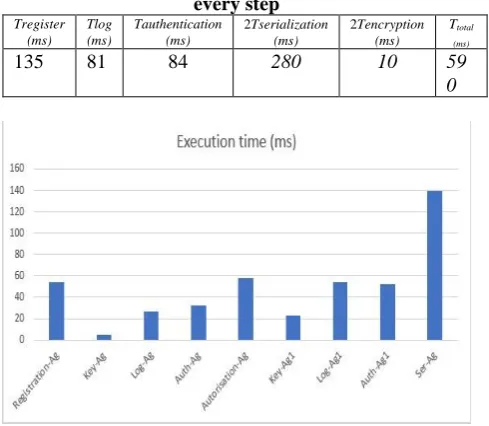
[image:7.595.308.539.357.511.2]Ttotal = 135 + 81 + 84 + 2 × 140 + 2 × 5 = 590ms
Table- II. Timing results obtained in the execution of every step
Tregister (ms)
Tlog (ms)
Tauthentication (ms)
2Tserialization (ms)
2Tencryption (ms)
Ttotal (ms)
135 81 84 280 10 59
0
Fig. 14. Timing results obtained in the execution of every agent used in the simulation.
Despite that we used asymmetric cryptography that takes a little longer time during its execution. The overhead of the security added for the mobility of the agent is 310 ms which
appears admissible, credible and not compromising the performances of our agent platform.
Fig. 15. Timing results obtained in the execution of different security processes
Security Analysis
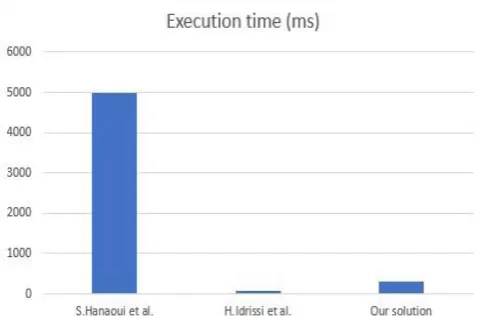
[image:7.595.50.295.487.700.2]The problem in this type of encryption is the use of a single key for encryption and decryption, if the key is stolen while transmitting data between sender and receiver it is very easy to decrypt the message. This work does not guarantee the availability of the agent .In the work “On the Security Communication and Migration in Mobile Agent Systems” [12], authors proposed an interesting solution based on a set of security mechanisms such as asymmetric-Key algorithm Rivest–Shamir–Adleman (RSA), Schnorr signature and an ECC elliptic curve algorithm to secure the agent during its mobility. However, the time execution for the hole solution is 5000 ms which is very big compared to our execution time in the current paper. This could be explained by the different asymmetric algorithms and signature used to guarantee the authentication, confidentiality, integrity and availability of the agent. Which require an important execution time. Nonetheless in our solution we guarantee all this security requirements by using a single ECC algorithm in 310 ms.
Fig. 16. Evaluation of the execution time of mobile-agent security solution for our Approach and two other
approaches
VI. CONCLUSION
This work deals with the problem of mobile agent security. The proposed solution is a novel contribution based on elliptic curve cryptography to secure mobile agent platforms against unauthorized access attacks. and binary serialization to guarantee an easy and flexible mobility. We offer a solution that protect the agent from different types of attacks like Replay attack, man-in-the-middle attack, Cookie theft attack, Offline password guessing attack, Stolen-verifier attack. We implemented our solution using JAVA programming language and JADE (Java Agent Development Framework) which allows us to simulate our solution between two platforms using a multi-agent system. The results of the solution timing performance show its efficiency and adaptability. In the following work we will extend our scheme by using our own asymmetric algorithm for mobile agent security.
REFERENCES
1. J.J. Adri Jovin, M. Marikkannan. A Review on Attacks and Security Approaches in Mobile Agent Technology. Australian Journal of Basic and Applied Sciences, 2016.
2. Alfred, J. Menezes, Paul C. Van Oorschot, Scott A. Vanstone. Handbook of applied cryptography. CRC press, 1996.
3. F. Bellifmine, A. Poggi and G. Rimassa. JADE: a FIPA2000 compliant agent development environment. 216-217.ACM, 2001.
4. Y. Berguig, J.Lassiri, S. Hanaoui. DDoS Detection based on Mobile Agent and Na¨ıve Bayes Filter. International Symposium on Advanced Electrical and Communication Technologies (ISAECT), 2018. 5. P. Braun, W. Rossak. Mobile agent security: Basic concepts, mobility
models and the tracytoolkit. Morgan Kaufmann/Elsevier anddpunkt. verlag, USA, 2005.
6. J. Cao, S. K. Das. Mobile agents in networking and distributed computing. (Vol. 3), Jhon Wiley & Sons, 2012.
7. G. Carl, G. Kesidis, RR. Brooks, S. Rai. Denial-of-service attack detection techniques Trans intern Comput 10(1):82–89, 2006. 8. P. Dadhich, D. K. Dutta, D. M. C. Govil. Security Issues in Mobile
Agents. Int. J. Comput. Appl., vol. 11, no. 4, pp. 1–7, 2010. 9. A. Esfandi, A. Rahimabadi. Mobile Agent Security in Multi agent
Environments Using a Multi agent-Multi key Approach, 2nd IEEE International Conference on Computer Science and Information Technology, 2009.
10. J. Ferber. Les syst`emes multi-agents. Versune intelligence collective. Inter Edition, Paris, 1995.
11. B. B. Gupta, Omkar P. Badve. Taxonomy of DoS and DDoS attacks and desirable defense mechanism in a Cloud computing environment. Neural Comput& Applic, 2017.
12. S. Hanaoui, Y. Berguig, J. Laassiri. On the Security Communication and Migration in Mobile Agent Systems. International Conference on Advanced Intelligent Systems for Sustainable Development. pp 302-313, 2019.
13. Y. Hedin, E. Moradian. Security in Multi-Agent Systems. Procedia Comput. Sci., vol. 60, no. 1, pp. 1604–1612, Jan. 2015.
14. X. Hong. Efficient threshold proxy signature protocol for mobile agents, Information Sciences 179, 4243–4248, 2009.
15. X. Huang, P. Gajkumar Shah, and D. Sharma. Multi-Agent System Protecting from Attacking with Elliptic Curve Cryptography, Advances in Intel. Decision Technologies, SIST 4, pp. 123–131, 2010. 16. H. Idrissi, E. Souidi and A. Revel. Mobile Agent Security Using IDBased Agreement Protocol and Binary Serialization, International Journal of Security and Its Applications Vol. 9, No. 5 , pp. 19-30, 2015. 17. A. Kannammal, N. Ch.S.N. Iyengar. A Framework for Mobile Agent Security in Distributed Agent-Based E-Business Systems, International Journal of Business and Information, Volume 3, Number 1, June 2008.
18. K. Keerthi, Dr. B. Surendiran. Elliptic Curve Cryptography for Secured Text Encryption. International Conference on circuits Power and Computing Technologies [ICCPCT], 2017.
19. S. Kumari, M. Karuppiah, A. Kumar Da, X. Li, F. Wu, N. Kumar. A secure authentication scheme based on elliptic curve cryptography for IoT and cloud servers. The Journal of Supercomputing, Volume 74, Issue 12, pp 6428–6453, 2017.
20. D.B. Lange, M. Oshima. Seven good reasons for mobile agents. Commun. ACM, ACM, vol. 42, 1999.
21. F. Lau, S. H. S. S. H. Rubin, M. H. Smith, L. Trajkovic. Distributed denial of service attacks. Syst. Man, Cybern. IEEE Int. Conf., vol. vol.3, no. SANS Security 401, pp. 2275–2280, 2000.
22. C. M.-F. for S. M. Code and undefined, Detecting attacks on mobile agents. pdfs.semanticscholar.org, 1997.
23. M. W. Madsen. An introduction to multi-agent statistics. CEUR Workshop Proc. vol. 1208, pp. 16–20, 2014.
24. N. Mehibel, M. Hamadouche. A New Approach of Elliptic Curve DiffieHellman Key Exchange, The 5th International Conference on Electrical Engineering, 2017.
25. D. Pritam Shah, P. Gajkumar Shah. Revisting of Elliptical Curve Cryptography for Securing Internet of Things (IOT), Advances in Science and Engineering Technology International Conferences (ASET). 2018.
26. B. Sabir, M. Youssfib, O. Bouattaneb, H. Allalia. Authentication and load balancing scheme based on JSON Token for Multi-Agent Systems, Second International Conference on Intelligent Computing in Data Sciences (ICDS), 2018.
27. J. R. Shaikh, M. Nenova, G. Iliev, Z. Valkova-Jarvis, Analysis of Standard Elliptic Curves for the Implementation of Elliptic Curve Cryptography in Resource-Constrained E-commerce Applications. IEEE International Conference on Microwaves, Antennas, Communications and Electronic Systems (COMCAS), 2017. 28. M.H. Shao, J. Zhou. Protecting mobile-agent data collection against
International Journal of Innovative Technology and Exploring Engineering (IJITEE) ISSN: 2278-3075, Volume-8 Issue-12, October 2019
29. C. Zrari, H. Hachicha, K. Ghedira. Agent’s security during communication in mobile agents’ system, in Procedia Computer Science, vol. 60, no. 1, pp. 17–26, 2015.
30. Foundation for Intelligent Physical Agents.” FIPA Agent Management Support for Mobility Specification”. document number dc00087c, 2002.
31. Mathematical routines for the NIST prime elliptic curves, 2010. 32. The cryptographic hash function SHA-256, CRIPTOGRAFIA MAII –
FIB.
AUTHORSPROFILE
Yousra BERGUIG member of Informatics, System Optimization Laboratory IbnTofail University Kénitra, Morocco. She works as computer system administrator. Her research interests include Wireless Sensor Networks, Network Security, Business Intelligent, Big Data, artificial intelligence, machine learning, cryptography and Smart-Cities, Phd student in Mobile-Agent and distributed systems security at Laboratory of Informatics systems and optimization at Ibn Tofail University, Kenitra, Morocco.
Dr. Jalal Laassiri member ofInformatics, System Optimization Laboratory at Ibn Tofail University, Kénitra, Morocco. Laboratory Team Head he received his Ph.D. degree in computer sciences and engineering from University of Mohammed V, Rabat, Morocco. He is Member of the International Association of Engineers (IAENG), Dr. laassiri authored/co-authored many Journal articles, Conference Proceedings and Book Chapters. His research interests include Wireless Sensor Networks, Network Security, Business Intelligent, Big Data, Smart-Cities, Internet of Things, He joined the Faculty of Sciences of Kénitra, Department of Computer Science, Ibn Tofail University, Morocco, as a Professor in October 2010.
Sanae HANAOUI member of Informatics, System Optimization Laboratory Ibn Tofail University Kenitra, Morocco. Phd student Working on the security of distributed systems and AI (MAS Technology). Her research interests include Wireless Sensor Networks, Network Security, Cryptography, artificial intelligence, machine learning. Affiliated to Informatics systems and optimization Laboratory at Ibn Tofail University, Kenitra, Morocco.