A Joint Model for Entity Analysis:
Coreference, Typing, and Linking
Greg Durrett and Dan Klein Computer Science Division University of California, Berkeley {gdurrett,klein}@cs.berkeley.edu
Abstract
We present a joint model of three core tasks in the entity analysis stack: coreference res-olution (within-document clustering), named entity recognition (coarse semantic typing), and entity linking (matching to Wikipedia en-tities). Our model is formally a structured con-ditional random field. Unary factors encode local features from strong baselines for each task. We then add binary and ternary factors to capture cross-task interactions, such as the constraint that coreferent mentions have the same semantic type. On the ACE 2005 and OntoNotes datasets, we achieve state-of-the-art results for all three tasks. Moreover, joint modeling improves performance on each task over strong independent baselines.1
1 Introduction
How do we characterize the collection of entities present in a document? Two broad threads exist in the literature. The first is coreference resolution (Soon et al., 2001; Ng, 2010; Pradhan et al., 2011), which identifies clusters of mentions in a document referring to the same entity. This process gives us ac-cess to useful information about the referents of pro-nouns and nominal expressions, but because clusters are local to each document, it is often hard to situate document entities in a broader context. A separate line of work has considered the problem of entity linking or “Wikification” (Cucerzan, 2007; Milne and Witten, 2008; Ji and Grishman, 2011), where mentions are linked to entries in a given knowledge 1System available athttp://nlp.cs.berkeley.edu
base. This is useful for grounding proper entities, but in the absence of coreference gives an incom-plete picture of document content itself, in that nom-inal expressions and pronouns are left unresolved.
In this paper, we describe a joint model of corefer-ence, entity linking, and semantic typing (named en-tity recognition) using a structured conditional ran-dom field. Variables in the model capture deci-sions about antecedence, semantic type, and entity links for each mention. Unary factors on these vari-ables incorporate features that are commonly em-ployed when solving each task in isolation. Bi-nary and higher-order factors capture interactions between pairs of tasks. For entity linking and NER, factors capture a mapping between NER’s seman-tic types and Wikipedia’s semanseman-tics as described by infoboxes, categories, and article text. Coreference interacts with the other tasks in a more complex way, via factors that softly encourage consistency of semantic types and entity links across coreference arcs, similar to the method of Durrett et al. (2013). Figure 1 shows an example of the effects such fac-tors can capture. The non-locality of coreference factors make exact inference intractable, but we find that belief propagation is a suitable approximation technique and performs well.
Our joint modeling of these three tasks is moti-vated by their heavy interdependencies, which have been noted in previous work (discussed more in Section 7). Entity linking has been employed for coreference resolution (Ponzetto and Strube, 2006; Rahman and Ng, 2011; Ratinov and Roth, 2012) and coreference for entity linking (Cheng and Roth, 2013) as part of pipelined systems. Past work has
Revenues of $14.5 billion were posted by Dell1. The company1 ...
en.wikipedia.org/wiki/Dell
en.wikipedia.org/wiki/Michael_Dell
Infobox type: company
Infobox type: person
ORGANIZATION
[image:2.612.91.299.52.148.2]PERSON
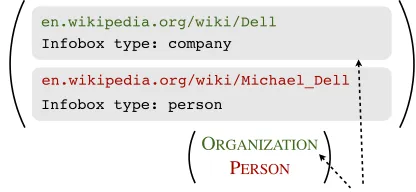
Figure 1: Coreference can help resolve ambiguous cases of semantic types or entity links: propagating information across coreference arcs can inform us that, in this context, Dellis an organization and should therefore link to the article onDellin Wikipedia.
shown that tighter integration of coreference and entity linking is promising (Hajishirzi et al., 2013; Zheng et al., 2013); we extend these approaches and model the entire process more holistically. Named entity recognition is improved by simple coreference (Finkel et al., 2005; Ratinov and Roth, 2009) and knowledge from Wikipedia (Kazama and Torisawa, 2007; Ratinov and Roth, 2009; Nothman et al., 2013; Sil and Yates, 2013). Joint models of corefer-ence and NER have been proposed in Haghighi and Klein (2010) and Durrett et al. (2013), but in neither case was supervised data used for both tasks. Tech-nically, our model is most closely related to that of Singh et al. (2013), who handle coreference, named entity recognition, and relation extraction.2 Our
sys-tem is novel in three ways: the choice of tasks to model jointly, the fact that we maintain uncertainty about all decisions throughout inference (rather than using a greedy approach), and the feature sets we deploy for cross-task interactions.
In designing a joint model, we would like to preserve the modularity, efficiency, and structural simplicity of pipelined approaches. Our model’s feature-based structure permits improvement of fea-tures specific to a particular task or to a pair of tasks. By pruning variable domains with a coarse model and using approximate inference via belief propaga-tion, we maintain efficiency and our model is only a factor of two slower than the union of the individual
2Our model could potentially be extended to handle relation extraction or mention detection, which has also been addressed in past joint modeling efforts (Daum´e and Marcu, 2005; Li and Ji, 2014), but that is outside the scope of the current work.
models. Finally, as a structured CRF, it is concep-tually no more complex than its component models and its behavior can be understood using the same intuition.
We apply our model to two datasets, ACE 2005 and OntoNotes, with different mention standards and layers of annotation. In both settings, our joint model outperforms our independent baseline mod-els. On ACE, we achieve state-of-the-art entity link-ing results, matchlink-ing the performance of the system of Fahrni and Strube (2014). On OntoNotes, we match the performance of the best published coref-erence system (Bj¨orkelund and Kuhn, 2014) and outperform two strong NER systems (Ratinov and Roth, 2009; Passos et al., 2014).
2 Motivating Examples
We first present two examples to motivate our ap-proach. Figure 1 shows an example of a case where coreference is beneficial for named entity recogni-tion and entity linking. The company is clearly coreferent toDellby virtue of the lack of other possi-ble antecedents; this in turn indicates thatDellrefers to the corporation rather than to Michael Dell. This effect can be captured for entity linking by a fea-ture tying the lexical itemcompany to the fact that COMPANYis in the Wikipedia infobox forDell,3
thereby helping the linker make the correct decision. This would also be important for recovering the fact that the mentionthe company links toDell; how-ever, in the version of the task we consider, a men-tion likethe companyactually links to the Wikipedia article forCompany.4
Figure 2 shows a different example, one where the coreference is now ambiguous but entity linking is transparent. In this case, an NER system based on surface statistics alone would likely predict that
Freddie Macis a PERSON. However, the Wikipedia article for Freddie Mac is unambiguous, which al-lows us to fix this error. The pronounhiscan then be correctly resolved.
These examples justify why these tasks should be handled jointly: there is no obvious pipeline order for a system designer who cares about the
ORGANIZATION PERSON
Donald Layton1 took the helm of Freddie Mac2after his1 ... NIL
en.wikipedia.org/wiki/Freddie_Mac
[image:3.612.314.540.52.214.2]PERSON
Figure 2: Entity links can help resolve ambiguous cases of coreference and entity types. Standard NER and coreference systems might fail to handle Freddie Mac correctly, but incorporating semantic information from Wikipedia makes this decision easier.
mance of the model on all three tasks.
3 Model
[image:3.612.73.295.59.153.2]Our model is a structured conditional random field (Lafferty et al., 2001). The input (conditioning con-text) is the text of a document, automatic parses, and a set of pre-extracted mentions (spans of text). Mentions are allowed to overlap or nest: our model makes no structural assumptions here, and in fact we will show results on datasets with two different men-tion annotamen-tion standards (see Secmen-tion 6.1 and Sec-tion 6.3).
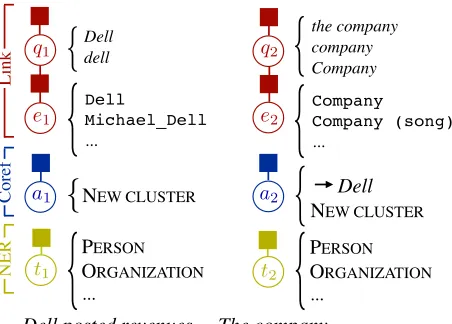
Figure 3 shows the random variables in our model. We are trying to predict three distinct types of annotation, so we naturally have one variable per annotation type per mention (of which there aren):
• Coreference variablesa= (a1, . . . , an)which
indicate antecedents:ai ∈ {1, . . . , i−1,NEW},
indicating that the mention refers to some pre-vious mention or that it begins a new cluster.
• Named entity type variables t = (t1, . . . , tn)
which take values in a fixed inventory of se-mantic types.5
• Entity link variables e = (e1, . . . , en) which
take values in the set of all Wikipedia titles. In addition we have variables q = (q1, . . . , qn)
which represent queries to Wikipedia. These are ex-plained further in Section 3.1.3; for now, it suffices 5For the next few sections, we assume a fixed-mention ver-sion of the NER task, which looks like multi-way classification of semantic types. In Section 6.3.1, we adapt the model to the standard non-fixed-mention setting for OntoNotes.
}
Dell posted revenues ... The company...
}
DellMichael_Dell ...
NEW CLUSTER
Dell
NEW CLUSTER
}
CompanyCompany (song) ...
}
}
PERSON ORGANIZATION ...}
PERSON ORGANIZATION ...}
the company company Company}
Delldell
NER
Core
f
L
ink
q1 q2
e2 e1
a1 a2
t1 t2
Figure 3: Random variables and task-specific factors present in our model. The ai model coreference an-tecedents, thetimodel semantic types, theeimodel en-tity links, and theqiare latent Wikipedia queries. Factors shown for each task integrate baseline features used when that task is handled in isolation. Coreference factors are described in Section 3.1.1, NER factors are described in Section 3.1.2, and entity linking factors are described in Section 3.1.3.
to remark that they are unobserved during both train-ing and testtrain-ing.
We place a log-linear probability distribution over these variables as follows:
p(a,t,e|x;θ)∝X q
expθ>f(a,t,e,q, x)
whereθ is a weight vector,f is a feature function,
andxindicates the document text, automatic parses, and mention boundaries.
We represent the features in this model with stan-dard factor graph notation; features over a particular set of output variables (and x) are associated with
factors connected to those variables. Figure 3 shows the task-specific factors in the model, discussed next in Section 3.1. Higher-order factors coupling vari-ables between tasks are discussed in Section 3.2.
3.1 Independent Model
structure and Ratinov and Roth (2009) note that it is a reasonable assumption to make for NER as well.6
In this section, we describe the features present in the task-specific factors of each type (which also serve as our three separate baseline systems).
3.1.1 Coreference
Our modeling of the coreference output space (as antecedents chosen for each mention) follows the mention-ranking approach to coreference (De-nis and Baldridge, 2008; Durrett and Klein, 2013). Our feature set is that of Durrett and Klein, target-ing surface properties of mentions: for each men-tion, we examine the first word, head word, last word, context words, the mention’s length, and whether the mention is nominal, proper or pronom-inal. Anaphoricity features examine each of these properties in turn; coreference features conjoin var-ious properties between mention pairs and also use properties of the mention pair itself, such as the dis-tance between the mentions and whether their heads match. Note that this baseline does not rely on hav-ing access to named entity chunks.
3.1.2 Named Entity Recognition
Our NER model places a distribution over possi-ble semantic types for each mention, which corre-sponds to a fixed span of the input text. We define the features of a span to be the concatenation of stan-dard NER surface features associated with each to-ken in that chunk. We use surface toto-ken features similar to those from previous work (Zhang and Johnson, 2003; Ratinov and Roth, 2009; Passos et al., 2014): for tokens at offsets of{−2,−1,0,1,2}
from the current token, we fire features based on 1) word identity, 2) POS tag, 3) word class (based on capitalization, presence of numbers, suffixes, etc.), 4) word shape (based on the pattern of uppercase and lowercase letters, digits, and punctuation), 5) Brown cluster prefixes of length 4, 6, 10, 20 using the clus-ters from Koo et al. (2008), and 6) common bigrams of word shape and word identity.
6Pairwise potentials in sequence-based NER are useful for producing coherent output (e.g. prohibiting configurations like O I-PER), but since we have so far defined the task as operating over fixed mentions, this structural constraint does not come into play for our system.
3.1.3 Entity Linking
Our entity linking system diverges more sub-stantially from past work than the coreference or NER systems. Most entity linking systems oper-ate in two distinct phases (Cucerzan, 2007; Milne and Witten, 2008; Dredze et al., 2010; Ratinov et al., 2011). First, in the candidate generation phase, a system generates a ranked set of possi-ble candidates for a given mention by querying Wikipedia. The standard approach for doing so is to collect all hyperlinks in Wikipedia and associate each hyperlinked span of text (e.g. Michael Jor-dan) with a distribution over titles of Wikipedia ar-ticles it is observed to link to (Michael Jordan,
Michael I. Jordan, etc.). Second, in the dis-ambiguation phase, a learned model selects the cor-rect candidate from the set of possibilities.
As noted by Hachey et al. (2013) and Guo et al. (2013), candidate generation is often overlooked and yet accounts for large gaps in performance between different systems. It is not always clear how to best turn the text of a mention into a query for our set of hyperlinks. For example, the phraseChief Exec-utive Michael Dell has never been hyperlinked on Wikipedia. If we query the substringMichael Dell, the highest-ranked title is correct; however, querying the substringDellreturns the article on the company. Our model for entity linking therefore includes both predictions of final Wikipedia titlesei as well
as latent query variablesqithat model the choice of
query. Given a mention, possible queries are all pre-fixes of the mention containing the head with op-tional truecasing or lemmatization applied. Unary factors on the qi model the appropriateness of a
query based on surface text of the mention, in-vestigating the following properties: whether the mention is proper or nominal, whether the query employed truecasing or lemmatization, the query’s length, the POS tag sequence within the query and the tag immediately preceding it, and whether the query is the longest query to yield a nonempty set of candidates for the mention. This part of the model can learn, for example, that queries based on lemma-tized proper names are bad, whereas queries based on lemmatized common nouns are good.
bi-a
1a
2e
1e
2q
1q
2t
1Dell
N
ER+Core
f
Li
nk+Core
f
N
ER+L
ink
The company
...
posted ...
t
2NER
Core
f
L
[image:5.612.73.295.45.278.2]ink
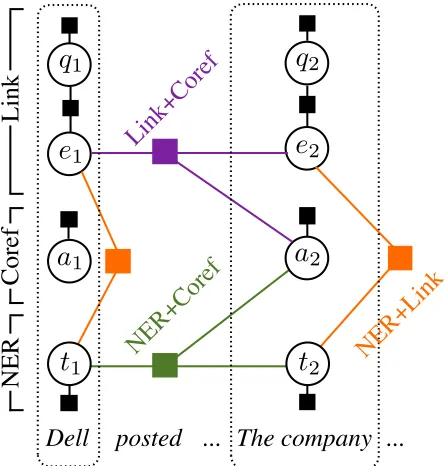
Figure 4: Factors that tie predictions between variables across tasks. Joint NER and entity linking factors (Sec-tion 3.2.1) tie semantic informa(Sec-tion from Wikipedia ar-ticles to semantic type predictions. Joint coreference and NER factors (Section 3.2.2) couple type decisions between mentions, encouraging consistent type assign-ments within an entity. Joint coreference and entity link-ing factors (Section 3.2.3) encourage relatedness between articles linked from coreferent mentions.
nary factors connectingqiandeithen decide which
title a given query should yield. These include: the rank of the article title among all possible ti-tles returned by that query (sorted by relative fre-quency count), whether the title is a close string match of the query, and whether the title matches the query up to a parenthetical (e.g.Paul Allen and
Paul Allen (editor)).
We could also at this point add factors between pairs of variables (ei, ej) to capture coherence
be-tween choices of linked entities. Integration with the rest of the model, learning, and inference would re-main unchanged. However, while such features have been employed in past entity linking systems (Rati-nov et al., 2011; Hoffart et al., 2011), Rati(Rati-nov et al. found them to be of limited utility, so we omit them from the present work.
3.2 Cross-task Interaction Factors
We now add factors that tie the predictions of multi-ple output variables in a feature-based way. Figure 4 shows the general structure of these factors. Each
couples variables from one pair of tasks. 3.2.1 Entity Linking and NER
We want to exploit the semantic information in Wikipedia for better semantic typing of mentions. We also want to use semantic types to disambiguate tricky Wikipedia links. We use three sources of semantics from Wikipedia (Kazama and Torisawa, 2007; Nothman et al., 2013):
• Categories (e.g. American financiers); used by Ponzetto and Strube (2006; Kazama and Torisawa (2007; Ratinov and Roth (2012)
• Infobox type (e.g.Person,Company)
• Copula in the first sentence (is a British politician); used for coreference previously in Haghighi and Klein (2009)
We fire features that conjoin the information from the selected Wikipedia article with the selected NER type. Because these types of information from Wikipedia are of a moderate granularity, we should be able to learn a mapping between them and NER types and exploit Wikipedia as a soft gazetteer. 3.2.2 Coreference and NER
Coreference can improve NER by ensuring con-sistent semantic type predictions across coreferent mentions; likewise, NER can help coreference by encouraging the system to link up mentions of the same type. The factors we implement for these pur-poses closely resemble the factors employed for la-tent semantic clusters in Durrett et al. (2013). That structure is as follows:
logFi−j(ai, ti, tj) =
(
0 ifai6=j
f(i, j, ti, tj) otherwise
That is, the features between the type variables for mentions iandj does not come into play unless i
andj are coreferent. Note that there are
quadrati-cally many such factors in the graph (before prun-ing; see Section 5), one for each ordered pair of mentions(j, i)with j < i. When scoring a
This model structure allows us to maintain uncer-tainty about coreference decisions but still propagate information along coreference arcs in a soft way.
Given this factor definition, we define features that should fire overcoreferentpairs of entity types. Our features target:
• The pair of semantic types for the current and antecedent mention
• The semantic type of the current mention and
the head of the antecedent mention, and the type of the antecedent and head of the current We found such monolexical features to improve over just type pairs and while not suffering from the spar-sity problems of bilexical features.
3.2.3 Coreference and Entity Linking
As we said in Section 2, coreferent mentions can actually have different entity links (e.g. Dell and
Company), so encouraging equality alone is less ef-fective for entity linking than it is for NER. Our fac-tors have the same structure as those for coreference-NER, but features now target overall semantic relat-edness of Wikipedia articles using the structure of Wikipedia by computing whether the articles have the same title, share any out links, or link to each other. More complex relatedness schemes such as those described in Ratinov et al. (2011) can be im-plemented in this framework. Nevertheless, these basic features still promise to help identify related articles as well as name variations by exploiting the abundance of entity mentions on Wikipedia.
4 Learning
Our training data consists ofddocuments, where a
given document consists of a tuple (x, C∗,t∗,e∗). Gold-standard labels for types (t∗) and entity links (e∗) are provided directly, while supervision for coreference is provided in the form of a clustering
C∗. Regardless, we can simply marginalize over the
uncertainty abouta∗ and form the conditional log-likelihood of the training labels as follows:
L(θ) =
d
X
i=1
log X
a∗∈A(C∗
i)
p(a∗,t∗i,e∗i|x;θ)
whereA(C∗)is the set of antecedent structures con-sistent with the gold annotation: the first mention in
a cluster must pick the NEW label and subsequent mentions must pick an antecedent from the set of those preceding them in the cluster. This marginal-ization over latent structure has been employed in prior work as well (Fernandes et al., 2012; Durrett and Klein, 2013).
We adapt this objective to exploit parameterized loss functions for each task by modifying the distri-bution as follows:
p0(a,t,e|x;θ)∝p(a,t,e, x) exp [αc`c(a, C∗)
+αt`t(t,t∗) +αe`e(e,e∗)]
where`c,`t, and`e are task-specific loss functions
with weight parametersα. This technique,
softmax-margin, allows us to shape the distribution learned by the model and encourage the model to move probability mass away from outputs that are bad ac-cording to our loss functions (Gimpel and Smith, 2010). As in Durrett and Klein (2013), we take
αc = 1 and use`cas defined there, penalizing the
model byαc,FA = 0.1for linking up a mention that
should have been nonanaphoric, by αc,FN = 3for
calling nonanaphoric a mention that should have an antecedent, and byαc,WL= 1for picking the wrong
antecedent for an anaphoric mention. `t and`e are
simply Hamming distance, withαt= 3andαe= 0
for all experiments. We found that the outcome of learning was not particularly sensitive to these pa-rameters.7
We optimize our objective using AdaGrad (Duchi et al., 2011) with L1 regularization andλ= 0.001.
Our final objective is
L(θ) =
d
X
i=1
log X
a∗∈A(C∗
i)
p0(a∗,t∗i,e∗i|x;θ)+λkθk1
This objective is nonconvex, but in practice we have found that it is very stable. One reason is that for any mention that has fewer than two antecedents in its cluster, all elements ofA(C∗) only contain one possibility for that mention, and even for mentions with ambiguity, the parameters that the model ends up learning tend to place almost all of the probability mass consistently on one antecedent.
Dev Test
MUC B3 CEAF
e Avg. NER Link MUC B3 CEAFe Avg. NER Link
INDEP. 77.95 74.81 71.84 74.87 83.04 73.07 81.03 74.89 72.56 76.16 82.35 74.71
JOINT 79.41 75.56 73.34 76.10 85.94 75.69 81.41 74.70 72.93 76.35 85.60 76.78
[image:7.612.74.538.53.116.2]∆ +1.46 +0.75 +1.50 +1.23 +2.90 +2.62 +0.42 −0.19 +0.37 +0.19 +3.25 +2.07 Table 1: Results on the ACE 2005 dev and test sets for the INDEP. (task-specific factors only) and JOINTmodels.
Coreference metrics are computed using their reference implementations (Pradhan et al., 2014). We report accuracy on NER because the set of mentions is fixed and all mentions have named entity types. Coreference and NER are compared to prior work in a more standard setting in Section 6.3. Finally, we also report accuracy of our entity linker (including links toNIL); entity linking is analyzed more thoroughly in Table 2. Bolded values represent statistically
significant improvements withp <0.05according to a bootstrap resampling test.
5 Inference
For both learning and decoding, inference consists of computing marginals for individual variables or for sets of variables adjacent to a factor. Exact infer-ence is intractabile due to our factor graph’s loopi-ness; however, we can still perform efficient infer-ence using belief propagation, which has been suc-cessfully employed for a similar model (Durrett et al., 2013) as well as for other NLP tasks (Smith and Eisner, 2008; Burkett and Klein, 2012). Marginals typically converge in 3-5 iterations of belief propa-gation; we use 5 iterations for all experiments.
However, belief propagation would still be quite computationally expensive if run on the full fac-tor graph as described in Section 3. In particu-lar, the factors in Section 3.2.2 and Section 3.2.3 are costly to sum over due to their ternary struc-ture and the fact that there are quadratically many of them in the number of mentions. The solu-tion to this is to prune the domains of the corefer-ence variables using a coarse model consisting of the coreference factors trained in isolation. Given marginals p0(ai|x), we prune values ai such that
logp0(ai|x) <logp0(a∗i|x)−kfor a threshold
pa-rameter k, which we set to 5 for our experiments; this is sufficient to prune over 90% of possible coref-erence arcs while leaving at least one possible gold link for 98% of mentions.8 With this optimization,
our full joint model could be trained for 20 iterations on the ACE 2005 corpus in around an hour.
We use minimum Bayes risk (MBR) decoding,
8In addition to inferential benefits, pruning an arc allows us to prune entire joint coreference factors and avoid instantiating their associated features, which reduces the memory footprint and time needed to build a factor graph.
where we compute marginals for each variable un-der the full model and independently return the most likely setting of each variable. Note that for coref-erence, this implies that we produce the MBR an-tecedent structure rather than the MBR clustering; the latter is much more computationally difficult to find and would be largely the same, since the poste-rior distributions of theaiare quite peaked.
6 Experiments
We present results on two corpora. First, we use the ACE 2005 corpus (NIST, 2005): this corpus anno-tates mentions complete with coreference, semantic types (per mention), and entity links (also per men-tion) later added by Bentivogli et al. (2010). We evaluate on gold mentions in this setting for com-parability with prior work on entity linking; we lift this restriction in Section 6.3.
Second, we evaluate on the OntoNotes 5 corpus (Hovy et al., 2006) as used in the CoNLL 2012 coreference shared task (Pradhan et al., 2012). This corpus does not contain gold-standard entity links, so we cannot evaluate this portion of our model, though the model still exploits the information from Wikipedia to make coreference and named entity de-cisions. We will compare to prior coreference and named entity work in the system mentions setting.
6.1 ACE Evaluation
Non-NILS NILS
Prec. Rec. F1 Prec. Rec. F1 Accuracy
FAHRNI 81.15 78.10 79.60 41.25 61.10 49.25 76.87
INDEP. 80.26 76.30 78.23 33.39 54.47 41.40 74.71
JOINT 83.26 77.67 80.37 35.19 65.42 45.77 76.78
[image:8.612.126.487.53.138.2]∆over INDEP. +3.00 +1.37 +2.14 +1.80 +10.95 +3.37 +2.07
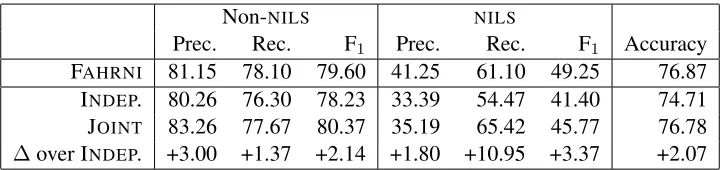
Table 2: Detailed entity linking results on the ACE 2005 test set. We evaluate both our INDEP. (task-specific factors
only) and JOINTmodels and compare to the results of the FAHRNImodel, a state-of-the-art entity linking system. We
[image:8.612.323.528.217.342.2]compare overall accuracy as well as performance at predictingNILS(mentions not in the knowledge base) and non-NILS. The JOINTmodel roughly matches the performance of FAHRNIand gives strong gains over the INDEP. system.
Table 1 shows our results. Coreference results are reported using MUC (Vilain et al., 1995),B3(Bagga
and Baldwin, 1998), and CEAFe (Luo, 2005), as
well as their average, the CoNLL metric, all com-puted from the reference implementation of the CoNLL scorer (Pradhan et al., 2014). We see that the joint model improves all three tasks compared to the individual task models in the baseline.
More in-depth entity linking results are shown in Table 2. We both evaluate on overall accuracy (how many mentions are correctly linked) as well as two more specific criteria: precision/recall/F1 of
non-NIL9predictions, and precision/recall/F1ofNIL
pre-dictions. This latter measure may be important if a system designer is trying to identify new entities in a document. We compare to the results of the best model from Fahrni and Strube (2014), which is a sophisticated discriminative model incorporating a latent model of mention scope.10
Our performance is similar to that of Fahrni and Strube (2014), though the results are not exactly comparable for two reasons. First, our models are trained on different datasets: Fahrni and Strube (2014) train on Wikipedia data whereas we train on the ACE training set. Second, they make use of the annotated head spans in ACE whereas we only use detected heads based on automatic parses. Note that this information is particularly beneficial for locat-ing the right query because “heads” may be multi-word expressions such asWest Bank as part of the phrasesouthern West Bank.
9NILis a placeholder for mentions which do not link to an article in Wikipedia.
10On the TAC datasets, this FAHRNImodel substantially out-performs Ratinov et al. (2011) and has comparable performance to Cheng and Roth (2013), hence it is quite competitive.
Coref NER Link
INDEP. 74.87 83.04 73.07 INDEP+LINKNER +1.85 +2.41
INDEP+COREFNER +0.56 +1.15
INDEP+COREFLINK +0.48 −0.16
JOINT−LINKNER +0.79 +1.28 −0.06 JOINT−COREFNER +0.56 +1.94 +2.07 JOINT−COREFLINK +0.85 +2.68 +2.57
JOINT +1.23 +2.90 +2.62
JOINT/LATENTLINK +1.26 +3.47 −18.8
Table 3: Results of model ablations on the ACE devel-opment set. We hold out each type of factor in turn from the JOINTmodel and add each in turn over the IN
-DEP. model. We evaluate the coreference performance
using the CoNLL metric, NER accuracy, and entity link-ing accuracy.
6.2 Model Ablations
To evaluate the importance of the different parts of the model, we perform a series of ablations on the model interaction factors. Table 3 shows the results of adding each interaction factor in turn to the base-line and removing each of the three interaction fac-tors from the full joint model (see Figure 4).
Link–NER interactions. These joint factors are
the strongest out of any considered here and give large improvements to entity linking and NER. Their utility is unsurprising: effectively, they give NER ac-cess to a gazetteer that it did not have in the baseline model. Moreover, our relatively rich featurization of the semantic information on Wikipedia allows the model to make effective use of it.
Coref–NER interactions. These are moderately
re-liable semantic types allows the coreference system to be bolder about linking up mention pairs that do not exhibit direct head matches. Part of this is due to our use of monolexical features, which are fine-grained enough to avoid the problems with coarse semantic type matching (Durrett and Klein, 2013) but still effectively learnable.
Coref–Link interactions. These are the least
use-ful of any of the major factors, providing only a small benefit to coreference. This is likely a re-sult of the ACE entity linking annotation standard: a mention likethe companyis not linked to the spe-cific company it refers to, but instead the Wikipedia article Company. Determining the relatedness of
Company to an article like Dell is surprisingly difficult: many related articles share almost no out-links and may not explicitly link to one another. Further feature engineering could likely improve the utility of these factors.
The last line of Table 3 shows the results of an ex-periment where the entity links were not observed during training, i.e. they were left latent. Unsur-prisingly, the system is not good at entity linking; however, the model is still able to do as well or even slightly better on coreference and named entity recognition. A possible explanation for this is that even the wrong Wikipedia link can in many cases provide correct semantic information: for example, not knowing whichDonald Laytonis being referred to is irrelevant for the question of determining that he is a PERSONand may also have little impact on coreference performance. This result indicates that the joint modeling approach is not necessarily de-pendent on having all tasks annotated. The model can make use of cross-task information even when that information comes via latent variables.
6.3 OntoNotes Evaluation
The second part of our evaluation uses the datasets from the CoNLL 2012 Shared Task (Pradhan et al., 2012), specifically the coreference and NER anno-tations. All experiments use the standard automatic parses from the shared task and mentions detected according to the method of Durrett and Klein (2013). Evaluating on OntoNotes carries with it a few complications. First, gold-standard entity linking annotations are not available; we can handle this by
a
1a
2e
1e
2q
1q
2t
1t
2Dell
}
O B-ORG I-ORG ...... NER+Core
f
Link+Core
f
NER+L
ink
The company ...
t
8t
9 [image:9.612.319.538.44.262.2]posted ...
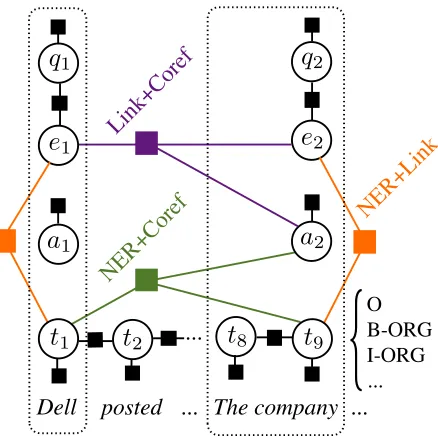
Figure 5: Modified factor graph for OntoNotes-style an-notations, where NER chunks can now diverge from men-tions for the other two tasks. NER is now modeled with token-synchronous random variables taking values in a BIO tagset. Factors coupling NER and the other tasks now interact with the NER chain via the NER nodes as-sociated with the heads of mentions.
leaving theeivariables in our model latent. Second,
and more seriously, NER chunks are no longer the same as coreference mentions, so our assumption of fixed NER spans no longer holds.
6.3.1 Divergent Coreference and NER
MUC B3 CEAFe Avg.
Prec. Rec. F1 Prec. Rec. F1 Prec. Rec. F1 F1
BERKELEY 72.85 65.87 69.18 63.55 52.47 57.48 54.31 54.36 54.34 60.33
FERNANDES − − 70.51 − − 57.58 − − 53.86 60.65
[image:10.612.83.528.52.151.2]BJORKELUND 74.30 67.46 70.72 62.71 54.96 58.58 59.40 52.27 55.61 61.63 INDEP. 72.25 69.30 70.75 60.92 55.73 58.21 55.33 54.14 54.73 61.23 JOINT 72.61 69.91 71.24 61.18 56.43 58.71 56.17 54.23 55.18 61.71
Table 4: CoNLL metric scores for our systems on the CoNLL 2012 blind test set, compared to Durrett and Klein (2013) (the Berkeley system), Fernandes et al. (2012) (the winner of the CoNLL shared task), and Bj¨orkelund and Kuhn (2014) (the best reported results on the dataset to date). INDEP. and JOINTare the contributions of this work;
JOINTimproves substantially over INDEP. (these improvements are statistically significant withp <0.05according
to a bootstrap resampling test) and achieves state-of-the-art results.
Cross-task factors that previously would have fired features based on the NE type for a whole tion now instead consult the NE type of that men-tion’s head.11 In Figure 5, this can be seen with
fac-tors involvinge2anda2touchingt9 (company), the
head of the second mention. Since the chain struc-ture enforces consistency between adjacent labels, features that strongly prefer a particular label on one node of a mention will implicitly affect other nodes in that mention and beyond.
Training and inference proceed as before, with a slight modification: instead of computing the MBR setting of every variable in isolation, we instead compute the MBR sequence of labeled NER chunks to avoid the problem of producing inconsistent tag sequences, e.g. O I-PERorB-PER I-ORG.
6.3.2 Results
Table 4 shows coreference results from our IN-DEP. and JOINT models compared to three strong systems: Durrett and Klein (2013), Fernandes et al. (2012) (the winner of the CoNLL shared task), and Bj¨orkelund and Kuhn (2014) (the best reported re-sults on the dataset). Our JOINT method outper-forms all three as well as the INDEP. system.12
Next, we report results on named entity recogni-tion. We use the same OntoNotes splits as for the coreference data; however, the New Testament (NT) 11The NER-coreference portion of the model now resembles the skip-chain CRF from Finkel et al. (2005), though with soft coreference.
12The systems of Chang et al. (2013) and Webster and Curran (2014) perform similarly to the FERNANDESsystem; changes in the reference implementation of the metrics make exact com-parison to printed numbers difficult.
Prec. Rec. F1
ILLINOIS 82.00 84.95 83.45
PASSOS − − 82.24
INDEP. 83.79 81.53 82.64
JOINT 85.22 82.89 84.04
[image:10.612.339.515.242.327.2]∆over INDEP. +1.43 +1.36 +1.40
Table 5: Results for NER tagging on the OntoNotes 5.0 / CoNLL 2011 test set. We compare our systems to the Illinois system (Ratinov and Roth, 2009) and the system of Passos et al. (2014). Our model outperforms both other systems in terms of F1, and once again joint modeling
gives substantial improvements over our baseline system.
portion of the CoNLL 2012 test set does not have gold-standard named entity annotations, so we omit it from our evaluation. This leaves us with exactly the CoNLL 2011 test set. We compare to two ex-isting baselines from the literature: the Illinois NER system of Ratinov and Roth (2009) and the results of Passos et al. (2014). Table 5 shows that we out-perform both prior systems in terms of F1, though
the ILLINOISsystem features higher recall while our system features higher precision.
7 Related Work
corefer-ence links between different entities, and use seman-tic information to make additional coreference links. Zheng et al. (2013) build coreference clusters greed-ily left-to-right and maintain entity link information for each cluster, namely a list of possible targets in the knowledge base as well as a current best link tar-get that is used to extract features (though that might not be the target that is chosen by the end of infer-ence). Cheng and Roth (2013) use coreference as a preprocessing step for entity linking and then solve an ILP to determine the optimal entity link assign-ments for each mention based on surface properties of that mention, other mentions in its cluster, and other mentions that it is related to. Compared to these systems, our approach maintains greater un-certainty about all random variables throughout ference and uses features to capture cross-task in-teractions as opposed to rules or hard constraints, which can be less effective for incorporating seman-tic knowledge (Lee et al., 2011).
The joint model most closely related to ours is that of Singh et al. (2013), modeling coreference, named entity recognition, and relation extraction. Their techniques differ from ours in a few notable ways: they choose a different objective function than we do and also opt to freeze the values of certain vari-ables during the belief propagation process rather than pruning with a coarse pass. Sil and Yates (2013) jointly model NER and entity linking in such a way that they maintain uncertainty over mention bound-aries, allowing information from Wikipedia to in-form segmentation choices. We could strengthen our model by integrating this capability; however, the primary cause of errors for mention detection on OntoNotes is parsing ambiguities rather than named entity ambiguities, so we would be unlikely to see improvements in the experiments presented here. Beyond maintaining uncertainty over men-tion boundaries, we might also consider maintain-ing uncertainty over the entire parse structure, as in Finkel and Manning (2009), who consider parsing and named entity recognition together with a PCFG.
8 Conclusion
We return to our initial motivation for joint model-ing, namely that the three tasks we address have the potential to influence one another. Table 3 shows
that failing to exploit any of the pairwise interac-tions between the tasks causes lower performance on at least one of them. Therefore, any pipelined sys-tem would necessarily underperform a joint model on whatever task came first in the pipeline, which is undesirable given the importance of these tasks. The trend towards broader and deeper NLP pipelines will only exacerbate this problem and make it more dif-ficult to find a suitable pipeline ordering. In addition to showing that joint modeling is high-performing, we have also shown that it can be implemented with relatively low overhead, requiring no fundamentally new learning or inference techniques, and that it is extensible, due to its modular structure and natural partitioning of features. Taken together, these as-pects make a compelling case that joint models can provide a way to integrate deeper levels of process-ing, particularly for semantic layers of annotation, and that this modeling power does not need to come at the expense of computational efficiency, structural simplicity, or modularity.
The Berkeley Entity Resolution System is avail-able athttp://nlp.cs.berkeley.edu.
Acknowledgments
This work was partially supported by BBN under DARPA contract HR0011-12-C-0014, by an NSF fellowship for the first author, and by a Google Fac-ulty Research Award to the second author. Thanks to Angela Fahrni for helpful discussions about en-tity linking and for providing system output, to the anonymous reviewers for their insightful comments, and to our action editor Jason Eisner.
References
Amit Bagga and Breck Baldwin. 1998. Algorithms for Scoring Coreference Chains. In Proceedings of the Conference on Language Resources and Evaluation Workshop on Linguistics Coreference.
Mohit Bansal and Dan Klein. 2012. Coreference Seman-tics from Web Features. InProceedings of the Associ-ation for ComputAssoci-ational Linguistics.
The People’s Web Meets NLP: Collaboratively Con-structed Semantic Resources.
Anders Bj¨orkelund and Jonas Kuhn. 2014. Learn-ing Structured Perceptrons for Coreference Resolution with Latent Antecedents and Non-local Features. In Proceedings of the Association for Computational Lin-guistics.
David Burkett and Dan Klein. 2012. Fast Inference in Phrase Extraction Models with Belief Propagation. In Proceedings of the North American Chapter of the As-sociation for Computational Linguistics.
Kai-Wei Chang, Rajhans Samdani, and Dan Roth. 2013. A Constrained Latent Variable Model for Coreference Resolution. InProceedings of the Conference on Em-pirical Methods in Natural Language Processing. Xiao Cheng and Dan Roth. 2013. Relational Inference
for Wikification. InProceedings of the Conference on Empirical Methods in Natural Language Processing. Silviu Cucerzan. 2007. Large-Scale Named Entity
Dis-ambiguation Based on Wikipedia Data. In Proceed-ings of the Joint Conference on Empirical Methods in Natural Language Processing and Computational Natural Language Learning (EMNLP-CoNLL). Hal Daum´e, III and Daniel Marcu. 2005. A Large-scale
Exploration of Effective Global Features for a Joint Entity Detection and Tracking Model. InProceedings of the Conference on Empirical Methods in Natural Language Processing.
Pascal Denis and Jason Baldridge. 2008. Specialized Models and Ranking for Coreference Resolution. In Proceedings of the Conference on Empirical Methods in Natural Language Processing.
Mark Dredze, Paul McNamee, Delip Rao, Adam Ger-ber, and Tim Finin. 2010. Entity Disambiguation for Knowledge Base Population. InProceedings of the In-ternational Conference on Computational Linguistics. John Duchi, Elad Hazan, and Yoram Singer. 2011. Adaptive Subgradient Methods for Online Learning and Stochastic Optimization. Journal of Machine Learning Research, 12:2121–2159, July.
Greg Durrett and Dan Klein. 2013. Easy Victories and Uphill Battles in Coreference Resolution. In Proceed-ings of the Conference on Empirical Methods in Natu-ral Language Processing, October.
Greg Durrett, David Hall, and Dan Klein. 2013. Decen-tralized Entity-Level Modeling for Coreference Reso-lution. InProceedings of the Association for Compu-tational Linguistics.
Angela Fahrni and Michael Strube. 2014. A Latent Variable Model for Discourse-aware Concept and En-tity Disambiguation. InProceedings of the European Chapter of the Association for Computational Linguis-tics.
Eraldo Rezende Fernandes, C´ıcero Nogueira dos Santos, and Ruy Luiz Milidi´u. 2012. Latent Structure Per-ceptron with Feature Induction for Unrestricted Coref-erence Resolution. InProceedings of the Joint Con-ference on Empirical Methods in Natural Language Proceedings and Conference on Computational Nat-ural Language Learning - Shared Task.
Jenny Rose Finkel and Christopher D. Manning. 2009. Joint Parsing and Named Entity Recognition. In Pro-ceedings of the North American Chapter for the Asso-ciation for Computational Linguistics.
Jenny Rose Finkel, Trond Grenager, and Christopher Manning. 2005. Incorporating Non-local Information into Information Extraction Systems by Gibbs Sam-pling. InProceedings of the Association for Computa-tional Linguistics.
Kevin Gimpel and Noah A. Smith. 2010. Softmax-Margin CRFs: Training Log-Linear Models with Cost Functions. In Proceedings of the North American Chapter for the Association for Computational Lin-guistics.
Yuhang Guo, Bing Qin, Yuqin Li, Ting Liu, and Sheng Li Li. 2013. Improving Candidate Generation for Entity Linking. InNatural Language Processing and Infor-mation Systems.
Ben Hachey, Will Radford, Joel Nothman, Matthew Hon-nibal, and James R. Curran. 2013. Evaluating En-tity Linking with Wikipedia. Artificial Intelligence, 194:130–150, January.
Aria Haghighi and Dan Klein. 2009. Simple Coreference Resolution with Rich Syntactic and Semantic Features. InProceedings of the Conference on Empirical Meth-ods in Natural Language Processing.
Aria Haghighi and Dan Klein. 2010. Coreference Res-olution in a Modular, Entity-Centered Model. In Pro-ceedings of the North American Chapter of the Asso-ciation for Computational Linguistics.
Hannaneh Hajishirzi, Leila Zilles, Daniel S. Weld, and Luke Zettlemoyer. 2013. Joint Coreference Res-olution and Named-Entity Linking with Multi-Pass Sieves. InProceedings of the Conference on Empir-ical Methods in Natural Language Processing. Johannes Hoffart, Mohamed Amir Yosef, Ilaria Bordino,
Hagen F¨urstenau, Manfred Pinkal, Marc Spaniol, Bilyana Taneva, Stefan Thater, and Gerhard Weikum. 2011. Robust Disambiguation of Named Entities in Text. InProceedings of the Conference on Empirical Methods in Natural Language Processing.
Heng Ji and Ralph Grishman. 2011. Knowledge Base Population: Successful Approaches and Challenges. In Proceedings of the Association for Computational Linguistics.
Jun’ichi Kazama and Kentaro Torisawa. 2007. Exploit-ing Wikipedia as External Knowledge for Named En-tity Recognition. InProceedings of the Joint Confer-ence on Empirical Methods in Natural Language Pro-cessing and Computational Natural Language Learn-ing.
Terry Koo, Xavier Carreras, and Michael Collins. 2008. Simple Semi-supervised Dependency Parsing. In Pro-ceedings of the Association for Computational Lin-guistics.
John D. Lafferty, Andrew McCallum, and Fernando C. N. Pereira. 2001. Conditional Random Fields: Proba-bilistic Models for Segmenting and Labeling Sequence Data. InProceedings of the International Conference on Machine Learning.
Heeyoung Lee, Yves Peirsman, Angel Chang, Nathanael Chambers, Mihai Surdeanu, and Dan Jurafsky. 2011. Stanford’s Multi-Pass Sieve Coreference Resolution System at the CoNLL-2011 Shared Task. In Proceed-ings of the Conference on Computational Natural Lan-guage Learning: Shared Task.
Qi Li and Heng Ji. 2014. Incremental Joint Extraction of Entity Mentions and Relations. InProceedings of the Association for Computational Linguistics.
Xiaoqiang Luo. 2005. On Coreference Resolution Per-formance Metrics. InProceedings of the Conference on Empirical Methods in Natural Language Process-ing.
David Milne and Ian H. Witten. 2008. Learning to Link with Wikipedia. InProceedings of the Conference on Information and Knowledge Management.
Vincent Ng. 2010. Supervised Noun Phrase Coreference Research: The First Fifteen Years. InProceedings of the Association for Computational Linguistics. NIST. 2005. The ACE 2005 Evaluation Plan. InNIST. Joel Nothman, Nicky Ringland, Will Radford, Tara
Mur-phy, and James R. Curran. 2013. Learning Multilin-gual Named Entity Recognition from Wikipedia. Arti-ficial Intelligence, 194:151–175, January.
Alexandre Passos, Vineet Kumar, and Andrew McCal-lum. 2014. Lexicon Infused Phrase Embeddings for Named Entity Resolution. InProceedings of the Con-ference on Computational Natural Language Learn-ing.
Slav Petrov, Leon Barrett, Romain Thibaux, and Dan Klein. 2006. Learning Accurate, Compact, and Inter-pretable Tree Annotation. InProceedings of the Con-ference on Computational Linguistics and the Associ-ation for ComputAssoci-ational Linguistics.
Simone Paolo Ponzetto and Michael Strube. 2006. Exploiting Semantic Role Labeling, WordNet and Wikipedia for Coreference Resolution. In Proceed-ings of the North American Chapter of the Association of Computational Linguistics.
Sameer Pradhan, Lance Ramshaw, Mitchell Marcus, Martha Palmer, Ralph Weischedel, and Nianwen Xue. 2011. CoNLL-2011 Shared Task: Modeling Unre-stricted Coreference in OntoNotes. InProceedings of the Conference on Computational Natural Language Learning: Shared Task.
Sameer Pradhan, Alessandro Moschitti, Nianwen Xue, Olga Uryupina, and Yuchen Zhang. 2012. CoNLL-2012 Shared Task: Modeling Multilingual Unre-stricted Coreference in OntoNotes. In Joint Confer-ence on EMNLP and CoNLL - Shared Task.
Sameer Pradhan, Xiaoqiang Luo, Marta Recasens, Ed-uard Hovy, Vincent Ng, and Michael Strube. 2014. Scoring Coreference Partitions of Predicted Mentions: A Reference Implementation. InProceedings of the Association for Computational Linguistics.
Karthik Raghunathan, Heeyoung Lee, Sudarshan Ran-garajan, Nathanael Chambers, Mihai Surdeanu, Dan Jurafsky, and Christopher Manning. 2010. A Multi-Pass Sieve for Coreference Resolution. In Proceed-ings of the Conference on Empirical Methods in Natu-ral Language Processing.
Altaf Rahman and Vincent Ng. 2011. Coreference Res-olution with World Knowledge. In Proceedings of the Association for Computational Linguistics: Hu-man Language Technologies.
Lev Ratinov and Dan Roth. 2009. Design Challenges and Misconceptions in Named Entity Recognition. In Proceedings of the Conference on Computational Nat-ural Language Learning.
Lev Ratinov and Dan Roth. 2012. Learning-based Multi-sieve Co-reference Resolution with Knowledge. In Proceedings of the Joint Conference on Empirical Methods in Natural Language Processing and Com-putational Natural Language Learning.
Lev Ratinov, Dan Roth, Doug Downey, and Mike Ander-son. 2011. Local and Global Algorithms for Disam-biguation to Wikipedia. InProceedings of the Associ-ation for ComputAssoci-ational Linguistics.
Avirup Sil and Alexander Yates. 2013. Re-ranking for Joint Named-Entity Recognition and Linking. In Pro-ceedings of the International Conference on Informa-tion and Knowledge Management.
David A. Smith and Jason Eisner. 2008. Dependency Parsing by Belief Propagation. InProceedings of the Conference on Empirical Methods in Natural Lan-guage Processing.
Wee Meng Soon, Hwee Tou Ng, and Daniel Chung Yong Lim. 2001. A Machine Learning Approach to Coref-erence Resolution of Noun Phrases. Computational Linguistics, 27(4):521–544, December.
Veselin Stoyanov, Nathan Gilbert, Claire Cardie, and Ellen Riloff. 2009. Conundrums in Noun Phrase Coreference Resolution: Making Sense of the State-of-the-Art. InProceedings of the Association for Com-putational Linguistics.
Veselin Stoyanov, Claire Cardie, Nathan Gilbert, Ellen Riloff, David Buttler, and David Hysom. 2010. Coref-erence Resolution with Reconcile. InProceedings of the Association for Computational Linguistics: Short Papers.
Marc Vilain, John Burger, John Aberdeen, Dennis Con-nolly, and Lynette Hirschman. 1995. A Model-Theoretic Coreference Scoring Scheme. In Proceed-ings of the Conference on Message Understanding. Kellie Webster and James R. Curran. 2014. Limited
Memory Incremental Coreference Resolution. In Pro-ceedings of the Conference on Computational Linguis-tics.
Tong Zhang and David Johnson. 2003. A Robust Risk Minimization Based Named Entity Recognition Sys-tem. In Proceedings of the Conference on Natural Language Learning.