International Journal of Innovative Technology and Exploring Engineering (IJITEE) ISSN: 2278-3075, Volume-8 Issue-12, October 2019
Abstract: Now-a-days artificial intelligence has become an asset for engineering and experimental studies, just like statistics and calculus. Data science is a growing field for researchers and artificial intelligence, machine learning and deep learning are roots of it. This paper describes the relation between these roots of data science. There is a need of machine learning if any kind of analysis is to be performed. This study describes machine learning from the scratch. It also focuses on Deep Learning. Deep learning can also be known as new trend of machine learning. This paper gives a light on basic architecture of Deep learning. A comparative study of machine learning and deep learning is also given in the paper and allows researcher to have a broad view on these techniques so that they can understand which one will be preferable solution for a particular problem.
Keywords : Machine Learning, Deep learning, Artificial Intelligence, shallow learning.
I. INTRODUCTION
I
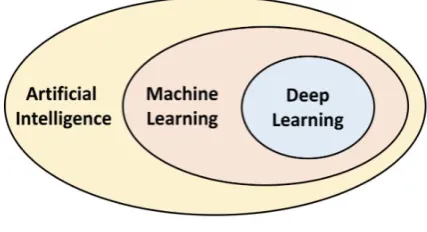
n the era of data sciences, artificial intelligence is trying to provide human kind intelligence to the computer and for this machine learning and deep learning are the technologies which are helping artificial intelligence to do it. Machine Learning is the branch or subset of artificial intelligence that train the machines how to learn. Deep learning is confined version of machine learning. It helps to raise the high standards of learning environment. Machine learning and deep learning both plays vital role in upgrading the computer systems to be an expert systems that can take decisions and make predictions without a human intervention.Artificial intelligence is a field which helps computer system to be intelligent and take decisions. Machine learning helps to implement Artificial Intelligence on the system and deep learning helps to achieve machine learning goals on the system more systematically. Figure 1 shows it pictorially.
This paper is divided into two parts. In section II, will explain machine learning, its procedures, its applications etc. In section III, Different approaches of machine learning are discussed such as deep learning and shallow learning. It describes each one’s different methods and different algorithms used by them. In section IV, a comparative study between deep learning and other conventional methods of machine learning.
Revised Manuscript Received on October 05, 2019.
* Correspondence Author
Ayushi Chahal*, Department of Computer Science and Applications,
Maharishi Dayanand University, Rohtak, India. Email:
Preeti Gulia, Department of Computer Science and Applications,
Maharishi Dayanand University, Rohtak, India. Email:
[image:1.595.324.538.149.265.2]Fig. 1. AI, machine learning and deep learning paradigm
II. MACHINELEARNING
Machine learning is based on the idea that system can learn from data, identify the patterns and make decision with minimum human intervention [2]. This is the scientific study of algorithms and statistical models with the help of which computer system perform a specific task without using instruction, inference and patterns. Machine learning algorithms build mathematical model based on sample data and then make the decision.
A. Machine learning procedure
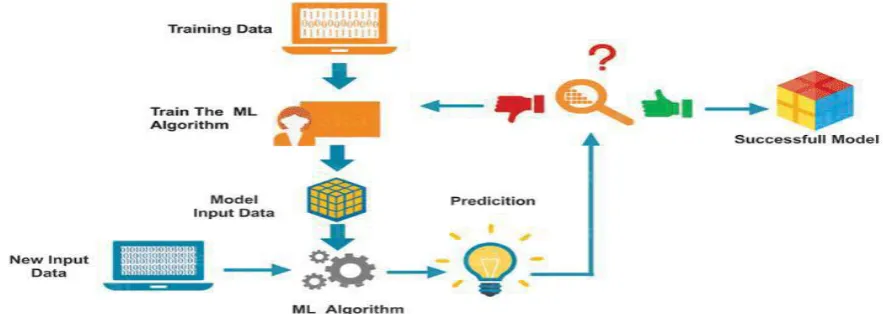
Machine learning incorporates four steps, given below (shown in the figure 2):
- First, feature extraction
- Second, selection of corresponding machine learning algorithm
- Third, training and evaluation the data model’s efficiency - Four, using trained model for prediction
B. Requirements to Create Good Machine Learning Systems:
Data preparation capabilities Basic and Advanced algorithms Scalability
Various processes i.e. Automation and Iterative Ensemble modeling
Machine Learning and Deep Learning
Fig. 2. Machine learning model
C. Relationship with Other Fields:
Machine learning is considered as the subset of artificial intelligence. In earlier days of AI as academic discipline, researchers were interested in having machine learn. They attempted to solve the problem with various symbolic methods as well as connectionist approach where neural network, pattern recognition are used. In 1990s, Machine learning is reorganized as a separate field. It shifted focus from symbolic approach to the methods and models of statistics and probability theory [4].
Relation to data mining: Both of these employ same methods often and overlap with each other. But machine learning focuses on prediction based on known properties while data mining focuses on the discovery of unknown properties. Data mining uses machine learning methods, machine learning also employs data mining methods; but with different goals or to improve the learner accuracy.
Relation to optimization: Machine learning is also intimated with optimization. Learning problems are formulated as minimization of loss function. Loss functions show the discrepancy between prediction of model and actual problem.
Relation to statistics: It is also closely related with statistics. The ideas of machine learning have had a relationship with statistics from methodological principles to theoretical tools such as the modeling paradigm.
D. Who’s Using Machine Learning?
As the industries grow, large volumes of data have been recognized. For handling that data, machine learning technology is required. With the machine learning, organizations are able to work more efficiently. Machine learning is used in following areas:
Financial services: In financial services, machine learning technology is used to identify the important insight in data and to prevent fraud. The insights help to identify investment opportunities or help investors to know when to trade. Data mining concepts also identify high risk profiles of clients or to pinpoint warning signs of fraud.
Health Care: This is the major area in which wearable devices and sensors are used to assess patient’s health in real time. Machine learning also helps medical experts to analyze the data to identify trends. This may lead to improve diagnoses and treatment.
Government sector: Government agencies use machine learning to mine the data for insight where agencies like public safety and utilities etc. have multiple sources of data. Sensor data analysis increases the efficiency and save money. Machine learning can also be used for security purpose i.e. help to detect fraud and to minimize the identity theft.
Retail sector: In retail sector, machine learning is used to analyze the buying history of customers. Retailers rely on machine learning to capture data, analyze and use it to personalize the shopping experience. It is also helpful to implement the marketing campaign, optimizing price, and for customer insights.
Transportation: Machine learning is used to make routes more efficient and to predict the problems to increase profitability. It can be done after analyzing the data to identify patterns and trends. Data analysis and modeling aspects are key factors to delivery companies and transportation organizations.
Oil and gas: In this sector, machine learning is used to find new energy source and to analyze minerals in ground. It is also used to predict refinery sensor failure. Streamlining oil distribution makes it more efficient and economic.
E. Processes and Techniques associated with machine learning:
A number of processes, techniques and methods can be applied to enhance the performance of machine learning and these are as follows:
Feature learning
Sparse dictionary learning Anomaly detection Decision tree Association rules
F. Applications of Machine learning:
There are many applications of machine learning such as: Adaptive websites
Bioinformatics
Brain-machine interface Computer vision Data quality
DNA sequence classification handwriting recognition Machine learning control
International Journal of Innovative Technology and Exploring Engineering (IJITEE) ISSN: 2278-3075, Volume-8 Issue-12, October 2019
III. MACHINELEARNINGAPPROACHES
[image:3.595.55.277.142.279.2]Basically, Machine learning methods are broadly categorized in two categories i.e. Shallow learning and deep learning [16]. Shallow learning basically uses neural networks with single layers or SVMs (Support Vector Machines) while deep learning uses neural network with more than one hidden layers. As shown in figure 3:
Fig. 3. Different approach of machine learning
A. Shallow Learning
Shallow learning is broadly divided into two categories: Supervised and Unsupervised Learning. But there are also other methods of machine learning. Overview of popular methods is as follows:
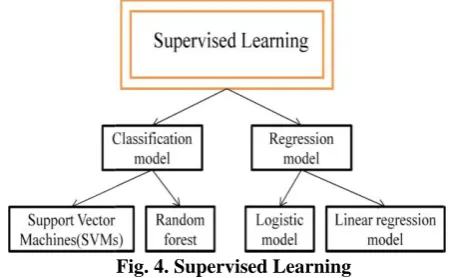
Supervised learning: In supervised learning, algorithm builds a mathematical model from a set of data that contains both the input and desired outputs.(wiki) These algorithms are trained using labeled examples i.e. input and desired outputs are known. In this learning, algorithm receives a set of inputs along with corresponding correct outputs. Algorithm learns by comparing its actual output with correct outputs to find out errors. Then, model is modified accordingly. Classification, regression, prediction and gradient boosting are the example of supervised learning which use pattern to predict the values. This learning is commonly used in those applications where historical data predicts future events. Classification and regression are the tasks that are performed by supervised learning. Some examples of supervised machine learning are Nearest neighbor, Naïve Bayes, Decision Tree, Regression Tree etc. Figure 4 gives the pictorial view of different method of supervised learning.
Unsupervised learning: In unsupervised learning, a mathematical model is to be built from a set of data which contains only inputs. Desired output labels are not present in this type of learning. Unsupervised learning is used against that data which doesn’t consists historical label. K-means, Association Rules are an example of such algorithms. Figure 5 describes different methods of unsupervised learning.
Fig. 4. Supervised Learning
Semi-supervised learning: In some cases, input may be only partially available, or restricted to special feedback. At that time, these algorithms are used. These are used to develop mathematical model from incomplete training data, where a portion of the sample input doesn’t consist labels. This learning is useful when cost of labeling is too high to allow for fully labeled training process.
Reinforcement learning: This is the area of learning concerned with how software agents take actions in an environment to maximize the cumulative reward. In this type of learning, a feedback is to be given in the form of positive or negative reinforcement in a dynamic environment. These are commonly used in autonomous vehicle or in learning to play game againsthumanopponent [3]. Q-learning is an example of reinforcement learning.
Active learning: Desired outputs are accessed for a limited set of inputs. In this learning, the inputs are based on budget, and optimize the choice of inputs for which output will be acquired.
[image:3.595.313.548.337.496.2] Meta learning: Here, algorithms learn their own inductive bias based on previous experiences. Some examples of meta learning are Bagging, Boosting, Random Forest.
Fig. 5. Unsupervised Learning
B. Deep Learning
Deep learning is a set of algorithms of machine learning which uses multiple layers that corresponds to different level of abstraction to each level. . It consists of input layer, output layer and several hidden layer. It is used for voice synthesis, image processing, handwriting recognition, object detection, prediction analytics and decision making. [10] Deep learning can be broadly classified into three types (figure 6):
[image:3.595.67.546.599.838.2] [image:3.595.64.289.645.784.2] Generative models: Generative models are used for unsupervised learning. It includes algorithms like Deep Belief Network (DBN), Deep auto-encoders, Deep Boltzmann (DBM).
Discriminative models: Discriminative models usually provide supervised learning approaches. It involves Convolution Neural Network (CNN), Deep Stacking Network (DSN).
Hybrid models: Hybrid models incorporate the benefits of both discriminative and generative models. Deep Neural network (DNN) is an example of hybrid models.
C. Deep Learning architecture
Deep Learning consists of supervised or unsupervised learning techniques based on many layers of artificial neural networks that are able to learn hierarchical representations in deep architectures. [11] It is extended version of artificial neural network. Deep Learning architectures consist of multiple processing layers. Each layer is able to produce non-linear responses based on the data from its input layer.
[image:4.595.92.493.186.316.2]The functionality of Deep Learning is imitated from the mechanisms of human brain and neurons for processing of
Fig. 8. Deep Neural network signals. Deep Learning architectures have gained more
attention in recent years compared to the other traditional machine learning approaches. Such approaches are considered as being shallow-structured learning architectures versions (i.e., a limited subset) of Deep Learning.
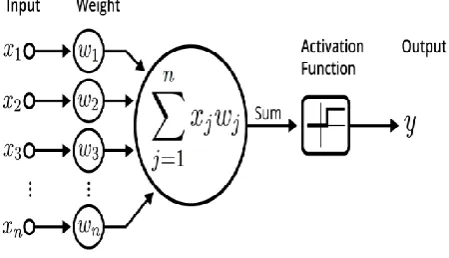
[image:4.595.309.551.490.834.2]A Deep Neural Network consists of an input layer, severalhidden layers, and an output layer. Each layer includes severalunits called neurons. These neurons are also called as artificial neurons. A neuron receives several inputs, performs a weighted summation over its inputs, then the resulting sum goes through an activation function to produce an output. Each neuron has a vector of weights associated to its input size as well as a bias that should be optimized during the training process. Figure 7 below shows the structure of neuron.
Fig. 7. Structure of a neuron
When these artificial neurons are assigned sequentially which makes a chain as one neurons output becomes input of next neuron, and this process goes on over and over which makes a Artificial Neural Network. Deep Learning Neural Networks consists of more than one hidden layer as shown below in figure 8.
IV. DEEPLEARNINGCOMPARISONWITH
CONVENTIONALMACHINELEARNING
TECHNIQUES
Deep learning is a new era of machine learning. Deep learning includes both supervised and unsupervised learning paradigm of machine learning. Machine learning and deep learning helps in providing intelligence to the system that can make prediction for future using past data.[12]
Conventional machine learning algorithms can’t learn directly from the raw data. They need careful engineering to carefully extract features from raw data and highly classified domain expertise, which are further used to in internal representations to identify these feature’s patterns. In Deep Learning, first step of machine learning procedure is not present. This step is automated in deep learning. Deep Learning can extract new features automatically from raw data. Figure 9 shows this point clearly [13].
[image:4.595.56.281.526.655.2]International Journal of Innovative Technology and Exploring Engineering (IJITEE) ISSN: 2278-3075, Volume-8 Issue-12, October 2019
Deep learning algorithms work more accurately on large Data set as compared to conventional machine learning algorithms. While machine learning algorithms outperforms deep learning in case of small or medium size datasets. [14]
Deep learning algorithms take less time to infer a problem as compared to conventional machine learning algorithms Deep learning performs a high amount of matrix multiple
hence it needs powerful engine preferably GPU (Graphical Processing Units) or specially designed TPU (Tensor Processing Units) while other conventional machine learning algorithms can work on low end machines. Deep learning algorithms are difficult to impossible to
interpret. Some of the machine learning algorithms like (logistics, decision tree) can be interpreted easily while some (like SVM) are almost impossible to interpret. [15] Training time for data to create the model is more in deep
learning as compared to other machine learning algorithms.
V. CONCLUSION
This article examined the concepts of machine learning. Machine learning has gained a lot of attention of researchers nowadays due to its distinct features. Firstly, the article specified the points to make a good machine learning system. Followed by this, the usage and applications of machine learning have been discussed in this article. However the road of machine learning is not as simple as it looks to be. There are some challenges in this area to get the expected results such as lack of suitable data, data bias, and lack of resources, privacy problems and evaluation problems. This paper crates a broad view for a researcher for machine learning by categorizing it into two parts, namely: shallow learning and deep learning. Supervised and unsupervised machine learning concepts are supposed to be in the category of shallow learning as these techniques use less number of hidden layers or SVMs. While deep learning is considered as a different category, because of its deep layered architecture discussed in the article.
Deep learning is a growing field in a sector of predictive analytics. This paper provides a comparative study of conventional methods of machine learning and deep learning which helps new researchers to choose which technique would be right to apply in a particular environment. Such as, if one is working on small training data set then he must use machine learning algorithms rather than deep learning while, if dataset needed to choose the features then one must use machine learning technique because in case of deep learning this feature selection procedure is automated researcher do not have to bother about it. This paper creates base for the researcher who wants to pursue research in field of artificial intelligence or predictive analytics.
REFERENCES
1. https://en.wikipedia.org/wiki/Machine_learning
2. https://www.sas.com › SAS Insights › Analytics Insights
3. Bishop, C. M. (2006), Pattern Recognition and Machine Learning,
Springer, ISBN978-0-387-31073-2
4. 11. Langley, Pat (2011). "The changing science of machine
learning". Machine Learning. 82 (3): 275–
279. Doi:10.1007/s10994-011-5242-y
5. Alpaydin, Ethem (2010). Introduction to Machine Learning. MIT
Press. p. 9. ISBN978-0-262-01243-0
6. Why Machine Learning Models Often Fail to Learn: QuickTake
Q&A". Bloomberg.com. 2016-11-10. Retrieved 2017-04-10.
7. "The First Wave of Corporate AI Is Doomed to Fail". Harvard Business Review. 2017-04-18. Retrieved 2018-08-20.
8. "Why the A.I. euphoria is doomed to fail". VentureBeat. 2016-09-18. Retrieved 2018-08-20.
9. "9 Reasons why your machine learning project will
fail". www.kdnuggets.com. Retrieved 2018-08-20.
10. P. Kuang, W.-N. Cao, and Q. Wu, “Preview on structures and
algorithms of deep learning,” in 2014 11th International Computer Conference on Wavelet Actiev Media Technology and Information Processing(ICCWAMTIP), Chengdu, China, 2014, pp. 176–179.
11. L. Deng, “Deep Learning: Methods and Applications,” Found.
Trends® Signal Process., vol. 7, no. 3–4, pp. 197–387, 2014.
12. J. L. Berral-García, “When and How to Apply Statistics, Machine
Learning and Deep Learning Techniques,” in 2018 20th International
Conference on Transparent Optical Networks (ICTON), 2018, pp. 1–4.
13. J. Latif, C. Xiao, A. Imran, and S. Tu, “Medical Imaging using
Machine Learning and Deep Learning Algorithms: A Review,” in 2019
2nd International Conference on Computing, Mathematics and Engineering Technologies (iCoMET), 2019, pp. 1–5.
14. N. G. Paterakis, E. Mocanu, M. Gibescu, B. Stappers, and W. van Alst,
“Deep learning versus traditional machine learning methods for
aggregated energy demand prediction,” in 2017 IEEE PES Innovative
Smart Grid Technologies Conference Europe (ISGT-Europe), 2017, pp. 1–6.
15. M. Sewak, S. K. Sahay, and H. Rathore, “Comparison of Deep
Learning and the Classical Machine Learning Algorithm for the
Malware Detection,” in 2018 19th IEEE/ACIS International
Conference on Software Engineering, Artificial Intelligence, Networking and Parallel/Distributed Computing (SNPD), 2018, pp. 293–296.
16. A. Jabeen, N. Ahmad, and K. Raza, “Machine Learning-based
state-of-the-art methods for the classification of RNA-Seq data,” Bioinformatics, preprint, Mar. 2017.
AUTHORSPROFILE
Ms. Ayushi Chahal has completed her M.Tech from GJUS&T University. She is currently pursuing Ph.D. in Computer Science at Department
of Computer Science & Applications,
M.D.University, Rohtak. Her main research area includes network security, Internet of Things (IoT), Machine Learning.
Dr. Preeti Gulia is currently working as Assistant Professor at Department of Computer Science & Applications, M.D.University, Rohtak, India. She is serving the Department since 2009. She earned her doctoral degree in 2013. She has published more than 65 research papers and articles
in journal and conferences of National/