International Journal of Innovative Technology and Exploring Engineering (IJITEE) ISSN: 2278-3075, Volume-8 Issue-10, August 2019
Abstract: Information technology adaptation in banking system is essential for facing challenges with competitors, smooth running and to meet requirement of the target customers by providing them best and fast services expected by them. Hence the objective of present research is to compare the adaptation of information technology in Nationalized and Private sector banks. This paper assesses the use of Information Technology and its services in Nationalized and Private banks. The present study was conducted in Nationalized and Private sector banks of Indore (M.P) division. While selecting the bank branch, care was taken to check whether that bank is using Information Technology for providing services to customers. The study shows that there is no major difference in level of Information Technology Adaptation, but Nationalized banks does not provide proper technical assistance and training programs as compared to Private banks. Data was collected from 298 employees of Nationalized and Private Banks from Indore division. T-test was used for data analysis.
Keywords: Information Technology, competitors, Nationalized Banks, Private Banks
I. INTRODUCTION
Information Technology Adaptation:
Information Technology Adaptation means using technologies for providing services and for transactions in an organization. Information technology covers all aspects of adapting digital devices like hardware, software, ERP (Enterprise Resource Planning), Networking, ICT etc. Implementation of application software or ERP plays an important role among all factors. Success of implementation of ERP is based on what type of application software is been selected. Resources should be provided to the employees according to the software they have adapted. Bank should provide proper training to their employees, so as to motivate them to adapt candidate system. Proper training and technical assistance is the major and foremost aspect in adapting information system. It is very important as it helps human resource (employees) to give their optimum output which helps in achieving goals and objectives of an organization. It also helps in increasing productivity which can be improved considerably through proper management of human resources. Adaptation of Information system or candidate
Revised Manuscript Received on August 09, 2019. * Correspondence Author
Mrs Simrat Tuteja is an Adjunct faculty at Prestige Institute of Management Research ,Indore and Research Scholar at Medi-Caps University.
Dr. Anukool Manish Hyde, Ph.D., M.P.A. & L.W., PGDPM, B.Sc. Professor and Head : HR and General Management
Dr. Rashmi Somani is an Associative Professor and Research Guide at Medi-Caps University, Department of Management Studies Indore.
system will lead to improve performance: it not only includes profit earning, but also behavior of employees will change towards their colleagues and problems related to jobs. They will accept the changes without complaints. The success of implementation of information system is dependent upon how much employees are using the software. The utmost important need of organization in this era is efficiency, effective implementation, quick transactions and its corresponding reactions, modernism and facing competitors.
In this digital era, an organization develops and attains their objectives easily with the adaptation of information system. Banking sector is influenced by two aspects while Adapting Information Technology: firstly the technology has led more competitive market environment. Customers and employees have knowledge about products and services. Financial services and products have become more transparent and now all information related to services and products are easily available. The degree of disputability in banking is also raised. Secondly economy of scale is influenced by technologies as banks are forced to lower their cost because of competitive pressure. Rather having a big bank, it should look upon optimal business structure to remain in competitive market. To get economy of scale, banks can outsource or include joint venture and get associated with small firms. Choosing the software according to the requirement is the most important part in adapting information technology. An organization requires more than one software program to meet the requirements. So it is necessary to analysis the requirement of the organization before selecting and implementing the software. It is important to take advice from software technician also.
Banking industry has been taking advantage of the following 19 Technology Products:
1.Internet banking 2.Bill payment 3.Shopping 4.NetSafe
5.Credit Card Online 6.Phone banking 7.One View 8.Mobile Banking 9.InstaAlerts 10. Phone Banking
11. e-Monies Electronic Fund Transfer 12. Online Payment of Excise & Service Tax 13. Ticket Booking
14. Smart Money Order
An Empirical Analysis on Information
Technology Adaptation in Nationalized and
Private Sector Banks
15. Prepaid Mobile Recharge
16. Railway Ticket Booking through SMS 17. Anywhere Banking
18. Funds Transfer (eCheques) 19. Card to Card Funds Transfer
Electronic backup : One should assure that their information should be properly stored, records are safe and regularly backups are taken. Records and information should be properly secured so that no unauthorized access is possible. They should make sure that backup files and copies are stored in a separate memory, so that it can be recovered easily at the time of lost of information. The technology has evolved over recent years as Cloud backup is used in this sphere. Cloud computing means providing online storage area for storing and managing information. Cloud computing backup are becoming more popular and are majorly used application. It is an automated technology.
Barnes has concluded mobile banking is conducting banking transactions and communicates with banks through digital and portable device. Cruz P (2010)found the scope of mobile banking that despite of advancement of technology online banking did not achieve the expected results. Luarn and Lin, Laukkanen and Yang has concluded that banking is a large industry, mobile or digital banking is very small part of banking process. Kleijnen et al. also concluded that banking is not using technology for every process and it is still lagging behind to meet the expected results. From the above findings, TAM (Technology Acceptance Model), (UTAUT) Unified Theory of Acceptance and Use of Technology, Innovation Diffusion Theory (IDT) are different theories that investigates to understand the adoption of mobile banking
TAM (Technology Acceptance Model) :The TAM is a excellent model to explain the acceptance of information system/information technology. The TAM model was derived by Davis et al., 1989, It can be applied in computer system. The TAM is based on two beliefs:- PU and PEU. PU shows the degree to which na individual believes technology has improved their performance towards job and PEU shows the degree to which an individual believes that technology is effort free. The model concluded that use of system is indirectly affected by both belief PU and PEU.
UTAUT (Unified Theory of Acceptance and Use of Technology )model
With the development of technology, life has become much easier and now humans are performing more smart work rather than hard work. Many new opportunities are opening. With the development of smart phone, android system, wireless communication, digital marketing everyone has a smart phone and users are doing transactions like shopping, paying bills, booking tickets, online banking etc. With the growth in digital technology banking system has also undergone many of changes. It becomes easy for users to spend money. And do their banking transaction anytime and from anywhere.
Advantages in Information Technology Adaptation:
1.It helps in recording all the transactions held everyday.
2.It is an efficient and easy way to maintain and store all the records and requires less storage space. 3.It helps in integrate information and transaction in all
the departments.
4.It is easy to generate all the types of reports as per the requirement.
5.It automatically tallies the records.
6.Many software are available in market, organization can choose as per their requirement.
7.It allows to keep backup files or records.
8.It automatically integrated with the latest rate and rules of taxes and transactions
II. REVIEW OF LITERATURE :
Kozak (2005) studied the cost benefit analysis with the impact of development in information technology by taking sample as US banking sector. He concluded that there is a positive co-relation between the cost benefit (profit and cost saving )and implementation of IT.Casolaro, Gobbi (2007) has studied to find the impact of information technology on cost,productivity and profitability in Italian bank. He studied on 600 italian bank as sample size. The study showed a significant effect for the expansion of information technology use on the cost, profitability and productivity in Italian banks. To et al. (2008), conducted a survey to understand the influence after the adaptation of instant massages, got a positive response of an employees towards the services. Mahdi & Mehrdad, (2010) has stated that there is e-development in financial services in recent years. There is fast changes in financial services and financial marketing such as e-banking, e-insurance, e-exchanges, e-money, e-brokerage, etc. Information technology has brought great changes in development of banking services. Akaka & Vargo, (2014) has concluded that technology brings value to information as it is easy to share information within and across service systems. Technology is one of the central latest in the study of service and service science. Wu, (2014) has found that with the growth of technology management challenges has also affected. Lusch & Nambisan, (2015) has concluded that technology is the practical application of skills and knowledge that helps in integrating resources and services. Lusch and Nambisan (2015) has found that information technology is influenced by process and outcomes of innovations means it plays both the role as operant as well as operand role. Zhang, Zhao, Voss & Zhu, (2016) has defined innovation as a application of ideas, nowledge, skills and method for doing transactions and to provide better services to customers.
OBJECTIVES OF THE STUDY:
1. To compare the level of Information Technology Adaptation in Private and Nationalized Banks in Indore (M.P) division.
International Journal of Innovative Technology and Exploring Engineering (IJITEE) ISSN: 2278-3075, Volume-8 Issue-10, August 2019
3. To compare the level of Cost of Capital of Information Technology Adaptation in Private and Nationalized Banks in Indore (M.P) division. 4. To compare the level of Technical Skills of
Information Technology Adaptation in Private and Nationalized Banks in Indore (M.P) division. 5. To compare the level of Competitive Advantage of
Information Technology Adaptation in Private and Nationalized Banks in Indore (M.P) division. 6. To compare the level of HR relationship of
Information Technology Adaptation in Private and Nationalized Banks in Indore (M.P) division.
HYPOTHESIS OF THE STUDY:
H01: There is no significant difference in adaptation of
information technology of Private and Nationalized Banks. H11: There is a significant difference in adaptation of
information technology of Private and Nationalized Banks. H02 : There is no significant difference in Top management
Commitment in adaptation of information technology of Private and Nationalized Banks.
H12 : There is significant difference in Top management
Commitment in adaptation of information technology of Private and Nationalized Banks.
H03 : There is no significant difference in Cost of Capital in
adaptation of information technology of Private and Nationalized Banks.
H13 : There is significant difference in Cost of Capital in
adaptation of information technology of Private and Nationalized Banks.
H04 : There is no significant difference in Technical Skills in
adaptation of information technology of Private and Nationalized Banks.
H14 : There is significant difference in Technical Skills in
adaptation of information technology of Private and Nationalized Banks.
H05 : There is no significant difference in Competitive
Advantage in adaptation of information technology of Private and Nationalized Banks.
H15 : There is significant difference in Competitive
Advantage in adaptation of information technology of Private and Nationalized Banks.
H06 : There is no significant difference in HR relationship in
adaptation of information technology of Private and Nationalized Banks.
H16 : There is significant difference in HR relationship in
adaptation of information technology of Private and Nationalized Banks.
RESEARCH METHODOLOGY:
Type of Research : Our study is descriptive in nature. Universe (sample taken for study) : Employees(Officers and Managers) of Nationalized and Private Banks of Indore (MP) Division.
Sample size: 187 employees of nationalized Banks and 110 employees of nationalized Banks
Sampling Technique used: Our study used Convenient method.
Tool for data collection: Likert scale used to develop Scale of Information technology adaptation that has been used for collecting data.
Tool for data analysis : After collecting data, data was tabulated and was analyzed using SPSS software, Normality, Reliability, T-test and were used to test hypothesis.
RESULTS AND DISCUSSION:
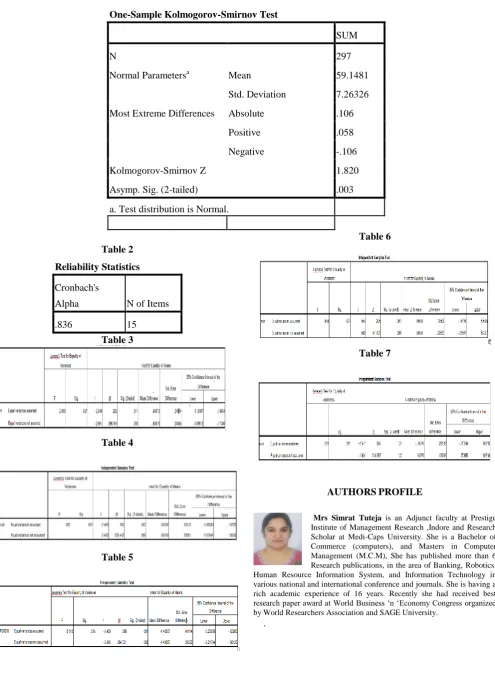
For testing the normality and reliability of adaptation of Information Technology, Normality of data test with the help of Kolmogorov-Smirnov Z test, Normality of data is (1.820) (refer Table 1 annexure ) as value is more that 0.5, which means data is normal. Reliability test with the help of coefficient (Cronbach Alpha). Reliability of data is (.836) (refer Table 2 annexure ) as value is more than 0.6, which means excellent. Data is reliable for study.
Since p=.156 (refer Table 3 annexure ) which is more than .05 which means that null hypothesis is accepted. Therefore, H02
(There is no significant difference in Top management Commitment in adaptation of information technology of Private and Nationalized Banks.) is accepted. Hence it is concluded that while adapting information system, top management plays an important role. It is their commitment to provide employee proper support, provide them enough resources for adoption of advanced technologies, encourage employees to use the new technologies in their daily tasks. This study found that both the banks top management give their commitment and motivate their employees to adapt information technology.
Since p=.931 (refer Table 4 annexure ) which is more than .05 which means that null hypothesis is accepted. Therefore, H03
(There is no significant difference in cost of capital in adaptation of information technology of Private and Nationalized Banks.) is accepted. Hence it is concluded that while adapting information system, investment is same in both the banks. Nationalized and Private banks both have same investment in implementing software and providing infrastructure to employees. Kozak (2005) studied the cost benefit analysis with the impact of development in information technology by taking sample as US banking sector. He concluded that there is a positive co-relation between the cost benefit (profit and cost saving )and implementation of IT.
Since p=.018 (refer Table 5 annexure ) which is less than .05 which means that null hypothesis is rejected. Therefore, H14
(There is significant difference in Technical Skills in adaptation of information technology of Private and Nationalized Banks.) is accepted. Hence it is concluded that after implementing information system private banks provide more facility and proper technical assistance and training programs than nationalized bank. Technical assistance is must to employees who assist them in software and hardware difficulties, and also help to understand instruction given for understanding technology. Nationalized banks should also provide such training programs and technical assistance. Tarafdar and Vaidya (2006) has proved that success of implementation of information technology depends upon well-thought-out implementation plan, technical infrastructure plan and regularly maintenance and upgrades. While non-availability of
and usage, its presence alone was found to be insufficient.
Since p=.421 (refer Table 6 annexure ) which is more than .05 which means that null hypothesis is accepted. Therefore, H05
(There is no significant difference in Competitive Advantage in adaptation of information technology of Private and Nationalized Banks.) is accepted. Hence it is concluded that both the sector bank should adapt information system, as today’s customer needs is best and fast services. Venkatesh et al., 2003 has studied the influencers of customer perception, customers attitude towards e-banking and their satisfaction level with the same.
Since p=.644 (refer Table 7 annexure ) which is more than .05 which means that null hypothesis is accepted. Therefore, H06
(There is no significant difference in HR relationship in adaptation of information technology of Private and Nationalized Banks.) is accepted. Hence it is concluded that information technology helps both the banks to maintain employee record.
From above result, it is concluded that adaptation of information technology in Nationalized and Private Banks is same but maintenance, technical assistance and training programs are differ. The technical assistance is significantly higher in case of Private Banks employees (X =15.8727) than Nationalized Banks employees (X =14.4332) . The technical assistance is significantly higher in case of Private Banks employees than Nationalized Banks employees. It found that factors like training program, technical assistance regarding software and hardware, instructions for ERP, other problem related to software, employee’s in private sector banks get more technical security. As a result motivation in using information technology seems to be higher in Private Banks. Top management commitment, cost of capital, competitive advantage and HR relationship is normally same in Nationalized Banks and Private Banks.
CONCLUSION :
Technology is vital role for any organization. It is very common for people to operate digital devices, and conduct daily activities. The Nationalized and Private sector banks, service based industry are the main factor of economic growth in India. Banks are service based sector, for better, fast and accurate service information technology is used. In this digital era, transactions need to be fast and flexible. Information technology helps employee to enhance the performance. The recent technologies are user friendly but still users find difficulties in selecting suitable applications for their organization. Gartner (Panetta, 2016) worked on different theories that helps in collecting data and find peoples requirements and then provide the information that helps them to select technology according to their requirement.
The result supported most of the developed hypothesis. The findings showed that management plays mediator role between information technology and users (employees and customers). However, the main focus of management is to provide environment and motivate employees to use information technology. The findings of this study have implications for developing e-banking systems and to find cost benefit analysis. It ensures that employees will use information technology to attain goals and to increase their
efficiency. E-banking authorities need to develop the beliefs of the customers regarding the usefulness, ease of use, and security and privacy of electronic banking. The findings of this research help top management to develop strategy which helps in success of e-banking.
LIMITATIONS OF THE STUDY :
The research can have its own limitation. Sample size were taken 297 employees of Nationalized and Private Banks of Indore Division. Further research work can be done by taking larger sample size and can be done in major cities of India. Study can include other types of bank. The study has its own limitations in terms of time and resources. The research of the study is based on data collection by the respondent, which might be biased or prejudiced. It might be possible facts are hidden on the part of respondents. All possible efforts have made to collect authentic information. Future research should make several extensions of the current study. The future researchers should also investigate whether customer perceived online service quality can influence customer satisfaction , adaptation and loyalty.
(1) REFERENCES :
1. Barnes SJ (2003) Mobile banking: concept and potential. International
Journal of Mobile Communications 1: 273-288.
2. Casolaro, L., & Gobbi, G. (2007). Impact of information technology and productivity changes in the banking industry economic notes.
3. Cheah CM, Teo AC, Sim JJ, Oon KH, Tan BI (2011) Factors affecting
Malaysian mobile banking adoption: an empirical analysis. International Journal of Network and Mobile Technologies.
4. Cruz P, Neto LBF, Munoz-Gallego P, Laukkanen T (2010) Mobile
banking rollout in emerging markets: Evidence from Brazil. International Journal of Bank Marketing 28: 342-371.
5. Kleijnen M, De Ruyter K, Wetzels M (2007) An assessment of value
creation in mobile service delivery and the moderating role of time consciousness. Journal of Retailing 83: 33-46.
6. Kozak, S. (2005), The role of information technology in the profit and cost efficiency improvementsof the banking sector, Journal of Academy of Business and Economics, February 1, 2005.
7. Luarn P, Lin HH (2005) Toward an understanding of the behavioral
intention to use mobile banking. Computers I Human Behavior 21: 873-891.
8. Laukkanen T (2007) Internet vs. mobile banking: comparing customer
value perceptions. Business Process Management Journal 13: 788-797.
9. Mahdi, S. & Mehrdad, A. (2010). E-Banking in Emerging Economy: Empirical Evidence of Iran, International Journal of Economics and Finance, 2(1), 201-209
10.Panetta, K. (2016). Gartner’s Top 10 Strategic Technology Trends for 2017: Artificial Intelligence, Machine Learning, and Smart Things Promise an Intelligent Future. (Available at
〈http://www.gartner.com/smarterwithgartner/gartners-top-10-technolo gy-trends-2017/〉).
11.To, P.-L., Liao, C., Chiang, J. C., Shih, M.-L., & Chang, C.-Y. (2008). An empirical investigation of the factors affecting the adoption of instant messaging in organizations. Computer Standards & Interfaces, 30(3), 148-156.
12.Sulaiman A, Jaafar NI, Mohezar S (2007) An overview of mobile
banking adoption among the urban community. International Journal of Mobile Communications 5: 157-168.
13.Venkatesh, V., Morris, M.G., Davis, G.B. & Davis, F.D. (2003). User acceptance of information technology: Towards a unified view. MIS Quarterly, 27(3), 425-478.
14.Yang AS (2009) Exploring adoption difficulties in mobile banking
services. Canadian Journal of Administrative Sciences 26: 136-149.
15.Zhou T, Lu Y, Wang B (2010) Integrating TTF and UTAUT to explain
International Journal of Innovative Technology and Exploring Engineering (IJITEE) ISSN: 2278-3075, Volume-8 Issue-10, August 2019
Annexure
Table 1One-Sample Kolmogorov-Smirnov Test
SUM
N 297
Normal Parametersa Mean 59.1481
Std. Deviation 7.26326
Most Extreme Differences Absolute .106
Positive .058
Negative -.106
Kolmogorov-Smirnov Z 1.820
Asymp. Sig. (2-tailed) .003
a. Test distribution is Normal.
Table 2 Reliability Statistics Cronbach's
Alpha N of Items
.836 15
Table 3
Table 4
Table 5
Table 6
Table 7
AUTHORSPROFILE
Mrs Simrat Tuteja is an Adjunct faculty at Prestige Institute of Management Research ,Indore and Research Scholar at Medi-Caps University. She is a Bachelor of Commerce (computers), and Masters in Computer Management (M.C.M), She has published more than 6 Research publications, in the area of Banking, Robotics, Human Resource Information System, and Information Technology in various national and international conference and journals. She is having a rich academic experience of 16 years. Recently she had received best research paper award at World Business ‘n ‘Economy Congress organized by World Researchers Association and SAGE University.
[image:5.595.51.547.74.748.2]Dr. Anukool Manish Hyde
Ph.D., M.P.A. & L.W., PGDPM, B.Sc.
Professor and Head : HR and General Management He joined the Institute on August 08, 2007 as Reader. Currently he is Professor and Head (HR and General Management) at the Institute. He is approved Ph.D. guide in Management for DAVV, Indore. Nine research scholars have done Ph.D. under him. He has more than twenty one years of teaching experience and has industrial experience in Personnel Department. He has been awarded “Best
Teacher” by PIMR in International Conference held in 2009. His areas of interest include Human Resource Management, Human Resource Development, Industrial Relations and Labour Laws, Organisation Behaviour. He was Organising Secretary for Second International Conference 08 at PIMR. He was Coordinator for National Research Methodology and National Case Writing Workshops at PIMR. He has attended several conferences and his many papers have been published in reputed Journals which are ABDC and UGC listed. His manuals on Emotional Intelligence Scale and Organisation Commitment have been published. He has attended FDPs which were sponsored by AICTE, New Delhi. He has conducted Personality Development sessions, Mock Interviews for CAs and Management Students. He has conducted sessions for Platoon Commanders at Rustamji Armed Police Training College, Indore, NGO and various organizations. He is an Editorial member for many reputed journals.