International Journal of Innovative Technology and Exploring Engineering (IJITEE) ISSN: 2278-3075, Volume-8 Issue-7, May, 2019
Abstract: Despite the synchronization requirements, Slotted ALOHA Medium Access Control MAC protocol has been successfully implemented in a low power Internet of Things (IoT) applications such as LoRaWan. Although the scheme provides an improvement compared to ALOHA, the protocol has low efficiency in terms of throughput, delay and energy consumption. By implementing a p-persistent approach with a suitable P-Threshold into a Slotted ALOHA, the probability of more than one node simultaneously transmit can be significantly reduced. It is demonstrated that p-persistent Slotted ALOHA can improve all the performances as mentioned earlier by up to by 30% compared to the standard Slotted ALOHA. The model is validated through Monte- Carlo simulations, and the optimal P-Threshold is obtained for different scenarios.
Index Terms: IoT, P-Threshold Slotted ALOHA, p-persistent, Slotted ALOHA.
I. INTRODUCTION
Wireless Sensor Network WSN is a key enabling technology for the realization of Internet of Things IoT as it provides information on the real-world measurements. By the year 2020, analyst garner Inc. [1] predicts that over 26 billion of IoT devices will be deployed around the world. This is clearly evident whereby IoT system has been used to monitor 200,000 by PetroChina [1]. Additionally, IoT is also used in other field such as “Home Automation”, “Smart Cities” (smart water system), “Social Life and Entertainment”, “Health and Fitness”, “Smart Environment and Agriculture”, “Supply Chain and Logistics” and “Energy Conservation” [2].
Frost & Sullivan [3] also expects that more than 50 billion connected devices (IoT) in 2020 and some estimates put is as high as 100 billion devices. As indicated by the GSMA [4], the growth of IoT devices can generate $1.8 trillion revenue opportunity to mobile network operators by 2026.
Despite the overwhelming benefits of IoT, it has some flaws and limitations. However, the limited wireless channel couple with the explosive growth of IoT devices means that concurrent access to the channels will be difficult to achieve.
Revised Manuscript Received on May 08, 2019.
Noor Zuriatunadhirah binti Zubir, Research and Innovation Department, Universiti Kuala Lumpur British Malaysian Institute Campus, Gombak Selangor, Malaysia.
Aizat Faiz Ramli, Research and Innovation Department, Universiti Kuala Lumpur British Malaysian Institute Campus, Gombak Selangor, Malaysia.
Hafiz Basarudin, Telecommunication Department, Universiti Kuala
Future IoT network will suffer from high packet collision resulting in increased latency and high energy consumption due to packet re-transmission. Long-Range Wide Area Network (LoRaWAN) is one of the leading technologies that facilitates low power IoT technology. It is based on pure ALOHA in MAC layer communication protocol [5] on the top of LoRa (Long Range) physical layer. With long range and low power usage, it is utilized to specify the node battery powered, system's limitation, quality services, securities and other kinds of applications provided by the network [6]. With 300bps to 50kbps of transfer rate [7], 10 years of battery life time and a maximum of 10 km communication range in rural area (2-5km in the city) [8], LoRaWAN is make it as appropriate protocol in IoT.LoRa and LoRaWAN use ALOHA for its MAC protocol due to its simplicity in communication networks. ALOHA protocols can be divided into two which are pure ALOHA and Slotted ALOHA. In pure ALOHA, the packet produce by a node is sent directly to the medium without first checking if other stations also transmit on the same medium or not. With the same operation as pure ALOHA, Slotted ALOHA sends packet randomly in a designated slot time where it wastes over 60% of the time either in collision or idle states [9]. Slotted ALOHA has been successfully implemented in LoRaWAN by [10] through their synchronization method. Experimental results by [10] shown that the Slotted ALOHA improves the performance of LoRaWAN network in terms of network throughput and packet loss rate. However, both ALOHA and Slotted ALOHA protocols still suffer with low throughput due to the high collision as the number of nodes increases [11]. Thus, some of the researches were done to overcome this problem in following section.The realization and mass acceptance of Internet of Things (IoT) will depend upon the development and performance of its Medium Access Control protocols (MAC) at the wireless sensing end. Therefore, in this paper, a study on the p-persistent of Slotted ALOHA has been used to improve throughput, delay as well as energy consumption of the nodes in the system.The rest of this paper is arranged as follows. In section II, the algorithm of P-Threshold Slotted ALOHA for single channel is introduced. In section III, presents the assumption and scenario of P-Threshold Slotted ALOHA. The result and analysis are introduced in Section IV. Finally, the conclusion is presented in section V.
Performance Analysis of
P-persistent
Slotted
ALOHA Protocol for Low Power IoT
Applications
II. RELATEDRESEARCH
In [12], ALOHA- QIR protocol was proposed to reduce the collision and retransmission as well as to improve the throughput and energy efficiency by using Q-learning in Slotted ALOHA. There were three processes involved; Q-learning to acquire the learning experience; Informed Receiving (IR), to change the nodes state into a sleep mode in which to avoid from idle listening and overhearing; Ping Packet, to switch the radio off especially in the low traffic condition, after transmission receives correct information from ping packet. However, the performances of throughput and energy efficiency were reduced. For the throughput, it decreased at a high rate of collision when the size of the frame is not optimum. So, the system cannot achieve a steady state during the training period. Meanwhile, the energy efficiency and delay also decreased. The energy efficiency decreases when the nodes mis-convey a lot of ping packet rather than data packets under low traffic. The delay increases when a lot of collision and transmission occurred during lowest frame size. This paper [13] proposed
p-persistent Slotted ALOHA protocol in Cognitive Radio Network for an unsaturated and saturated p-persistent
Slotted CR ALOHA protocol in which it consists of Primary user (PU) and some of Secondary users (SU) with Poisson traffic. The p-persistent Slotted CR ALOHA are the combination of Carrier Sense Multiple Access (CSMA) and Slotted ALOHA protocol where the energy sensing [14] and slot times to improve the context awareness in order to define the ideal access probability parameter p. In this model, there are two behaviour of SU epochs, the relevant and irrelevant epoch. Relevant epoch triggered, when the PU is idle and SU is successfully transmitted when there is no interruption from other SU after sensing operation. If a collision occurs, it usually because of the packet failed during initial transmission, and it will not be a problem because SU has at least one additional packet in its queue. In optimization of context awareness, the suitable p value is used to achieve the best performance of throughput and delay through the number of SUs and average load. Irrelevant epoch triggered, when PU is in active state or changing it states, then SU transmission will not be considered as success during the sensing slots of the SU frame [14]. However, the number of SU is higher thus increased the number of delay performance. In spite of that, this model is considered sensing operation in Slotted ALOHA protocol while Slotted ALOHA itself does not have a sensing operation. Then it would be no different with p-persistent CSMA.
ALOHA-NOMA was proposed in [11]. It is the combination of ALOHA protocol and power domain non-orthogonal multiple access (NOMA) which can be found in IoT applications. It has been used due to its simplicity (ALOHA), superior throughput (NOMA) and ability to resolve collision (Successive Interference Cancellation- SIC). The main objective of this research is to propose a protocol that is scalable, energy efficient, produce high throughput and compatible with IoT device requirements. By designing a dynamic frame structure with great flexibility in
International Journal of Innovative Technology and Exploring Engineering (IJITEE) ISSN: 2278-3075, Volume-8 Issue-7, May, 2019
Additionally, using the LoRaWAN uplink and the above steps, the rearrangement rate of end-node RTC and reference time clock for the gateway are sufficient with synchronization algorithm by store the timestamp in both node and gateway when RX window is scheduled in 1 second (ACK confirmation) after the packet received by the gateway without overhead. With the above method, it shows that Slotted ALOHA is suitable for use at the top of the LoRaWAN protocol for low cost IoT devices thereby enhancing throughput performance and reducing packet loss rate by adjusting the slot width size. However, the drawback of this method is that the lack of synchronization transient occurs during initial phase causing the synchronization algorithm to not be performed for all nodes and collision nodes in a single round (network re-configuration).
III. P-PERSISTENTSLOTTEDALOHA
A. Network Layout
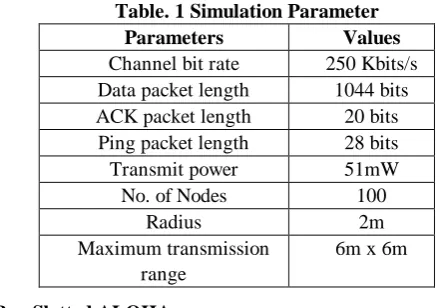
MATLAB simulation software is used to evaluate the performance of p-persistent Slotted ALOHA for low power IoT technology such as LoRAWAN. In the simulation, 1 communication link (R1 or R2), 1 access point (AP1 or AP2) and 100 number of nodes are assigned at all stations. With radius of 2m, every communication link and every node are randomly deployed within the range of the area. The area is between 6m x 6m.
[image:3.595.311.550.76.323.2]There are two situations; a) nodes transmit within access point region (within the same communication link), b) nodes transmit to other access point (overlapping region- between R1 and R2). Access point in R1 refer as AP1 and access point in R2 refer as AP2 as shown in Figure 1. Table 1 provides summary on the communication parameters employed to evaluate the p-persistent Slotted ALOHA.
Table. 1 Simulation Parameter
Parameters Values
Channel bit rate 250 Kbits/s
Data packet length 1044 bits
ACK packet length 20 bits
Ping packet length 28 bits
Transmit power 51mW
No. of Nodes 100
Radius 2m
Maximum transmission range
6m x 6m
B. Slotted ALOHA
In Slotted ALOHA, slot time is used to prevent chaotic transmission between nodes thus improves double utilization (maximum throughput) in Slotted ALOHA.
Slot time is a time between two synchronization pulses where it only can be fit with one packet for one-time unit per transmission as derived in (1). Formula (1) was used to generate the packet interval time by a node such that it conforms to Poisson distribution
(1) Where,
Itime is the average inter-arrival time of packets
[image:3.595.50.271.497.651.2]x is random value between 0 to 1
Fig. 1 Shaded region that shares the same medium in different communication link
Each transmission starts at the beginning of slot time. In the Slotted system, the node only transmits a packet into the slot time without checking if another station already transmits or not. If two or more packets are transmitting at the same time in the slot time, then collision occurs, and no packets are successfully delivered. Therefore, the colliding packet are buffered and retransmitted after random transmission delay.
C. P-Threshold Slotted ALOHA
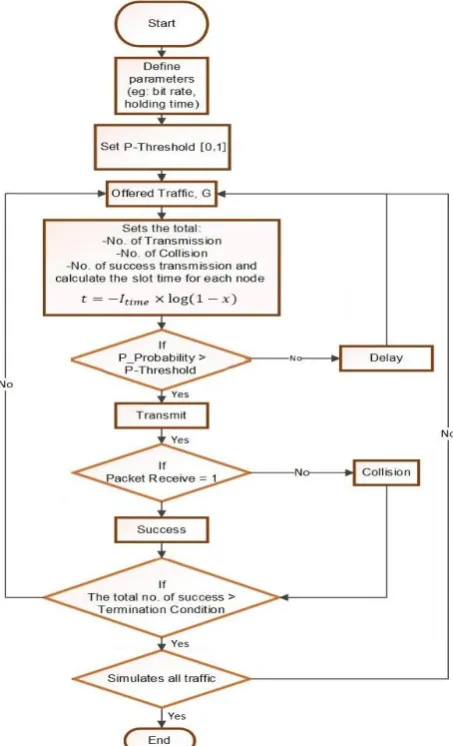
As referred in the flowchart of p-persistent of Slotted ALOHA (Figure 2). The value of P-Threshold is first pre-determining with range of 0 to 1 using Monte Carlo simulation. Then, the suitable value of P-Threshold is selected based on the higher throughput. Each node will then generate a random P-probability value 0 to 1.
Upon a packet generation of by a node, the P-probability random value generated by the node is compared to the P-Threshold. If P-probability is greater than P-Threshold then the node will transmit the packet. If not, the packet would be delayed and retransmitted with difference P-probability in next slot time. If only one packet is received by the node’s respective access point (packet receive =1), then the packet is successfully transmitted. Otherwise the packet experience collision due to simultaneous transmission by another node in the network. After that, the system checks if other nodes transmit the packet in the same time slot. The transmission will be continuous for every offered traffic by looping until the number of successful transmissions is bigger than the termination condition.
If yes, the collision happened, and the buffered collision packet needs to be re-transmitted at random transmission delays until the transmission is successful. Otherwise, the transmission will be aborted if there are too many failures in the packet transmission.
Normally, the collision happened because of interruption from other transmission within its region or within overlapping region. In its region (within the same radius), collisions occur when there is more transmission in a slot time. For overlapping region, a collision does not occur if, one node from the R1 transmits packet to the Access Point 1 AP1, collisions occur when the nodes from R2 that is located in shaded region transmit a packet at the same time to Access Point 2 AP2. A collision occurs due to the factor of distance between node in R1 and node in R2 (node in R2 transmits a packet to AP1 or perhaps, the nodes from R2 transmit a packet to both access points). P-persistent Slotted ALOHA reduces the probability of collisions caused by nodes located in the shaded region as nodes in the network have to generate a P-probability value that is greater than P Threshold. Limiting the number of nodes that is able to transmit at a given time reduces the probability of collision.
Fig. 2 Flowchart of P-Threshold Slotted ALOHA
IV. METRICSFORENERGYEFFICIENCY
This section explains the Energy Consumption Ratio metrics that is used to evaluate the energy efficiency gained by employing p-persistent Slotted ALOHA.
A. Energy Consumption
Energy consumption, E is the amount of energy consume by the network in a given traffic. Below is the formula to find the delay; -
(2)
B. Energy Consumption Ratio (ECR)
Energy consumption Ratio (ECR) is the ratio of a system’s energy consumption to its capacity (joules/bit).
(3)
[image:4.595.56.283.343.716.2]V. RESULTS
Figure 3 shows the maximum throughput performances of Slotted ALOHA with varying P-Threshold for overlapping communication link in one channel. The throughput appears to grow linearly with the P-Threshold until it reaches 0.1 and then begins to decrease until P-Threshold is 0.9. It shows that, the highest limit of average throughput is 0.31445 bits per second when P-Threshold is 0.1 and the lowest limit of average throughput is 0.08495 bit per second when P-Threshold is 0.9.
[image:4.595.306.551.517.718.2]According to Figure 3, the throughput increases from 0 to 0.1 P-Threshold. Beyond 0.1 threshold, the throughput decreases due to collisions and the transmission terminated when there is too much of it.
Fig. 3 Maximum throughput for all P-Threshold
Energy Consumption (Joules) ECR =
International Journal of Innovative Technology and Exploring Engineering (IJITEE) ISSN: 2278-3075, Volume-8 Issue-7, May, 2019
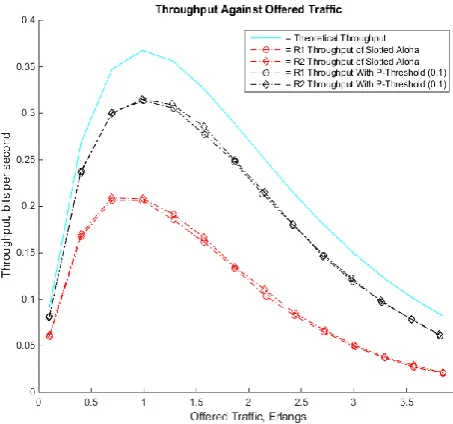
[image:5.595.52.279.172.384.2]Therefore, 0.1 of P-Thresholds has been selected it gives the highest value of throughput performance through the channel. The P-Threshold value of 0.1 has been used in the simulation where, it is compared to the theoretical, normal Slotted ALOHA and P-Threshold Slotted ALOHA. Below shows the value of the throughput, delay, energy consumption and energy consumption ratio (ECR) for all protocols.
Fig. 4 Throughput performance using P-Threshold
[image:5.595.306.541.198.413.2]From Figure 4, the maximum theoretical throughput is 0.3679 bits per second when offered traffic is 1 based on the formula (1) as derived in [9][15]-[17] where only one packet is generated in a slot time of time and it wasted over 60% of the time either in collision or idle states [9]. As a result, the throughput is substantially increased, as it now accounts both for the successful received and subsequently resolved transmissions.
Fig. 5 Delay performance using P-Threshold
In Figure 5, the delay performance for both protocols has been demonstrated. Slotted ALOHA has a higher delay which is 209.81 seconds due to more collisions and retransmission, P-SA has a lower delay which is 139.79 seconds during low traffic because the node immediately sends the packet to the access point without interruption from other packets since
P-probability has limited the transmission between the nodes thereby improving about 33.21% of total delay of Slotted ALOHA performance.
Fig. 6 Energy Consumption using P-Threshold
[image:5.595.296.549.536.836.2]In Figure 6, the energy consumption performance for both protocols has been demonstrated. Minimum point of P-SA is 2.7567 joule where it much better compared than Slotted ALOHA which is 3.7094 joule and it improved about 25.68% of total energy consumption hence improving the delay performances of Slotted ALOHA.
[image:5.595.48.291.540.750.2]In Figure 7, the ECR performance for both protocols has been demonstrated. Minimum point of P-SA is 1.2541x10⁻⁵ joule per bit where it is better than Slotted ALOHA which is 1.6985x10⁻⁵ joule per bit. The result demonstrates an improvement of approximately 26.16% of total ECR hence improving all performances of Slotted ALOHA.
VI. CONCLUSION
Based on the results of this study, it can be concluded that the optimal P-Threshold is 0.1 in which it improves the performance of throughput approximately 51.86%, from basic simulation of Slotted ALOHA and 14.52%, consistent with theoretical model. In addition, performances for delay, energy consumption and energy consumption ratio (ECR) have been improved by 33.21%, 25.68% and 26.15% respectively when compared to Slotted ALOHA.
REFERENCES
1. I. M. S. Board, Internet of Things: Wireless Sensor Networks. Geneva, Switzerland: International Electrotechnical Commission (IEC), 2014. 2. M. Kalmeshwar and A. P. D. N. P. K S, “Internet Of Things:
Architecture,Issues and Applications,” Int. J. Eng. Res. Appl., vol. 07, no. 06, pp. 85–88, Jun. 2017.
3. C. Castaneda, “Internet of Things to Become Cornerstone of Excellent Customer Service, Finds Frost & Sullivan,” PR Newswire. [Online]. Available:
https://ww2.frost.com/news/press-releases/internet-things-heralds-new-it-s ervices-opportunities-2016-says-frost-sullivan/. [Accessed: 08-Mar-2019]. 4. C. Fenny, “GSMA Highlights US$1.8 Trillion IoT Revenue Opportunity for Mobile Network Operators,” Press Release, Sep-2017. [Online]. Available:
https://www.gsma.com/newsroom/press-release/gsma-highlights-us1-8-tril lion-iot-revenue-opportunity-mobile-network-operators/. [Accessed: 28-Feb-2019].
5. D. Bankov, E. Khorov, and A. Lyakhov, “On the Limits of LoRaWAN Channel Access,” in 2016 International Conference on Engineering and Telecommunication (EnT), 2016, no. November, pp. 10–14.
6. LoRa Alliance, “Whitepaper: LoRaWAN,” no. November, 2015. 7. N. Singh and J. Bhardwaj, Computing, Communication and Signal
Processing, vol. 810. Singapore: Springer Singapore, 2019.
8. F. Adelantado, X. Vilajosana, P. Tuset-Peiro, B. Martinez, J. Melia-Segui, and T. Watteyne, “Understanding the Limits of LoRaWAN,” IEEE Commun. Mag., vol. 55, no. 9, pp. 34–40, 2017.
9. Y. Li and L. Dai, “Maximum Sum Rate of Slotted Aloha With Capture,”
IEEE Trans. Commun., vol. 64, no. 2, pp. 690–705, Feb. 2016. 10. T. Polonelli, D. Brunelli, and L. Benini, “Slotted ALOHA Overlay on
LoRaWAN: a Distributed Synchronization Approach,” Sep. 2018. 11. E. Balevi, F. T. Al Rabee, and R. D. Gitlin, “ALOHA-NOMA for
Massive Machine-to-Machine IoT Communication,” in 2018 IEEE International Conference on Communications (ICC), 2018, vol. 2018–May, pp. 1–5.
12. Y. Chu, P. D. Mitchell, and D. Grace, “ALOHA and Q-Learning based medium access control for Wireless Sensor Networks,” in 2012 International Symposium on Wireless Communication Systems (ISWCS), 2012, pp. 511–515.
13. J. Reis, M. Luis, L. Bernardo, R. Oliveira, R. Dinis, and P. Pinto, “Performance of a cognitive p-persistent slotted Aloha protocol,” in 2015 IEEE International Conference on Communication Workshop (ICCW), 2015, vol. 2015, pp. 405–410.
14. M. Luis, A. Furtado, R. Oliveira, R. Dinis, and L. Bernardo, “Towards a Realistic Primary Users’ Behavior in Single Transceiver Cognitive Networks,” IEEE Commun. Lett., vol. 17, no. 2, pp. 309–312, Feb. 2013. 15. H. Harada and R. Prasad, “Simulation and Software Radio for Mobile
Communications.” p. 467, 2002.
16. N. Abramson, “Packet switching with satellites,” Proc. Fall Jt. Compet. Conf., pp. 695–702, 1973.
17. D. G. Jeong and W. S. Jeon, “Performance of an Exponential Backoff Scheme for Slotted-ALOHA Protocol in Local Wireless Environment,”
IEEE Trans. Veh. Technol., vol. 44, no. 3, pp. 470–479, 1995.
AUTHORSPROFILE
Noor Zuriatunadhirah binti Zubir is a Research Scholar, Universiti Kuala Lumpur and received her graduation degree from Universiti Kuala Lumpur British Malaysian Institute in 2016. Her research interest including artificial intelligence, wireless sensor network and Internet of Things (IoT).
Aizat Faiz Ramli is a senior lecturer at Electronics Technology, Universiti Kuala Lumpur British Malaysian Institute. He is currently Research and innovation Coordinator. Dr. Aizat Faiz was awarded PhD from the University of York, United Kingdom in 2014 and a Master of Engineering degree in Electronic Engineering (MEng) from University of Hull, United Kingdom. His area of expertise and current research interest includes cognitive radio, artificial intelligence, wireless sensor networks and Internet of Things (IOT).