International Journal of Innovative Technology and Exploring Engineering (IJITEE) ISSN: 2278-3075, Volume-8 Issue-8, June, 2019
Partial Replacement of Bitumen with the
Sugarcane Waste Molasses
Ujjwal Gupta, Deepak Juneja
Abstract: Bitumen the buildup left over from fossil oil refining is all through the world the most noteworthy holding specialist utilized for street strategy development. Unrefined oil is a fossil mineral assets and fuel supply which will be evaporated among next 50 years. Expanding vitality costs and the solid overall interest for fossil oil has propelled the advancement of various covers to change or supplant black-top folios. The advantages of utilizing different fasteners square measure that they'll spare the regular assets and scale back vitality utilization, while keeping up, and now and again improving asphalt execution. In light of squeezing might want of framework, recovery and support, the presentation and utilization of such practical and ecological amicable materials like sugar stick squander syrup square measure required. What's more, today the interest lies around two hundred million tons.
Keywords — Bitumen, Molasses, Alternative Binders, Mixing Bitumen and Molasses, Eco- Friendly.
I. INTRODUCTION
Vitality assumes a vital job in development of creating nations like India. With regards to low accessibility of non-sustainable power source assets not to mention the necessities of enormous amounts of vitality for materials like bitumen, the significance of utilizing mechanical waste can't be thought little of. Amid the creating of hydrocarbon from the raw petroleum ton a ton of amount of benzene, sulfur dioxide and contamination territory unit free this gases will be controlled to some degree in the organization, yet all through the transportation and application strategy the hydrocarbon is warmed to high temperatures then the unsafe gas carbon oxide (co2) is free into the air exacting lung sicknesses and high danger to the setting. In the Backdrop, the look for less expensive substitute to bitumen might be a needful one. Bitumen is a blend of natural fluids that region unit incredibly gooey, dark, sticky, completely solvent in carbon disulfide, and made principally out of exceptionally dense polycyclic fragrant hydro carbons. Normally happening or unrefined bitumen might be a sticky, tar-like type of non-renewable energy source that is in this manner thick and overwhelming that it ought to be warmed or weakened before it'll stream. At the room temperature, it is much similar to cold sir up. Refined bitumen is the leftover (base) portion gotten considerably refining of petroleum derivative. It is the heaviest part and furthermore the one with the best breaking point, bubbling at 525 0C (997 0F). In British English, the word black-top alludes to blend of mineral total and hydrocarbon.
Revised Manuscript Received on June 14, 2019.
Ujjwal Gupta, M.Tech Student, Department of Civil Engineering, Chandigarh University, Gharuan, India
Deepak Juneja, Assistant Professor, Department of Civil Engineering, Chandigarh University, Gharuan, India
In Australian English, bitumen is commonly utilized on the grounds that the conventional term for street surfaces. Bitumen is essentially utilized for clearing streets. Its different uses are for hydrocarbon waterproofing stock. Counting the utilization of bitumen in the creation of material felt and for waterproofing level and rooftops.
Why Replacement???
The subject supplanting of bitumen with waste materials is that the one suspected that took life from perusing the astonishing things in regards to rotting of setting on account of concrete. There region unit some present issues all inclusive that are compromising nature! Being respectful designers it's our ostensible obligation to deal with mother earth.
The problems with hydrocarbon
1. Bitumen's discharge huge amount of and nbsp; carbon oxide.
2. There will be 8 to 37 you take care of carbons in a single gallon oil hydrocarbon.
3. The surfaces of black-top streets produced using customary hydrocarbon have a tendency of getting to be "oily" in wet street conditions; this is regularly because of oil substance of buildup hydrocarbon.
4. Dark cleared surfaces produced using hydrocarbon assimilate such a great deal heat, that critical vehicles have been known to "lift" the street surface making street security perils for the overall population and furthermore for the motorcars.
5. Colossal amount of warmth is expected to relax the and nbsp; bitumen amid transportation and application
II. MATERIAL USED SOLID WASTE FROM SUGAR INDUSTRY 1) Molasses
Molasses is the dull, sweet, syrupy side-effect made all through the extraction of sugars from sugarcane and sugar beets. Molasses can shift shading, sweetness, and healthful substance relying upon the range or what amount sugar has been separated. Molasses includes a left a mark on the world inside the Caribbean and Southern us, where sugarcane and sugar beets are intensely developed. Molasses was furthermore a boundless sugar all through the utilization inside the mid twentieth century.
How molasses is created
Amid the sugar making strategy, juice extricated from sugarcane or sugar beets is come down till the sugars solidify and encourage out. The syrup left over when crystallization is alluded to as syrup. Commonly, sugar stick juice experiences three cycles of bubbling and crystallization to remove as a ton of sugar as feasible. With every sequential cycle, the left over molasses contains less sugar.
2) Bitumen
Bitumen is a blend of natural fluids that a very gooey, dark, sticky, altogether dissolvable in carbon disulfide, and made basically out of exceedingly dense polycyclic aromatic hydro carbons. Normally happening or rough bitumen could be a sticky, tar-like type of shake oil that is accordingly thick and noteworthy that it ought to be warmed or weakened before it'll stream. At the room temperature, it
resembles cold molasses. Refined bitumen is the lingering (base) part gotten by partial procedure of rough. It is the heaviest division and furthermore the one with the absolute best breaking point, bubbling at 525 0C (997 0F). In British English, the word black-top alludes to a blend of mineral total and hydrocarbon. In Australian English, bitumen is commonly utilized on the grounds that the nonexclusive term for street surfaces. Bitumen is principally utilized for clearing streets. Its different uses are for hydrocarbon waterproofing item. Counting the utilization of hydrocarbon in the generation of material felt and for waterproofing level rooftops.
III. METHODOLOGY
For this examination the sort of technique that is utilized is test strategy. There are three fundamental pieces of this analysis. The initial segment incorporates examination of customary and rheological properties of black-top fastener with molasses. The second part comprises of arrangement of blend structure for black-top fastener, total and molasses. Furthermore, the third part examines the affectability of the blend made out of black-top cover, total and molasses for dampness.
Material properties
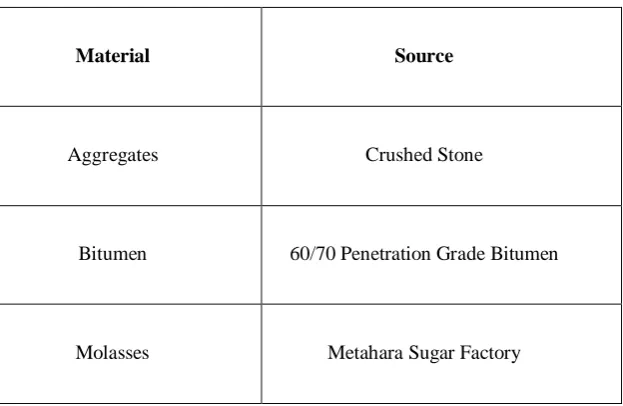
[image:2.595.143.455.457.660.2]Materials needed+for this study+are the constituents+of hot mix+asphalt and+molasses, Table 3.1 present sources+of these materials.
Table 3.1 Material Sources
Material Source
Aggregates Crushed Stone
Bitumen 60/70 Penetration Grade Bitumen
Molasses Metahara Sugar Factory
These tests were performed on black-top folio blended with various rates of Molasses changing between 3%-15% by weight of the bitumen. First the black-top fastener was warmed to a temperature of 135-170 0C then the vital measure of molasses was added to black-top folio by petulantly blending the blend for 15-20 minutes at a consistent temperature to guarantee great homogeneity, at that point the accompanying distinctive tests were performed.
Diverse tests were performed on the readied tests as
International Journal of Innovative Technology and Exploring Engineering (IJITEE) ISSN: 2278-3075, Volume-8 Issue-8, June, 2019
PENETRATION TEST
SOFTENING POINT TEST
DUCTILITY TEST
MARSHALL MIX DESIGN
Research center experimentation was directed to explore the incomplete supplanting of black-top cover
with molasses. Distinctive research facility examinations were done to test both the folio and HMA properties of black-top fastener containing molasses.
IV. RESULTS AND DISCUSSIONS 4.1 PENETRATION TEST
Effect of Molasses on Penetration:
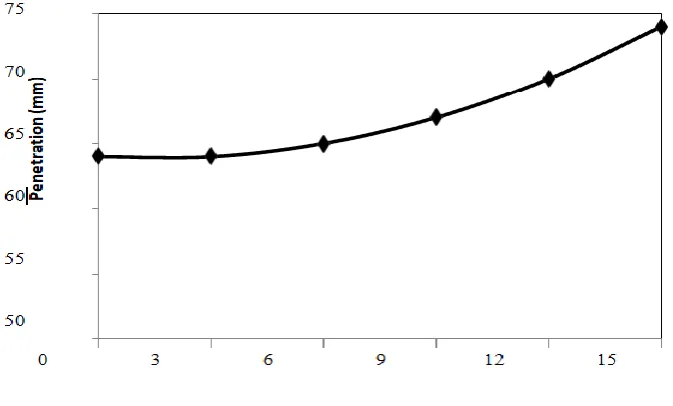
[image:3.595.116.453.156.359.2]Molasses Content (%) Figure 4.1 Penetration test result
Figure 4.1 speaks with the impact of variable groupings of Molasses on the infiltration properties of black-top cover. From the diagram, the expansion of 3% Molasses doesn't influence the infiltration at everything except as the rate increments to 6% the entrance esteem somewhat increment from 64 mm to 65 mm. All things considered, as the level of Molasses increment to 15%, the level of infiltration increments
and its esteem winds up 74 mm. From this perception we can predicts that the material will demonstrate further increment in entrance an incentive as Molasses rate further increment. Subsequently, the expansion in the infiltration capacity of the black-top cover as the Molasses content increments suggests a decline in the hardness properties of the folio and makes it delicate.
4.2 SOFTENING TEST
Effect of Molasses on Softening Point
[image:3.595.128.448.540.722.2]Molasses Content (%)
From Figure 4.2, it tends to be seen that expansion of Molasses offer lesser variety in the conditioning purpose of the black-top fastener. In the plot underneath, the conditioning temperature can be seen to plunge as Molasses rate increment. The abatement in relaxing point indicates negative impact on the property of black-top cover. As per Noor et al., the increments in the conditioning point reflect in better rutting obstruction at higher temperature.
4.3 DUCTILITY TEST
The Effect of Molasses on Ductility
Molasses Content (%) Figure 4.3 Ductility test result
A synopsis of the normal estimations of the malleability test is displayed in Figure 5.3 beneath. The aftereffect of flexibility test indicates decline in pliability esteems up on expanding level of Molasses. The lessening in malleability esteem suggests the breaking of the fastener quickly under a standard testing condition. Also, it is commonly viewed as that a fastener with an exceptionally low flexibility will have poor glue properties.
4.4 MARSHALL TEST
The Effect of Molasses on Marshall Properties
The incorporation of Molasses has impacted the conduct of the black-top cement blends. The Figure beneath demonstrates the connection between Marshal Stability and Molasses content. The general pattern demonstrates that as the Molasses content increments to 3%, the solidness marginally diminishes and keeps on diminishing as the Molasses content increments. Despite the fact that, strength somewhat diminished with increment in Molasses content, the dependability of blends at Molasses content up to 11% were inside the breaking points of Marshall Criteria for overwhelming traffic, i.e., over 8 kN.
[image:4.595.150.522.484.681.2]Molasses Content (%)
Figure 4.4 The effect of Molasses Content on Marshal Stability
For the most part, the steadiness of HMA arranged by incompletely supplanting black-top fastener with Molasses diminishes as the Molasses content increments. As the molasses content increments to 3% the security of the HMA isn't influenced yet as the molasses content further builds the soundness diminishes by 1.5%, 17%, 22% and 27% for
International Journal of Innovative Technology and Exploring Engineering (IJITEE) ISSN: 2278-3075, Volume-8 Issue-8, June, 2019
The reduction in security esteem what's more of Molasses on HMA can be clarified because of generally poor attachment, when contrasted with traditional black-top blend, created among bitumen and totals because of intermolecular holding. A superior attachment improves intermolecular attractions which thusly upgrade quality of black-top blend, which help to expand toughness and dependability of the black-top blend.
V. CONCLUSION
This examination attempts to think about the traditional and rheological properties of fastener blends, produced using this cover blends and their affectability to dampness. In doing as such, test parameters were assessed. In light of the outcomes acquired from this examination, the accompanying ends can be made:
1.The lessening in malleability esteem suggests the breaking of the cover quickly under a standard testing condition. What's more, it is commonly viewed as that a cover with a low malleability will have poor cement properties
2.The mellowing temperature can be seen to plunge as Molasses rate increment. The diminishing in relaxing point demonstrates negative impact on the property of black-top fastener. The increments in the conditioning point reflect in better rutting obstruction at higher temperature.
3.The increment in the infiltration capacity of the black-top folio as the Molasses content increments suggests a lessening in the hardness properties of the fastener and makes it delicate. The solidifying of the bitumen can be advantageous as it builds the solidness of the material, subsequently the heap spreading capacities of the structure.
4.The solidness of HMA arranged by mostly supplanting black-top cover with Molasses diminishes as the Molasses content increments. As the molasses content increments to 3% the strength of the HMA isn't influenced yet as the molasses content further builds the solidness diminishes by 1.5%, 17%, 22% and 27% for molasses substance of 6%, 9%, 12% and 15% individually.
5.A better bond improves intermolecular attractions which thus upgrade quality of black-top blend, which help to build sturdiness and strength of the black-top blend.
REFERENCES
1. A Sustainable Built Environment National Research Centre (SBEnrc) literature review by Curtin University American Association of State Highway and Transportation Officials, Standard Specifications for Transportation Materials and Methods of Sampling and Testing, (1998) Asphalt Institute Manual Series No. 2 MS-2 Cairns Post, (1941), Uses of molasses for road building
2. Chen, Jian-Shiuh, (1996), Rheological Properties of Asphalt-Mineral Filler Mastics Transportation Research Board, 75th Annual Meeting, Washington, D.C.
3. Cooperative Highway Research Program. National Research Council, Washington, D.C.
4. Cristian Druta, (2006), A Micromechanical Approach For Predicting The Complex Shear Modulus And Accumulated Shear Strain Of Asphalt Mixtures From Binder And Mastics
5. Damien Johnson, Ecopave Australia GEO320 technology improves shell bitumen
6. Delgadillo, Rodrigo, K. Nam, and H. Bahia, (2004), Why do we need to change G*/sinδ and how? Transportation Research Board, 83rd Annual Meeting, Washington, D.C.
7. E. Ravi, Animesh S, A.T.Manikandan, G.karthick, A. Abdul J., ( 2015), Study on Effect of Molasses on Strength of Soil, International Journal of Advanced Research Trends in Engineering and Technology, (2)51-61Ecos,( 2005 (Aug-Sep))
8. Ethiopian Sugar Development Corporation, (2014)
9. Ethipians Road Authority Pavement design Manual for Flexible pavements (2013)
10. Hand, A. J., J.L. Stiady, T.D. White, A.S. Noureldin, and K. Galal, (2001), Gradation Effects on Hot Mix Asphalt Performance, Transportation Research Record 1767, National Research Council, Washington, D.C., pp.152-158 (2001).