Garcia Yarnoz, Daniel and Sanchez Cuartielles, Joan-Pau and McInnes,
Colin (2014) Passive sorting of asteroid material using solar radiation
pressure. Journal of Guidance, Control and Dynamics, 37 (4). pp.
1223-1235. ISSN 1533-3884 , http://dx.doi.org/10.2514/1.62412
This version is available at
https://strathprints.strath.ac.uk/46556/
Strathprints is designed to allow users to access the research output of the University of Strathclyde. Unless otherwise explicitly stated on the manuscript, Copyright © and Moral Rights for the papers on this site are retained by the individual authors and/or other copyright owners. Please check the manuscript for details of any other licences that may have been applied. You may not engage in further distribution of the material for any profitmaking activities or any commercial gain. You may freely distribute both the url (https://strathprints.strath.ac.uk/) and the content of this paper for research or private study, educational, or not-for-profit purposes without prior permission or charge.
Any correspondence concerning this service should be sent to the Strathprints administrator:
PASSIVE SORTING OF ASTEROID MATERIAL USING SOLAR
RADIATION PRESSURE
D. García Yárnoz,
*J. P. Sánchez Cuartielles,
†and C. R. McInnes
‡Understanding dust dynamics in the vicinity of asteroids is key for future
science missions and, in the long-term, for asteroid exploitation. This paper
ana-lyzes the feasibility of manipulating asteroid material by means of solar
radia-tion pressure. A novel method is proposed for passively sorting material as a
function of its grain size or density, where solar radiation pressure is used as a
passive in-situ ‘mass spectrometer’. A simplified analysis shows that in
prin-ciple this method allows an effective sorting of regolith material. This could
have immediate applications for a sample return mission, and for industrial scale
in-situ resource utilization to separate and concentrate regolith according to
par-ticle size or composition.
INTRODUCTION
Asteroids are regarded as prime targets for space exploration missions. This interest is
justi-fied as asteroids are among the least evolved bodies in the Solar System and can provide a better
understanding of its formation from the solar nebula [1]. Under NASA’s flexible path plan [2],
*
PhD Researcher, Advanced Space Concepts Laboratory, Dept. of Mechanical and Aerospace Engineering, University of Strathclyde, Glasgow G1 1XQ, UK.
†
Research Fellow, Advanced Space Concepts Laboratory. ‡‡
Director, Advanced Space Concepts Laboratory.
Proof-reading draft. Final version will be made available at
asteroids have also become attractive targets to be visited by crewed missions, with the benefit of
not requiring the capability to land in and take-off from a deep gravity well. In addition, they may
well be the most affordable source of in-situ resources to underpin future space exploration
ven-tures [3].
To date, in-situ observations of asteroids (e.g., Itokawa, Eros…) indicate that all Near-Earth
Objects (NEOs) visited thus far, including very small bodies, are not bare lumps of rock [4]. A
very fine layer of regolith material is likely to have a ubiquitous presence on most asteroid
sur-faces. The formation of this layer of regolith is usually explained by the effect of impact cratering
and sandblasting through micro-meteoroid bombardment [5]. The presence of this fine dust,
coupled with weak and irregular gravitational and electrostatic forces, increases the risk of
trig-gering transient dust atmospheres during asteroid operations that can potentially degrade
instru-mentation, damage mechanisms and reduce visibility and communications. The future
exploita-tion of asteroid material would need to take into account the dynamical behavior of dust under
solar radiation pressure (SRP) in order to minimize the risk of such transient dust atmospheres.
Considerable efforts have been made to understand the perturbing forces and space environment
in the vicinity of cometary and asteroid bodies [6, 7]. These perturbing forces need to be
consi-dered and will have direct implications for the operations of spacecraft around and on small
bo-dies. On the other hand, they also represent an opportunity, if engineered for practical benefit, to
devise new types of highly non-Keplerian trajectories and novel methods for asteroid resource
exploitation.
Extra-terrestrial resource exploitation is by no means a new idea. It was first proposed well
over a century ago by the first pioneers of astronautics [8], and in the past decades it was given a
comprehensive treatment by Lewis [9]. Ross further discusses the feasibility of extra-terrestrial
the founding of two companies with the final objective of mining asteroids: Planetary Resources*
and Deep Space Industries†
On Earth, industrial separation processes for mineral processing [
. If in-situ industrial scale exploitation is ever considered, various
separation and material processing techniques would need to be implemented.
11] range from the more
tra-ditional gravity concentration devices to numerous ‘modern’ methods including magnetic and
electrostatic separation or, more recently, automated ore sorting [12]. Methods based on gravity
or centrifugal separation are still used extensively in mineral processing as a first step to generate
mineral concentrates for further treatment, or to discard waste, due to their simplicity and high
capacity [13]. However, most of these gravity-driven separation methods are clearly no longer
applicable in microgravity, or have a reduced performance, whereas others may require
large-scale in-situ machinery.
There is an abundant literature on proposals for the exploitation and processing of lunar
rego-lith [9, 14]. Magnetic separation techniques have been tested and proven useful on lunar
simu-lants generated in the laboratory [15, 16]. Both reports show that paramagnetic pyroxene silicates
and non-magnetic plagioclases can be effectively sorted with magnetic separation. So-called dry
methods are effective down to particle sizes of 150 µm, whereas for smaller particles the use of
slurries is needed [15], possibly due to cohesion. Further tests carried out in simulated lunar
grav-ity on parabolic flights on tribocharged lunar silicate simulants [17] demonstrated the
effective-ness of magnetic and electrostatic techniques in low gravity. Equivalent processes could be
ap-plied to asteroids [18], given the similarities in the silicate minerals present in both types of
rego-lith and the vacuum and low-gravity environment. The higher ferro-metallic content in asteroid
regolith would suggest that techniques based on magnetic separation are even more suited for
*
†
asteroid resource exploitation to separate metals. Although this may be true, they require large,
complex machinery for the separation, and for the previous steps of grinding and feeding. These
methods would benefit from a prior regolith size separation or mineral concentration process.
With this intention, new methods that take advantage of the low-gravity and vacuum environment
of asteroids could be utilized.
This paper proposes and performs a feasibility analysis of one such novel method for sorting
asteroid material, exploiting the dynamical interaction of regolith particles with solar radiation
pressure. Separation is achieved by differential solar radiation pressure on ejected particles of
different area-to-mass ratio. The concept is analogous to the separation process of ‘winnowing’ in
agriculture, used for many thousands of years for separating grain from chaff due to differential
atmospheric drag, again for materials with different area-to-mass ratio. This method has
potential-ly attractive applications for large-scale industrial exploitation of asteroids, such as allowing a
first, coarse, in-situ separation of different regolith particle sizes, or pre-concentration and
separa-tion of different materials based on their density. Future asteroid engineering and mining
endea-vors would benefit from this sorting technique, where solar radiation pressure is used as a passive
in-situ ‘mass spectrometer’. This process could be used in combination with, or as a first stage of
a more complex process exploiting electrical or magnetic effects for more precise sorting.
Exploiting Solar Radiation Pressure for Material Sorting
Regarding the dynamical environment of asteroids, depending on an asteroid’s size and its
spin state, the effective ambient gravitational acceleration experienced by dust grains on small
bodies can range from micro-gravity to milli-gravity [6], much lower than on the Moon. Under
such conditions, the SRP perturbation becomes the largest non-gravitational force affecting single
grains that have been lifted from the asteroid’s surface, either naturally by micrometeoroid
area-to-mass ratio can escape from the asteroid [19], whereas those with smaller area-to-area-to-mass ratios will
remain bounded. Their trajectories will nevertheless be significantly perturbed, even when ejected
at low initial velocities. Based on this effect of differential SRP influence on dust grains, a
me-thod can be designed for passively sorting asteroid material as a function of grain size or density.
The proposed idea consists of one surface element that collects and scoops loose regolith directly
from the asteroid surface and expels it at a small velocity (either before or after grinding it), and
one or several collectors that capture sorted particles as they fall back to the surface. A similar
natural process, caused by electrostatic levitation [20], is believed to be responsible for the
movement and concentration of fines (particles smaller than 40 µm) on shaded or shallow areas
on asteroid surfaces. This process has been suggested as a possible explanation for the dust ponds
observed at Eros [21].
In the following sections, simplified equations will be presented describing the trajectories of
dust particles in the vicinity of an asteroid considering the third body perturbation of the Sun and
the solar radiation pressure perturbation. In order to achieve a better understanding of the
differ-ent regimes experienced by orbiting dust, a simple analytical formulation is applied to the
prob-lem. Both the analytical approximation and subsequent numerical propagations prove useful in
studying the behavior of the dust particles. Preliminary conclusions can then be drawn from the
analysis regarding the prospect of actively engineering and exploiting the forces experienced by
dust grains in the vicinity of asteroids. Two separation strategies are presented, and the effect of
uncertainties in the initial conditions on the separation is analyzed.
The preliminary analysis presented in this paper does not consider the modeling of additional
perturbations, among them inter-particle forces, leaving it for future work. However, given the
low gravity and vacuum conditions around asteroids, these additional forces acting on dust grains,
pro-posed sorting method. The implications of inter-particle forces are discussed by the authors in the
final section of the paper.
THE PHOTO-GRAVITATIONAL RESTRICTED 3-BODY PROBLEM
The problem to be tackled can be modeled, in a first approximation, by the well-known
photo-gravitational circular restricted three-body problem [22-24] applied to a spherical asteroid. The
solar radiation pressure force acting on a particle is modeled with the standard cannon-ball
ap-proach:
3
4
SUN SRP
SUN
r
LQA
F
c r
π
=
(1)where L is the solar luminosity, Q the solar radiation pressure coefficient, which depends on the
material properties, A the cross-sectional area of the particle, c is the speed of light and
r
SUNis theradio-vector from the Sun to the particle. The solar radiation pressure coefficient is 1 for a
per-fectly absorbing particle, and is equal to 2 for the case of ideal specular reflection. Unless
other-wise stated, for the analysis in this paper the conservative value of Q=1 is assumed.
Assuming spherical particles of constant density , the ratio of SRP perturbation with respect
to the gravitational attraction of the Sun can be represented with the particle lightness number
given by:
3
4
S16
SLQ
S
LQ
c
m
c
r
β
π µ
π µ ρ
=
=
(2)where µS is the gravitational constant of the Sun, S/m the area to mass ratio of the particle, and r
the equivalent particle radius. Note that this lightness number has been defined with respect to the
gravitational attraction of the Sun, and not the asteroid gravity as it is usual in literature. This
parameter will prove useful to describe the different orbiting regimes of particles in the vicinity of
increases when the particle radius decreases. Therefore, for small dust grains, SRP can provide a
significant perturbing force.
For simplicity, it is assumed that the asteroid follows a circular orbit of heliocentric distance d
around the Sun. In a co-rotating frame with the origin at the barycenter of the system and with the
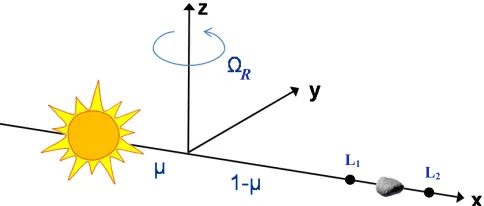
x-axis pointing towards the asteroid (see Figure 1), the motion of a particle can be described by
the following set of differential equations:
(
)(
)(
)
(
)
(
)
(
(
(
)
)
)
(
)(
)
(
)
(
)
(
(
)
)
(
)(
)
(
)
(
)
(
(
)
)
23/ 2 3/ 2
2 2 2 2 2 2
2
3/ 2 3/ 2
2 2 2 2 2 2
2
3/ 2 3/ 2
2 2 2 2 2 2
1
1
1
2
1
1
1
2
1
1
1
1
R R R R Rx
x
x
y
x
x
y
z
x
y
z
y
y
y
x
y
x
y
z
x
y
z
z
z
z
x
y
z
x
y
z
µ
β
µ
µ
µ
µ
µ
µ
β
µ
µ
µ
µ
β
µ
µ
µ
−
−
+
+ −
− Ω
= Ω
−
−
+
+
+
+ −
+
+
−
−
+ Ω = Ω
−
−
+
+
+
+ −
+
+
−
−
= Ω
−
−
+
+
+
+ −
+
+
(3) 3; A S
A
R
A S d
µ
µ
µ
µ
µ
µ
+
= Ω =
+ (4)
where distances have been normalized with respect to d,
µ
Sandµ
Aare the gravitationalparame-ters of the Sun and the asteroid respectively, and ΩR is the frequency of rotation of the two
bo-dies (and the frame) around the barycenter. Higher order gravitational perturbations of the
astero-id, which can be of great importance for irregularly shaped asteroids, are not taken into account at
this stage of the investigation. Similarly, any inter-particle forces are neglected, and eclipses have
Figure 1. Schematic representation of the co-rotating frame with the origin at the barycenter of the
Sun-asteroid system.
This system of equations has an integral of motion C:
C = -2E = 2U-2T (5)
where U and T are the potential and kinetic energy, which can be expressed as:
(
)
(
)(
)
(
)
(
)
(
(
)
)
(
)
2 2 2
1/ 2 1/ 2
2 2 2 2 2 2
2 2 2
1
1
1
2
1
1
2
R
U
x
y
x
y
z
x
y
z
T
x
y
z
µ
β
µ
µ
µ
−
−
= Ω
+
−
−
+
+
+
+ −
+
+
=
+
+
(6)
For particles ejected from the surface, it is possible to calculate zero velocity curves
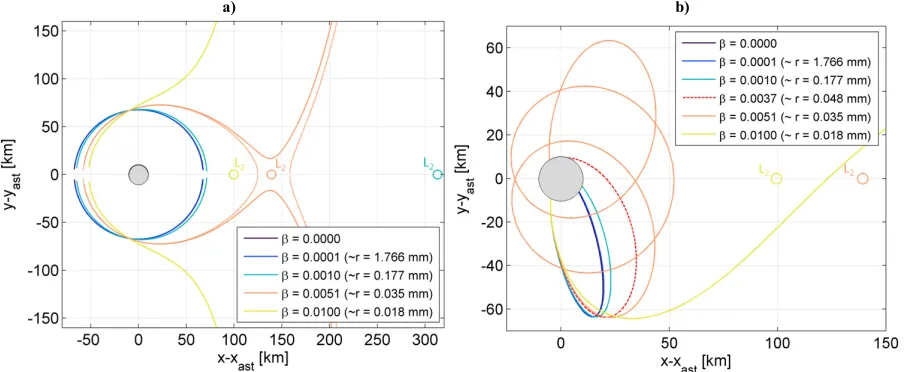
(corres-ponding to C = 2U) that depend on the lightness number . Figure 2 represents the zero velocity
curves for different particle sizes ejected with a fixed velocity from a hypothetical 10 km radius
asteroid at 1 AU from the Sun, along with a set of example trajectories for a particular ejection
site on the equator. The asteroid is assumed to be rotating with a 4 hour period around the z-axis,
and the ejection velocity direction is selected radially outwards, normal to the asteroid surface.
The average NEO density of 2.6 g/cm3 [25] is considered for the asteroid, whereas estimates on
the particle radius are provided assuming spherical grains of constant density of 3.2 g/cm3,
representing a relatively low density olivine. If the composition and structure of the asteroid is
uniform, this implies a macro-porosity of 19%, close to the average S-type asteroid [26]. For
ejec-tion velocities above 11.2 m/s the zero velocity curves are open around L2 for all values of . An R
L1
corresponds to particles larger than approximately 35 µm radius) have closed zero velocity
curves. This velocity increases with the rotation period (e.g. for a fast rotator with shorter 3 hour
period, a correspondingly lower ejection velocity of 9.5 m/s has similar effects).
The range of lightness number selected covers from large boulders down to particles of size
tens of µm. Smaller particles are likely to levitate naturally, or potentially escape when ejected
due to the SRP perturbation (an example of this can be observed in Figure 2b). Two values of
are particularly relevant: the for which the zero velocity curves open (5x10⁻³ in this particular
case), which sets an upper bound in particle size for dust to escape, and the value of that ensures
a re-impact before one revolution.
[image:10.612.82.534.295.481.2]a) b)
Figure 2. Zero velocity curves (a) and trajectories in the co-rotating frame (b) for ejection velocities of
10.34 m/s from a 10 km asteroid with a 4 hour rotational period, for different values of . Particle size
estimation are given assuming spherical grains of constant density and Q=1. Zero velocity curves are open
for all particles with larger than 0.0051. All particles with lower than 0.0037 re-impact before one
revolution for this particular ejection site (dashed red line).
The first value sets a theoretical limit for particles to escape, based solely on energy
escape or not, as reaching escape conditions depends not only on the energy level, but also the
solar longitude of the ejection site and the orbital geometry in general.
The positions in the x-axis of the two collinear libration points of the Sun-asteroid system,
x
1and
x
2, can be calculated solving the system in Eq. (7) for each particular lightness number, andfrom there the associated value of the integral of motion C is obtained.
(
)(
)
(
)
(
)
(
)(
)
(
)
(
)
1 2 2 1 1
1 1
2 2 2 2 2
2 2
1
1
0;
2 ( )
1
1
1
0;
2 ( )
1
x
C
U x
x
x
x
C
U x
x
x
µ
β
µ
µ
µ
µ
β
µ
µ
µ
−
−
−
+
=
→
=
+
+ −
−
−
−
−
=
→
=
+
+ −
(7)Given these values of C, and equating them to Eq. (5), substituting the potential energy of
points on the surface of the asteroid, the ejection velocity required for the zero velocity curves to
be open through the L1 or L2 points can be obtained. Because of the influence of the SRP
pertur-bation, it is the L2 point that offers the lowest energy for the zero velocity curves to be open, and
thus also the lowest ejection velocity for escape trajectories of the dust grains. The main effect of
SRP on the location of the libration points is to displace both the L1 and L2 points towards the
Sun, resulting in an L2 point closer to the surface of the asteroid (see Figure 2). Theoretically
there is a particle size at which the L2 point would be on the surface of the asteroid, and any
smaller particles lifted from the surface with an infinitesimally small velocity at the correct time
in a rotational period of the asteroid may escape. In reality, that region is in eclipse and the SRP
would only affect particles that are still orbiting when the Sun comes into view.
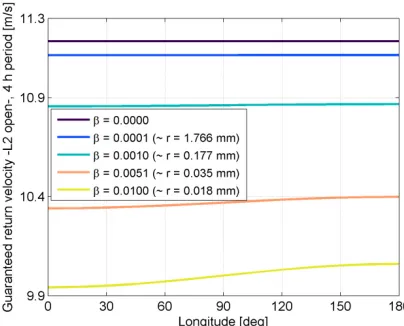
It is then possible to calculate a guaranteed return velocity, for a given value of , that ensures
closed zero velocity curves and eventual re-impact with the surface. Figure 3 plots this velocity
for a 10 km asteroid rotating along the z-axis assuming vertical ejection along the equator, where
easier escape at lower velocities. This guaranteed return velocity shows small variations with the
[image:12.612.199.401.114.277.2]longitude of the ejection site.
Figure 3. Guaranteed return velocity for dust particles ejected radially outwards along the equator of
a 10 km asteroid with a 4 hour rotational period, for different values of . The longitude of the
ejec-tion site is measured along the equator with respect to the antisolar direcejec-tion.
In contrast, the value of that ensures re-impact before one revolution is highly dependent on
the point of ejection, and the relative geometry of the orbit with respect to the Sun. Certain
ejec-tion sites will have all particles directly re-impact under the perturbaejec-tion of solar radiaejec-tion
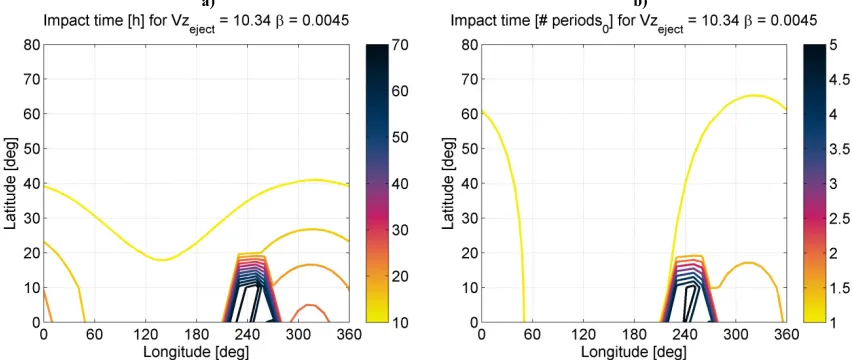
pres-sure, whereas others will have a limiting that allows multiple revolutions. Figure 4 represents
the re-impact time in a longitude-latitude grid of the ejection site for the selected vertical ejection
velocity of 10.34 m/s. The lightness number is set to 0.0045 to ensure closed zero velocity
curves and re-impact of all particles. Figure 4b gives the re-impact time in number of periods
calculated with the initial osculating semi-major axis at ejection. The semi-major axis, and
there-fore also the period, is larger at the equator. For most of the surface of the asteroid the re-impact
time is less than one initial period, while there is a region in the longitude’s third quadrant that
allows multiple revolutions. As expected, it is the region near the equator that has the highest
probability of generating ejecta that perform more than one revolution. Also, the longitude’s first
shorter re-impact times that the third and fourth quadrant where the effect of the SRP perturbation
contributes to raising the pericenter height.
[image:13.612.94.520.115.295.2]a) b)
Figure 4. Re-impact time on a 10 km asteroid with a 4 hour rotational period, for dust particles of
= 0.0045 ejected radially outwards with 10.34 m/s ejection velocity. The re-impact time is given in
hours (a) and number of initial periods (b).
It is difficult to draw more significant conclusions from this general form of the equations of
motion, or to predict the re-impact of the dust without full numerical propagation for each
par-ticular case, which is time consuming. For this reason, a semi-analytical approximation is used in
this paper to study the behavior and various regimes of ejected dust in the vicinity of an asteroid.
HAMILTONIAN APPROACH
The graph in Figure 6 is obtained by plotting the previously generated trajectories in an
eccen-tricity-
φ
space, with the solar phase angleφ
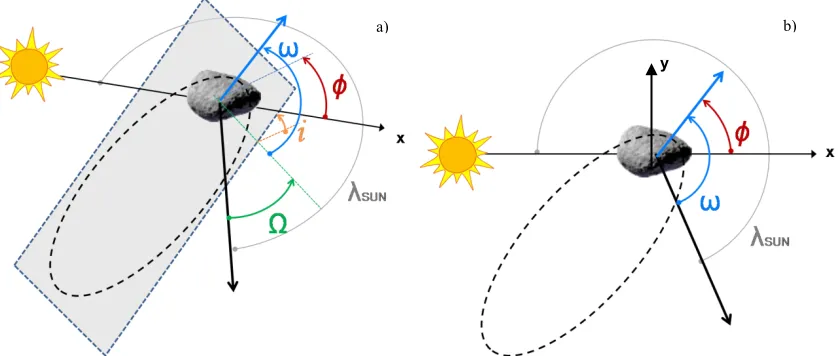
given by the following relation (see Figure 5a):cos sin
arctan
cos
SUNi
ω
φ
λ
π
ω
= Ω +
−
+
(8)where Ω represents the right ascension of the ascending node of the dust particle orbit around the
longi-tude. Initial ejection eccentricities range from 0.965 for an equatorial ejection, up to 1 for a polar
ejection. It can be easily appreciated that the eccentricity increases along the trajectory when
φ
islarger than 180 degrees, and decreases when
φ
is between zero and 180 degrees. Only a fewtrajectories with initial solar phase angle
φ
around 90 degrees and latitudes close to the equatorperform multiple revolutions. As an illustration, the evolution of a particular multi-revolution
equatorial trajectory is plotted in Figure 6. The osculating ellipses are represented at ejection (A),
re-impact (D) and two intermediate points when crossing the eccentricity value of 0.6. For this
particular example, the eccentricity drops down to 0.5 before increasing back to values close to 1
causing a re-impact, while the solar phase angle evolves from 120 (A) to close to 240 degrees
(D), as the pericenter rotates.
This eccentricity-solar phase graph resembles the phase space in the work by Oyama et al.
[27] for the limiting case with infinite SRP-gravity ratio. Their analysis was based on an approach
proposed by Hamilton and Krikov [28] to study the behavior of circumplanetary dust in a planar
case, which consisted in orbit-averaging Lagrange’s planetary equations over one revolution. This
method was later used by Oyama et al. and various authors to describe applications for
high-area-to-mass ratio spacecraft for Earth geo-magnetic tail exploration [27, 29], passive de-orbiting, and
heliotropic orbits applications [30]. It can be shown that it is also well-suited to describe the
Figure 5. Eccentricity-
φ
plot of dust trajectories for different latitude-longitude ejection sites on a10 km asteroid with a 4 hour rotational period, for dust particles of = 0.0045 ejected radially
out-wards with 10.34 m/s ejection velocity. An example equatorial trajectory is plotted, along with the
osculating ellipses at ejection (A), re-impact (D) and two intermediate points along the trajectory.
Figure 6. Definition of
φ
in the 3D case (a) and the planar case (b).Following loosely Hamilton and Krikov’s methodology, a planar case is assumed (see
Fig-ure 5b) in which the asteroid’s rotational axis is perpendicular to the plane of movement of both
the asteroid around the Sun and the dust particle around the asteroid. The phase angle
φ
betweenthe anti-solar direction and the periapsis line is in the planar case simply given by y
[image:15.612.98.517.365.543.2]SUN
φ ω λ
= −
+
π
. The dynamics of the dust under the influence of the solar radiation pressureperturbation and tidal forces caused by solar gravity can be described by the Hamiltonian [28]:
(
)
2
1
21
1 5cos(2 )
cos
2
H
=
−
e
+
Ae
+
φ
−
Ce
φ
(9)where the coefficients C and A correspond to the SRP and tidal term respectively, and they can be
expressed with the nomenclature followed by this paper as:
3
2
S Aa
C
d
µ
β
µ
=
3 33
4
S Aa
A
d
µ
µ
=
(10)The eccentricity and semi-major axis that appear in Eq. (9) and Eq. (10) are orbit averaged
values. This is an acceptable assumption in the case of circumplanetary dust, as the variation of
the semi-major axis over one revolution is zero [28] and the eccentricity changes slowly. In the
case of dust around asteroids, the excursions of the osculating semi-major axis from the mean and
the variations in eccentricity in one revolution are much larger, introducing deviations from the
analytical approximation, but the behavior of the system is still well described with the
Hamilto-nian approach. The evolution of the eccentricity and angle
φ
is then given by the followingHa-miltonian system in non-canonical form, which uses the solar longitude as its independent
varia-ble. 2 2
1
1
SUN SUNe
e
H
e
e
H
e
e
λ
φ
φ
λ
∂
−
∂
= −
∂
∂
∂
−
∂
=
∂
∂
(11)While the initial argument of pericenter of the ejected dust can be arbitrarily chosen by
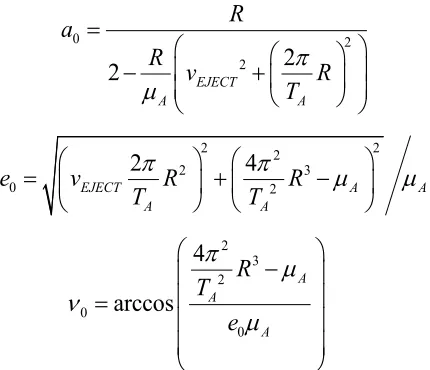
select-ing an ejection site/time, the rest of the initial osculatselect-ing orbital elements
a
0,e
0 and true anomaly0
0 2 2
2
2
EJECT A AR
a
R
v
R
T
π
µ
=
−
+
2 2 2 2 3 0 22
4
EJECT A A
A A
e
v
R
R
T
T
π
π
µ
µ
=
+
−
2 3 2 0 04
arccos
A A AR
T
e
π
µ
ν
µ
−
=
(12)with R being the asteroid radius, TA its rotational period and vEJECT the ejection velocity, once
[image:17.612.199.414.55.240.2]again assumed normal to the surface of the asteroid.
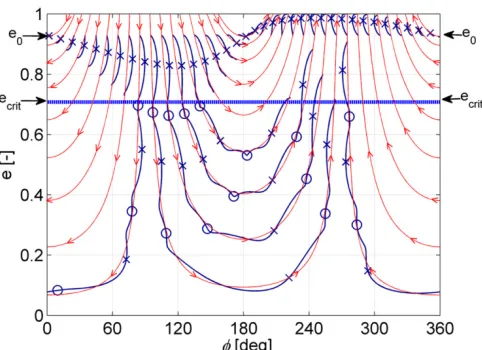
Figure 7 plots the comparison between the numerical propagation of ejected dust trajectories,
and the isolines of constant Hamiltonian that the orbit-averaged elements should follow in the
analytical approximation. The ejection velocity of this particular plot is 9.5 m/s and the rotation
period of the asteroid 3 hours. The initial eccentricity calculated with Eq. (12) is 0.93 for these
ejection conditions. No equilibrium points are found in the phase-space, due to the high SRP
per-turbation when compared to the cases studied by Oyama et al. [27] and Colombo et al. [30]. This
is consistent with the fact that no stable equatorial orbits can be found around small bodies when
SRP is taken into account: the eccentricity starts eventually increasing up to values that cause a
re-impact, or in the case of very high area-to-mass ratio, up to a hyperbolic escape. Still, the
Ha-miltonian approach correctly predicts the evolution of the eccentricity. For the initial conditions
selected, there is an increase in eccentricity for all points with
φ
>180°, resulting in a decrease inpericenter height and immediate re-impact before one revolution of all particles ejected in two
The region around
φ
=90° (which corresponds to ejection points with negative y in the thirdquadrant of longitude as foreseen in Figure 4) contains both trajectories that re-impact and others
that perform multiple revolutions. The eccentricity is decreasing in all cases, but only for a small
range of initial phase angles does the pericenter height raise above the asteroid radius and the
resulting trajectory performs multiple revolutions. To better illustrate this multi-revolution
re-gime, a thick blue dashed horizontal line is plotted in Figure 7, which represents a critical
eccen-tricity given by:
0
1
CRITR
e
a
= −
(13)corresponding to a value of 0.708 for the initial conditions selected in the figure. For
eccentrici-ties above this value and the initial semi-major axis, the osculating pericenter is below the
astero-id surface, which results in a re-impact. As the variation of a over one revolution is zero, and
ejection/re-impact takes place close to pericenter, this approximation is accurate enough.
The apocenters and pericenters in the numerical trajectories have been indicated with X and O
markers. Any pericenter (O marker) taking place above the critical eccentricity line implies a
re-impact. It can be observed that whenever the eccentricity is lower than the critical value by the
first pericenter, the dust particle manages to perform multiple revolutions, until after a few loops
the eccentricity grows again above the critical one. The maximum reduction in eccentricity over
one revolution does not take place though exactly at
φ
=90°, and the region of multi-revolutionFigure 7. Isolines of constant Hamiltonian (red with arrows) and numerical propagation of ejected
dust (dark blue with X and O markers) plotted in the eccentricity-
φ
phase space. Apocenters andpericenters of the numerical trajectories are indicated with X and O respectively. Vertical ejection
velocity is 9.5 m/s, = 0.0045, and the rotation period of the asteroid is 3 hours.
A series of operational guidelines can then already be drawn from these results with regards to
the selection of the extraction site, to determine the solar longitudes when operations are safer to
avoid re-impact of dust on crewed missions or equipment. If transient dust atmospheres are to be
avoided, solar longitudes close to
φ
=270° = − °(
90)
would be preferred. Operations at othersolar longitudes are still feasible if the forces used ensure the ejection velocity of dust stays well
below the limit that allows multi-revolution trajectories.
Time integration
The Hamiltonian system in Eq. (11) can be transformed in full canonical form with the change
of variable [28]:
2
1
k
=
−
e
(14)SUN SUN
k
H
H
k
λ
φ
φ
λ
∂
∂
=
∂
∂
∂
∂
= −
∂
∂
(15)It can be demonstrated that the tidal term A is of the same order as the SRP only for distances
of the order of the 20 asteroid radii, while the trajectories of interest stay bounded well below this
distance. If the tidal term A is neglected, Oyama et al. [27] showed that it is possible to integrate
the system to obtain the time needed for a particle to travel along a line of constant Hamiltonian
H* between two values of k (or eccentricity), obtaining:
(
)
(
2)
(
2)
0
0 3 2 2
2
1
*
1
*
1
arccos
arccos
1
*
1
*
1
sC
k
H
C
k
H
t t
d
C
C
H
C
C
H
C
µ
+
−
+
−
−
− = −
+
−
+
−
+
(16)As a result, it is possible to plot isolines of transfer time on the phase-space graphs, in
particu-lar the isolines corresponding to the time until apocenter or pericenter, to determine if the next
pericenter takes place before or after critical eccentricity is reached.
To obtain the orbital period it is also necessary to take into account the variation in argument
of pericenter due to SRP. The Lagrange planetary equation for the derivative of time with respect
to true anomaly, which includes a term related to the variation in
ω
, is:3 2 3/ 2 2 2 2
2 2 2
(1
)
(1
)
sin( ) sin(
)
1
cos
(1
cos )
(1
cos )
1
cos
S
A A
dt
a
e
a
e
d
e
d e
e
e
µ
ν
φ ν
β
φ
ν
µ
ν
µ
ν
ν
−
−
+
=
−
+
+
+
+
(17)Integrating over one revolution considering the mean values of semi-major axis and
eccen-tricities, the orbital period can be approximated as:
3 2 2
2
1 12 13
2 1 cos
2 4
S
A A
a a e
T
d e
µ
π
β
φ
µ
µ
+ ≈ − (18)A similar approach can be followed to obtain the first semi-period until apocenter. Plotting on
apocenter and pericenter calculated analytically (see Figure 8), they are a good match for the
ap-sides points calculated with the numerical propagation. This allows an accurate analytical
predic-tion of the condipredic-tions for a particle to perform multiple revolupredic-tions. The region in the phase space
where the isolines of time to pericenter is below the critical eccentricity line corresponds to
multi-revolution trajectories. It is important to note that the critical eccentricity varies with the
semi-major axis along the orbit, so there can be pericenters close to the limiting values on either side
that may impact or fly-over depending on the exact value of the semi-major axis at the re-impact
[image:21.612.190.431.263.434.2]time for the two extreme cases.
Figure 8. Apocenter and pericenter analytical time estimation (dotted black lines) on the eccentrici-ty-
φ
phase space. Vertical ejection velocity is 9.5 m/s, = 0.0045, and the rotation period of theaste-roid is 3 hours.
MATERIAL SORTING APPLICATIONS
One of the benefits of the differential effect of solar radiation pressure on ejected dust particles
is the possibility to engineer these forces in order to passively separate material as a function of .
This processing of material can be considered either for separation of the same material as a
func-tion of the grain size on an asteroid of uniform composifunc-tion (the larger the grain, the lower the ),
or alternatively, after a grinding process to reduce all materials to a similar grain size, as a method
the lower the ). The SRP sorting concept takes advantage of the low gravity on asteroids, which
would render other techniques such as classical gravity concentration processes unfeasible.
Two possible strategies for collecting the separated material can be devised (see Figure 9): a
hovering spacecraft that collects on-orbit the material that has been lifted from the surface by a
surface element or rover, or several collection points on ground at pre-calculated distances. Each
method has preferred ejection points on opposite sides of the asteroid (
φ
= ± °90 ). The surfaceelement can then collect material and, if needed, grind it for one asteroid revolution, and then
eject it at the appropriate time depending on the selected strategy.
[image:22.612.95.506.267.424.2]a) b)
Figure 9. Schematic representation of separation strategies with a hovering spacecraft collection
point (a) and a ground-based collection point (b) for a heavier particle (solid blue) and a lighter one
(dashed red). X-Y axes are parallel to the co-rotating frame axes and centered on the asteroid.
On-orbit collection
In the first method, the preferred ejection point is close to
φ
= °90 , where the SRP contributesto increasing the pericenter height and multiple revolutions are possible. The collection point
should be hovering at a certain distance on the Y-axis. Once an ejection velocity has been
se-lected, there is a minimum value of that will avoid re-impact in the first revolution, essentially
discriminating a maximum size of the grains of interest (larger grains would fall back onto the
reaching the desired height on the Y-axis for collection. Figure 10 shows on an eccentricity-
φ
phase plot the lines that correspond to a particular height over the Y-axis on the asteroid assuming
a constant mean semi-major axis. Only for certain ejection sites close to
φ
= °90 does theeccen-tricity evolution along the constant Hamiltonian isolines allow the particles to reach heights over
55 km on the Y-axis after a number of revolutions. The thick blue line shows a propagated
trajec-tory of this type, where the eccentricity decreases down to 0.1 (almost circular), before it
increas-es again when the phase angle shifts to valuincreas-es close to 270°. The sixth apocenter for this
trajecto-ry is well above 60 km.
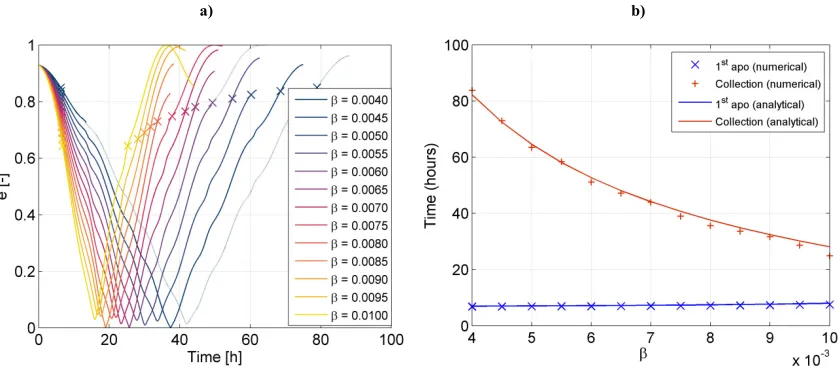
The passive separation takes place in time, as larger particles (particles with smaller ) require
more revolutions and thus longer times to reach the collection area. This is shown in Figure 11a,
where the time to come back to the initial eccentricity levels increases with decreasing . The plot
shows the time evolution of the eccentricity for different values of and the same ejection site at
the equator and
φ
= °90 , a rotation period of 3 hours, and an ejection velocity of 9.5 m/s.Par-ticles with ≤ 0.004 re-impact before the first pericenter.
It is possible to analytically estimate the time until collection by calculating with Eq. (16) the
time to reach the eccentricity of intersection of the ejection point isoline with
φ
=180°orφ
= °0 .Obtaining the intersection point is straightforward by substituting the phase angle
φ
in Eq. (9).Figure 11b shows a comparison between the analytical estimates and the numerical propagated
trajectories. The collection point for each is assumed as the point when the eccentricity reaches
the value at the first apocenter again, and is indicated with markers in Figure 11a. The first lighter
Figure 10. Eccentricity-
φ
phase space graph with isolines of constant height over the Y-axis in km (number-labeled green contours). Vertical ejection velocity is 9.5 m/s, = 0.0045, and the rotation period of the asteroid is 3 hours. For ejection sites close toφ
=90° trajectories can reach heights over55 km on the Y-axis when the phase angle shifts to 270° after a number of revolutions.
a) b)
Figure 11. a) Evolution of the eccentricity with time for φ=90° and different values of . Markers
indicate the first apocenter and collection point. Discontinuous lines indicate there has been a
re-impact on the surface. b) Time to collection and analytical approximation as a function of .
The main difficulty concerning this strategy is the large variation in height at the Y-axis
cross-ing for orbitcross-ing particles of different . Furthermore, simplifications in the model, such as the
omission of the eclipse times and not including other perturbations such as higher order
[image:24.612.97.516.308.493.2]point higher. A non-planar case would have the added difficulty of the evolution of the orbital
plane. Very large collectors (of the order of hundreds of meters for an asteroid of radius 10 km)
would be required in order to capture a significant number of particles, or an elaborate station
keeping strategy that changes height with time would be needed in order to compensate for these
variations. This greatly increases the complexity of operations for a hypothetical collection
on-orbit. The ejection velocities involved are also higher than for a ground based collection point.
On-ground collection
The second method envisages a series of collector points spaced on the surface of the asteroid
(or a collector band or strip extended over some distance). The differential separation of particles
as a function of is performed in space, rather than in time. The preferred ejection point is in this
case close to or equal to
φ
=270° (pericenter on the negative Y-axis), which corresponds totrajectories where the SRP reduces the pericenter height and thus re-impact is assured before one
revolution for most values of .
Figure 12 shows the distance between re-impact points for two regolith particles of different
sizes and densities as a function of the ejection velocity. The ejection velocity in the X-axis has
been scaled with the radius of the asteroid. For asteroids in the size range of 100 m to 10 km the
required ejection velocities for the same separation densities scale well with the radius. Only in
the case of fast rotators (blue lines with 2.5 hour period) if the ejection velocity increases there is
actually a clear bifurcation between the separation at a 1 km asteroid (dashed) and the 10 km one
(continuous line) for the range of velocities plotted, and there can even be cases with particles
escaping. For a smaller 100 m asteroid the bifurcation takes place at lower relative ejection
a) b)
Figure 12. Re-impact point separation between 1 mm-1 cm (blue) and 0.1 mm-1 mm (orange) grains
of homogenous density of 3.2 g/cm3 (a), and between grains of different densities (2.68 and 3.74
g/cm3) of the same size, 1 mm in blue, 0.1 mm in orange (b). Particles are ejected with a phase angle
φ
of 270 degrees for different asteroid rotation periods. Dashed and solid lines indicate the 1 km and10 km asteroid respectively. Only for the short period case (2.5 h) does the 1 km line deviate from the
10 km one for this range of ejection velocities.
Figure 12a assumes spherical particles of constant average density of 3.2 g/cm3 (homogeneous
asteroid of a low density olivine) for the suggested ejection site and different rotational periods of
the asteroid. If the desired separation between two such particles of size 1 mm and 1 cm is 1 m,
the graph shows that for an asteroid rotating with a 2.5 hour period the required ejection velocity
would be 2 m/s on a 10 km asteroid. This velocity would more than double in the case of a
non-rotating asteroid (~ 4.5 m/s). If the size of the particles desired for separation is one order of
mag-nitude lower (0.1 mm and 1 mm), the ejection velocities range from 0.5 to 1.7 m/s for the same
separation distance. These velocities are almost one order of magnitude lower than the ones
sug-gested for a hovering spacecraft collection point.
Figure 12b assumes instead a differentiated asteroid with two materials to be separated. The
Assuming 1 mm grains composed of plagioclase (average density of 2.68 g/cm3) and a denser
olivine or pyroxene (3.74 g/cm3), the ejection velocities required for a 1 m separation on a 10 km
asteroid range from 4 to 6.2 m/s depending on its rotation rate. For finely ground 0.1 mm
par-ticles, these velocities are reduced to 1 to 2.6 m/s. As the required ejection velocities scale with
the radius, on a 1 km size asteroid they would be one order of magnitude lower.
In addition to the lower ejection velocities, other benefits of the ground base collection when
compared to on-orbit collection is that eclipses have little or no influence in the trajectories of the
particles as the preferred ejection sites result in effectively eclipse-free trajectories except for a
short interval at ejection. Other perturbations, such as higher order harmonics of the gravity field
for the usually irregularly shaped asteroids would affect all particles in a similar form, regardless
of the value, so the differential effect of SRP would still cause a separation in re-impact points
of the same order. Non-planar trajectories would be affected in a similar way over one revolution,
and the only concern of an ejection point away from the equator would be a higher required
ejec-tion velocity, similar to the case of a slowly rotating asteroid.
EFFECT OF UNCERTAINTIES
One of the concerns that arise when evaluating this method is the sensibility of the separation
to errors or uncertainties in the ejection conditions. As the relative difference in grain size or
den-sity is small, errors in the velocity at ejection may induce greater dispersion on the grains than the
solar radiation pressure perturbation.
The separation caused by velocity errors was calculated for various asteroid sizes and rotation
periods. Figure 13 shows the re-impact point separation for an error in the velocity modulus of
1% (a) and an error in the ejection direction of 0.33 degrees (b). The color patches indicating the
comparison. It can be observed that there is a limiting asteroid size for each ejection velocity for
which the SRP induced separation is no longer effective compared to errors in velocity.
Focusing on specific examples on Figure 13a (indicated by vertical lines), for the case of a fast
rotating asteroid with a period of 2.5 h (blue square ), the required ejection velocity for a
sepa-ration of 1 m is equal to 0.06 xR m/s. With velocity modulus errors of 1%, the separation
be-tween equal particles would be of the order of 20 m for a 10 km asteroid, 2 m for a 1 km one, and
0.2 m for asteroids of 100 m radius. For a slowly rotating asteroid (period of 100 h, ), the
sepa-rations due to errors in velocity modulus are of the order of 0.5, 0.07 and 0.02 m for asteroids of
10, 1 and 0.1 km radius respectively. While the dispersions in a slow rotator for asteroids up to 1
km seem acceptable for implementing the SRP particle sorting, they would render it useless for
larger asteroids of 10 km radius, or for fast-rotators.
[image:28.612.93.523.352.538.2]a) b)
Figure 13. Re-impact point separation for errors in ejection velocity modulus of 1% (a) and errors in
ejection angle (in-plane) of 0.33 degrees (b). Line-styles indicate asteroid size; colors indicate its
rota-tion period. The patches indicating the separarota-tion by differential SRP are also included for reference.
Figure 13b shows a similar plot for errors in the velocity angle (only in-plane errors were
con-sidered). The separation induced by errors in angle has actually a minimum at a particular
veloci-1 2 1
ty, which lies close to the required ejection velocity to obtain an orbital period for the grains equal
to the rotational period of the asteroid. Close to this velocity, an error in the ejection angle causes
an error in semi-major axis that barely modifies the re-impact time. As the particles perform a
revolution at approximately the same time as the surface, there is a particular velocity for which
errors in angle would result in the same re-impact point at the surface, only slightly before or after
in time. When considering the same two examples as in the previous case, the separation induced
by errors in ejection angle is of the order of 4, 0.4 and 0.03 m for the fast-rotator case , and 10,
1 and 0.1 m for the slow-rotator . This seems to indicate that only asteroids of up to 100 m
ra-dius (or slightly larger) are good candidates for the sorting method proposed.
In order to have a more comprehensive analysis of the effect of additional uncertainties, such
as variations in the grain size or the densities of the materials, Monte Carlo simulations with
10000 shots were run for a 100 m radius fictitious asteroid rotating with a period of 5 h and with
regolith that has previously been ground to a particle radius of 100 µm.
For the composition of the asteroid, an ordinary chondrite S-type asteroid is assumed,
contain-ing mostly silicates (in general olivine-pyroxene with densities rangcontain-ing from 3.2 to 4.37 g/cm3)
and a few traces of metal (of density 7.3 to 7.7 g/cm3) [26]. Table 1 lists the material composition
as well as the assumed mean density and dispersion for 5 selected materials: Fe-Ni metallic
grains, a high density orthopyroxene (opx), two olivine (ol) silicates of medium and low density
and a plagioclase silicate. The average grain density is of 3.52 g/cm3 for this particular mix, which
Table 1. Regolith composition and densities. opx: orthopyroxene, ol: olivine
Material Percentage
in regolith Mean density
*
26
, [ ]
(g/cm3)
1- Std. dev.
(g/cm3)
Fe-Ni 2% 7.50 0.07
High density opx 15% 3.95 0.10
Medium density ol 50% 3.50 0.10
Low density ol 28% 3.20 0.05
Plagioclase 5% 2.68 0.04
Table 2 presents additional variables with uncertainties in the Monte Carlo simulation. The
ve-locity modulus is selected to obtain a nominal separation of 1 m for an asteroid with a rotation
period of 5 hours for 100 µm particles of the materials selected in the previous section (see
Fig-ure 13b). The errors in velocity modulus follow a normal distribution with a 3- uncertainty of
3% of the velocity modulus. Errors in ejection angle are assumed in two orthogonal directions
(along the longitude and latitude) with 1 deg 3- . The particles in the regolith are assumed to be
ground prior to ejection down to a fine dust with radius of 100 µm. The distribution of particle
size is assumed to follow a lognormal distribution of parameters µlogand log of -9.21 and 0.05,
which corresponds to a mode in particle radius of 100 µm. The mean value is slightly higher and
[image:30.612.198.415.512.587.2]the standard deviation is approximately 5 µm, as can be seen in Table 2.
Table 2. Uncertainties in Monte Carlo simulation.
Mean 1- Std. dev.
Velocity modulus (cm/s) 2.35 1%
Error angle (deg) 0.00 0.33
Particle radius (µm) 100.38 5.22
*
Figure 14 shows the results of one Monte Carlo run with 10000 shots. Figure 14a represents
the trajectory in the Sun-asteroid co-rotating frame, with the Sun in the negative X-axis. Metallic
particles are the least affected by the SRP and fall closer to the trajectory without perturbations
(red dashed line). In Figure 14c the same trajectories are plotted in a local horizontal frame with
the xloc-axis tangent to the longitude lines on the asteroid (in this case the equator) and the zloc-axis
normal to the surface. The Sun direction rotates but it is also close to the negative xloc-axis due to
the selected ejection point with phase angle
φ
=270°. From the point of view of the ejector (i.e.,Figure 14c), the particles start travelling upwards along the local vertical up to a height of about 5
meters, and then start falling behind as the asteroid rotates, with the closest heavier particles
fall-ing around 3 m in the anti-solar direction and the lightest particle considered re-impactfall-ing 7 m
away from ejection. A trajectory without SRP is also plotted (red dashed line) for comparison.
The re-impact points are represented on Figure 14b and d. Figure 14b shows the displacement
along the xloc-axis for different densities, while Figure 14d plots the re-impact point in the local
horizontal frame. The theoretical re-impact point without SRP is also indicated in both plots. The
main effect of errors in velocity in the yloc direction is a displacement of the re-impact point in the
same direction. Its influence in the separation or mixing of particles is limited.
The separation as a function of density is particularly effective for metallic particles, due to
their well differentiated density. There is a much less clear separation among different silicate
materials, although a gradient in density along the local x-axis is evident, from heavier
pyroxene-olivine mixtures to lighter silicates of the plagioclase-feldspar family. The distances involved are
also acceptable from an engineering point of view. A 10 meter collector band extended from the
ejection module could be deployed to collect material, or a rover could sweep the re-impact area
Figure 14. Monte Carlo run with 10000 ejected particles of different materials. Plot a) shows
trajectories in the Sun-asteroid co-rotating frame; b) shows the separation as a function of
densi-ty; c) plots the height versus the local horizontal frame separation along the x-axis; d) shows the
re-impact points in a local horizontal frame.
DISCUSSION AND MODELING LIMITATIONS
The analysis presented so far represents a first feasibility study of the concept of passive
sort-ing of material on asteroids by means of solar radiation pressure. This analysis already shows that
ground based collection of material seems to be a promising technique. It would be particularly
suited for concentrating materials with well differentiated densities, or to coarsely separate grain
sizes.
c) d)
In the first case of material separation as a function of density prior grinding is needed. A
possible implementation would consist of regolith grinders that operate for a full asteroid
revolu-tion and eject the material only at the desired solar longitude. The collectors would be static,
placed a few meters away or even attached to the ejector. Similar to mining terrestrial processes,
the collectors could consist of simple mounds, strips of material, or “pools” on the surface where
material accumulates for later collection or processing. The process can be repeated iteratively
with the material in these mounds being ejected again from a different location for further
re-finement.
On the other hand, for regolith particle size separation, no grinding is required. The regolith
collected could be directly ejected by a moving system that advances ideally at the same rate that
the asteroid rotates (at a rate of a few millimeters or centimeters per second depending on the
asteroid period). A first line of rovers could rake the regolith in advance, while a second line that
maintains its position close to the terminator on the shaded region at the correct solar longitude
scoops it and ejects it continuously. The collectors need also advance at the same rate and in
coordination with the ejectors, maintaining their relative position in the lighted area after sunrise
close to the terminator to receive the ejected material. However, surface mobility at the required
speeds is at best questionable in the microgravity conditions and rough uneven surfaces of
astero-ids [33]. Legged rovers with gripping mechanisms are currently under development for
move-ment in very steep surfaces on Mars or the microgravity conditions of asteroids [34, 35]. They
would enable steady locomotion on asteroids and the ability to traverse obstacles, but unlikely at
the required speeds to allow a continuous ejection system that keeps up with the asteroid rotation.
Large industrial ventures may consider the installation of complex machinery and systems such
Alternatively, both for density and regolith size separation, a possible solution is moving
rov-ers or excavators that return to a designated ejection point at the appropriate time to eject the
col-lected and/or ground material. These rovers could use the already mentioned gripping-motion
systems, but at much lower speeds. The ejection sites could be preselected to take advantage of
the local topography for better separation or ease of collection.
The main benefit of the separation method in itself is the simplicity of its physical principle.
This is an advantage for implementation, which can be modular and scalable, with potential for
high throughput. Because of this, it has potential applications for the concentration of materials or
grain sizes prior to or in combination with more sophisticated processing techniques specific for
each material type or particle size. It would comprise the first step of an industrial process similar
to gravity concentration on Earth. Nevertheless, further work on the numerical validation of these
semi-analytical results is desirable in order to ensure the efficacy of the method presented in a
more complete dynamical model of a small body.
First of all, the use of the CR3BP for numerical propagation instead of a more complex model
including the eccentricity of the asteroid orbit around the Sun has a minor influence on the
re-sults, as the timescales of the trajectories considered are short compared to the period of a NEO
orbit around the Sun. In addition, the analytical results correspond to a simplified planar case and,
although an extension to low inclination is possible and the general behavior is not expected to
change, a three-dimensional model is required for large inclination trajectories for ejecta from
higher latitudes or from asteroids where the rotation axis is not perpendicular to the Sun-line. For
these cases, the closed-form solution of the radiation pressure approximation (RPA) by Richter
and Keller [7, 36] could allow an analytical extension of the problem to 3D. The RPA approach
may however not be best suited to study the trajectories of interest, as the model fails if the
num-ber of revolutions is small, as in this case.
The irregular shape of asteroids has also an important effect on the method proposed, not only
due to unmodeled gravitational perturbations that may render some of the multi-revolution
trajec-tories presented unfeasible [37, 38], but also due to the changes in the re-impact point position
and direction as a function of the local geometry. Higher order gravitational terms should affect
all particles independently of their lightness number, so their influence on the SRP induced
sepa-ration is expected to be limited for the on-ground collection method where a full revolution does
not take place. However, the shape of the asteroid will change the departure and re-impact
condi-tions significantly.
Regarding the solar radiation pressure force modeling and the material properties, the same
reflectance was assumed for all materials by setting the radiation pressure scattering coefficient
Q=1, corresponding to complete absorption. The lightness number is proportional to Q/ and
material dependant variations in the radiation pressure coefficient would affect the separation
between particles. However, reflectance spectra analysis from meteorite metal-silicate
mixtures [39] show that the absolute reflectance of orthopyroxene and olivine silicates is greater
than that of denser metallic mixtures, thus having the effect of a greater gap in values, and
theo-retically increasing the re-impact separation between metallic and silicate particles. The simple
cannon-ball model used for SRP is considered accurate enough to study particle evolution, where
the shape and effective area and the attitude of the particle are not known. In addition, as pointed
out earlier, eclipses would not affect the on-ground collection scheme as preferred ejection points
result on effectively eclipse-free trajectories (except for the ejection instant). However, if