City, University of London Institutional Repository
Citation
:
Chuang, J. & Lazarev, A. (2007). Dual Feynman transform for modular operads. Communications in Number Theory and Physics, 1(4), pp. 605-649.This is the accepted version of the paper.
This version of the publication may differ from the final published
version.
Permanent repository link: http://openaccess.city.ac.uk/14048/
Link to published version
:
Copyright and reuse:
City Research Online aims to make research
outputs of City, University of London available to a wider audience.
Copyright and Moral Rights remain with the author(s) and/or copyright
holders. URLs from City Research Online may be freely distributed and
linked to.
DUAL FEYNMAN TRANSFORM FOR MODULAR OPERADS
J. CHUANG AND A. LAZAREV
Abstract. We introduce and study the notion of a dual Feynman transform of a modular
operad. This generalizes and gives a conceptual explanation of Kontsevich’s dual construction producing graph cohomology classes from a contractible differential graded Frobenius alge-bra. The dual Feynman transform of a modular operad is indeed linear dual to the Feynman transform introduced by Getzler and Kapranov when evaluated on vacuum graphs. In marked contrast to the Feynman transform, the dual notion admits an extremely simple presentation via generators and relations; this leads to an explicit and easy description of its algebras. We discuss a further generalization of the dual Feynman transform whose algebras are not neces-sarily contractible. This naturally gives rise to a two-colored graph complex analogous to the Boardman-Vogt topological tree complex.
Contents
Introduction 1
Notation and conventions 2
1. Main construction 4
2. Twisted modular operads and their algebras 8
3. Algebras over the dual Feynman transform 12
4. Stable graph complexes 13
4.1. Commutative case 14
4.2. Associative case 15
5. Examples 18
6. Moduli spaces of metric graphs 19
6.1. Commutative case 19
6.2. Associative case 21
7. BV-resolution of a modular operad 22
7.1. Basic construction and description of algebras 23
7.2. Stable BV-graph complexes 24
References 26
Introduction
The relationship between operadic algebras and various moduli spaces goes back to Kontse-vich’s seminal papers [20] and [21] where graph homology was also introduced.
Kontsevich proposed two constructions producing classes in the ribbon graph complex. The ‘direct’ construction has as the input aZ/2-gradedA∞-algebra with an invariant scalar product (or symplecticA∞-algebra in the terminology of [13]). The output is a collection of homology classes in the ribbon graph complex (or a corresponding collection of cohomology classes in the moduli spaces of Riemann surfaces with marked points). This construction is now well understood from various standpoints, see, e.g. [14], [7].
2000Mathematics Subject Classification. 55N30, 55U30, 18D50.
Key words and phrases. Modular operad, Feynman transform, Frobenius algebra, sheaf cohomology, topolog-ical field theory.
The other, ‘dual’, construction starts with a contractible differential graded Frobenius algebra with an odd scalar product and gives rise to a collection of cohomology classes in the ribbon graph complex. By pairing the direct and the dual constructions it is possible to prove the non-triviality of both. Explicit examples involving so-called Moore algebras, cf. [13], [24], [12] will be discussed in future work.
The dual construction was motivated by the combinatorics of Feynman graphs in the quantum Chern-Simons theory. Its conceptual formulation based on the Batalin-Vilkovisky formalism is given in [15] (for the commutative graph complex). It is probable that the approach of [15] could be generalized to accommodate the case of general modular operads, using the language of operadic noncommutative geometry as it is presented in e.g. [11].
The purpose of this paper is to give the most general formulation of Kontsevich’s dual con-struction from the point of view of modular operads. We introduce the notion of a ‘dual Feynman transform’ F∨O for a differential graded modular operad O. It turns out that F∨O
is itself a modular operad (more precisely, a mild generalization thereof which we call an ex-tended modular operad). In other words, there is no twisting as in the case of the usual or ‘direct’ Feynman transform of [9]. Moreover, the vacuum part ofF∨O, corresponding to graphs without legs, is indeed linear dual toFO. On the other hand the components corresponding to graphs with legs are contractible, in contrast to FO. Another striking difference between the direct and dual notions is that the dual Feynman transform F∨O admits an extremely simple presentation in terms of generators and relations; it is obtained from FO by freely adjoining a generator s of square zero and such thatd(s) = 1 where 1 is the operadic unit. This leads to the correspondingly simple description of algebras over F∨O as O-algebras with a choice of a contracting homotopy. Note that the description of algebras overFOis much more complicated; it is given in terms of a quantum master equation, cf. [2].
Applying this construction to the modular operad OTFT (open topological field theory) whose algebras are noncommutative Frobenius algebras we recover Kontsevich’s dual construc-tion. In fact we find that its original formulation needs to be modified in order to produce cohomology classes. This can be achieved by imposing a rather stringent condition on the input Frobenius algebra. Alternatively one can modify the ribbon graph complex by allowing the contraction of certain (or all) loops. The latter approach corresponds to compactifying the moduli space of metric ribbon graphs, and the dual construction in fact produces cohomology classes of certain constructible sheaves on these compactifications.
We also introduce a certain generalization of the dual Feynman transform for a modular operadOwhich we call the Boardman-Vogt (or BV) resolution as suggested by Sasha Voronov. The BV-resolution is closely related to the canonical free resolution of O given by the twice-iterated Feynman transform of O; it could be used to construct a minimal model of an O -algebra. An algebra over the BV-resolution of O is an O-algebra supplied with a Hodge-like decomposition compatible with the action of O. Note that the de Rham algebra of a smooth oriented manifold does indeed have such a structure as follows from Hodge theory. This suggests a possible application to Chern-Simons theory on general manifolds.
Notation and conventions. In this paper we work mostly in the category of Z/2-graded vector spaces (also known as super-vector spaces) over a fieldkof characteristic zero. The reason for this choice is that operadic algebras giving rise to nontrivial classes in graph complexes tend to beZ/2-graded. However all our results (with obvious modifications) continue to hold in the Z-graded context. The adjective ‘differential graded’ will mean ‘differential Z/2-graded’ and will be abbreviated as ‘dg’. The category of dg vector spaces overkwill be denoted by dgVect. All of our unmarked tensors are understood to be taken overk. On the other hand, by achain complex we will mean the usual Z-graded notion – a collection C• ={Cn}, n ∈Z of k-vector spaces together with a differential d : Cn → Cn−1. Similarly a cochain complex will mean a
collectionC• ={Cn}, n∈Zofk-vector spaces together with a differentiald:Cn→Cn+1. The suspension of a chain complex C• is defined by (ΣC)i = Ci−1 and that of a cochain complex C• is defined by (ΣC)i = Ci+1. For a Z/2-graded vector space V = V0 ⊕V1 the symbol ΠV
will denote the parity reversion ofV; thus (ΠV)0 =V1 while (ΠV)1 =V0. For d∈Z/2 we set
ΠdV := (
ΠV ifd= 1
V ifd= 0 . For an ungraded vector spaceV of dimensionnandd∈Z/2 we write
Detd(V) for the Z/2-graded vector space (ΠnΛnV)⊗d∼= (ΠV)⊗nd. For a finite set S we write Detd(S) for Detd(kS). Note that Detd(S)∗ is canonically isomorphic to Detd(S).
We use extensively the results of [9]. Here is a brief summary of the relevant terminology (adapted to theZ/2-graded context); the reader is referred to the original paper of Getzler and Kapranov for details. An ordered pair (g, n) of nonnegative integers isstable if 2(g−1) +n >0. The only pairs which are unstable, i.e. not stable, are (0,0), (0,1), (0,2) and (1,0). The group Aut(1,2, . . . , n) is denoted by Sn. A cyclic S-module is a collection of dg vector spaces
{V((n))|n≥0} with an action ofSn on V((n)). A stable S-module is a collection of dg vector spaces{V((g, n))|g, n ≥0} with an action of Sn on each V((g, n)), such that V((g, n)) = 0 for
unstable (g, n). Furthermore, if Vis a stable S-module andI is a finite set then we set
V((g, I)) :=hMV((g, n)) i
Sn
where the direct sum is extended over all bijections {1,2, . . . , n} → I. We also set V((n)) := L
g≥0V((g, n)) andV((I)) :=
L
g≥0V((g, I)). We will consider the following stableS-modules:
s((g, n)) = Πnn,
Π((g, n)) = Πk.
Here n is the alternating character of Sn.
A graph is a one-dimensional cell complex; we will only consider connected graphs. From a combinatorial perspective a graph consists of the following data:
(1) A finite set, Flag(G), consisting of the half-edges orflags of G.
(2) A partition Vert(G) of Flag(G). The elements of Vert(G) are called the vertices of G. The half-edges belonging to the same vertexvwill be denoted by Flag(v); the cardinality of Flag(v) will be called thevalence of v and denoted byn(v).
(3) An involutionσ acting on Flag(G). The edges ofGare pairs of half-edges ofGforming a two-cycle of σ; the set of edges will be denoted by Edge(G). Thelegs of G are fixed points of σ; the set of legs will be denoted by Leg(G).
A stable graph is a graph G having each vertex v ∈ Vert(G) decorated by a non-negative integerg(v), thegenus ofv; it is required that (g(v), n(v)) is stable for each vertexv ofG. The
genus g(G) of stable graphG is defined by the formula
(0.1) g(G) = dim(H1(G)) +
X
v∈Vert(G) g(v).
Contracting an edgeein a stable graphGyields a new stable graphGe; the decorationsg(v)
of the vertices of Ge are defined in the obvious way, so that g(Ge) = g(G). The set of stable
graphs forms a category whose morphisms are generated by isomorphisms and edge-contractions
G→Ge.
We denote by Γ((g, n)) the category whose objects are stable graphs G of genus g with n
labeled legs (i.e., equipped with a bijection between{1, . . . , n}and Leg(G)). Note that Γ((g, n)) is empty whenever (g, n) is unstable.
For a stable graph Gand a stable S-moduleVwe define the dg vector space
V((G)) := O
v∈V ert(G)
V((g(v),Flag(v))
of Vdecorations onG. Further, set
K(G) = Det(Edge(G));
For a categoryC, we denote by [C] the set of isomorphism classes of objects, and by IsoCthe subcategory of isomorphisms.
1. Main construction
In this section we introduce the notion of the dual Feynman transform of a modular operad and give its graphical interpretation. Crucially the dual Feynman transform contains an ‘un-stable’ generator; it will be necessary to relax the stability condition of Getzler and Kapranov.
Definition 1.1.
(1) An extended stableS-module is a collection of dg vector spaces{V((g, n))|g, n≥0}with an action ofSnon eachV((g, n)), such thatV((g, n)) = 0 for (g, n) = (0,0),(0,1),(1,0).
(2) An extended stable graph is a connected graph G having each vertex v labeled by a non-negative integer g(v) called the genus of v. We require that vertices of valence 0 have genus at least 2 and those of valence 1 have genus at least 1.
Remark 1.2. Our definition is a mild generalization of the notions of a stable S-module and a stable graph, see [9], in that the unstable pair (0,2) is allowed. In what follows we introduce analogues of the notions considered by [9] in the context of extended stable graphs and extended S-modules. We will omit most of the details since the treatment given by Getzler and Kapranov can be carried over to the present situation almost verbatim.
The genus g(G) of an extended stable graph G is defined by the same formula (0.1) as in the stable case. Furthermore, the set of extended stable graphs of genus g with nlabeled legs forms a category, just as in the case of stable graphs; the morphisms are again generated by isomorphisms of graphs and edge-contractions. We will denote this category by Γ((g, n)). Note that the only graphs in Γ((g, n)) for unstable (g, n) are the strings • • . . . • • of bivalent vertices of genus 0, which lie in Γ((0,2)).
Suppose (g, n) is stable. Then any extended stable graphG∈Γ((g, n)) contains at least one
stable vertex, i.e. a vertex vfor which (g(v), n(v)) is stable. So Gdetermines a stable graph ˜G
obtained fromGby forgetting the bivalent vertices ofGhaving genus 0. Clearly the association
G7→G˜ is a functor Γ((g, n))→Γ((g, n)).
Recall that ahyperoperad is a collectionDof functors from the categories Iso Γ((g, n)) to the category dgVect together with structure maps defined for any map between two stable graphs
f :G0 →G1:
νf :D(G1)⊗
O
v∈Vert(G1)
D(f−1(v))→D(G0)
subject to some natural coherence conditions.
Any hyperoperad extends to a collection of functors on the categories Iso Γ((g, n)): for an extended stable graph G we set D(G) := D( ˜G) if (g, n) is stable and D(G) :=k (with trivial Sn-action) otherwise. The structure maps also extend in an obvious way: if the morphism f
corresponds to contracting an edge abutting an unstable vertex, i.e. a bivalent vertex of genus 0, then the corresponding νf is the identity map.
Given a hyperoperad D we define an endofunctor MD on the category of extended stable
S-modules by the formula
MDV((g, n)) = colim
G∈Iso Γ((g,n))
D(G)⊗V((G)).
HereV((G)) is defined in the same way as in the stable case, and we refer toD(G)⊗V((G)) as the space of D-twisted V-decorations on G.
The arguments of [9] show that the functor MD is a triple.
Definition 1.3. An extended modular D-operad is an algebra over the triple MD. For an
extended stableS-moduleVthe corresponding extended stableS-moduleMDVis called the free
extended modular D-operad generated by V.
IfVis stable the colimit definingMDV((g, n)) may be taken over Iso Γ((g, n)), and we recover
Getzler and Kapranov’s triple MD in the category of stable S-modules. Thus a modular D-operad is precisely an extended modular D-operad whose underlying S-module is stable.
Now let S be the extended stable S-module for which S((g, n)) = 0 if (g, n) 6= (0,2) and S((0,2)) = Πlk, a shifted copy of the ground field with the trivial action ofS2. We will denote
bys= Πl1 the canonical basis element inS((0,2)). LetObe a modular D-operad and consider the coproduct of O and MDS in the category of extended modular D-operads. Informally
speaking, this is the D-operad over O freely generated by the operation s. To emphasize this point of view, we will denote this operad by O[s]. We have the following simple but crucial result.
Lemma 1.4. There is an isomorphism
O[s]((g, n))∼= colim
G∈Iso Γ((g,n))
Detl(Edge(G))⊗D(G)⊗ O(( ˜G)).
(If (g, n) is unstable thenG˜ is undefined and we read O(( ˜G)) as k.)
In other words, this formula expresses O[s]((g, n)) as a space of D-twisted O-decorated ex-tended stable graphs where the decorations are only placed on the stable vertices. The degrees of the graphs are then calculated according to the number of edges and the degree ofs.
Proof. Let us assume first thatO=MDVfor some stableS-module V. It is clear that
(1.1) O[s]((g, n)) =MD(V⊕S)((g, n)) =
M
G∈[Iso Γ((g,n))]
[D(G)⊗(V⊕S)((G))]Aut(G).
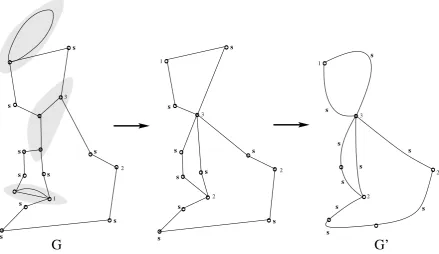
Now for any extended stable graphGwe denote byG0 the extended stable graph obtained from
G by contracting all edges connecting stable vertices (including loops at stable vertices) and replacing all strings of unstable bivalent vertices of length mby strings of length m−1.
G
s s
s s
s s
s s
s
s s s
s
s s
s s
s
s s
s
s s
s s
s s
G’
22 3
1
1
2 3
2 1
3
[image:6.595.78.518.432.686.2]2
Figure 1. Contract edges connecting stable vertices, then replace unstable
ver-tices by edges. Verver-tices are understood to have genus 0 unless otherwise notated.
on G0, tensored with N
Πlk, where the product is taken over the unstable vertices of G or equivalently theedges ofG0. Here we are implicitly making use of the induced homomorphisms Aut(G)→Aut(G0). The desired statement is proved in this special case.
In general we have a canonical split coequalizer in the category of modularD-operads
MDMDO ////MDO //O,
and using the fact that a split coequalizer is preserved by any functor we reduce the general case to the one considered.
Remark 1.5. Although our proof of Lemma 1.4 is fairly unilluminating its statement is easy to visualize. The vertices of our decorated graphs correspond to the operations in the operadO
whilst the edges correspond to the adjoined operation sso a decorated graph itself represents an iterated composition of elements in O withs.
Definition 1.6. Let Dbe a hyperoperad andO be a modularD-operad. Define an extended
stable S-module O+ by the formula O+((g, n)) =
(
O((g, n)) if (g, n)6= (0,2)
k if (g, n) = (0,2). Here S2 acts trivially onO+((0,2)). Furthermore, define the structure of an extended modularD-operad on O+ by the following composition
MDO+((g, n)) = colim
G∈Iso Γ((g,n))
D(G)⊗ O+((G))→ colim
G∈Iso Γ((g,n))D(G)⊗ O+((G))→ O+((g, n))
where the first arrow is induced by the functor Γ((g, n))→ Γ((g, n)) :G7→ G˜ and the second one is given by the structure of a modular D-operad on O. The canonical basis element 1
of O+((0,2)) is called the unit of O+, and the extended modular D-operad O+ is said to be
obtained from O by adjoining a unit.
From now on we will assume thatDis a cocycle, i.e. D(G) is one-dimensional (concentrated in either even or odd degree) for any stable graph G and that the corresponding structure maps νf are isomorphisms. In that case an MD-algebra structure on O gives rise to (possibly
parity reversing) operadic composition maps ◦i : O((m))⊗ O((n)) → O((m +n−2)) and
ξij : O((n)) → O((n−2)) by restricting the structure map MDO → O to the graphs having
only one edge.
We are now ready to define our main object of study. Recall from [9] that the Feynman transform FDOof a modular D-operad Ois a modularK⊗D∗-operad whose underlying stable
S-module is
MK⊗D∗(O∗)((g, n)) = colim
G∈Γ((g,n))K(G)
⊗D(G)∗⊗ O((g, n))∗.
The differential onFDO is the sum of the ‘internal’ differential induced by that on O and the
differential induced by the edge-expansions of stable graphs and the operadic composition inO.
Definition 1.7. Let D be a cocycle, and O be a modular D-operad. The dual Feynman transform ofOis the quotient of the extended modularD-operad (O[s])+, whereshas degree 1,
by the relations2 :=s◦1s= 0. It will be denoted by F∨DO. The differential d on F∨DO is the
unique extension of the differential onO satisfying d(s) =1.
Theorem 1.8.
(1) The dg vector space F∨DO((g, n)) is contractible for n >0 and any g.
(2) There is an isomorphism of dg vector spaces F∨DO((g,0))∗ ∼=FDO((g,0)).
Proof. According to Lemma 1.4 we have
O[s]((g, n))∼= colim
G∈Iso Γ((g,n))
K(G)⊗D( ˜G)⊗ O(( ˜G)).
Recall that the edges of a decorated extended stable graph G represent the operation s, and unstable bivalent vertices between edges correspond to composing s with itself. Since these
compositions are zero in F∨DO we conclude that the only nonzero contributions to the direct sum are from graphs all of whose unstable vertices are adjacent to legs.
Let n > 0 and (g, n) 6= (0,2). For any stable graph G ∈ Γ((g, n)) we need to consider the 2n graphs obtained from G by placing unstable bivalent vertices on a subset (possibly empty) of legs of G. Denote the space spanned by such graphs by V; we see therefore that the (g, n )-component ofF∨DO is isomorphic to
M
G∈[Γ((g,n))]
(K(G)⊗D(G)⊗ O((G)))Aut(G)⊗V.
It is clear thatV is isomorphic to the tensor product of contractible dg vector spaces of dimension two: k·1⊕k·s with d(s) =1. In particular F∨DO((g, n)) is contractible. The contractibility ofF∨DO((0,2)) is obvious since the latter space is spanned by 1and sand d(s) =1. Part (1) of our theorem is proved.
Now let n= 0. We saw that the unstable vertices are allowed on the legs only and thus we are reduced to considering the usual stable graphs. We have thus:
O[s]/s2((g,0))∼= colim
G∈Iso Γ((g,0))K(G)⊗D(G)⊗ O((G)).
Recalling our assumption that the characteristic of kis zero, this establishes an isomorphism
F∨DO((g,0))∗ ∼=O[s]/s2((g,0))∗∼=FDO((g,0))
as Z/2-graded vector spaces. The differential on O[s]/s2((g,0)) is the sum of the internal differential on tensor powers of O and the differential induced by the equation d(s) =1. The latter is the usual graph differential corresponding to the contractions of edges of stable graphs and given by operadic compositions in O. The total differential is therefore dual to that in
FDO((g,0)).
Remark 1.9. Let us represent the identity operation by the graph • and the operationsby the graph • • . An element inF∨DO will be represented by a graph whose stable vertices are decorated by elements inO inscribed in circles and whose unstable vertices (which are only allowed on the legs) are represented as dots. The differential is induced by contractions of edges plus the internal differential in F∨DO. For example the equations d(s) = 1 and d(1) = 0 are represented as
d( • • ) = • and d( • ) = 0
The operadic composition inF∨DO is described by the following pictures.
x ◦ y x◦y
x • ◦ y x y
by one. According to our definition of adjoining a unit to a modular operad the glueing of the two edges of • is equal to zero. The relations2= 0 translates into the following picture.
x • ◦ • y zero
The last equation gives a graphical explanation why the unstable vertices – the dots – do not appear on the edges.
2. Twisted modular operads and their algebras
In this section we describe algebras over modular D-operads and discuss some important examples. We will only be concerned with the case D= Detd where dis an integer modulo 2, i.e. D(G) = Det(H1(G))⊗d for a stable graphG. In particular, if d= 0 this corresponds to an
(untwisted) modular operad. Note that since for a tree graphG the twisting by Detd is trivial the genus zero part of any modular Detd-operad is a usual cyclic operad. Let V be a dg vector space with a symmetric inner product of degreed, i.e. an (even) symmetric mapV⊗V →Πdk. Then the stable S-module {E((g, n)) = V⊗n} forms a modular Kd-operad, see [2]. Note that the genus zero part ofE is not a cyclic operad unlessd= 0; to remedy the situation we twist the operadE by the S-modulesd⊗Πd, i.e. consider instead the operad
˜
E((g, n)) :=sd((g, n))⊗Πd((g, n))⊗ E((g, n))∼= Πd(ΠdV)⊗n.
Then ˜E is a modular Detd-operad, and its genus zero part ˜E(0,•) forms a cyclic operad. Using the isomorphismV ∼= Πd(V∗) we see that that ˜E(0,•) is isomorphic to the endomorphism cyclic operad{Hom(V⊗(n−1), V)}.
Definition 2.1. Let O be a cyclic operad andV be a dg vector space with equipped with an inner product of degree d. Then a (cyclic) O-algebra structure on V is a homomorphism of cyclic operads O →E˜(0,•).
The notion of a O-algebra is easy to work out explicitly in the case of a quadratic cyclic operad O. In that case O is generated by a set of cyclically invariant elements in O((3)) and a O-algebra structure on V is specified by a collection of binary operations on V which are cyclically invariant when regarded as elements in V⊗3.
Example 2.2. Let us consider what this definition specializes to in the case of the three standard cyclic operads: commutative, associative and Lie.
(1) Let O = Com be the commutative non-unital cyclic operad: O((n)) = (
0, n= 1,2
k, n≥3 . The operad Ois generated by a single element of even degree in O((3)) with the trivial action ofS3. It follows that a cyclicCom-algebra is a (graded)-commutative dg algebraA
with an inner producth,iof degreedwhich is invariant in the sense thathab, ci=ha, bci
for any a, b, c∈A. In other words, Ais a dg commutative Frobenius algebra.
(2) LetO=Assbe the associative non-unital cyclic operad: O((n)) = (
0, n= 1,2
k[Sn/Zn], n≥3
.
The operad Ois generated by two elements of even degree inO((3)). It follows that an cyclic Ass-algebra is an associative dg algebraA with an inner product h,i of degree d
which is invariant in the sense that hab, ci=ha, bci for any a, b, c∈A. In other words,
A is a (possibly noncommutative) dg Frobenius algebra.
(3) Let O = Lie be the Lie cyclic operad. It is generated by a single element of even degree in O((3)) on which S3 acts by the sign representation; the relations come from
the Jacobi identity. It follows that a cyclic Lie-algebra is a dg Lie algebra A with an inner product h,i of degree d which is invariant in the sense that h[a, b], ci = ha,[b, c]i
for any a, b, c∈A. For example, any reductive Lie algebra is a cyclic Lie-algebra. The commutator Lie algebra of an Ass-algebra is a Lie-algebra.
Now letO be a modular Detd-operad and ˜E ={E˜((g, n))}be the Detd-operad associated to a dg vector spaceV with a symmetric inner product of degreedas defined above.
Definition 2.3. The structure of a (modular) O-algebra on V is a homomorphism of Detd -modular operads O →E˜.
Recall that for any stable graphG∈Γ((g, n)) a modular Detd-operadO determines a homo-morphism µG: Detd(G)⊗ O((G))→ O((g, n)) which corresponds to taking operadic
composi-tions in O((G)) along the internal edges ofG. For a structure of anO-algebra onV given by a mapf :O →E˜we can form the composition
f ◦µG: Detd(G)⊗ O((G))→E˜((g, n))∼= Πd(n−1)V⊗n.
We will denote f◦µG by ZV(G) and call it theFeynman amplitude of the decorated graph G
corresponding to the algebra V.
We are going to introduce certain modular operads closely related toAss,Com andLie, and describe the algebras over them. To do this we need to use the modular closure of a cyclic operad introduced in [16]. We will use a slightly more general notion than that considered in the cited reference in order to include the case of Det-operads.
The functor of restricting to the genus zero part of a modular Detd-operad takes values in the category of cyclic operads. This functor admits a left adjoint; the value of the latter on a cyclic (non-unital) operad Owill be denoted by Od. Ford= 0 we will shorten this notation to
O. The existence ofOdfollows immediately from the description of twisted modular and cyclic operads as algebras over appropriate triples. Indeed, let O be generated by a cyclicS-module
{C((n))}. We can consider it as a stable S-module with C((g, n)) = 0 for g 6= 0. Then Od is constructed from the free Detd-operad MDetdO by quotienting out by the same relations as
those defining O. We will call Od the Detd-modular closure (or simply modular closure for
d= 0) of O. We have the following result which follows immediately from definitions.
Proposition 2.4. There is a one-to-one correspondence between cyclicO-algebra structures on a dg vector spaceV with an inner product of degreedand modular Od-algebra structures on V.
Remark 2.5. There is another functor from cyclic operads to modular Detd-operads which is
right adjoint to the genus zero part functor. We will denote the value of this functor on a cyclic operad O by Od, and will shorten this to O for d = 0. Algebras over Od are characterized
by the property that their Feynman amplitudes on stable graphs of positive genus are always zero. Note thatOdis the quotient ofOdby the ideal generated by the images of all contraction
mapsξij : ΠdO d
((I))→ Od((I\ {i, j})). One can consider other modular operads, intermediate betweenOdandOdwhich have the property that some, but not all, contraction maps are trivial.
We will now show that the modular Detd-operads naturally give rise to two-dimensional surfaces. Denote by Mg(n) the category of compact oriented 2-dimensional surfaces of genus g with n
parametrized and labeled boundary components; morphisms are homeomorphisms preserving orientation, parametrizations and labelings.
Consider the modular operad TFTd such that
TFTd((g, n)) = (
k[Mg(n)] ifd= 0, or d= 1 and g= 0,
The operadic compositions are induced by the glueing or self-glueing of surfaces at the bound-aries. In case d = 1 a surface of positive genus obtained as a result of glueing is regarded to be zero. This clearly makes TFTdinto a modular Detd-operad. Algebras over TFTd are called (twisted) topological field theories.
Similarly define the modular Detd-operad OTFTdas follows. Consider a two-dimensional ori-ented compact surface of genusγ withν boundary components, equipped with non-overlapping orientation-preserving embeddings of n parametrized and labeled intervals into its boundary. The category of such surfaces, with morphisms being homeomorphisms preserving orientation, parametrizations and labelings, will be denoted by Mγ,ν(n). Set
OTFTd((γ, ν, n)) = colim
G∈Mγ,ν(n)
Detd(H1(G))
and
OTFTd((g, n)) = M
2(γ−1)+ν=g−1, ν>0
OTFTd((γ, ν, n)).
The operadic compositions on OTFT are induced by the glueing or self-glueing of surfaces at the open boundaries, i.e. at the embedded intervals. This makes OTFTd into a modular Detd-operad. Algebras over TFTdare called (twisted) open topological field theories.
Remark 2.6. LetG be a oriented surface with boundary. Then an ordering of the boundary components ofGspecifies a canonical nonzero element of Det(H1(G)). To see this, consider the
following exact Mayer-Vietoris sequence:
0→H2(Gc)→H1(∂G)→H1(G)→H1(Gc)→0,
whereGcis the closed surface obtained fromGbe glueing a disk onto each boundary component.
Taking the canonical generators of Det(H2(Gc)) = ΠH2(Gc) and of Det(H1(Gc)), we obtain an
isomorphism Det(H1(G))∼= Det(H1(∂G)).
It follows that forG∈Mγ,ν(n), the action of Aut(G) on Det(H1(G)) is trivial if and only if the
surfaceGhas at most onefree boundary component, i.e. boundary component not containing any open boundaries. Hence OTFT1((γ, ν, n))∼=LDetd(H1(G)) where the sum is over isomorphism
classes of such surfaces.
Theorem 2.7. There are isomorphisms of modularDetd-operads:
(1) Comd∼= TFTd (2) Assd∼= OTFTd.
Proof. To prove (1) letCbe the underlying stableS-module for the (non-unital) operadCom. In
other words, C((g, n)) = (
k forg= 0, n≥3
0 forg6= 0 or n= 0,1,2. The free modular Det
d-operad
MDetdC
generated by C is spanned by isomorphism classes of Detd-graphs with vertices of valence at least three. The modular Detd-operad Comd is the quotient of MDetdC by the associativity
relation. This means that two graphs are considered equivalent if one is obtained from the other by a sequence of expansions or contractions of edges that are not loops. To any such graph we associate a two-dimensional surface obtained by replacing each vertex by a sphere
S2 and each edge by a thin tube homeomorphic to the cylinder [0,1]×S1. Contracting an edge clearly results in a homeomorphic surface and we thus obtain a map f : Comd → TFTd of modular Detd-operads. Let d = 0. The space TFTd((g, n)) is spanned by the elements corresponding to spheres withghandles and nclosed boundary components. This corresponds to the graph with one vertex, g loops and n legs. Thus, the map f is surjective. To see that it is injective let G1 and G2 be two graphs which give rise to homeomorphic surfaces. Let g
and n be their genus and the number of boundary components respectively. Since G1 and G2
are equivalent to graphs having only one vertex it follows that these graphs should both have g
loops and n legs and therefore they are isomorphic. This shows the injectivity of f. The case of an odd d is even simpler since a graph G having a loop admits an automorphism acting as
multiplication by −1 on Det(H1(G)); thus such graphs do not contribute to Com
d
. Similarly surfaces of positive genus do not contribute to TFTd and so we are left with just spheres with boundaries. It follows that in this caseComd∼=Comd∼= TFTd.
The proof of (2) is similar. The free Detd-modular operad generated by the stable S-module underlying Ass is the space spanned by isomorphism classes of Detd-twisted ribbon graphs; the associativity relation allows one to contract or expand any edge that is not a loop. The ribbon structure allows one to replace each edge and leg by a thin strip which results in a surface with boundary. Note that the legs turn into parametrized intervals embedded into the boundary. As in the commutative case we obtain a map Assd → OTFTd of modular Detd -operads. The surjectivity of the map follows from the classification of topological surfaces with boundary. To see that it is injective it suffices to show that any homeomorphism of surfaces could be realized as a sequence of edge-contractions and expansions. It suffices to deal with the casen= 0 when the graphs have no legs. Consider the category whose objects are ribbon graphs of genus γ and with ν boundary components and whose morphisms are generated by isomorphisms and edge-contractions. It is known, cf. for example [17] that the classifying space of this category is homeomorphic to the moduli space of Riemann surfaces of genus γ with ν
boundary components. The desired statement then follows from the well-known fact that this
moduli space is connected.
Remark 2.8. Theorem 2.7 is a variation on the well-known theorem due to Atiyah et al. (see, e.g. [22]) which states that a tensor functor into the category of vector spaces from the category of closed 1-dimensional manifolds and cobordisms between them is equivalent to a Frobenius algebra. Our theorem is different in several respects. First of all, we treat algebras over modular operads rather than functors from the corresponding monoidal categories. Second, we also discuss open topological field theories and show that they give rise to not necessarily commutative Frobenius algebras. Finally, we include also the twisted versions of the corresponding theories which give rise to Frobenius algebras with an odd inner product. In this connection we mention the result of Costello [6] that open topological conformal field theories are in one-to-one correspondence with Calabi-Yau A∞-categories which could be viewed as a derived and categorified version of part (2) of Theorem 2.7.
Remark 2.9. As mentioned in the proof of part (1) of Theorem 2.7, for d = 1 there is an isomorphism Comd ∼= Comd. Therefore the Feynman amplitude of a commutative Frobenius algebra with an odd inner product on a stable graph of positive genus is zero. In the cased= 0 the vanishing of such amplitudes is a rather strong condition on a Frobenius algebra.
Next we introduce a modular Detd-operad lying betweenAssd and Assd.
Definition 2.10. The modular Detd-operadKAssdis the quotient ofAssdby the ideal generated by all surfaces with at least one free boundary component.
We will see later on that the operad KAssd appears in the construction of a certain com-pactification of decorated Riemann surfaces due to Kontsevich who used it in his proof of the Witten conjecture [19].
Remark 2.11. Representing surfaces as ribbon graphs we see thatKAssdis obtained fromAssd
by imposing the relation
(2.1) • = 0.
Similarly Assdis obtained from Assd by imposing both relation (2.1) and the further relation
(2.2) • = 0.
For example, let A be an algebra over Assd and P
iai ⊗bi ∈ A⊗A be the inverse to the
invariant form onA. Then equation (2.1) implies that in order thatAbe an algebra overKAssd
we should have P
iaibi = 0. Similarly we see from equation (2.2) that A further lifts to an
algebra overAssdif and only if the following additional condition holds: for anyx∈Awe have P
i(−1)|ai||x|aixbi= 0.
Remark 2.12. While KAssd appears to be the most important quotient ofAssd, we list some others that might be of interest:
• RAssd: the quotient of Assd by the ideal generated by all surfaces of positive genus, equivalently modulo the relation
(2.3) • = 0.
• KRAssd: the quotient of Assd by the ideal generated by all surfaces with at least one free boundary component and all surfaces of positive genus, i.e. modulo relations (2.1) and (2.3).
• SAssd: the quotient ofAssd by the relation (2.2).
We have the following commutative diagram of modular Detd-operads; each arrow is a quotient map:
Assd
y
y %%
KAssd
%
%
RAssd
y
y $$
KRAssd
%
%
SAssd
z
z
Assd
We remark that SAssd is rather close to Assd; indeed we have SAssd((g,0))∼= Assd((g,0)) for all g >0.
The surface corresponding to the ribbon graph appearing in relation (2.3) is a torus with one boundary component containing one open boundary. The relation translates, in the notation of Remark 2.11, to the condition P
i,j(−1)
|aj||bi|a
iajbibj = 0 for an Ass d
-algebra to lift to a RAssd-algebra. It is unclear whether this equation has any significance from an algebraic point of view.
3. Algebras over the dual Feynman transform
In this short section we give a general formulation of Kontsevich’s dual construction for algebras over a modular Detd-operad. Before stating the result, we extend Definition 2.3 in an obvious way. LetO be an extended modular Detd-operad. Given a dg vector spaceV equipped with an inner product of degreed, the operad ˜E constructed in Section 2 may be regarded as an extended modular Detd-operad. AnO-algebra structure onV is defined to be a homomorphism
O → E˜ of extended modular Detd-operads. If O is equipped with a unit 1 ∈ O((0,2)), we require1 to be mapped to the identity operator in ˜E((0,2))∼= Hom(V, V).
Theorem 3.1. Let O be a modular Detd-operad and V be a dg vector space with an inner product h,i of degree d. Then the structure of an F∨
DetdO-algebra on V is equivalent to the
following data:
(1) The structure of an O-algebra on V.
(2) An odd operator s:V →V such that
• s2 = 0;
• (ds+sd)(a) =afor any a∈V;
• hs(a), bi= (−1)|a|ha, s(b)i.
In other words, an F∨
DetdO-algebra is an O-algebra together with a contracting homotopy
having square zero and compatible with the given inner product.
Proof. By definition, the extended modular Detd-operadF∨
DetdO is generated byO and an odd
elements∈F∨DetdO((0,2)) of square zero; this translates into the existence of an odd square-zero
operator on V which we denote by the same symbol s. The compatibility condition between
s and d is equivalent to the identity d(s) = 1 in F∨
DetdO. Finally, since the action of Z2 is
trivial on s∈F∨DetdO the corresponding operators∈Hom(V, V) is likewiseZ2-invariant which
is equivalent to the stated compatibility condition between sand the inner producth,i.
In particular, taking Feynman amplitudes ofV on Detd-twistedO-decorated graphs without legs (the partition function ofV) we obtain a chain map
F∨DetdO((•,0))∼=FDetdO((•,0))∗−→Πdk
or, in other words, a cycle in the dg vector space ΠdFDetdO((•,0)).
Remark 3.2. Let V be an F∨
DetdO-algebra, and let s :V → V be the contracting homotopy
given by Theorem 3.1. Then it is easy to see that Ims is an isotropic complement to the isotropic subspace Kerd= ImdinV.
Conversely letV be a contractibleO-algebra, and letU0be an arbitrary isotropic complement to U := Kerd = Imdin V. Then d restricts to an isomorphism of U0 onto U, and we define
s:V →V to be inverse todon U and zero onU0. It is straightforward to check thatssatisfies the required conditions of Theorem 3.1, makingV anF∨DetdO-algebra.
From this characterization it follows thatany contractible O-algebra can be given the struc-ture of anF∨
DetdO-algebra.
The isotropic complement U0 is not unique, so different choices may lead to nonisomorphic F∨
Detd(O)-algebras. However it can be shown (see [4]) that the cycle in Π
dF
Detd(O)((•,0))
obtained via Feynman amplitudes of legless stable graphs depends only on the original O -algebra V. Hamilton and Lazarev have confirmed that this is true when O = Comd, using different methods [15].
4. Stable graph complexes
We have seen that the dual Feynman transform of a modular D-operad O may be viewed as a space of twisted O-decorated stable graphs. In this section we focus our attention on the modular Detd-operads directly related toCom andAss that were defined in the previous section, namely O = Com,Com,Ass,KAss,Ass and their twisted versions. In these cases we shall use Theorem 2.7 to interpret twistedO-decorated stable graphs in purely combinatorial terms, as ‘oriented’ graphs with additional combinatorial structure on vertices.
Thus we define certain graph complexes associated to these modular Detd-operads, which serve as explicit models for their (dual) Feynman transforms. The associated cell complexes were introduced and studied in [19], [26], [30] and [27]; however our explicit description of the corresponding chain complexes is new.
Definition 4.1. Let O be a modular Detd-operad with vanishing differential. Then for i = 0,1,2, . . . theith grading component of the Feynman transform ofO is
FiDetdO:=
M
G
h
K(G)⊗Detd(G)⊗ O((G))∗ i
AutG
where the direct sum is extended over the isomorphism classes of stable graphs with iedges.
Remark 4.2. It is clear thatFDetdOactually has aZ×Z/2-grading and theZ-grading defined
above is obtained by simply forgetting theZ/2-grading.
4.1. Commutative case. We start with the simplest case of commutative graphs. A stable commutative graph is essentially what Getzler and Kapranov called a stable graph except we will not consider graphs with legs. Furthermore, whenever a vertex has genus g we will attach to itgdotted loops. In other words, we represent a commutative stable graph as a usual graph having no vertices of valence 0, 1 or 2, such that some of its loops are dotted as in the following picture.
• • •
Whenever we say simply ‘edge’ or ‘loop’ without an adjective we shall mean ‘solid edge’ and ‘solid loop’. The set Edge(G) will refer to the set of edges but H1(G) will refer to the first
homology group ofGtaking into account the dotted edges.
We define a 0-orientation on a stable commutative graph G to be an ordering of the edges of G modulo even permutations. Similarly we define a 1-orientation to be an ordering of the vertices together with an orientation of every edge of G, again modulo even permutations. A
d-orientation onGdetermines a non-zero element of Det(Edge(G))⊗Detd(H1(G)), see, e.g. [5];
reversing the orientation means negating the corresponding element. We will now introduce chain complexes GComd
• for d= 0,1. The underlying vector space for
GComd
• is spanned by the isomorphism classes ofd-oriented stable commutative graphs, modulo the relation that oppositely oriented graphs sum to zero.
The differential is defined as follows. Let G be a stable commutative graph with a d -orientation and e be an edge of G. If e is not a loop we denote by Ge the graph resulting
from the contraction ofe. Ifeis a loop thenGeis obtained fromGby replacingewith a dotted
loop. In any caseGe inherits a d-orientation fromGand we define the differential by
(4.1) d(G) = X
e∈Edge(G) Ge.
We denote byGComd
• (g) the subcomplex ofGCom
d
• spanned byd-oriented stable graphs of genusg; it is clear that these subcomplexes form a direct sum. The complex GComd
• (g) will be called the
stable graph complex for d= 0 and twisted stable graph complex ford= 1. The corresponding homology will be called stable graph homology and stable twisted graph homology respectively; it will be denoted byH•Comd(g).
Remark 4.3. Our terminology ‘graph complexes’ and ‘twisted graph complexes’ is in agree-ment with that of Getzler and Kapranov since these notions correspond to the dual Feynman transform of a modular operad and that of a twisted modular operad respectively; see Propo-sition 4.4 below. However since the Feynman transform of a modular Detd-operad is (after an appropriate transfer of structure) a modular Det1−d-operad, it might also be reasonable to interchange the labels ‘twisted’ and ‘untwisted’ – this alternative convention is adopted in [20] and [21]. The same remark applies to the various versions of ribbon graph complexes defined below.
The spaces spanned by graphs having at least one dotted loop form subcomplexes inGComd • (g); quotienting out by these subcomplexes we obtain the complex of (commutative) graphsG•Comd(g). This corresponds to the fact that the (twisted) modular operadComd is a quotient ofComd.
It will be convenient for us to use the corresponding cochain complexes. For O = Comd
or O = Comd we denote by G•
O(g) the cochain complex which is k-dual to G•O(g) so that
Gi
O(g) = Hom(GiO(g),k). The corresponding cohomology will be denoted by HOi (g).
The following proposition compares the stable commutative graph complexes with the Feyn-man transforms of the corresponding Detd-modular operads
Proposition 4.4. For O=Comd or O=Comd there is an isomorphism of complexes
F•DetdO((g,0))∼=G
• O(g).
Proof. Direct inspection of definitions.
4.2. Associative case. In the associative case we have more versions of the graph complex as in addition to the modular operads Assd and Assd we have the intermediate operad KAssd. Again, for the sake of simplicity of exposition we will only treat graphs without legs.
Definition 4.5. A prestable ribbon graph (or simply a prestable graph) is a connected graph such that the set of half-edges around each vertex is partitioned into cyclically ordered subsets; additionally a pair of non-negative integers (γ, β) is assigned to each vertex. The integer γ is called the genus defect and the integer β is called the boundary defect of the corresponding vertex. We do not allow both the genus defect and boundary defect to be zero at a 1-valent vertex nor at a bivalent vertex whose two half-edges form a cycle.
It is convenient to represent a vertex v as a ‘ghost’ surface Sv having genus γ and β free
boundary components. Let Flag(v) =`
i∈IFlagibe the given partition of Flag(v) into cyclically
ordered subsets; then the remaining (non-free) boundary components of Sv are labeled by I;
moreover the open boundary intervals embedded into theith boundary component are in one-to-one correspondence with the set Flagi in a way compatible with the given cyclic ordering of Flagi.
This description is similar to that of a stable commutative graph complex; the ghost surfaces being analogous to the dotted loops. The notion of a prestable graph is nothing but a stable graph decorated by the operad OTFT. The definition of ad-orientation is similar to the stable commutative case. A 0-orientation is again an ordering of edges, and a 1-orientation is an ordering of vertices, an orientation of each edge and an ordering of the boundary components of the ghost surface at each vertex. As before a d-orientation is defined up to even permutation, so each prestable graph has two d-orientations, opposite to each other. A d-orientation on a prestable graph G determines a nonzero element of K(G)⊗Detd(G) ⊗OTFTd((G)); see Remark 2.6.
1
e2
e3
[image:16.595.94.503.608.725.2]e
Just like a usual ribbon graph, a prestable graphGhas a set ofboundary components. These are defined as follows. Thicken the edges of G to form ribbons connecting the ghost surfaces attached to the vertices. The boundary components of the resulting connected surfaceS(G) will be called the boundary components ofG; clearly their number is an isomorphism invariant ofG. This generalizes the notion of a boundary component of a usual ribbon graph. Note that we can meaningfully speak of a sequence of edges of a prestable graph forming a boundary component. In particular, an edge (not necessarily a loop) could itself form a boundary component.
G S(G) S(G) with arcs
[image:17.595.70.527.179.302.2]e
Figure 3. A prestable ribbon graph G and its associated surface S(G). Note
that the edge eitself forms a boundary component.
Further, thegenus of a prestable graph is defined as the genus of the surface S(G). We will
now introduce complexes GAssd
• (γ, ν) for d = 0,1. They will be called prestable ribbon graph complex ford= 0 and twisted prestable graph complex for d= 1. The underlying vector space for GAssd
• (γ, ν) is spanned by the isomorphism classes of d-oriented prestable graphs of genus
γ with ν boundary components; the grading is chosen in such a way that Gn corresponds to
the graphs with n edges. As in the commutative case, we identify an oriented graph with the negative of the oppositely oriented graph. We will sometimes omit indicating explicitly the dependence of the complexes under considerations on the numbersγ and ν.
Let G be a prestable graph and let e be an edge connecting two vertices v1 and v2 (which
could coincide). We will regardeas a thin ribbon joining the surfacesSv1 and Sv2; there results a new surface Sv1v2 which is the union of Sv1, Sv2 and e. Consider the new prestable ribbon graphGe obtained from G by coalescing the verticesv1 and v2 into a new vertex decorated by Sv1v2. Then the differential inG
Assd
• is defined by the same formula as in the stable commutative case (4.1).
Figure 4. Graph obtained by ‘contracting’ the edgeein Figure 2.
Remark 4.6. The main thrust of this section has been to give a purely combinatorial de-scription, in terms of graphs, of certain (dual) Feynman transforms. Temporarily taking the
[image:17.595.75.521.561.690.2]opposite approach, replacing graphs by surfaces, we are led to arc systems and the point of view of Penner [29].
We saw above that a prestable graph G determines a surface S(G) formed by replacing vertices by ghost surfaces and thickening edges into strips. Of course different prestable graphs may give rise to the same surface; one way to obtain a faithful representation is to endow
S(G) with a system of arcs, one for each thickened edge, connecting opposite boundaries. See Figure 3.
This recipe gives rise to an equivalence between the category of prestable graphs and the category A(0) whose objects are compact oriented surfaces G with boundary, equipped with a system Arc(G) of non-overlapping embedded intervals with endpoints in the boundary of
G; each arc in Arc(G) is required to be non-isotopic (relative to the boundary) to any other arc in Arc(G), or to a boundary arc. Morphisms in A(0) are generated by homeomorphisms preserving orientation and arc systems, and by ‘arc deletions’. We then have an isomorphism of chain complexes
F∨DetdOTFTd((0))∼= colim
G∈IsoA(0)Det(Arc(G))⊗Det
d(H
1(S(G))),
where the differential on the right hand side is given by arc deletion. To reconstruct all of F∨
DetdOTFT
d, including the operadic structure, we should use categoriesA(n) of arc systems in
surfaces with nopen boundaries.
We will now introduce two other types of associative graphs.
Definition 4.7. LetGbe a prestable graph. It is called astable ribbon graph if every vertex of
Ghas a zero boundary defect. If every vertex ofGhas zero genus defect, zero boundary defect and trivial partition on its half-edges, thenGis called a ribbon graph.
Remark 4.8. The term ‘ribbon graph’ just introduced is indeed consistent with the common usage. Indeed if each vertex of a prestable graphGhas zero genus defect, zero boundary defect and trivial partition on adjacent half-edges, then all its ghost surfaces are disks. Clearly these ghost surfaces could simply be ignored, makingGa usual ribbon graph.
Further we define two other associative graph complexesGKAss
• (γ, ν) andG Ass
• (γ, ν), and their twisted versions GKAss1
• (γ, ν) and G Ass1
• (γ, ν); we will call these stable ribbon graph complexes and ribbon graph complexes respectively. The definitions of the underlying vector spaces are the same as in the prestable graph complexes. The differential is likewise defined just as in the prestable case, except if an operation of collapsing an edge produces a graph of a prohibited type then this operation is set to be zero. For example, the prestable graph pictured in Figure 2 is stable, but contraction of the loop e2 yields a vertex with boundary defect 1 and therefore
does not contribute to the differential in GKAss
• . On the other hand, contracting the loop e3
does yield another stable ribbon graph.
We have the following hierarchy of modular operads; both arrows are quotient maps:
Assd−→KAssd−→ Assd
This gives rise to quotient maps between the corresponding graph complexes:
GAssd
• (γ, ν)−→ GKAss
d
• (γ, ν)−→ GAss
d
• (γ, ν).
We find it convenient to use the corresponding cochain complexesGO•(γ, ν) := Hom(G•O(γ, ν),k) and their cohomologyHO•(γ, ν) where Ois Assd,KAssdorAssd. Finally we have the following analogue of Proposition 4.4 whose proof consists of simply unraveling the definitions.
Proposition 4.9. Let O be Assd, KAssd or Assd. Then there is an isomorphism of complexes
F•DetdO((g,0))∼=
M
2(γ−1)+ν=g−1, ν>0
GO•(γ, ν)
5. Examples
To understand how Theorem 3.1 works in more down-to-earth terms, let us consider the case
O=Ass, and let V be a dg algebra with a contracting homotopys:V → V and an invariant inner producth,iof degreed. We will now recall, in slightly different language, the formulation of the dual construction given by Kontsevich in [20]. LetGbe ad-oriented ribbon graph without legs. Recall that a 1-orientation means that the vertices are ordered and each edge is directed; reversing the order of two vertices or the direction of an edge results in changing the sign of G. Similarly a 0-orientation is an ordering of the edges, again with the understanding that an odd permutation means a reversal of sign. We associate the tensor hv1. . . vn−1, vni to any vertex
of G of valence n; this tensor can be viewed as an element in Πd(n−1)V⊗n by virtue of the isomorphism ΠdV ∼=V∗. We then associate the ‘propagator’ h?, s(?)i ∈Πd+1(V∗⊗V∗) to any edge of Gand perform contractions along all the edges of G. The resulting functionZV(G) on
ribbon graphs, called thepartition function ofV, is thus a cocycle on an appropriate version of the ribbon graph complex.
However, one needs to be careful to specify in what sort of ribbon graph complex a cycle is obtained. The original version of the (ribbon) graph complex defined by Kontsevich is what we have denoted by G•Assd. It corresponds to the dual Feynman transform of the modular Detd -operadAssd since the formula for the differential in this complex does not include contractions of loops. An algebra over this modular operad isnot an arbitrary differential graded Frobenius algebra, but one satisfying (2.1) and (2.2).
Similarly, a contractible dg Frobenius algebra satisfying (2.1) determines a cocycle on the stable ribbon graph complexGKAssd
• , and finally an arbitrary contractible dg Frobenius algebra determines a cocycle on the prestable graph complexGAssd
• .
Example 5.1. LetV be a two-dimensionalZ/2-graded vector space spanned by the elements
a and 1 in degrees 1 and 0 respectively. We define an associative product on V by requiring that 1 be a two-sided unit and that a2 = 1. There is an odd scalar product on V given by
ha,1i = 1. The differential d is given by the formula d(a) = 1 and d(1) = 0. Finally, the contracting homotopy fordhas the forms(1) =aands(a) = 0. Note thath,i−1 =a⊗1−1⊗a
and so (2.1) is satisfied but (2.2)is not.
Observe that the propagator h?, s(?)i is zero on 1⊗a, a⊗aand a⊗1, so in the expression for the Feynman amplitude of a ribbon graph the non-zero contributions only come from the graphs having all their half-edges decorated by the element 1. It follows that all vertices of such graphs should have odd valence. Consider the following ribbon graph with three vertices A, B
and C:
G= A• •
B • C
Here the cyclic ordering around each vertex is given by a local embedding into the 2-plane as shown in the picture above. We will first regardG as being an element inG•Ass1, i.e. the usual graph complex where contracting loops is not allowed. The differential applied toGproduces a sum of four ribbon graphs. The two obtained by contracting the edgeAB orBC have vertices of even valence and thus zero amplitude for V. The other two are isomorphic and identically oriented graphs of the following shape:
• •
It follows that the amplitude corresponding to the linear combination of graphs d(G) for the algebraV is equal to ±2; the sign here depends on the orientation of G. ThereforeV does not
give a cocycle on the usual twisted ribbon graph complexG•Ass1.
However we know that V must give a cocycle in the twisted stable ribbon graph complex
GKAss1
• ; indeed one can check that the non-zero term described above cancels with the amplitude corresponding to the graph obtained by contracting the loop situated at the vertexB.
Example 5.2. The Z/2-graded associative algebra underlying the contractible dg algebra V considered in the previous example gives rise to an involution in the super-Brauer group ofk, i.e. the group of central simple Z/2-graded associative k-algebra modulo Morita equivalence. If k is algebraically closed this involution generates the super-Brauer group. It turns out that V gives rise to a non-trivial cocycle on the twisted stable graph complex; the proof will be given elsewhere. On the other hand the identity element is represented by the algebras End(km⊕(Πk)n). It could be shown that any F∨DetdAss
d
-algebra structure supported on such a matrix algebra gives rise to the trivial cocycle on the twisted stable ribbon graph complex.
Example 5.3. Consider the two-dimensional contractible dg algebraV with an invariant odd scalar product, defined exactly as in Example 5.1, except that the associative product is given by a2 = 0. With this modification, both conditions (2.1) and (2.2) are satisfied; hence V is an algebra over F∨DetAss1. However since the corresponding Feynman amplitudes for all ribbon graph without legs are zero, the algebra V does not furnish any nontrivial cocycles on the twisted ribbon graph complex.
6. Moduli spaces of metric graphs
In this section we introduce spaces of metric commutative and associative graphs and show that the algebraic graph complexes considered in section 4 compute the homology of various sheaves on these spaces. For simplicity we treat graphs without legs throughout this section.
6.1. Commutative case. Consider the following functor from the opposite category Γop((g,0)) of stable (commutative) graphs without legs to the category TOP of topological spaces:
MgCom :G7→ the set of all functions l: Edge(G)→R≥0 such that X
e∈Edge(G)
l(e) = 1.
Definition 6.1. Themoduli space of stable metric graphs of genusgis the colimit of the functor
MgCom. It will be denoted by MgCom.
It is clear that the space MgCom consists of conformal isomorphism classes of stable metric graphs (whose first homology group has rank g), i.e. stable graphs whose edges are supplied with a positive length function. Contracting an edge corresponds to setting its length to zero.
Remark 6.2. There is an open dense subspace MgCom inMgCom consisting of the usual metric graphs (i.e. those with vertices all of genus zero). The space MgCom is a classifying space for Out(Fg), the group of outer automorphisms of the free group ong generators, see [8]. Allowing
the contraction of loops leads to the compactificationMgCom.
The spaceMgCom is an (orbi)-simplicial complex: it is a union of quotients of open topological simplices by actions of finite groups. There is precisely one simplex σG for each isomorphism
class of G ∈ Γ((g,0)). Denote by st(σG) (the open star of σG) the union of interiors of all
simplices containing a given simplexσG. Clearly the collection {st(σG)}is an open covering of MCom
g .
Consider a functor F : Γop((g,0))7→ dgVect. Then F gives rise to a dg sheaf F on MgCom. Namely, we defineF to be the sheaf associated with the presheaf whose space of sections over st(σG) is F(G)Aut(G). This sheaf is constructible, i.e. its restriction onto the interior of each
simplex σG is isomorphic to a constant sheaf.
Now let O be a modular Detd-operad. LetFO be the dg sheaf on MgCom corresponding to
the functor FO : G 7→ Detd(G)⊗ O((G))∗. Note that the Feynman transform FDetdO((g,0))
Π Ker(FDetdO((g,0))→ O((g,0))∗). In other words ˆFDetdO((g,0)) is obtained from the Feynman
transformFDetdO((g,0)) by throwing away the term corresponding to the graph with no edges
and then reversing parity.
Theorem 6.3. There is an isomorphism
HMgCom,FO
∼
=HFˆDetdO((g,0))
.
Remark 6.4. The reason we need to consider ˆFDetdO((g,0)) rather thanFDetdO((g,0)) is that
in our simplicial framework a metric graph necessarily has at least one non-trivial edge.
Before tackling the proof of Theorem 6.3 observe the following special cases corresponding to the operads Comd or Comd. Denote by detd the sheaf on MCom corresponding to the modular Detd-operad Comd. Note that if d= 0 then detd is the constant sheaf k. By abuse of notation we will also denote by detd the inverse image (restriction) of detd on MgCom ⊂ MCom
g . For
O=Comd orO=Comd defineH•O(g) by the following formula:
ˆ
HOk(g) = (
HOk−1(g) ifk >0
k ifk= 0
Corollary 6.5. There is a following isomorphism; hereHc(−)denotes cohomology with compact
supports:
Hc•(MgO,detd)∼= ˆHO•(g).
Remark 6.6. For uniformity we used cohomology with compact supports in the formulation of the above theorem for both moduli spaces. Note, however, that the space MgCom is itself compact and so the usual sheaf cohomology is the same as cohomology with compact supports.
In preparation for the proof of Theorem 6.3 we will introduce the notion of a labeled stable graph. Note that the number of half-edges of a stable graph of genus g is not greater than 6g−6. Let S be a finite set of cardinality not less than 6g−6 and consider the categoryCg of
S-labeled stable graphs (or simply labeled stable graphs) which is defined as follows.
An object of Cg is a stable graph G of genus g without legs together with a injective map
Flag(G) ,→S; thus the half-edges of G are labeled by distinct elements ofS. The morphisms in Cg are morphisms of stable graphs compatible with labellings, so they are generated by isomorphisms preserving labels and by edge-contractions. Note that a labeled stable graph has no non-trivial automorphisms. The permutation groupA:= Aut(S) acts on the categoryCg by changing the labels of the half-edges of labeled stable graphs.
Consider the following functor from the opposite categoryCgop to the category TOP:
Fg :G7→ the set of all functionsl: Edge(G)→R≥0 such that
X
e∈Edge(G)
l(e) = 1.
Definition 6.7. The moduli space of labeled stable metric graphs of genus g is the colimit of the functorFg. It will be denoted byMg.
It is clear that the space Mg consists of conformal isomorphism classes of labeled stable metric graphs (whose first homology group has rankg), i.e. labeled stable graphs whose edges are supplied with a positive length function. Contracting an edge corresponds to setting its length to zero.
The space Mg is a simplicial complex with precisely one simplex σG for each isomorphism
class of labeled stable graph G ∈ Cg. The group A acts on this simplicial complex properly discontinuously; the stabilizer of a simplex σG is the group Aut(G) of automorphisms of the
graphG. The functorCg →Γ((g,0)) of forgetting the labelings on half-edges determines a map of topological spacesf :Mg →MCom
g , which induces a homeomorphism between the quotient
Mg/AandMgCom. In other words, we have represented the spaceMgCom of stable metric graphs
as a global quotient of a simplicial complex by the action of a finite group.
Denote by st(σG) the union of interiors of all simplices containing a given simplexσG. Clearly
the collection {st(σG)}is an open covering of Mg.
Consider a functor F :Cg → dgVect. Then F gives rise to a dg sheaf F on Mg. Namely, we define F to be the sheaf associated with the presheaf whose space of sections over st(σG)
is F(G). This sheaf is constructible, i.e. its restriction onto the interior of each simplex σG is
isomorphic to a constant sheaf.
Now consider a functor Γ((g,0))op → dgVect and its restriction along the label-forgetting functor Cg → Γ((g,0)). Associated to these functors are the sheaves F and F on MgCom and
Mg respectively. It follows directly from definitions that
• F =f−1F;
• F =f∗AF.
Here f−1 and f∗A stand for the inverse image andA-equivariant direct image functors respec-tively. We can now prove Theorem 6.3 following [23], Theorem 3.7.
Proof of Theorem 6.3. Note that the functors f−1 and Rf∗A establish an equivalence of the de-rived category of sheaves onMgwith a full subcategory in the derived category ofA-equivariant sheaves on MgCom. Therefore there is an isomorphism
RΓ(MgCom,F)=∼RΓA(Mg,F)
where RΓA(Mg,F) = (RΓ(Mg, F))A is the A-equivariant derived global sections functor (ob-serve that since A is a finite group the functor of A-invariants is exact). Furthermore, since F
is a constructible sheaf its derived global sections could be computed using the ˇCech complex ˇ
C(Mg,F) corresponding to the covering ofMg by the open stars of its vertices. It only remains
to note that the dg vector space ofA-invariants ˇCA(Mg,F) is isomorphic to ˆFDetdO((g,0)).
6.2. Associative case. The moduli spaces of metric ribbon graphs and their decorated versions are treated in a way completely parallel to the case of metric commutative graphs. Therefore we shall restrict ourselves with providing the relevant definitions and formulations. In fact, the most general treatment in the associative case would entail considering modular non-Σ-operads and corresponding sheaves on the moduli spaces of metric ribbon graphs. We won’t go so far and instead consider the most important special cases related to the operad Ass.
Let Γ((γ, ν,0)) be the category whose objects are prestable ribbon graphs of genus γ withν
boundary components and having no legs; the morphisms are generated by isomorphisms and edge-contractions.
Consider the following functors from the opposite category Γop((γ, ν,0)) of prestable graphs to the category TOP of topological spaces:
Mγ,νAss :G7→ the set of all functions l: Edge(G)→R≥0 and such that
X
e∈Edge(G)
l(e) = 1.
Definition 6.8. Themoduli space of prestable metric ribbon graphs (or simplyprestable metric graphs) is the colimit of the functorMAss
γ,ν . It will be denoted byMγ,νAss.
Similarly to the commutative case the points inMγ,νAss are conformal isomorphism classes of stable metric ribbon graphs (of genusγ withν boundary components) i.e. those stable ribbon graphs whose edges are supplied with a positive length function l. There are certain natural subspaces in Mγ,νAss.
Definition 6.9.
(2) The moduli space of metric ribbon graphs is the subspace MAss
γ,ν of Mγ,νAss consisting
of prestable metric graphs whose ghost surfaces are spheres with only one boundary component.
It is clear that the space Mγ,νAss consists of conformal isomorphism classes of usual metric ribbon graphs of genusγ and withν boundary components i.e. graphs whose edges are supplied with a positive length function. Contracting an edge corresponds to setting its length to zero. Allowing the contraction of loops we arrive at two different notions of stability: if the contraction of boundary components is prohibited we obtain the notion of a stable metric ribbon graph; dropping this restriction we get prestable metric ribbon graphs. Note in passing that there are other moduli spaces corresponding to modular operads intermediate betweenAss and Ass; see Remark 2.12.
We can now formulate the analogue of Theorem 6.3 (or, rather, of Corollary 6.5) in the case of associative graphs. The proof, which carries over from the commutative case almost verbatim, will be omitted. For O=Assd,AssdorKAssdwe define
ˆ
HOk(γ, ν) = (
HOk−1(γ, ν) ifk >0
k ifk= 0
Theorem 6.10. There is an isomorphism:
Hc•(Mγ,νO ,detd)∼= ˆHO•(γ, ν).
Remark 6.11. Our combinatorial moduli spaces admit interpretations in terms of moduli spaces of algebraic curves overCas follows.
(1) Denote by Mγ,ν the coarse (uncompactified) moduli space of curves of genus γ with ν
marked points and by ∆n−1 the (n−1)-dimensional topological simplex. Then there is a homeomorphism Mγ,ν ×∆ν−1
/Sν ∼=Mγ,νAss. HereSν acts onMγ,ν by permuting the
marked points, on ∆ν−1 by permuting the barycentric coordinates. This follows from the theory of Jenkins-Strebel differentials.
(2) Denote by Mγ,ν the moduli space of stable curves – the Deligne-Mumford
compactifi-cation of Mγ,ν. Two stable curves are equivalent if there is a homeomorphism between them that is complex-analytic on all components containing marked points. The quo-tient KMγ,ν ofMγ,ν by the closure of this equivalence relation is called the Kontsevich
compactification ofMγ,νand there is a homeomorphismMKAss
γ,ν ∼= KMγ,ν×∆ν−1
/Sν.
This is stated in [19] and proved in [26, 30].
(3) Consider the moduli space of stable curves of genus γ with ν marked points where each marked point is decorated by a non-negative number, its perimeter. One requires that the sum of all perimeters equals 1. This moduli space is clearly homeomorphic to Mγ,ν×∆ν−1. Two stable curves are then equivalent if there is a homeomorphism
between them that is complex analytic on all components having at least one marked point with a non-zero perimeter. The quotient of Mγ,ν×∆ν−1 modulo the closure of
this equivalence relation is a compactification of the decorated moduli space of curves. The quotient of this compactification by Sν is homeomorphic to Mγ,νAss. This is proved
in [27].
7. BV-resolution of a modular operad
Recall that algebras over the dual Feynman transform of a modular Detd-operad O are essentially O-algebras together with a choice of contracting homotopy. A natural question is whether one can adapt this construction to not necessarily contractible O-algebras. In this section we will outline such a construction and explain how it provides a resolution ofOclosely related to the canonical resolutionFK⊗D∗FDO. We will call our variation on the dual Feynman