International Journal of Pharmaceutical
Development & Technology
e ISSN - 2248 - 910X
www.ijpdt.com
Print ISSN - 2248 - 9096FORMULATION AND EVALUATION OF RANITIDINE FLOATING
CONTROLLED RELEASE TABLETS BY USING OKRA GUM
N. Sireesha
*and Ch. Manjula
Sri Venkateswara College of Pharmacy, Etcherla, Srikakulam – 532001, Andhra Pradesh, India.
ABSTRACT
Ranitidine hydrochloride (RHCl) is a histamine H2-receptor antagonist. It is widely prescribed in active duodenal ulcers, gastric ulcers, Zollinger-Ellison syndrome, gastro-esophageal reflux disease, and erosive esophagitis. Floating tablets containing 336mg of Ranitidine hydrochloride could be prepared by wet -granulation technique employing Okra gum of different grades as natural polymer and release retardant, Ethyl cellulose, Sodium CMC as floating enhancer and sodium bicarbonate and citric acid as gas generating agent. The evaluation results for in-vitro drug release showed that Okra gum was able to retard the drug release more than 12 hours. All the floating tablets prepared contained ranitidine hydrochloride within 100 ± 5% of the labelled claim. As such the prepared floating tablets were of good quality with regard to drug content , angle of repose, bulk density and tapped density and. In the in-vitro buoyancy study varieties were observed in the floating lag time and floating time. The dissolution data of tablets F1 to F9 was fitted to zero order, first order, Korsmeyer and Peppas and Higuchi models. The results of correlation coefficient (R2) were used to select the most appropriate model. The release profiles of formulations F7 fitted best to zero order model.
Keywords: Controlled systems, Floating systems, Natural polymer, Semi-Synthetic polymers.
INTRODUCTION
Solid dosage forms are widely prevalent due to their age-old application. Especially, oral solid formulations hold a high potential as they serve to be most convenient for the administration of drugs. These have been developed into a wide range of formulations from conventional dosage forms for immediate release of the drug to controlled release dosage forms for the constant rate of drug release. Oral route is the most convenient and commonly used method of drug delivery. More than 50% of drug delivery systems available in the market are oral drug delivery systems. They offer convenience and ease of administration, greater flexibility in dosage form design and ease of production and low cost. Pharmaceutical oral solid dosage forms
have been used widely for decades mainly due to their convenience of administration and their suitability for delivery of drugs for systemic effects. The most commonly used pharmaceutical solid dosage forms today include granules, pellets, tablets and capsules [1].
Moreover, the impetus for research into drug delivery can be attributed to the exorbitant cost and large development period involved in ‘new drug development’ with concomitant recognition of the therapeutic advantages of Controlled / Sustained drug delivery [2]. Controlled release (CR) / Sustained release (SR) technology has rapidly
emerged over the past three decades as a new interdisciplinary science that offers novel approaches to the delivery of bioactive agents into the systemic circulation for a prolonged period at a predetermined rate. The choice of drug to be delivered, clinical needs, and drug pharmacokinetics are some of the important considerations in the development of CR / SR formulations, in addition to the relationship between the rates of drug release from the delivery system to the maximum achievable rate of drug absorption in to the systemic circulation.
By achieving a predictable and reproducible bioactive agent release rate for and extended period of time, CR / SR formulations can achieved optimum therapeutic responses, prolonged efficacy, and also decreased toxicity.
Aim and Objective
The main objective of the work is to develop controlled release floating tablets of Ranitidine Hydrochloride.
Need for Ranitidine Hydrochloride in the form of Controlled Release Floating Tablets:
Despite tremendous advancements in drug delivery the oral route remains the preferred route of administration of therapeutic agents because of low cost of therapy and
easy of administration lead to high levels of patient compliance. But the issue of poor bioavailability (BA) of orally administered drugs is still a challenging one, though extensive advancements in drug discovery process are made [3]. Gastric emptying is a complex process and makes in vivo performance of the drug delivery systems uncertain. In order to avoid this variability, efforts have been made to increase the retention time of the drug-delivery systems for more than 12 hours. The floating or hydro dynamically controlled drug delivery systems are useful in such application [4].
Ranitidine hydrochloride (RHCl) is a histamine H2-receptor antagonist. It is widely prescribed in active duodenal ulcers, gastric ulcers, Zollinger-Ellison syndrome, gastro-esophageal reflux disease, and erosive esophagitis. The recommended adult oral dosage of ranitidine is 150 mg twice daily or 300 mg once daily. The effective treatment of erosive esophagitis requires administration of 150 mg of ranitidine 4 times a day [5].
A conventional dose of 150 mg can inhibit gastric acid secretion up to 5 hours but not up to 10 hours. An alternative dose of 300 mg leads to plasma fluctuations; thus a sustained release dosage form of ranitidine hydrochloride is desirable [6]. The short biological half-life of drug (~2.5-3 hours) also favors development of a sustained release formulation. A traditional oral sustained release formulation releases most of the drug at the colon, thus the drug should have absorption window either in the colon or throughout the gastrointestinal tract. Ranitidine is absorbed only in the initial part of the small intestine and has 50% absolute bioavailability [7,8]. Moreover, colonic metabolism of ranitidine is partly responsible for the, poor bioavailability of ranitidine from the colon [9]. These properties of ranitidine hydrochloride do not favor the traditional approach to sustained release delivery. Hence, clinically acceptable sustained release dosage forms of ranitidine hydrochloride prepared with conventional technology may not be successful [10]. The gastro retentive drug delivery systems can be retained in the stomach and assist in improving the oral sustained delivery of drugs that have an absorption window in a particular region of, the gastrointestinal tract. These systems help in continuously releasing the drug before it reaches the absorption window, thus ensuring optimal bioavailability [11]. It is also reported that oral treatment of gastric disorders with an H2-receptor
antagonist like ranitidine or famotidine used in combination with antacids promotes local delivery of these drugs to the receptor of the parietal cell wall.
Local delivery also increases the stomach wall receptor site bioavailability and increases the efficacy of drugs to reduce acid secretion [12]. Several approaches are currently used to prolong gastric retention time. These include floating drug delivery systems, also known as hydro dynamically balanced systems, swelling and expanding systems, polymeric bio-adhesive systems, modified-shape systems, high-density systems, and other delayed gastric emptying devices. The principle of buoyant preparation
offers a simple and practical approach to achieve increased gastric residence time for the dosage form and sustained drug release [13]. In context of the above principles, a strong need was recognized for the development of a dosage form to deliver ranitidine hydrochloride in the stomach and to increase the efficiency of the drug, providing sustained action. The present investigation applied a systematic approach to the development of gastro retentive ranitidine hydrochloride dosage forms.
Floating drug delivery systems offer important advantages: as they are less prone to gastric emptying resulting in reduced intra and inter subject variability in plasma drug levels, effective for delivery of drugs with narrow absorption windows, reduced dosing and increased patient compliance, reduced Cmax and prolonged drug levels above the minimum effective concentration, and improved safety profile for drugs with side-effects associated with high Cmax [14].
In the present study an attempt will be made to formulate and evaluate hydro dynamically balanced drug delivery system of Ranitidine Hydrochloride for the treatment of ulcer.
MATERIALS AND METHODS
Preparation of Ranitidine HCl Floating Tablets
Floating tablets of Ranitidine hydrochloride were prepared employing various polymers as per formulae given in Table. 3.
Method of Preparation of Dry Powder of Okra gum The matured fruits were collected, washed, dried using tray dryer at 370 C for 24 h, later the dried fruits crushed and soaked in water and heated up to 800-9000 C for 30-45 min for complete release of the water soluble mucilage/polysaccharide into the solvents. The mucilage/polysaccharide was then extracted by using multi layer muslin/cheese cloth bag to remove the mare and concentrated viscous solution under reduced pressure at 600-7000 C. Acetone was added to the concentrated viscous solution with constant stirring. The gel like precipitate was formed and separated by filtration. The precipitate was washed 2-3 times with acetone after complete washing of the precipitate with acetone, creamy powder was obtained. The powder was dried in an oven at 3700 C, collected, grounded, passed through a sieve no # 80 and stored in a desiccators till use.
Method of Preparation of Ranitidine hydrochloride Floating Tablets
Ranitidine hydrochloride tablets were prepared by wet granulation method.
The coherent mass was passed through mesh No 16 and the granules obtained were air dried.
The lubricants talc (2%) and magnesium stearate (2%) were passed through mesh No.60 onto the dry granules and blended in a closed polyethylene bag.
Finally the dried granules were compressed by using tablet compression to get the tablets.
Evaluation of Ranitidine hydrochloride Floating Tablets Physical Evaluation:
The physical properties of tablet blend were determined as follows
Bulk density
Tapped density
Compressibility index
Angle of repose
All the floating tablets prepared were evaluated for
Hardness
Friability
Thickness
Drug content
FTIR Studies
Floating lag time
Floating time
In vitro dissolution studies
In-vitro drug release kinetic studies
Bulk and Tapped density
Bulk and tapped densities were measured by using 10 ml of graduated cylinder. The sample poured in cylinder was tapped mechanically for 100 times, then tapped volume was noted down and bulk density and tapped density were calculated [15].
Tapped density = Mass of Formulation / Volume
Hausner ratio
Method: Tapped density and bulk density were measured and the Hausner ratio was calculated using the form [15] Hausner ratio = ρt / ρo
Where, ρt = tapped density, ρo = bulk density
Compressibility Index
Method: The bulk density and tapped density was measured and Compressibility index was calculated using the formula [15],
% Compressibility index (C.I.) = {(ρt - ρo) / ρt} × 100
Where, ρt = tapped density, ρo = bulk density
The Angle of repose (θ):
Angle of repose has been defined as the maximum angle possible between the surface of pile of powder and horizontal plane. Angle of repose of different formulations was measured according to fixed funnel standing method (n= 3). The granules mass was allowed to flow out of the funnel orifice on a plane paper kept on the horizontal surface. This forms a pile of granules on the paper. The angle of repose was calculated by substituting the values of base radius ‘r’ and pile height ‘h’ in the following equation [16],
Tanθ = h / r
Where, θ is the angle of repose, h is the height and r is the radius
Drug Content and Percentage Yield
Ten milligrams of Ranitidine hydrochloric acid drug was dissolved in small quantity of methanol and then made up to 10 ml with 0.1N hydrochloric acid. The lipid was solidified and the drug solution was filtered through What man filter paper. The sample was analyzed for drug content by UV spectrophotometry at 286 nm after suitable dilutions. Drug stability in the dissolution medium was checked for a period of more than 12 hours. The percentage yield of each formulation was calculated.
Floating lag time
In vitro buoyancy was determined by floating time
as per the method described by Dave B.S.etal3. The randomly selected tablets from each formulation were kept in a 250ml beaker containing 150ml simulated gastric fluid, pH 1.2 as per USP. The time taken for the tablet to rise to the surface and float was taken as floating lag time (FLT). The time interval between the introduction of the tablet into the dissolution medium and its buoyancy to the top of dissolution medium was taken as floating lag time [17].
Floating time
The floating behavior of the formulated floating controlled release tablet of ranitidine hydrochloride was studied. The floating time was determined using a USP XXIV type II (paddle) apparatus at 37 ± 0.50C containing 900 ml of 0.1N hydrochloric acid and at 50 rpm. The time for which the tablet remains a float on the surface of the medium was measured as total floating time (TFT).
In-vitro Dissolution Rate Studies
of drug released was determined from the standard calibration curve of pure drug.
In-vitro drug release kinetic studies
The dissolution profiles of all the batches was fitted to various models like zero-order, first order, Peppas and Higuchi models to ascertain the kinetic modeling of drug release.
Details of the dissolution test 1. Apparatus: USP type II 2. Volume of medium: 900ml 3. Temperature : 37 ± 0.50C 4. Paddle speed : 50rpm
5. Dissolution medium used : 0.1N HCL 6. Aliquot taken at each time interval : 10ml
RESULTS AND DISCUSSIONS
Drug Excipient Compatibility Studies Using FTIR Spectroscopy
Floating tablets containing 336mg of Ranitidine hydrochloride could be prepared by wet -granulation technique employing Okra gum of different grades as natural polymer and release retardant, Ethyl cellulose, Sodium CMC as floating enhancer and sodium bicarbonate and citric acid as gas generating agent[18].
The influences of various process parameters on physicochemical properties and drug release potential have been studied. Different formulation ratios of blend affects the physical appearance of the tablets was observed. Micromeritic properties data were presented in Table: 4. The measured tapped density 0.513 to 0.643 (g /cm3), bulk density 0.443 to 0.540 (g/cm3), Carr’s index(I) 15.29 to 23.04% and were well within the limits, which indicates good flow potential for the prepared tablets. Angle of repose (θ0) values for the granules was in the range 24.36 to 27.22
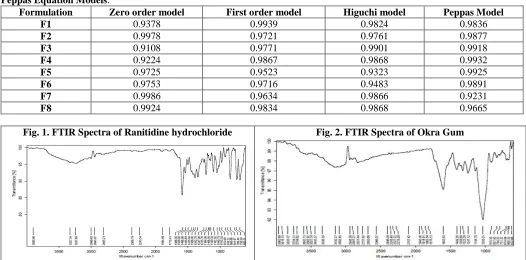
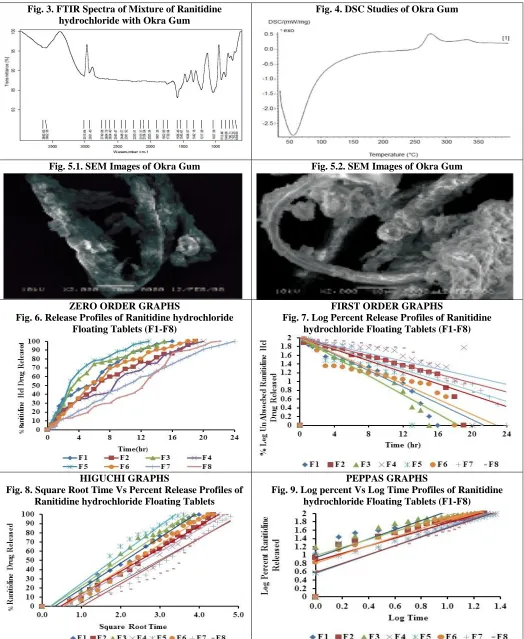
indicating good flow potential for the tablets. Resultant tablets blend did not have any incompatibilities showed in FTIR studies (Fig: 1, 2, 3) and determination of purity of the compound showed in DSC studies (Fig: 4) Although the
tablets with Okra gum were able to float for more than 12 hours.
The evaluation results for in-vitro drug release showed that Okra gum was able to retard the drug release more than 12 hours. All the floating tablets prepared contained ranitidine hydrochloride within 100 ± 5% of the labeled claim. As such the prepared floating tablets were of good quality with regard to drug content , angle of repose, bulk density and tapped density and. In the in-vitro buoyancy study varieties were observed in the floating lag time and floating time (Table. 5).
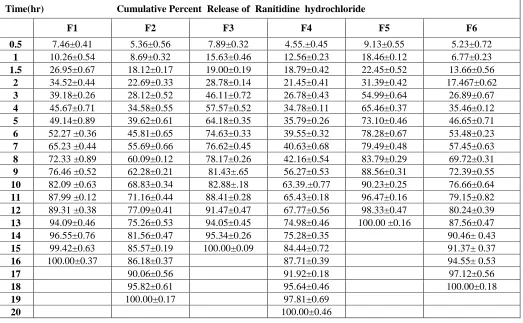
Ranitidine hydrochloride release profiles of the floating tablets are shown in the (Table:6, 7) and Fig.6 to 9) Ranitidine hydrochloride release from floating tablets was shown and spread over 12h depended on the composition of the matrix it concentration of Okra gum, Ethyl cellulose, Sodium CMC and sodium bicarbonate, and citric acid [19]. The dissolution data of tablets F1 to F9 was fitted to zero order, first order, Korsmeyer and Peppas and Higuchi models. The results of correlation coefficient (R2) were used to select the most appropriate model. The release profiles of formulations F7 fitted best to zero order model (table. 8). Percent drug released verses square root time were found to be linear indicates that the drug release from the floating tablets prepared was diffusion controlled. The release data was also analyzed by the Korsmeyer and Peppas equation shown below in order to assess the release mechanism.
Mt/Mœ= k t n
Log (Mt/Mn) = log K + n log t
In the above equation, m t/mœis the fractional release of the drug, t is the release time, k is the constant for incorporating structural and geometric characteristic of the relative device and n is the release exponent that could be used to characterize the different release mechanisms as n=0.5 (fickian diffusion), 0.5<n<1 non-fickian (anomalous transport) n=1 (case II transport i.e, zero order release) and n>1(super class II transport).
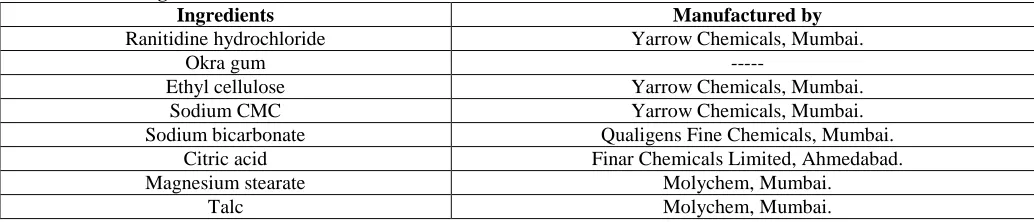
Table 1. List of Ingredients used in the Formulation
Ingredients Manufactured by
Ranitidine hydrochloride Yarrow Chemicals, Mumbai.
Okra gum ---
Ethyl cellulose Yarrow Chemicals, Mumbai.
Sodium CMC Yarrow Chemicals, Mumbai.
Sodium bicarbonate Qualigens Fine Chemicals, Mumbai.
Citric acid Finar Chemicals Limited, Ahmedabad.
Magnesium stearate Molychem, Mumbai.
Equipments
Table 2. List of Equipments used in the Formulation
Name of the equipment Manufactured by
Tablet Compression Machine 8 station Rimek
Friabilator Tester Electro lab
Hardness tester DR. Schleuniger Phermotron
Tap Density Tester Electro lab
Dissolution Tester Lab India Disso 2000
U V spectrophotometer Perkin Elmer
PH Meter Thermo electron corporation
Weighing Balance Sartorius cp 2250D (210gms)
Weighing Balance Sartorius cp 34001s (34kgs)
Table 3. Formulae of Ranitidine hydrochloride Controlled Floating Tablets
Ingredients (mg/tablet) F1 F2 F3 F4 F5 F6 F7 F8
Ranitidine hydrochloride 336 336 336 336 336 336 336 336
Okra gum 60 90 --- --- --- --- 120 ---
Ethyl Cellulose --- --- 60 90 --- --- --- 70
Sodium CMC --- --- --- --- 60 90 --- 70
Sodium bicarbonate 50 50 50 50 50 50 50 50
Citric acid 10 10 10 10 10 10 10 10
Lactose 74 44 74 44 74 44 14 ---
Talc 10 10 10 10 10 10 10 10
Magnesium stearate 10 10 10 10 10 10 10 10
Total tablet weight 550 550 550 550 550 550 550 550
Table 4. Cumulative Percent Ranitidine hydrochloride Released from Floating Tablets
Time(hr) Cumulative Percent Release of Ranitidine hydrochloride
F1 F2 F3 F4 F5 F6
0.5 7.46±0.41 5.36±0.56 7.89±0.32 4.55.±0.45 9.13±0.55 5.23±0.72
1 10.26±0.54 8.69±0.32 15.63±0.46 12.56±0.23 18.46±0.12 6.77±0.23 1.5 26.95±0.67 18.12±0.17 19.00±0.19 18.79±0.42 22.45±0.52 13.66±0.56
2 34.52±0.44 22.69±0.33 28.78±0.14 21.45±0.41 31.39±0.42 17.467±0.62 3 39.18±0.26 28.12±0.52 46.11±0.72 26.78±0.43 54.99±0.64 26.89±0.67 4 45.67±0.71 34.58±0.55 57.57±0.52 34.78±0.11 65.46±0.37 35.46±0.12 5 49.14±0.89 39.62±0.61 64.18±0.35 35.79±0.26 73.10±0.46 46.65±0.71 6 52.27 ±0.36 45.81±0.65 74.63±0.33 39.55±0.32 78.28±0.67 53.48±0.23 7 65.23 ±0.44 55.69±0.66 76.62±0.45 40.63±0.68 79.49±0.48 57.45±0.63 8 72.33 ±0.89 60.09±0.12 78.17±0.26 42.16±0.54 83.79±0.29 69.72±0.31 9 76.46 ±0.52 62.28±0.21 81.43±.65 56.27±0.53 88.56±0.31 72.39±0.55 10 82.09 ±0.63 68.83±0.34 82.88±.18 63.39.±0.77 90.23±0.25 76.66±0.64 11 87.99 ±0.12 71.16±0.44 88.41±0.28 65.43±0.18 96.47±0.16 79.15±0.82 12 89.31 ±0.38 77.09±0.41 91.47±0.47 67.77±0.56 98.33±0.47 80.24±0.39 13 94.09±0.46 75.26±0.53 94.05±0.45 74.98±0.46 100.00 ±0.16 87.56±0.47
14 96.55±0.76 81.56±0.47 95.34±0.26 75.28±0.35 90.46± 0.43
15 99.42±0.63 85.57±0.19 100.00±0.09 84.44±0.72 91.37± 0.37
16 100.00±0.37 86.18±0.37 87.71±0.39 94.55± 0.53
17 90.06±0.56 91.92±0.18 97.12±0.56
18 95.82±0.61 95.64±0.46 100.00±0.18
19 100.00±0.17 97.81±0.69
Table 5. Cumulative Percent Ranitidine hydrochloride Released from Floating Tablets
Time(hr) F7 F8
0.5 1.56.±0.26 3.06±0.37
1 3.78±0.33 4.28±0.39
1.5 9.84±0.23 10.65±0.28
2 12.33±0.34 12.55±0.47
3 15.48±0.33 13.49±0.40
4 21.72±0.25 16.48±0.56
5 24.68±0.55 18.96±0.73
6 31.11±0.72 26.48±0.39
7 34.24±0.11 29.12±0.26
8 42.79±.0.45 30.09±0.21
9 45.48±0.45 36.18±0.45
10 49.99±0.36 38.38±0.38
11 54.17 ±0.62 41.19±0.49
12 59.99±0.79 46.88±0.12
13 61.44±0.45 58.44±0.67
14 66.46±0.67 65.52±0.67
15 70.19±0.37 72.57±0.67
16 74.25±0.19 86.34±0.67
17 79.01±0.83 89.05±0.44
18 82.56±76 89.93±0.41
19 86.48±0.54 92.62±0.43
20 90.82±0.69 95.41±0.11
21 93.37 ±0.82 99.35±0.41
22 95.10±0.45 100.00±0.55
23 97.71±0.78
24 100.00±0.12
Table 6. Correlation Coefficient (R2) Values in the Analysis of Release Data as per Zero order, First order, Higuchi, and
Peppas Equation Models.
Formulation Zero order model First order model Higuchi model Peppas Model
F1 0.9378 0.9939 0.9824 0.9836
F2 0.9978 0.9721 0.9761 0.9877
F3 0.9108 0.9771 0.9901 0.9918
F4 0.9224 0.9867 0.9868 0.9932
F5 0.9725 0.9523 0.9323 0.9925
F6 0.9753 0.9716 0.9483 0.9891
F7 0.9986 0.9634 0.9866 0.9231
F8 0.9924 0.9834 0.9868 0.9665
Fig. 3. FTIR Spectra of Mixture of Ranitidine hydrochloride with Okra Gum
Fig. 4. DSC Studies of Okra Gum
Fig. 5.1. SEM Images of Okra Gum Fig. 5.2. SEM Images of Okra Gum
ZERO ORDER GRAPHS
Fig. 6. Release Profiles of Ranitidine hydrochloride Floating Tablets (F1-F8)
FIRST ORDER GRAPHS
Fig. 7. Log Percent Release Profiles of Ranitidine hydrochloride Floating Tablets (F1-F8)
HIGUCHI GRAPHS
Fig. 8. Square Root Time Vs Percent Release Profiles of Ranitidine hydrochloride Floating Tablets
PEPPAS GRAPHS
CONCLUSION
Okra gum is an efficient matrix former for floating tablets based on gas generation principle. Drug release from the prepared tablets was showed over more 12h and depended on the composition of Okra gum and sodium
bicarbonate. Ranitidine hydrochloride release was diffusion controlled and follows zero order kinetics. In case of F7 formulation Non-fickian diffusion was the drug release mechanism from the prepared Ranitidine hydrochloride floating.
REFERENCES
1. Rubinstein MH. Tablets in pharmaceutics, The science of dosage form design. Aulton, M. E. Ed.,Churchill Livingstone, New
York., 2000, pp. 305.
2. Chien YW. Rate Control drug delivery systems, Controlled release vs. Sustained release. Med Prog Techn., (15), 1989, 3. 121- 46.
4. Rubinstein MH. Tablets in pharmaceutics, The science of dosage form design. Aulton, M. E. Ed., Churchill Livingstone, New
York. 2000, pp. 305.
5. Chien YW. Rate Control drug delivery systems, Controlled release vs. Sustained release. Med Prog Techn., (15), 1989, 6. 121- 46.
7. Chien YW. Novel drug delivery system. Marcel Dekker Inc, New York., Vol. 14, 1992, pp. 139-196.
8. Lordi NG. Sustained release dosage forms. In the Theory and Practice of Industrial Pharmacy, 3Lachman, L Lieberman, HA
Kanig, JL Eds Lea and Febiger, Philadelphia. 3rd Ed, 1991, pp. 430-435.
9. Desai S, Botton SA. Floating controlled release drug delivery system in vitro – in vivo evaluation. Pharm Res.,(10), 1993, 1321 – 1325.
10. Vantrappen GR, Peterstl, Janssens J. The secretory component of inter digestive migratory motor complex in man. Scand j
gastro-enterol, (14), 1979, 663-667.
11. Hui Ho- Wah, Robinson JR. Design and fabrication of oral controlled release drug delivery systems, in controlled drug delivery fundamentals and applications. Robinson R, Lee VH, Eds Marcel Dekker Inc, New York, Vol. 29, 3rd Ed, 1995, pp. 373-378.
12. Shargel L, Wu- Pong S, Yu AB. Applied biopharmaceutics and pharmacokinetics. Mc. Graw Hill., 5th Ed, 2005, pp. 515-520. 13. Aulton ME, Pharmaceutics the science of dosage form design. Churchill Livingstone., 2nd Ed, 2002, pp. 414-418.
14. Arora S, Ali A, Ahuja NA, Khar RK and Baboota S. Floating drug delivery systems, a review. AAPS PharmSciTech. 6(3), 2010, 72‐90.
15. Yie W Chein. Novel drug delivery system. Marcel jekker Inc, New York. (2), 1992, 1-3.
16. Deshpande AA, Shah NH, Rhodes CT, Malick W. Development of a novel controlled-release system for gastric retention.
Pharm Re., (14), 1997, 815-819.
17. Rubinstein MH. Tablets in Pharmaceutics, The Science of dosage form design. Aulton M E, Ed Churchill Livingstone, New
York., 2000, pp. 305.
18. Chien YW. Rate ccontrol drug delivery Systems, Controlled Release vs. Sustained Release. Med Prog Techn., (15), 1989, 21-46.