Isomorphisms between pattern classes
M. H. Albert, M. D. Atkinson and Anders Claesson
Isomorphismsφ:A −→ B between pattern classes are considered. It is shown that, if φ is not itself a symmetry of the entire set of permutations, then, to within symmetry, A is a subset of one of a small set of pattern classes whose structure, including their enumeration, is determined.
Mathematics Subject Classification: 05A05
1. Introduction
The set S of all (finite) permutations is a partially ordered set under the pattern containment order. It has been known since the work of Simion and Schmidt [2] that this poset has eight poset automorphisms induced by the symmetries of the square which act in a natural way on the diagrams of per-mutations. Throughout this paper we shall simply call these automorphisms
symmetries. It was tacitly assumed for many years that there were no fur-ther automorphisms of this poset but this fact was not explicitly proved until Smith’s work [3] on permutation reconstruction.
The pattern containment order is studied almost exclusively by the in-vestigation of down-sets (lower ideals) and these are called pattern classes. The image of a pattern class under one of the eight symmetries is again a pattern class having the same order-theoretic properties; in systematic inves-tigations this can be very useful in limiting the number of cases that have to be considered. In particular two pattern classes connected in this way have the same enumeration, a property which is known asWilf-equivalence. One interesting aspect of the theory of pattern classes is that Wilf-equivalent classes may not be related by a symmetry. Even more strikingly two Wilf-equivalent pattern classes are usually not even isomorphic as ordered sets. This leads to a natural question:
What order-preserving isomorphisms are there between pattern classes beyond the restrictions of the eight symmetries?
arXiv:http://arxiv.org/abs/arXiv:1308.3262
In this paper we shall answer this question. Our answer is complete in the following sense:
1. We do not count two isomorphisms that differ within symmetries as being distinct. Thus, if φ : A −→ B is an isomorphism and µ and ν
are symmetries then the isomorphismsφand µ−1φν :Aµ−→ Bν are essentially the same.1
2. Ifφ:A −→ B is an isomorphism and there are larger classesA ⊆ A0
and B ⊆ B0 with an isomorphism ψ between them for whichψ|A =φ
then we do not regardφas the “real” isomorphism. In other words we shall be chiefly interested inmaximal isomorphisms φ:A −→ B that cannot be extended to a larger class.
To expand on the second point, note that the union of a chain (ordered by inclusion) of isomorphisms is also an isomorphism, so each isomorphism is in fact contained in a maximal one – but in fact we will see as a consequence of Proposition3below that there are even more restrictive conditions which make it possible to carry out the desired classification.
In the next section we shall give the necessary notation and background to understand our basic method. Then in Section3we construct the maximal isomorphisms φ : A −→ B and describe the structure and enumeration of the classesAon which they are defined.
2. Background
LetP be a poset and letx < yinP. We say thaty coversx, denoted x <·y, if no z ∈ P satisfies x < z < y. We also define the shadow and downset
(down closure) ofy∈P by
∆y={x∈P :x <·y} and Cl(y) ={x∈P :x≤y}
A bijection f : P → Q between two posets P and Q is an isomorphism
if f(x) < f(y) if and only if x < y. If, in addition, P = Q then f is an
automorphism. All the posets we will be considering are lower ideals of S. All these posets are ranked – for every permutation π the lengths of the maximal chains with maximum element π are all (finite and) the same. In particular, the rank ofπ∈ S is equal to the length ofπ(number of letters in
π). Any bijectionf between ranked posets is an isomorphism exactly when
f(x)<·f(y) if and only ifx <·y. Since the covering relations of an ordered set are precisely the relationsx < y where x∈∆(y) we have
Lemma 1. A bijection f :P →Qbetween ranked posets is an isomorphism if and only if (∆y)f = ∆(yf) for all y∈P.
Smith [3] has shown that no pairs of permutations of length at least five share the same shadow. This is a key step in her proof that the automorphism group of symmetries of S is the dihedral group of order eight; it contains reverse (r), complement (c) and inverse (i). If we refine her shadow result slightly by spelling out what happens for permutations of fewer than five elements we arrive at the following proposition.
Proposition 2. Let σ andτ be permutations. Then
∆σ = ∆τ
if and only if one of the following holds
{σ, τ}={12,21};
{σ, τ} ⊆ {132,213,231,312};
{σ, τ}={2413,3142};
σ =τ.
As mentioned in Section1 down-sets ofS are called pattern classes. We shall say that two pattern classes are isomorphic if they are isomorphic as posets. In this paper we shall study isomorphisms between classes. From Lemma1 and Proposition 2we get the following result.
Proposition 3. Let A and B be pattern classes. Then any isomorphism f :A → B is determined by its restriction f|R to the finite pattern class
R= Cl{2413,3142}={1,12,21,132,213,231,312,2413,3142}.
Proof. Suppose that both f : A → B and g : A → B are isomorphisms. Suppose further thatf|R=g|R. For the sake of contradiction suppose that there exists π ∈ A with πf 6= πg. Among all such permutations π, choose
one (also calledπ) of minimum length. Then
∆(πf) = (∆π)f by Lemma 1
= (∆π)g by minimality
= ∆(πg) by Lemma1.
By Proposition 3, any isomorphism f : A → B is uniquely deter-mined by its restriction to R = Cl{2413,3142}. Since isomorphisms are length preserving, it must further hold that 1f = 1, {12,21}f = {12,21}, {132,213,231,312}f ={132,213,231,312}and{2413,3142}f ={2413,3142}.
The reader may well wonder “what if A does not contain R?” There are two ways to answer that question. First, and simplest, is to interpret
f|R as f|R∩A. Alternatively it is easy to see that f could be extended to
an isomorphism between A ∪ R and B ∪ R – by taking the union with any length-preserving bijection between R \ Aand R \ B.
This motivates the following approach to the original question: begin with an isomorphism h : R → R; then use Lemma 1 repeatedly to define extensions to larger pattern classes obtaining, in the limit, themaximal class
AcontainingRand image classBsuch thathextends to an isomorphismf :
A → B. To this end, let ⊥be an arbitrary symbol standing for “undefined”. We first define a functiong:S → S ∪ {⊥}recursively:
πg =
πh ifπ∈ R,
σ ifπ6∈ R but (∆π)g = ∆σ for someσ∈ S, ⊥ otherwise.
Note that the second condition implicitly requires that θg 6= ⊥ for any
θ∈∆π. Now set A={π ∈ S :πg 6=⊥} and B=Af, with f =g|
A. Then
(f,A,B) is the required triple.
This recursive definition gives rise to an infinite process that converges to the triple (f,A,B) – and to the basis,B, ofA(thoseβ∈ S \ A for which ∆β ⊆ A). We accumulate the elements of A and of its basis in order of length. Given a permutation α not presently in A whose lower covers do belong to A, we apply f to ∆α and, if the result is the shadow of some permutation β, we add α toA and set αf =β; otherwise we add α to the basisB of the classA.
Considering only the basis ofA there is noa priori guarantee that this process will terminate, since it is conceivable that the class A might have an infinite basis. However, in practice, we always reach a situation where no new basis elements are found in small lengths 7, 8, 9. At this stage we have a finite subset of the pattern classAon which is defined an isomorphism f
We carry out this analysis in the next section. For any particular map h, the detailed calculation of this structure will be largely omitted since it is relatively routine2. We shall however, in each case, display a map defined on Av(B) that extends h and prove that it is isomorphism.
Before continuing with the consideration of maximal isomorphisms we give a non-maximal isomorphism that features several times in the discus-sion. The class Av(132,312) is well-known to consist of permutations which are the union of an increasing sequence with a decreasing sequence where the increasing terms are all greater than the decreasing terms. The diagrams of such permutations have the form
and, for obvious reasons, we name this class V . There are 3 further ‘wedge’ classes related to it by symmetries which we call V,V and V . The classV has an obvious automorphism induced by the complement symmetry but, as we shall now see, there is another automorphism not induced by any symmetry.
Let π be a permutation of length n in V and define the word πω =
c2c3. . . cn in{a, b}n−1 by
ci=
(
a ifπ(i)> π(1),
b ifπ(i)< π(1).
It is easy to see that ω is a bijection and thus has an inverse ω−1. We can now define a bijection onV by
ξ=ωrω−1
Here r denotes reversal (of words) and composition is left to right. As an example, 45367821ω = abaaabb; the reverse of this string is bbaaaba =
2We actually usedPermLab[1] to compute this structure but it is easily within
43256718ω; and thus 45367821ξ= 43256718:
a a a ab b b ξ 7−→
a a a a
b b b
Sinceξ is a fairly unusual bijection we shall call it theexotic map on V .
Proposition 4. The exotic map is an automorphism of V .
Proof. The set K of words over the alphabet {a, b} is an ordered set under the subsequence ordering. Its covering relationsλ < µare those relations in which λ is obtained from µ by deleting a single letter. We shall show that
ω is an isomorphism of ordered sets by verifying that it maps the set of covering relations ofV onto the set of covering relations ofK.
A covering relationα < β of V is a pair of permutations in which α is obtained fromβby deleting a term ofβ(and relabeling). If this deleted term is not the first term then the corresponding words ofKare related in that one word is obtained from the other by deleting the letter that corresponds to the deleted term. But, if the deleted term is the first term then the resulting permutation is the same as that obtained when we delete the second term. The converse is equally clear.
Therefore the exotic map is a composition of isomorphisms ωrω−1 on ordered sets and so is also an isomorphism.
Finally in this section we recall some standard terminology. Aninterval
in a permutation π is a contiguous subsequence of π whose terms form a set of consecutive values. If the only intervals of π are itself and singletons thenπ is said to be simple. Notation such asπ =σ[α1, . . . , αr] signifies that π can be represented as a juxtaposition of intervals π = α1· · ·αr where
the pattern formed by the αi defines the permutation σ. In such a case we
say that π is obtained from σ by inflating its points into intervals αi. In
the special cases σ = 12 or σ = 21 then we say that π is decomposable or skew-decomposable respectively.
3. The maximal isomorphisms
We will classify all triples
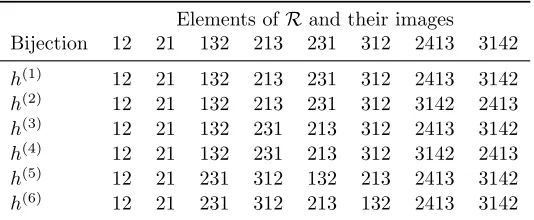
Table 1: 6 representative bijections onR
Elements ofRand their images Bijection 12 21 132 213 231 312 2413 3142
h(1) 12 21 132 213 231 312 2413 3142 h(2) 12 21 132 213 231 312 3142 2413 h(3) 12 21 132 231 213 312 2413 3142 h(4) 12 21 132 231 213 312 3142 2413 h(5) 12 21 231 312 132 213 2413 3142 h(6) 12 21 231 312 213 132 2413 3142
wheref :A → B is an isomorphism and Aand B are maximal classes with this property. This classification will be “up to symmetry” as described in Section 1. In other words, we consider (f,A,B) and (f0,A0,B0) to be essentially the same if there are symmetries µ and ν of S such that the following diagram commutes:
A B
A0 B0
µ ν
f
f0
Although it is not at all cleara priorithat, when (f,A,B) is a maximal isomorphism, there will be asymmetry mapping Aonto B this will indeed prove to be the case. So, in fact, every maximal isomorphism is equivalent to some maximal automorphism (f,A,A). Remembering that the maps f
are built up from an initial isomorphismh:R → R, we shall take some care (available only after the fact) in the choice of representative maps h on R
to allow this result to emerge naturally.
Since we could arbitrarily permute the permutations of length two, three, and four in R (preserving length of course) there are apparently 96 maps
h to consider. Some routine calculations establish that there are only 6 equivalence classes of such maps under the symmetry operations given above. We shall use the representatives given in Table1(recall that an isomorphism necessarily maps 1 to 1).
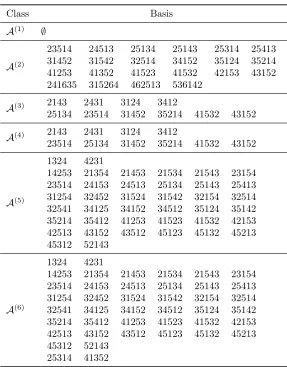
forA given in Table2. Recall that, until we have exhibited an isomorphism on Av(B) that extends h, we only know that A ⊆ Av(B). The necessary verifications are carried out below. In addition we shall give the enumerations of the various classes.
For easy reference let
(f(i),A(i),B(i))
where B(i) = (A(i))f(i)
, be the maximal isomorphism that extends the ith bijection on R in Table 1. For instance, f(3) is the maximal isomorphism defined by fixing 132 and 312 while interchanging 213 and 231; and
A(3) = Av(2143,2431,3124,3412,23514,25134,31452,35214,41532,43152)
The triple (f(1),A(1),B(1))
The mappingf(1) fixes all permutations of Rand is thus the identity map-ping;f(1) can be seen as the representative for any of the symmetries of the full pattern containment order. Moreover, the basis forA(1) is empty and so A(1)=B(1)=S.
The triple (f(2),A(2),B(2))
Now letAstand for the class defined by the putative basis elements ofA(2).
The class A is related to the separable permutations3. It also includes two simple permutations of length four, and four of length five:
T ={2413,3142,24153,31524,35142,42513}.
None of the permutations inT can be non-trivially inflated. ThusA is the
⊕and completion of the finite class Cl(T). In other words, A is defined by the following system of set-equations:
A=C ∪ D ∪U,
C = (D ∪U)⊕ A, D= (C ∪U) A,
whereU ={1} ∪T. In these equations C and Dstand, respectively, for the set of sum-decomposable and skew-decomposable permutations ofA. In this
Table 2: Bases for classesA(1), . . . ,A(6)
Class Basis
A(1) ∅
A(2)
23514 24513 25134 25143 25314 25413 31452 31542 32514 34152 35124 35214 41253 41352 41523 41532 42153 43152 241635 315264 462513 536142
A(3) 2143 2431 3124 3412
25134 23514 31452 35214 41532 43152
A(4) 2143 2431 3124 3412
23514 25134 31452 35214 41532 43152
A(5)
1324 4231
14253 21354 21453 21534 21543 23154 23514 24153 24513 25134 25143 25413 31254 32452 31524 31542 32154 32514 32541 34125 34152 34512 35124 35142 35214 35412 41253 41523 41532 42153 42513 43152 43512 45123 45132 45213 45312 52143
A(6)
1324 4231
14253 21354 21453 21534 21543 23154 23514 24153 24513 25134 25143 25413 31254 32452 31524 31542 32154 32514 32541 34125 34152 34512 35124 35142 35214 35412 41253 41523 41532 42153 42513 43152 43512 45123 45132 45213 45312 52143
representation of A all the unions are disjoint, a property we will now use. Let g :U → U be defined by 2413g = 3142, 3142g = 2413 and πg =π for
π∈U\ {2413,3142}.
Now extend the definition ofgto the whole ofAby defining it recursively on sums and skew sums:
πg = (
σg⊕τg ifπ∈ C and π =σ⊕τ , τg σg ifπ∈ D and π=σ τ .
Since 1g = 1 it is clear that g fixes all permutations of length up to 3. Since alsog exchanges 2413 and 3142 we haveg|R=h(2)|R. It remains only
to prove thatg is order preserving. By Lemma 1it suffices to prove that
(1) (∆π)g = ∆(πg)
for all π ∈ A. The proof will again use contradiction starting from the assumption thatπ is a counterexample to the above of minimal length.
That (1) holds for π ∈U ∪ R is easy to check by direct calculations, so our minimal counterexample must lie inA \(U∪ R). We first make a simple observation: for any permutationsσ andτ,
∆(σ⊕τ) = (∆σ)⊕τ ∪ σ⊕(∆τ); (2)
∆(σ τ) = (∆σ) τ ∪ σ (∆τ).
(3)
Assume thatπ=σ⊕τ withσ ∈ D ∪U and τ ∈ A. Then
∆(πg) = ∆(σg⊕τg) by definition ofg
= (∆(σg))⊕τg ∪ σg⊕(∆(τg)) by (2)
= (∆σ)g⊕τg ∪ σg⊕(∆τ)g by minimality
= ((∆σ)⊕τ)g ∪ (σ⊕(∆τ))g by definition ofg
= (∆(σ⊕τ))g by (2)
= (∆π)g.
So we would have a contradiction in this case, and similarly ifπ were skew-decomposable.
In summary, the isomorphism g behaves like the identity except that it exchanges intervals 2413 and 3142 wherever they occur. It is easy to see that g is its own inverse. In particular, g is an automorphism and hence
The system of set-equations above directly translates to a system of equations for the corresponding generating functions
A(x) =C(x) +D(x) +U(x),
C(x) = (D(x) +U(x))A(x),
D(x) = (C(x) +U(x))A(x),
in which U(x) = 1 + 2x4+ 4x5. Solving for A(x) we find that
A(x) = p
p(x)−q(x)−2
q(x)−pp(x)−2,
where
p(x) = 1−6x+x2−12x4−20x5+ 8x6+ 4x8+ 16x9+ 16x10,
q(x) =−1 +x+ 2x4+ 4x5.
The first few values of{|An|}n≥1 are
1,2,6,24,102,446,2054,9818,48218,241686,1231214,6356050,33178450, . . .
The triple (f(3),A(3),B(3))
LetA denote the class defined by the avoidance conditions in theA(3) row
of Table2. In this caseA is the Vclass with its apex inflated to 2413, 3142 or any permutation inV :
(4) A=σ[1, . . . ,1, τ] :σ∈ V, τ ∈V ∪ {2413,3142} .
We need to define an isomorphism onAthat extends h(3). We shall use
the exotic map ξ defined in Section 2 as an automorphism of V and we extend it toV ∪ {2413,3142}by having it fix 2413 and 3142. Now we define a map g on A by defining it on a general element π = σ[1, . . . ,1, τ], with
σ∈ Vand τ ∈V ∪ {2413,3142}as
πg =σ[1, . . . ,1, τξ].
g. For the remaining two permutations inR= Cl{2413,3142} we have
213g = 1[213ξ] = 1[231] = 231;
231g = 1[231ξ] = 1[213] = 213.
Thus g agrees with h(3) on R. To prove that g is an isomorphism we have to show that (∆π)g = ∆(πg) for all π in A. To this end we note that, for
π=σ[1, . . . ,1, τ]∈ A, we have
∆π = ρ[1, . . . ,1, τ] :ρ∈∆σ ∪
σ[1, . . . ,1, ρ] :ρ∈∆τ .
Thus
∆(πg) = ∆(ρ[1, . . . ,1, τξ])
=
ρ[1, . . . ,1, τξ] :ρ∈∆σ ∪
σ[1, . . . ,1, ρ] :ρ∈∆(τξ)
=
ρ[1, . . . ,1, τξ] :ρ∈∆σ ∪
σ[1, . . . ,1, ρξ] :ρ∈∆τ
= ∆(σ[1, . . . ,1, ρ])g
= (∆π)g.
Thus A=A(3) as required. Because the exotic map ξ is an involution, the
mapf is also an involution; in particular, B(3) =A(3).
We can modify (4) a little to make the representation unique. We have
A=σ[1, . . . ,1, τ] : σ∈ V, τ ∈ V \(I ∪ D)∪ {1,2413,3142} ,
where I = {1,12,123,1234, . . .} and D = {1,21,321,4321, . . .}. Thus the generating functionA(x) ofA is
A(x) = x 1−2x
x
1−2x + 2x
4− 2x2
1−x
1
x
= 2
1−x −
11 8 (1−2x) +
1
2 (1−2x)2 −x
3−1
2x
2−1
4x− 9 8.
From this partial fraction decomposition it is routine to derive a closed formula for an = |An|, the number of permutations of length n in A. We
find that
forn≥4. The first few values of {an}n≥1 are
1,2,6,20,54,138,338,802,1858,4226,9474,20994,46082,100354,217090, . . .
The triple (f(4),A(4),B(4))
This case is almost the same as the previous case. The only difference is that we must extend the exotic map to interchange (rather than fix) 2413 and 3142. Otherwise the calculations are the same. Notice thatA(3)=A(4)
and so this class has two inequivalent maximal isomorphisms. Their prod-uct is also an isomorphism of course but it is not a maximal isomorphism. Clearly the product interchanges 2413 and 3142 whenever they occur as in-tervals and leaves other points unaltered. It is therefore the isomorphism that extends to the larger class A(2). The full automorphism group of A(3)
is thus hc, f(2), f(3)i and it is easy to see that this group is isomorphic to
Z2×Z2×Z2.
The triple (f(5),A(5),B(5))
LetAbe the class defined by the basis in theA(5)row of Table2. The class A consists of the four wedge classes together with four extra permutations of length four, and two of length five:
A=V∪ V∪ V ∪V ∪ {2143,2413,3142,3412,25314,41352}.
An isomorphism g that extends h(5) may be defined as follows. It will map the wedge classes as indicated in
V f1 V V V
f2
f4
f3
where f1 = iξi, f2 = rξc, f3 = ciξic, f4 = cξr, and ξ denotes the exotic
map (composition of maps is left to right). It is routine to check that these maps are consistent (e.g. that permutations in V∩ V are mapped in the same way by f1 and f2). Furthermore we define g to exchange 2143 and 3412 and to fix four permutations 2413, 3142, 25314 and 41352. Since each of
We further note that the mapf is its own inverse. In particular, it is an automorphism and so B = A. Using inclusion-exclusion it is easy to show that
|An|= 2n+1−4n+ 2
forn≥6. The first few values of {|An|}n≥1 are
1,2,6,22,48,106,230,482,990,2010,4054,8146,16334,32714,65478,131010, . . .
The triple (f(6),A(6),B(6))
LetAbe the class defined by the basis in theA(6)row of Table2. The class A is like A(5) but without the two non-wedge permutations of length 5 in
that class:
A=V∪ V∪ V ∪V ∪ {2143,2413,3142,3412}.
In this case an isomorphism g that extends h(6) may be defined as follows. It maps the wedge classes amongst themselves as shown
V V
V
V
f1
f2
f3 f4
wheref1=riξr,f2 =rξri,f3 =rirξ,f4 =ξi, andξdenotes the exotic map;
again composition is left to right. The mapg is also defined to interchange 2143 and 3412 and to fix 2413 and 3142. Again it is readily checked thatgis consistent on the intersections of wedge classes and that it is an isomorphism, obviously an automorphism. In this case the square ofg happens to be the symmetryrc.
The cardinality|A(6)n |is the same as|A(5)n |except forn= 5.
4. Conclusion
To within symmetry there are only 6 maximal isomorphisms and the classes
A(i) on which they are defined are rather restricted. Non-maximal
isomor-phisms are (also to within symmetry) necessarily defined on subclasses of the A(i) and are therefore also quite restricted although we have not
Corollary 5. If φ : A −→ B is an isomorphism and A has no basis el-ement of length 5 or less then φ is induced by a symmetry of the pattern containment order.
Proof. If φ is not a symmetry then, to within a symmetry, A is contained within one of the classes A(i),i= 2,3,4,5,6 above and since each of these
classes contains a basis element of length 5 or less so also will Aitself.
Furthermore, as all the proper classes that occur are subclasses ofA(2),
whose growth rate is easily seen to be the reciprocal of the smallest positive root of the polynomialp(x) we obtain:
Corollary 6. If Aadmits a non-symmetry isomorphism onto another class Bthen the growth rate ofAis at most 5.90425. FurthermoreAcontains only finitely many simple permutations and therefore is partially well-ordered.
Finally, we note that it also makes sense to pursue this investigation in search of classes having automorphisms extending those of the finite class
R. Specifically, given a subgroupG≤Aut(R) there is a maximal classA(G)
containing R such that every element of G extends to an automorphism of A(G). The basic scheme of inductively building up the class still applies
though one must ensure of course that all the images of some permuta-tion π under the elements of G can be defined. Because of this stringent condition, one would expect generally that the classesA(G) should be
rela-tively small. The group of automorphisms ofRis isomorphic to (Z/2Z)2×S4
since (and independently) the two monotone permutations inRcan be fixed or interchanged, as can the two permutations of length four, while the re-maining four non-monotone permutations of length three can be arbitrarily permuted. In searching for automorphisms we no longer have the option of applying different symmetries on each side to obtain an equivalent class – we must apply the same symmetry. Effectively we have a single case for each orbit of subgroups of Aut(R) under the action of the normal symmetries by conjugation. Rather than report complete results for this case, which we have not computed, we mention only one result:
Theorem 7. The maximal classAextendingRwith the property that every automorphism ofRextends toAconsists ofRand all the permutations that can be expressed as the sum or skew sum of an increasing permutation and a decreasing permutation (in either order).
References
[1] Albert, M. Permlab: Software for permutation patterns.http://www. cs.otago.ac.nz/PermLab, 2012.
[2] Simion, R., and Schmidt, F. W. Restricted permutations. European J. Combin. 6, 4 (1985), 383–406.
[3] Smith, R.Permutation reconstruction. Electron. J. Combin. 13 (2006),
Note 11, 8 pp.
M. H. Albert
Department of Computer Science University of Otago
E-mail address: [email protected]
M. D. Atkinson
Department of Computer Science University of Otago
E-mail address: [email protected]
Anders Claesson
Department of Computer Science University of Strathclyde
E-mail address: [email protected]