City, University of London Institutional Repository
Citation
:
Schulz, A., De Martino, A. and Egger, R. (2010). Spin-orbit coupling and spectral
function of interacting electrons in carbon nanotubes. Physical Review B (PRB), 82(3), doi:
10.1103/PhysRevB.82.033407
This is the accepted version of the paper.
This version of the publication may differ from the final published
version.
Permanent repository link:
http://openaccess.city.ac.uk/1684/
Link to published version
:
http://dx.doi.org/10.1103/PhysRevB.82.033407
Copyright and reuse:
City Research Online aims to make research
outputs of City, University of London available to a wider audience.
Copyright and Moral Rights remain with the author(s) and/or copyright
holders. URLs from City Research Online may be freely distributed and
linked to.
City Research Online:
http://openaccess.city.ac.uk/
[email protected]
arXiv:1003.3495v2 [cond-mat.mes-hall] 15 Jul 2010
Andreas Schulz,1 Alessandro De Martino,2 and Reinhold Egger1
1
Institut f¨ur Theoretische Physik, Heinrich-Heine-Universit¨at, D-40225 D¨usseldorf, Germany
2
Institut f¨ur Theoretische Physik, Universit¨at zu K¨oln, D-50937 K¨oln, Germany
(Dated: July 16, 2010)
The electronic spin-orbit coupling in carbon nanotubes is strongly enhanced by the curvature of the tube surface and has important effects on the single-particle spectrum. Here, we include the full spin-orbit interaction in the formulation of the effective low-energy theory for interacting electrons in metallic single-wall carbon nanotubes and study its consequences. The resulting theory is a four-channel Luttinger liquid, where spin and charge modes are mixed. We show that the analytic structure of the spectral function is strongly affected by this mixing, which can provide an experimental signature of the spin-orbit interaction.
PACS numbers: 71.10.Pm, 72.15.Nj, 73.63.Fg, 72.25.Rb
Spin-orbit interaction (SOI) effects1 are of great
in-terest in the field of spintronics, and their detailed un-derstanding is both of fundamental and of technologi-cal interest, e.g., for the coherent manipulation of spin qubits.2 In single-wall carbon nanotubes (SWNTs) the
SOI arises predominantly from the interplay of atomic SO coupling and curvature-induced hybridization, and its effect on the electronic bandstructure has recently been clarified.3–11 Contrary to other carbon-based
ma-terials, as, e.g., flat graphene, where SOI is very weak (of the order of few µeV), in SWNTs it can reach frac-tions of meV and has important consequences, previously overlooked. New experiments12,13on ultraclean SWNTs,
made possible by advances in the fabrication technology, have indeed observed modifications of the electronic spec-trum due to SOI. These results confirm the theoretical expectations, and motivate renewed interest on SOI in nanotubes. So far on the theory side the main focus has been on nanotube quantum dots,14 where the SOI
manifests itself in spectral features. Here we study long SWNTs, where long-ranged interactions can induce non-Fermi liquid electronic phases.15 In particular, without
SOI, Luttinger liquid (LL) behavior16has been predicted
for metallic SWNTs.17 Experimental evidence for this
strongly correlated phase has been reported using quan-tum transport18and photoemission spectroscopy.19
The question therefore arises how the LL theory of SWNTs17 is modified when the SOI is taken into
ac-count, and what are its observable consequences. This question is addressed and answered in detail below. Our main results are as follows. (i) The low-energy theory of metallic SWNTs still describes a Luttinger liquid. How-ever, the decoupled plasmon modes do not correspond to spin and charge anymore. Spin-charge separation in the usual sense16 is therefore broken by the SOI. This
effect can be traced back to a term in the SO Hamil-tonian diagonal in sublattice space (see Eq. 1), which was previously overlooked. (ii) We discuss in detail the
spectral function, a quantity that can directly be probed experimentally for SWNTs.19 We show how the mixing
of spin and charge modes due to SOI affects its ana-lytic structure and modifies it from the established
spin-ful LL behavior16,21. The predicted deviations are small
but should be observable. (iii) The tunneling density of states, and hence most typical quantum transport ob-servables, is only weakly affected by the SOI. This may explain why the SOI in SWNTs has long been overlooked. (iv) We shall clarify the similarities and the differences of the present SWNT theory to the LL description of 1D interacting semiconductor wires with Rashba SOI.22–28
To start, let us address the bandstructure of a nomi-nally metallic (n, m) SWNT, where 2n+m ∈ 3Z. The
chiral angle15 is θ = tan−1[√3m/(2n+m)], and the
tube radius isR[nm]≃0.0391√n2+nm+m2. We
em-ploy the effective SO Hamiltonian for π electrons de-rived in Ref. 11 in the k·p scheme. This model is in semi-quantitative accordance with available experimental Coulomb blockade spectroscopy data,12and summarizes
earlier theoretical work. In particular, it includes the re-cently discovered “diagonal” contributionESO, which is
of crucial importance in our analysis (see below). Within this framework, the single-particle HamiltonianH0(k) for
wavevectork= (k, k⊥) relative to the respectiveKpoint
is a 2×2 matrix in sublattice space corresponding to the two basis atoms of the honeycomb lattice. This sepa-rately applies to bothK pointsα=±and both spin di-rectionsσ=±, where the spin quantization axis is along the tube axis. To leading order in the SOI, the spin label σ is still a good quantum number.3,4,8 Periodic
bound-ary conditions around the SWNT circumference imply a quantization of transverse momentum, k⊥R = n0 ∈ Z.
We assume a Fermi energyEF >0 but sufficiently small
to justify that only then0= 0 band has to be retained.
All other bands are then separated by an energy gap
≈~vF/R≈1 eV, wherevF ≈8×10⁵m/s. Then,H 0(k)
is given by11
ασESO −α~vF[φ⊥+i(k+αφk)]
−α~vF[φ⊥−i(k+αφk)] ασESO
.
(1) This form neglects trigonal warping corrections,15which
2
parameter estimates of Ref. 11, the diagonal term is
ESO[meV]≃ −0.135 cos(3θ)
R[nm] . (2)
Writingφ⊥ =φ⊥,SO+φ⊥,cur, the SOI corresponds to a
spin-dependent shift of the transverse momentum,8,11,12
φ⊥,SO[nm−1]≃ασ2.7×10 −4
R[nm] , (3)
while curvature effects11,15 give
φ⊥,cur[nm−1] ≃ 0.011 cos(3θ)
(R[nm])2 ,
φk[nm−1] ≃
0.045 sin(3θ) (R[nm])2 .
We remark that the Hamiltonian (1) contains the two leading effects of curvature-induced SOI, namely the di-agonal contribution ESO and the Rashba-type SOI
en-coded by φ⊥,SO. Subleading terms, e.g., the “intrinsic”
SOI,8are much smaller and not taken into account here.
The dispersion relation obtained from Eq. (1) is
E±(α,σ)(k) =ασESO±~vF q
φ2
⊥+ (k+αφk)2, (4)
where the Kramers degeneracy is reflected inE±(α,σ)(k) =
E±(−α,−σ)(−k). SinceEF >0, only the conduction bands
(positive sign) are kept, and the Fermi momenta k(F)rασ
for right- and left-movers (r = R/L = ±) follow from E+(α,σ)
k(F)rασ
=EF,k(F)rασ≈r(EF−ασESO)/~vF−αφk.
We linearize the dispersion relation around the Fermi points, always assuming thatEF is sufficiently far away
from the band bottom. The 1D Fermi velocitiesvα,σ =
~−1∂kE+(α,σ)k=k+,ασ(F) take only two different values,
vA ≡ v−,↑ = v+,↓ and vB ≡ v+,↑ = v−,↓. We
men-tion in passing that R/L movers have pairwise identi-cal velocities only in the absence of trigonal warping and orbital magnetic fields29 or transverse fields,30 as
assumed here. It is convenient to introduce the mean velocity v = (vA+vB)/2 and the dimensionless
differ-ence δ = (vA−vB)/(2v). After some algebra, Eq. (4)
together with the parameter estimates above yields
v vF ≃
1−0.01(R[nm])
2+ 17 cos2(3θ)
(EF[meV])2 (R[nm])4 ,
δ ≃ (E 0.83 cos(3θ)
F[meV])2 (R[nm])3
. (5)
The renormalization of v away from vF goes always
downwards, but the quantitative shift is small. The asymmetry parameterδeffectively parametrizes the SOI strength and is more important in what follows. For fixed EF and R, it is maximal forθ = 0 (zig-zag tube)
and vanishes for θ = π/6 (armchair tube). Moreover,
δ increases for smaller tube radius, but the continuum description underlying our approach eventually breaks down forR.0.4 nm. SinceEF should at the same time
be sufficiently far above the band bottom in Eq. (4), in practice this leads to rather small values,δ.0.05. This is a rather conservative estimate, though, based on the parameter values of Ref. 11 and larger values could be obtained if one uses different estimates. Nonetheless, we show below that observable consequences do arise.
The theory is then equivalently formulated using Abelian bosonization,16 which allows for the
nonpertur-bative inclusion of interactions. We employ the boson fields φα(x) with α = c+, c−, s+, s−, representing the
total and relative charge and spin density modes,17 and
their conjugate momentum fields Πα(x) =−∂xθα, where θαare the dual fields. Those fields are conveniently
com-bined into the vectors ΦI(x) = (φc+, θc+, φs−, θs−)T and
Φ0(x) = (φc−, θc−, φs+, θs+)T. The important
electron-electron forward scattering31 effects are parametrized
by the standard LL parameter K ≡ Kc+, where K = 1 for noninteracting electrons butK ≈0.2. . .0.4 for SWNTs deposited on insulating substrates (or for suspended SWNTs) due to the long-ranged Coulomb interaction.17–19 The low-energy Hamiltonian of a
spin-orbit-coupled interacting metallic SWNT then reads
H =~v 2
Z
dx
∂xΦI ∂xΦ0
T
h(K) 0 0 h(1)
∂xΦI ∂xΦ0
(6) with theK-dependent matrix
h(K) =
1
K2 0 δ 0
0 1 0 δ δ 0 1 0 0 δ 0 1
.
The above representation shows that SOI (δ6= 0) breaks spin SU(2) symmetry. Notably, the modes ΦI and Φ0
decouple, and interactions (K 6= 1) only affect the ΦI
sector. In each sector, the Hamiltonian is then formally identical to the one for a semiconductor wire with Rashba SOI in the absence of backscattering.28 We consider a
very long SWNT and ignore finite-length effects, i.e. the zero modes contributions to the Hamiltonian (6).
Equation (6) can be diagonalized by the linear transformation32 Φ
I = VIΦa and Φ0 =V0Φb, with the
4×4 matrix
VI =
cosη 0 −sinηy 0
0 cosη 0 −ysinη ysinη 0 cosη 0
0 sinyη 0 cosη
, (7) where
y=p(1 +K−2)/2, tan(2η) = 2δy
y2−1. (8) V0 is as in Eq. (7) withK = 1, i.e., y= 1 andη =π/4.
with mutually dual boson fieldsφjρ andθjρfor each set
(j =±, ρ = a/b), the diagonalized Hamiltonian is seen to describe a four-channel Luttinger liquid,
H =X
j,ρ
~vjρ
2
Z
dx
1
Kjρ
(∂xφjρ)2+Kjρ(∂xθjρ)2
.
(9) The interacting sector corresponds to ρ= a, where the effective LL parametersK±,aand the plasmon velocities v±,aare
K±,a = y∓1 r
3 +K−2±∆
3K−2+ 1±∆, (10) v±,a
v =
p
y2+δ2±∆/2,
∆ = p(K−2−1)2+ (4δy)2
with y in Eq. (8). For ρ=b, the noninteracting values apply, K±,b = 1 and v±,b = v(1±δ). Note that the
above expressions recover the LL theory for δ = 0,17
wherevjρ=vF/KjρwithKjρ= 1 except forK+,a=K.
Within the framework of the LL Hamiltonian (9), us-ing the bosonized form of the electron field operator16,17
Ψrασ(x, t) and the transformation (7), it is possible to
obtain exact results for all observables of interest. In particular, arbitrary correlation functions of exponentials of the boson fields can be calculated. As an important application, we discuss here the spectral function for an r=R/Lmoving electron with spin σnear theK point α=±, which is defined as
Arασ(q, ω) =−
1 π ImG
ret
rασ(q, ω), (11)
with the Fourier transform of the single-particle retarded Green’s function (Θ is the Heaviside function),
Gretrασ(x, t) =−iΘ(t)
Ψrασ(x, t)Ψ†rασ(0,0)
+ c.c.
,
and the momentum q is measured with respect to the relative Fermi momentumkrασ(F).
After some algebra, Eq. (11) follows in closed form, which we specify in the zero-temperature limit now. With the short-distance cutoff (lattice spacing) a0 ≈
0.246 nm, we find
Arασ(q, ω)∝
Z ∞
−∞
dx
Z ∞
−∞
dt e−i[qx−ωt] (12)
× " Y j,ρ Y µ=±
1 +ivjρt+µrx a0
−Γ(j,ρασ;µ)
+ (x, t)→(−x,−t)
#
where the exponents for j =±andµ=±are given by [see also Eq. (8)]
Γ(ασ)j,a;µ =
1 16
h
cos(η)Kj,a1/2−µK −1/2 j,a
(13)
+ ασjsin(η)yjK1/2
j,a −µy−jK −1/2 j,a
i2
,
Γ(ασ)j,b;µ = 1
2δj,ασδµ,−.
-v
+,aq
-v
-,aq
v
-,aq
v
+,aq
ω
A(
ω
)
- vFq/K vFq vFq/K
v(1-δ)q v(1+δ)q v-,aq
0
[image:4.612.321.565.49.228.2]0
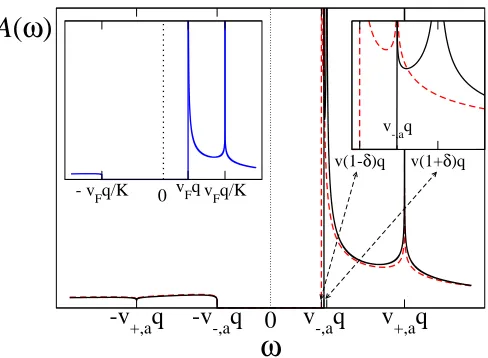
FIG. 1: (Color online) Spectral function (14) for a right-mover in an interacting SWNT with LL parameterK= 0.4 and SOI parameter δ = 0.05, shown in arbitrary units as function ofω for given wavevector q > 0. The black solid curve is forασ= +1, while the red dashed curve is forασ= −. Note that ARασ(q, ω) = 0 for −v−,aq < ω < ¯vq. Right
inset: Magnified view aroundω≈v−,aq. Left inset: Same as
main panel but without SOI (δ= 0). Shifts of the positions of the singularities due to the shifts of Fermi momenta are not included in the figure since each spectral functionArασ(q, ω) is evaluated at momentumq relative to therespectiveFermi momentum.
The remaining Fourier integrals are difficult to perform. We here follow Ref. 16 and focus on the analytic structure of the spectral function, which can be obtained by the power counting technique and Jordan’s lemma. Up to an overall prefactor, the spectral function exhibits power-law singularities close to the lines ω = ±vjρq. These
singularities are captured by the approximate form
Arασ(q, ω) ≈
Y
j,µ
|ω+µrvj,aq|Γ
(ασ)−1−Γ(ασ)
j,a;µ
(14)
× |ω−r(1 +ασδ)vq|Γ(ασ)−3/2
× [Θ(ω−r¯vq) + Θ(−ω−rv−aq)],
where ¯v= min[v−,a,(1 +ασδ)v] and
Γ(ασ)=X jρµ
Γ(ασ)jρµ . (15)
We stress that Eq. (14) is asymptotically exact: it has the same analytic structure and the same exponents of the power laws at the singular linesω =±vjρq as the exact
spectral function. Away from the singularities, however, it only serves illustrative purposes.
4
structure can be observed forδ 6= 0. First, the singular feature aroundω=v−,aqsplits into two different
power-law singularities whenδ6= 0, see the right inset of Fig. 1 for a magnified view. For largeq, the corresponding fre-quency differences are in the meV regime and can be resolved even for the rather smallδ expected here. Sec-ond, for −v+,aq < ω < −v−,aq, the spectral function is
finite (albeit small) whenδ6= 0. Note that forδ= 0, the respective velocities are v+,a = vF/K and v−,a = vF,
implying a large frequency window where this effect may take place. These predictions for the spectral function could be detected by photoemission spectroscopy.
Many standard quantum transport properties, how-ever, will hardly show an effect due to the SOI, which may explain why effects of SOI in SWNTs have been so long overlooked. For instance, the tunneling density of states averaged over (r, α, σ) exhibits power-law scaling withω for low frequencies,ν(ω)∝ωγ−1. The exponent γ is the smaller of the quantities Γ(±) in Eq. (15). This
exponent is analytic in δ, and the smallness of δ then implies that the tunneling density of states in SWNTs will be very close to the one in the absence of SOI. Let us also briefly comment on the relation of our
re-sults to the LL theory for semiconductor quantum wires with Rashba SOI.22–28 The “interacting” sector ρ = a
in Eq. (9) coincides with the semiconductor theory when electron-electron backscattering can be neglected. The additional presence of the “noninteracting” sectorρ=b, however, causes additional structure in the spectral func-tion. Moreover, while backscattering in semiconductor wires is likely an irrelevant perturbation in the renormal-ization group sense,28 it nonetheless causes a
renormal-ization of the LL parameters and the plasmon velocities. Such renormalization effects are negligible in SWNTs.
To conclude, we have studied SOI effects on the effec-tive low-energy theory of interacting metallic SWNTs. We have shown that a four-channel Luttinger liquid the-ory remains applicable, but compared to the previous for-mulation without SOI,17all four channels are now
charac-terized by different Luttinger liquid parameters and plas-mon velocities, reflecting the broken spinSU(2) symme-try. The coupling of spin and charge modes leads then to observable modifications in the spectral function, which provide an experimental signature of SOI. This work was supported by the SFB TR 12 of the DFG.
1
R. Winkler, Spin-Orbit Coupling Effects in Two-Dimensional Electron and Hole Systems(Springer, Berlin, 2003).
2
C. Flindt, A.S. Sørensen, and K. Flensberg, Phys. Rev. Lett.97, 240501 (2006); D.V. Bulaev, B. Trauzettel, and
D. Loss, Phys. Rev. B77, 235301 (2008). 3
T. Ando, J. Phys. Soc. Jpn.69, 1757 (2000). 4
A. De Martino, R. Egger, K. Hallberg, and C.A. Balseiro, Phys. Rev. Lett.88, 206402 (2002).
5
A. De Martino, R. Egger, F. Murphy-Armando, K. Hall-berg, J. Phys. Cond. Matt.16, S1437 (2004).
6
L. Chico, M.P. Lopez-Sancho, and M.C. Munoz, Phys. Rev. Lett. 93, 176402 (2004); Phys. Rev. B 79, 235423
(2009).
7
A. De Martino and R. Egger, J. Phys. Cond. Matt. 17,
5523 (2005).
8
D. Huertas-Hernando, F. Guinea, and A. Brataas, Phys. Rev. B74, 155426 (2006).
9
J. Zhou, Q. Liang, and J. Dong, Phys. Rev. B79, 195427
(2009).
10
J.S. Jeong and H.W. Lee, Phys. Rev. B80, 075409 (2009). 11
W. Izumida, K. Sato, and R. Saito, J. Phys. Soc. Jpn.78,
074707 (2009).
12
F. Kuemmeth, S. Ilani, D.C. Ralph, and P.L. McEuen, Nature452, 448 (2008).
13
H.O.H. Churchill, F. Kuemmeth, J.W. Harlow, A. J. Best-wick, E. I. Rashba,1, K. Flensberg, C. H. Stwertka, T. Taychatanapat, S. K. Watson, and C. M. Marcus, Phys. Rev. Lett.102, 166802 (2009).
14
B. Wunsch, Phys. Rev. B79, 235408 (2009); A. Secchi and
M. Rontani, Phys. Rev. B 80, 041404(R) (2009); M.R.
Galpin, F.W. Jayatilaka, D.E. Logan, and F.B. Anders, Phys. Rev. B81, 075437 (2010).
15
For reviews, see: T. Ando, J. Phys. Soc. Jpn. 74, 777
(2005); J.C. Charlier, X. Blase, and S. Roche, Rev. Mod. Phys.79, 677 (2007).
16
For a textbook discussion, see A.O. Gogolin, A.A. Ners-esyan, and A.M. Tsvelik, Bosonization and Strongly Cor-related Systems(Cambridge University Press, Cambridge, 1998).
17
R. Egger and A.O. Gogolin, Phys. Rev. Lett. 79, 5082
(1997); Eur. Phys. J. B3, 281 (1998); C. Kane, L. Balents,
and M.P.A. Fisher, Phys. Rev. Lett.79, 5086 (1997). 18
M. Bockrath et al., Nature 397, 598 (1999); Z. Yao,
H.W.C. Postma, L. Balents, and C. Dekker, Nature402,
273 (1999); B. Gao, A. Komnik, R. Egger, D.C. Glattli, and A. Bachtold, Phys. Rev. Lett.92, 216804 (2004). 19
H. Ishiiet al., Nature426, 540 (2003). 20
O.M. Auslaenderet al., Science308, 88 (2005); Y. Jompol
et al., Science325, 597 (2009). 21
V. Meden and K. Sch¨onhammer, Phys. Rev. B46, 15753
(1992); Phys. Rev. B47, 16205 (1993); J. Voit, Phys. Rev.
B476740 (1993). 22
A.V. Moroz, K.V. Samokhin, and C.H.W. Barnes, Phys. Rev. Lett.84, 4164 (2000); Phys. Rev. B62, 16900 (2000). 23
A. De Martino and R. Egger, Europhys. Lett. 56, 570
(2001).
24
M. Governale and U. Z¨ulicke, Phys. Rev. B 66, 073311
(2002).
25
W. H¨ausler, Phys. Rev. B70, 115313 (2004). 26
V. Gritsev, G.I. Japaridze, M. Pletyukhov, and D. Baeriswyl, Phys. Rev. Lett.94, 137207 (2005).
27
J. Sun, S. Gangadharaiah, and O.A. Starykh, Phys. Rev. Lett.98, 126408 (2007).
28
A. Schulz, A. De Martino, P. Ingenhoven, and R. Egger, Phys. Rev. B79, 205432 (2009).
29
30
W. DeGottardi, T.-C. Wei, and S. Vishveshwara, Phys. Rev. B79, 205421 (2009).
31
Electron-electron backscattering effects in SWNTs are tiny17
and disregarded here. Moreover, we stay away from half-filling such that Umklapp scattering processes also
play no role.
32
T. Kimura, K. Kuroki, and H. Aoki, Phys. Rev. B53, 9572