© 2015, IRJET.NET- All Rights Reserved
Page 992
A Critical Study Of Total Bed Material Load Predictors
Mubeen Beg
1Nadeem Ahmad
21
Associate Professor, Civil Engineering department, AMU, Aligarh,202002, U.P.,India,
Email Id:[email protected]
2
P.G. Student, Civil Engineering department, AMU, Aligarh,202002, U.P.,India,
Email Id:
[email protected]
---
Abstract
-
The accurate estimation of sediment transport rate in alluvial channels is vital for safe and economical design of canals and other hydraulic structures. The total bed material load transport phenomenon depends on such a large variety of circumstances that it is difficult to define such definite laws that would suggest prediction of total bed material load transport rate at a particular location in a stream with 100% accuracy. Moreover, despite vast knowledge gained from the intensive research carried out on this phenomenon, no definite solution is yet available. There are several total bed material transport predictors available; however, these predictors produce wide range of total bed material load estimates transport rate for the same set of data. In this paper an effort has been made to ascertain which of the predictors produce a reasonable estimate of the total bed material load transport rate that can be used by field engineers and researchers in the designs of hydraulic structures Ten well known total bed material load predictors are testified against the reliable published field data. A new model for predicting total bed material load is also developed using the same set of data. The study reveals that authors predictor followed by Ackers and White, Karim & Kennedy and Engelund & Hansen predictors produce more reasonable estimate of total bed material transport rate.Key Words
: Sediment, transport, bed load, total load,
prediction.
1. INTRODUCTION
Total bed material load is a measure of rate of transport of sediments in alluvial channels. The knowledge of rate of total sediment transport for given flow, fluid and sediment characteristics are essential in the study of field alluvial problems, i.e., the design of hydraulic structures and alluvial channel.
In addition to this problems such as aggradations and degradation, river training, reservoir sedimentation, etc. also depend on the knowledge of total bed material load
transport. The phenomena of sediments transport is governed by several interrelated parameters.
Ab. Ghani (1993)describes the fundamental parameters that govern the sediment transport processes in steady or gradually varied free surface flow in alluvial channels namely flow depth (y0), hydraulic radius (R), mean flow velocity (v), shear stress (τ0), kinematic viscosity (ν), density of water (ρ),sediment size (d), particle density (ρs), volumetric concentration of sediment (Cv), cross-section geometry (B and y0), bed roughness (n), friction factor ( f ), bed slope (S0) and acceleration due to gravity (g). Shields proposed two non-dimensional numbers: Shear Reynolds number ( ) and Non-dimensional shear stress ( ) which govern the sediment transport processes. The parameters like Shear Reynolds number ( ), Non-dimensional shear stress ( ), total load function ( ) and particle fall velocity (ωs) proposed by different investigators also govern the sediment transport processes significantly.
A number of total bed load material transport rate predictors have been developed by several investigators (Ab. Ghani 1993; Karim 1998; Molinas and Wu 2001, Laursen (1958), Garde et al. (1963), Graf (1968), Engelund and Hansen (1967), Ackers and White (1973), Yalin (1977), Brownlie (1981), Yang (1973, 1984, 1996), Karim and Kennedy (1983), Raudkivi (1990), Ariffin (2004) and Sinnakaudan et al. (2006).. These predictors were developed using limited set of laboratory data and field data obtained from different sources.
© 2015, IRJET.NET- All Rights Reserved
Page 993
laboratory data, based on his unit stream power theory.Molinas and Wu in 2001 had proposed the use of energy concept in the development of sediment transport equation based on universal stream power by Yang (1996).
These predictors produce wide range of total bed material load estimates for the same set of data which is a problem for hydraulic engineers that which of the predictors should be used to estimate the total bed material load transport rate that can be used by field engineers and researchers in the designs of hydraulic structures with confidence. In this paper the ten commonly used and cited total bed material load transport rate predictors namely Garde and Dattari (1963), Engelund and Hansen (1967), Graf and Acaroglu (1968), Ackers and White (1972), Yang (1973), Brownlie (1981), Karim and Kennedy (1983), Yang (1996), Ariffin (2004) and Sinnakaudan (2006) are examined against the reliable published field data obtained from various sourcesin order to find the more accurate total bed material load predictor and a general equation is developed for total bed material load prediction. Using same set of data that has been used in this study, a new predictor has also been proposed for estimating the total bed material oad rate.
2. COLLECTION OF DATA USED IN PRESENT
STUDY
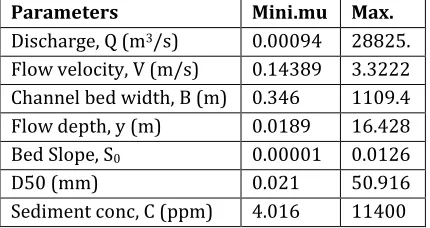
[image:2.612.36.251.503.617.2]The wide range of data of various flow and sediment variables which has been used in present study are given in Table 1.
Table 1: Range of Hydraulic and sediment data used in present study
Parameters Mini.mu
m Value Max. Value
Discharge, Q (m3/s) 0.00094 1
28825. 68 Flow velocity, V (m/s) 0.14389
6
3.3222 66 Channel bed width, B (m) 0.346 1109.4
72 Flow depth, y (m) 0.0189 16.428
7 Bed Slope, S0 0.00001
05
0.0126
D50 (mm) 0.021 50.916
Sediment conc, C (ppm) 4.016 11400
As given in Table 1, in present study, a total number of 137 sets of hydraulic and sediment data covering wide range of flow and sediment conditions have been taken from the Compendium of Alluvial Channel data compiled and published by W.R. Brownlie. The ranges of physical parameters of field data used in this study are shown in Table 1.
3.SELECTION
OF
PARAMETERS
AND
DEVELOPMENT OF NEW TOTAL BED MATERIAL
LOAD PREDICTOR
Various factors affect the phenomena of total bed material load transport. Ab. Ghani (1993) describes the fundamental parameters that govern the sediment transport processes in steady or gradually varied free surface flow in open channels consisting of the flow depth (y0), hydraulic radius (R), mean flow velocity (v), shear stress (τ0), kinematic viscosity (ν), density of water (ρ),sediment size (d), particle density (ρs), volumetric concentration of sediment (Cv), cross-section geometry (B and y0), bed roughness (n), friction factor ( f ), bed slope (S0) and acceleration due to gravity (g). Shields proposed two non-dimensional numbers: Shear Reynolds number ( ) and Non-dimensional shear stress ( ) which govern the sediment transport processes. The parameters like Shear Reynolds number ( ), Non-dimensional shear stress ( ), total load function ( ) and particle fall velocity (ωs) proposed by different investigators also govern the sediment transport processes significantly. For developing new total bed material load predictor, the most significant parameters have been selected by carrying out factor analysis on the various available parameters which may govern of total bed material load concentration. Factor analysis is concerned with interpreting the structure of the variance and covariance matrix obtained from a collection of multivariate observations. Factor analysis is performed to find out the most significant independent variables affecting the dependent variable.Based on factor analysis performed on various parameters influencing the total bed material transport rate following parameters are found to be more significant:
(i) Total load parameter ( )
(ii) Dimensionless shear stress ( )
(iii) Darcy-Weisbach friction factor ( f )
After finding most significant parameters affecting the phenomena of sediment transport, regression analysis was performed on the selected parameters to develop new total bed material load predictor as under with correlation coefficient [R2=0.7382]:f = 0.3917. (1) where
Total load function, =
Non dimensional shear, =
© 2015, IRJET.NET- All Rights Reserved
Page 994
4. VERIFICATION OF TOTAL BED MATERIAL LOAD
PREDICTORS USED IN PRESENT STUDY WITH
OBSERVED DATA:
Applying the selected total bed material load predictors to the selected data, the values of total bed material load were computed and were compared with the observed values of total bed material load in order to assess the accuracy of selected ten total bed material load predictors. Thereafter, analysis of the results was made in three ways: (1) In first approach, the accuracy of each predictor was assessed by comparing the measured and computed values of total bed material load between a discrepancy ratio range of 0.5 to 2.0.The discrepancy ratio can be defined as the ratio of computed and measured values of total bed material load. Percentile scores of all the ten predictors considered in this study and authors' newly developed predictor in the discrepancy ratio range of 0.5 to 2.0 were computed [Table 2] to assess the accuracy of each predictor.
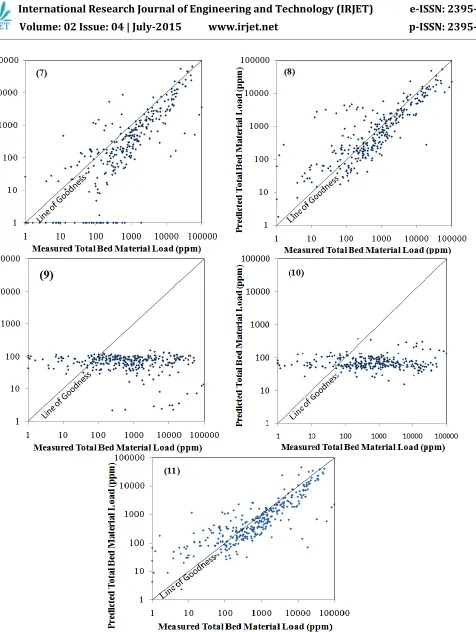
(2) In second approach, the computed values obtained from each total bed material load predictor selected in present study were plotted against the observed values of total bed material load [Fig. 1 to.11]. The scattering of data points around line of goodness indicates the accuracy of the corresponding predictor. The closeness of the plotted data points to the goodness line indicates good performance of the predictor.
(3) In third approach, the values of statistical parameters, like mean standard error, correlation coefficient and average geometric deviation were computed [Table 3] to assess the accuracy of each predictor.
* Mean Standard Error is used in order to select the best total bed material load predictor due to large difference between observed and calculated total sediment load. The value of MNE closer to zero shows higher accuracy of predictor.
Mean Standard Error (MNE)
N = number of data = Observed sediment load total sediment load
= Calculated total
* Average geometric deviation measures the geometric mean of the discrepancy betweenobserved and calculated total sediment load. The value of Average
geometric
deviation closer to unity shows higher accuracy
of predictor.
Average Geometric Deviation (AGD) =
if
if
*
The correlation coefficient between observed and predicted values varies from 0 to 1. A small value indicates little or no linear relationship between dependent variable and independent variables.Correlation coefficient =
The analysis has been performed on the selected data neglecting the data producing in
finite or
Indeterminate values of MNE and AGD
.
Table 2: Percentage of data falling within
e Tabl3.Statistical analysis of ten selected
predictors and authors' predictor
.
Predictor Percentile scores
within discrepancy ratio range (0.5-2.0)
Garde and Dattari’s Formula (1963)
25.0
Engelund and Hansen’s Formula (1967)
48.38
Graf and Acaroglu’s Formula
34.67
Yang’s Formula (1973) 36.29 Ackers and White’s
Formula (1973)
50.0
Brownlie’s Formula (1981) 45.96
Karim and Kennedy’s Formula (1983)
48.38
Yang’s Formula (1996) 25.0 Ariffin’s Formula (2004) 22.58 Sinnakaudan et al. Formula
(2006)
16.93
Present study 47.58
Predictor used
Mean Standard Error (MNE)
Average Geometric Deviation (AGD)
Correlation Coefficient
Garde-Dattari’s Formula
830.72 7.23 0.2579
Engelund-Hansen’s Formula
© 2015, IRJET.NET- All Rights Reserved
Page 995
Graf-Acaroglu’s Formula
150.77 3.65 0.4014
Yang’s Formula (1973)
321.83 4.15 0.3727
Ackers-White’s Formula
248.47 2.77 0.6452
Brownlie’s Formula
182.36 2.83 0.7008
Karim-Kennedy’s Formula
188.23 2.94 0.4291
Yang’s Formula (1996)
590.45 5.15 0.398
Ariffin’s Formula
680.13 5.02 0.4841
Sinnakaudan et al.
Formula
1028.68 5.83 0.4545
Present Study
97.04 2.59 0.5523
RESULTS AND ANALYSIS
The values of total bed material load concentration obtained from the total bed material load predictors considered in this study using the published field data are compared. The accuracy of the selected predictors is assessed by three approaches, firstly by comparing the results obtained from each predictor in the discrepancy ratio range of 0.5 to 2.0, secondly by plotting scatter graphs between measured and predicted values of total bed material load and thirdly by statistical check.
A new empirical relationship is also developed in present study using the same data that are used for the evaluation of different predictors in this study.
In first approach the percentages of results falling within discrepancy ratio range of 0.5 to 2.0 are plotted and shown in Table 1. It can be observed from Table 1 that authors' predictor followed predictors of Ackers and White, Karim and Kennedy, Engelund and Hansen, Brownlie, Yang (1973, 1996) produce more accurate result as compared to other predictors used in present study
In second approach the scatter graphs are drawn between measured and predicted values of total bed material load obtained from authors' predictor and ten total bed
material load predictors used in this study as shown in figures 1-12. These figures depict that the scattering of data points around the goodness line is less in authors' predictors and the predictors of Ackers and White, Karim and Kennedy,Engelund and Hansen,Brownlie, Yang (1973, 1996); which implies that these predictors yield more reasonable results. The scatter graphs shown in figures (1, 3, 9 & 10) depict large scattering around the goodness line; which indicates that predictors of Garde and Dattari, Graf and Acaroglu, Ariffin and Sinnakaudan produce less accurate results.
Similarity in the scatter trend in all the predictors except Sinnakaudan and Ariffin, can be observed in the scatter graphs shown in Fig. 9 and Fig. 10. The reason of the variation in the scatter trend of Sinnakaudan and Ariffin predictors can be attributed to the data used in present study and data used (Malaysian river data) by these authors in the development of their predictors. Sinnakaudan and Ariffin have used Malaysian river data in the development of their predictors It is suggested that the study can be extended by using Malaysian river data also. The measured and computed values of total bed material load obtained from all predictors used in this study and authors'predictor are plotted together as shown in Fig. 12. The two lines shown in Fig.12 indicate the band of discrepancy ratio range of 0.5 to 2.0. Most of the results obtained from predictors of Ackers and White, Karim and Kennedy,Engelund and Hansen, Brownlie, Yang (1973, 1996) and present study lie within the discrepancy ratio range of 0.5 to 2.0.
In third approach the values of statistical parameters, like mean standard error, correlation coefficient 'R' and average geometric deviation are computed to assess the accuracy of each predictor are shown in Table 3 for field data. It can be concluded from Table 3 that authors' predictor and the predictors of Engelund and Hansen, Graf, Karim and Kennedy,Yang, Brownlie produce lower value of mean standard error, average geometric deviation; and higher value of correlation coefficient than the corresponding values of other predictors.
CONCLUSIONS
Ten well-known predictors of Engelund and Hansen, Ackers and White, Karim and Kennedy, Garde and Dattari, Graf and Acaroglu, Yang, Brownlie, Ariffin and Sinnakaudan are used to examine their predicting ability of total bed material load using published field data covering a wide range of flow and sediment conditions.
A new relationship is also developed using the same set of data that are used for the evaluation of ten predictors in this study.
© 2015, IRJET.NET- All Rights Reserved
Page 996
geometric deviation and correlation coefficient producedby each predictor.
The reason of the variation in the scattering trend in scatter graphs [Fig. 9 and Fig. 10] of Sinnakaudan and Ariffin predictors can be attributed to the data used in present study and data used (Malaysian river data) by these authors in the development of their predictors. It is suggested that Malaysian river data can also be used in further study.
It can be concluded that author’s predictor and the predictors of Ackers and White, Karim and Kennedy, Engelund and Hansen, Brownlie produce more reasonable estimate of total bed material load and thus these predictors can be used by the field engineers with more confidence for the computation of total bed material load needed in the design of hydraulic structures.
LIST OF NOTATIONS
B
Bed width of channelSediment concentration by weight
Volumetric concentration
,
Total load concentration in ppm by weightD,y
0 Depth of flowd,d
50 Median size of sedimentDimensionless particle diameter
Darcy-Weisbach friction factor
G,
Specific gravity of sedimentGravitational acceleration
Manning’s roughness coefficient
Q
Total dischargeTotal load transp./unit width of channel
R
Hydraulic radiusShear Reynolds number
SS
R Regression sum of squaresSS
T Total sum of squaresBed slope
Critical velocity of flow
Shear velocity
Critical shear velocity
U, V
Mean velocity of flowBed shear stress
Dimensionless shear stress
Dimensionless critical shear stress
Total load function
Unit weight of sediment
Unit weight of fluid
Mass density of fluid
Mass density of sediment
Fall velocity of sediment underideal condition
Fall velocity of sediment particle
Kinematic viscosity of fluid
Geometric standard deviation
REFERENCES
[1] Ackers, P.,White, W.R., (1973): Sediment transport. New approach and analysis. Journal of the Hydraulics Division 99 (HY11), 2041e2060.
[2] Ariffin, J., Ab. Ghani, A., Zakaria, N. A., and Yahya, A S. (2002): “Evaluation of Equations on Total Bed Material Load.” Proc., Int. Conf. on Urban Hydrology for the 21st Century, Kuala Lumpur, Malaysia, 321– 327.
[3] Ariffin, J. (2004) : Development of Sediment Transport Models for Rivers in Malaysia using Regression Analysis and Artificial Neural Network. Ph.D Thesis, University of Science Malaysia, Penang, Malaysia.
[4] Beg, Mubeen, (1995) : “The Prediction of Total Bed Material Load Transport in Streams”. Sixth
International Symposium on River Sedimentation, N. Delhi, 351-358.
[5.] Beg, N., Ahmad N.,Beg, S., (2014): “Predicting Capacity of Total Bed Material Load Transport Rate in Alluvial Channels”. National Conference on Water Resource Management-Achievements & Challenges, JamiaMilliaIslamia, N. Delhi, Mar. 2014.
[6.] Brownlie, W.R. (1981): Compilation of Alluvial Channel Data: Laboratory and Field Data.California Institute of Technology, California.
© 2015, IRJET.NET- All Rights Reserved
Page 997
[8] Cheng, N. S. (1997): Simplified settling velocityformula for sediment particle. Journal of Hydraulic Engineering,123(2), 149-152
[9] De Vries, M. (1983): Keynote Address on “Hydraulics of Alluvial Rivers”. Proc. Of 2nd Int. Symposium of River Sedimentation, Nanjing, China, Oct..
[10]Engelund, F., Hansen, E., (1967): A Monograph on Sediment Transport in Alluvial Streams. TekniskVorlag, Copenhagen.
[11] Garde, R.J. and Dattari (1963): Investigations of the Total Sediment Discharge of Alluvial Streams. University of Roorkee Research Journal, Roorkee (India), Vol. VI, No. II.
[12. Graf, W.H. and Acaroglu (1968): Sediment Transport in Conveyance System. Bulletin of International Association of Scientific Hydrology, Vol. 13, No.2.
[13]Karim, M.F. and J.F. Kennedy (1983):. Computer-Based Predictors for Sediment Discharge and Friction Factor of Alluvial Streams. Proc of 2nd Int. Symposium on River Sedimentation, Nanjing, China, Oct.
[14]Molinas, A., and Wu, B. (2001): Transport of Sediment in Large Sand Bed Rivers. Journal of Hydraulic Research, 39, No.2, 135-146.
[15]Raudkivi, A.J. Loose Boundary Hydraulics. Pergamon Press, U.K. (1990):
Sinnakaudan, S., AbGhani, A., Ahmad, M.S.S., Zakaria, N.A., 2006. Multiple linear regression model for total bed material load prediction. Journal of Hydraulic Engineering 132(5), 521e528 ., pp.52-59.
[16] Yalin, M.S. (1977): Mechanics of Sediment Transport. Pergamon Press, Oxford (England), 2nd Ed..
[17] Yang, C.T. (1972): Unit Stream Power and Sediment Transport. JHD, Proc. ASCE, Vol. 18, No. HY-10.
[18]Yang, C.T. (1973): Incipient Motion and Sediment Transport.JHD, Proc. ASCE,Vol. 99, No. HY-10, Oct. [19] Yang, C.T. and Molinas, A. (1996): Sediment
© 2015, IRJET.NET- All Rights Reserved
Page 999
Fig. 1-11
: Verification of the predictors of : (1) Garde-Dattari ;(2); Engelund-Hansen (3); Graf-Acaroglu (4) ;Yang
(1973); (5) Ackers-White; (6) Brownlie; (7); Karim-Kennedy Formula (8); Yang (1996); (9) Ariffin; (10)
© 2015, IRJET.NET- All Rights Reserved
Page 1000
Appendix-2: Source of Data, Number Of Data And Data RangeData Source (No. of data)
Q(m3/s) V(m/s) B(m) y(m) S
0 (%) d50(mm) Cv(ppm)
ACOP Canal(10) 29.59-486.82 0.49-1.27 35.66-128.32 1.68-2.19 0.0085-0.0146
0.085-0.21 34-2083
American River (3) 1.22-29.19 0.47-0.74
3.2-22.19 0.8-2.53 0.0058-0.0331
0.222-7 99.1-448
Atchafalaya river(5) 1393-14186 0.64-1.96 316.9-503.2 6.88-14.72 0.0011-0.0051
0.091-0.226 38.22-501.22
Chitale Canal(5)
3-242.19 0.472-0.949
5.78-79.09
1.1-3.56 0.0064-0.0114
0.021-0.064 981-5758.99
Chop Canal(10) 27.52-427.57 0.6906-1.5369 23.774-121.615 1.3106-3.4138 0.0085-0.0202
0.09-0.311 232.336-1316.88 Colorado River(8) 77.5315-500.1605 0.5307-0.8953 95.167-254.55 1.1339-3.3132 0.0133-0.0277
0.175-0.36 22.7-768.7
HII River(8) 0.0009-4.8513 0.1439-0.9299 0.346-8.001 0.0189-0.652 0.084-0.839
0.21-1.44 116.553-5638.613 Middle Loup(6)
9.3726-12.4873 0.6216-0.876 44.806-46.33 0.2707-0.4118 0.125-0.133
0.344-0.395 482.24-2444
Mississippi River(7) 3567.815-28825.7 0.8376-1.5814 479.145-1109.472 6.5837-16.428 0.0031-0.0118
0.173-0.31 25.859-320.575 Mountain Creek(10) 0.0644-1.4631 0.3961-0.7802 3.551-4.334 0.0396-0.4327 0.137-0.315
0.286-0.899 72.65-2600.582 Rio Magdalena(8) 81.9998-10199.99 0.5256-1.3669
36-582 1.32-13.28
0.0024-0.046
0.1-1.08 99.473-2000.352 Niobrara River(6) 5.918-16.0552 0.6683-1.2707 21.031-21.946 0.421-0.5757 0.125-0.1799
0.218-0.329 392-2339.998 Saskatchewan River(7) 4.7096-33.1091 2.1123-3.3223 3.048-6.096 0.7315-2.1946 0.158-1.26
17.6-50.916 32.236-760.168 Red River(8)
190.2833-1537.56 0.4073-1.1398 140.513-182.88 2.9992-7.3762 0.0066-0.0077
0.108-0.204 26.494-499.751 Rio Grande River(25) 1.9198-285.9915 0.4265-2.3493 20.422-194.462 0.2408-3.112 0.053-0.235
0.18-0.645 129-114
Snake River(7) 971.2385-2888.23 1.6835-2.9971 137.16-198.12 4.2062-5.9131 0.0245-0.121
0.42- 25 4.016-32.687
Trinity River(4) 39.6424-82.6826 1.2658-2.1774 30.175-53.95 0.6614-1.1979