Enhancing Student Learning with Casebased Learning Objects in a
Problembased Learning Context: The Views of Social Work Students
in Scotland and Canada
Neil Ballantyne Manager
The Learning Exchange
Scottish Institute for Excellence in Social Work Education Glasgow, Scotland
Alan Knowles Social Work Program Grant MacEwan College
Edmonton, AB CA
Abstract
This paper summarizes the results of an evaluation of students’ perspectives comparing learning from a multimedia casebased learning object with learning from textbased case studies. A secondary goal of the study was to test the reusability of the learning object in different instructional contexts. The learning object was deployed in the context of a problembased learning approach to teaching social work students in three different courses in two different countries: Scotland (N=39) and Canada (N=57). Students completed a structured survey form including a series of statements using a five point Likert scale to quantify their views of the different case types (textbased and multimedia). Results indicate strong support for the use of multimedia case scenarios in social work education. Students felt their learning was enhanced using multimedia case studies compared to textbased case studies. A number of benefits, disadvantages and recommendations were identified that will help guide the future development, (re)use, and exchange of digitized learning resources in social work education.
Keywords: Learning objects, problembased learning, multimedia, elearning, social work education.
Introduction
One of the key challenges facing social work educators is that there are very few LOs available for use in social work courses (Knowles, 2007). In this paper the perspectives of social work students learning to use one type of LO, a multimedia case study, will be examined. The case study was developed by the Scottish Institute for Excellence in Social Work Education (SIESWE) and is stored in the Learning Exchange, the first Learning Object Repository for social work education in the world. The case study was developed based on problembased and constructivist learning strategies. The development of the Learning Exchange and a learning object approach to social work education has been described elsewhere by Ballantyne (2007).
Learning for Practice & Problembased Learning
One of the central problems and tensions for all university or collegebased instructors of professional education courses – whether they teach nurses, engineers, architects or social workers is the perceived relevance of the program to the skills and competencies required of professionals in the field. Within social work education this problem has been variously described as the theory/practice dilemma (Barbour, 1984); the problem of readiness to practice (Marsh & Triseliotis, 1996); and, more recently, the problem of integrated learning (Clapton, Cree, Allan, Edwards, Forbes, Irwin, Paterson, & Perry, 2006).
Problembased learning (PBL) has had considerable influence within professional education across many different professions and within many different countries as an approach to tackling the theory/practice divide (Boud & Felletti, 1997). PBL emerged in the field of medical education to address the problem of the integration of knowledge and practice for medical students in their preclinical years (Barrows & Tamblyn, 1980). Within PBL students learn relevant knowledge in the context of, and in order to understand, authentic case situations. Didactic lectures are largely, or wholly, replaced by student participation in small groups undertaking selfdirected learning to resolve problems represented by questions or case material. The role of the tutor becomes that of facilitator or coach to the students’ learning, focusing in particular on the metacognitive skills they require to arrive at a solution.
Within the domain of social work education there are many articles offering broadly positive reviews of the local implementation of PBL including programs in United Kingdom (Burgess & Jackson, 1990; Cree & Davidson, 2000; Downes & McCluskey, 1985; Plowright & Watkins, 2004), Australia (Bolzan & Heycox,1997; Gibbons & Gray, 2002; Smith, 1985), the United States (Sable, Larrivee, & Gayer, 2001), and Hong Kong (Lam, 2004; Wong & Lam, 2007).
eLearning, PBL, and Multimedia
In a traditional PBL curriculum students spend considerable amounts of time in facetoface discussion with tutors in small groups, reading and discussing articles, reflecting on and responding to textbased case materials. More recently, there has been interest in considering ways in which technology might be harnessed to support a PBL approach to teaching and learning. Several theorists have discussed the connection between new media, a constructivist approach to designing environments for student learning, and problembased learning (Koschmann, Myers, Feltovich, & Barrows,1994; Savery & Duffy, 1996; Grabinger, Dunlap, & Duffield, 1997; Jonassen, 1998). PBL instructors are beginning to make use of computermediated communication (CMC) to support reflective discussions within PBL study groups, and to do so in both distance and blended educational settings (Barrows, 2002; de Leng, Dolmans, Muijtjens, & Van der Vleuten, 2006; Stromso, Grottumt, & Lycke, 2007). Others are harnessing web based multimedia to enrich problembased case material (Balslev, de Grave, Muijtjens, & Scherpbier, 2005; de Leng, Dolmans, Muijtjens, & Van der Vleuten , 2007; Kamin, O’Sullivan, Deterding, & Younger, 2003).
Sole reliance on written cases or verbal vignettes, as Bransford and others (1989) have noted, may have dysfunctional consequences for the learner. For example, the medical student who is trained to make a diagnosis based on verbal vignettes may be at a loss when confronted with real patients. (p.97)
Part of the argument for the efficacy of PBL is related to the assumed cognitive effects of learning from authentic cases. From a cognitive perspective Norman and Schmidt (1992) argue that PBL ought to be able to facilitate:
· the acquisition of factual knowledge in the context in which it will subsequently be used;
· the mastery of general principles or concepts in such a manner that they can be transferred to solve new similar problems;
· the acquisition of prior examples that can be used for problem solutions on the basis of similarity or pattern recognition.
Or, as Williams (2001) puts it, “the closer the learning situation resembles the situation in which the information is to be applied, the better the retrieval of the information is likely to be” (p.92).
Describing a study conducted in the context of medical education, de Leng et al. (2007) suggest that the use of videobased scenarios offers a number of potential pedagogical advantages over textbased scenarios. First, a more holistic and complex picture of the case can be depicted allowing students to develop skills in pattern recognition rather than relying on the preprocessed verbal descriptions of an expert tutor. Secondly, they offer freedom for a student to experience the patient’s or service user’s perspective on reality directly, adding richness to the case and highlighting the value of the service user’s perspective. Thirdly, videobased scenarios can have a stronger emotional impact conveyed through body language and subtle nonverbal and paraverbal cues, supporting a more caring and empathic response from learners. Finally, videobased cases may be a medium that is more familiar to the new generation of digital natives (Prensky, 2001).
The use of multimedia technology in social work education predates the Web. Innovative social work educators have incorporated images, audio, and video into the curriculum to enrich and enliven teaching ever since it was possible to do so. As Gelman and Tosone (2006) indicate, the use of video has been relatively common within social work education to achieve a variety of pedagogical purposes including the explanation of a concept, the illustration of a technique, or the exploration of a social issue (Fredollino & Knaggs, 2005; Gelman & Tosone, 2006; Jerry & Collins, 2005; Seabury, 2003; Shibusawa, Van Esselstyn, & Oppenheim, 2006). However, in none of this work have social work educators evaluated the use of video in a casebased PBL context, nor have any of the materials in the studies been designed as learning objects or tested the reusability of learning objects in different instructional contexts.
Learning Objects
Learning objects are digital learning resources designed as small, focused elements of instruction that can be used and reused in different contexts (McGreal, 2004). They can be combined with other learning objects to form larger units of instruction, or blended with other more traditional learning resources in an online, blended or facetoface course. Wiley (2000) captured the essence of the learning object approach when he observed, “the fundamental idea behind learning objects is that instructional designers can build small (relative to the size of the entire course) instructional components that can be reused a number of times in different learning contexts” (p. 3).
object, there is little agreement in the literature on how best to describe these different degrees of granularity. The IEEE Learning Technology Standards Committee (2002) identifies four different levels of learning object aggregation or “functional granularity” of learning objects from the finest grained, such as a single image or other digital asset, through to the largest level of a complete certificated course. Leaving aside these efforts to precisely define levels of granularity, the important point for our present purposes is that the more decontextualized and granular a learning object is, the more reusable it will be across a range of different contexts (South & Monson, 2000). At the same time, the more granular a learning object is, the less educationally useful it will be. This has become known as the “reusability paradox” (Wiley, 2003).
Wiley et al. (2004) argue that the drive for reusability (in search of cost efficiencies) is leading to an emphasis on the production of more and more granular and decontextualized learning objects. However, approaches to LO development appear to be moving in the opposite direction with a renewed pedagogical emphasis on the value of context that draw on current learning theories including situated learning, constructivist approaches, and problembased learning. The challenge of balancing granularity and context may be more apparent in relation to learning objects deployed as “content chunks” or “information containers” or as Wiley et al. (2004) describe them, “glitzy information dumps, or lectures with high production values, as if all that online or distributed learning required was a larger megaphone for the instructor” (p. 509). Wiley et al. (2004) argue for a model of learning object development that supports problem or projectbased work. However, they don’t appear to consider the idea that a learning object could itself be casebased. A problembased multimedia case scenario can in fact be created as a standalone, self contained learning object, designed to be reusable in a range of cognate instructional contexts and offering a rich context for learning.
Description of Study
The purpose of this study was to evaluate social work students’ perspectives and experiences of learning using multimedia case studies compared with textbased case studies. The purpose was also to evaluate the feasibility of reusing digitized resources (learning objects) across instructional contexts and to provide insights and recommendations regarding the (re)use of multimedia case studies. The Scottish students (N=39) encountered the learning object in a social work law course; the Canadian students made use of the same learning object in a social work methods course (N=26) and a mental health course (N=31).
The child protection case used in the study was written by two instructors teaching the Scottish social work law course. Although the case was fictional, the case writers followed good practice in PBL case design by writing to reflect practice issues found in similar reallife cases (Hafler, 1997). The case was designed as a focus for learning about the legal, ethical and practice issues emerging from a child protection case scenario. The case study consisted of five short video clips (originally encoded in Windows Media format and embedded in a series of html pages) representing the case at different points in time (over the course of a year) and offering the different perspectives of key players in the case: an anonymous phone caller; social workers involved in the initial investigation; a neighbor; a foster caregiver (parent); and a thirteenyearold daughter of a drug abusing parent. All parts in the case scenario were played by professional actors and filmed to a high standard by a University film production unit.
and the transcriptions made available to students as a download. The case can be found at
http://www.merlot.org/merlot/viewMaterial.htm?id=280709
Method Sample
The students in Canada were enrolled in a social work practice methods course (N=26) and a social work mental heath course (N=31). The students in Scotland (N=39) were enrolled in a social work and the law module. The Canadian students took their courses in a blended online format where 50% of the learning took place online and 50% in a facetoface classroom environment. The blended mental health course included a small number of students (N=9) who were located at a rural offcampus site. The students in Canada worked on the learning object as part of an online problembased collaborative module in each of their courses. Students in the social work practice methods course worked in small groups to construct an assessment and respond to a number of questions and practice issues related to the case. The students in the mental health course focused on assessing the mental health of one of the primary characters, identifying related practice issues, and case planning. In both courses the module activities included leading and participating in online collaborative asynchronous discussions. The students in Scotland worked through the case with learning activities focused on legal issues related to child welfare social work practice. The Scottish students were learning in a faceto faceenvironment; however, they also had online access to the case from home or through the university lab. The students in Canada were taking first and second year social work diploma courses. The students in Scotland were in the second year of the fouryear Scottish social work degree.
Data Collection
At the end of their courses, students were invited to complete a questionnaire that included a series of statements to quantify their views and experiences of learning from digitized multimedia and textbased case studies. The responses were stored independently until all marks were submitted. In Canada, the questions exploring the students’ views on multimedia case studies were embedded in a larger survey and ongoing project evaluating blended learning in social work education. Questions and statements related to the video case scenario included general demographic data, information related to students’ computer skills and Internet access, 14 statements related to learning using multimedia case studies, and the opportunity to provide responses to the following openended statements: “My learning from the multimedia case study would have been improved if ”; “The benefits of multimedia case material are”; and, “Recommendations and other comments”. The students in Scotland completed a shorter version of the same survey including the same demographic questions, 14 statements, and openended responses.
Results
In Scotland, 39 of 52 students completed the survey for a response rate of 75%. In Canada, 26 of 27 students in the social work methods course and 31 of 40 students in the mental health course completed the survey for response rates of 96.2% and 77.5%, respectively.
The age ranges of the students reflected similar age ranges in both groups. In Scotland, 74% of the students were female and 26% were male. In Canada, 97% of the students were female, and 3% (2 students) were male (the program average for gender balance in the Canadian program is approximately 85% female and 15% male). In the Canadian group, 55% of the students were working part time, 17% worked full time, 21% worked only in the spring and summer, and 7% were not employed.
Both groups had good access to computers and the Internet: 98% of the Canadian students and 97% of the Scottish students owned their own computer; 98% of the Canadian students and 87% of the Scottish students had access to the Internet at home; 79% of the students in Scotland had high speed access, while 21% had access to dial up connections. In Canada, 81% had access to high speed Internet; 2% to dial up; 5% did not know; and one student (2%) did not have Internet access at home. All of the urban students in Canada had high speed Internet connections. Where rural students did not have high speed access at home, they were able to access their course and the multimedia case study through a local education centre or their employers and field practicum agencies. Eighty two percent of the Scottish Students accessed the case study in their classroom; 31% at the university lab(s); 44% at home and 3% at other locations. None of the Canadian students accessed the case study in the classroom: 56% accessed the case study at home; 21% at home and their field agency or work; 12% at only their field agency or work; 4% at on campus labs, and 7% other locations (community education centre, friend’s home, public library, and neighbor)
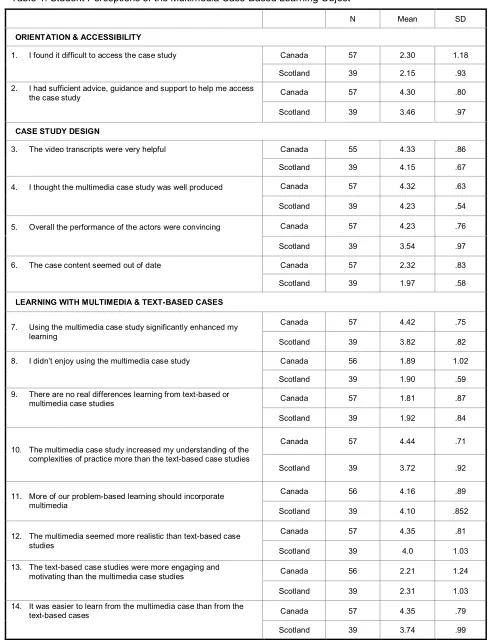
Table 1 presents the mean scores and standard deviations on the extent of agreement or disagreement scored by the respondents using a five point Likerttype scale where 1=Strongly Disagree; 2=Disagree; 3=Neutral; 4=Agree; 5=Strongly Agree. The questionnaire included 14 statements covering students’ views on orientation to the case and accessibility (questions 12), casestudy design (questions 35), and learning from multimedia and textbased cases (questions 614). The Scottish and Canadian results are shown separately.
a) Orientation and accessibility: similar proportions of students in Scotland and Canada disagreed with the statement that the case material was ‘difficult to access’. With regard to the advice, guidance, and support offered to help them with accessing the case: the Canadian students were more positive than the Scottish students who tended to be more neutral.
b) Case study design: the results provided helpful feedback on the design aspects of the multimedia case study. Similar proportions of Canadian and Scottish students agreed that the textbased transcriptions of the video clips were a helpful addition. There was strong and consistent agreement that the multimedia case was wellproduced, and that the content was up to date. Overall, students agreed that the performance of the actors was convincing; although, interestingly, the Scottish students were a little less supportive of this statement than the Canadian students. The students also provided important feedback and suggestions in their comments to the openended questions (see below).
c) Learning from multimedia compared with textbased cases: the means from both the Scottish students and Canadian students demonstrate broad agreement that:
· the multimedia case significantly enhanced their learning;
· they enjoyed using the multimedia case material;
· there are differences in learning from multimedia case as opposed to textbased cases;
· the multimedia case study increased their understanding of the complexities of practice more than textbased case studies.
· the multimedia case seemed more realistic than textbased cases;
· textbased cases were not more engaging and motivating to learn from than multimedia (note: this could be interpreted to mean that textbased and multimedia cases are equally engaging and motivating; however, the responses to the openended statements suggest otherwise)
Table 1. Student Perceptions of the Multimedia CaseBased Learning Object
N Mean SD
ORIENTATION & ACCESSIBILITY
Canada 57 2.30 1.18
1. I found it difficult to access the case study
Scotland 39 2.15 .93
Canada 57 4.30 .80
2. I had sufficient advice, guidance and support to help me access the case study
Scotland 39 3.46 .97
CASE STUDY DESIGN
Canada 55 4.33 .86
3. The video transcripts were very helpful
Scotland 39 4.15 .67
Canada 57 4.32 .63
4. I thought the multimedia case study was well produced
Scotland 39 4.23 .54
Canada 57 4.23 .76
5. Overall the performance of the actors were convincing
Scotland 39 3.54 .97
Canada 57 2.32 .83
6. The case content seemed out of date
Scotland 39 1.97 .58
LEARNING WITH MULTIMEDIA & TEXTBASED CASES
Canada 57 4.42 .75
7. Using the multimedia case study significantly enhanced my learning
Scotland 39 3.82 .82
Canada 56 1.89 1.02
8. I didn’t enjoy using the multimedia case study
Scotland 39 1.90 .59
Canada 57 1.81 .87
9. There are no real differences learning from textbased or multimedia case studies
Scotland 39 1.92 .84
Canada 57 4.44 .71
10. The multimedia case study increased my understanding of the complexities of practice more than the textbased case studies
Scotland 39 3.72 .92
Canada 56 4.16 .89
11. More of our problembased learning should incorporate multimedia
Scotland 39 4.10 .852
Canada 57 4.35 .81
12. The multimedia seemed more realistic than textbased case studies
Scotland 39 4.0 1.03
Canada 56 2.21 1.24
13. The textbased case studies were more engaging and motivating than the multimedia case studies
Scotland 39 2.31 1.03
Canada 57 4.35 .79
14. It was easier to learn from the multimedia case than from the textbased cases
Overall, there is a remarkable consistency in the results of the Canadian and Scottish students. However, although both groups felt that using multimedia enhanced their learning, there were some significant differences in comparing the mean responses of the two groups.
Students in Canada (M = 4.30, SD = .81) were more positive about the advice, guidance, and support using the case compared to the Scottish Students (M = 3.46, SD = .96), t(94) = 4.613, p<.001). Interestingly, the Scottish students (M = 3.54, SD. = .96), were less supportive of the statement that the actors’ performance was convincing compared to the Canadian students (M = 4.23, SD = .75), t(94) = 3.909, p= <.001. Although both groups felt that using multimedia enhanced their learning, the Canadian students (M = 4.44, SD = .79) were more supportive of the statement that the multimedia case study increased understanding of the complexities of practice compared to the Scottish students (M = 3.72, SD = .91), t(94) = p= <.001). The Canadian group (M = 4.35, SD = .79) also was stronger in their support regarding the ease of use of the multimedia case (M = 3.74, SD = .99), t(94) = 3.329, p= .001).
Students’ Response to the Openended Questions
Both groups provided valuable comments and recommendations about learning using multimedia case studies. The vast majority of the openended comments related to the benefits of using multimedia case studies. Students identified that the multimedia case study was more authentic, engaging, and motivating than textbased case studies. For example, students commented:
“It is easier to engage with the ‘client’ if you are able to see a real person. It also helped me empathize with them.”
“It brought (the case) to life. You can put a face to the name and see their emotions and struggles for their scenario.”
In particular, students stated that the ability to see and hear verbal and nonverbal cues improved their learning and their ability to relate to emotions expressed by the characters.
“It is more realistic and it feels as though there is more point in helping them, which gives you more motivation to carry out the work as paper based case studies are very repetitious.”
They also stated that flexible access and the ability to revisit the video clips were important benefits:
“You can watch them over and over, therefore it helps you pick on more issues.”
“Can access from home.”
And some students commented that the multimedia content was easier to memorize
“It is easier to understand therefore remember it better. More realistic.”
Students identified few disadvantages of using the multimedia case studies. The primary disadvantage identified by both groups was technology related. This included access to the Internet at home, problems viewing without broadband connections, having older computers, technical problems in accessing WebCT, and software problems. However, the above comments have to be considered in the context of a sample where over 97% owned their own computers; around 80% stated that they had highspeed broadband access from home; and over 75% stated that they were confident in the use of technology.
“I highly recommend the use of multimedia in all courses”;
“I really enjoyed this class and the things I learned. I feel computers are an essential part of everyday life and this really gets one into using them. Seeing the simulated video clips was amazing as it gave me a better understanding of what was going on. I really enjoyed my learning experience”;
“Please incorporate more multimedia. I found that aside from a few technical difficulties every now and then, it really made a difference in my learning in the course”.
Discussion and Conclusion
This study examined the perspectives of social work students in Scotland and Canada learning using a multimedia casebased learning object. The majority of students agreed that using the multimedia case study significantly enhanced their learning; that they enjoyed learning using the multimedia case material; that there are differences in learning from multimedia cases as opposed to textbased cases; and that the multimedia case increased their understanding of the complexities of practice more than textbased studies. The multimedia case was perceived as more authentic, motivating, memorable, and convenient. In particular, students appreciated access to nonverbal and paraverbal cues.
The findings support the feasibility of reusing casebase LOs across different jurisdictions and in different instructional contexts. The LO was reused successfully in three different courses to achieve different learning objectives; in multiple learning environments; and across two different practice jurisdictions. The LO was also successfully used at different stages of students’ learning (although this latter point is likely to be more true of casebased learning objects than of conceptual learning object). The results highlight the value of encouraging international educator collaboration and exchange of LOs in social work education.
The students’ responses also provided valuable feedback and recommendations on the design of case based LOs, which has been since used to revise the case and guide the development of a Canadian multimedia case. For example, optional closed captions have been added to the case, one scene has been updated, and the streaming video format now uses Adobe Flash, an open source player. A Canadian multimedia problembased case has been developed incorporating additional background information and intercultural elements.
The students’ perspectives on the amount of contextual case information highlights important instructional design considerations for future case study development including the level of the learner, stage of professional development, the amount of background information and context provided with the case(s), and the need to preserve the ill structured nature of problembased learning. A related key design issue is the need to balance the amount of contextual information while maximizing reusability of the learning object (the reusability paradox).
The results of this exploratory study are limited by the study design, which was selfreport in nature and based on the subjective views of students. The study did not measure objective learning gains. One researcher was also the instructor for the Canadian courses. As the study was limited to one casebased LO, the findings cannot be generalized to other LOs, or different types of LOs.
However, the robustness of these findings is offered some support by the findings of de Leng et al. (2007). Their results (derived from focus groups exploring the views of medical students on videobased scenarios) found that videobased scenarios were perceived as more authentic than textbased cases; provided a more comprehensive view of patients situations; were more motivating and challenging; and were considered to be more memorable.
significant improvements in data exploration, theory building, and theory evaluation as evidenced by an analysis of their verbal interactions in the study groups. Kamin et al. found that (2003) the use of a video case enhanced the critical thinking of students in both facetoface and virtual PBL groups.
Future work could usefully focus on: a) factors associated with effective reuse of a casebased LO (including factors associated with the design of the object and with the instructor’s approach to embedding the object in an instructional context); and, b) more objective studies of learning outcomes using multimedia cases especially in relation to transfer of learning to real cases.
References
Altshuler, S., J., & Bosch, L., A. (2003). Problembased learning in social work education. Journal of Teaching in Social Work, 23 (1/2), 201215.
Ballantyne, N. (2007). Object Lessons: A learning object approach to elearning for social work education. Journal of Technology in Human Services, 25 (1/2), 116.
Balslev, T., de Grave, W.S., Muijtjens, A.M.M., and Scherpbier, A.J.J.A. (2005). Comparison of text and video cases in a postgraduate problembased learning format. Medical Education, 39, 10861092.
Barbour, R. S. (1984). Social work education: Tackling the theory / practice dilemma. British Journal of Social Work, 14 (6), 557557
Barrows, H. (2002). Is it truly possible to have such a thing as dPBL? Distance Education, 23 (1), 119 122.
Barrows H.S. & Tamblyn R.M. (1980). ProblemBased Learning: An Approach to Medical Education. New York: Springer Publishing Company.
Bolzan, N., & Heycox, K. (1997). Use of an issue based approach in social work education. In D. Boud & G. I. Feletti (Eds.). The challenge of problembased learning (pp. 194202). London: Kogan Page.
Boud, D., & Feletti, G. I. (1997). Changing problem based learning. Introduction to the second edition. In D. Boud & G. I. Felleti (Eds.), The challenge of problembased learning (2nd ed., pp.114). London: Kogan Page.
Bridges, E. M. (1992). Problem based learning for administrators. Eugene, OR: ERIC Clearinghouse on Educational Management. (ERIC Document Reproduction Service No. ED 347 617)
Burgess, H. & Jackson, S. (1990). Enquiry and action learning: A new approach to social work education. Social Work Education, 9(3), 319.
Clapton, G., Cree, V. E., Allan, M., Edwards, R., Forbes, R., Irwin, M., Paterson, W. & Perry, R. (2006). Grasping the Nettle: Integrating Learning and Practice Revisited and Reimagined. Social Work Education, 25(6), 645656.
Cree, V. E. & Davidson, R. (2000). Enquiry and action learning: a model for transferring learning. In Transfer of Learning in Professional and Vocational Education, V. E. Cree & C.Macaulay (Eds.). London: Routledge.
de Leng, B.A., Dolmans, H.J., Muijtjens, A.M.M., and Van der Vleuten, C.P.M. (2007). How video cases should be used as authentic stimuli in problembases medical education. Medical Education, 41, 181188.
de Leng, B.A., Dolmans, H.J., Muijtjens, A.M.M., and Van der Vleuten, C.P.M. (2006). Student
perceptions of a virtual learning environment for a problembased learning undergraduate medical curriculum. Medical Education, 40, 568575.
qualifying course in social work. Journal of Social Work Practice, 2(2), 2440.
Duncan, C. (2003). Granularization. In A. Littlejohn (Ed.), Reusing online learning resources: A sustainable approach to elearning. London: KoganPage.
Fredollino, P.P., & Knaggs, D.G. (2005). Building a predominantly webbased course from facetoface and interactive video pilots: Administrative skills for social work practice. Journal of Technology in Human Services, 23(3/4), 201213.
Gelman, C., R., & Tosone, C. (2006). Making it real: Enhancing curriculum delivery through the use of studentgenerated training videos. Journal of Technology in Human Services, 24 (1), 3752.
Gibbons, J. & Gray, M. (2002). An integrated and experiencebased approach to social work education: The Newcastle model. Social Work Education, 21(5), 529–549.
Grabinger, S., Dunlap, J. C., & Duffield, J. A. (1997). Rich environments for active learning in action: Problembased learning. ALTJ, 5(2), 317.
Hafler, J. P. (1997). Case writing: Case writers' perspectives. In D. Boud and G. Feletti (Eds.), The challenge of problembased learning (pp.151159). 2 nd Edition. London: Kogan Page.
Hoffman, B. & Ritchie, D. (1997). Using multimedia to overcome the problems with problem based learning. Instructional Science, 25(2), 97115
IEEE Learning Technology Standards Committee (2002). Draft standard for learning object metadata. Retrieved August 31, 2007, from http://ltsc.ieee.org/wg12/20020612FinalLOMDraft.html
Jerry, P. & Collins, S. (2005). Webbased education in the human services use of webbased video clips in counselling skills training. Journal of Technology in Human Services, 23(3/4),183199.
Jonassen, D. (1998). Designing Constructivist Learning Environments. In C.M. Reigeluth (Ed.) Instructional theories and models. Mahwah, NJ: Lawrence Erlbaum Associates.
Kamin, C., O’Sullivan, P., Deterding, R., & Younger, M. (2003). A Comparison of Critical Thinking in Groups of Thirdyear Medical Students in Text, Video, and Virtual PBL Case Modalities. Academic Medicine, 78(2), 204211.
Kim, K., Bonk, C. (2006). The future of online teaching and learning in higher education: The survey says . . . . Educause Quarterly, 4, 2230.
Knowles, A., J. (2007). Pedagogical and policy challenges in implementing elearning in social work education. Journal of Technology in Human Services, 25(1/2), 1743.
Koschmann, T.D., Myers, A.C, Feltovich, P.J., & Barrows, H.S. (1994). Using technology to assist in realizing effective learning and instruction: A principled approach to the use of computers in collaborative learning. The Journal of the Learning Sciences, 3(3), 227264.
Lam, D. (2004). Problembased learning: An integration of theory and field. Journal of Social Work Education, 40(3), 371389.
McGreal, R. (2004). Online education using learning objects. London: RoutledgeFalmer.
Macaulay, C. (2000). Transfer of learning. In V. E. Cree & C. Macaulay (Eds.) Transfer of Learning in Professional Education. London: Routledge.
Norman, G. & Schmidt, H. (1992). The psychological basis of problem based learning, Academic Medicine, 67, 557–565.
Prensky, M. (2001). Digital natives, digital immigrants. On the Horizon, 9(5), 16.
Sable, M. R., Larrivee, L. S., & Gayer, D. (2001). Problembased learning: Opportunities and barriers for training interdisciplinary health care teams. Journal of Teaching in Social Work, 21(3/4), 217234.
Savery, J., & Duffy, T. (1996). Problem based learning: An instructional model and its constructivist framework. In B. Wilson (Ed.) Constructivist learning environments: Case studies in instructional design (pp. 135148). Englewood Cliffs, NJ: Educational Technology Publications.
Seabury, B. (2003). Online, computerbased, interactive simulations: Bridging classroom and field. Journal of Technology and Human Services, 22(1), 2948.
Shibusawa, T., VanEsselstyn, D., & Oppenheim, S. (2006). Third space: A webbase learning
environment for teaching advanced practice skills. Journal of Technology in Human Services, 24(4), 2133.
Smith, B. (1985). Problembased learning: The social work experience. In D. Boud (Ed.), Problembased learning in education for the professions. Sydney: Higher Education and Development Society of Australasia.
South, J.B., & Monson, D.W. (2000). A universitywide system for creating, capturing, and delivering learning objects. In D.A. Wiley (Ed.), The instructional use of learning objects: Online version. Retrieved August 31, 2007, from http://reusability.org/read/chapters/south.doc
Stromso, H.I., Grottumt, P. & Lycke, K.H. (2007). Content and process in problembased learning: a comparison of computermediated and facetoface communication. Journal of Computer Assisted Learning, 23, 271282.
Williams, B. (2001). The theoretical links between problembased learning and selfdirected learning for continuing professional nursing education. Teaching in Higher Education, 6, 8598.
Wiley, D. A. (2000). Connecting learning objects to instructional design theory: A definition, a metaphor, and a taxonomy. In D. A. Wiley (Ed.), The Instructional Use of Learning Objects: Online Version. Retrieved August 31, 2007 from http://reusability.org/read/chapters/wiley.doc
Wiley, D. (2003). Learning objects: Difficulties and opportunities. Retrieved August 31, 2007 from
http://opencontent.org/docs/lo_do.pdf
Wiley, D., Waters, S. Dawson, D. Lambert, B., Barclay, M., Wade, D. & Nelson, L. (2004). Overcoming the limitations of learning objects. Journal of Educational Multimedia and Hypermedia, 13(4), 507 521.
Wong, D.K.P., and Lam, D.O.B. (2007). ProblemBased Learning in Social Work: A Study of Student Learning Outcomes. Research on Social Work Practice, 17, 5565.
Manuscript received 31 Aug 2007; revision received 19 Nov 2007.
This work is licensed under a