arXiv:0812.0143v2 [math.CO] 3 Feb 2009
n−4 PASSES THROUGH A STACK
ANDERS CLAESSON, MARK DUKES AND EINAR STEINGR´IMSSON
Abstract. We characterise and enumerate permutations that are sortable by n−4 passes through a stack. We conjecture the number of permutations sortable byn−5 passes, and also the form of a formula for the general case n−k, which involves a polynomial expression.
1. Background
We view permutations as words without repeated letters; if π is a permutation of an nelement set andπ(i) =πi, then we writeπ=π1. . . πn. The stack sorting
operatorScan be defined recursively on permutations of finite subsets of{1,2, . . .} as follows. Ifπis empty thenS(π) =π. Ifπis nonempty writeπas the concatena-tionπ=LnR, wherenis the greatest element ofπandLandRare the subwords to the left and right ofnrespectively. Then
S(π) =S(L)S(R)n.
For example,S(42513) = 24135. We say that a permutationπisk-stack sortable if Sk(π) = id, whereSk=S◦Sk−1,S0 is the identity operator and id is the identity
permutation 12. . . n. Let the(stack sorting) complexity ofπ, denoted sscπ, be the smallest k such that π is k-stack sortable. Let Sn be the set of permutations of
{1, . . . , n}. For the permutations inS3we have
π = 123 132 213 231 312 321 sscπ = 0 1 1 2 1 1
LetWn,k be the set of allk-stack sortable permutations inSn; in other words,
Wn,k is the set of permutations inSn whose complexity is at mostk. Let En,k be
the set of permutations inSn whose complexity is exactlyk. Note that
En,k=Wn,k−Wn,k−1;
Wn,k=Sn−(En,k+1∪ · · · ∪En,n
−1).
It is easy to see that Wn,n−1=Sn. Knuth [1, 2.2.1.5] leaves as an exercise to
the reader to show that Wn,1=Sn(231). In his PhD thesis West [3] showed that
Wn,2=Sn(2341,35241),
where Sn(2341,35241) is the set of permutations in Sn that avoid the pattern
2341 and the “barred” pattern 35241; for information on these, see [2], especially Section 7. West also showed that Wn,n−2 are precisely those permutations that
do not have suffix n1. This last statement is easily shown by proving that the permutations inEn,n−1 are those with suffixn1.
In addition, West characterizedEn,n−2. To state that result it is convenient to
introduce some notation for special sets of words over the alphabet{1,2, . . .}. Let an asterisk (∗) stand for any word of zero or more characters, and let a question
mark (?) stand for any single letter. These conventions are adopted from the so
called glob patterns in computer science. For a wordwover{∗,?} ∪ {1,2, . . .}, let
hwidenote the set of words of the formw. For instance,h ∗n1iconsists of all words with suffixn1, andS5∩ h ∗51?i={23514,24513,32514,34512,42513,43512}. Let
hw1, . . . , wki=hw1i ∪ · · · ∪ hwki.
West’s characterisation ofEn,n−1andEn,n−2can then be stated as in the following
two lemmas, which follow from Theorems 4.2.4 and 4.2.17 in [3] and their proofs.
Lemma 1.1. For alln≥2,
En,n−1=Sn∩ h ∗n1i.
Thus, the cardinality of En,n−1 is(n−2)!.
Lemma 1.2. For alln≥4,
En,n−2=Sn∩ h ∗n2, ∗(n−1)1n, ∗n1?, ∗n?1, ∗n∗(n−2)∗(n−1)1 i.
Thus, the cardinality of En,n−2 is(n−3)!(7n−12)/2.
By subtracting the cardinalities in Lemmas 1.1 and 1.2 from n!, we get the following result.
Proposition 1.3. For alln≥4 the cardinality of Wn,n−3 is
(n−3)! 2 2n
3−6n2−5n+ 16
.
2. Permutations requiring exactly (n−3)-stack sorts
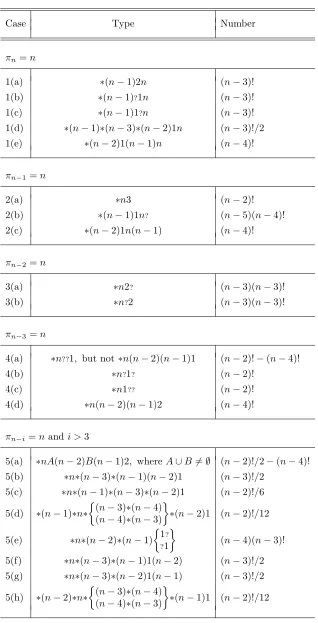
Theorem 2.1. For all n ≥6, the set of permutations En,n−3 are those given in
column labeled “Type” of Table 1. The number of such permutations is
(n−4)! 3
47
n−6 2
+ 194
n−6 1
+ 297
. (2.1)
To prove this we require some terminology and results from West [3, §4.2]. A
forbidden pattern of order k in a permutationπ is a triple (B, c, a), where B is a
subsequence of length kin πand (c, a) is a pair of entries inπsuch that for every b∈B the subsequencebcais an occurrence of the pattern 231, that is, a < b < c. In such a situation we say that the pair (c, a)witnesses the forbidden patternB. We call a forbidden pattern (B, c, a)uninterrupted if there is no subsequence bxb′ in πwhereb, b′∈B andx > c.
Lemma 2.2. [3, Theorems 4.2.10 and 4.2.14]Let π be a permutation.
(i) ssc(π)≤kif πdoes not contain any forbidden pattern of orderk;
(ii) ssc(π)> kif πcontains an uninterrupted forbidden pattern of orderk.
Proof of Theorem 2.1. Let π ∈ Sn. Using the contrapositive of (i) and (ii) in
Lemma 2.2, if ssc(π) =n−3, then π contains a forbidden pattern of ordern−4 and does not contain an uninterrupted forbidden pattern of order n−3. The forbidden pattern of ordern−4 must be witnessed by entries that appear in some two of the positions n−3, n−2, n−1 or n of the permutation. We will first condition on the position of the largest entry in the permutations, then condition on those permutations that contain a forbidden pattern of the required order, and finally single out those permutations that are inEn,n−3.
Supposeπn =n. A permutationπ=π′nis a member ofEn,n
−3precisely when
π′ is a member ofEn
−1,n−3. Thus entries 1(a)–1(e) of Table 1 immediately follow
Case Type Number
πn =n
1(a) ∗(n−1)2n (n−3)!
1(b) ∗(n−1)?1n (n−3)!
1(c) ∗(n−1)1?n (n−3)!
1(d) ∗(n−1)∗(n−3)∗(n−2)1n (n−3)!/2 1(e) ∗(n−2)1(n−1)n (n−4)!
πn−1=n
2(a) ∗n3 (n−2)!
2(b) ∗(n−1)1n? (n−5)(n−4)!
2(c) ∗(n−2)1n(n−1) (n−4)!
πn−2=n
3(a) ∗n2? (n−3)(n−3)!
3(b) ∗n?2 (n−3)(n−3)!
πn−3=n
4(a) ∗n??1, but not∗n(n−2)(n−1)1 (n−2)!−(n−4)!
4(b) ∗n?1? (n−2)!
4(c) ∗n1?? (n−2)!
4(d) ∗n(n−2)(n−1)2 (n−4)!
πn−i=nandi >3
5(a) ∗nA(n−2)B(n−1)2, whereA∪B 6=∅ (n−2)!/2−(n−4)! 5(b) ∗n∗(n−3)∗(n−1)(n−2)1 (n−3)!/2
5(c) ∗n∗(n−1)∗(n−3)∗(n−2)1 (n−2)!/6 5(d) ∗(n−1)∗n∗
(n−3)∗(n−4) (n−4)∗(n−3)
∗(n−2)1 (n−2)!/12
5(e) ∗n∗(n−2)∗(n−1)
1? ?1
(n−4)(n−3)! 5(f) ∗n∗(n−3)∗(n−1)1(n−2) (n−3)!/2 5(g) ∗n∗(n−3)∗(n−2)1(n−1) (n−3)!/2 5(h) ∗(n−2)∗n∗
(n−3)∗(n−4) (n−4)∗(n−3)
[image:3.612.140.458.59.682.2]
∗(n−1)1 (n−2)!/12
Supposeπn−1=n. We must haveπn ≥3, for otherwise, by Lemmas 1.1 and 1.2,
we would have π ∈En,n−1 or π ∈En,n−2. If πn = 3 then the permutation is in
En,n−3, and hence we get 2(a). If k = πn > 3 then it is impossible for (n, k)
to witness a forbidden pattern F of order n−4 since there could be at most n−k−1< n−4 elements inF. Thus the forbidden patternF must be witnessed by (πn−3, πn−2). As there are nown−2 values from which to form the forbidden
pattern F, we are forced to choose the extreme values from this set as the values for (πn−3, πn−2). Consequently, ifk =n−1 then we must have (πn−3, πn−2) =
(n−2,1), giving case 2(c). Otherwise 3< k < n−1 and (πn−3, πn−2) = (n−1,1)
which gives case 2(b). One easily verifies that all such permutations are inEn,n−3.
Supposeπn−2=n. By Lemma 1.2 the value 1 cannot be to the right ofn. Letk
be the smaller of the two valuesπn−1andπn. Ifk >2 then the pair (n, k) witnesses
a forbidden pattern of order at mostn−k−1−1 < n−4. For the same reason, (πn−1, πn) cannot witness a forbidden pattern of ordern−4. So exactly one of the
entries to the right ofnmust be 2, giving 3(a) and (b). One easily verifies that all such permutations are inEn,n−3.
Supposeπn−3=n. If 1 is to the right ofninπthen (n,1) witnesses a forbidden
pattern of ordern−4. However, ifπ∈ h ∗n(n−2)(n−1)1i, it has one of the forms given in Lemma 1.2. In all other cases the permutation is in En,n−3. This gives
4(a), (b) and (c).
Alternatively, if 1 is to the left of n, let kbe the value of the smallest entry to the right of n. Since there are at mostn−5 entries to the left ofninπ that take values betweenkandn, the pair (n, k) cannot witness a forbidden pattern of order n−4. In order forπto contain a forbidden patternF of ordern−4 it must be witnessed by the pair (πn−1, πn) and have as the block of n−4 values the value
πn−2 along with then−5 elements to the left of nthat are not 1. Thus πn = 2,
πn−1=n−1 and
π∈ h ∗nk(n−1)2i
for some k6= 1. One easily checks that the only value ofkfor whichπ∈En,n−3is
k=n−2. This gives 4(d).
Suppose πn−i = n for some i >3. Then (n, k) can never witness a forbidden pattern of ordern−4. In the remainder of the proof, we condition on the relative positions of (n−2), (n−1) andn. Ifπ=AnB(n−1)C(n−2)Dwhere|B∪C∪D| ≥2, then
S(π) =S(A)S(B)S(C)S(D)(n−2)(n−1)n. This gives
π∈En,n−3 ⇐⇒ S(A)S(B)S(C)S(D)∈En−3,n−4
⇐⇒ S(A)S(B)S(C)S(D)∈ h ∗(n−3)1i. Since |B∪C∪D| ≥2, the ways in which this can happen are restricted to
(i) D= 1 and n−3∈C, giving case 5(c),
(ii) D= 1, C=∅andn−3∈B, giving case 5(b), (iii) D=∅,C= 1 andn−3∈B, giving case 5(f). Ifπ=AnB(n−2)C(n−1)D where|B∪C∪D| ≥2, then
S(π) =S(A)S(B)S(C)(n−2)S(D)(n−1)n. This implies that πbelongs toEn,n−3 if and only if
S(A)S(B)S(C)(n−2)S(D)∈En−2,n−4.
If D = ∅ then π belongs to En,n−3 if and only if S(A)S(B)S(C) belongs to
we get 5(g). Otherwise S(A)S(B)S(C)(n−2)S(D) belongs to the types listed in Lemma 1.2. There are 3 cases to consider:
(i) S(D) = 2, soπ=AnB(n−2)C(n−1)2 whereB∪C6=∅, giving case 5(a); (ii) S(D) = 1k, soD= 1kor D=k1, giving case 5(e); and
(iii) it is not possible thatS(A)S(B)S(C)(n−2)S(D) matches the last type in Lemma 1.2 since this would mean thatS(D) ends in 1, its smallest entry. If π = A(n−1)BnC(n−2)D where |C∪D| ≥ 3, then a forbidden pattern of order n−4 can only be witnessed by the pair (n−2,1). Furthermore, all elements 2 through n−3 must be to the left of n−2, so πn−1 = n−2 and
πn = 1, that is π = A(n−1)BnC(n−2)1 where |C| ≥ 2. From this we have S2(π) =S(S(A)S(B))S(S(C)1)(n−2)(n−1)nand
π∈En,n−3 ⇐⇒ π′ =S(S(A)S(B))S(S(C)1)∈En−3,n−5.
The conditions on π′ (and therefore π) are easily derived by comparing π′ to the types in Lemma 1.2. Since|C| ≥2 one cannot have (n−3)2 as a suffix ofS(S(C)1). Similarly, (n−3)1kand (n−3)k1 cannot be suffixes ofS(S(C)1). Also, it is only possible that
π′∈ h ∗(n−3)∗(n−5)∗(n−4)1i
ifC=∅, which is not allowed. The only possibility forπ′is that it has (n−4)1(n−3) as a suffix, and son−4, n−3∈Csince|C| ≥2. Under these conditions,S2(π) has
suffix (n−4)1(n−3)(n−2)(n−1)nandπ∈En,n−3. ThusD= 1 andn−4, n−3∈C,
from which we get case 5(d).
Ifπ=A(n−2)BnC(n−1)D where|C∪D| ≥3 then S(π) =S(A)S(B)(n−2)S(C)S(D)(n−1)n.
Now, π belongs toEn,n−3 if and only ifπ′ =S(A)S(B)(n−2)S(C)S(D) belongs
toEn−2,n−4. Since|C∪D|is at least 3, the entryn−2 has at least 3 entries to its
right inπ′. By comparing this to the possible types that it may take in Lemma 1.2, we find that the only possibility is
π′∈ h ∗(n−2)∗(n−4)∗(n−3)1i.
This happens if and only ifD= 1 and n−4, n−3∈C, which gives case 5(h). For the two final cases in which n−2 and n−1 are to the left of n, it is not possible for π to contain a forbidden pattern of ordern−4, since at least one of n−2,n−1 andnis needed in order to witness such a pattern, and none of them are in the rightmost four positions of the permutation.
The number of permutations of each type is shown in column three of Table 1. Adding these gives (47n2−223n+ 240)(n−4)!/6 which may be be rewritten as in
formula (2.1).
Corollary 2.3. Forn≥6, the collection of(n−4)-stack sortable permutations in
Snare those permutations that are not of the types listed in Lemma 1.1, Lemma 1.2
or Table 1. The number of these is (n−4)!(3n4−18n3−4n2+ 158n−192)/3.
It is now straightforward to write down (a lengthy expression for) the descent polynomial of the (n−4)-stack sortable permutations, that is, the polynomial whose k-th coefficient is the number of (n−4)-stack sortable permutations with exactly k descents (a descent inπ=a1a2. . . an is anisuch that ai > ai+1).
The following conjecture is based on computer generated data forn≤13.
Conjecture 2.4. For alln≥8, the number of permutations inEn,n−4 is
(n−5)! 10
854
n−8 3
+ 5099
n−8 2
+ 12545
n−8 1
+ 16130
or equivalently, the number of (n−5)-stack sortable permutations is
(n−5)! 60 60n
5−600n4+ 506n3+ 11241n2−38369n+ 34236
.
We end with a conjecture about the form of an expression for the number of permutations needing exactly n−k stack sorts. This has been verified for all n≤14 and all relevantk.
Conjecture 2.5. For all n≥2k, the number of permutations in En,n−k may be
written as
(k−1)!(n−k−1)! 2(k−1)
!
k−1 X
i=0
ai
n−2k
i
where ai∈N.
References
[1] D. E. Knuth,The art of computer programming. Vol. 1: Fundamental algorithms, Addison Wesley Publishing Co., Reading, Mass.-London-Don Mills, Ont, 1969.
[2] E. Steingr´ımsson: Generalized permutation patterns — a short survey, “Permutation Pat-terns, St Andrews 2007,” S.A. Linton, N. Ruskuc, V. Vatter (eds.), LMS Lecture Note Series, Cambridge University Press, to appear.
[3] J. West, Permutations with forbidden subsequences; and, Stack sortable permutations, Ph.D. thesis, Massachusetts Institute of Technology, 1990.
The Mathematics Institute, Reyjav´ık University, 103 Reykjav´ık, Iceland.