An Equivalent Condition on the Switching
Construction of Differentially
4
-uniform
Permutations on
F2
2kfrom the Inverse Function
Xi Chen, Yazhi Deng, Min Zhu and Longjiang Qu**
Abstract
Differentially 4-uniform permutations on F22k with high nonlinearity are often chosen as substitution
boxes in block ciphers. Recently, Qu et al. used the powerful switching method to construct permutations with low differential uniformity from the inverse function [10], [11] and proposed a sufficient but not necessary condition for these permutations to be differentially 4-uniform. In this paper, a sufficient and necessary condition is presented. We also give a compact estimation for the number of constructed differentially 4-uniform permutations. Comparing with those constructions in [10], [11], the number of functions constructed here is much bigger. As an application, a new class of differentially4-uniform permutations is constructed. The obtained functions in this paper may provide more choices for the design of substitution boxes.
Index Terms
Differentially4-uniform permutation, Substitution box,4-Uniform BFI, Preferred Boolean function, APN function
I. INTRODUCTION
In the design of many block ciphers, permutations with specific properties are chosen as substitution box (S-box) to bring confusion into ciphers. To prevent various attacks on the cipher, such permutations are required to have low differential uniformity, high algebraic degree and high nonlinearity. Furthermore, for software implementation, such functions are usually required to be defined on fields with even degrees, namely F22k. Throughout this paper, we always let n= 2k be an even integer.
It is well known that the lowest differential uniformity of a function defined on F2n can achieve is 2 and such functions are called almost perfect nonlinear (APN) functions. On this aspect, they are the most ideal choices for the design of substitution boxes. However, it is very difficult to find APN permutations over F22k, which is called BIG APN Problem. Due to the lack of knowledge on APN permutations on
F22k, a natural trade-off solution is to use differentially 4-uniform permutations as S-boxes. For example, the Advanced Encryption Standard (AES) uses the multiplicative inverse function, which is a differentially 4-uniform permutation with known maximal nonlinearity. Hence to provide more choices for the S-boxes, it is important to construct more infinite families of differentially 4-uniform permutations on F22k with other good cryptographic properties.
Recently, many constructions of differentially 4-uniform permutations were introduced [2]–[4], [6], [10]– [15]. In 2013, Qu et al. used the powerful switching method [7] to construct many infinite families of
such permutations from the inverse function [10], [11]. In the constructions, they introduced a type of function calledpreferred Boolean function (PBF). More precisely, they studied the functions with the form
G(x) = 1x+f(1x), wheref is a Boolean function. They proved that if f is a PBF, then Gis a permutation polynomial over F2n whose differential uniformity is at most 4. The number n-variable of PBFs is at least 22
n+2
3 [11]. However, as pointed out in [11], f to be a PBF is only a sufficient but not necessary condition
for f to be a differentially 4-uniform permutation. Thus it is interesting to find an equivalent condition. To decide the number of the functions in this class is another interesting problem.
The rest of this paper is organized as follows. We introduce some necessary definitions and useful lemmas in Section II . In Section III, a generalization of PBF which is called4-uniform Boolean function with respect to the inverse function (4-Uniform BFI for short) is presented. Then we find a sufficient and necessary condition for G(x) = 1x +f(1x) to be a differentially 4-uniform permutation. As an application, a new class of differentially 4-uniform permutations where f are not PBFs is constructed. In Section IV, we give a compact estimation to the number of 4-Uniform BFIs. The estimation indicates that the number of differentially 4-uniform permutations constructed by our equivalent condition is much bigger than those constructed by PBFs. These constructed functions may provide more choices for the design of Substitution boxes.
II. NECESSARY DEFINITIONS AND USEFUL LEMMAS
In this section, we give necessary definitions and lemmas which will be used in the paper.
Let F2n be a finite field with 2n elements. It can be regarded as a vector space of dimension n over
F2, and can then be identified with Fn2. In the following, we will switch between these two points of view
without explanation if the context is clear. Letω=α2
n−1
3 whennis an even integer, whereα is a primitive
element of F2n. Thenω is an element of F24 \F2.
Given two positive integersnandm, a functionF :F2n →F2m is called an(n, m)-function. Particularly, whenm= 1,F is called ann-variable Boolean function, or a Boolean function withnvariables. We denote byBn the set of Boolean functions ofnvariables. The basic representation of any Boolean functionf ∈Bn is by its truth table, i.e.,
f = [f(1), f(α), f(α2),· · · , f(α2n−2), f(0)].
Let F be an (n, n)-function. Then F can be expressed uniquely as a polynomial over F2n with degree at most 2n−1. It is called a permutation polynomial if it induces a permutation overF2n.
Let ξ = (ξ(1),· · · , ξ(m))T be a column vector inFm2 and ξ(i) be the i-th element of ξ. The Hamming
weight of ξ, denoted by wt(ξ), is the size of the support of ξ, where the support of ξ is defined as Supp(ξ) = {1 ≤ i ≤m|ξ(i) = 1}. Let~0 be the vector whose all m elements are 0 and~1 be the vector with m same elements 1. Define el ∈ Fm2 to be the vector whose l-th element is 1 and others are all 0.
Suppose that ξ = (ξ(1),· · ·, ξ(m))T, η = (η(1),· · ·, η(m))T are two column vectors in Fm2 , define ξ η
if and only if ξ(i)≤η(i) for any 1≤i≤m.
We define the expected value of a random variable X asE(X).We use|S|to indicate the number of the
elements in a set S. Define the absolute trace function from F2n to F2 by Tr(x) =Pn−1 i=0 x2
i
. Denote by
F∗2n the set of all nonzero elements ofF2n. Note that for the multiplicative inverse function x−1, we always define 0−1 = 0 in this paper.
For any (a, b)∈F∗
2n×F2n, define
δF(a, b) =|{x:x∈F2n|F(x+a) +F(x) =b}|.
The multiset {∗ δF(a, b) : (a, b)∈F2∗n×F2n ∗} is called thedifferential spectrum of F. The value
∆F , max
(a,b)∈F∗2n×F2n
is called the differential uniformity of F, or we call F a differentially ∆F-uniformfunction. In particular, we call F almost perfect nonlinear (APN) if ∆F = 2. It is easy to see that APN functions achieve the lowest possible differential uniformity for functions defined on fields with an even characteristic.
The following lemmas are useful in our further discussion.
Lemma 2.1: [5] Letnbe an even integer and f be an n-variable Boolean function. Then x+f(x) is a permutation polynomial overF2n if and only if f(x) =f(x+ 1) holds for any x∈F2n.
Lemma 2.2: [9] For anya, b∈F2n anda6= 0, the polynomialf(x) =x2+ax+b∈F2n[x]is irreducible if and only if Tr(ab2) = 1.
Lemma 2.3: [8, Lemma 4.1] Let b∈F2n\F2. Then Tr(1
b) = 0if and only if there exists z∈F2n\F4 such thatb=z+z−1.
III. AN EQUIVALENTCONDITION WHICH PROVIDES MORE CONSTRUCTIONS
In this section, we give the definition of 4-Uniform BFI and an equivalent condition on the switching construction of differentially 4-uniform permutations on F22k from the inverse function. As an application, we present a new class of differentially 4-uniform permutations which can not be constructed from PBFs.
A. Definition of4-Uniform BFI
In [11] the authors introduced a type of functions called preferred Boolean functions, and then constructed many infinite families of permutations of the form G(x) = 1x +f(x1), whose differential uniformity are at most 4.
Theorem 3.1: [11] Let n= 2k be an even integer and f be an n-variable Boolean function. Let ω be an element in F2n with order3. Then f is a PBF if and only if it satisfies the following two conditions: (1) f(x+ 1) =f(x) for any x∈F2n;
(2) f(0) +f(z+1z) +f(ωz+ ωz1 ) +f(ω2z+ ω12z) = 0 for any z∈F2n\F4.
Theorem 3.2: [11] Let n= 2kbe an even integer, f be a Boolean function with nvariables. Define
G(x) = 1
x +f(
1
x).
If f(x) is a PBF, then G(x)is a permutation polynomial on F2n whose differentially uniformity is at most 4.
Theorem 3.2 builds a bridge from PBFs to permutation polynomials with differentially uniformity at most 4. However, as pointed out in [10], f to be a PBF is only a sufficient but not necessary condition. Then a natural question is to search for an equivalent condition. For convenience, we introduce the following definition.
Definition 3.3: Let n = 2k be an even integer and f be an n-variable Boolean function. We call f a 4-uniform Boolean function with respect to the inverse function (4-Uniform BFI for short) when G(x) =
1
x+f(
1
x) is a permutation whose differential uniformity is at most 4. Hence a PBF is a 4-Uniform BFI and not vice versa.
B. An Equivalent Condition
Now we introduce the main theorem of this section. It is an equivalent condition on the switching construction of differentially 4-uniform permutation of F22k from the inverse function.
Theorem 3.4: Let n be an even integer and f be an n-variable Boolean function. Let ω be an element inF2n with order 3. Then G(x) = 1
x +f(
1
if f(x) = f(x+ 1) holds for any x ∈ F2n and for any z ∈ F2n\ F4, at least one of the following two equations holds.
f(0) +f(z+1z + 1) +f(ωz+ ωz1 + 1) +f(ω2z+ω12z + 1) = 0, (1)
f(0) +f(z+1z + 1) +f(ω(z+1z + 1)) +f(ω2(z+1z + 1)) = 1. (2)
Proof: It follows from Lemma 2.1 that G(x) is a permutation if and only if f(x) =f(x+ 1) holds for any x∈F2n. Then we only need to compute the differential uniformity of G.
Sufficiency: Assume that the differential uniformity of G(x) = 1x +f(1x) is more than 4. Then there exist a∈F∗
2n, b∈F2n such that
G(x+a) +G(x) =b (3)
has more than4 solutions in F2n. Since f is a Boolean function, we have
1
x+
1
x+a =b
f(1x) +f(x+1a) = 0, (4)
or
1
x+
1
x+a =b+ 1
f(1x) +f(x+1a) = 1. (5)
It is clear that Eq.(4) and Eq.(5) have no common solutions and each of them has at most 2 solutions in
F2n\{0, a}. Hence0is a solution of Eq.(4) or Eq.(5) and each of them has exactly2solutions inF2n\{0, a}. The following proof is divided into two cases.
Case 1. 0is a solution of Eq.(4) In this case, we have ab= 1 and
f(0) +f(1
a) = 0. (6)
Substituting ab= 1 into Eq.(4) and Eq.(5), we get
1 x+
1
x+a =
1
a
f(1x) +f(x1 +1a) = 0, (7)
or
1 x+
1
x+a =
1
a+ 1
f(1x) +f(x1 +1a+ 1) = 1. (8)
If x6= 0 ora, then Eq.(7.1) is equivalent to x2+ax+a2 = 0, which always has 2solutions x= ωa and
x= ωa2.
Now we consider Eq.(8.1). It is clear that0 andaare not the solutions of Eq.(8.1) anda6= 1. Hence Eq. (8.1) is equivalent to
x2+ax+ a
2
1 +a = 0 (9)
Since nis an even integer, then Tr(a+11 ) = Tr(a+1a ) = Tr(1+11
a
). It follows from Lemma 2.2 that Eq.(9)
has solutions in F2n if and only if 0 = Tr( 1
a+1), which is equal to Tr( 1 1+1
a
). It follows froma6= 0,1 that
1 + 1a ∈F2n\ F2. Then according to Lemma 2.3, Tr( 1
1+1
a
) = 0 if and only if there exists z ∈F2n\ F4
such that 1a+ 1 =z+1z. Hence Eq.(8.1) has a solution inF2n if and only if there existsz∈F2n\ F4 such thata= z+11
Let x1 = ωz+11
ωz+1 . Then
1
x1+a
= 1 1
ωz+ 1
ωz+1 +z+11
z+1
= (ωz+
1
ωz + 1)(z+
1
z+ 1)
ω2z+ 1
ω2z
= ωz
2+ 1
ωz2
ω2z+ 1
ω2z
+ 1 =ω2z+ 1
ω2z + 1.
Hence
1
x1
+ 1
x1+a
= (ωz+ 1
ωz + 1) + (ω
2z+ 1
ω2z + 1) =z+
1
z =
1
a+ 1,
which means that x1 = ωz+11
ωz+1
is a solution of Eq.(8.1). Clearly, x2 =x1+a= ω2z+11
ω2z+1
is the other solution of Eq.(8.1).
Substituting a= z+11
z+1
into Eq.(6), Eq.(7.2) and Eq.(8.2), one gets the following equation system.
f(0) +f(z+1z + 1) = 0, f(ω(z+ 1z+ 1)) +f(ω2(z+1z + 1)) = 0, f(ωz+ωz1 + 1) +f(ω2z+ω12z + 1) = 1.
(10)
Hence there exists z∈F2n\ F4 such that neither Eq.(1) nor Eq.(2) holds, a contradiction. Case 2. 0is a solution of Eq.(5)
Similarly as Case 1, we have a(b+ 1) = 1 and there existsz∈F2n\ F4 such thata= 1 z+1
z+1
. Then we get
f(0) +f(z+1z + 1) = 1, f(ω(z+ 1z+ 1)) +f(ω2(z+1z + 1)) = 1,
f(ωz+ωz1 + 1) +f(ω2z+ 1
ω2z + 1) = 0.
(11)
Thus there exists z∈F2n\ F4 such that neither Eq. (1) nor Eq. (2) is hold, a contradiction. Hence the differential uniformity of G is at most 4.
Now we prove that Gcan not be an APN function. AssumeG(x) = 1x+f(1x) is an APN function. Then Eq.(3) has at most2 solutions in F2n for any a, b∈F2n anda6= 0.
As in the proof of Case 1, let a= z+11
z+1
andb=z+z1+ 1, wherez is any element of F2n\ F4. Then
we can verify that x = 0, x =a, x = ωa and x = ωa2 are the solutions of Eq. (4.1), while x =
1
ωz+1
ωz+1 ,
x = ω2z+11
ω2z+1
are the solutions of Eq.(5.1). Since Eq.(3) has at most 2 solutions in F2n, at most one equation of Eq.(10) holds.
Now we turn to Case 2. Let a= z+11
z+1
andb=z+1z. Similarly, at most one equation of Eq.(11) holds. Hence at most two of the six equations of Eq.(10) and Eq.(11) hold. On the other hand, one and only one of Eq.(10.1) and Eq.(11.1) holds since f is a Boolean function. By the same reason, exactly three of these six equations hold, contradicts.
Hence G(x) = 1x+f(1x) is not an APN permutation but a differentially 4-uniform permutation.
Necessity: Assume, on the contrary, that there exists z ∈ F2n\ F4 such that neither Eq.(1) nor Eq.(2) holds. Sincef is a Boolean function, we have f(0) +f(z+1z+ 1) = 0or1. Here we only prove one case. The proof for the other case is similar and is left to the interested readers.
Assume that f(0) +f(z+ 1z + 1) = 0. Then with the assumption that neither Eq.(1) nor Eq.(2) holds, one can get the equation system Eq.(10). Let a = z+11
z+1
and b =z+1z + 1. It is clear that ab= 1 and
It follows from Eq.(10.1), Eq.(10.2) and a6= 0 thatx = 0, x =a, x= ωa and x= ωa2 are four different
solutions of Eq.(4). Similarly as in the sufficient part of the proof, one can verify that x = ωz+11
ωz+1 and x = ω2z+11
ω2z+1
are two different solutions of Eq.(5). Obviously, Eq.(4) and Eq.(5) have no common solutions. Hence Eq.(3) has at least6 different solutions in F2n, a contradiction.
We finish the proof.
We make two comments on Theorem 3.4. First, in the above proof the condition f(x) = f(x+ 1) was not used in the computation of the differential uniformity of G. Hence if we remove this condition in the theorem, G is also a differentially 4-uniform function but may be not a permutation. This means that Theorem 3.4 can be used to construct more differentially 4-uniform functions. Second, it was proved that G(x) = 1x +f(x1) constructed by 4-Uniform BFI is not an APN function. In particular, those G(x) constructed by PBF can not be APN functions either.
C. A New Infinite Family of Differentially 4-Uniform Permutations
In this subsection we construct a new infinite family of differentially4-uniform permutations with Boolean functions which are not PBFs but4-Uniform BFIs. We first introduce a lemma.
Lemma 3.5: Let nbe an even integer andω be an element in F2n with order3. Ifz∈F2n\ F4, then 1
z+1z + 1+
1
ωz+ωz1 + 1+
1
ω2z+ 1
ω2z + 1
= 0.
Proof. It is clear that1 +ω+ω2 = 0 andz+ 1z ∈ {/ 0,1}. Then
1
ωz+ωz1 + 1+
1
ω2z+ 1
ω2z + 1
= z+
1
z (ωz+ωz1 + 1)(ω2z+ 1
ω2z + 1)
= z+
1
z
z2+ 1
z2 +z+
1
z
= 1
z+1z + 1.
Theorem 3.6: Let n be an even integer. Letα, β ∈F2n satisfying
α+ 1
α + 1 =β+
1
β ∈F2n\ F4, (12)
Tr(ωα+11
ωα+1
) = 1 andTr(ωβ+11
ωβ+1
) = 1. Define two subsets of F2n as follows.
U :={α+ 1
α, α+
1
α+ 1, ωα+
1
ωα, ωα+
1
ωα + 1, ω
2α+ 1
ω2α, ω
2α+ 1
ω2α + 1,
ωβ+ 1
ωβ, ωβ+
1
ωβ + 1, ω
2β+ 1
ω2β, ω
2β+ 1
ω2β + 1}.
V :={ω(ωα+ 1
ωα + 1), ω
2(ωα+ 1
ωα+ 1), ω(ω
2α+ 1
ω2α + 1), ω
2(ω2α+ 1
ω2α + 1),
ω(ωβ+ 1
ωβ + 1), ω
2(ωβ+ 1
ωβ + 1), ω(ω
2β+ 1
ω2β + 1), ω
2(ω2β+ 1
ω2β + 1)}.
Let us define
f(x) =
1, when x∈U;
0, else. (13)
Proof. It is easy to verify that the elements of U are distinct and 0 ∈/ U. Then f(0) = 0. Let z be any element of F2n\ F4. According to Theorem 3.4, it suffices to prove that at least one of the following two equations holds.
f(0) +f(z+1z + 1) +f(ωz+ ωz1 + 1) +f(ω2z+ω12z + 1) = 0, (14)
f(0) +f(z+1z + 1) +f(ω(z+1z + 1)) +f(ω2(z+1z + 1)) = 1. (15)
It follows from Eq.(12) and Lemma 2.3 thatTr(α+11
α+1
) = Tr(β+11
β+1
) = 0. By the assumptionTr(ωα+11
ωα+1 ) =
Tr(ωβ+11
ωβ+1
) = 1and Lemma 3.5, we have Tr(ω2α+11
ω2α+1
) = Tr(ω2β+11
ω2β+1
) = 1. Then it follows from
Lemma 2.3 that neither of ωα+ ωα1 , ω2α + ω12α, ωβ +
1
ωβ, ω
2β + 1
ω2β can equal to z+
1
z + 1. Hence
z+ 1z + 1 ∈ U if and only if z ∈ {α,α1, β,1β, ωα,ωα1 , ωβ,ωβ1 , ω2α, 1
ω2α, ω2β,
1
ω2β}. It is also clear that
z+1z + 1∈U if and only ifωz+ωz1 + 1, ω2z+ω12z+ 1∈U. The rest of the proof is split into two cases
according to whether z+1z + 1∈U. Case 1. z+1z + 1∈/U
Then f(z+1z + 1) = f(ωz+ωz1 + 1) =f(ω2z+ ω12z + 1) = 0 since neither of z+
1
z + 1, ωz+
1
ωz + 1, ω2z+ω12z+ 1 is inU. Hence Eq.(14) holds.
Case 2. z+1z + 1∈U
Contrary to Case 1, now Eq.(14) does not hold since z+1z+ 1, ωz+ωz1 + 1, ω2z+ω12z+ 1∈U. Hence
f is not a PBF. Now we need to prove that Eq.(15) must hold, or equivalently, to prove that
f(ω(z+1
z+ 1)) =f(ω
2(z+1
z + 1)). (16)
We distinguish two subcases.
Subcase 2.1. z∈ {ωα,ωα1 , ωβ,ωβ1 , ω2α,ω12α, ω
2β, 1
ω2β}
It is clear thatω(z+1z+1), ω2(z+1
z+1)∈V. Then it follows from the definition off and the assumption
U ∩V =∅ that f(ω(z+1z + 1)) =f(ω2(z+1
z + 1)) = 0, which means Eq.(16) holds. Subcase 2.2. z∈ {α,α1, β,1β}
Let U1 = {α+ α1 + 1 = β + 1β, α+ α1 = β+ β1 + 1}, U2 = U\U1. Then one can easily verify that
u1+u2 ∈U2 holds for anyu1 ∈U1, u2 ∈U2. Since z+ 1z+ 1∈F2n\ F4, we have ωi(z+1
z + 1)∈/U1,
i= 1,2. Thenω(z+z1 + 1)∈U2 if and only if ω2(z+1z + 1) = (z+1z + 1) +ω(z+1z + 1)∈U2, which
means f(ω(z+1z + 1)) = 1 if and only if f(ω2(z+ 1z+ 1)) = 1. Hence Eq.(16) holds.
The proof is completed.
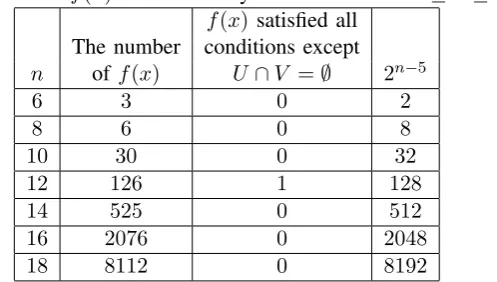
TABLE I: The number of f(x) constructed by Theorem 3.6 for 6≤n≤18 (nis even)
f(x) satisfied all The number conditions except
n of f(x) U∩V =∅ 2n−5
6 3 0 2
8 6 0 8
10 30 0 32
12 126 1 128
14 525 0 512
16 2076 0 2048
18 8112 0 8192
Theorem 3.6 indicates that there exist some functions which are 4-Uniform BFIs but not PBFs. Indeed, the number of4-Uniform BFIs is much bigger than that of PBFs. We will estimate the number of4-Uniform BFIs in the next section.
IV. THENUMBER OF4-UNIFORM BFIS
According to Definition 3.3, G(x) = x1 +f(1x) is a differentially 4-uniform permutation if and only if f
is a 4-Uniform BFI. Thus it is interesting to calculate the number of 4-Uniform BFIs. In this section, we first introduce an algorithm to calculate the exact number of4-Uniform BFIs. As it is difficult to realize the algorithm, even onF28, we propose a method to estimate the number ofη-partly4-Uniform BFIs(introduced
in Definition 4.5) and then discuss the accuracy of our compact estimation. At last we generalize the method to estimate the number of4-Uniform BFIs.
A. The Exact Number of 4-Uniform BFIs
We first consider the number of PBFs. Suppose that h:F2n →F2n is defined by h(z) =z+1
z+ 1. Then Eq.(1) and Eq.(2) in Theorem 3.4 can be written as
f(0) +f(h(z)) +f(h(ωz)) +f(h(ω2z)) = 0,
f(0) +f(h(z)) +f(ωh(z)) +f(ω2h(z)) = 1.
Define the following three sets:
Lx = {{x, x+ 1}:x∈F2n},
Lz = {{0, h(z), h(ωz), h(ω2z)}:z∈F2n\F4},
Lh = {{0, h(z), ωh(z), ω2h(z)}:z∈F2n\F4}.
Clearly |Lx| = 2n−1. Note that when z ∈F2n\F4, the elements z+1
z + 1, ωz+
1
ωz + 1, ω
2z+ 1
ω2z + 1
are pairwise distinct since the sum of them is1 and none of them can be 1. Then the6 different elements
z, ωz, ω2z,1z,ωz1 ,ω12z lead to the same element of Lz, hence |Lz|=
2n−4
6 =
2n−1−2
3 . It is clear that|Lh| ≤ 2n−1
3 . Since different elementszmay lead to the same element inLh, we can not get|Lh|directly. However,
it can be calculated easily for small number of variables with a computer.
Then we define a matrix M0 with the size of (|Lz|+|Lx|)×2n, where the columns of M0 are indexed
Algorithm 4.1:
1 i n p u t n ;
2 M0 := 0;i:= 0;M supp:= 0;SetZ :=∅;SetX :=∅; 3 f o r z∈F2n\F4 do
4 i f z+1
z + 1∈/ SetZ t h e n
5 i:=i+ 1;M0[i,0] := 1; 6 f o r j∈ {0,1,2} do 7 M0[i, ωjz+ 1
ωjz + 1] := 1;M supp[i, j+ 1] :=ωjz+ω1jz + 1;
8 SetZ :=SetZS{z+1z + 1, ωz+ωz1 + 1, ω2z+ω12z + 1}; 9 f o r x∈F2n do
10 i f x /∈SetX t h e n
11 i:=i+ 1;M0[i, x] := 1;M0[i, x+ 1] := 1; 12 SetX :=SetXS{x, x+ 1};
13 o u t p u t M0;M supp.
Here we useM supp to save the support of those lines produced by Lz. The elements ofM0 are in F2 and
each line ofM0 save some messages of the condition of PBFs. Then we get the number of PBFs according
to the following theorem.
Theorem 4.2: [11] Let M0 be defined as above and let f be an n-variable Boolean function expressed
by its truth table. Then f is a PBF if and only if it satisfies the equation
M0fT= 0. (17)
Further, the number of the Boolean functions satisfying (17) is 22n−Rank(M0). Particularly, if M
0 is a full
rank matrix, then this number equals to 22 n+2
3 .
Now we focus on the number of 4-Uniform BFIs. Assume that the n-variable Boolean function f is a 4-Uniform BFI. Letξ = (ξ(1),· · · , ξ(|Lz|))T be a column vector inF|2Lz| andξ(i)be thei-th element ofξ.
Replace the vector0 in Eq.(17) by(ξ(1),· · · , ξ(|Lz|),0,· · ·,0)T, where the last |Lx|elements are0. Then
f(x) +f(x+ 1) = 0 holds for any x ∈F2n. For any 1≤i≤ |Lz|, assume that M0[i,0] =M0[i, h(zi)] =
M0[i, h(ωzi)] =M0[i, h(ω2zi)] = 1and other elements are 0in the i-th line of M0 according to Algorithm
4.1, where zi ∈ F2n \F4. For those i satisfying ξ(i) = 0, the equation f(0) +f(h(zi)) +f(h(ωzi)) +
f(h(ω2zi)) = 0 holds. And for the other i satisfying ξ(i) = 1, the equation above does not hold, which means the following three equations must hold according to Theorem 3.4.
f(0) +f(h(zi)) +f(ωh(zi)) +f(ω2h(zi)) = 1, (18)
f(0) +f(h(ωzi)) +f(ωh(ωzi)) +f(ω2h(ωzi)) = 1, (19)
f(0) +f(h(ω2zi)) +f(ωh(ω2zi)) +f(ω2h(ω2zi)) = 1. (20)
We define the matrix Mξ which adds the three conditions above as new lines toM0 for anyi∈Supp(ξ).
Algorithm 4.3:
1 i n p u t ξ, M0, M supp;
2 Mξ:=M0;iξ:=|Lz|+|Lx|;SetY :=∅ 3 f o r i i n Supp(ξ) do
4 f o r j i n {0,1,2} do
5 i f M supp[i, j+ 1]∈/ SetY t h e n
6 iξ :=iξ+ 1;Mξ[iξ,0] := 1;Mξ[iξ, M supp[i, j+ 1]] := 1; 7 Mξ[iξ, ωM supp[i, j+ 1]] := 1;Mξ[iξ, ω2M supp[i, j+ 1]] := 1;
8 SetY :=SetY ∪ {M supp[i, j+ 1], ωM supp[i, j+ 1], ω2M supp[i, j+ 1]} 9 mξ :=iξ
10 o u t p u t Mξ;mξ;
Here mξ is the row number of Mξ, which means Mξ is a matrix of the size mξ×2n. Due to Algorithm 4.3,mξ=|Lz|+|Lx|+|Lh| ≤ |Lz|+|Lx|+2
n−1
3 ≤2
n. The columns ofM
ξ are indexed by the2nelements in F2n and the elements of Mξ are inF2. It is clear that for any ξ, let l∈Supp(ξ) then mξ+e
l ≤mξ+ 3. Define a column vector vξ on F2 with mξ elements as follows: The first |Lz| elements of vξ are the same as the vector ξ, the next|Lx|elements are 0 and the last mξ− |Lz| − |Lx| elements are 1.
Theorem 4.4: Let n be an even integer. For any ξ ∈F2|Lz|, let Mξ, vξ be defined as above and letf be ann-variable Boolean function expressed by its truth table. Thenf is a4-Uniform BFI if and only if there exists a ξ ∈F|2Lz| such that f satisfies the following equation.
MξfT =vξ. (21)
Further, the number of 4-Uniform BFIs on F2n is
BF(n) = X
ξ∈F|2Lz|
(Rank(Mξ)−Rank([Mξ, vξ]) + 1)×22
n−Rank(M
ξ). (22)
Proof: For any 1 ≤ i≤ |Lz|, if ξ(i) = 0, then f(0) +f(h(zi)) +f(h(ωzi)) +f(h(ω2zi)) = 0 holds in these lines. And if ξ(i) = 1, the last mξ− |Lz| − |Lx| elements are 1, which ensures that all of Eq.(18), Eq.(19) and Eq.(20) hold according to Algorithm 4.3. Clearly,f(x) =f(x+ 1)holds for anyx∈F2n since the |Lx| elements in the middle of vξ are 0 (vξ(|Lz|+1) = vξ(|Lz|+2) = · · · = vξ(|Lx|+|Lz|) = 0). Then for any ξ ∈ F|Lz|
2 , the solutions of Eq.(21) are 4-Uniform BFIs due to Theorem 3.4. Since all of the cases in
Theorem 3.4 have been considered when ξ runs over F|2Lz|, thusf is a 4-Uniform BFI if and only if f is
the solution of Eq.(21).
Clearly those solutions corresponding to different ξ are pairwise distinct. By the knowledge of linear algebra, for any ξ ∈ F|2Lz|, the number of the Boolean functions satisfying MξfT = vξ is 22
n−Rank(M ξ) whenRank(Mξ) = Rank([Mξ, vξ]). Otherwise, the number is 0. Here the matrix [Mξ, vξ]is the augmented matrix of Eq.(21). Thus the number of 4-Uniform BFIs on F2n is
X
ξ∈F|2Lz|
(Rank(Mξ)−Rank([Mξ, vξ]) + 1)×22
n−Rank(M ξ).
This completes the proof of Theorem 4.4.
With the help of the computer, we get the exact number of 4-Uniform BFIs onF26, which is16198656≈
224. In [11], it is computed that the number of PBFs on
almost eight times as that of PBFs. It is difficult to calculate the number even onF28 since the complexity
is over 242. Thus it is important to estimate the number of 4-Uniform BFIs.
B. The Estimated Number of 4-Uniform BFIs
In this subsection, we first defineη-partly4-Uniform BFIsas a subset of4-Uniform BFIs. Then we give a heuristic method to estimate the number ofη-partly4-Uniform BFIs. As it is not a rigorous method, we also do some experiments to show the accuracy of our method. Most of the symbols we use here are introduced in Section II and |Lz|= 2
n−1−2
3 is a fixed number as we defined in last subsection.
Definition 4.5: Let n be an even integer and η ∈ F|Lz|
2 . We call the n-variable Boolean function f an
η-partly 4-Uniform BFI if there exists ξ η such that f satisfies Eq.(21). Then the number of η-partly 4-Uniform BFIs is
BF(n, η) =X ξη
(Rank(Mξ)−Rank([Mξ, vξ]) + 1)×22
n−Rank(M
ξ), (23)
where Mξ, vξ are defined in Theorem 4.4.
In particular, the number of4-Uniform BFIs equalsBF(n, ~1)and the number of PBFs equalsBF(n, ~0) = 22n−Rank(M0).
Since Mξ, vξ depend on ξ and the relationships between them are quite complex, it is difficult for us to calculate the value Rank(Mξ)−Rank([Mξ, vξ]) + 1for all ofξ ∈F|2Lz|whenn≥8. To make the problem
simpler, we regard vξ as a random column vector of Fm2ξ, which means only the length mξ depends on ξ. SinceMξis identified when ξ fixed,Rank(Mξ)−Rank([Mξ, vξ]) + 1only depends on the random variable
vξ. Then we use the expected value E(Rank(Mξ)−Rank([Mξ, vξ]) + 1) in Eq.(23) as an approximation, which means
BF(n, η)≈X
ξη
E(Rank(Mξ)−Rank([Mξ, vξ]) + 1)×22
n−Rank(M
ξ) ,BF(n, η).
We call BF(n, η) the estimation of η-partly 4-Uniform BFIs.
Now we calculate the expected valueE(Rank(Mξ)−Rank([Mξ, vξ])+1)for the random variablevξfor any
ξ∈F|Lz|
2 . Clearly there are totally2mξ possiblevξ. Since2Rank(Mξ)of them are linear combinations overF2
of the column vectors inMξ, the probability thatvξ isF2-linearly dependent with the column vectors inMξ is2Rank(Mξ)−mξ. And in this case, we haveRank(M
ξ)−Rank([Mξ, vξ])+1 = 1. In the other case,vξ isF2
-linearly independent of the column vectors inMξ, the valueRank(Mξ)−Rank([Mξ, vξ])+1will be0. Then the expected valueE(Rank(Mξ)−Rank([Mξ, vξ])+ 1)equals2Rank(Mξ)−mξ×1+ (1−2Rank(Mξ)−mξ)×0 = 2Rank(Mξ)−mξ.
Thus
BF(n, η) ≈ BF(n, η)
= X
ξη
2Rank(Mξ)−mξ ×22n−Rank(Mξ)
= X
ξη
22n−mξ.
Then we need to estimate the value BF(n, η). For any η ∈ F|Lz|
2 , define a series of vectors with ascending order from ~0 to η:~0 = η0 η1 · · ·
ηs−1 ηs and only one bit of them is different. We first discuss the relationship between BF(n, ηs) and
BF(n, ηs−1).
Lemma 4.6: Let nbe an even integer. For any ηs∈F2|Lz|, let l1 ∈Supp(ηs), then
X
ξηs
22n−mξ ≥ 9 8
X
ξηs−el1
22n−mξ.
The equality happens if and only if mξ+el1 =mξ+ 3 holds for anyξ ηs−el1.
Proof: For anyξ ηs−el1, it is clear thatmξ+el1 ≤mξ+ 3according to the definition in Algorithm 4.3.
Then
X
ξηs
22n−mξ = X ξηs−el1
22n−mξ+ X el1ξ+el1ηs
22n−mξ+el1
≥ X
ξηs−el1
22n−mξ+ X ξηs−el1
22n−mξ−3
= 9
8 X
ξηs−el1
22n−mξ
Clearly, the equality happens if and only ifmξ+el1 =mξ+ 3holds for any ξηs−el1.
Sincewt(ηs−el1) =s−1, letηs−1 =ηs−el1. ThenBF(n, ηs)≥
9
8BF(n, ηs−1)always holds according
to Lemma 4.6. Then we can get a rough estimation of the number ofη-partly4-Uniform BFIs immediately since m0 =|Lx|+|Lz|= 2
n+1−2
3 .
Proposition 4.7: Let n be an even integer andη∈F|2Lz|. Then
BF(n, η)≈X
ξη
22n−mξ ≥
9 8
wt(η) 22
n+2
3 ,
Equality in the last inequality happens if and only if there exists a series of vectors with ascending order from~0 to η, satisfying mηs =mηs−1 + 3 for any 1 ≤ s≤wt(η). This may happens if wt(η) is not very
large. But it is impossible when 2n9+2 < wt(η) ≤ |Lz|. Otherwise, mη = |Lx|+|Lz|+ 3wt(η) > 2n, a contradiction. Thus we need to find a better estimation of BF(n, η).
Lemma 4.8: Letnbe an even integer. For any ηs∈F2|Lz|, letl1∈Supp(ηs), ifmηs ≤mηs−el1+ 2, then
there exists l2 ∈Supp(ηs−el1), such that
X
ξηs
22n−mξ ≥ 41 32
X
ξηs−el1−el2
22n−mξ.
Proof: Since mηs ≤mηs−el1 + 2, there exists l2 ∈Supp(ηs−el1) such that
{M supp[l1,1], ωM supp[l1,1], ω2M supp[l1,1]},{M supp[l1,2], ωM supp[l1,2], ω2M supp[l1,2]},
{M supp[l1,3], ωM supp[l1,3], ω2M supp[l1,3]}
\
{M supp[l2,1], ωM supp[l2,1], ω2M supp[l2,1]},
according to Algorithm 4.3. This means mξ+el1+el2 ≤mξ+ 5holds for any ξ ηs−el1−el2. It is clear
thatmξ+el1 ≤mξ+ 3and mξ+el2 ≤mξ+ 3for the otherξ. According to Lemma 4.6, we get
X
ξηs
22n−mξ
= X
ξηs−el1
22n−mξ+ X el1ξ+el1ηs−el2
22n−mξ+el1 + X
el1+el2ξ+el1+el2ηs
22n−mξ+el1+el2
= X
ξηs−el1
22n−mξ+ X ξηs−el1−el2
22n−mξ+el1 + X ξηs−el1−el2
22n−mξ+el1+el2
≥ 9
8
X
ξηs−el1−el2
22n−mξ+ X ξηs−el1−el2
22n−mξ−3+ X ξηs−el1−el2
22n−mξ−5
= 41 32
X
ξηs−el1−el2
22n−mξ.
The proof is completed.
Assume that there exists a series of vectors with ascending order from~0toη, satisfyingmηs ≥mηs−1+ 2
for any 1 ≤ s ≤ wt(η) as an approximation. Following the approximation above, and assuming that
ms =ms−1+ 2 happens t times, we have mη =|Lz|+|Lx|+ 3wt(η)−t. This means mηs =mηs−1+ 2
happens 3wt(η) +|Lz|+|Lx| −mη = 3wt(η)− |Lh| times and mηs =mηs−1+ 3 happens |Lh| −2wt(η)
times. Then we can give a compact estimation of BF(n, η) according to Lemma 4.6 and Lemma 4.8.
X
ξη
22n−mξ ≈ (41 32)
3wt(η)−|Lh|(9 8)
(|Lh|−2wt(η))−(3wt(η)−|Lh|)22 n+2
3
= (82 81)
3wt(η)−|Lh|(9 8)
wt(η)22n+2 3 .
Then we give a compact estimation of the number ofη-partly4-Uniform BFIs. Particularly it is a compact estimation of the number of 4-Uniform BFIs when η=~1.
Proposition 4.9: Let n be an even integer andη∈F|Lz|
2 . Then
BF(n, η)≈BF(n, η)≈(82 81)
3wt(η)−|Lh|(9 8)
wt(η)22n+2 3 .
Particularly, the number of 4-Uniform BFIs is
BF(n,1)≈(82 81)
2n−1−2−|L
h|(9 8)
2n−1−2 3 2
2n+2 3 .
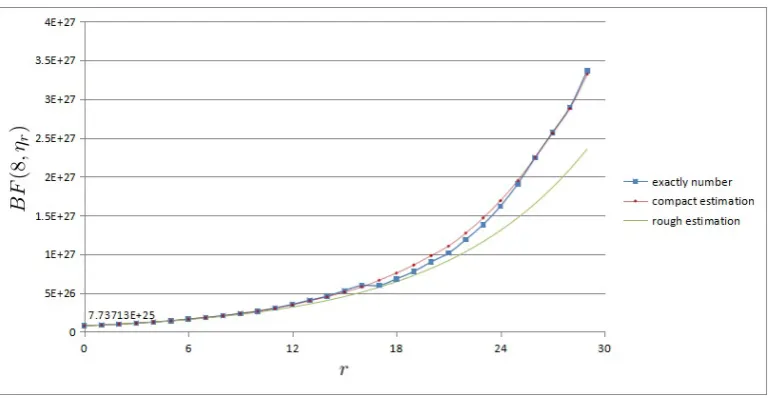
Since the method that we use to estimate the number of η-partly4-Uniform BFIs in this subsection is not a rigorous method, we also do some experiments to show the accuracy of the our method. We calculate the exact number of η-partly 4-Uniform BFIs for some η. By observing the trend of η-partly 4-Uniform BFIs whenwt(η)grows, we check the accuracy of our compact estimation in Proposition 4.9. Experiment results show that our compact estimation of the number of 4-Uniform BFIs is reliable.
Fig. 1: The trend of BF(8, ηr) whenr grows
The figure above is the trend of BF(8, ηr) and the trend of our compact estimation when r grows from 0 to 29. We also draw the curve (98)r22
n+2
3 as a rough estimation according to Proposition 4.7. As can be
seen in figure1, our compact estimation is further better than the rough estimation and the method we use is reliable. Due to Rank(Mξ)−Rank([Mξ, vξ]) + 1 = 0 for any e17 ξ η17, the data of r = 16 and
r = 17 is equal. However, our compact estimation still regards vξ as a random vector and uses the total expected valueE(Rank(Mξ)−Rank([Mξ, vξ]) + 1)instead as an approximation. This leads to a larger error but this error is counteracted with the growth ofr.
Now we list the number of |Lh| when 6 ≤ n ≤22 is an even integer. Then the number of 4-Uniform BFIs in our compact estimation is calculated by BF(n,1)≈(8281)2n−1−2−|L
h|(9
8)
2n−1−2 3 2
2n+2 3 .
TABLE II: The estimation ofBF(n,1)when6≤n≤22 is even
n 6 8 10 12 14 16 18 20 22
|Lh| 18 69 310 1189 4746 19189 76398 305845 1223266
BF(n,1)≈ 15780877 1028.34 10112.7 10450.7 101802 107207 1028831 10115321 10461286
Here we make two comments. First, according to Proposition 4.9, the number of differentially 4-uniform permutations constructed by 4-Uniform BFIs is much bigger than those constructed by PBFs. Second,
BF(n, η) may be estimated more accurately if one consider more details. It is an interesting problem to enhance the precision of the estimation, or to decide the exact number of 4-Uniform BFIs when n≥8.
As an application, we can estimate the number of differentially4-uniform functions constructed in Theorem 3.6. Each of those constructions is corresponding to differentξ with wt(ξ) = 2, which means Eq.(21) have solutions for these ξ. Then the number of differentially4-uniform functions constructed in Theorem 3.6 is at least T(n)×22
n−13
3 , where T(n) is the exact number of f(x) in Table I.
V. CONCLUDINGREMARKS
the design of substitution boxes. For further research, it is interesting to find subclasses of the functions constructed by Theorem 3.4 with other good cryptographic properties such as high nonlinearity. To decide the exact number of this class of functions is also an interesting problem. A more important challenge is the BIG APN Problem.
VI. ACKNOWLEDGEMENT
We are greatly indebted to Claude Carlet, who has instructed and helped us a lot in revising the last part of the paper. We would also like to thank the editor and the anonymous reviewers for their valuable comments and insightful observations, which allowed to significantly improve the presentation of this paper.
REFERENCES
[1] W.Bosma, J.Cannon and C.Playoust, The magma algebra system.I. The user language, J.Symbolic Comput, 24, 235C265, 1997.
[2] C. Bracken and G. Leander. A highly nonlinear differentially 4 uniform power mapping that permutes fields of even degree. Finite Fields and Their Applications, 16(4), 231–242, 2010.
[3] C. Bracken, C.H. Tan and Y. Tan, Binomial differentially4-uniform permutations with high nonlinearity, Finite Fields and Their Applications 18 (3), 537–546, (2012).
[4] C. Carlet, On known and new differentially uniform functions, Lecture Notes in Computer Science, Vol. 6812, ACISP 2011, 1–15, (2011).
[5] P. Charpin and G. M. Kyureghyan, On a class of permutation polynomials overF2n, Lecture Notes in Computer Science, Vol 5203, SETA 2008, 368–376, (2008).
[6] C.Carlet, More constructions of APN and differentially 4-uniform functions by concatenation, Science China, Vol.56 No.7,1373-1384,(2013).
[7] Y. Edel and A. Pott, A new almost perfect nonlinear function which is not quadratic, Advances in Mathematical Communications 3(1), 59–81, (2009).
[8] G. Lachaud and J. Wolfmann, The weights of the orthogonals of the extended quadratic binary Goppa codes, IEEE Trans. on Information Theory, 36(3), 686-692, (1990).
[9] R. Lidl, H. Niederreiter, Finite Fields, Encyclopedia of Mathematics and its Applications 20, (1997).
[10] L.J. Qu, Y. Tan, C. Tan and C. Li, Constructing Differentially4-Uniform Permutations overF22k via the Switching Method, IEEE Transactions on Inform. Theory, 59(7), 4675-4686, (2013).
[11] L.J.Qu, Y.Tan, C.Li and G.Gong, More Constructions of Differentially 4-uniform Permutations onF22k, Des. Codes Cryptogr. DOI 10.1007/s10623-014-0006-x.
[12] Y.Q.Li, M.S.Wang a and Y.Y.Yu, Constructing Differentially 4-uniform Permutations over F22k from the Inverse Function Revisited, https://eprint.iacr.org/2013/731.pdf.
[13] D.Tang, C.Carlet and X.H.Tang, Differentially 4-Uniform Bijections by Permuting the Inverse Function, Des. Codes Cryptogr. DOI 10.1007/s10623-014-9992-y.
[14] Y.Y.Yu, M.S.Wang and Y.Q.Li, Constructing differential 4-uniform permutations from know ones. Chinese Journal of Electronics, 22(3), 495-499, (2013).