City, University of London Institutional Repository
Citation
:
Stumpf, S. (2001). Analysis and representation of rhetorical construction of understanding in design teams' experiential learning. (Unpublished Doctoral thesis, University College London)This is the unspecified version of the paper.
This version of the publication may differ from the final published
version.
Permanent repository link: http://openaccess.city.ac.uk/225/
Link to published version
:
Copyright and reuse:
City Research Online aims to make research
outputs of City, University of London available to a wider audience.
Copyright and Moral Rights remain with the author(s) and/or copyright
holders. URLs from City Research Online may be freely distributed and
linked to.
City Research Online: http://openaccess.city.ac.uk/ [email protected]
Analysis and representation of rhetorical construction
of understanding in design teams’ experiential learning
Simone Stumpf
This thesis is submitted for the degree of Doctor of Philosophy of
University College London
Ph.D. Computer Science
August 2001
Department of Computer Science
Abstract
Every analysis and representation is embedded in a particular paradigm that structures
what is highlighted or neglected. One of the thesis contributions is to identify four main
paradigms in design and compare these to designers’ experience of designing in
practice. Most closely aligned to the experience of designing is individual experiential
learning. The thesis clarifies this paradigm in relation to team designing and contributes
extensions that locate the team design process in the rhetorical construction of
understanding.
An analysis of design team discourse is derived through a method of discourse analysis.
In the thesis, a coding scheme based on the New Rhetoric is developed to study the use
of argumentation in designers’ interaction. Understanding of the micro-level process of
team experiential learning is furthered by a detailed analysis of design team discourse,
illustrated by excerpts drawn from a design exercise transcript. Results show that
designers increase the presence of statements to focus the team’s attention, organise
their understanding through associations based on the structure of reality, keep notions
flexible through association establishing the structure of reality and attempt to reframe
the team’s understanding through dissociations. How these distinct rhetorical means are
used in the unfolding of the design discourse is discussed, especially in attempts at
establishing a team frame. Team frame in this sense means a shared perspective of what
the design problem is and how it is to be solved. Results of submitting the coding
Akin to the influence that paradigms have for the analysis, so in turn they determine
appropriate representations for describing and supporting design team activity. An
examination of models of the designer, design task and design process leads to the
proposal of characteristics and criteria for representations that capture team experiential
learning. Comparisons between discourse analysis studies of how teams establish team
frames and an examination of design discourse and design process representations
motivate the capture of the micro-level and macro-level process in team experiential
learning. The thesis sets out a new representation that emphasises the unfolding nature
of design discourse as a ‘frame rationale’. A variety of representations about learning
experiences make aspects of design team’s experiential learning more visible. These
representations can be used to enhance reflection-in-action or reflection-on-action. The
thesis shows how frame rationales can be used to identify and support instances of team
reframing within design teams and provide another facet in the basis for learning
Table of Contents
Abstract... 2
Table of Contents ... 4
Acknowledgements... 8
Chapter 1 Introduction ... 10
1.1 Introduction ... 10
1.2 Problem Statement... 12
1.3 Research Questions ... 13
1.4 Contributions ... 14
1.5 Thesis Structure ... 15
Chapter 2 Design Paradigms: Perspectives, Assumptions and Prescriptions ... 21
2.1 Introduction ... 21
2.2 Design paradigms... 21
2.2.1 Definition of Design Paradigm ... 22
2.3 Design practice... 25
2.4 The rational problem-solving design paradigm ... 28
2.5 The social process design paradigm ... 30
2.6 The hypothesis testing design paradigm... 33
2.7 The experiential learning design paradigm... 35
2.8 Conclusion ... 38
Chapter 3 Individual and team experiential learning... 41
3.1 Introduction ... 41
3.2 Learning and experiential learning... 42
3.2.1 Learning – the traditional view ... 42
3.2.2 Experiential learning ... 42
3.2.3 Experiential learning in design... 43
3.2.3.1 An individual’s experiential learning in design ... 43
3.2.3.2 A team’s experiential learning in design... 46
3.3 Experiential learning in design: the model of designers ... 48
3.3.1 The designer as a participant in argumentation... 49
3.3.2 Roles of designers in the design team ... 50
3.4 Experiential learning in design: the model of design tasks... 52
3.5 Experiential learning in design: the micro-level design process model ... 55
3.6.1 Explaining individual sense-making ... 57
3.6.2 World-making ... 58
3.6.3 Understanding social behaviour... 59
3.6.4 Organising experience... 60
3.7 Framing in individual experiential learning ... 61
3.8 The difference between frames and framing... 63
3.9 Naming... 64
3.10 Moving... 65
3.11 Reflecting... 66
3.12 Experiential learning in design: the macro-level design process model ... 67
3.12.1 Frame convergence ... 68
3.12.2 Macro-level process failure... 68
3.13 Experiential learning in design: corollaries ... 69
3.13.1 Representations ... 70
3.14 Summary... 71
Chapter 4 Analysis of design discourse ... 74
4.1 Introduction ... 74
4.2 Method for the analysis of design discourse ... 75
4.2.1 Aims and method of discourse analysis and related approaches ... 76
4.3 A coding scheme to analyse team design discourse ... 78
4.3.1 Premises ... 79
4.3.2 Argumentation schemes ... 80
4.3.3 Association based on the structure of reality ... 81
4.3.4 Association establishing the structure of reality ... 82
4.3.5 Dissociation... 84
4.4 The team design discourse example ... 85
4.4.1 Experimental setting... 85
4.4.2 Design session overview ... 86
4.5 Analysis of team design discourse ... 89
4.5.1 Premises and experiential learning in design ... 90
4.5.1.1 Increasing presence – examples ... 92
4.5.2 Associations based on the structure of reality and experiential learning ... 94
4.5.2.1 Organising and evaluating – examples ... 95
4.5.3 Association establishing the structure of reality and experiential learning... 97
4.5.3.1 Flexible notions – examples... 98
4.5.4 Dissociation and experiential learning ... 100
4.5.4.1 Changing the way that reality is perceived – example... 101
4.5.5 The unfolding of design discourse ... 102
4.5.5.1 Reframing acceptance ... 102
4.5.5.2 Unfolding design discourse – example ... 103
4.5.5.3 Rejected reframing ... 105
4.6 Validity in discourse analysis ... 107
4.6.1 Inter-coder reliability ... 108
Chapter 5 Representations of team experiential learning ... 115
5.1 Introduction ... 115
5.2 Definition of representation in design ... 116
5.2.1 Purposes of representations: description of reflection-in-action/ support for reflection-on-action ... 117
5.3 Characteristics of team experiential learning that a representation should capture ... 118
5.3.1 A description of design teams by focussing on individual or team characteristics ... 118
5.3.2 Characteristics concerning the designers ... 119
5.3.2.1 Characteristics of the designer as learner... 119
5.3.2.2 Designers as participants in rhetorical construction of understanding... 120
5.3.3 Characteristics concerning the design task ... 120
5.3.4 Characteristics concerning the design process ... 122
5.3.4.1 Characteristics of the macro-level design process ... 122
5.3.4.2 Characteristics of the micro-level design process ... 123
5.3.5 Summary ... 124
5.4 Requirements for representations of design discourse that are sensitive to team experiential learning ... 126
5.5 Related approaches to representing team design discourse ... 127
5.5.1 Design rationale ... 128
5.5.2 Linkography ... 131
5.6 Conclusion ... 134
Chapter 6 Frame rationale - a representation of rhetorical construction of understanding... 138
6.1 Introduction ... 138
6.2 Basic representational structure of a frame rationale ... 140
6.3 Boundary of attention ... 144
6.4 Organisation of premises and introduction of new and flexible notions... 147
6.5 Strength of agreement... 151
6.6 Attempts at framing ... 156
6.7 Unfolding ... 157
6.8 Conclusion ... 161
Chapter 7 Learning about team learning: Representations and their use for reflection ... 163
7.1 Introduction ... 163
7.2 Experiential learning in design revisited... 165
7.2.1 Measuring Experiential Learning... 166
7.3 Learning situations and experimental set-up ... 167
7.3.1 Design exercise set-up... 168
7.4 Design discourse representations... 172
7.5.1 Example of using critical instances in directed learning situations ... 176
7.6 Complementary representations of team experiential learning – designers, design task and design process... 182
7.6.1 Designers and Learning styles ... 182
7.6.2 Designers and their perceptions of designing ... 184
7.6.2.1 Perception Questionnaire ... 186
7.7 Representations of designers’ learning styles ... 187
7.7.1 Team 1 learning styles ... 187
7.7.2 Team 2 learning styles ... 189
7.7.3 Team 3 learning styles ... 190
7.7.4 Learning styles discussion... 191
7.8 Representation of designers’ perceptions... 192
7.8.1 Team 1 perceptions ... 192
7.8.2 Team 2 perceptions ... 193
7.8.3 Perception discussion ... 194
7.8.4 Correlations over all perceptions ... 195
7.9 Connections between designers and their perceptions... 196
7.10 Conclusion ... 197
Chapter 8 Conclusion... 200
8.1 Thesis summary ... 200
8.2 Review of key claims and contributions ... 208
8.3 Further work... 211
References ... 213
Appendix 1 An argumentation primer ... 223
Appendix 2 Coding Scheme ... 238
Appendix 3 Transcription Convention ... 244
Appendix 4 Frame Rationale ... 245
Appendix 5 Learning styles questionnaire ... 249
Appendix 6 Learning styles archetypes ... 252
Appendix 7 Feedback Questionnaire ... 253
Acknowledgements
This thesis could not have been written without the support of a whole raft of people. I
would like to use this space to pass on my gratitude to all those who have helped me
over the last few years.
There are individuals who, whilst not involved in my particular research area, lent a
hand to critique and hone my work. I would like to express my thanks to Simon
Attfield, Sacha Brostoff, Ismail Ismail, Sophie Phillips, and the UCL Design Group
who have commented on the thoughts that have found their way into this thesis.
Thanks must also go to the participants in experiments I carried out. Alas, to preserve
their anonymity, they must remain nameless; they know who they are.
I would like to give my acknowledgements to Rianne Valkenburg who graciously
provided me with transcripts, videos and time to talk about Schön’s work. Furthermore,
I would like to thank Prof. John Worthington for inviting me to the LEAF workshop
and for discussing designers’ dependence on language in early stages of designing. I
am also grateful to Alistair Blyth for his time and open ear. My thanks also need to go
to Petra Badke-Schaub and Gabriella Goldschmidt, who supplied material that
stimulated my thinking.
A big ‘thank you’ goes to John Dowell, Anthony Finkelstein and Angela Sasse for their
Janet McDonnell, my supervisor, was always on hand to advise on the content and
structure of my work. Without her I would not have got as far as writing this thesis: she
knew when to cheer me up, distract me from getting bored, push me to complete work
and nail me down on deadlines. She deserves a medal but, unfortunately, she will have
to make do with my deepest gratitude.
When I needed practical help, she was there. When I was frustrated, she was there.
When something made me happy, she was there. My final acknowledgement has to go
Chapter 1
Introduction
1.1
Introduction
Research into designing, linked with the rise of design methodology – the study of
“principles, practices and procedures of design” (Cross, 1984) – has gained impetus
over the last forty years. Designing is investigated not only to provide better support for
designers, but also to gain a better understanding of what designing actually is.
Traditionally, design has been understood nearly as a synonym with construction. The
emphasis in this version of designing is on the creation of material artefacts, such as
buildings and products. Consequently, most research into designing has been driven by
fields such as architecture and mechanical engineering. A shift however can be noticed
to apply the term ‘design’ to fields where abstract artefacts are created, such as
computer software and systems engineering, town planning, management and policy
planning. The underlying rationale for extending research into designing to these areas
is the belief that, elementally, design activities do not differ from field to field, only
domain knowledge does. Therefore, one of the aims of design research is to shed light
on these elemental ways of designing.
Design research is, however, not an objective enterprise; it is grounded in certain
assumptions that curtail the description and idealise what is going on. It has been
pointed out that assuming design works similarly to science emphasises technical
rationality (Schön, 1991). This entails the separation of setting from
problem-solving, applied knowledge from theoretical knowledge and professional learning from
the role of the designer as a ‘reflective practitioner’ (ibid.) whose design activities
comprise the integrative qualities of problem-setting and problem-solving. In the
description of the designer as a reflective practitioner, emphasis is placed on the role of
experiential learning in design. This thesis concerns itself, firstly, with identifying
differing views of what designers are and do and how they influence what count as
elemental design activities. Secondly, a particular view of designing – experiential
learning – that experienced designers feel is intuitively right (Dorst, 1997) is examined
as to its assumptions about designers, the design task and design processes. Analyses of
experiential learning are illustrated using examples drawn from a traditional design field
and a design field that deals with products that are more abstract: product design and
software systems design.
Moreover, the rise of the industrial age has pushed design into a fast-paced world.
Design projects have grown larger; specialisation of domain knowledge of designers has
increased. Consequently, designing is less often seen as an individual enterprise and
moved to be shared within a team. Speed, quality and efficiency in design are not solely
due to what the designers know, but depend crucially on how teams work. A
reorientation to a certain degree has taken place: communication skills of designers have
to be added to their technical skills. Communication has been seen as crucial in the
work of design teams; individual designers bring many perspectives to the problem.
Whilst research into teamwork has either stressed the social aspect of design team
processes (Minneman and Leifer, 1993; Bucciarelli, 1994; Brereton et al., 1996; Cross
and Clayburn Cross, 1996;) or the resolution of conflicts of viewpoints (Olson et al.,
1992; Finkelstein and Sommerville, 1996; Brooks and Jones, 1996), research into how
received little attention. In this thesis, it will be examined how designers use verbal
communication when they are designing in a team. Team designing will be investigated
using a background of argumentation theory to illuminate how team experiential
learning is carried out.
Lastly, design research builds knowledge of what designing is and this also forms the
basis to suggesting ways for supporting designing. Whilst the view of design as a
science tends to offer support through formal methods and prescriptive life cycle
models, support for experiential learning has only received scant focus. In this thesis,
representations that can be used to support team experiential learning are proposed and
examined.
1.2
Problem Statement
Design research is influenced by assumptions and perspectives; viewing designing as
experiential learning has only recently gained attention. Problems remain: it is still
unanswered how experiential learning is effected in design teams and how experiential
learning in teams can be supported. The problem statement that results from the
problem area can be stated as:
How can design teams’ use of verbal interaction be analysed as a means to describe
team experiential learning, resulting in descriptive representations that can be used
to support design teams’ experiential learning?
The main points of this problem statement – indicated in italics – can be summarised as
follows. This thesis examines designing viewed from the background of a particular
perspective – experiential learning. The thesis will clarify this perspective with respect
to analyse team design discourse as a record of verbal interaction using a background of
argumentation theory in order to highlight the rhetorical construction of understanding.
Characteristics of descriptive representations, viewed from a team experiential learning
perspective, are outlined. Results from the analysis of team design discourse will be
presented which are used to develop a descriptive representation of rhetorical
construction of understanding as part of team experiential learning. Descriptive
representations for supporting design teams’ experiential learning will be developed
and evaluated.
1.3
Research Questions
Each individual area that this thesis addresses in answer to the problem statement in
itself can be formulated as a research question. The area of the examination of designing
viewed from a particular perspective of experiential learning provides the answer to
research question 1:
How is the description of designing influenced by perspectives, assumptions and
prescriptions?
The clarification of this perspective with respect to teams to serve descriptions of design
teams’ experiential learning is answered by research question 2:
How can notions about individual experiential learning be extended to capture team
experiential learning?
In order to show how to analyse team design discourse as a record of verbal interaction
construction of understanding and the idea of establishing a team-frame (defined in
chapter 3). Research question 3 can be formulated as:
How do designers establish a team-frame in early design episodes through rhetorical
construction of understanding?
The area of characteristics of descriptive representations, viewed from a team
experiential learning perspective, is illuminated through research question 4:
What characteristics need to be captured in representations of team experiential
learning?
In combination with research question 4, results from the analysis of team design
discourse will be presented which are used to develop a descriptive representation of
rhetorical construction of understanding as part of team experiential learning in answer
to research question 5:
How can a representation of the team experiential learning process be constructed?
Finally, the use of descriptive representations in supporting team experiential learning
will be examined through research question 6:
How can descriptive experiential learning representations be used by design teams?
1.4
Contributions
This thesis contributes to the study of design and the representations of team
1. Identification and comparison of design paradigms (in chapter 2)
2. Clarification of experiential learning design paradigm (in chapter 3)
3. Identification of elements of argumentation that correspond to experiential
learning (in chapter 4)
4. Development and application of a coding scheme to investigate design discourse
(in chapter 4)
5. Identification of characteristics for representation of team experiential learning
(in chapter 5)
6. Development of frame rationale as a way of representing team experiential
design process (in chapter 6)
7. Demonstration of team experiential learning representations in learning
situations (in chapter 7)
1.5
Thesis Structure
The thesis aims to answer the research questions outlined over the next seven chapters.
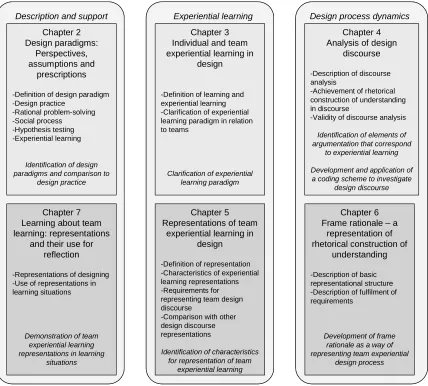
Chapters 2 and 7 deal with description and support: chapter 2 describes the way that
design paradigms influence descriptions of designing; chapter 7 describes the use of
descriptive representations in design teams as support within the experiential learning
design paradigm. Chapters 3 and 5 focus on the team experiential learning paradigm in
particular: in the former, experiential learning with respect to teams is clarified, whereas
in the latter characteristics that descriptive representations need to display are identified.
Chapters 4 and 6 emphasise dynamics of the team experiential learning design process,
investigating team design discourse and descriptive representation, respectively. The
Description and support Chapter 2 Design paradigms: Perspectives, assumptions and prescriptions
-Definition of design paradigm -Design practice
-Rational problem-solving -Social process -Hypothesis testing -Experiential learning
Identification of design paradigms and comparison to
design practice
Chapter 3 Individual and team experiential learning in
design
-Definition of learning and experiential learning -Clarification of experiential learning paradigm in relation to teams
Clarification of experiential learning paradigm
Chapter 4 Analysis of design
discourse
-Description of discourse analysis
-Achievement of rhetorical construction of understanding in discourse
-Validity of discourse analysis Identification of elements of argumentation that correspond
to experiential learning Development and application of
a coding scheme to investigate design discourse
Chapter 6 Frame rationale – a
representation of rhetorical construction of
understanding
-Description of basic representational structure -Description of fulfilment of requirements
Development of frame rationale as a way of representing team experiential
design process
Chapter 7 Learning about team learning: representations
and their use for reflection
-Representations of designing -Use of representations in learning situations
Demonstration of team experiential learning representations in learning
situations
Chapter 5 Representations of team
experiential learning in design
-Definition of representation -Characteristics of experiential learning representations -Requirements for representing team design discourse
-Comparison with other design discourse representations
Identification of characteristics for representation of team
experiential learning
Design process dynamics Experiential learning
Description and support
Chapter 2 Design paradigms:
Perspectives, assumptions and
prescriptions
-Definition of design paradigm -Design practice
-Rational problem-solving -Social process -Hypothesis testing -Experiential learning
Identification of design paradigms and comparison to
design practice
Chapter 3 Individual and team experiential learning in
design
-Definition of learning and experiential learning -Clarification of experiential learning paradigm in relation to teams
Clarification of experiential learning paradigm
Chapter 4 Analysis of design
discourse
-Description of discourse analysis
-Achievement of rhetorical construction of understanding in discourse
-Validity of discourse analysis Identification of elements of argumentation that correspond
to experiential learning Development and application of
a coding scheme to investigate design discourse
Chapter 6 Frame rationale – a
representation of rhetorical construction of
understanding
-Description of basic representational structure -Description of fulfilment of requirements
Development of frame rationale as a way of representing team experiential
design process
Chapter 7 Learning about team learning: representations
and their use for reflection
-Representations of designing -Use of representations in learning situations
Demonstration of team experiential learning representations in learning
situations
Chapter 5 Representations of team
experiential learning in design
-Definition of representation -Characteristics of experiential learning representations -Requirements for representing team design discourse
-Comparison with other design discourse representations
Identification of characteristics for representation of team
experiential learning
[image:17.595.117.545.55.441.2]Design process dynamics Experiential learning
Figure 1.1 – Thesis structure outline
In chapter 2, perspectives, assumptions and prescriptions are examined that underlie
how designing is viewed. A definition of design paradigms is provided in section 2.2.
Dimensions of designing are described viewed from within a particular design
paradigm; models of the designer, design task and design process are identified that
capture these dimensions of designing. A model describes designing, yet it also
idealises; corollaries – such as the attitude to learning and notions underlying
techniques, methods and representations – are determined by design paradigm models.
In the remainder of chapter 2, these models are used to structure the identification of
design paradigms and their comparison with design practice. In section 2.3, design
to 2.7 each identify and structure design paradigms that underlie descriptions of
designing. These design paradigms are clarified as rational problem-solving, social
process, hypothesis testing and experiential learning. It is noted that, whilst experiential
learning comes closest to what designers think is going on, the notion of experiential
learning in teams needs to be clarified.
Chapter 3 clarifies experiential learning in relation to design teams. To do this, in
section 3.2 the traditional understanding of learning is examined and contrasted with the
notion of experiential learning and particularly with experiential learning in design. In
the remainder of the chapter, the descriptive models are considered in turn. Section 3.3
takes into consideration the model of the designer viewed in the light of team
experiential learning. In particular, the designer as a participant in argumentation and
the role of designer in design teams is investigated. The notion of rhetorical construction
of understanding is introduced. The model of design task is investigated in section 3.4.
The notion of team-frame as a shared perspective of the design task is discussed and
defined. Following on from this, section 3.5 discusses the model of the micro-level
design process. In particular, the construction cycle of framing, naming, moving and
reflecting is introduced. These individual modes of the construction cycle are further
investigated. Conceptions of frames and framing are outlined in section 3.6.
Conceptions of frames and framing as explaining individual sense-making,
world-making, understanding social behaviour and organising experience are identified. A
discussion how framing is understood in individual experiential learning is given in
section 3.7. A distinction between frames and framing is introduced in section 3.8.
Naming, moving and reflecting are discussed in sections 3.9 to 3.11, respectively. The
macro-level design process is examined in section 3.12, paying particular attention to
that result out of descriptive models of team experiential learning and their impact on
representations.
The way that a team-frame is achieved through and in discourse is the focus of chapter
4. To this end, discourse analysis as a method is introduced in section 4.2. The
development of a coding scheme to be used in team design discourse analysis is
described in section 4.3. The application of the coding scheme is then illustrated
through an example, described in section 4.4. Elements of argumentation that
correspond to experiential learning are identified and results and illustrations of the
analysis of team design discourse are given in section 4.5. It is shown that designers
bring premises into presence and highlight them from the background frame of
reference. Premises allow focus of attention to be detected, and what names are applied
to things in the situation. Associations based on the structure (ABS) of reality introduce
organisation and evaluation into the design discourse. Associations establishing the
structure of reality (AES) on the other hand enable designers to establish new premises
by either generalisation or similarity by making use of the plasticity of notions to drive
the solution development forward. These notions function as keywords that encapsulate
understandings and positions in the design discourse. Dissociations can be used as
markers for potential reframing. Opportunities to affect the team frame arise when
dissociations are introduced by an individual, however further agreement by other team
participants is needed for reframing to actually occur. This agreement can be given
explicitly or implicitly. In the latter instance, dissociations and ensuing associations are
used as rhetorical identifiers for implicit agreement for reframing. Attempts at reframing
can be rejected at the team level, either explicitly or implicitly. Implicit disagreement
question of validity of this analysis is addressed and evidence of inter-coder reliability
provided.
Chapter 5 highlights how aspects of team experiential learning suggest certain
representations that describe designing. Representations also form part of the reflective
turn in design research (Glock, 2000), which makes them into tools for support of
design practitioners. In section 5.2, representations in design are defined. Section 5.3
concentrates focus onto team experiential learning in particular; characteristics
appropriate to dimensions of designing that descriptive representations should capture
are proposed. In section 5.4, the results of discourse analysis, together with the
characteristics of the design process outlined in the previous section, are used as the
basis to formulate requirements that design discourse representations of team
experiential learning need to satisfy. In section 5.5 two current ways of representing
team design discourse are examined with respect to these requirements. Whilst design
rationale and linkography representations can capture certain aspects, they do not fulfil
all requirements that are proposed in section 5.4.
Chapter 6 proposes a new representation for team design discourse, called frame
rationale. In section 6.2, an example transcript is reproduced that is used throughout this
chapter to illustrate the frame rationale representation. The basic representational
structure of a frame rationale as a formal abstraction of design discourse is described in
section 6.3. Sections 6.4 to 6.7 then deal with each requirement identified in chapter 5.
Section 6.8 shows how frame rationale captures the unfolding of design discourse and
Chapter 7 attends to the use of descriptive representation and their use for reflection in
design teams. In section 7.2, experiential learning in design is revisited and measures for
experiential learning are proposed. A set of learning situations is described in section
7.3, for which the use of descriptive representations is illustrated. The use of frame
rationale for reflection is discussed in section 7.4: whilst the use of frame rationale by
designers themselves does not provide any conclusive learning, frame rationale allows a
researcher to analyse design discourse and develop ‘critical instances’ that can be used
by designers to reflect on their design discourse. In sections 7.6 to 7.9, descriptions of
characteristics following from the model of designers and design task, discussed in
chapter 5, are turned into representations that design teams can use to support their
reflection. Results from the analysis of these representations are presented.
Chapter 8 concludes this thesis with a chapter summary and a review of key claims and
Chapter 2
Design Paradigms: Perspectives,
Assumptions and Prescriptions
2.1
Introduction
The description of and the support given to designing, as a whole usually referred to as
design methodology, does not take place in a theoretical vacuum. Design methodology
can be described as “the study of principles, practices and procedures of design” (Cross,
1984). However, this study is dependent on researchers’ views of designing in the first
place. This chapter sets the scene by, firstly, discussing the notion of design paradigms
in section 2.2, which includes perspectives, assumptions and prescriptions that underlie
studies that researchers carry out and the methods and techniques proposed to support
design activity. Secondly, this chapter outlines concerns of design practice in section
2.3. Perspectives, assumptions and prescriptions are structured into design paradigms in
the remaining sections of this chapter, based on a literature review.
2.2
Design paradigms
The analysis of design episodes forms an important part in informing the way design is
seen, either as a precursor to fuller theoretical pictures of designing or to suggest better
practical ways of doing design. However, each analysis is embedded within a design
paradigm, which determines, amongst other things, how the analysis is carried out, what
features are attended to or disregarded and what outcomes are expected. A design
paradigm, just like a metaphor, raises certain features and suppresses others, places
emphasis on different aspects of designing, and can hence better explain certain aspects
Snodgrass, 1995). Dorst (1997), for instance, has provided an example of how the
different paradigms of rational problem-solving and reflective practice influence the
way that design is viewed and hence, what an analysis of a design episode highlights.
Whilst there is an ebb and flow of particular design paradigms in terms of their take-up
both within the design community and the design research community, nonetheless
more than one co-exist at one time. Moreover, since design paradigms focus attention
on certain aspects whilst neglecting others, researchers may employ a complementary
amalgamation of design paradigms to study designing. The question of which is the
better design paradigm to describe, explain and support designing still remains. An
overriding criterion of validity that has been put forward is that a design paradigm must
measure up to how designers encounter designing in everyday instances, i.e. a
comparison between the design paradigm and human experience of designing
(Snodgrass and Coyne, 1992; Coyne and Snodgrass, 1995).
2.2.1 Definition of Design Paradigm
A design paradigm in the context of this thesis is a coherent collection of archetypal
models through which aspects of designing are interpreted1. Models in this sense mean
idealised and simplified viewpoints of particular dimensions of designing. These models
can be divided into descriptive models and prescriptive models, i.e. models that aim to
represent what designing is and models that should be imitated, respectively.
All design paradigms have something to say about describing certain dimensions of
designing. These dimensions can be broken down into the model of the designer, the
design task and the dynamics of the design process (Dorst, 1997). The model of the
designer outlines how important features of designers – what they do and how they
1
behave – are viewed through a design paradigm. A view of the intricacies of how the
design task is understood by the designer is given by the model of the design task. The
model of design process dynamics describes the activities that a designer carries out
during designing and this can be further subdivided into micro-level processes and
macro-level processes. In this respect, a macro-level process dynamic takes place over
the whole course of the design, whilst a micro-level process forms the smallest unit of
design activities that the model recognises.
Whilst these models above certainly aim to describe dimensions of designing, they are
also idealised. In themselves, they set standards that dimensions of designing should
attain. Consequently, there are prescriptive models of designing that cater to the features
that the design paradigm highlights and that embody a set of teleological notions
appropriate to each design paradigm. These notions form the basis of corollary
dimensions of designing, i.e. dimensions that follow from the idealised view that is
taken towards designing. These corollaries include a body of methods and techniques
that aim to either attain a standard or to ensure that designing does not deviate from a
norm. Methods are a set of overarching formal procedures that should be followed in
macro-level design activity, whereas techniques form smaller informal actions that aim
to achieve a particular purpose in micro-level designing. Furthermore, teleological
notions also underlie representations that tie in with the respective models. Since
prescriptive models deal with the attainment of a standard of designing – the
performance of a skill – attitudes to learning can be identified for each design paradigm,
which circumscribes what is to be learned by a designer and how learning is thought to
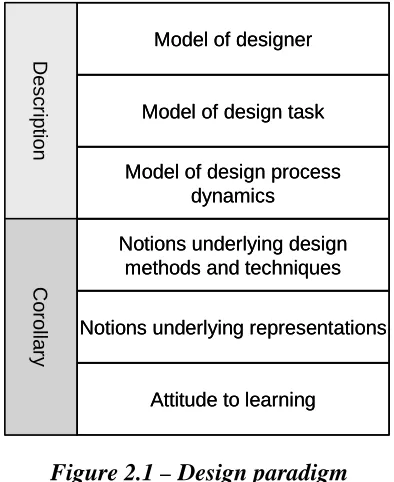
In short, models of designer, design task
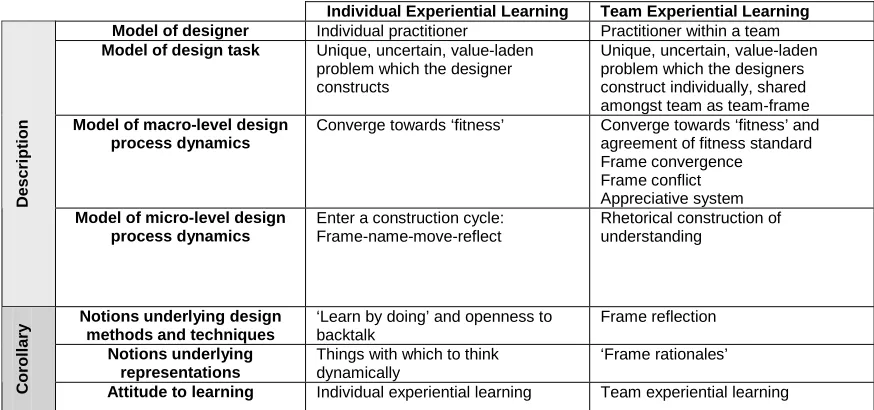
and design process dynamics are the basis
for methods and techniques,
representations and learning. The
descriptive elements seen through design
paradigms, at the same time, are idealised
and thus normative. These norms form the
basis of corollary dimensions to correct
when things are going wrong or safeguard
against things going wrong. Learning in
particular is associated with a longer-term
view of how designers can be trained or train themselves to do designing ‘right’ or
better. These models and corollaries are shown in Figure 2.1.
With the discussion of the role that design paradigms play in influencing how designing
is described and prescribed in mind, attention can be turned to identifying current design
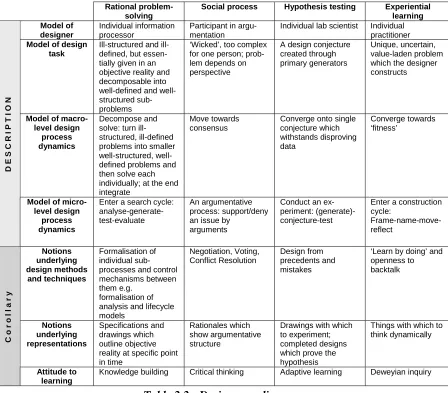
paradigms. Based on a literature review, four main design paradigms can be pinpointed
and structured: rational problem-solving, social process, hypothesis testing and
experiential learning. These are discussed in turn in sections 2.4 to 2.7 and contrasted
with how design is perceived in practice. For the purposes of this thesis, it is of
particular interest to note the relevance of the model of the designer for a team setting.
In this respect, multi-functional (such as project teams quite often are), designer-client
and peer design teams are treated equally, as expressions of a generic team setting, in
which two or more people need to provide input to lead to a designed end-product. First,
however, a view of design practice that outlines the concerns felt by design practitioners
[image:25.595.337.534.59.300.2]is provided in section 2.3.
Figure 2.1 – Design paradigm models as descriptions and
prescription
Model of designer Model of design task Model of design process
dynamics
Notions underlying design methods and techniques Notions underlying representations
Attitude to learning
Des c ripti o n C o ro lla ry
Model of designer Model of design task Model of design process
dynamics
Notions underlying design methods and techniques Notions underlying representations
Attitude to learning
2.3
Design practice
Design paradigms illuminate to a greater or lesser extent the description and
prescription of designing. To begin with, an outline of the experience and practice of
designers themselves is presented, which will be contrasted in subsequent sections
against design paradigms.
In this exploration, the structure of models of designer, design task and design process,
etc. is used to highlight issues in design practice. The basis of the view presented here is
mainly drawn from personal experience of what designers say they find important and
complemented with writings by design practitioners.
One view – reflected in design education – expresses the understanding of designers as
‘designer-heros’, working in isolation to solve problems they are employed to address.
However, in practice this view of the designer does not seem to hold (Cuff, 1991). Team
work becomes the main focus of practice, where different parties communicate with
each other. Indeed, this involvement as a participant in communication seems to present
some of the initial problems, particularly in architectural or construction design:
“When the architects and clients got together, it was hard to follow the thread of their conversation; they left meetings with no more decisions made than at the outset.” (Cuff, 1991, p.4)
From a subjective point of view, this state of affairs is not necessarily confined to
contacts between design practitioners and clients within a participative context. This
practice of being involved in communication is also played out in a team of design
practitioners. Problems that are perceived to have their roots in communication have
Turning our attention to the specifics of the design task in practice, we can observe that
the task is perceived to be ‘wicked’ and too complex for one person (Rittel and Webber,
1984). To address this complexity requires team work. Cuff (1991) notes that design
problems in practice include ‘countless voices’ of influence, the perspectives of which
are distributed across participants. The dynamics and complexity of design problems in
practice lead to a continuous sense of discovery and uncertainty. Only gradually is the
design task constrained, so that individuals in a team can bring their expertise to bear on
working out their allocated subtasks. Again, communication features highly in this and
practices are proposed that ensure that the communication is rich enough for the
co-ordination of effort to function correctly (Wheelwright and Clark, 1992). Indeed, the
design task does not appear to be given from the outset. Often, it is the case that the
design task is fashioned through communication and thus crystallises out of team
interaction, co-ordinating values and perspectives. Only when the design task has been
fleshed out by the team can individual design occur. But even then, individual
interpretations can affect and unbalance earlier established team constraints and need to
be integrated (Bucciarelli, 1994), leading to a changing appreciation of the design task.
This description gives an indication of how the macro-level process is viewed in
practice. There appear to be two distinct phases to any team design activity: a complex,
language-rich phase in which the project is defined and clarified, and effort co-ordinated
across the team; a slightly simpler, object-heavy phase in which the individual expertise
is applied to the interpreted design task. In the micro-level process, the language-rich
phase plays itself out by individuals putting forward their case, which then needs to be
The methods and techniques that are offered in practice often are imposed by the
professional organisations, rather than individual designer themselves, and centre
around managing the macro-level process. For this, simple ‘waterfall’ guidelines are
used which control the flow through a design project. Following these waterfall
guidelines entails the production of outputs in the form of specifications and documents,
which detail the current knowledge about the problem. This is usually seen as beneficial
once the object-heavy phase has been reached, but causes concern in earlier,
language-rich, phases of design because the guidelines are perceived to be at odds with what
actually takes place in practice.
Learning in practice is perceived to be two-fold: a designer should learn from one
design project to the next, building on his or her experiences. However, individual
designers also tell a further story: each design task is perceived as essentially unique and
requires its own adapted design process, hence there is individual learning during an
individual project as well. Moreover, there appears to be another kind of learning at a
team-level. This learning concerns the learning about each other as individual designers
with unique perspectives and the understanding that is created out of interaction2.
Having discussed concerns of design practice, attention is now turned to the
identification of design paradigms. The paradigms were categorised as rational
problem-solving, social process, hypothesis testing and experiential learning. These are
now discussed and contrasted with design practice in turn, paying particular attention to
the relevance of the model of the designer for a team setting.
2I would like to express my gratitude to Professor John Worthington, University of Sheffield and Deputy
2.4
The rational problem-solving design paradigm
The rational problem-solving paradigm (Simon, 1969) is the most widely held design
paradigm amongst design researchers, reflecting the rise of an information-processing
approach to thinking in general, and designing in particular. In terms of the model of the
designer, a rational computation machine serves as a metaphor for the designer who
algorithmically processes problems to churn out solutions. In this process, she is only
restricted by memory and time, which forces her to ‘satisfice’ i.e. choose solutions
which are good enough, rather than optimum. The model of the design task states that
the problem is there to be seen; it can be objectively perceived by everyone who looks
at it. In this respect, a difficulty that can be perceived through the design paradigm is the
complexity of design problems: they are ill-structured and ill-defined (Simon, 1984).
However, by formalising the problem it is possible to find ways of decomposing it into
well-structured and well-defined sub-problems:
“The whole design, then, begins to acquire structure by being decomposed into various problems of component design, and by evoking, as the design progresses, all kinds of requirements to be applied in testing the design of its components. During any given short period of time the architect will find himself working on a problem which, perhaps beginning in an ill-structured state, soon converts itself through evocation from memory into a well-structured problem.” (ibid., p.155)
These sub-problems are then amenable to an algorithmic approach of applying
‘operators’ in order to result in a solution, much like a calculation. Once all
sub-solutions to all sub-problems have been found, it is necessary to integrate them to
provide the overall solution to the original problem. The micro-level process dynamics
follow that of a search or optimisation cycle: first analyse the problem to find a set of
requirements that have to be fulfilled and can be used as a function against which to test
against the evaluation function. Evaluate the outcome of this test; if the solution
succeeds, then stop – if not, enter the search cycle again.
In the normative stance implied through the design paradigm, designing can go wrong
in the analysis phase when the problem is under-specified by considerations being
forgotten or not noticed, and in the synthesis phase when the integration of
sub-problems disturbs their interrelations. Decomposition and integration as a macro-level
process is expressed through methods, which aim to regulate these into stages, such as
the ‘waterfall’ process. As a basis of these stages, it is necessary that the analysis of the
problem is adequate, and thus a formalisation of sub-processes is required to ensure that
a well-structured and well-defined problem is available as input to a problem-solving
process. Techniques incorporating the exhaustive listing of constraints and grouping
them carefully to uncover a structure of more or less ‘self-contained’ components are
aimed at supporting analysis (Alexander, 1964). Furthermore, using rational evaluation
techniques, such as an application of Multi-Attribute Utility Theory (MAUT), is seen to
ensure that the matching of problem specification and solution generation is adequate
(Blandford, 1993; Pugh, 1991). As part of these methods and techniques, certain
representations are expected in the form of specifications and drawings, which form a
set of constraints and describe the problem in unambiguous terms.
The attitude to learning expressed through this design paradigm is related to the view of
how design problems are constituted. Since problems are there to be objectively
perceived, the designer learns by accumulating knowledge about design problems: new
constraints, new goals, new operators, ways of decomposing problems, etc. Once these
have been stored in long-term memory, the designer can refine the way this knowledge
This design paradigm’s main attraction to the design community is that designing,
ultimately, can be reduced to an algorithm (or heuristics) to be carried out by the
designer – it is clean, rational and proceeds in logical and sequential steps. However,
this contradicts what most designers feel when they are designing: designing is messy.
Also, crucially, the paradigm only makes claims about the individual designer operating
in an objective reality, since a team – again within this metaphor – is only a change in
capacity: more memory, hence quicker operations. However, this does not relate to how,
again, designing is perceived in practice: designers have different viewpoints; they
disagree. Some design researchers felt that the rational problem-solving paradigm was
not highlighting these particular problems and a new design paradigm had to be
fashioned that moved beyond this ‘first-generation’ approach (Rittel, 1984) and
highlighted the communicative interactivity that can be observed in design.
2.5
The social process design paradigm
The ‘second-generation’ design paradigm of social process seeks to overcome the
shortcomings of rational problem-solving (Rittel, 1984). Designing is viewed as
involving the negotiation and interpretation of designers’ social constructions
(Bucciarelli, 1994), which are dependent on their values and perspectives. Rather than a
self-reliant designer, this means that a designer is intricately involved with other
designers in a team situation: the individual designer does not know best, since the
problem is too complex for one person. Therefore, the designer is just one participant in
a process of argumentation, contributing her viewpoint and expertise, to solve ‘wicked’
problems (Rittel and Webber, 1984).
Wicked problems, in contrast to ill-structured and ill-defined problems, are
tell when the design is finished, no true or false answers, a lack of a closed set of
solutions or operations, and the absence of classifications of similar problems.
From this stance, designers use argumentation and persuasion to move towards
consensus about perspectives taken towards the problem (Minneman and Leifer, 1993),
uncover differences in perspectives and develop their understanding of the design
problem and solution as a macro-level process. Shaping the problem-setting continues
side by side with problem-solving, as the way a problem is viewed impinges on the way
it can be solved. To achieve consensus at the macro-level, individual designers need to
perform an argumentative process (Rittel, 1984) on the micro-level by adopting a
dialectical approach (Toulmin, 1958) of proposing issues that define the problem and
positions that solve these issues. In turn, these alternative positions are supported or
denied by arguments (Olson et al., 1992).
Design methods and techniques as part of a social process paradigm centre on ensuring
that the argumentative process moves ahead correctly. To this effect, techniques are
proposed that make certain that the issues, positions and arguments considered cover an
adequate spectrum by performing a Design Space Analysis (McKerlie and MacLean,
1994; MacLean et al., 1993; MacLean et al., 1996). The aim is that, by moving through
questions that structure and delineate possible features of a design artefact, options that
solve them and criteria that evaluate the ‘grade’ of these options, further questions,
options and criteria become apparent. Furthermore, although argumentation is generally
seen as a good thing, conflict resolution and voting ensures that commitment to options
takes place eventually, rather than being deferred indefinitely. Hence, voting procedures
to manage conflict have been the focus of some of these techniques (Lee and Lai, 1992;
within a team have also gained attention (Stahl, 1993; Stahl, 1998; Stahl, 2000). The
outputs from these techniques are usually in the form of a rationale, which shows the
argumentative structures. Various systems, both paper-based and computer-supported,
have been developed to capture and structure these argumentation-based rationales
(Kunz and Rittel, 1970; Conklin and Begeman, 1988; Potts and Bruns, 1988; Lee, 1990;
MacLean et al., 1996; Conklin and Burgess-Yakemovic, 1996). These vary in terms of
notation used, detail captured and support given for decision-making procedures. All,
however, conform to the notion of interrelated networks of issues, positions and
alternatives.
Learning as perceived through the social process paradigm is based on an understanding
of designing as an argumentative process. Hence, the way that a particular designer
learns is by critically challenging his or her own perspectives and knowledge, and that
of other participants involved in designing, to find good reasons why something is to be
believed. Furthermore, there is a correct process of argument construction that the
designer needs to learn, which follows the structure of a good dialectical argument
(Freeman, 1991). Of crucial importance in this respect is the use of Critical Thinking as
a way of epistemology and rationality (Rescher, 1977; Toulmin et al., 1984; Walton,
1989; Voss and Means, 1991; Voss, 1991; Slade, 1995; Perkins et al., 1983; Perkins et
al., 1991).
Invoking a social process paradigm towards designing concentrates, firstly, on the
communicational aspects between team participants. This means that language,
specifically the verbal utterances between designers, forms the aspects that are attended
to and highlighted when designing is analysed within this paradigm. Secondly, because
considerations of all the aspects – moving towards a consensus, the individual role of
designers in the process is devalued.
2.6
The hypothesis testing design paradigm
The hypothesis testing design paradigm is mainly associated with Hillier et al. (1984)
and Broadbent (1984), who propose this perspective as an alternative to overcome
perceived shortcomings in both the rational problem-solving and social process design
paradigms. The shortcoming with respect to rational problem-solving that hypothesis
testing seeks to overcome is the perceived mismatch of how designers proceed by
proposing a solution and then testing against it (Lawson, 1997) rather than by an
analysis/synthesis process dynamic. Hence, the most striking differences that can be
observed are in the realm of how the design process dynamics are viewed. Furthermore,
the social process paradigm is criticised by the hypothesis testing paradigm for being
too relativistic: the technical expertise of the designer is felt to be devalued against the
need for consensus.
As a result, the design paradigm sets out that the designer is an insular expert who
knows best how to accomplish the designs technically and it behoves her to make sure
that she is acquainted with the concerns of others. Akin to a lab scientist, she first of all
constructs first-cut designs, called design conjectures, which solve these concerns:
“He will start with hunches, guesses, conjectures about these phenomena and will tend to collect data which support his conjectures.” (Broadbent, 1984, p.343)
If the design task is very much constrained, one particular conjecture will dominate;
however, in other situations numerous conjectures can compete against each other. A
designer has the duty to test her design conjectures rigorously, especially to find
data against which to evaluate the design conjecture. Hence, designing is treated like an
experiment, which can succeed or fail. If such an experiment fails, the design conjecture
has to be revised or abandoned, resulting a single design conjecture that is put forward
as the solution. To summarise, the process that the designer is deemed to adhere to is of
a ‘conjecture/test’ dynamic (Darke, 1984). This process is elaborated by separating out
the pre-structuring of the design problem itself, which leads to the application of
conjectures through the use of primary generators (ibid.). A primary generator is seen to
be a (often visual) concept – or even group of concepts – that allows the designer to
structure and constrain the problem. It should be noted that a primary generator is not a
list of external requirements; rather, it is “a designer-imposed constraint, not necessarily
explicit” (ibid., p.181). These primary generators then give rise to the conjectures to be
tested. However, evidence is also provided that conjectures are resistant to abandonment
unless the gap between requirements and what the conjecture delivers is too great.
The proposed methods and techniques associated with this particular paradigm are
allied to the process that it proposes: a collection of precedents that have been proven to
be solutions in the past should be used as design conjectures and tested against the
current requirements. Obviously, the more data is available to test against, the better the
design will be and the more mistakes will be avoided. Furthermore, if mismatches
become evident during the design stage, the conjecture needs to be revised and undergo
the testing procedure yet again, or rejected out of hand. It therefore behoves the designer
to behave objectively and, to a certain degree, be emotionally removed from his design
conjectures. If mistakes are evident after the design has been delivered, then these
instances need to be excluded as precedents and examined as to what went wrong (Levi
and Salvadori, 1992). Representations that are used with these methods and techniques
finished designs, which become established as precedents. Learning then proceeds via
accumulation of precedents and what can be termed adaptive learning. If something
works as a solution, it is added to the store of knowledge; if mistakes are made, then it
needs to be adapted or rejected.
The strength of this design paradigm lies in its recognition of a solution-focussed
approach in designing which relies heavily on precedents. However, it appears that
architecture as a design field trains people to adopt a solution-focussed approach,
whereas other design fields appear to favour a problem-based approach (Lawson, 1997).
Moreover, the paradigm can be criticised for its conception of a self-reliant designer.
The paradigm does not address what happens in a team setting, although we could
speculate that cultural and professional training would ensure that precedents are shared
within the team. The questions of the intricate process of sharing and developing
conjectures within a team, and of how team learning proceeds remain unanswered.
2.7
The experiential learning design paradigm
The experiential learning paradigm of designing has gained popularity in recent years
because it accounts for the dynamic, cyclic and unfolding nature of design, which
experienced designers feel is intuitively ‘right’ (Isenberg, 1987; Dorst, 1997). In terms
of the model of a designer, it places emphasis on an individual expert practitioner, as
indicated by the way that she displays implicit skill rather than explicit control.
Furthermore, the designer as practitioner is immersed in the technical knowledge, the
values and judgements of quality that her design profession demands and an
understanding of the difficulties of design problems (Schön and Wiggins, 1992; Schön,
1996). In contrast to the rational problem-solving paradigm, the problem cannot be
reduced to well-defined problems, since it is a unique, value-laden and uncertain
“But, as we have come to see with increasing clarity over the last twenty or so years, the problems of real-world practice do
not present themselves to practitioners as well-formed
structures. Indeed, they tend not to present themselves as problems at all but as messy, indeterminate situations. […] If they are to get a well-formed problem matched to their familiar theories and techniques, they must construct it from the materials of a situation that is, to use John Dewey’s (1938) term, “problematic”. And the problem of problem setting is not well formed.” (Schön, 1987, p.4)
Although a designer might have set a problem by constructing it out of a situation, the
construction process does not stop there. When the designer gets ‘stuck’ and the
problem she has constructed does not afford a solution anymore, she enters a
construction cycle. This construction cycle proceeds by a ‘conversation with the
situation’: by interactively framing the problem and naming the things the designer
attends to within this frame, she is able to generate moves towards a solution within that
structure and reflect on the outcomes of these moves (Schön, 1991). In this respect, the
situation ‘talks back’: by comparing expected outcomes of design moves and the result,
the designer gains a new appreciation of the current situation. On the macro-level the
process moves towards ‘fitness’, where the designer makes a judgement that the design
satisfies the problem situation. This in itself also involves a process of learning that
changes the design problem and generates new conditions of ‘fit’ or ‘misfit’ (Schön,
1990). As the designer’s appreciation of the design problem changes and grows, she
also changes the way that a ‘fitness’ judgement is applied within the current design
situation.
To carry out this micro- and macro-level process, the techniques that designers apply
appear to be less structured than the other paradigms. Indeed, in experiential learning,
there might not be any methods as such, since each design situation is unique and calls
for designing that is different from all other designing instances. In experiential
by the designer immersing herself in the action of designing and a willingness to deepen
her appreciation of the situation. In this regard, the designer needs to be open to
‘backtalk’ of the situation. The representations that allow her to do this are things with
which to think dynamically and can include sketches and scenarios.
As the name implies, the experiential learning design paradigm is deeply connected
with learning per se. Indeed, designing only proceeds by learning, by gaining new
understandings. In this way, it is equivalent to a Deweyian inquiry (Dewey, 1997).
Certain distinctions, however, as to the scope of learning are made. One type of learning
concerns fashioning a problem out of a situation and gaining new understandings of the
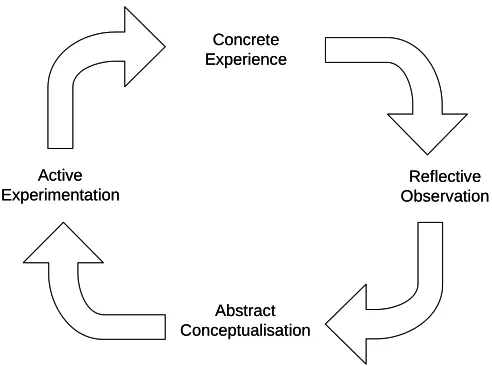
problem through a cycle of concrete experimentation and reflective thought, whereas
another type of learning takes experiences and – through a process of reflection and
abstraction – transfers new knowledge and skills onto the next design episode (Kolb,
1984). This distinction is discussed in more detail in section 3.2.
Design practitioners find this design paradigm intuitively appealing (Dorst, 1997; Blyth
and Worthington, 2001; Bardwell, 1991). Experiential learning also appears to come
closest to describing the concerns that are confronted in design practice in the
language-rich phase: designing leads to a permanent sense of discovery and uncertainty; there are
different influences and interpretations that change over time and the problem is created
out of the situation. However, this paradigm lacks a detailed account of experiential
learning in a team setting. Steps have been taken to fill in the gaps: Valkenburg and
Dorst (1998, 1999), for example, try to show how framing, naming, moving and
reflecting proceed in a team to enable project managers to better run design projects.
Whilst irreconcilable controversy – not resolvable through simple communication – is