
epl draft
The electric double layer at high surface potentials: The
influ-ence of excess ion polarizability
MARIUSM. HATLO1 RENE VAN´ ROIJ1 ANDLEOLUE2
1 Institute for Theoretical Physics, Utrecht University, Leuvenlaan 4, 3584 CE Utrecht, The Netherlands 2 Department of Chemical and Process Engineering, University of Strathclyde
James Weir Building, 75 Montrose Street, Glasgow G1 1XJ, United Kingdom
PACS 82.45.Gj– Electrolytes
PACS 73.30.+y– Surface double layers, Schottky barriers, and work functions
PACS 82.47.Uv– Electrochemical capacitors; supercapacitors
Abstract.- By including excess ion polarizability into Poisson-Boltzmann theory, we show that the decrease
in differential capacitance with voltage, observed for metal electrodes above a threshold potential, can be understood in terms of thickening of the double layer due to ion-induced polarizability-holes in water. We identify a new length which controls the role of excess ion polarizability in the double layer, and show that when this is comparable to the size of the effective Debye layer, ion polarizability can significantly influence the properties of the double layer.
Near a charged surface in contact with an electrolyte, at-tracted counterions and depleted coions form a layer that elec-trically screens the interfacial charge, rendering the so-called double layer electrically neutral. The counterion layer is loosely associated with the charged surface, under the influ-ence of both the attractive and repulsive Coulomb force and thermal motion. The double layer has been studied extensively due to its importance within a wide number of areas e.g. colloid science, electrochemistry, and geophysics. Much attention has been devoted to the low and moderate surface potential regime, where established Gouy-Chapman-Stern (GCS) models [1–3] can quantitatively explain most experimental results. However, the double layer is also a key ingredient in applications such as supercapacitors [4] and microfluidic devices [5], which of-ten operate at surface poof-tentials much larger than the thermal voltage (kBT /e= 25mV, whereeis the fundamental unit of charge). The behavior of double layers at such high voltages is not well understood, and experimentally available quanti-ties, such as the electroosmotic mobility and the differential ca-pacitance, deviate from established models based on GCS the-ory [1–3, 6]. Many experimental observations in the high sur-face potential regime can be qualitatively explained by includ-ing ionic excluded volume interactions into Poisson-Boltzmann theory, either by a lattice approximation [6–8] or by the more accurate BMCSL equation of state [6, 9, 10]. However, quan-titative agreement between theory and experimental data is in most cases only obtained with unphysically large ion sizes [6], suggesting that other effects are equally or more important.
In this Letter, we study ions in water near planar electrodes at a surface potentialψ0, including not only excluded volume,
ψ0 > ψα andv < v0, the thickness of the double layer
in-creasesas a function of voltage due to an interplay between di-electrophoretic repulsion and Coulomb attraction. Forv > v0,
the double layer thickness also increases with voltage, however, excluded volume interactions are the main driving mechanism, as found previously in Refs. 6–8. This increase of the double layer is qualitatively different from the decrease predicted by the standard GCS model and is in agreement with experimental measurements of the specific differential capacitanceC
C≡ ∂Σ ∂ψ0
(1)
of the double layer per unit area, whereΣis the surface charge density of the electrode.
The first description of the double layer was due to Helmholtz [20], who considered it as a normal two plate capac-itor: the metal electrode is separated from the electrolyte solu-tion (assumed to behave as a perfect conductor) by a medium of dielectric constantǫand thicknessd, due to the finite size of the ions. For a planar electrode, the capacitance per unit area according to the Helmholtz model is
CH = ǫ
4πd, (2) independent ofψ0and the bulk electrolyte concentrationc.
In the early 1900’s, Gouy [1] and Chapman [2] consider-ably improved this model by including the diffusive structure of the loosely bound counterions. The Gouy-Chapman differ-ential capacitance, assuming symmetric monovalent ions (with chargeq±=±e), is [1, 2]
CGC = ǫ 4πκcosh
φ0
2
≡ ǫ
4πλ(κ, φ0)
, (3)
whereφ0 = βeψ0 is the dimensionless electrode potential, κ2 = 8πβe2c/ǫ
is the Debye screening parameter, β−1 = kBT,T is the temperature, and kB the Boltzmann constant. In analogy with the Helmholtz capacitance Eq. (2) λ(κ, φ0)
can be viewed as the effective thickness of the double layer, i.e. most of the neutralizing charge is located within a distance λ(κ, φ0)from the electrode. The effective thickness of the
dou-ble layer within the GC modelλ(κ, φ0)is a decreasing function
of bothψ0andc, and approaches zero when|φ0| → ∞.
How-ever, such unphysical divergence of the differential capacitance isnot observed experimentally [21–23], and it is only when λ(κ, φ0) ≫ d, corresponding to low surface potential and
di-lute electrolyte solutions, that this model accurately describes the double layer. For monovalent ions in water, ion-ion corre-lations (including image charges) play a minor role, justifiying the mean field approximation underlying the Gouy-Chapman model [24].
To describe the regime whereλ(κ, φ0)∼d, Stern suggested
a combination of the Gouy-Chapman model and the Helmholtz model, splitting the double layer into a normal two-plate ca-pacitor close to the electrode (Eq. (2)), in series with the Gouy-Chapman capacitance (Eq. (3)) [3]. The GCS model is now the established way of describing the double layer, and can ex-plain many of its aspects, especially at low to moderate voltage.
When the voltage is increased beyond a certain level (varies with electrolyte and electrode), the GCS model fails, e.g. it cannot explain the experimentally observed nonmonotonic de-pendence of the differential capacitance with increasing voltage [21, 25, 26]. Such nonmonotonic behavior is often interpreted in terms of a voltage dependent Stern capacitance. From fits of experimental measurements to such a model, it has been con-cluded that the dielectric constant of the Stern layer is different from bulk water, and varies with voltage [25, 27].
The influence of static excess ion polarizability on the elec-tric double layer has been studied in various forms, dating back to the classic paper by Bikerman [7]. In recent years, a modified Poisson-Boltzmann approach has been developed, which con-sistently takes into account excess ion polarizability [11, 13], describing both its influence on the chemical potential of the ions and the dielectric constant of the solution. These studies suggest that excess ion polarizability can significantly influence the double layer when|φ0| ≫ 1. It is experimentally known that the dielectric constant of abulkelectrolyte varies linearly with bulk salt concentration forc < 2M [19]. Within a mean field approximation, this linear relation also holds for an inho-mogeneous system. The net dielectric constant of the solution then becomes position dependent, and at a distancez from a planar electrode, [11, 13, 14, 19]
ǫ(z) =ǫw+ 4πα+c+(z) + 4πα−c−(z), (4)
whereǫw is the dielectric constant of water, c±(z)is the lo-cal concentration of cations (+) and anions (−), andα±is the excess polarizability of the ions. In Eq. (4), we assume the di-electric constant of water to be equal to its bulk value, valid for electric fields below0.25V nm−1
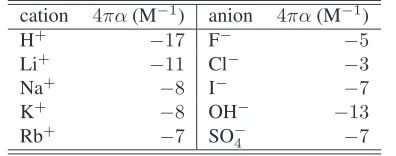
[27–30]. For most ions in waterα < 0 [19], meaning they reduce the dielectric con-stant of the solution. The measured values of the excess ion polarizability are tabulated in Table 1. Note that the actual po-larizability of the ion is not the most important, but rather the polarizability hole that the ion creates in water [13, 31]. The negative sign ofαcan be further understood by invoking the Clausius-Mossotti relation [30], which for a homogenous di-electric constantǫiinside the polarizability hole is given by
α=R3
iǫw ǫi−ǫw ǫi+ 2ǫw
, (5)
where Ri is the effective ion radius, including the water molecules in the hydration shell. Withǫi < ǫw, due to the ori-entationally restricted water molecules in the hydration shell, we haveα <0.
Within a mean field approximation, the excess energy of a polarizable particle in an external electric field is [7, 11, 13, 14, 19]
βEex=
1 2l
2 |φ′
(z)|2
(6)
where the prime denotes a derivative, andl = (−α/βe2
)1/2
is a new length scale characterizing the coupling between bare and induced charges (we assume equalαfor both ion species for notational convenience). The quadratic relation in Eq. (6) was found in Ref. 30 to hold for |ψ′
| < 0.25V nm−1
+ + -
ψ0 d
εw
+ +
+ +
+ +
+ +
-
-
[image:3.595.35.282.87.238.2]-
Fig. 1: Electrode at potentialψ0in contact with an electrolyte solution. The ions are restricted from within a distancedfrom the plate and are surrounded by a layer of ordered water molecules (see Ref. 13 for a similar illustration).
|ψ′
| ≫ 0.25V nm−1
the energy becomes linear in the elec-tric field due to the polarizability saturation of water [7]. In this Letter, we do not include dispersion interactions between the ions and the electrode; such interactions are very short ranged and are approximately captured here by the thickness of the in-ner Stern layer.
To estimate the double layer thicknessζfor|φ0| ≫ 1, we compare the induced-dipole contribution Eq. (6) with the term due to bare charges,l2
|φ′
(0)|2
/2 =φ0. Assuming the
poten-tial varies linearly through the double layer,φ′(0) ≈ φ
0/ζ, it
follows
ζ∼lp|φ0|, (7)
which is an increasing function of the surface potential, in con-trast toλ(κ, φ0). Below, in Eq. (12), a more detailed expression
forζwill be derived.
The geometry we study, similar to a typical experimental setup, is shown in Fig. 1. An electrolyte solution with bulk ion concentration2c is in contact with a planar electrode at con-stant potentialψ0≡ψ(z= 0), and the solvent is modeled as a
continuum with dielectric constantǫw. The ions are restricted from a region of thicknessdnear the electrode, corresponding to the inner Stern/Helmholtz layer.
By including the induced dipole density of the ions in the Poisson equation, we find [32]
− 1
4π{ǫ(z)ψ ′
(z)}′=e(c+(z)−c−(z)) (8)
[image:3.595.322.520.104.182.2]whereǫ(z)is the effective dielectric constant given by Eq. (4). To complete Eqs. (8) and (4), we relate the local electric po-tential to the local ion density by the Boltzmann distribution [7, 13, 14]. To include excluded volume interactions, we use the lattice approach introduced by Bikerman in Ref. 7
c±(z) =
cexph∓φ(z)−l2
2|φ
′(z)|2i
1 +vexph−l2
2|φ
′(z)|2icosh(φ(z))−v,
(9)
Table 1: Experimentally measured excess polarizability [13, 19].
cation 4πα(M−1
) anion 4πα(M−1
) H+
−17 F−
−5
Li+
−11 Cl−
−3
Na+ −8
I− −7
K+ −8
OH− −13
Rb+
−7 SO−4 −7
wherev = 2ca3
, andais the lattice spacing, approximately equal to the ion diameter. Ions that increase the local dielectric constant of the solution are attracted to regions of high fields, while ions that decrease the dielectric constant are repelled. The extra repulsion/attraction is caused by the dielectrophoretic force due to polarization effects in a nonuniform electric field [12]. Assuming a uniform dielectric constant in the Stern layer, the electric potential obeys
ψ(d) =ψ0+dψ′(d). (10)
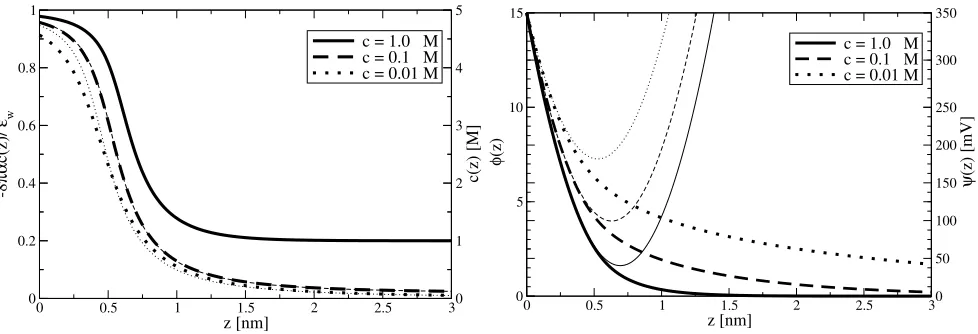
In Fig. 2a, we plot the ion density profile (solving Eqs. (4), (8) and (9)) forφ0 = 15,4πα = −8M−1,a = 0.6nm and d = 0at different bulk ion concentrations. We observe three surprising phenomena: (i) a saturation of the density profile ap-proaching−8παc(z)/ǫw = 1, (ii) an increase of the thickness of the saturated layer with concentrationc, completely opposite to the established GCS model, and (iii) almost identical density profiles fora = 0.0nm anda = 0.6nm. The ion concentra-tion close to the plate saturates atc ≈ 5M, which for an ion of hydrated diametera= 0.6nm corresponds tov ≈0.65, i.e. below close packing. To facilitate a simple analysis to better understand the physics involved, we assume zero coion density in the vicinity of the electrode. Without any loss of generality, we assume negatively charged counterions, i.e.φ0>0. For the
planar geometry depicted in Fig. 1, withφ0 ≫ 1 there is an
analytical solution to Eqs. (8), (4), and (9) forα <0andz < ζ [13],
φ0−φ(z) = z
2l2[2ζ−z] (11)
where
ζ=l r
2hφ0−φα i
, (12)
which is a more accurate version of Eq. (7). The solution is only valid forφ0> φα= ln [1−v]/[(κl)2−v/2],(κl)2 >
v/2, and v < 1. For(κl)2 < v/2
saturation of the density profile due to excluded volume will dominate, a regime which has been analyzed elsewhere [6]. For the polarizability of K+
, excluded volume will dominte the large potential regime when
a >0.7nm.As predicted earlier,ζis an increasing function of the surface potential, and, as suggested by Fig. 2a,ζincreases with concentrationc.
The resulting counterion density is c−(z) = c/(κl)2 =
−ǫw/8πα, the effective dielectric constant is ǫ = ǫw/2 (see Eq. (4)), and the differential capacitance per unit area is
C= ǫ
4πζ = ǫw
0 0.5 1 1.5 2 2.5 3
z [nm]
0 0.2 0.4 0.6 0.8 1
-8
πα
c(z)/
ε w
0 1 2 3 4 5
c(z) [M]
c = 1.0 M c = 0.1 M c = 0.01 M
0 0.5 1 1.5 2 2.5 3
z [nm]
0 5 10 15
φ
(z)
0 50 100 150 200 250 300 350
ψ
(z) [mV]
c = 1.0 M c = 0.1 M c = 0.01 M
Fig. 2: (a) Counterion density profiles and (b) electric potential near an electrode atβeψ0= 15for4πα=−8M−1(corresponding to K+), a= 0.6nm and different bulk ion concentrations. The thin lines in (a) are witha= 0.0nm and in (b) the analytical approximation Eq. (11).
confirming thatζis the effective thickness of the double layer.
In Fig. 2b, we plot the electric potential for different bulk electrolyte concentrations, and compare the result with the an-alytical solution. The anan-alytical solution is accurate forz < ζ and becomes unphysical for z > ζ, where the potential in-creases withz.
In Fig. 3, we plot the electric field at the electrode surface (E(0) = −ψ′
(0)) as a function of the surface potentialψ0,
for different values of the bulk electrolyte concentrationc. The excess ion polarizability are for both ions set equal to K+
in Ta-ble 1. Here we see that the maximum electric field in the regime of interest is below the limit where the polarization saturation of water must be accounted for (E(0)<0.25V nm−1
). We also see from Fig. 3 that the field with and without excluded volume interactions are nearly identical, signifying the relative impor-tance of ionic excess polarization compared to ionic packing.
In Fig. 4a, we compare the differential capacitance calcu-lated numerically to the low voltage result given by Eq. (3) and the high voltage result given by Eq. (13). For intermediate volt-ages both approximations fail, and a full numerical solution must be used to obtain accurate results. To validate our the-oretical predictions we compare the results with experimental data for the differential capacitance of KPF6in contact with a
silver electrode [21]. Neglecting the Stern layer (i.e.d= 0, see Fig. 1), the agreement between theory and measurments is only qualitative (thick dashed-dotted line in Fig. 4a), and the differ-ential capacitance is overestimated. Good agreement between our theory and the experimental data is found ford = 4.8A˚ corresponding toCH= 146µF cm−2
(solid line of Fig. 4a), in agreement with values obtained in previous studies [6, 33]. In Fig. 4b, we compare our results with the same measurements for several bulk ion concentrations, withd= 4.8A and excess˚ ion polarizabilities for both ions corresponding to K+ in
Ta-ble 1. The agreement is very good, especially for negative volt-age, when K+
is the counterion. To obtain similar agreement for positive voltage, it is necessary to use a different ion polar-izability for PF−6, as well as two different distances of closest
approach, as the ions have different effective sizes in water.
0 0.1 0.2
ψ0[V]
0 0.1 0.2 0.3 0.4
E(0) [V/nm]
[image:4.595.55.544.83.250.2]c = 1 mM c = 10 mM c = 100 mM
Fig. 3: The maximum electric field in the double layer as a function of surface potential for4πα=−8M−1andd=0.48 nm. Thick lines
witha= 0.6nm and thin lines witha= 0.0nm.
In Fig. 5, we plot the counterion density a distancedfrom the electrode surface as a function of the surface potentialψ0, for
different values of the bulk electrolyte concentrationc. The ex-cess ion polarizability are for both ions set equal to K+in table
1. In the regime of interest the maximum ion density is below
4M, which is in the regime where Eq. (4) is valid [19]. The thin lines are the predictions witha= 0.6nm corresponding to an ion radius ofR = 0.3nm, which is about the hydrated ion radius of K+
. Excluded volume interactions reduce the surface density, however only in a small quantitative manner. In Fig. 6 we plot the capacitance with a lattice spacinga= 0.6nm. As we can see from Fig. 6 the excluded volume interactions do not change the results much compared to thev= 0(see Fig. 4).
[image:4.595.312.561.300.477.2]-0.4 -0.2 0 0.2 0.4
ψ0 [V]
0 50 100 150 200
C [
µ
F cm
-2 ]
-16 -8 0 8 16
φ0
0 0.34 0.68 1.02 1.36
C/CH
GC Eq. 3 Eq. 13 d = 0 Experiment d = 0.48 nm
-0.2 0 0.2
ψ0 [V]
0 10 20 30 40 50 60
C [
µ
F cm
-2 ]
-8 0 8
φ0
0 0.07 0.14 0.21 0.27 0.34 0.41
C/CH
[image:5.595.40.530.77.260.2]c = 5 mM c = 20 mM c = 40 mM c = 100 mM
Fig. 4: Experimentally measured [21] differential capacitance (symbols) of an Ag-electrode in an aqueous KPF6 solution, in (a) for a salt concentrationc= 0.01M and in (b) for a series ofc’s. The curves are theoretical predictions with4πα=−8M−1(for K+) ,a= 0.0nm, and asinglefit parameterd= 0.48nm. In (a) the vertical lines represent the threshold potential±ψα, the dot-dashed curve is the prediction
ford= 0, and the dotted and dashed curves are the asymptotic low- and high-potential curves of Eqs. (3) and (13), respectively.
0 0.1 0.2
ψ0 [V]
0 1 2 3 4
ρ
(d) [M]
c = 1 mM c = 10 mM c = 100 mM
Fig. 5: The counterion density at the distance of closest approach as a function of surface potential for4πα=−8M−1andd=0.48 nm. The
thick lines are the results without excluded volume and the thin lines are with excluded volume, witha= 0.6nm.
specific, and reflect interactions between water and the elec-trode material.
In this Letter, we have shown that excess ion polarizabil-ity strongly affects the double layer at large surface potentials. There is a decrease in capacitance as a function of voltage and bulk ion concentration above a threshold voltageψα. This trend is opposite to the well-known behavior at thermal voltages. When we account for the inner Stern layer, quantitative agree-ment between experiagree-mental measureagree-ments and our theory is found. For surface potentials aboveψα, the double layer thick-ens due to dielectrophoretic repulsion of ions from the charged surface. We have shown that saturation of the ion density pro-file near the electrode due to excess ion polarizability will for
-0.4 -0.2 0 0.2 0.4
ψ0 [V]
0 10 20 30 40 50 60
C [
µ
F cm
-2 ]
-16 -8 0 8 16
φ0
0 0.07 0.14 0.21 0.27 0.34 0.41
C/CH
c = 5 mM c = 20 mM c = 40 mM c = 100 mM
Fig. 6: Experimentally measured [21] differential capacitance (sym-bols) of an Ag-electrode in an aqueous KPF6solution. The curves are theoretical predictions with4πα =−8M−1,a = 0.6nm (for K+
), and asinglefit parameterd= 0.48nm.
many systems occur before saturation due to excluded volume, and will therefore be more important. Our new contribution to the theory of the double layer will facilitate a better under-standing of supercapacitors at high surface potentials, used for example in desalination and blue energy devices [34–36], and for microfludic devices based on induced charge electroosmotic flow [6].
The theory presented in this Letter is valid when the di-electric constant of water is nearly unaffected by the exter-nal electric field, which is found in Ref. 30 to hold forE <
0.25V nm−1
[image:5.595.39.546.334.518.2]manner as predicted here, and could thus provide an alterna-tive for the presently proposed excess-polarization mechanism. However, this alternative relies on two or more fit parameters to explain the data of Ref. 21. This is in contrast to the prediction presented here, whereno fit parameteris needed other than the thickness of the Stern layerd.
Correlation effects in electrolytes become important when
lB/a ≫1, where the interaction between ions becomes much larger than the thermal energy. For the present system,lB/a∼ 1, and correlation effects will only give a small quantitative correction, even at high ion density. For systems with ions of higher valency and/or solvents with lower dielectric constant, correlation effects must be accounted for [38, 39]. For systems without a solvent (e.g., ionic liquids), the ion polarizability is positive and will have the opposite effect on the differential ca-pacitance [40] than that found in this work.
In many electrolyte-electrode systems specific adsorption of anions plays an important role, and such behavior must be in-cluded to obtain quantitative agreement between theory and measurements. In order to disentangle fundamental processes we have therefore considered here an electrode-electrolyte sys-tem where little specific anion adsorption is found. In this work, the maximum electric field is< 0.25V nm−1
, where the di-electric constant of water is still nearly equal to its bulk value [29,30]. We therefore believe that including polarizability satu-ration of water into the present theory, will only lead to a small quantitative change that can be captured by adjustingd. How-ever, for even larger voltages and/or other electrode materials, the influence of the electric field on the dielectric constant of water must be included, for example along the lines of the work by Grahame [25]. Specific interactions between the ions and the electrode material may be accounted for by incorporating additional contributions to the Boltzmann weights in the nu-merator and denominator of Eq. (9). The present work is a natural starting point for extensions along all these lines.
∗ ∗ ∗
This work is part of the reasearch program of the “Stichting voor Fundamenteel Onderzoek der Materie (FOM)”.
REFERENCES
[1] GOUYG.,J. Phys. (France),9(1910) 475. [2] CHAPMAND. L.,Philos. Mag.,25(1913) 475. [3] STERNO. Z.,Electrochem.,30(1924) 508.
[4] JAYALAKSHMIM. and BALASUBRAMANIANK.,Int. J. Elec-trochem. Sci.,3(2008) 1196.
[5] STONEH., STROOCKA. and AJDARI A.,Annu. Rev. Fluid Mech.,36(2004) 381411.
[6] BAZANTM. Z., KILICM. S., STOREYB. D. and AJDARIA., Adv. Colloid Interfac. Sci.,152(2009) 48.
[7] BIKERMANJ. J.,Philosophical magazine,33(1942) 384. [8] KILICM. S., BAZANTM. Z. and AJDARIA.,Phys. Rev. E,75
(2007) 021503.
[9] LUEL., ZOELLERN. and BLANKSCHTEIND.,Langmuir,15 (1999) 3726.
[10] BIESHEUVELP. M. and VAN SOESTBERGENM.,J. Colloid Interf. Sci.,316(2007) 490.
[11] BEN-YAAKOV D., ANDELMAN D., HARRIES D. and POD
-GORNIKR.,J. Phys.: Condens. Matter,21(2009) 424106. [12] POHLH. A.,J. Appl. Phys.,22(1951) 869.
[13] BEN-YAAKOV D., ANDELMAN D. and PODGORNIK R., J. Chem. Phys.,134(2011) 074705.
[14] NETZR. R.,Eur. Phys. J. E,5(2001) 189. [15] BIESHEUVELP. M.,Eur. Phys. J. E,16(2005) 353. [16] GOUYG.,Ann. de physique,175(1917) 129. [17] FRUMKINV. A.,Z. f. Physik,35(1929) 792. [18] BUTLERJ. A. V.,Proc. R. Soc. A,122(1929) 399.
[19] HASTEDJ. B., RITSOND. M. and COLLIEC. H.,J. Chem. Phys.,16(1948) 1.
[20] HELMHOLTZH.,Pogg. Ann.,211(1853) .
[21] VALETTEG.,J. Electroanal. Chem.,122(1981) 285. [22] VALETTEG.,J. Electroanal. Chem.,138(1982) 37. [23] GRAHAMED. C.,J. Am. Chem. Soc.,76(1954) 4819. [24] HATLOM. M. and LUEL.,Soft Matter,4(2008) 1582. [25] GRAHAMED. C.,J. Chem. Phys.,18(1950) 903.
[26] HAMELINA. and STOICOVICIUL.,J. Electroanal. Chem.,234 (1987) 93.
[27] BOOTHF.,J. Chem. Phys.,19(1951) 391.
[28] DANIELEWICZ-FERCHMINI. and FERCHMIN A. R., Chem. Phys. Lett.,351(2002) 397.
[29] JOSHI R. P., QIAN J., SCHOENBACH K. H. and
SCHAMILOGLUE.,J. Appl. Phys.,97(2004) 3617.
[30] GAVRYUSHOVS. and LINSEP.,J. Phys. Chem. B,107(2003) 7135.
[31] NETZR. R.,Curr. Opin. Colloid Interfac. Sci.,9(2004) 192. [32] JACKSONJ. D.,Classical Electrodynamics(Wiley, New York)
1975.
[33] BELTRAMO G., GIESEN M. and IBACH H., Electrochimica Acta,54(2009) 4305.
[34] BOONN. andVANROIJR.,Mol. Phys.,109(2011) 1229. [35] BIESHEUVELP. M. andVAN DERWALA.,J. Membrane Sci.,
346(2010) 256.
[36] BROGIOLID.,Phys. Rev. Lett.,103(2009) 058501.
[37] FRYDELD. and OETTELM.,Phys. Chem. Chem. Phys. ,13 (2011) 4109.
[38] BAZANTM. Z., STOREYB. D. and KORNYSHEVA. A.,Phys. Rev. Lett.,106(2011) 046102.
[39] HATLOM. M. and LUEL.,Europhys. Lett.,89(2010) 25002. [40] LAUWY., HORNEM. D., RODOPOULOST. and LEERMAKERS
![Fig. 4: Experimentally measured [21] differential capacitance (symbols) of an Ag-electrode in an aqueous KPF6and afor solution, in (a) for a saltconcentration c = 0.01 M and in (b) for a series of c’s](https://thumb-us.123doks.com/thumbv2/123dok_us/1674515.120919/5.595.39.546.334.518/experimentally-measured-differential-capacitance-symbols-electrode-solution-saltconcentration.webp)
