Open Access
C O R R E S P O N D E N C E
© 2010 McDonald et al; licensee BioMed Central Ltd. This is an Open Access article distributed under the terms of the Creative Com-mons Attribution License (http://creativecomCom-mons.org/licenses/by/2.0), which permits unrestricted use, distribution, and reproduc-tion in any medium, provided the original work is properly cited.
Correspondence
Building capacity for evidence generation,
synthesis and implementation to improve the care
of mothers and babies in South East Asia: methods
and design of the SEA-ORCHID Project using a
logical framework approach
Steve McDonald*
1, Tari Turner
1, Catherine Chamberlain
1, Pisake Lumbiganon
2, Jadsada Thinkhamrop
2,
Mario R Festin
3, Jacqueline J Ho
4, Hakimi Mohammad
5, David J Henderson-Smart
6, Jacki Short
6, Caroline A Crowther
7,
Ruth Martis
7, Sally Green
1for the SEA-ORCHID Study Group
1Abstract
Background: Rates of maternal and perinatal mortality remain high in developing countries despite the existence of effective interventions. Efforts to strengthen evidence-based approaches to improve health in these settings are partly hindered by restricted access to the best available evidence, limited training in evidence-based practice and concerns about the relevance of existing evidence. South East Asia - Optimising Reproductive and Child Health in Developing Countries (SEA-ORCHID) was a five-year project that aimed to determine whether a multifaceted intervention designed to strengthen the capacity for research synthesis, evidence-based care and knowledge implementation improved clinical practice and led to better health outcomes for mothers and babies. This paper describes the development and design of the SEA-ORCHID intervention plan using a logical framework approach.
Methods: SEA-ORCHID used a before-and-after design to evaluate the impact of a multifaceted tailored intervention at nine sites across Thailand, Malaysia, Philippines and Indonesia, supported by three centres in Australia. We used a logical framework approach to systematically prepare and summarise the project plan in a clear and logical way. The development and design of the SEA-ORCHID project was based around the three components of a logical framework (problem analysis, project plan and evaluation strategy).
Results: The SEA-ORCHID logical framework defined the project's goal and purpose (To improve the health of mothers and babies in South East Asia and To improve clinical practice in reproductive health in South East Asia), and outlined a series of project objectives and activities designed to achieve these. The logical framework also established outcome and process measures appropriate to each level of the project plan, and guided project work in each of the
participating countries and hospitals.
Conclusions: Development of a logical framework in the SEA-ORCHID project enabled a reasoned, logical approach to the project design that ensured the project activities would achieve the desired outcomes and that the evaluation plan would assess both the process and outcome of the project. The logical framework was also valuable over the course of the project to facilitate communication, assess progress and build a shared understanding of the project activities, purpose and goal.
* Correspondence: [email protected]
1 Australasian Cochrane Centre, Monash University, Melbourne, VIC 3168,
Australia
Background
Poor health and pregnancy care leads to over half a mil-lion maternal deaths and almost eight milmil-lion perinatal deaths each year. For every woman who dies, about 20 more suffer injuries, infection and disabilities [1]. The burden of death and injury falls disproportionately on low and middle income countries, as is indicated by the life-time risk of maternal death in South East Asia which is one in 130 compared to one in 7,300 in developed regions [2]. Importantly, much of this burden could be prevented if interventions which have been demonstrated by research to be effective and feasible were implemented at scale [3].
Implementation of the results of research into practice has been identified by the WHO as the most significant challenge to health care [4]. An overview of approaches to bridging the gap between research and practice has high-lighted the lack of primary research about what interven-tions are effective in increasing use of research in health care in low-income settings [5]. In part this reflects the low priority afforded to health services research in these settings [6]. This is a concern given that increasing the generation and use of research in health care are essential steps in improving health systems and achieving better health, particularly in low-income settings [7-9].
Ensuring access to scientifically valid and up-to-date information is a prerequisite to use of research in guiding health care, or 'evidence-based practice'. In spite of the profusion of health information available in print and electronic media (and several international initiatives to promote access), healthcare workers in low-income set-tings are still disadvantaged when it comes to accessing reliable information on effective care [10,11]. Organisa-tional, financial and technical barriers to accessing research (including lack of computers and internet access, limited scientific literacy, lack of availability of research, inappropriate format of research publications, etc.) and concerns about relevance to local settings are compounded by a lack of skills among practitioners and other stakeholders to appraise and interpret research findings [12].
The South East Asia - Optimising Reproductive and Child Health in Developing Countries (SEA-ORCHID) project aimed to address some of these issues. This five-year project (2004-08) was funded through the Interna-tional Collaborative Research Grants Scheme, a partner-ship between the UK-based Wellcome Trust and Australia's National Health and Medical Research Coun-cil. The scheme was designed to foster collaborative research between countries in South East Asia and Aus-tralia by funding research into major health issues affect-ing developaffect-ing countries and developaffect-ing research capacity.
The objective of SEA-ORCHID was to evaluate whether a intervention designed to strengthen the capac-ity for research generation, synthesis, and use, improved perinatal practice and led to better health outcomes for mothers and babies.
The SEA-ORCHID study protocol reporting the overall research design and project plan has been published pre-viously [13]. The protocol outlined the core groups tar-geted by the intervention and key intervention activities. Planning and designing the intervention was undertaken in two stages: development of a project-wide logical framework before the intervention phase; and a site-spe-cific action research-based operationalisation of this framework undertaken during the intervention phase. In this paper, we describe the methods and results of the first stage.
Methods
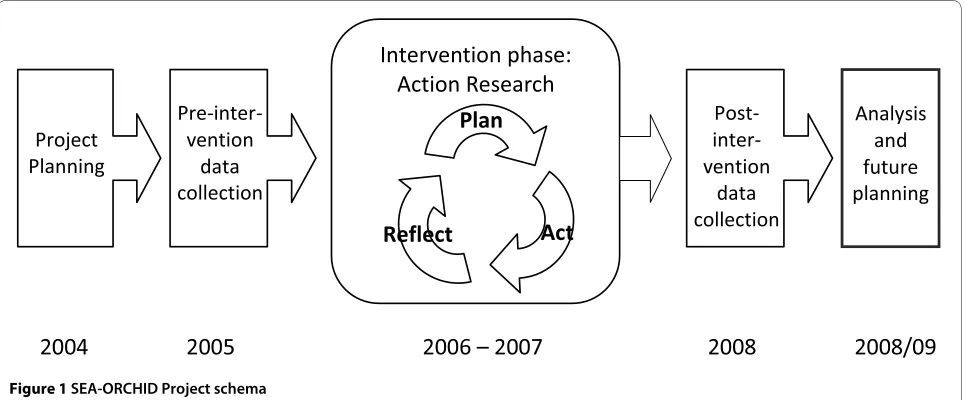
The SEA-ORCHID project was a pragmatic study that used an uncontrolled before-and-after design to evaluate the impact of a multifaceted tailored educational inter-vention, implemented within an action research frame-work (Figure 1). The intervention consisted of a wide range of components and strategies, based on sound edu-cational principles, tailored to meet the needs, priorities and resources of each of the participating hospitals.
The project was approved by the ethics committee rele-vant to each participating hospital and by the ethics com-mittee of the administering institution in Australia (University of Sydney).
Logical Framework Approach
In complex projects that have broad goals, a logical framework approach can help summarise and describe the multiple strands of the project clearly and systemati-cally, and clarify the core goals, broad objectives, activi-ties and expected outcomes [14]. There are three main components of a logical framework: project rationale (analysis of main problems and their causes); project plan (goal, objectives, activities, outputs) and evaluation and measurement strategy. The logical framework tool helps develop and demonstrate the logic of the project in two dimensions. The first, vertical dimension, is whether the activities of the project are likely to achieve the objectives and whether these objectives are likely to achieve the broader goals. The second, horizontal dimension, is whether the evaluation plan will measure the project's progress (process measures) and whether the progress of the project will in turn address the identified problems (outcome measures).
Development of the logical framework
development of the logical framework, drawing on infor-mation from several sources, along with contributions from members of the SEA-ORCHID team.
Information sources
The information sources used to develop the logical framework included the study protocol [13], a brief sur-vey of perceived current practice, and in-depth discus-sions at investigator and project meetings (to capture the experiences and perspectives of the local decision-mak-ers). The study protocol set the parameters of the project in terms of its overall aims and design.
At the start of the project planning phase, the SE Asian investigators completed an informal survey of current practice which provided a snap shot of the extent to which care was in line with research (as perceived by the investigators who were senior clinicians working in the participating sites) at different levels within the hospital system in each country (tertiary, regional, provincial and district). The survey also collected data on any comple-mentary research activities that might inform or affect the intervention design, such as participation in the
WHO Reproductive Health Library cluster randomised trial [15] (Additional file 1: SEA-ORCHID survey).
Discussions at the early investigator meetings were piv-otal in articulating the key issues and beginning the pro-cess of translating these into objectives linked to activities. At the first full meeting of all the investigators and Australian-based educators in Adelaide in March 2005, several general principles were agreed with respect to intervention planning:
• sustainability and capacity-building should under-pin all intervention strategies;
• interdisciplinary teamwork, including both clinical and non-clinical staff, such as librarians and biostatis-ticians, should be encouraged;
• SEA-ORCHID project baseline data on clinical practices should be used wherever possible to deter-mine local priorities.
During the same meeting, each SE Asian investigator summarised the current situation at the project hospitals in their country in terms of awareness, acceptance and use of research in practice; outlined particular barriers and enablers that could affect the intervention; and sug-gested activities they considered priorities.
The information from these three sources served as the raw material for the logical framework.
Contributors
The logical framework was developed with input from the seven chief investigators (one from each of the SE Asian countries, and three from Australia), the two proj-ect coordinators (from Australia and Thailand) and the Australian project staff.
The SE Asian investigators were senior obstetricians or neonatologists responsible for co-ordinating the project and determining both local and national priorities within the overall framework of the project.
The selection of investigators was determined on the basis of existing partnerships and networks within SE Asia and Australia (Figure 2). Professional links have been fostered over many years through regular meetings of Federation of Asia and Oceania Perinatal Societies and the Perinatal Society of Australia and New Zealand. The participating centres and their respective investigators in Thailand (Khon Kaen University, Khon Kaen), The Phil-ippines (University of the PhilPhil-ippines, Manila) and Indo-nesia (Gadjah Mada University, Yogyakarta) collaborate on studies initiated by the World Health Organization and are also linked through INCLEN (International Clini-cal Epidemiology Network) and the Global Network for Perinatal and Reproductive Health. In Thailand, Khon
Figure 1 SEA-ORCHID Project schema
Intervention phase:
Action Research
Project
Planning
Pre-inter-
vention
data
collection
Post-inter-
vention
data
collection
Analysis
and
future
planning
2004
2005
2006 – 2007
2008 2008/09
Plan
Kaen University also serves as the co-ordinating base of the Thai Cochrane Network. The participating centre in Malaysia (initially at Ipoh Hospital and then Penang Medical College) is the focal point for initiatives to sup-port and develop Cochrane activity.
The three Australian investigators were from centres that have strong links with The Cochrane Collaboration and international research networks for maternal and perinatal health. The Australian Research Centre for Health of Women and Babies (ARCH) at the University of Adelaide http://www.health.adelaide.edu.au/og/research/ arch.html comprises several research divisions. The research synthesis division, where the regional
co-ordi-nating unit for the Cochrane Pregnancy and Childbirth Group is based, also includes the ARCTURUS Clinical Trials division and the national coordinating office for the WOMBAT Collaboration http://www.wombatcollaboration. net and promotes and supports high quality randomised trials in maternal and perinatal health.
The Centre for Perinatal Health Services Research at the University of Sydney aims to improve the process and outcome of care for mothers and infants in New South Wales, nationally and internationally, through research and education promoting evidence-based practice http:// www.psn.org.au/. The Centre is also the regional co-ordi-nating base for the Cochrane Neonatal Group. The third Australian site was at Monash University and houses the Australasian Cochrane Centre http://www.cochrane. org.au/, which is responsible for training and supporting review authors and fostering the development of Cochrane activity in Australasia and South East Asia.
The nine study sites (hospitals) were purposively selected to include tertiary referral hospitals (University and regional), provincial hospitals and district hospitals. All were public hospitals and ranged in size from a dis-trict hospital in Indonesia with 100 births a month to a tertiary referral hospital in the Philippines with up to 2500 births a month (Table 1). We selected hospitals in which the SEA-ORCHID team members were actively involved in providing clinical services to ensure that the project would be locally owned and that project develop-ment, implementation and evaluation would be partici-patory. The participatory approach to designing the intervention plan did not extend to formal engagement
Figure 2 Location of SEA-ORCHID Project partners
Table 1: Hospitals in the SEA-ORCHID Project
Country Hospital site Type of hospital Average births per month (in 2005)
Indonesia Dr Sardjito Hospital, Yogyakarta Tertiary 100
Sleman District Hospital, Yogyakarta District 100
Malaysia Ipoh Hospital, Ipoh Tertiary 750
Kelantan Hospital, Kota Bharu Tertiary 650
Philippines Philippine General Hospital, Manila Tertiary 500
Jose Fabella Hospital, Manila Tertiary 2500
Thailand Srinagarind Hospital, Khon Kaen Tertiary 200
Khon Kaen Hospital, Khon Kaen Regional 300
with local decision-makers or community members who were not actively involved in SEA-ORCHID.
Development process
Development of the logical framework included estab-lishing a project rationale by defining and unpacking the central problem - the problem analysis - and developing a project goal that captured the overarching aim of the project in addressing the central problem.
The project planning component of the process sought to generate a range of possible activities and outputs designed to meet the objectives underpinning the proj-ect's overall aim. The third component of the logical framework - evaluation and measurement - outlined the process measures designed to monitor the project's prog-ress and the outcome measures designed to assess whether the project was meeting its goal and purpose.
Refining the logical framework was a four-month, itera-tive process with drafts circulated among the project teams for feedback and comments. The final version of the logical framework was approved in June 2005.
Results Project rationale
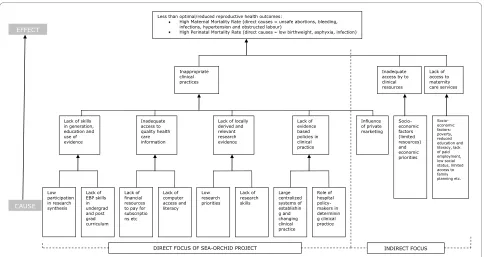
The starting point for the problem analysis (Figure 3) was the less than optimal reproductive health outcomes in South East Asia, as reflected by high maternal and perin-atal mortality. The direct causes of maternal mortality were understood to be unsafe abortions, bleeding, infec-tions, hypertension and obstructed labour; and of
perina-tal morperina-tality were understood to be low birth weight, asphyxia and infection. In response to this, the overarch-ing goal developed for the SEA-ORCHID project was 'To improve the health of mothers and babies in South East Asia'.
Three issues were identified as underlying the central problem of poor reproductive outcomes. These were:
1. Inappropriate clinical practices 2. Inadequate access to clinical resources 3. Lack of access to maternity care services
Since SEA-ORCHID was not a multi-million dollar international aid project, our focus was on the first of these. The purpose of the SEA-ORCHID project was thus defined as 'To improve clinical practice in reproductive health in South East Asia'.
The problem analysis outlined several reasons why clin-ical practice was not always in line with the results of research. These included a lack of skills in generating and using evidence; inadequate access to reliable healthcare information; lack of locally derived and relevant research evidence; and lack of evidence-based policies and clinical practice guidelines (Figure 3).
These reasons were determined to have several under-lying causes:
• low participation in research synthesis
• lack of evidence-based practice training in medical and nursing curricula
• lack of financial resources to pay for subscriptions, etc
• lack of computer access and literacy
Figure 3 Project rationale: problem analysis
Less than optimal/reduced reproductive health outcomes:
High Maternal Mortality Rate (direct causes = unsafe abortions, bleeding, infections, hypertension and obstructed labour)
High Perinatal Mortality Rate (direct causes=low birthweight,asphyxia, infection)
Inappropriate clinical practices
Inadequate access by to clinical resources Lack of access to maternity care services
Lack of skills in generation, education and use of evidence Inadequate access to quality health care information
Lack of locally derived and relevant research evidence Large centralized systems of establishin g and changing clinical practice Socio-economic factors: poverty, reduced education and literacy, lack of paid employment, low social status, limited access to family planning etc. Lack of EBP skills in undergrad and post grad curriculum Lack of financial resources to pay for subscriptio ns etc Lack of computer access and literacy Lack of evidence based policies in clinical practice Low research priorities Lack of research skills Influence of private marketing Role of hospital policy-makers in determinin g clinical practice Low participation in research synthesis
DIRECT FOCUS OF SEA-ORCHID PROJECT INDIRECT FOCUS
• low priority given to research • lack of research skills
• large centralized systems of establishing and chang-ing clinical practice
• role of hospital policy-makers in determining clini-cal practice.
Project Planning
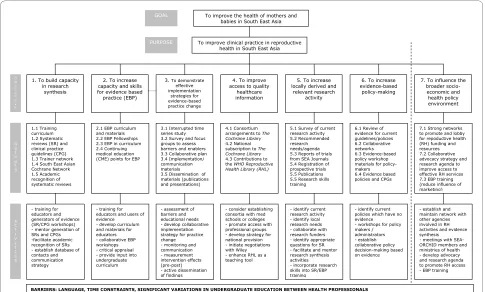
In the project planning phase, project objectives were developed to address these underlying causes (Figure 4). The objectives of the SEA-ORCHID project were:
1. to build capacity in research synthesis
2. to increase capacity and skills for evidence-based practice
3. to demonstrate effective implementation strategies for evidence-based practice change
4. to improve access to quality healthcare information 5. to increase locally derived and relevant research activity
6. to increase evidence-based policy making
7. to influence the broader socio-economic and health policy environment.
In relation to the first objective 'To build capacity in research synthesis', proposed activities included training in systematic reviews and guideline development, devel-oping structures to sustain research synthesis activity in
the longer term, and facilitating recognition of systematic reviews as a valid form of academic research.
Activities linked to the second objective 'To increase capacity and skills for evidence-based practise' included developing curriculum materials, training educators and users of evidence, and working towards the integration of EBP within existing curricula.
In relation to the third objective 'To demonstrate effec-tive implementation strategies for evidence-based practice change', activities focused on assessing barriers and edu-cational needs, promulgating adult learning principles, monitoring clinical practice and disseminating findings, and developing collaborative implementation strategies.
The fourth objective 'To improve access to quality healthcare information' gave rise to activities that included pursuing consortia with medical schools or col-leges, promoting access to various professional groups, and developing a longer term strategy to secure national provision to The Cochrane Library.
The fifth objective 'To increase locally derived and rele-vant research activity' included activities aimed at identi-fying local research needs and appropriate questions for systematic reviews, facilitating and mentoring those involved in research synthesis, and incorporating research skills into training programs.
Figure 4 Project description
To improve the health of mothers and babies in South East Asia
To improve clinical practice in reproductive health in South East Asia
3. To demonstrate effective implementation
strategies for evidence-based practice change
2. To increase capacity and skills for evidence based practice (EBP)
4. To improve access to quality
healthcare information 1. To build capacity
in research synthesis
6. To increase evidence-based
policy-making
7. To influence the broader socio-economic and health policy environment 5. To increase
locally derived and relevant research
activity
1.1 Training curriculum 1.2 Systematic reviews (SR) and clinical practice guidelines (CPG) 1.3 Trainer network 1.4 South East Asian Cochrane Network 1.5 Academic recognition of systematic reviews
3.1 Interrupted time series study 3.2 Survey and focus groups to assess barriers and enablers 3.3 Collaborative plan 3.4 Implementation/ communication materials 3.5 Dissemination of materials (publications and presentations)
4.1 Consortium arrangements to The Cochrane Library
4.2 National subscription to The Cochrane Library
4.3 Contributions to the WHO Reproductive Health Library (RHL)
5.1 Survey of current research activity 5.2 Recommended research needs/agenda 5.3 Reports of trials from SEA Journals 5.4 Registration of prospective trials 5.5 Publications 5.5 Research skills training
6.1 Review of evidence for current guidelines/policies 6.2 Collaborative networks 6.3 Evidence-based policy workshop materials for policy-makers 6.4 Evidence based policies and CPGs
7.1 Strong networks to promote and lobby for repoductive health (RH) funding and resources 7.2 Collaborative advocacy strategy and research agenda to improve access to effective RH services 7.3 EBP training (reduce influence of marketing)
- training for educators and generators of evidence (SR/CPG workshops) - mentor generation of SRs and CPGs -facilitate academic recognition of SRs - establish database of contacts and communication strategy
2.1 EBP curriculum and materials 2.2 EBP Fellowships 2.3 EBP in curriculum 2.4 Continuing medical education (CME) points for EBP
- training for educators and users of evidence - develop curriculum and materials for educators - collaborative EBP workshops - critical appraisal - provide input into undergraduate curriculum
- assessment of barriers and educational needs - develop collaborative implementation strategy for practice change - monitoring and communication - measurement intervention effects (pre-post) - active dissemination of findings
- consider establishing consortia with med schools or colleges - promote access with professional groups - develop strategy for national provision - initiate negotiations with Wiley - enhance RHL as a teaching tool
- identify current research activity - identify local research needs - collaborate with research funders - identify appropriate questions for SR - facilitate and mentor research synthesis activities - incorporate research skills into SR/EBP training
- identify current policies which have no evidence - workshops for policy makers / administrators - establish collaborative policy decision-making based on evidence
- establish and maintain network with other agencies involved in RH activities and evidence synthesis - meetings with SEA-ORCHID members and ministries of health - develop advocacy and research agenda to promote RH access - EBP training
GOAL PURPOSE O B J E C T I V E O U T P U T S A C T I V I T I E S
BARRIERS: LANGUAGE, TIME CONSTRAINTS, SIGNIFICANT VARIATIONS IN UNDERGRADUATE EDUCATION BETWEEN HEALTH PROFESSIONALS
Activities in relation to objective six 'To increase evi-dence-based policy making' included identifying evidence gaps and organising workshops for policy makers.
The final objective 'To influence the broader socio-eco-nomic and health policy environment' was concerned with activities around advocacy and awareness raising, and collaborating with other agencies.
These broad objectives and activity descriptions were used by the project teams in each country and site to develop and implement detailed project plans reflecting local priorities, needs and resources. Descriptions of the specific activities undertaken at each participating hospi-tal are available at http://www.seaorchid.org.
Evaluation and measurement
Outcome Measures
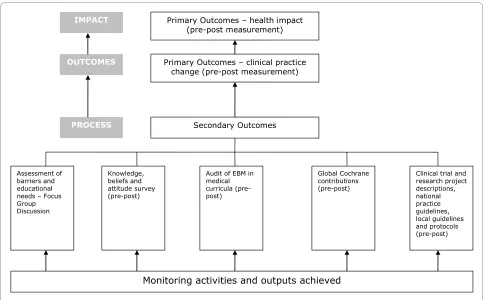
To establish whether the project met its goal of improving health for mothers and babies and its purpose of improv-ing perinatal clinical practice, primary outcome measures were designed to evaluate change in maternal and neona-tal health outcomes and 15 key evidence-based clinical practices. At each of the participating hospitals we col-lected data on 1000 births before and after the project intervention to determine changes in health outcomes and practices (Figure 5). Specific outcome measures were also established to evaluate each of the project objectives.
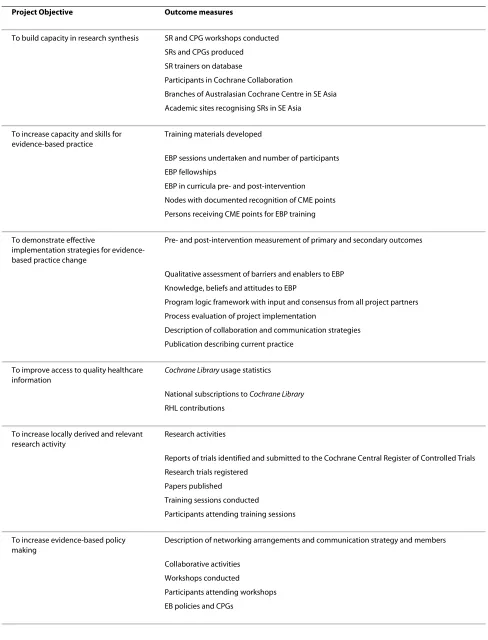
These secondary outcome measures are provided in Table 2.
Process measures
Assessment of the progress of the project was done through face-to-face project meetings, teleconferences and regular reporting. Project meetings involving team members from all SEA-ORCHID sites were held every nine months to provide an opportunity for sharing suc-cesses, brainstorming approaches to overcoming barriers, encouraging networking across nodes and refining the planned activities for the next period of the intervention phase. Between project meetings, the Australian educa-tors initiated regular two-monthly teleconferences with each of the project nodes to ensure progress was on track, provide support and resources, and help with any prob-lems or issues that arose. The project investigators also had regular teleconferences. SEA-ORCHID team mem-bers reported every two months on the activities under-taken at their hospital by completing activity statements which were then uploaded to the SEA-ORCHID website http://www.seaorchid.org to give a cumulative summary of all activities undertaken during the project.
Discussion
There are many different program logic models and frameworks used for planning and evaluating programs.
Figure 5 Project evaluation and measurement
Primary Outcomes – health impact (pre-post measurement)
Primary Outcomes – clinical practice change (pre-post measurement) IMPACT
OUTCOMES
PROCESS Secondary Outcomes
Knowledge, beliefs and attitude survey (pre-post)
Clinical trial and research project descriptions, national practice guidelines, local guidelines and protocols (pre-post) Audit of EBM in
medical curricula (pre-post)
Global Cochrane contributions (pre-post) Assessment of
barriers and educational needs – Focus Group Discussion
Table 2: Objectives and related outcome measures of the SEA-ORCHID Project
Project Objective Outcome measures
To build capacity in research synthesis SR and CPG workshops conducted
SRs and CPGs produced
SR trainers on database
Participants in Cochrane Collaboration
Branches of Australasian Cochrane Centre in SE Asia
Academic sites recognising SRs in SE Asia
To increase capacity and skills for evidence-based practice
Training materials developed
EBP sessions undertaken and number of participants
EBP fellowships
EBP in curricula pre- and post-intervention
Nodes with documented recognition of CME points
Persons receiving CME points for EBP training
To demonstrate effective
implementation strategies for evidence-based practice change
Pre- and post-intervention measurement of primary and secondary outcomes
Qualitative assessment of barriers and enablers to EBP
Knowledge, beliefs and attitudes to EBP
Program logic framework with input and consensus from all project partners
Process evaluation of project implementation
Description of collaboration and communication strategies
Publication describing current practice
To improve access to quality healthcare information
Cochrane Library usage statistics
National subscriptions to Cochrane Library
RHL contributions
To increase locally derived and relevant research activity
Research activities
Reports of trials identified and submitted to the Cochrane Central Register of Controlled Trials
Research trials registered
Papers published
Training sessions conducted
Participants attending training sessions
To increase evidence-based policy making
Description of networking arrangements and communication strategy and members
Collaborative activities
Workshops conducted
Participants attending workshops
Despite differences in approach, they share a common purpose which is to describe the rationale behind a pro-gram and to clarify the relationships between monitoring and evaluation and the project activities. In development projects, logical frameworks are the predominant pro-gram logic method used and are particularly important as communication tools in projects that cover diverse coun-tries, cultures and languages [16]. The purpose of using a logical framework in the SEA-ORCHID project was to:
• assess whether the project activities were addressing perceived needs;
• clarify the expected cause-and-effect relationships between the project activities and expected out-comes;
• predict the extent to which the planned outcome measures were likely to evaluate the impact of the project activities; and
• assist project workers to reach a consensus about realistic goals and outcomes of the project.
The logical framework became the core tool that guided the overall intervention strategy and was taken by each site and used as the basis for devising a tailored suite of activities that was implemented within an action research framework during the two-year intervention phase (2006-07). Over the course of the project the logi-cal framework was a powerful tool for facilitating com-munication within and between sites, and for maintaining a shared understanding of the purpose and progress of a complicated, multilayered intervention.
There are several limitations of the logical framework approach for projects of this nature. Firstly, the linear model does not always do justice to the complex multi-faceted influences, dynamic interactions, cultural differ-ences and unforeseen consequdiffer-ences that are part of everyday reality. Therefore they need to be used flexibly and adapted as projects evolve. Secondly, the logical framework only represents the consensus of the individu-als involved in developing it. However, they can be used to clarify the assumptions on which project plans are made and allow incoming members of the project to check whether these assumptions are relevant to their local context. Finally, the logical framework approach in
this instance had to be adapted to meet the realities of planning a project intervention within the constraints of a research grant. Under ideal conditions, projects are planned systematically by looking first at the problem, then developing goals and objectives, and finally devising an accompanying evaluation plan [17]. In SEA-ORCHID, the broad issue of building capacity for evidence-based practice and the pre- and post-intervention evaluation strategy was defined first and the specific goals and objectives defined subsequently within the requirements of a research protocol.
Experts in healthcare improvement emphasise the cru-cial importance of acquiring a good understanding of the problem, the target group, its setting and obstacles to change [5]. Logic models, such as the logical framework, value participatory processes in project planning as a means of achieving this understanding. SEA-ORCHID is an international collaborative project that aims to improve health outcomes for mothers and babies in South East Asia by strengthening capacity for generating, synthesising and implementing evidence. The logical framework approach is an established project design method that is based on a systematic analysis of the prob-lem or situation and an exploration of possible solutions. For SEA-ORCHID, the use of a project-wide logical framework has provided a mechanism for further devel-oping site-specific intervention plans. Overall, this approach is both robust and flexible and appropriate for real-world research into change processes.
Conclusions
The process of developing a logical framework in the SEA-ORCHID project was valuable because it enabled a reasoned, logical approach to the project design that ensured the project activities would achieve the desired outcomes and that the evaluation plan would assess both the process and outcome of the project. The logical framework was also valuable over the course of the proj-ect to facilitate communication, provide a reference for assessment of progress and build a shared understanding of the project activities, purpose and goal.
To influence the broader socio-economic and health policy environment
Documented advocacy strategies
Advocacy and lobbying networks and activities
Responses and outcomes to advocacy activities
Systematic Review (SR), Clinical Practice Guidelines (CPG), Evidence-Based Practice (EBP), Continuing Medical Education (CME), WHO Reproductive Health Library (RHL)
Additional material
Abbreviations
EBP: Evidence-based practice; SE Asia: South East Asia; SEA-ORCHID: South East Asia - Optimising Reproductive and Child Health in, Developing Countries; WHO: World Health Organization
Competing interests
The authors declare that they have no competing interests.
Authors' contributions
DH-S, PL, SG and CAC conceived the SEA-ORCHID study. SM and CC devised and refined the logical framework based on contributions from the tors. SM wrote the initial draft of the manuscript which TT revised. All investiga-tors and Australian educainvestiga-tors were involved in developing the design of the project, critically revising the manuscript for intellectual content and have given final approval of the version to be published.
Acknowledgements
All authors were funded individually by their respective university/institution for the development and design of the project. This study is jointly funded by an International Collaborative Research Grant from the National Health and Medical Research Council of Australia (No. 307703) and Wellcome Trust, United Kingdom (071672/Z/03/Z).
Author Details
1Australasian Cochrane Centre, Monash University, Melbourne, VIC 3168,
Australia, 2Department of Obstetrics and Gynaecology, Khon Kaen University,
Khon Kaen 40002, Thailand, 3Department of Obstetrics and Gynecology,
College of Medicine, University of the Philippines Manila, Manila 1000,
Philippines, 4Department of Paediatrics, Penang Medical College, Penang
10450, Malaysia, 5Department of Obstetrics and Gynecology, Gadjah Mada
University, Yogyakarta 55281, Indonesia, 6NSW Centre for Perinatal Health
Services Research, Queen Elizabeth II Research Institute, University of Sydney,
NSW 2006, Australia and 7Discipline of Obstetrics and Gynaecology, University
of Adelaide, SA 5006, Australia
References
1. Hill K, Thomas K, AbouZahr C, Walker N, Say L, Inoue M, Suzuki E:
Estimates of maternal mortality worldwide between 1990 and 2005: an assessment of available data. Lancet 2007, 370:1311-19.
2. WHO, UNICEF, UNFPA and The World Bank: Maternal mortality in 2005:
estimates developed by WHO, UNICEF, UNFPA and The World Bank.
Geneva 2007 [http://www.childinfo.org/
maternal_mortality_countrydata.php ].
3. Jones G, Steketee RW, Black RE, Bhutta ZA, Morris SS, the Bellagio Child
Survival Study Group: How many child deaths can we prevent this year?
Lancet 2003, 362:65-71.
4. World Health Organization: Bridging the "Know-Do" Gap: Meeting on
Knowledge Translation in Global Health. Geneva, Switzerland. World Health Organization; 2005.
5. Haines A, Kuruvilla S, Borchert M: Bridging the implementation gap
between knowledge and action for health. Bull World Health Organ
2004, 82:724-32.
6. Sanders D, Haines A: Implementation research is needed to achieve
international health goals. PLoS Med 2006, 3(6):e186. DOI: 10.1371/ journal.pubmed.0030186
7. Pang T, Sadana R, Hanney S, Bhutta ZA, Hyder AA, Simon J: Knowledge for
better health: a conceptual framework and foundation for health research systems. Bull World Health Organ 2003, 81:815-20.
8. Lansang M, Dennis R: Building capacity in health research in the
developing world. Bull World Health Organ 2004, 82:764-70.
9. Global Forum for Health Research: Statement by the Global Forum for
Health Research Forum 8, Mexico City. 2004 [http://
www.globalforumhealth.org/Forums/Annual-Forums/Previous-Forums/
Forum-8/Statement-by-the-Global-Forum-at-the-conclusion-of-Forum-8].
10. Volmink J, Siegfried N, Robertson K, Gülmezoglu AM: Research synthesis
and dissemination as a bridge to knowledge management: the Cochrane Collaboration. Bull World Health Organ 2004, 82:778-83.
11. Martis R, Ho JJ, Crowther CA: Survey of evidence-based practice
knowledge and clinical change among maternal and infant health practitioners in South East Asia. in press.
12. Godlee F, Pakenham-Walsh N, Ncayiyana D, Cohen B, Packer A: Can we
achieve health information for all by 2015? Lancet 2004, 364:295-300. 13. Henderson-Smart DJ, Lumbiganon P, Festin MR, Ho JJ, Mohammad H,
McDonald SJ, Green S, Crowther CA: Optimising reproductive and child
health outcomes by building evidence-based research and practice in South East Asia (SEA-ORCHID): study protocol. BMC Med Res Methodol
2007, 7:43. DOI:10.1186/1471-2288-7-43
14. AusAID: AusGuideline: the logical framework approach. 2005 [http://
www.ausaid.gov.au/ausguide/pdf/ausguideline3.3.pdf]. Canberra 15. Gülmezoglu AM, Langer A, Piaggio G, Lumbiganon P, Villar J, Grimshaw J:
Cluster randomized trial of an active, multifaceted educational intervention based on the WHO Reproductive Health Library to improve obstetrics practices. BJOG 2007, 114:16-23.
16. Furnell S: Developing and using a program theory matrix for program
evaluation and performance monitoring. In Program theory in Evaluation: Challenges and Opportunities, New Directions for Evaluation Volume 87. Edited by: Rogers P, Hacsi T, Petrosino A, Heubner T. San Francisco: Jossey-Bass; 2000:91-101.
17. Owen JM: Program Evaluation, Forms and Approaches. St Leonards,
NSW: Allen and Unwin; 1993.
Pre-publication history
The pre-publication history for this paper can be accessed here: http://www.biomedcentral.com/1471-2288/10/61/prepub
doi: 10.1186/1471-2288-10-61
Cite this article as: McDonald et al., Building capacity for evidence genera-tion, synthesis and implementation to improve the care of mothers and babies in South East Asia: methods and design of the SEA-ORCHID Project using a logical framework approach BMC Medical Research Methodology 2010, 10:61
Additional file 1 SEA-ORCHID survey.
Received: 1 December 2009 Accepted: 1 July 2010 Published: 1 July 2010
This article is available from: http://www.biomedcentral.com/1471-2288/10/61 © 2010 McDonald et al; licensee BioMed Central Ltd.
This is an Open Access article distributed under the terms of the Creative Commons Attribution License (http://creativecommons.org/licenses/by/2.0), which permits unrestricted use, distribution, and reproduction in any medium, provided the original work is properly cited.