Procedia Engineering 102 ( 2015 ) 668 – 675
1877-7058 © 2015 The Authors. Published by Elsevier Ltd. This is an open access article under the CC BY-NC-ND license (http://creativecommons.org/licenses/by-nc-nd/4.0/).
Selection and peer-review under responsibility of Chinese Society of Particuology, Institute of Process Engineering, Chinese Academy of Sciences (CAS) doi: 10.1016/j.proeng.2015.01.162
ScienceDirect
The 7th World Congress on Particle Technology (WCPT7)
Particle aggregation in large counter-current spray drying towers:
Nozzle configuration, vortex momentum and temperature.
Victor Francia
a,b,*, Luis Martín
b, Andrew E. Bayly
b, Mark J.H. Simmons
aaSchool of Chemical Engineering, University of Birmingham, Birmingham, B15 2TT, United Kingdom
bProcter & Gamble R &D, Newcastle Innovation Centre, Newcastle upon Tyne, United Kingdom
Abstract
This work investigates particle growth in a counter-current swirl detergent dryer, operating with a single nozzle, at a range of nozzle heights, air drying temperatures, TA, and superficial air velocities, UA, which were selected to enhance or inhibit particle
aggregation in the dryer. The growth kinetics are discussed paying special attention to the impact of the cycle of deposition and re-entrainment of material from the wall deposits. All cases lead to substantial aggregation and mono-modal product size distributions. The operation at low UAand high TA, (i.e. low momentum) does not inhibit growth as one would expect from a
lower particle concentration and faster heat and mass transfer, conditions which would lead to less particle collisions resulting in growth. In contrast, generation of aggregated particles > 850 μm is promoted, suggesting that a change in the erosion behavior of particles from the wall due to a reduction in energy of particle impacts. As a result of lower stresses, erosion is suppressed and clusters remain at the wall for longer, what allows them to sinter and be re-entrained at larger sizes. In contrast, increasing the momentum of the continuous phase by operation at low TA and high UA inhibits particle growth, particularly in the production of
the largest sizes > 850 μm. In this case the rate and energy of impacts to the wall increases, this leads to higher disruptive stresses on the wall deposits, thus, reducing the size of the clusters re-entrained. In summary, this work describes aggregation mechanisms in swirl detergent dryers operated with single nozzles, suggesting that, contrary to expectations, wearing of deposits rather than air-borne contacts may be a key contributor to the enhancement or inhibition of growth.
© 2014 The Authors. Published by Elsevier Ltd.
Selection and peer-review under responsibility of Chinese Society of Particuology, Institute of Process Engineering, Chinese Academy of Sciences (CAS).
Keywords: agglomeration; spray drying; deposition; re-entrainment; turbulent swirling flow;
* Corresponding author.
E-mail address: [email protected] / [email protected]
© 2015 The Authors. Published by Elsevier Ltd. This is an open access article under the CC BY-NC-ND license (http://creativecommons.org/licenses/by-nc-nd/4.0/).
1.Introduction.
Spray dryers present a complex fluid dynamics owing to the momentum exchange between fluid and solid phases, especially nearby the atomizer, and large heat and mass transfer rates [1]. Counter-current units are preferred for the production of temperature insensitive products. In the manufacture of detergents some of the designsmake use of strong turbulent swirling flows [2] to improve efficiency, this adds complexity to the flow filed due to the introduced pressure profiles and various instabilities. Particles and droplets in a dryer cohabit in a wide range of size, or properties such as viscosity, temperature or water contents. While in the air, inter-particle impacts may result in aggregation, those to the wall cause the continuous generation and breakage of deposits [3]. Both types of contacts become fundamental in determining the structure and density of final particles, and thus product performance [2,3,4,5]. Inter-particle interactions only begins to be accounted for in comprehensive numerical frameworks in co-current units [5] by usage of an stochastic description [6,7]. However, in addition to the better established multi-phase flow description, growth sub-models still require a substantial development, particularly into the description of the contact mechanics of semi-dried particles, which only recently starts to be investigated in detail in experimental [8] or numerical [9,10] works.
Aggregation is further enhanced in a counter-current design due to higher particle concentrations and recirculation which bring into contact particles of different drying stages. The lack of data for these systems is widely recognized [2,11] due to the inherent complexities, among others due to 1- limited measurements are available inside large production dyers, 2- a strong interaction between the turbulent swirling fluid dynamics and the rates of heat, mass and momentum transfer, 3- inter-particle contacts of varying efficiency and 4- extensive wall particulate fouling. In addition to previous studies in the context of detergents [13], it has been recently highlighted that the dynamics of generation and wearing of deposits is as critical part of the process, impacting particle structure, growth and residence time [3,14]. This work aims at contributing to a systematic description of the process, providing an outline of the aggregation patterns in a swirl counter-current unit. The growth kinetics is discussed under production of a standard detergent formulation from different nozzle locations, maintaining the same initial droplet size while modifying the inlet air temperature, TA,IN, and air mass flow rate, MA. A full description of these
series of experiments, including product characterization and a comparative study of different nozzles levels, multi-nozzle systems and scales will be published in separate works.
2.Experimental methodology.
2.1 Unit design and operation.
The particulate product is dried to a target level and exits the unit from the bottom end, while the elutriated particles are collected in the cyclones. As one would expect, inter-particle contacts are originated in regions of high
n, particularly nearby the wall and in the proximity of atomizers, where substantial aggregation occurs. The collisions to the wall at sufficiently high water contents and velocities to cause deposition are particularly frequent in the area of projection of the spray, where deposits develop as thick multi-layers at the walls [14]. In the same dryer and conditions it has been demonstrated that an equilibrium exits in this region between the rates of deposition and re-entrainment, which involves > 12 to 20 % of the full production rate that is in fact re-entrained material [3]. Furthermore, most of granules > 850 μm were seen to result from the aggregation of atomized droplets and clusters at the deposits (containing up to 10 to 37 % of re-entrained material). This is also most likely to occur within the matrix of deposits when they are subject to collisions of wet droplets at high momentum i.e. where the spray projects to the wall [3].
2.2 Measurement and configuration.
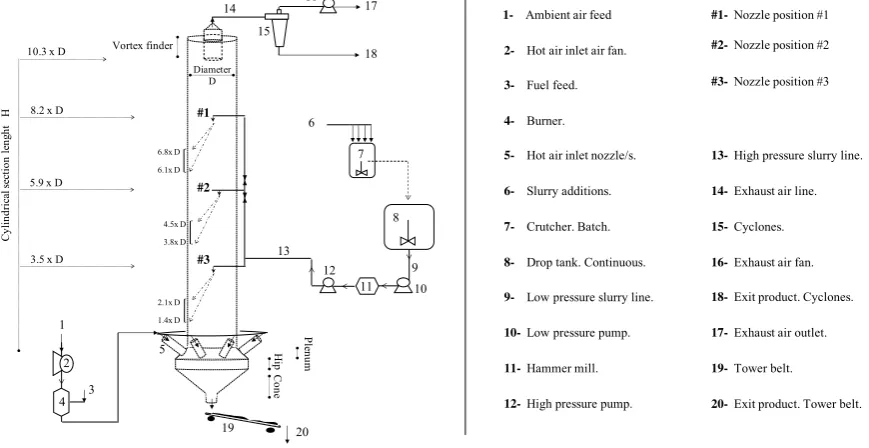
The same standard detergent formulation was used in all experiments, comprised of surfactant/s, polymer/s and inorganic salt/s to overall solids content up to 30-60% in mass. The initial droplet size was kept constant by maintaining the atomization pressure and temperature. It was measured by means of laser diffraction (Malvern Spraytec Particle Sizer, RTSizer 5.6) by replication of the same conditions in an external rig. Product particle size was measured by sieving using the Taylor series. Samples were taken at the exit of the tower belt in Fig.1 by the collection of the full exit stream. Air temperature, TA, was obtained by inserting a metallic hollow bar fitted with
K-type glass thermocouples into the tower chamber. Deposition was prevented by aligning these in the shadow of the swirl direction, and taking measurements sufficiently far from the nozzle.
This paper investigates the operation of the tower from three different nozzle locations, denoted as positions #1, #2 or #3 in Fig. 1, maintaining the same production rate and the same initial and final water content in the product. The air flow process conditions were kept reasonably constant during the operation of each case. Three different sets were investigated: 1- the reference operation and 2- higher or 3- lower momentum in the vortex, which were given respectively by reducing or increasing TA,IN by ± 40°C. The air mass rate, MA, was then controlled to yield the same
13-High pressure slurry line.
12-High pressure pump. 1 5 6 7 8 9 10 11 12 13 #1 14 17 18 19 20
6- Slurry additions. 1- Ambient air feed
4- Burner. 2- Hot air inlet air fan.
5- Hot air inlet nozzle/s.
7- Crutcher. Batch.
8- Drop tank. Continuous.
9- Low pressure slurry line.
10-Low pressure pump.
#1-Nozzle position #1
14-Exhaust air line.
16-Exhaust air fan. 3- Fuel feed.
15-Cyclones.
11-Hammer mill.
20-Exit product. Tower belt. 18-Exit product. Cyclones.
17-Exhaust air outlet.
19-Tower belt. 2 4 15 3 16 C yl indr ic al s ec ti on l eng ht H Vortex finder P le num Hi p Co ne Diameter D
10.3 x D
4.5x D 3.8x D
5.9 x D #2
#3
3.5 x D 8.2 x D
#2-Nozzle position #2
#3-Nozzle position #3
6.8x D 6.1x D
[image:3.544.47.482.405.629.2]2.1x D 1.4x D
water content in the product and thus maintain a similar overall heat and mass transfer between the phases. Subsequently, the inlet air velocity, UA,IN , was increased by 8 - 20 % or decreased by 6 - 10 % respectively, resulting
in a higher 25 - 54 % or lower 18 - 24 % variation in the vortex inlet momentum flux ρA,IN UA2IN .
3.Results and discussion.
3.1 Nozzle location.
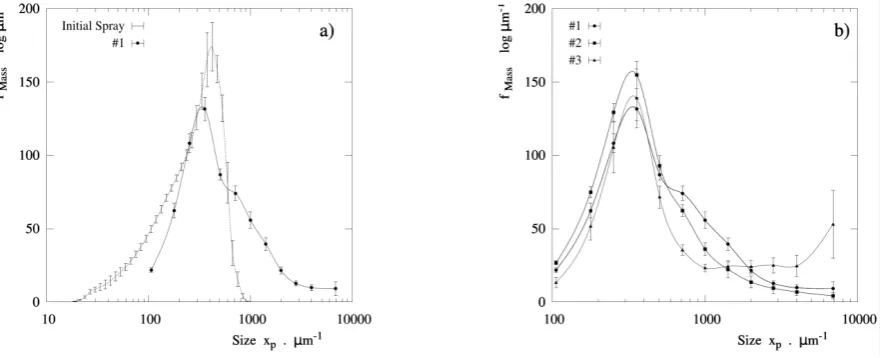
Fig. 2 provides comparison between the droplet and the product size distributions in the reference operation. In all cases the use of a single nozzle provides a mono-modal product size distribution, at a similar size range than the atomization. However, aggregation is responsible for the generation of most of the product. Clearly the long tails observed > 500 to 600 μm result from particle growth (notice x90th in the primary droplets ≈ 520 μm), But also the
particles near the mode size, which is similar between the atomization and particle distribution between 300 - 500
μm, is not associated to primary droplets, but comprises of aggregates as supported by the analysis of morphology. When the spray is located at the top position #1, the product shows significantly higher sizes, characterized by a longer tail and the occurrence of a shoulder between 600 to 850 μm, features that cannot be accurately described by a log-normal distribution but imply more growth into the large fractions. As the nozzle is lowered to position #2, the mode narrows reducing the growth > 600 μm and causing the disappearance of the shoulder. This narrowing continues when moving the nozzle further down to position #3, perhaps in an indication of the growth being reduced due the droplets facing higher temperatures. However, a plateau now starts to develop into the sizes > 850 μm, which in this case represent > 35 % of the production, versus 24% and 14% in the operation from #1 and #2.
3.2 Drying conditions.
When the nozzle is brought downwards, droplets are sprayed into hotter areas and one expects the initial heat transfer to be enhanced. Several considerations should be made to differentiate the overall drying kinetics and the drying state involved in wall deposition. The drying mechanism associated to slurries containing solids often include [16] 1- an initial shrinking period followed by 2- an intermediate stage dominated by internal diffusion of water when solids have achieved a critical n, and 3- a final stage referred to as “puffing” where the balance between heat and mass transfer rates increases droplet temperature above the boiling point. This generates water vapor inside the drop, which either expands the structure or bursts out forming cavities. The relative rates of the heat and mass transfer in each case determine whether the process is governed by external or internal mass transfer, or if boiling occurs. If the formulation used is such that the shrinkage period is short and drying is limited by internal diffusion of moisture, then the drying rate is expected to be largely independent of local temperature conditions. This means that the water content may not vary much when droplets first impact the wall from different nozzle locations. However, during the flow in the air thereafter however, drying kinetics vary substantially. As one brings the nozzle down, the droplets in the air are in general subject to a higher temperatures and shorter residence times. From the perspective of air-borne contacts leading to coalescence near the atomizer or aggregation of semi-dried particles one would be inclined to think that higher heat transfer rates would reduce the time droplets remain sufficiently wet to cause aggregation (i.e shortening the shrinkage period and bringing them to boil faster). On the contrary, when spraying from upper locations, the residence time increases and droplets face lower temperatures, such that aggregation is expected to increase (i.e. the shrinkage period would be extended and boiling may be suppressed).
In the size evolution shown in Fig. 2b it would be controversial to state the growth is neither enhanced nor suppressed by nozzle height. The growth process rather changes substantially. It appears that generation of particles within the mode and the shoulder indeed decreases when moving the nozzle down from position #1 to #2. The mode also narrows in position #3, but in turn this causes the generation of aggregates > 850 μm, limited in #1 and #2, starting to produce a final plateau that include pieces as large as 10000 μm. Two processes may lead to this effect: 1- higher UA at the bottom end causes the elutriation of a higher proportion of the product, and increases
Fig. 2. Evidences of aggregation under the standard operation conditions. (a) The initial volume based droplet size distribution (b) Comparison of the product mass based size distribution obtained under different nozzle locations.
vary for different heights. A larger UA at the bottom end causes the stagnation of larger particles, and thus a higher n
(i.e. being more frequent in the initial droplet distribution). As the nozzle is brought downwards to position #3, stagnation may start to become relevant in the proximities of the nozzle, and if it develops significantly within the projection of the spray (i.e. high velocity wet droplets) it could increase severely the aggregation levels, or 2- a fundamentally different aggregation mechanism to particle contacts in the air may be involved. It is interesting noticing that precisely fractions > 850 μm are known to contain large proportions of re-entrained material, being comprised of aggregates of atomized droplets and deposits [3]. In this way, the evolution given in Fig. 2, particularly the formation of the plateau into this size range, may not be only related only to the outcome of inter-particle contacts, but be a consequence of the dynamics of deposition and wear. In order to clarify this effect, the same population of droplets was confronted to a vortex showing a higher or lower inlet momentum flux. Production rate and exit water content were kept constant, defining an overall heat and mass transfer rate between the phases. As a control strategy, one can only try modifying the air temperature drop and adjusting, MA, such that a similar overall
heat and mass transfer occurs. Put simply, one can provide the required enthalpy change in the air by either 1- generate a small ΔT in a large mass rate (operating at lower TA and hence a higher UA), what increases n and dries
the solid phase with smaller heat transfer rates or 2- promote the opposite, a large ΔT in a vortex of smaller mass rate, causing lower n and residence time, but enhancing the heat transfer. By modifying the inlet condition TA,IN by ±
40 °C and adjusting MA accordingly ρA,IN UA2IN was modified as 51 % , 25 % or 54 % higher or a 20 %, 24 % or 18 % lower versus the reference for #1, #2 and #3 respectively.
One expects that lower n and fast heat transfer would suppress growth, and on the contrary, decreasing TAand
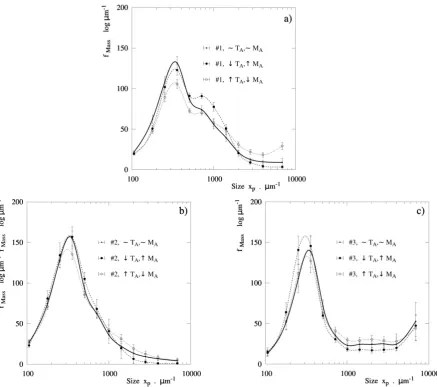
increasing in n would enhance it. Experimental observations however contradict this view. Fig. 3 provides comparison of the product size distributions of the reference and the higher and lower momentum flux cases. The span of 80 °C in TA,In between the high and low momentum cases is reduced to 48 - 58 °C t the bottom conical region
due to substantial heat losses in the air distributor. The same evolution in the particle size can be observed in all scenarios: as UA decreases (i.e. TA rises and n drops) in position #1 there is a clear promotion of growth into
aggregates > 850 μm. Increasing UA suppresses this process. In turn, it causes growth into the range 600 to 1180 μm
for position #1 transforming the shoulder into a clear secondary mode. The same suppression of growth is appreciable from position #2, where the tail is reduced by operating at higher UA and lower TA,IN. Similarly, the
generation of the plateau in position #3 is also reduced by increasing UA. To evaluate the reasons behind this
particularly in the sizes of the plateau shown in Fig. 3. Being dried within a multi-layer structure, clusters may sinter and therefore, their size when they become re-entrained is likely to be linked to the microstructure of the deposits. Re-entrainment is known to be triggered by impact of particles, and thus, it is safe to assume that whenever the rate of wall impacts increases in a given dryer at a given production rate, the wall ex-change rate must increase accordingly, what reduces the time the clusters are allowed to spend at the wall. In other works, this is equivalent to state that the higher the momentum and rate of impacts in a given wall section, the more likely is for a cluster to be hit and re-entrained back.
With this dynamics in mind, the observations provided in Fig. 3 suggest that growth is related to the enhancement or suppression of erosion of the wall deposits. When the vortex contains a momentum flux it holds a high particle n
[image:6.544.56.494.232.619.2]and transfers a substantial amount of kinetic energy and angular momentum to the dispersed solid phase. When the solids impact the wall at high rates and momentum, they transfer some of this energy to the deposits and cause higher disruptive stresses. The wear of the structure could then be promoted. Particles are not allowed to sinter and become re-entrained as smaller granules. Many experimental evidences discusses the large force required to
cause re-entrainment of small particles from surfaces due to among other reasons, larger specific contact areas [17,18]. As the energy transferred to the wall is increased in the cases of a high momentum flux, the re-entrainment rate increases and thus the size is reduced. Clearly, the reversed scenario could have opposite effects. Despite the temperature increase, when the vortex contains a lower momentum flux, it cannot sustain a large particle n and the energy transferred to the solid phase diminishes. As the impacts to the wall now cause lower disruptive stresses, the clusters are allowed to grow further, and thus are re-entrained as larger pieces either by the sole action of gravity if they grow sufficiently, or in combination by the inertia of particle impacts. Expressed in strict terms, it appears that the net growth observed correlates with the evolution of the disruptive stresses exerted upon the wall deposits.
Conclusions.
The work presented highlights there is substantial aggregation during the standard spray drying of detergents in a swirl counter-current unit. Significant growth is observed from all spray locations leading to mono-modal size distributions whenever single nozzles are used. Production of large aggregates, in particular the generation of a final plateau in the product size distribution > 850 μm suggests that growth sources other than inter-particle contacts in the air may be present. This is supported by the evolution observed when the same population of droplets is confronted to an air vortex at increasing temperature and decreasing inlet momentum flux, and vice versa. In all the cases investigated it appears that under a similar overall drying, lower momentum promotes growth despite reducing
n and increasing temperature differences in the dryer. In contrast, higher momentum, causing higher n and lower temperature differences between the phases, but clearly suppresses growth into the largest particle sizes.
This behavior points at a more complex dependency than anticipated between the growth kinetics and the fluid dynamics. In part it may be related here to the enhancement or suppression of wearing of the wall deposits, known to be involved in the production of large granules [3]. An increase in n, and thus in the energy transferred to the wall by particle impacts may be responsible of a rise in the stresses sustained by the structure. As the disruptive stresses increase, a higher number of bonds and of a higher strength may be broken in the network of clusters that forms the deposits, decreasing the size of the clusters broken off. In contrast, when n drops and heat transfer is enhanced by using high temperatures, the clusters can spend longer times at the wall due the reduction in the rate and energy of wall impacts. Lower disruptive stresses develop, and may only be capable of re-entraining large granules when they grow sufficiently and gravity aids the detachment, explaining the promotion of growth observed experimentally.
Acknowledgments.
VF was supported by an Engineering Doctorate Studentship sponsored by the Engineering and Physical Sciences Research Council (EPSRC) and Procter & Gamble in the Industrial Doctoral Centre in Formulation Engineering, School of Chemical Engineering, University of Birmingham.
Nomenclature
D Diameter of the cylindrical section of the spray dryer (m).
H Length of the cylindrical section of the spray drying tower (m)
M Mass rate (kg s-1)
T Temperature (°C).
U Velocity (m s-1).
f Mass based size probability density function.(log(μm-1))
Subscripts
A In the air phase.
IN At the inlet line.
EX At the exhaust line.
mass Mass based.
References
[1] Oakley. D.E. Spray Dryer Modeling in Theory and Practice, Drying Technology: An International Journal, 22, 6, 1371-1402, 2004. [2] Huntington D. H. The influence of the spray drying process on product properties. Drying technology, 22, 6, 1261-1287, 2004.
[3] Francia, V., Martin, L., Bayly, A.E. and Simmons, M.J.H. Experimental evidence of the role of wall deposition and re-entrainment within a swirl counter-current spray drying tower. AIChE. To be submitted, 2014.
[4] Palzer S. Agglomeration of pharmaceutical, detergent, chemical and food powders. Similarities and differences of materials and processes. Powder technology, 206, 2–17, 2011.
[5] Verdurmen R.E.M., Menn P., Ritzert J., Blei S., Nhumaio G.C.S., Sørensen T.S., Gunsing M., Straatsma J., Verschueren M., Sibeijn M., Schulte G., Fritsching U., Bauckhage K., Tropea C., Sommerfeld M., Watkins, A.P., Yule A.J. and Schønfeldt H. Simulation of agglomeration in spray drying installations: The EDECAD project. Drying technology, 22, 6, 1403-1461, 2004.
[6] Sommerfeld, M. Validation of a stochastic Lagrangian modeling approach for inter-particle collisions In homogeneous isotropic turbulence. International joudnal of Multiphase flow 27, 1829-1858, 2001.
[7] Guo, B., Fletcher, D.F. and Langrish, T.A.G. Simulation of the agglomeration in a spray using Lagrangian particle tracking. Applied Mathematical Modelling 28, 273–290, 2004.
[8] Kuschel M. and Sommerfeld M. Investigation of droplet collisions for solutions with different solids content. Experiments in Fluids, 54- 1440, 2013.
[9] Hoeven M.J. Particle - Droplet collisions in spray drying. Ph.D. dissertation. School of Engineering. University of Queensland, 2008. [10] Focke C., Kuschel M., Sommerfeld M. and Bothe D.. Collision between high and low viscosity droplets: Direct Numerical Simulations and
experiments. International journal of multiphase flow, 56, 81-92, 2013.
[11] Zbicinski, I. & Piatkowski, M. Continuous and discrete phase behavior in countercurrent spray drying. Drying Technology, Vol 27, 12, 1353 – 1362, 2009.
[12] Wawrzyniak, P., Podyma, M., Zbicinski, I., Bartczak, Z & Rabaeva, J. Modeling of air flow in an industrial counter-current spray drying tower. Drying Technology, Vol 30, 217 – 224, 2012.
[13] Francia V., Martin L., Simmons M.J.H, Bayly A.E. Origin of particle aggregation mechanisms in a pilot scale counter-current spray drying tower. International granulation workshop. Lausanne. Switzerland, 2011.
[14] Hassall G. Wall build up in spray driers. EngD dissertation. Chemical Engineering. University of Birmingham, 2011.
[15] Handscomb C.S., Kraft M., Bayly. A.E. A new model for the drying of droplets containing suspended solids. Chemical engineering science, 64, 628-637, 2009.
[16] Papavergos P.G. and Hedley, A.B. Particle deposition behaviour from turbulent flows. Chemical Engineering Research and Design, 62, 5, 275-295, 1984.