Robust dimensional variation control of
compliant assemblies through the
application of sheet metal joining process
sequencing
Adam Nagy-Sochacki
October 2015
A thesis submitted for the degree of
Doctor of Philosophy
of
The Australian National University
c
Acknowledgments
This has been a long journey for me, and without a doubt has taken me further than
I thought possible. I would never have gotten to the end without a strong group of
people around me, helping in many different ways.
Firstly, I would like to thank my supervisors, Doctor Matthew Doolan, Professor
Michael Cardew-Hall and Associate Professor Bernard Rolfe. It has been a long battle
to get to the end and they have given me nothing but encouragement and support.
They never gave up on me, and exhibited patience beyond comprehension. I think
this was quintessential to getting to the end, and it is a trait I admire greatly.
My sincerest thanks to Ford Australia for their support with this project and to all
those that were involved in my time down in the factory in Geelong; including the
technical inspection team at the time Peter Jenkinson, Chris Wickens, Andrew Hill,
Glen Rush and Peter Ilijevski.
All the past and current research students that have gone through the Materials
and Manufacturing research group; in particular, Chris Stokes-Griffin, Hamza
Bendemra and Timothy Matuszyk. My time researching at the ANU was made all
the more enjoyable by learning and questioning work outside of my research field.
I would also like to say thank you to Dave Tyschen-Smith and Ben Nash in the
ANU Engineering Manufacturing Workshop, for letting me have free reign to do as I
needed, whenever I needed. Also, to Dave in particular, for being a good friend and
for all the cups of tea and good laughs while consuming said tea with over priced
baked goods.
To all my friends, including Steve & Miranda, Sarah, Miriam, Adam M & Reggie,
Dave H & Pauline, Florian, Alistair, Rob and Craig; many of who shared their homes
with me at a variety of times throughout my studies. Thank you for the coffees,
up for lunch or messing about under cars for the afternoon; they were always very
welcomed breaks. To Sarah for the many chats, coffees and times reminiscing of
how easy undergraduate life was and what it was like when we thought we knew
things. I would also like to thank Miriam for all the encouragement over the years
and countless edits to finally see this through to the end.
I would also like to thank my dad. He has had to put up with me and my random
working hours at a variety of stages of my candidature when I lived with him. More
than once I lost track of time working in the lab and forgot plans we had together, his
understanding will not be forgotten. And to my mum, for always staying positive
and being sure to see that I am okay, eating well and making progress.
Finally, I would like to immensely thank my partner Keely. It has been many
long years now, and I would not have made it here without the effort, patience,
Abstract
Imperfections are inherent in every manufactured part - when the hundreds of sheet
metal components that form the automotive Body In White (BIW) are assembled
together, significant deformation and variability are possible. Although early work
by Takazawa (1980) showed that compliant components can absorb individual
component variability when assembled, interactions between the components and
successive operations complicates analysis of the assembly process and prediction
of the assembled output. Therefore, improving vehicle dimensional quality requires
more detailed knowledge of the assembly process and control of features critical to
functionality and aesthetic appeal. In the automotive industry, these features
include: uneven gaps and flushness between panels, high closure forces, and
incorrect seal gaps leading to leaks and excessive noise. Despite significant research
in the field of compliant assembly, there have not been sufficiently detailed studies
regarding the joining sequence process. Further, existing works are based on a
number of assumptions that limits the applicability of their results.
This thesis addresses this gap by utilising the joining process sequence to control
deformations and minimise dimensional variation during the assembly of complex
non-ideal compliant components. In this work, a geometry class to represent
complex compliant assemblies is presented; the interactions of process sequences
and variations examined; the criteria for robust sequence selection established; and
a method for the rapid identification of robust sequences is developed.
In addressing the aim of this research a number of key findings were developed.
A broad method of classifying the input variation of the components is presented.
Using this basis, identifying when the joining process has a significant influence on
final assembly dimensionality can be established. The pre-existing guidelines of
fixed-to-free end were then further generalised for complex geometries, resulting in
the approach of most-to-least rigid configuration, noting the importance of prior
joining operations and the fixture boundary conditions. In determining the
potential impact of the joining sequence, the need to consider the build-up of
internal stresses while modelling the assembly process is highlighted. A novel
method, which analyses the natural frequency shift of the structure between
successive joins, is presented as a technique of calculating a robust joining sequence.
This technique requires no knowledge of the part deformations, only the
component geometry, fixture configuration and weld locations, and hence is more
practical to industry. Experimental studies to validate the simulation-based work
were then performed. Although sequence-based trends are identifiable in some of
the extracted data patterns, the twist induced in the experimental structure was less
significant when compared to the simulated results. This difference is a result of a
number of factors which are then postulated and analysed. Further investigation of
this effect would be beneficial to further validate the approach.
To build on the work in this thesis, two notable directions in addition to further
industrial validation have been identified. By assessing the functional impact of
variation patterns in measurement data, functional variation sequence synthesis
could be investigated; where the goal is to select a sequence that best controls these
critical functional variations. Evolvable assembly systems that utilise the input work
and holding forces to optimise the sequence operations and minimise potential
spring-back of the component can also be considered. This strategy would negate
the need for the additional measurement step for process feedback which currently
hampers existing adaptive techniques.
With between four and six thousand joins performed per vehicle, an estimated
300 billion joining operations are performed annually worldwide. With minimal
knowledge available to industry regarding the impact of the joining process
sequence, the results from this work have the potential to significantly improve
Publications
1. Nagy-Sochacki, A. F.; Cardew-Hall, M.; Rolfe, B.; and Doolan, M., 2012.
Influence of welding sequences on compliant assembly geometric variations in
closure assemblies. In Trans. of CIRP conference on Assembly Technologies.
Acknowledgments ii
Abstract iv
List of Figures xxi
List of Tables xxiii
1 Introduction 1
1.1 Background . . . 2
1.2 Problem Statement . . . 3
1.3 Research question and objectives . . . 5
1.3.1 Research question . . . 5
1.3.2 Objectives of this research . . . 5
1.4 Structure of this thesis . . . 7
2 Literature Review 9 2.1 Background . . . 10
2.1.1 Principals of compliant assembly . . . 11
2.1.2 Summary . . . 13
2.2 The Sheet Metal Assembly Process . . . 14
2.3 Root cause diagnosis of variability . . . 18
2.4 Modelling of the Compliant Body Assembly Process . . . 23
2.4.1 Multi-station models . . . 28
2.5 Variation influencers and control techniques . . . 29
2.5.1 Design based variation control . . . 29
Contents viii
2.5.2 Operation based variation control . . . 32
2.6 Characterising shape variations . . . 38
2.7 This work . . . 43
3 Research methodology 45 3.1 Methodology overview . . . 45
3.2 Structure topology . . . 48
3.2.1 Geometric representation . . . 49
3.2.1.1 Beam section . . . 49
3.2.1.2 Finite element representation . . . 51
3.2.2 Input deviations . . . 52
3.2.3 Summary . . . 53
3.3 Assembly process finite element model . . . 53
3.4 Experimental assembly design . . . 56
3.5 Output measurement strategies . . . 58
3.5.1 Principal component analysis . . . 59
3.5.1.1 Point Distribution Models . . . 60
3.6 Experimental study methodology . . . 60
3.6.1 Sample preparation . . . 60
3.6.2 Methodology used for the analysis . . . 62
3.7 Chapter summary . . . 63
4 Industrial context 64 4.1 Context description . . . 65
4.1.1 Process description . . . 66
4.1.2 Assembly comments and notes . . . 67
4.2 Process deviations and variations . . . 69
4.2.1 End-of-line . . . 69
4.4 Chapter summary . . . 79
5 Joining sequence modelling results 81 5.1 Simulated influence of incoming dimensional variation patterns . . . . 83
5.1.1 Summary . . . 85
5.2 Influence of joining process sequence on joint gap variation . . . 85
5.2.1 Impact on twist . . . 89
5.2.2 Impact on other patterns . . . 92
5.3 Interactions between clamp and joining sequences . . . 94
5.4 Discussion . . . 99
5.4.1 Notes about pattern analysis . . . 100
5.4.2 A preferred sequence . . . 102
5.5 Chapter summary . . . 102
6 Beam based sequence analysis considering internal stresses 104 6.1 Background . . . 105
6.1.1 The importance of internal stress build-up . . . 107
6.2 A two dimensional joining sequence problem . . . 110
6.2.1 A sequence variation robustness index . . . 111
6.3 Beam assembly joining sequence results . . . 113
6.3.1 Case 1: Cantilevered beams . . . 113
6.3.2 Case 2: Polygon beam assembly . . . 119
6.3.3 Joining sequence case summary . . . 129
6.4 Considerations regarding internal stress build-up . . . 130
6.4.1 Modelling with or without stress build-up? . . . 130
6.4.2 The addition of clamping . . . 131
6.5 Sequence robustness discussion . . . 134
6.5.1 Need to consider internal stresses . . . 138
Contents x
6.5.3 Robust Vs. Best sequence . . . 140
6.6 Chapter summary . . . 140
7 A joining sequence synthesis method 142 7.1 A joining process sequencing algorithm . . . 143
7.1.1 Summary . . . 145
7.2 Application to the idealised assembly . . . 146
7.2.1 Simulated study . . . 147
7.3 Discussion of synthesis method . . . 149
7.4 Chapter summary . . . 151
8 Experimental joining sequence results 153 8.1 Experimental procedure . . . 154
8.1.1 Assembly process . . . 154
8.1.2 Assembly fixture . . . 160
8.1.3 Experimental program . . . 165
8.2 Experimental assembly results . . . 166
8.2.1 Sample dimensional variation . . . 166
8.2.2 Induced twist variation . . . 168
8.2.2.1 Two millimetre induced twist . . . 168
8.2.2.2 Five millimetre induced twist . . . 169
8.2.2.3 Eight millimetre induced twist . . . 170
8.2.2.4 Other variation modes . . . 171
8.2.3 Discussion . . . 172
8.2.3.1 Simulated process idealisations . . . 173
8.2.3.2 Correlated experimental study noise . . . 175
8.2.4 Summary . . . 176
8.3 Simulating with pre-assembly experimental data . . . 176
8.3.2 Results analysis . . . 179
8.3.3 Discussion . . . 181
8.3.3.1 Geometry modification . . . 182
8.3.3.2 Plasticity in weld behaviour . . . 183
8.3.3.3 Discussion summary . . . 184
8.4 Chapter summary . . . 184
9 Discussion 186 9.1 A view of the assembly process . . . 186
9.2 Further implications of this work . . . 190
9.2.1 Industry terminology . . . 190
9.2.2 Technology transfer . . . 191
9.2.3 Vehicle safety ratings . . . 192
9.3 Future research directions . . . 192
9.3.1 Industrial assessment and algorithm development . . . 193
9.3.2 Functional variation sequence synthesis . . . 193
9.3.3 Evolvable assembly systems . . . 194
9.4 Chapter summary . . . 195
10 Conclusion 196 10.1 Place of this work . . . 196
10.2 Contributions of this work . . . 198
10.3 Future research . . . 200
10.4 Final remarks . . . 201
References 217 A Simulation creation and analysis procedure 218 A.1 Creation of simulation files . . . 219
Contents xii
A.3 Processing of simulation data . . . 221
B Experimental program 222
B.1 Fixture layout and access position of weld gun . . . 222
B.2 Sequence information . . . 223
C Industry quality process measures 224
C.1 Process capability . . . 224
C.2 Process performance . . . 225
D Mathematical procedures 226
D.1 Hausdorff distance . . . 226
1.1 The structure of this thesis, including the four objectives and the
chapters in which they are addressed. . . 7
2.1 Twisted component example, (a) before clamping, (b) after clamping
and joining and (c) after final release. Colour scale highlighting the
displacement from the nominal position. . . 11
2.2 The Place, Clamp, Fasten and Release cycle (Chang and Gossard, 1997) 15
2.3 The 3-2-1 locating strategy. Clamps and pins are indicated byCi andPi
respectively. In this example, the pins also coincide with the location
of two of the locating surfaces. (Ceglarek and Shi, 1999) . . . 16
2.4 Fish-bone diagram illustrating potential root causes of variation that
feed into the assembly process (Huet al., 2001)1 . . . 17 2.5 Fault manifestation of variation pattern for a 3-2-1 layout fixture
(Ceglarek and Shi, 1999). . . 19
2.6 Cross-sectional views of joint geometries for (a) Lap joint, (b) Butt joint,
and (c) Butt-Lap joint (Ceglarek and Shi, 1998). . . 30
2.7 Sequence synthesis based on welding from weak to strong (Liu and
Hu, 1995b). . . 33
2.8 Proposed method to minimise dimensional variability induced by
stress build up (Shiuet al., 2000). . . 34
3.1 Breakdown of the steps used in this thesis and the relevant chapters. . . 46
3.2 Cutaway section illustrating the profile and structure geometry. . . 49
3.3 Twisting of the geometry (a) before and (b) after joining of the structure. 51
LIST OF FIGURES xiv
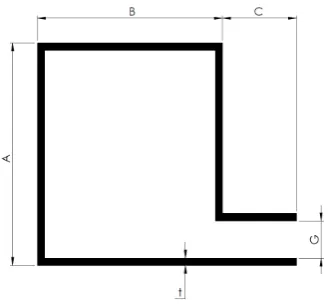
3.4 Cross section of the final geometry with dimensions illustrated. . . 52
3.5 Complete finite element model representing the structure along with
analytical rigid surfaces representing the fixture clamps and weld tips
(illustrated at the centre of the assembly). . . 55
3.6 Exploded view of the sheet metal components used to create the
assembly used in this study. . . 57
3.7 Laboratory Fixture used during the assembly process (a) during a
sub-assembly phase and (b) prior to final sub-assembly. . . 58
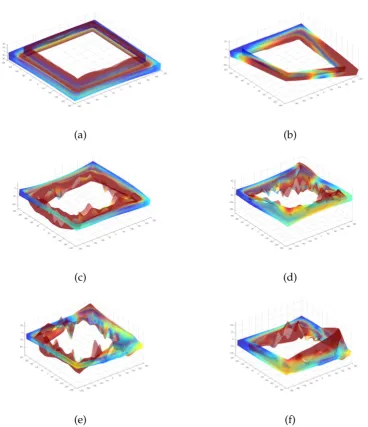
3.8 Gap variation modes extracted from scan measurement data: (a) Mode
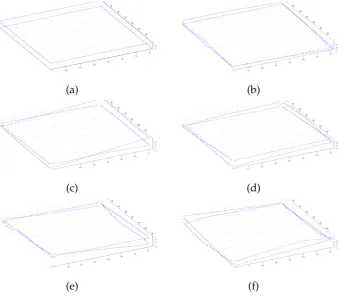
1, (b) Mode 2, (c) Mode 3, (d) Mode 4, (e) Mode 5 and (f) Mode 6. . . . 61
4.1 An exploded view of the sheet metal components that combine
together to create the closure assembly for a production sports utility
vehicle. . . 66
4.2 Production history data from standard measurements representing
mean shifts and variation in these measurements. Relative vector size
is indicative of magnitudes. . . 70
4.3 Dominant variation patterns observed in the six measurement points.
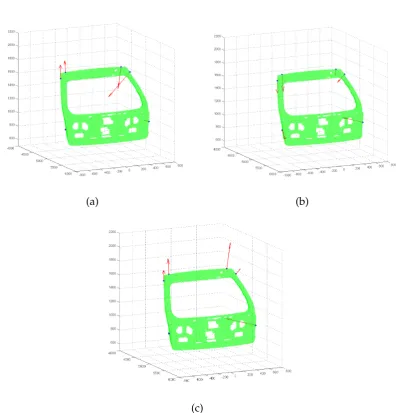
(a) Mode 1, (b) Mode 2, and (c) Mode 3. . . 72
4.4 Projected data points of the first three principal components of the
history data used with the KDE-PDM model applied to visualise the
distribution of these points. . . 74
4.5 Data point history mapped against variation pattern: (a) Mode 1, (b)
Mode 2 and (c) Mode 3. Series of graphs showing the apparent random
order of the sample components signifying there was no step shift in
5.1 Mapping of resulting twist for each joining sequence against the
spring-back twist. Twist scale provided as a measure of the principal
component and angular representation. Secondary y-axis detailing
the equivalent flushness difference from left to right caused by the
degree of structural twist. . . 84
5.2 Mapping of resulting twist for each joining sequence based on the gap
input deformation. Secondary y-axis detailing the equivalent flushness
difference from left to right caused by the degree of structural twist. . . 84
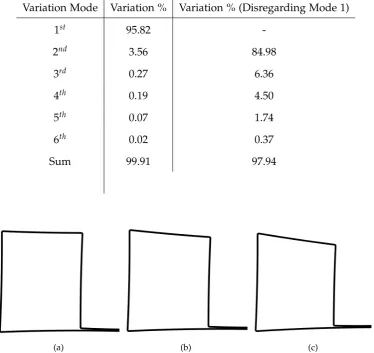
5.3 Cross section of deformed input gap variation at: (a) 2 mm, (b) 5 mm
and (c) 8 mm. This represents the primary variation mode in the
extracted data which is neglected for this study. . . 88
5.4 Extracted variation mode vectors across all simulated sequences and
gap variants: (a) Mode 1, (b) Mode 2, (c) Mode 3, (d) Mode 4, (e) Mode
5 and (f) Mode 6. . . 89
5.5 Mapping of the second principal component for the selected weld
sequences across all gaps. . . 90
5.6 Mean geometry from all simulations with colour-map illustrating
divergence from nominal. Illustrated as reference for the principal
component magnitudes. Ten times deformation shown. . . 91
5.7 Distributions for the selected curves based on the input distribution
with a mean of three millimeters and standard deviation of 0.5
millimeters. . . 91
5.8 Mapping of principal component 2the second principal component
(twist) for all weld sequences across all gaps. . . 92
5.9 Comparison of principal components 2 and 6 with the weld sequence
LIST OF FIGURES xvi
5.10 Plot of principal component coefficients for the second, third and
fourth components. Graph depicts the strong non-linear relationship
each individual sequence has between the patterns. A single line
representing a weld sequence, with the points representing the
simulated gap level. . . 94
5.11 Extracted variation mode vectors across all simulated weld and clamp
sequences, and gap variants: (a) Mode 1, (b) Mode 2, (c) Mode 3, (d)
Mode 4, (e) Mode 5 and (f) Mode 6. . . 96
5.12 The second principal component mappings for each clamp sequence:
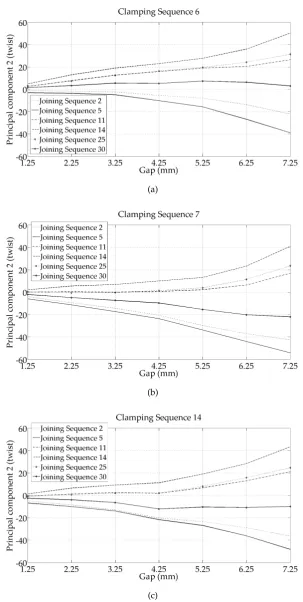
(a) Sequence 6, (b) Sequence 7, (c) Sequence 14, (d) Sequence 20, (e)
Sequence 21 and (f) Sequence 22. . . 97
5.12 The second principal component mappings for each clamp sequence:
(a) Sequence 6, (b) Sequence 7, (c) Sequence 14, (d) Sequence 20, (e)
Sequence 21 and (f) Sequence 22. . . 98
6.1 Analysis assumptions and relationships between joining sequence,
variability and structural design. . . 106
6.2 Two dimensional, two beam sequencing problem with exaggerated
example deformation. . . 107
6.3 Comparison of analysis by considering stress build-up and without
stress build-up. For variation pattern one, refer to Figure 6.8 (a). . . 108
6.4 Comparison of analysis by considering stress build-up and without
stress build-up. For variation pattern two, refer to Figure 6.8 (b). . . 108
6.5 Comparison of analysis by considering stress build-up and without
stress build-up. For variation pattern three, refer to Figure 6.8 (c). . . . 109
6.6 Comparison of final geometric positions by considering stress buildup
compared to without stress build-up for variation pattern three. . . 109
6.7 Example mapping of two different sequence curves given a particular
6.8 Variation patterns studied in the cantilever beam assembly
sequencing problem. (a) Variation pattern 1, (b) Variation pattern 2,
and (c) Variation pattern 3. . . 114
6.9 Mapping curve (a) and mapping curve derivative (b) for the first
variation pattern. . . 116
6.10 Mapping curve (a) and mapping curve derivative (b) for the second
variation pattern. . . 117
6.11 Mapping curve (a) and mapping curve derivative (b) for the third
variation pattern. . . 119
6.12 Two-dimensional, polygon-based beam assembly model with an
illustrative deformation applied. . . 120
6.13 Variation patterns for the polygon geometry (a) Pattern one, (b) Pattern
two, and (c) Pattern three. . . 121
6.14 Mapping and gradient curves for each input variation pattern
illustrating the selected sequences. (a) Pattern one (i) Mapping (ii)
Gradient, (b) Pattern two (i) Mapping (ii) Gradient, and (c) Pattern
three (i) Mapping (ii) Gradient. . . 123
6.14 Mapping and gradient curves for each input variation pattern
illustrating the selected sequences. (a) Pattern one (i) Mapping (ii)
Gradient, (b) Pattern two (i) Mapping (ii) Gradient, and (c) Pattern
three (i) Mapping (ii) Gradient. . . 124
6.14 Mapping and gradient curves for each input variation pattern
illustrating the selected sequences. (a) Pattern one (i) Mapping (ii)
Gradient, (b) Pattern two (i) Mapping (ii) Gradient, and (c) Pattern
LIST OF FIGURES xviii
6.15 Shape deformations for the weak-to-strong and fixed-to-free
methodologies modelled with and without internal stress build-up.
(a) Pattern one (i) Sequence 1-4-2-3 (ii) Sequence 3-2-4-1, (b) Pattern
two (i) Sequence 1-4-2-3 (ii) Sequence 3-2-4-1, and (c) Pattern three (i)
Sequence 1-4-2-3 (ii) Sequence 3-2-4-1. . . 126
6.15 Shape deformations for the weak-to-strong and fixed-to-free
methodologies modelled with and without internal stress build-up.
(a) Pattern one (i) Sequence 1-4-2-3 (ii) Sequence 3-2-4-1, (b) Pattern
two (i) Sequence 1-4-2-3 (ii) Sequence 3-2-4-1, and (c) Pattern three (i)
Sequence 1-4-2-3 (ii) Sequence 3-2-4-1. . . 127
6.15 Shape deformations for the weak-to-strong and fixed-to-free
methodologies modelled with and without internal stress build-up.
(a) Pattern one (i) Sequence 1-4-2-3 (ii) Sequence 3-2-4-1, (b) Pattern
two (i) Sequence 1-4-2-3 (ii) Sequence 3-2-4-1, and (c) Pattern three (i)
Sequence 1-4-2-3 (ii) Sequence 3-2-4-1. . . 128
6.16 Illustration of the increasing structural stress against the increase in
total variation of the polygon structure. . . 129
6.17 Comparison of robustness index against geometric profile change for
the polygon assembly. . . 130
6.18 Variation patterns for the nonagon geometry (a) Pattern one, and (b)
Pattern two. . . 132
6.19 Comparison of clamped and released geometries for two different
sequences: (a) Clamped configuration, (b) Released configuration. . . . 133
6.20 Preferred robust sequences for (a) the cantilever beam and (b) the
polygon geometries. . . 136
6.21 Cantilever beam sequence results presented by Liu and Hu (1995b). . . 137
7.1 Sequence calculated using the developed algorithm for the idealised
7.2 Simulated optimal joining sequence (Sequence 31) for (a) simultaneous
clamping configuration, and (b) clamping condition 1-2-3-4 (Clamp
sequence 21) configuration, presented against the poorest performing
simulated joining sequence (Sequence 14). . . 148
8.1 Set of laser-cut components. . . 154
8.2 Set of components bent into shape with joggle applied to the corner sections. . . 155
8.3 Set of upper components assembled with 16 joins. . . 156
8.4 Set of lower components assembled with 12 joins. . . 156
8.5 Example of outer lip to be joined during phase two of assembly. . . 157
8.6 Completed assembly with inner and outer connections made. . . 158
8.7 Positioning and mounting of Faro Co-ordinate measurement arm on assembly fixture. . . 159
8.8 Scanned measurement point cloud with point grid projected onto the surface for a top assembly. . . 160
8.9 Scanned measurement point cloud with point grid projected onto the surface for a bottom assembly. . . 160
8.10 Rotating bed and plate holding tooling elements with a physical stop used for limiting rotation to the same position. . . 161
8.11 Resistance spot welder mounted on rails with pin location system for positioning of joins on the assembly. . . 162
8.12 Illustration of brass limit blocks used to consistently position the resistance spot welder. . . 162
8.13 Clamping blocks holding the four components of the lower assembly in place where the corner joins are applied. . . 163
8.14 All components manufactured prior to the final assembly operation. . . 164
LIST OF FIGURES xx
8.16 Percentage reduction in the Root Mean Square (RMS) value of
variation for each sample group of five components at each gap level
for each sequence . . . 167
8.17 First variation mode of the two millimeter Principal Component
Analysis (PCA) analysis which is closest to representing the twist
variation mode. . . 168
8.18 First variation mode of the five millimeter PCA analysis which is
closest to representing the twist variation mode. . . 170
8.19 First variation mode of the five millimeter PCA analysis which is
closest to representing the twist variation mode. . . 171
8.20 Mapping of both the first and fourth principal component coefficient
illustrating groupings caused by different sequence selection. . . 172
8.21 Comparison of gap opening after joining. 8mm joined component with
plastic yielding at the weld zone, and (b) 2mm joined component with
no noticeable plastic yielding at the weld zone. . . 174
8.22 Overlay of prior simulation and digitised component geometry from
the experimental study. . . 175
8.23 Example of a distorted Finite element model generated utilising
scanned data. Colours illustrate deviation from intended design, with
red representing greatest and blue closest to nominal. . . 178
8.24 Experimental measurement points projected onto a simulated
geometry with 10x magnitude deformation. . . 178
8.25 Extracted variation modes across all revised simulated studies. (a)
Mode 1, (b) Mode 2, (c) Mode 3, (d) Mode 4, (e) Mode 5, (f) Mode 6,
(g) Mode 7 and (h) Mode 8. . . 180
8.26 Mapping of both the first and sixth principal component coefficient
illustrating the loss of relationship to sequence when new revised
8.27 Ability of a perfect rectangle to shear in comparison to a trapezoidal
geometry. (a) Initial rectangle, (b) Sheared rectangle, (c) Initial
irregular trapezoid, and (d) Sheared irregular trapezoid. . . 183
10.1 Illustrative example of the relationship between modelling complexity
and analysis accuracy placing this work in comparison to other works. 197
A.1 Procedure used to create the simulation input decks in the respective
simulation folder. . . 219
A.2 Procedural flow for the continuous execution of simulation on a given
quantity of processing cores. . . 220
A.3 Data extraction and processing procedure for the analysis of the
simulation database files. . . 221
B.1 Positions of each spot weld on the fixture. Illustration also indicated
the positions and numbering used in the simulated trials. . . 222
E.1 Mapping curve (a) and mapping curve derivative (b) for the first
variation mode used in the six join clamped polygon geometry. . . 229
E.2 Mapping curve (a) and mapping curve derivative (b) for the second
List of Tables
4.1 Process capability and process capability index across 30 of the
measurements. Numbered measurements begin at the top right
corner of the illustrations. . . 70
4.2 Variation modes, contributing variation percentage, per variation
pattern and cumulative variation. . . 73
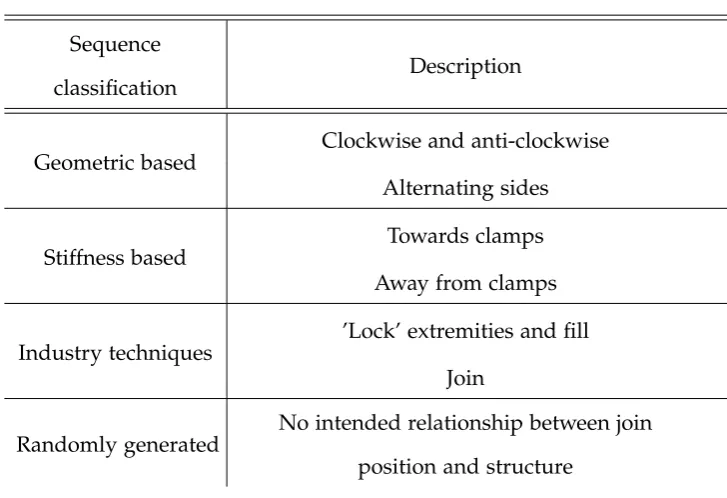
5.1 Tabulated descriptions of different joining sequence trends used in the
simulated study. . . 86
5.2 Individual principle component contributions for each weld sequence
and gap level. . . 87
5.3 Contribution of variation modes for 30 different weld sequences and 7
gap input variation levels. . . 88
5.4 Contribution of variation modes for six different weld sequences, six
different clamp sequences and seven gap input variation levels. . . 95
6.1 Summary of sequence analysis works for developing sequence
synthesis methodologies. . . 106
6.2 All two dimensional beam assembly problems simulated. . . 110
6.3 Robustness measure for selected sequences based on given input
variations for the cantilever geometry. The calculated robustness
measure indicated in brackets. . . 115
6.4 Robustness measure for selected sequences based on given input
variations for the polygon geometry. . . 122
6.5 Robustness measure for selected sequences based on given input
variations for the polygon geometry with clamping incorporated. . . 134
8.1 Complete experimental program with the selected sample numbers for
each gap size and the assigned sequence number. . . 165
8.2 Sequence and modal coefficient values for the twist principal
component in the two millimetre experimental data. . . 169
8.3 Sequence and modal coefficient values for the twist principal
component in the five millimetre experimental data. . . 170
8.4 Sequence and modal coefficient values for the twist principal
component in the five millimetre experimental data. . . 171
B.1 Access positions of spot weld gun for the relevant weld on the fixture. . 223
E.1 Sequence robustness evaluation for the cantilever geometry, ranked
according to their ability to reduce variation . . . 227
E.2 Sequence robustness evaluation for the polygon geometry, ranked
List of Acronyms
BIW Body In White
CAD Computer Aided Design
DCA Designated Component Analysis
DCT Discrete Cosine Transform
EAVS Elastic Assembly Variation Simulation
Efi Effective independence
FE Finite Element
FEA Finite Element Analysis
GD&T Geometric Dimensioning & Tolerancing
KDE-PDM Kernel Density Estimate - Point Distribution Model
MC Monte Carlo
MIC Method of Influence Coefficients
mm Millimetre
MPC Multi Point Constraint
PCA Principal Component Analysis
PCFR Place,Clamp,Fasten andRelease
PCMR Place,Clamp,Measure andRelease
PDM Point Distribution Model
RMS Root Mean Square
RSS Root Sum of Squares
RSW Resistive Spot Weld
SHS Square Hollow Section
SMA Statistical Modal Analysis
SOVA Stream of Variation Analysis
SQP Sequential Quadratic Programming
SUV Sports Utility Vehicle
Chapter1
Introduction
The quality of a product can be measured in a number of ways, the most important
being how it compares to the customer’s perceptions. Improving measures deemed
to be important to the aesthetics and functionality of a product will improve
customer perceptions of brand quality. This leads to increased sales and improved
brand reputation. This link is particularly evident in the automotive market, where
a reputation for poor quality vehicles can take decades to reverse and a brand’s
reputation for quality can take years to develop.
A customer’s perception of a high quality product is influenced by the product’s
ability to reliably perform to the customer’s expectations. As expectations increase,
a demand is placed on manufacturers to improve product quality. In the automotive
industry, some of the physical characteristics of a vehicle on which a customer builds
their perception of quality are: uneven gaps and flushness between panels, high
closure forces, and incorrect seal gaps leading to leaks and excessive vehicle interior
noise.
Improving product quality requires more detailed knowledge of the assembly
process and control of features critical to product functionality and aesthetic appeal.
As greater product quality is achieved, warranty costs will be reduced and customers’
perceptions of the brand’s quality will increase; leading to quicker production set up
due to decreased testing iterations and increased sales.
1.1
Background
The dimensional quality of a vehicle is the predominant factor affecting functionality
and aesthetics in the automotive market. Examples include: the flushness and gap
between panels; the sealing ability and general fit of closure assemblies; and the
effort required for opening and closing of these closure assemblies - all of which are
related to dimensional quality. Improving product quality therefore requires detailed
knowledge of the mechanics involved during assembly. Imperfections are inherent in
every manufactured part and when these imperfect parts are combined together to
create a more complex assembly, the dimensionality of the assembly will inherently
be a function of the individual components’ initial imperfections. Consequently, for
the assembly to function as intended, certain dimensional restrictions must be in
place not only on the assembly, but also on its constituents.
The relationship between a part and the final assembly dimensionality is the area
of tolerance design. Acceptable dimensional restrictions for the deviations of a part
from nominal are specified as tolerances; these allow manufacturers to work within
a range of the targeted dimension. Traditionally, the process of tolerance analysis is
applied to determine the final assembly level variation. This is often a cyclic process
where part design, manufacturing operation and tolerance specifications are revised
until the final assembly achieves its requirements - which can prove to be a costly
exercise. Alternatively, part tolerances can be estimated based on the desired final
assembly tolerance, a process know as tolerance synthesis or allocation.
Traditionally, the quality of assemblies is improved by increasing the accuracy
and precision of the individual components - a philosophy known as net build
(Hammett et al., 1998). Variations and deviations stack together, and the final
assembly dimensionality can be determined. However, all of the commonly applied
techniques (see Section 2.1) are based on the assumptions of rigid body assembly,
normal distributions and linearity. When analysing compliant bodies, such as sheet
§1.2 Problem Statement 3
these well known tolerance analysis models fail because they do not represent the
appropriate assembly mechanics.
1.2
Problem Statement
Sheet metal does not follow the traditional rigid body assembly laws, and to study
this, a variety of approaches have been developed to understand the mechanics of
assembly. Unfortunately, many of these are resource intensive or lack the ability to
adequately represent the assembly mechanics observed in certain situations. An
example of this is the degree of non-linearity present when studying clamp and
joining process sequencing. If this behaviour is not captured appropriately, then the
sequence appears to have either no influence or the results will be significantly
different in practice. When a detailed study investigating variational effects is
combined with sequence based assembly process design, it can often be unrealistic
to execute the large number of simulations or assembly trials required to adequately
understand the mechanics of that particular component’s assembly.
While to date focus has been been given to modelling the behaviour observed
during assembly, comparatively little attention has been given to the effect different
assembly joining sequences have on the assembly. Early work suggested that, as a
general rule, weld sequence should be performed from the weakest-to-strongest
area of the assembly (Liu and Hu, 1995b). However, other works suggested a
fixed-to-free end methodology; that would minimise internal stress buildup and, as
a consequence, was shown to reduce variation. Such statements are useful in a
production situation as they can enable more informed decisions to be made about
process sequencing. However, in some production situations these guideline, along
with other common industry practices, has not always been successful in reducing
variation - as presented by Wärmefjordet al.(2010c).
The impact on the final output variation is not only a function of the assembly
variations. Matuszyk et al. (2007) showed this for a slender top hat assembly
involving clamp sequencing. Furthermore, each shape variation was shown to
require a different ideal sequence, but it was possible to find a generic robust
solution. As mentioned, not all assembly guidelines have been successful in
minimising dimensional variation. This can be attributed to varying input
variations being undesirable with the sequences chosen, or the possibility that
certain variations cannot be controlled by joining sequence operations. This allows a
contrast to be made between the best sequence and the most robust sequence,
where the sequence the reduces variability the greatest for a particular input
variation, may perform poorly for another. Thus, a robust solution would be
preferable when no production variability information is available.
An understanding of the compliant assembly process is critical in developing
methods that seek to optimise the process. While researchers have focused on
developing models to represent the assembly process, to date comparatively little
focus has been given to understanding the generalised influence that different
operations have on compliant assemblies. Where studies have examined this, the
work has considered simplified lower dimensional situations that are not
representative of practical applications. Moreover, a unique possibility exists by
using the joining sequence to control variability because it can be freely altered in
existing production assemblies at minimal cost, even after vehicle launch. This work
addresses this opportunity using a combination of higher and lower dimensional
geometry cases to determine the requirements of joining sequence operations to
§1.3 Research question and objectives 5
1.3
Research question and objectives
1.3.1 Research question
As discussed in Sections 1.2 and 2.1.1, compliant bodies do not follow the
traditional rigid body assembly rules. Variations in the components propagate in a
non-linear manner as a consequence of geometric deformation and contact
conditions in manufacturing operations. As a result, there is an industry-wide need
for more detailed knowledge about the assembly of compliant bodies. This need is
addressed by the key research question of this work:
How can joining process sequencing be applied effectively to control
deformations and minimise dimensional variation during assembly of complex
non-ideal compliant components?
1.3.2 Objectives of this research
In addressing the aim, this work will focus on the analysis of different types of
incoming variability and the resulting impact on outgoing variability under realistic
processing conditions for use in practical applications. As such, it will centre on a
complex generalised assembly, rather than a specific case study or lower
dimensional representation. However, a case study will be utilised for topological
context, and a lower dimensional situation used to develop a deeper understanding
of the influencing factors in join sequencing. This research will address the aim by
focusing on the following four objectives:
Objective 1. Develop a geometry class to represent complex compliant assemblies.
The first component of this work simplifies an industrial case to develop an idealised
situation of the assembly process for further investigation. This involves interpreting
on a production situation. This objective addresses the area of the research question
relating to the complex non-ideal compliant assembly.
Objective 2. Demonstrate the interactions of process sequences and variations.
A significant component of this work is devoted to demonstrating the resulting
impact of the interactions between the incoming component variations, clamp
sequence, and joining process sequence on outgoing variation. To achieve this, the
simplified representative assembly from Objective 1 is used, and combined with
both computational simulation and experimental techniques for determining the
structure’s response. This forms the foundation of this thesis, and is used to answer
a number of sub-questions to the key research question, specifically:
1. When can weld sequence be used to control variation?
2. What is the impact of clamp sequencing on joining sequencing?
Objective 3. Determine the criteria for optimal sequence selection.
This objective involves determining the input conditions for an optimal joining
sequence. The assumptions used to model the analysis process are also considered
within the scope of this objective. A number of sequences can be defined as optimal;
however, for the purposes of this objective the three following research questions
are posed:
1. What is a robust sequence for minimising output variation given any input
dimensional variation pattern?
2. What is the influence of structural design on optimal sequence selection?
3. What is the significance of internal stress build-up to the analysis process?
Objective 4. Develop a method for the rapid identification of robust sequences.
§1.4 Structure of this thesis 7
robust sequence selection. This knowledge will be formalised in a procedural or
mathematical approach in order to develop an algorithm to determine a suitable
joining process sequence; henceforth allowing for faster setup and less guess work
where more complicated assemblies are concerned.
1.4
Structure of this thesis
To address the four objectives, this thesis is separated into seven proceeding chapters,
followed by the conclusions of this work. The structure is detailed in Figure 1.1.
Interpret process as observed in an industrial context and idealise
the geometrical situation for further analysis.
Create and validate a model of the assembly sequence process.
Investigate input variations and their interactions with process
variables.
Investigate a simplified model for sequence analysis, and
determine the requirements for optimal sequence selection.
Develop and demonstrate a sequence synthesis method for the
rapid identification of robust sequences.
Figure 1.1: The structure of this thesis, including the four objectives and the chapters in which they are addressed.
Firstly, a literature review is presented (Chapter 2) that provides an in-depth
compliant assembly and assembly in general. The methodology of this thesis then
follows (Chapter 3), which presents the methodological approaches used, and
includes the development of the idealised representative structure used throughout
the remainder of this work. This is then followed by an industrial context chapter
(Chapter 4), which aids in highlighting the applicability of the topology of the
structure developed in the methodology and specific limitations with existing
knowledge when confronted with a complex industrial application.
The next four chapters (Chapters 5, 6, 7 and 8) are devoted to the studies
performed on the idealised structure and the development of a generalised
algorithm. This can be separated into two areas: developing an understanding of
the process and its impact on variability; and developing an understanding of the
modelling assumptions and their impact on variability estimates for sequence
synthesis. Chapters 5 and 8 detail both computer-based simulations to study the
sequence dependence during assembly, and experimental-based trials for validation
of variation reduction through robust sequence selection. A study of the sequence
analysis process and modelling assumptions is provided in Chapter 6 by utilising a
simplified beam model with a variety of geometric forms. This is then followed by a
chapter that presents an algorithm for sequence synthesis (Chapter 7). Chapter 9
then presents a broader high level discussion on the application and place of this
work in the automotive and wider industries. The final chapter (Chapter 10)
presents the conclusions of this work and recommendations for future
Chapter2
Literature Review
This chapter presents a detailed review of the research involved in sheet metal
assembly, which, more broadly, is within the field of compliant body assembly. The
chapter begins with an overview of methods for tolerance analysis based on a rigid
body assumption (Section 2.1). Included here is an example application of possible
variation reduction observed in compliant assemblies to exemplify the shortcomings
of the discussed rigid body models. The next section (Section 2.2) presents a
detailed description of the assembly process and develops much of the terminology
used within this work. Specific attention is paid to common practices in industry.
This is then followed by a section on root cause diagnosis of variation (Section 2.3);
an area that formed the basis for much of the early research into sheet metal
assembly. Following this, a review of modelling techniques used to replicate the
assembly process is provided in Section 2.4. Since these models then form the basis
for studying variability within the assembly process, Section 2.5 reviews the
opportunities to minimise and control variability. Lastly, the chapter provides a
review of the work related to measurement and classification of variations and its
place within the design-to-manufacture process (Section 2.6). This highlights the
current issues and limitations of previously developed techniques to identify key
areas for investigation.
2.1
Background
The most common tolerance analysis techniques are the Worst Case (WC) and Root
Sum of Squares (RSS) (Chase and Parkinson, 1991). In the Worst Case model,
maximum variations are summed to produce the possible assembly variation. This
model guarantees assembly dimensional quality, but places tighter tolerances on the
part dimensions than are often required; therefore leading to an increase in
manufacturing costs. The RSS approach attempts to alleviate this issue by
considering a statistical model, where the part variations are assumed to be
normally distributed. The potential variation of two individual components of
length L1 and L2 when placed together can be estimated statistically, by applying
the law of propagation of uncertainties, expressed by Equation 2.1.
∆y=
v u u t n
∑
i=1∂y ∂xi
2
∆xi2 (2.1)
Where the function y = f(x1,x2, . . . ,xn), in this case the function y can be
expressed as L=l1+l2representing the summation, or stacking of two components
of lengths l1 and l2. By applying the law of propagation of uncertainties the
variation inL can be expressed by Equation 2.2.
∆L=
q
∆l12+∆l22 (2.2)
This model allows for larger tolerance zones, which results in lower production
costs. However, it can also underestimate the required tolerance if skewness,
kurtosis, different input distributions, and/or mean shifts are present in the
measured data. Modified versions of the RSS model have been developed to take
into consideration some of these shortcomings and to allow for skewed inputs and
mean shifts. In higher dimensional situations, these techniques are based on vector
chains, either open or closed loop. These chains contain links that pass between the
§2.1 Background 11
final assembly variation.
2.1.1 Principals of compliant assembly
Takazawa’s (1980) research illustrated that flexible or compliant components, such
as sheet metal panels, do not follow the traditional rigid body assembly rules, and
that part variations could be absorbed through the assembly process. This ability to
absorb variations is based on a relationship between the joined and unjoined stiffness
of the parts.
The geometric stiffness is an important aspect in minimising dimensional
variability in compliant assemblies. The change in stiffness pre- to post- joining has
the ability to dictate the degree of spring-back when a deformed component is
released. This aspect of compliant assembly is not new; Hu and Koren (1997)
highlighted the relationship that exists between stiffness and variation during
multistage assembly. They showed that propagation of variation was closely
dependent on the type of assembly, either serial or parallel. For serial component
assembly, the resulting assembly became less rigid and consequently an increase in
variation was observed. For parallel assembly, such as closure assemblies, a
reduction in variation was observed due to the increase in stiffness of the whole. To
illustrate the relationship between structural stiffness and variability, an example of
a twisted component is provided(Figure 2.1).
(a) (b) (c)
Figure 2.1: Twisted component example, (a) before clamping, (b) after clamping and joining and (c) after final release. Colour scale highlighting the displacement from the nominal position.
position, joined and released. Here, a thin wall Square Hollow Section (SHS),
represented by Figure 2.1 is used. The section requires a moment applied to it for it
to lie flat. This moment can be determined based on elementary mechanics, where
the moment per unit angular deflection can be represented by Equation 2.3.
T
θ =
JG
L (2.3)
Here, J is the torsional moment of inertia, Gthe shear modulus andLthe length
of the beam. The process of joining the beams together along the open edge, alters
the torsional moment of inertia of the beam. Before joining, the torsional moment
of inertia for the beam can be calculated using Equation 2.4; by taking the sum of
the polar moment of inertia for each side of a square hollow section, as no shear
flow circuit exists over the beam’s cross section. After joining, the torsional moment
of inertia can be estimated by Equation 2.5, a known torsional property for SHS
members.
Jopen =Σ dt3
3 =
4(d−t)t3
3 (2.4)
JClosed =t(d−t)3 (2.5)
Where, for a rectangular section with equal sides, d is the width and height of
the rectangle and t is the material thickness. By determining the load applied to
the beam initially based on a level of deflection, then applying the opposite of this
load to the joined structure, the final assembly deformation can be determined using
Equation 2.6.
θout = 4 t2
§2.1 Background 13
By applying this to a 40mm SHS with a 1mm wall (Equation 2.7)
θout=8.77×10⁻⁴θin (2.7)
The variance of Equation 2.7 can then be determined by applying the law of
propagation of uncertainties presented in Equation 2.1. This results in the expected
variation presented in Equation 2.8.
σout2 = (8.77×10⁻⁴)2σin2 (2.8)
Given 10 degrees of twist variation prior to assembly, the equation can be completed
as shown in Equation 2.9.
σout=
q
(8.77×10⁻⁴)2×102 =8.7×10⁻³deg (2.9)
As has been shown using the example of torsion in open and closed sections, by
joining the profile a significant increase in the geometric torsional stiffness occurs.
Since this increase causes a corresponding reduction in variation, it is this principle
that forms the basis for studying variation control in complex assemblies, such as
closure panels, where significant stiffness changes can occur.
2.1.2 Summary
The complete assembly process of compliant components, in this instance sheet
metal, can be considered as a step-based process involving incremental increases of
stiffness - such as the increase observed in the example. As each joining operation,
such as a spot weld or self piercing rivet, is performed, the compliant component is
pulled to a nominal location by the joining tool, then it is joined and released. When
released the component will return to a different location that will depend on the
stiffness of the components and the component geometry prior to the execution of
with each prior operation repeatedly clamping and releasing the assembly from and
to different locations. Additionally, each prior operation also results in internal
stresses in the components which may have an impact on the complete process,
particularly when the final assembly is released from the tooling elements (fixture)
used to locate the component for each of these sequenced joining operations. This
complete process is described in further detail in Section 2.2.
2.2
The Sheet Metal Assembly Process
The sheet metal assembly process is a complex series of operations that differs from
the traditional rigid body assembly processes. The compliant nature of the
components leads to assembly process interactions influencing the final assembly
output. These interactions make the assembly process difficult to model, sensitive to
process variables and problems, and make faults more difficult to diagnose. Given
these complexities, a wide variety of modelling and analysis approaches have been
used to understand the sheet metal assembly process. Previous research has applied
control theory, pattern recognition and artificial intelligence algorithms to
investigate these problems, and to attempt to reduce variations in production.
An automobile body, otherwise known as a Body In White (BIW), is constructed
from hundreds of individual components that are assembled together. To achieve the
end result, a large number of assembly operations are performed that build smaller
assemblies, or sub-assemblies, before they are combined to form larger assemblies,
and eventually the complete BIW. This process may be repeated many times, where
smaller sub-assemblies have other components added on; building on the assembly.
The most basic element of this larger chain of processes is a single assembly
process. Chang and Gossard (1997) represented the assembly of sheet metal
components by a four stage process, the Place, Clamp, Fasten andRelease (PCFR) cycle (Figure 2.2). Components are placed on an assembly station, aligned using
§2.2 The Sheet Metal Assembly Process 15
components onto the control surfaces. The fastening procedure is then performed;
this is commonly performed by spot welding, although self piercing rivets are also
used. Finally, the components are un-clamped from the assembly station.
Figure 2.2: The Place, Clamp, Fasten and Release cycle (Chang and Gossard, 1997)
To locate a component onto the assembly station, control strategies are used to
restrain the component’s available degrees of freedom. Translations and rotations
about each axis for a rigid component are restricted by a 3-2-1 locating system
(Figure 2.3). The locating strategy defines the number of points of contact in each
plane, where three points of contact are used in the primary datum plane, followed
by two in the secondary and one in the tertiary (Krulikowski, 2007). For compliant
bodies, Caiet al.(1996) showed that a N-2-1 locating strategy is effective in reducing
dimensional variability from external loading during the assembly of compliant
bodies. In this strategy, additional locating surfaces are used in the primary plane to
constrain the flexibility of the component and bring it to the desired position. The
secondary and tertiary planes are typically constrained using a locating pin with a
Figure 2.3: The 3-2-1 locating strategy. Clamps and pins are indicated byCi and Pi
respectively. In this example, the pins also coincide with the location of two of the locating surfaces. (Ceglarek and Shi, 1999)
The combination of control surfaces and pin tooling elements used to support a
workpiece are assembled into a supporting framework. These supporting
frameworks will be referred to as assembly fixtures. These assembly fixtures form
part of the assembly station, which also consists of the joining equipment and
appropriate safety equipment. The clamps that are used to hold the components
onto the control surfaces are most commonly pneumatically operated to aid the
automation of the assembly process.
The joining operation is then performed. The most common type of join is a
Resistive Spot Weld (RSW); however, self-piercing rivets are growing in use,
particularly when joining materials which are dissimilar or hard to join. For
resistive spot welding the methods of tip actuation and control can also vary. The
most common types are the positional and compensating tip control methods,
although servomechanism controlled tips are becoming increasingly popular. For
positional tip control, one weld tip is moved into position before the other is
clamped down onto it. Compensating weld tips close simultaneously and utilise
pneumatics as a force balance. Servomechanism controlled tips utilise force sensors
that can control the force exerted by the tips to control the position and clamping
force. The primary benefit of a servomechanism is the improved control of the force
§2.2 The Sheet Metal Assembly Process 17
2000).
Measurement of the assembly can be described by a similar technique, known
as the Place, Clamp, Measure andRelease (PCMR) (Ceglarek and Shi, 1999) cycle. In this cycle the components undergo a similar process, but are measured rather
than joined. In both the PCFR and PCMR process cycles, significant interactions and
deformations can occur to the component.
Due to the complexity of the sheet metal assembly process, any deviations of the
component from their target, or nominal, values become difficult to incorporate into
a tolerance analysis method. This affects the entire design-to-manufacture process,
and, as such, identifying the source of any variability within these deviations is
a critical concern. This can be visualised graphically by considering the potential
sources of variation using a fish-bone diagram, as shown in Figure 2.4. Due to the
need to understand the causes of variations in the assembly process, early work in
the area of sheet metal assembly focused on root cause diagnosis.
Figure 2.4: Fish-bone diagram illustrating potential root causes of variation that feed into the assembly process (Huet al., 2001)1
1Note that PCWR is used here to represent the PCFR cycle, where W refers to weld instead of F for
2.3
Root cause diagnosis of variability
Determining the sources of variations is critical to quality improvement. Early work
showed that 72 percent of assembly variations in the sheet metal assembly process are
a result of faults in assembly fixtures (Ceglarek and Shi, 1995). To diagnose a fault,
a fault configuration is matched to an observed variation. In sheet metal assembly,
fault diagnosis is commonly considered as a simple linear mapping exercise; also
known as a parity relation (Venkatasubramanian et al., 2003), and is represented by
Equation 2.10.
x=D·v+ω (2.10)
Where x = [x1,x2, . . . ,xn]T is a random sample of n measurements; v =
[v1,v2, . . . ,vp]T is a vector representing the contribution of each fault; D= [d1,d2, . . . ,dp], is annx pconstant matrix, that represents the faults in the data;
andωis the uncorrelated noise. D, referred to as the diagnostic matrix is comprised
of a set of pdiagnostic vectors of length n. To diagnose faults, the diagnostic matrix
must first be determined. This can be achieved by using process information
(model-based) or through historical data (data-driven). Apley and Shi (2001)
presented a methodology that used factor analysis to estimate the diagnostic matrix
based on measurement data. Data-driven models have been proven to be useful to
identify variation sources (Apley and Lee, 2003); however, they suffer from pattern
interpretation in terms of the real physical process (Kong et al., 2008) and a lack of
historical data prevents their use in the early stages of production (Ronget al., 2000).
When a complete set of all faults is known, model-based pattern recognition
algorithms can be applied. Ceglarek and Shi (1996) used this approach in
identifying single fixture faults. Based on the fixture design, a set of diagnostic
vectors corresponding to each rigid body motion was formulated, as shown in
§2.3 Root cause diagnosis of variability 19
Figure 2.5: Fault manifestation of variation pattern for a 3-2-1 layout fixture (Ceglarek and Shi, 1999).
The measurement data were mapped onto the reduced data space generated by
performing Principal Component Analysis (PCA)2 on the diagnostic matrix. Fault matches were then determined using a minimum distance classifier. However, in
cases where excessive measurement noise is present, the fault is unknown or a new
variation pattern is observed from multiple faults, a misdiagnosis can be made.
Ceglarek and Shi (1999) presented an extension of this approach to incorporate
uncorrelated noise. Later, Ding et al. (2002) extended the application of PCA to
identify faults in a multi-stage process using a state-space model. This work
identified that it is not always possible to achieve complete diagnosis using PCA
due to the potential similarities between diagnostic vectors in multi-stage processes.
A more detailed pattern recognition algorithm, based on PCA, that is capable of
dealing with multiple faults, has also been proposed for a single station (Li and
Zhou, 2006) but has not been successfully translated to the multi-stage process.
Model-based methods that utilise direct estimation techniques allow for reduced
diagnostic sets to be used and predict faults using probability estimates. Ronget al.
(2000) combined diagnostic information obtained from the inverse stiffness matrix
of a beam model and PCA to identify the eigen-value/vector combinations from
measurement data. Hypothesis testing was then successfully applied to test the
plausibility of single faults given the diagnostic information. Kong et al. (2008)
presented a methodology for multiple fault diagnosis in a multi-station assembly
process by combining a state-space model with orthogonal diagonalisation analysis,
a method based on PCA. However, the variation patterns identified using PCA are
estimated as strictly orthogonal eigenvectors, whereas fixture faults can result in
non-orthogonal vectors. In addition, multiple variation patterns can be
compounded into one eigenvector representing maximum variation (Camelio and
Hu, 2004). As a result, PCA is capable of diagnosing a single fault but can be
insufficient for multiple fault diagnosis (Liu and Hu, 2005).
To address multiple fault diagnosis, Apley and Shi (1998) developed a method
using a least squares estimate. This approach was shown to be successful in
diagnosing multiple faults in an assembly fixture using a 3-2-1 locating strategy.
However, the ability for the technique to diagnose multiple faults depends on the
independence of the fault patterns. Noting this issue with the ability to diagnose,
Ronget al.(2001) developed an adjusted least squares approach which improved the
algorithm’s accuracy of diagnosis.
Liu and Hu (2005) presented another approach to address multiple fault
diagnosis when fault patterns may be close to co-linear. The technique uses
Designated Component Analysis (DCA), which has proved successful in diagnosing
multiple faults in both a 3-2-1 (Liu and Hu, 2005) and a N-2-1 (Camelio and Hu,
2004) locating strategy. The technique allows the fault pattern vectors to be selected
based on process knowledge. These designated patterns then need to form an
orthogonal set. Consequently, the set of patterns is then orthonormalised to convert
it to an orthogonal normalised basis (Lay, 2005). Unlike PCA, the components for
DCA do not need to be orthonormal and independent from the outset. For PCA an
orthogonal set is formed as a result of extracting the variation patterns. DCA has
proven more successful in diagnosing multiple fault patterns that are close to
co-linear than the least squares approach (Camelio and Hu, 2004). The approach
also allows greater physical significance of the patterns as they are dictateda priori.
DCA can be considered as a special case of the least squares algorithm where the
diagnostic vectors form an orthogonal set.
§2.3 Root cause diagnosis of variability 21
becomes significantly more difficult due to the potential co-linearity of the
diagnostic vectors. Ceglarek and Prakash (2011) developed the enhanced piecewise
least squares approach for diagnosis in these situations. The technique applies QR
factorisation3 as a method of orthonormalising the potentially ill-conditioned
inverse stiffness matrix used as the diagnostic vectors, according to Stream of
Variation Analysis. The method proved successful in diagnosis for both a single and
a two fault case which were tested.
Previous research has also considered sensor placement for effective diagnosis of
faults. To determine the placement of the sensors, a complete diagnostic set of all
the fixture failures is required (Khan et al., 1999). Using a 3-2-1 locating strategy,
Khan et al. (1999) developed a constrained optimisation procedure in which the
objective was to maximise the distance between each dominant eigen-vector. A
diagnosability index was also developed to compare different sensor locating
positions and their ability to diagnose faults. The same technique was then
extended to locating sensors for single fault diagnosis in a multi-stage process
(Khan et al., 1998). Sensor positioning to identify multiple fixture faults in a N-2-1
locating strategy was studied by Camelio et al. (2005). The effective independence
method was applied to locate the sensors based on the diagnostic matrix assembled
from each single fixture fault. This method maximised the independence between
each of the sensors and showed the least squares estimate to be effective in
diagnosing multiple faults for the single assembly station.
Distributing sensor positions across the manufacturing process was also
considered by Khan and Ceglarek (2000) and was shown to improve the ability to
diagnose faults when compared to end of line measurements. More recently, Shukla
et al.(2013) developed an approach to distributed sensor placement with the specific
aim of feature based measurement across multiple stations. In this instance, the
features were key characteristics that were defined from Geometric Dimensioning &
Tolerancing (GD&T) information.