ÌQDD<D[p©G][D
DGQW©8ÖCLU©DQÖ
© Q f f l f e
P©Cfû ©Qfl(?!ô)(o)ʧfi@(ÎS© 0(fûW§§Q©(?0(n)g)g(o)aCrDfe """T(2)(?D@(o)a(n)fe
(DglOuSa (1(Μ10®(ο)©§) [ô)©(? gOÖ OlJiM§eßflöm)©(iDUÖ
I1QÎ](?®(O)©©© 0[rû«©gQSffo(n)g)§È)a[n)te
No 40-July 1984
ISSN 0250-3891The Board of Governors of the European Investment Bank, consisting of the Finance or Economic Affairs Ministers from the ten Member States of the Euro-pean Community, held its annual meeting in Luxem-bourg on 4 June 1984 with iVlr H. Onno RUDING, Minister of Finance and Governor for the Nether-lands, in the chair.
The Governors expressed their approval of the Board of Directors' and the Management Committee's con-duct of the Bank's affairs In 1983. They approved the 1983 Annual Report and the ElB's balance sheet and profit and loss account presented by the Bank's President, Mr Yves LE PORTZ, on behalf of the Board of Directors.
The President having announced his intention to relinquish his post on 1 August 1984, the Governors appointed Mr Ernst-Günther BRÖDER as his succes-sor. Mr Broder comes to the EIB from Kreditanstalt für Wiederaufbau (KfW), a German long-term credit institution active in the field of international aid. Since 1975, he has been a full member of KfW's Board of Management and this Board's Spokesman since 1980.
Also relinquishing his post on 1 August 1984 is Mr Horst-Otto STEFFE, Vice-President since 1972. The Governors have appointed a new Vice-President, Mr Alain PRATE, First Deputy Governor of the Banque de France since 1980.
The Annual Report shows that EIB financing operations for industrial, agricultural, energy and Infrastruc-ture development in the Community — and in 29 other countries linked to the EEC through cooperation agree-ments — totalled almost 6 billion ECUs last year, compared with close on 4.7 billion in 1982.
In this issue
Annual meeting of the Board of Governors Management
Committee changes, Development in financing in France EIB lending in the first half of 1984
EIB offices : new addresses
Page 1-5
3
6-9
10-12
9,12
At 31 December 1983, the Bank's balance sheet total stood at over 29 500 million ECUs as against 23 700 million at end-1982. The ElB's own funds — comprising paid-in capital, reserves and the balance of the profit and loss account to be appropriated to reserves and provi-sions — totalled 2 950 million ECUs at year-end compared with 2 450 million at end-1982. The funded debt totalled 20 745 million ECUs (16 565 million at end-1982); the amount of loans and guarantees outstanding was 25 660 million ECUs (20 740 mil-lion at end-1982).
Below follows the address to the Board of Governors by Mr LE PORTZ.
Mr Chairman, Gentlemen,
In 1983, The European Investment Bank, having weathered three years with demand and production at a standstill, was able to go about its work sustained by the incipient
re-covery in the economy. That recov-ery was brisk in the United States, less marked in Japan and Canada and patchy in Europe. In the Com-munity, rehabilitation policies served, by and large, to bring down rates of inflation quite appreciably and to ease current payments ba-lances, although the measure of success achieved on these fronts, as with the problems of growth and employment, varied considerably from one Member Country to another, and heavy unemployment continues to prevail.
One of the nnain reasons for the fragility and unevenness of the re-covery seems to be the inadequacy of productive investment.
en-terprises. It has once again emphas-ised the importance of transferring resources to the less prosperous regions as a way of achieving prog-ress on regional and social policies. As its appointed task under the Sta-tute is indeed to contribute to the balanced development of the Com-munity through the financing of priority investment projects, the Bank is operating along precisely these lines.
I should like, as I did last year, to single out for you just a few of the more striking aspects of Bank activ-ity in 1983, the Bank's 25th anniver-sary year.
Total loans and guarantees provided by the EIB came to close on 6 billion ECUs (5 948 million) in 1983.
EIB-INFORMATION is published per-iodically by the European Invest-ment Bank In seven different languages (Danish, Dutch, English, French, German, Greek and Italian). Material which appears in EIB-INFORMATION may be freely repro-duced; an acknowledgement would be appreciated and also.a clipping of any article published.
100, bd Konrad Adenauer L-2950 Luxembourg tel. 4379-1 - telex 3530 bnkeu lu
telecopier 43 77 04 Department for Italy: Via Sardegna, 38 - 1-00187 Rome tel· 49 79 41 - telex 611130 bankeu i
telecopier 474 58 77 Representative Office in Brussels:
Rue de la Loi 227 B-1040 Brussels
tel· 230 98 90 - telex 21721 bankeu b telecopier: 230 58 27
Liaison Office for the United Kingdom:
68, Pall Mall London SW1Y 5ES
tel· 839 3351 telex 919159 bankeu g
telecopier 930 9929 Representative Office in Athens:
Odo Ypsilantou 13-15 GR-10675 Athens
tel· 724 9811 telex 222126 bkeu gr
telecopier 724 9814
Bank financing of priority invest-ment in the Community showed steady progress, totalling 4 256 mil-lion from own resources and 1 212 million from New Community Instru-ment (NCI) resources: 5 468 million in all. This was consistent with the growth pattern that has been sus-tained since 1977, when the Board of Governors and the European Council called for the expansion of Bank activity using own resources, at a rate of some 22% at current prices and 11 % In real terms, or 26% and 15% respectively if the NCI re-sources are included.
The expansion of activity in 1983 was chiefly attributable to opera-tions iri Italy, France, the United Kingdom and, to a lesser extent, Germany and Denmark. Financing in Greece and Ireland, on the other hand, decreased slightly, while no operations at all were concluded in Belgium, Luxembourg or the Netherlands.
The main streams of activity during the year were investment in en-ergy, industry and environmental schemes, although regional de-velopment remains by far the most important economic policy objective served.
Finance fpr projects helping to re-duce the Community's reliance on imported petroleum came to 1 821 million ECUs (1 506 million from own resources and 315 million fom NCI resources), an increase of 36% over the 1982 figure.
Credit for industrial or infrastructur-al investment designed to make more rational use of energy doubled (614 million in all, or over one third of total financing for energy pro-jects). There was also an upturn in operations in support of developing the Community's indigenous re-sources (1 007 million in all), predo-minantly the production of oil and gas from Community fields and the tapping of hydroelectric and geoth-ermal resources.
Another of the year's significant de-velopments was the rise in financing for industry and other productive sectors, which came to 1 565 mil-lion, and the fact that over three quarters of the loans in question (1 193 million) took the form of
glob-al loans for financing smglob-all and medium-sized enterprises. Those figures include 485 million worth of global loans from NCI resources to finance productive investment by small and medium-sized enterprises outside assisted areas. Credit drawn down from global loans already acti-vated served to channel funds into 3 243 small ventures, the total amount involved being 1 043 million, 55% of it in regional development areas.
As far as individual loans from the Bank's own resources for larger pro-jects are concerned, one figure worth mentioning is the 172 million ECUs that went for investment in the development or introduction of adv-anced technology, especially in the field of electronics and its practical applications to machine tools and industrial robots.
Lending towards environmental pro-tection (130 million) more than dou-bled in comparison with 1982, the chief objective being the reduction of pollution in the Mediterranean. There were in addition many pro-jects (111 million), especially in the United Kingdom, that pursued the same ends: effluent treatment works and urban waste disposal schemes. Although these were the year's sa-lient points, there was of course no departure from the basic pattern of Bank activity:
— priority for projects of regional interest;
— a continuing high level of sup-port for the improvement of both regional and Community infrastruc-ture.
EIB Management Committee Changes
At its annual meeting on 4 June 1984, the Board of Governors made two appointments to the ElB's Management Committee: Ernst-Günther BRÖDER was named as the Bank's new President, in succession to Yves LE PORTZ, and Alain PRATE as Vice-President, in succession to Horst-Otto STEFFE. Both appointments take effect from 1 August 1984.
In appreciation of the exceptional service rendered to the Bank by Mr LE PORTZ (14 years as President) and Mr STEFFE (Vice-President for 12 years), the Governors conferred upon them the titles of Honorary President and Honorary Vice-President.
The Management Committee - composed of the Bank's President and five Vice-Presidents - is the Bank's full-time "motor", controlling current operations, recommending policy changes and financing decisions to the Board of Directors and then carrying responsibility for their Implementation. The President presides at meetings of the Board of Directors.
The composition of the Management Committee is as follows (from 1 August 1984):
Ernst-Günther BRÖDER - President
German, born 1927. Previous career: Corporate Staff, Bayer AG 1956-1961; Projects Department, World Bank 61-64; Kreditanstalt für Wiederaufbau 64-84, as Head of Department 67-68, Deputy Manager 68-69, Manager 69-75, Member of Board of Management 75-84, Board of Management Spokesman 80-84. He has been a Director of the EIB 80-84, and Member, inter alia, of the Supervisory Board, Deutsche Finanzierungsgesellschaft für Beteiligungen in Entwicklungsländern GmbH (DEG) ; Panel of Conciliators, International Centre for Settlement of Investment Disputes; Special Advisory Group, Asian Development Bank.
C. Richard ROSS - Vice-President since July 1978
British, born 1924 : Fellow, Hertford College, Oxford and University Lecturer in Economics 51 ; Economic Adviser to H.M. Treasury 52-55; taught at Oxford 55-63 (Bursar of Hertford College from 1959); Dean, School of Social Studies and Professor of Economics, University of East Anglia 63-68; Member, East Anglia Regional Economic Planning Council 66-69 (Deputy Chairman 67-69) ; Special Consultant to OECD 68-71 ; Deputy Secretary, Central Policy Review Staff ( T h i n k Tank "), UK Government Cabinet Office 71-78.
Arie PAIS - Vice-President since June 1982
Dutch, born 1930; Administration of the Rijkspostspaarbank, culminating as Personal Adviser to the Director-General of the PTT 59-67; Reader, later Professor of Economics at the University of Amsterdam 67-77; Member of the Economic and Social Council (appointed by the Crown) 75-77 ; Minister of Education and Science 77-81 ; Member of the First Chamber of the Parliament 77, 81-82; Member of Advisory Board, Banque de Paris et des Pays-Bas 75-77. Also Member, Amsterdam City Council 67-77, and Member, North Holland Provincial States, 70-74.
Lucio IZZO - Vice-President since June 1982
Italian, born 1932; Economic Research Department, Bank of Italy 58-60, 62-63; Rockefeller Fellow, Department of Economics, Massachussetts Institute of Technology 60-62; Assistant Professor of Economics, University of Rome 63-66; Associate Professor then Professor of Economics, University of Siena 66-74, subsequently Professor of Economics at the University of Rome; also Visiting Professor of Economics, London School of Economics 71-72. Participated in International Economic Association Round Tables 69, 75. Economic Adviser to the Minister of the Budget, Rome, 74-78 ; Economic Adviser to the Minister of the Treasury, 80-82. Italian Representative, OECD Working Party 3, Economic Policy Committee 76-81.
(
^
- - J
Noel WHELAN - Vice-President since June 1982
Irish, born 1940; Assistant General Manager, Coras lompair Eireann (National Transport Authority) 69-74; Deputy Secretary, Department of the Public Service 74-77; Secretary, Department of Economic Planning and Development 77-80 ; Second Secretary then Secretary, Department of the Taoiseach (Prime Minister) 80-82 and Chairman of National Economic and Social Council (77-82). Amongst other positions in Ireland, served as President and Chairman, Institute of Public Administration, Council Member and Member of the Executive Committee of the Economic and Social Research Institute (78-82) and Council Member of the Statistical and Social Enquiry Society. Special consultant to OECD (78-82).
» ï ^ ^
Γ
Alain PRATE - Vice-President
as well as safeguarding the 200 000 jobs provided by those firms that borrowed from the Bank to finance improvement works, in addition, the amount of employment generated directly or indirectly during the im-plementation of these sometimes lengthy projects is reckoned to be sufficient to keep 450 000 to 500 000 workers occupied.
As far as energy investment in 1983 is concerned, the works when com-pleted are expected to reduce the Community's dependence on oil by some 22 million tonnes per-annum, or 4.6% of the 1978 oil import figure, the level chosen as the target ceiling for Community petroleum imports in 1990. The correspondirig figures for all such projects financed between 1977 and 1983 are 100 million t.o.e. or 21.2% of imports.
The Bank's overall financing activity for the year, concentrated largely in those Member Countries that are faced with the worst structural prob-lems, helped to underpin the efforts they are making to boost invest-ment, by achieving a large-scale transfer of capital.
Operations in countries outside the Community in 1983 came to 480 million ECUs, less than one tenth of all financing provided during the year.
In the Mediterranean, a sizeable proportion of loans went towards investment in Spain and Portugal (105 and 85 million respectively) as part of the pre-accession financial cooperation with those countries. This gave the Bank an opportunity to establish relations with the au-thorities and institutions in question that will stand it in good stead when widening its operations after acces-sion.
The most noteworthy developments in the other Mediterranean countries were the continuation or resumption of financing in the Maghreb. and Mashreq countries (86 million ECUs altogether) under existing protocols or following the entry into force of new financial protocols, and further financing for the Yugoslav motor-way connecting Greece and the Mid-dle East with Western Europe (66.7 million ECUs).
As a result of the worsening economic conditions in most of the African, Caribbean and Pacific countries and the adverse climatic pattern, there was a downturn in financing. More than half the 138 million ECUs advanced there, 90 mil-lion of it from own resources, went for investment in industry, chiefly by small and medium-sized enterprises via loans to local or regional de-velopment banks. At the end of the third year's term of the Second Lomé Convention, funds accounting for almost half the ceilings for lend-ing from resources managed by the Bank had been committed, in spite of the reduced number of bankable countries and the dearth of viable projects.
In 1983, the Bank found no difficulty in raising the wherewithal to sustain its own-resources lending activity: it culled a total of 3 619 million ECUs from the capital markets (3 205 mil-lion in 1982), chiefly in dollars, Deutsche Mark, Yen, Guilders and Swiss francs. ECU-denominated is-sues, at 230 million, came to more than double thé previous year's figure.
The Board of Directors is recom-mending that you transfer from the balance of the profit and loss ac-count 5.2 million to the provision for conversion rate adjustments and 387.7 million to the Additional Re-serves.
At 31 December 1983, the Bank's balance sheet total stood at 29.5 billion ECUs, a 25% increase on the previous year's figure.
During the first five months of 1984, Bank operations have been running at some 13% over the volume achieved in 1983, to reach a total of 2.2 biilion ECUs, of which slightly more than 1.8 billion took the form of loans from the Bank's own re-sources.
The outlook for Bank activity as submitted to the Board of Directors at the beginning of the year for the full twelve-month period suggested that total financing would continue to follow a steady upward curve. The realisation of the projections put forward, will, of course, depend on
certain assumptions, as yet unclear, being borne out: the absence of any undue upheaval in the capital mar-kets and, as far as lending from NCI resources is concerned the institu-tion before the autumn of a further tranche to maintain continuity (in terms of financing decisions, the proceeds of the first are now more or less committed in full).
To sum up, the Bank's activity in 1983 and its likely pattern in 1984 are very much in line with the outlook suggested to you inJune 1981, when the Bank's capital was last in-creased.
As was intimated at the time by a number of the Governors, the next capital increase could be effected at the beginning of 1986, but prepar-ations for it should be made in good time so that the necessary decisions can be taken by the Board of Gover-nors before then.
As basic working assumptions on which to build in preparing the capi-tal increase, the following are com-mended : a steady increase in Bank activity in the existing ten Member Countries, as was assumed by the working party which prepared the last capital increase, but adjusted to allow for the drop in the rate of inflation; steady growth in opera-tions in Spain and Portugal follow-ing their Community accession, and the continuation of activity ouside the Community at a somewhat limi-ted level.
Mr Chairman, Gentlemen,
As you are aware, the time has come for my colleague, Vice-President Horst-Otto STEFFE, and I to take our leave: we are today attending our last meeting of the Board of Gover-nors.
I should like to take this opportunity to thank all the members of the Board of Governors for the invalu-able support they have always given this Institution through the Direc-tives that have informed and guided the work of the Bank, the moral and financial support which they have been ready to provide at all times, especially when it has been a ques-tion of raising the Bank's capital, and the way they have facilitated the Bank's vital access to the capital markets. Our thanks go also to the members of the Board of Directors, whose expertise and wisdom have stood the Bank in such good stead and whose commitment to the Euro-pean idea and mutual respect have never failed to produce workable solutions serving the interests of the Community.
Naturally, my appreciation goes also to my colleagues on the Manage-ment Committee, who have shared with me the burden of responsibility for the day-to-day running of the Bank and the formulation of the recommendations we have made to the Board of Governors and the Board of Directors. To the Bank's staff, I express my thanks for the able, responsible and unstinting ap-proach to their work that is the very stuff of which the efficiency and soundness of the EIB is made.
As my farewell note, may I offer my best wishes to the new President and Vice-President you are about to appoint and all success to the Bank in the pursuit of its task in the years to come.
After reviewing 1983's operations, the Governors discussed the future development of EIB lending in sup-port of Community priority
invest-ment objectives. They endorsed the recommendations, contained in a special report on the outlook for Bank activity, submitted by the Board of Directors.
This, defines several key. areas of Bank lending policy for the years ahead, including;
— the size of loans: the Bank will continue to lend up to 50% of the cost of projects; when an EIB loan is combined with loan finance from another Community source, the total should still not exceed 50%, except in special circumstances, or 70% of the project costs if an EIB loan is twinned with Community grant aid.
— the environment: the Bank reaf-firms its commitment to protection of the environment and will continue strictly to ensure that projects it finances comply with relevant na-tional and Community regulations. Apart from weighing the environ-mental impact when assessing the economic viability of a project, the Bank wants to make a more con-certed effort to raise awareness amongs its clients of the problems posed in the environment and ways of solving them. It may offer extra finance, beyond the 50%/70%
ceil-ings, for the installation of anti-pol-lution equipment offering greater protection than that required under existing standards.
— procurement policy: with regard to international competition for the supply of goods and services for projects financed — and while rigor-ously ensuring compliance with cur-rent directives— the Bank will main-tain, increase and bolster its efforts to persuade project promoters in this direction. It will invite a similar approach from the other sources of Community finance. In areas not co-vered by Community directives, the Bank's requirements on the opening up of markets will evolve gradually but progressively, considering prog-ress achieved in the Community on a more general level in the non-dis-criminatory access to markets, and in liaison with the other Community finance instruments.
— financing of industry: while maintaining its priority interventions
in favour of investment contributing to developing the under-privileged regions, reducing the Community's dependence on external oil supplies and providing infrastructure of be-nefit to the Community, particularly as regards communications and protection of the environment, the Bank will develop its operations in support of investment in modernis-ation, sharpening the competitive edge of European industry. This is on the understanding, however, that the EIB must not become a credit institution for the general financing of industry. In particular, it will carry on its operations in favour of economically significant investment in the field of advanced technology, for the development of products and processes that should be more wide-ly spread at the Community level and which help to improve the competi-tiveness of Community industry, and for projects which arise from coop-eration between enterprises from different Member Countries.
— floating rate borrowings/lend-ing: the EIB basically lends at fixed interest rates, but for a trial period, to respond to existing demand, the Bank may widen its financing pos-sibilities by borrowing up to 500 million ECUs at floating rates and on-lending on matching terms.
Nigel LAWSON, Chancellor of the Exchequer, United Kingdom, took over from H. Onno RUDING, Netherlands Finance Minister, the chairmanship of the Bank's Board of Governors until the 1985 Annual Meeting. The chair-manship rotates annually, follo-wing the alphabetical order of the Member States.
The European Investment Bank expands financing
in France
The whole of 1983 and the beginning of 1984 saw a sharp rise in the activities of the European Invest-ment Bank (EIB) in France. The volume of lending in 1983 (Ffrs 6.1 billion) doubled compared with 1982 and this trend has been maintained in 1984. This growth results from the new slant of Bank lending. Without abandoning Its financing for large energy
projects and major regional Infrastructure schemes, the Bank has stepped up its activity in two areas especially: financing for local authorities to assist them in maintaining or Increasing the level of their medium-scale investment; and financing for small and medium-sized enterprises to help them to resume Investment In productive activities.
Local authority Investment
In France, the European Invest-ment Bank's financing for local authorities is channelled main-ly through the Caisse d'Aide à l'Equipement des Collectivities Locales (CAECL), a public institu-tion administered by the Caisse des Dépôts et Consignations.
Through it, the EIB finances three types of investment:
— small and medium-scale infra-structure schemes in regional de-velopment zones;
— larger infrastructure schemes in the same zones;
— public sector investment in-tended to save energy throughout France.
Since the European Investment Bank was created in 1958, regional development aid has been the main activity to which it has devoted most of its financing; like the European Regional Development Fund (ERDF), the Bank, as a matter of policy, adopts national criteria for defining assisted regions. In France, these regions are of two types: — regions whose development has fallen behind that of the rest of the country: these are essentially the West, Centre-West and the South-West;
— regions which were industrial-ised long ago or where unemploy-ment is growing as a result of the recessions of 1974 and 1982 and industrial changes: the areas con-cerned are chiefly Nord-Pas de Calais and Lorraine.
In 1983, the European Investment Bank made Ffrs 600 million available to the Caisse d'Aide à l'Equipement des Collectivités Locales in the form of global loans for small and medium-scale infrastructure
pro-jects contributing towards the economic development of regional development zones. Most of the finacing provided has gone to im-prove the departmental road sys-tems in the North, West, South-West, Auvergne and Midi-Pyrénées reg-ions. Other operations include cre-dits for improving regional railway links in Midi-Pyrénées. These global loans granted in 1983 and the begin-ning of 1 984 have benefited a total of more than 300 infrastructure pro-jects.
The global loans, from which all these financing operations have been funded, are drawn from credits opened by the European Investment Bank in favour of the Caisse d'Aide à l'Equipement des Collectivités Locales, which uses them to fund its own loans to local authorities granted on its usual terms and con-ditions. The local authorities (de-partments, municipalities, groups of municipalities, public bodies) are eligible to receive financing from these loans provided that the cost of the project involved is less than Ffrs 100 million, the amount of Bank financing being limited to half this amount. In fact, the average amount of EIB financing made available for such purposes is around Ffrs 2 mil-lion.
Larger investment schemes under-taken by local authorities in the same zones may also receive EIB financing through CAECL. In such cases, the projects undergo indi-vidual appraisal.
Examples of such financing in 1983 were the Bordeaux western ring road, a new coal terminal at Montoir (Loire Atlantique), forming part of the autonomous port of Nantes-St. Nazaire, and, in previous years, the Lille-Valenciennes motorway (North Department) and the Nantes-Cholet road link (Pays de la Loire).
Since 1974, financing for investment projects to achieve energy savings
or to exploit local energy resources has been an important priority for the European Investment Bank. Through the intermediary of CAECL, the EIB has assisted French local authorities in carrying out this type of investment throughout the coun-try. A global loan for Ffrs 200 million was granted by the EIB for this purpose in 1983 while at the same time it opened a credit of Ffrs 250 million in favour of the Fonds Spé-cial de Grands Travaux to finance investment schemes leading to ener-gy savings.
The main investment projects fi-nanced by the Bank by means of the global loan to CAECL are located in the Paris region and concern the exploitation of geothermal energy resources; others have concerned the installation of coal-fired (in place of oil-fired) generators at the munici-pal district heating plant at Besan-çon and in the suburbs of Paris, or mini-hydroelectric power stations in Hérault and Hautes-Pyrénées. In May 1984, a new global loan for Ffrs 200 million was granted in the same context. Through the Fonds Spécial de Grands Travaux more than 160 credits have been granted for installing double glazing or solar panels, improving heating systems, the use of waste as fuel, etc. in hospitals, schools or various munici-pal buildings throughout the country.
Other, larger-scale, operations have been financed by means of individu-al loans:
— exploitation of geothermal re-sources in the Paris region to heat 7 000 dwellings in a district of the town of Meaux;
— the use of waste heat from the Eurodif uranium-enrichment plant for district heating and for heating greenhouses in Drôme;
— modernisation of the Villeurban-ne district heating system.
As regards small-scale public infra-structure schemes, the European In-vestment Bank has helped to fi-nance improvements to parts of the national road network in regional development zones by granting a loan for Ffrs 250 million to the Fonds Spécial de Grands Travaux. In 1983, 12 road improvement projects were financed by means of this credit in the West, South-West, Lorraine and . Corsica.
In all, the EIB lent more than Ffrs 1 billion in France in 1983 for small and medium-scale public infrastruc-ture schemes, compared with Ffrs 300 million in the previous year.
Investment by small and medium-sized enterprises (SMEs)
The second area in which the EIB stepped up its financing in France in 1983 was that of investment by small and medium-scale enterprises. Since 1982, its traditional global loans for investment by SMEs in regional development zones have been supplemented by financing provided for small and medium-scale investment throughout France drawing on funds borrowed by the Community under the New Com-munity Instrument for borrowing and lending ('the Ortoli facility'). Since, for practical reasons, the Bank cannot itself establish direct contact with small and medium-sized enterprises, it makes funds available to institutions specialising in financing for SMEs, which onlend them to the SMEs on their usual terms and conditions. The main ben-eficiaries of the Bank's loans have been Sociétés de Développement Régional —SDRs (regional develop-ment companies), Crédit d'Equipe-ment des PME (CEPME), Crédit Na-tional and, for sea fishing and re-lated activities, the Caisse Centrale de Crédit Coopératif (CCCC). The procedure for making the funds available is flexible and quick; the prospective borrower applies direct-ly to the intermediary institution. Global loans granted since 1 Janu-ary 1983 have reached almost Ffrs 2.9 billion, comprising Ffrs 1.2 billion for investment in regional de-velopment zones, for which the Bank has traditionally provided fi-nancial assistance, and Ffrs 1.7 bil-lion from New Community Instru-ment funds for loans outside these zones.
Between 1982 and mid-June 1984, credits were provided for more than 2100 small and medium-scale in-vestment projects; global loans tinue to be drawn down and con-tracts for others should shortly be signed, ensuring further expansion in financial cooperation with these intermediary institutions (1).
Investment projects financed so far cover a wide range of activities, in-cluding metalworking and mechan-ical engineering, foodstuffs, wood-working, paper, chemicals, sea fish-ing, plastics, electrical engineerfish-ing, building and civil engineering and building materials. The hotel trade and tourism and various services have also benefited. At the regional level, investment projects financed from the ElB's own resources (zones eligible for regional development aid) have been concentrated espe-cially in Brittany, Aquitaine, Pays de la Loire, Poitou-Charentes, Auverg-ne, Midi-Pyrénées, Nord-Pas de Calais and Languedoc-Rousillon, while those financed with NCI funds have been located in Rhône-Alpes, Ile-de-France, Haute Normandie, Franche-Comté, Burgundy, Proven-ce-Côte d'Azur and Centre.
In addition to financing provided for small and medium-sized enterprises, the EIB in 1983 granted Crédit Na-tional a loan of Ffrs 150 million for financing small investment projects carried out by enterprises of all sizes and intended to save energy or to develop mini-hydroelectric power stations. Almost 60 projects have been financed in this way; they are estimated to have reduced oil im-ports by the equivalent of 130 000 tonnes (toe) per annum. A second loan (of Ffrs 100 million) granted in May 1984 marked a continuation of this financial assistance.
Continued financing for large in-vestment projects in the energy sector
Alongside its global loans for small and medium-scale investment pro-jects, the Bank has continued to provide its traditional financing in
l'I Intermediary institutions in France onlending EIB global loans at mid^June 19β4 were: CEPME for Indus try and the hotel trade : Crédit National for Industry and energy savings; 16 Sociétés de Développement Rég-ional In: Brittany. Bourgogne — Franche-Comté. Champagne-Ardenne. Corsica. South-West. Lorraine. Mediterranean. Nord - Pas de Calais. Normandy. Picar-dy, Alsace. Centre — Centre-West, West, Languedoc-Rouslllon. South-East and South-West for industry: and the Caisse Centrale de Crédit Coopératif for sea fishing.
the form of individual loans for ma-jor projects in the energy sector aimed at reducing imports of oil. In 1983, Ffrs 910 million was lent to Electricité de France (EdF) towards construction of the Flamanville nuc-lear power station on the Cherbourg peninsula and for continuation of work at the Super-Phénix power sta-tion at Creys-Malville, while Ffrs 200 million was lent to Charbonnages de France for construction of a thermal power station burning lignite at Gar-danne, near Aix-en-Provence. Another important investment pro-ject for which the Bank provided financing is the interconnection of the British and French electricity grids by submarine cables under the Channel. A sum of Ffrs 400 million was lent to Electricité de France and more than Ffrs 1.4 billion to the Electricity Council for this power link which, by allowing exchanges of electricity, will afford the two sys-tems greater operating flexibility and security of supply. This possibil-ity for the two grids to supply each other with electricity will avoid the need in the future to install addition-al generating capacity estimated at around 1 500 MW; the energy sav-ings expected are estimated at ab-out 400 000 toe per annum.
Taking into account also financing provided prior to 1983/84, total nuc-lear, hydroelectric and coal-fired generating capacity financed by the EIB in France represents electricity output equivalent to almost 17 mil-lion tonnes of oil per annum. Simultaneously with the large ener-gy programmes, the European In-vestment Bank has continued to fi-nance large infrastructure schemes making an important contribution to regional development. Ffrs 1 070 million was lent to the Caisse Nationale des Télécommunications under this heading in 1983 for the extension of the trunk telephone network in zones eligible for region-al development aid and for improv-ing telephone installations in Nord-Pas de Calais.
In addition, Ffrs 550 million was lent in 1984 for construction of the motorway link between Lorraine and Burgundy, improving the former re-gion's communications.
Terms and conditions of loans
Almost Ffrs 26 billion since 1958
EIB lending in France between 1958 and mid-June 1984 totalled around Ffrs 25.6 billion (1), almost half of it having been provided in the last three years. In 1983, in fact, France was the second largest recipient of EIB loans in the Community. In order of importance, investment financed since 1958 concerned energy (Ffrs 10 billion), industry (Ffrs 5.2 billion, including Ffrs 3.6 billion for SMEs), telecom-munications (Ffrs 4.7 billion), motorways and other roads (Ffrs 3 billion) and, to a lesser extent, various port infrastructure, agricultural schemes and improvements to railway and air links.
Energy
More than Ffrs 7 billion was lent for the construction of nuclear power stations (Super-Phénix, Bugey, Dampierre-en-Burly, Belleville, Fessenheim, Flamanville) and the Eurodif uranium-enrichment plant. The total installed generating capacity concerned amounted to around 11 000 MW with output estimated at 16 million tonnes of oil equivalent (toe) per annum.
Ffrs 1.04 billion was provided for thermal power stations (Gardanne, Cordemais) and Ffrs 0.5 billion for hydroelectric schemes (Verdon, Rhône, Rhin, Moyenne-Durance and Gambesheim, a pumped-storage power station in the Ardennes). Total installed capacity: about 2 500 MW; estimated output: 940 000 toe per annum.
Some Ffrs 1 billion went to finance gas pipelines, the France-United Kingdom power link and modernisation of a refinery at Donges. Lastly, almost Ffrs 1 billion went towards projects intended to save energy, exploit geothermal energy resources and diversify energy consumption.
Industry
By means of direct loans and especially by means of global loans in favour of SMEs, the EIB has financed a wide range of industrial investment projects directed towards regional development, modern-isation of production installations and higher productivity.
Telecommunications
The EIB has helped finance more than a million telephone and telex lines in the less prosperous regions or those facing problems of industrial modernisation: Nord-Pas de Calais, Lorraine, Pays de la Loire, Midi-Pyrénées, South-West, Auvergne and Brittany in particular. It has also contributed towards improving international links by means of underground and submarine cables, satellites and microwave radio links.
Motorways and other roads
The EIB has been associated with the construction of the Roque-brune-Menton-ltaly, Paris-Metz-Germany, Paris-Brussels, St. Geours de Maremne-Spain, Beaune-Besancon, Estérel-Côte d'Azur, Bor-deaux-Poitiers, Lille-Valenciennes and Lorraine-Burgundy motor-ways, as well as with the Fréjus tunnel between France and Italy. Lastly, it has also provided financing to improve secondary roads in less favoured regions or others which are having to cope with development or conversion problems (Brittany's internal network, the Nantes-Cholet road, the Bordeaux west ring road) and, in more recent years, improvements to the departmental road network, lespecially in the North, West, South-West, Languedoe-Roussillon and Midi-Pyrénées regions.
" I including around Ffrs 2.8 billion from NCI resources
for industry and up to 20 years for infrastructure), carrying fixed inter-est rates and benefiting from the most favourable market conditions (the EIB enjoys an 'AAA' credit rating and is non-profit-making); they also allow grace periods to be tailored to the nature of individual projects. Loans from NCI resources are granted on comparable terms and conditions. These specific advan-tages complement the terms offered by the French banking system and the national capital market.
Because it raises funds on the world's principal financial markets, the EIB is less directly affected by the constraints of any single issues calendar and is therefore more read-ily able to meet financing appli-cations at any time. In addition, the fact that it grants loans in cocktails of currencies, in which the ECU has assumed an increasingly important place, means that national economies receive appreciable in-flows of foreign exchange.
EIB loans and employment
Industrial investment projects, which are essentially concerned with improving the competitiveness of enterprises, are less important for the number of jobs which they cre-ate than for the number which they secure. It is estimated that loans granted by the European Investment Bank to French industry in 1983 were conducive to securing more than 100 000 jobs.
To this must be added the spin-off effects of infrastructure projects which directly and indirectly create a large number of jobs during the implementation period, not least among firms supplying equipment, while at the same time helping, to improve the necessary conditions for developing economic activities in the regions concerned. Thus, for example, the large-scale works fi-nanced in the Rhône-Alpes region concerned with improving energy supplies had important direct and indirect effects on the . local economy.
large number of which were in France.
The sustained high demand for financing, particularly for global loans, the continuation of work on motonways, the need to complete the provision of good telephone facilities and ensure that new tele-communications technology is in-troduced, coupled with the determi-nation to press ahead with securing energy supplies and saving energy, suggest a likely further increase in EIB financing in France.
This leveloffinancingisthe European Community's practical response to the inadequate volume of capital available on the national markets. The ElB's operations run parallel to loans from the Community's more special-ised agencies — EURATOM for nuc-learenergy and the nuclearfuel cycle, the European Coal and Steel Com-munity for iron and steel and mining activities and regions—the loan for4 billion ECUs granted to France at the beginning of 1983 to help with its balance of payments, and financing provided by Community agencies
New irepreseniative office in Athens
Athens has joined Rome, London and Brussels as the fourth Commun-ity capital, outside its Luxembourg headquarters, in which the Euro-pean Investment Bank is represented locally. The Athens office was formally inaugurated on 22 May 1984 by EIB Vice-President, Noel WHELAN, on the occasion of a press cocktail held at the Bank's premises at:
Ypsilantou 13-15 GR-10675 Athens
Tel. 72 49 811 - Telex 22 21 26 bkeu gr Telecopier 7249 814.
The aim of having an office in Athens is to add the extra dimension of direct and on-going contact to the ElB's already close co-operation with the Greek authorities and the Greek public and private sectors. The prime task of the Athens office, which is headed by Konstantin ANDREOPOULOS, is to facilitate the development of the ElB's financing activities in support of productive investment in Greece. Since 1981, the Bank has channelled over Dr 86 billion (1 198 million ECUs) into infrastructure, energy and industrial investment in Greece.
performing structural tasks (ERDF, EAGGF guidance).
In all, financing for the equivalent of almost Ffrs 40 billion was provided in
France in 1983 either in the form of loans from Community institutions or as aid from Community budgetary funds earmarked for structural pur-poses.
Meeting oo the environment at the Eyiropean
Investment Bank
From June 13 to 15 the European Investment Bank was host to rep-resentatives of the world's major development finance institutions and to observers from governmental and non-governmental organisa-tions attending the annual meeting of the Committee of International Development Institutions on the En-vironment (CIDIE). The EIB is a sig-natory of the Declaration of Environ-mental Policies and Procedures re-lating to economic development, to-gether with the African Development Bank, the Arab Bank for Economic Development in Africa, the Asian Development Bank, the Caribbean Development Bank, the Commission of the European Communities, the Inter-American Development Bank, the Organisation of American States, the United Nations Develop-ment Programme, the United Na-tions Environmental Programme, and the World Bank. The signatories are members of the CIDIE and meet regularly to discuss aspects of the relationship between economic de-velopment and environmental pro-tection. The conference at the ElB's Luxembourg headquarters covered a wide variety of environmental sub-jects, ranging from acid rain, to
pes-ticides, and the conservation of soils and land resources. It was opened with statements by Arie PAIS, vice-President of the EIB, Josy BARTHEL, Luxembourg Minister of the Envi-ronment, and Y.J. AHMAD, repre-senting the Executive Director of the Nairobi based United Nations En-vironmental Programme which acts as the CIDIE Secretariat.
In supporting investment, the Euro-pean Investment Bank is attentive to the environmental consequences. It also finances projects that help to prevent or cure damage to the envi-ronment. The Treaty of Rome and the Statute of the Bank, which is an integral part of the Treaty, designate the ElB's task as to further balanced and steady economic growth. Ba-lanced growth, the Bank feels, necessarily implies respect for the environment. As to the drafting of environmental legislation, the prim-ary responsibility in this field lies with national governments and with the Council of Ministers and the European Commission as far as the Community is concerned. However, the Bank abides - and makes its borrowers abide - by the existing
national and international stan-dards. It helps to implement environ-mental policy and, in addition; it promotes environmental awareness among its borrowers. And finally, every project the Bank helps to fi-nance is evaluated by the ElB's tech-nical advisory service which asses-ses the environmental impact of the investment concerned.
motoirwav loan .
To improve communications bet-ween the Member States of the EEC, the EIB lent the equivalent of Flux 750 million (16 million ECUs) in June 1984 towards the construction of two sections of the Luxembourg-Trier motorway. Once completed this motorway will form the final stretch of a major international road link of direct European interest con-necting Northern and Central Ger-many with France, and Southern Germany with the Benelux coun-tries.
For the Grand Duchy of Luxem-bourg the motorway will improve communication with its main trading partners.
EIB lending continues to grow In the first half
of 1984
European Investment Bank financing operations to support priority investment in the European Com-munity, and in countries outside linked to the EEC, amounted close on 3.1 billion ECUs in the first six months of this year.
Overall, financing has so far continued broadly in line with the expansion witnessed ih recent years. In the first half of 1984 lending was roughly a quarter up over the same period last year.
While lending increased by some 20% within the
Community, in countries outside the Community — in the iVIediterranean, African, Pacific and Caribbean regions — funds channelled into development assist-ance almost doubled in volume.
Indications, based only on the figures for the first six months are that lending operations can be expected to show continued growth over the whole of 1984. In previous years the tendency, for various technical reasons, has been for loans to be concentrated more in the second half.
Within the Community
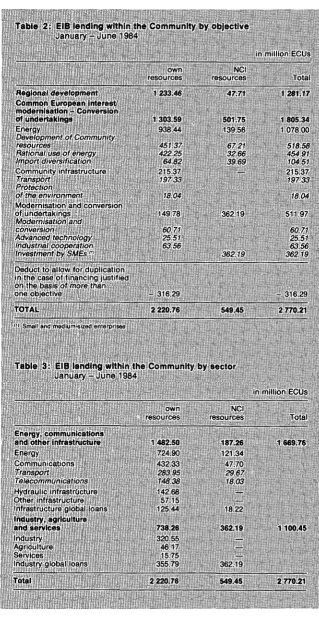
EIB financing operations within the European Community to support in-vestment in industrial, energy and infrastructure development totalled over 2 770 million ECUs. The bulk of this, some 80%, came from the Bank's own resources (essentially from borrowings which the EIB makes in its own name). The balance of nearly 550 million ECUs, was drawn from New Community Instru-ment resources, financed from funds raised in the name of the EEC by the Commission of the European Communities.
The major direction of the ElB's financing efforts continued to be towards investments in the Com-munity's economically more back-ward areas. In line with the Bank's main task, as set down by the Treaty of Rome, to promote more even economic development throughout Europe, some 62% of total financing was concentrated on Italy, Greece, and Ireland as having the most seri-ous regional development problems.
There was a doubling in the total finance made available in the form of global loans - basically lines of credit to banks and financial institu-tions for on-lending to small and medium-sized enterprises (nearly 720 million ECUs - over half from New Community Instrument re-sources'" - compared with just over 315 million ECUs in the first six months of 1983). ,
The general increase in demand for EIB funds in the industry sector was also reflected in the growth in the demand for finance from small-sized ventures. During the period, invest-ments in nearly 2 300 small-sized enterprises were financed, almost three times the level of the previous year.
'^' The Commission of the European Communities has been authorised by the Council of the European Communities to contract borrowings in the name of the EEC, within limits set by the Council, for the purpose of promoting investment in the Community. The Commission decides the eligibility of projects for a loan within guidelines laid down by the Council of the European Communities. The EIB examines the loan applications in accordance with its customary criteria, decides on the loans to be granted and the terms, and administers the loans.
Energy investments aimed at imple-menting the European Community's priority objective to reduce depend-ence on oil imports, continued to receive major support;.with financ-ing gofinanc-ing to projects aimed at more rational energy use and at diversify-ing energy sources seediversify-ing a sub-stantial increase.
EIB financing of energy ranged from support for small-scale schemes to rationalise energy use in Denmark and Italy, the introduction of solar panels in residential and service-sector buildings in Italy, three hydro-power plants in Greece, the develop-ment of three gas fields in Lombardy and the construction of a section of the Algeria-Italy intercontinental gasline in Latium, Italy, to a cross-channel electricity power link bet-ween France and the United Kingdom.
Financing of communications, espe-cially for transportation, also in-creased, with the Bank providing funds in particular towards con-struction of sections of the
Lorraine-The greatest growth in EIB opera-tions within the Community was in support of modernisation or conver-sion of enterprises to improve pro-ductivity and to introduce advanced technology, such as providing fi-nance towards the construction of part of a new advanced commuter aircraft near Naples, Italy, under a joint venture between Italy and France.
The major portion of this lending to support modernisation or conver-sion of industry was concentrated on small and medium-sized enter-prises.
Table 1 : EIB lending within the Community by country January - J u n e 1984
Belgium Denmark Germany Greece France Ireland Italy Luxembourg United Kingdom
Total
own resources
32.54 93 73 24.68 112.56 231.44 73 65 1 207.27 16 44 428.4E
2 220.76
NCI resources
79.43
—
18.04 143.56 15.09 232.82
—
10.52
549.45
in
Total
32.54 173.16 24.68 130.62 375.00 88.72 1 490 09
16.44 438.97
2 770.21
million ECUs
%
1.17 6.25 0.89 4.72 13.54 3.20 53.79 0.59 15.85
100.0
Bourgogne motorway in France, and part of the Luxembourg-Trier motor-way in Luxembourg as well as major road improvements in Ireland, the United Kingdom and Italy. Expan-sion and modernisation of the tele-phone networks in Southern Italy and Greece also received EIB funds. Projects with a beneficial environ-mental impact were also supported, such as financing of sewerage in-stallations to reduce pollution in the Gulf of Naples, and to assist in clear-ing up and improvclear-ing the environ-ment in the Mersey estury in the United Kingdom.
Outside the Community
Financing of projects in countries in the Mediterranean, African, Carib-bean and Pacific regions within the framework of agreements with the European Community was in-creased to total over 300 million ECUs. This compares with some 160 million ECUs ttie Bank channelled into development finance in coun-tries outside the European Com-munity over the comparable period last year (and 480 million for the whole of 1983).
Growth in financing operations was particularly marked in Mediter-ranean countries with the largest share going towards investments in Spain and Portugal in preparation for their membership oif the Com-munity. Lending operations in the Mashreq group of countries also saw a notable expansion.
Small and medium-sized invest-ments in the industry, infrastructure, agriculture and tourism sectors in many of the countries in the Mediter-ranean region, in particular Spain and Portugal, were supported with global loans.
In the Northern Mediterranean coun-tries, EIB financing went towards projects such as railway improve-ments and pumped storage hydro-electric schemes in Spain, construc-tion of a power staconstruc-tion and airport developments in Portugal, and the modernisation pf the Trans-Yugos-lav railway.
Examples of investments receiving EIB financing in other Mediterra-nean countries include the
connec-Table 2: EIB lending within the Community by objective January-June 1984
in million ECUs
Regional development Common European interest' modernisation - Conversion of undertalcings
Energy
Development of Community resources
Rational use of energy Import diversification Community infrastructure
Transport Protection of the environment
Modernisation and conversion of undertakings
Modernisation and conversion
Advanced technology Industrial cooperation Investment by SMEs '•
owin resources
1 233.46
1 303.59 938.44
451.37 42225 64.82 215.37 197 33
18.04
149 78
60 71 25.51 63.56
NCI resources
47.71
501.75 139.56
67.21 32.66 39.69
36219
362.19
Total
1 281.17
1 805.34 1 078.00
518.58 454.91 104.51 215.37
197 33
18 04
51197
60 71 25.51 63.56 362.19
Deduct to allow for duplication in the case of financing justified on ttte basis of more tfian
one objective 316.29 316.29
TOTAL 2 220.76 549.45 2 770.21
Small and modium-sized entorprrsos
Table 3: EIB lending within the Community by sector January-June 1984
m million ECUs
Energy, communications and other infrastructure Energy
Communications Transport
Telecommunications Hydraulic infrastructure Otfier infrastructure Infrastructure global loans Industry, agriculture and services Industry Agnculture Services
Industry global loans
Total
own resources
1 482.50 724.90 432.33 283.95 148.38 142.68 57.15 125.44
738.26 320 55
4617 15.75 355.79
2 220.76
NCI resources
187.26 121.34 47.70 29 67 18.03
18.22
362.19
362.19
549.45
Total
1 669.76
1 100.45
2 770.21
tion of a thermal power station to the national electricity grid, in Egypt, and a major new highway in Syria. Projects financed in the African, Caribbean and Pacific regions co-vered by the Lomé Conventions ranged from construction of a hyd-roelectric power scheme to supply electricity to Burundi, Rwanda and
Zaire, to strengthening the St Lucia Development Bank with an increase in its share capital and resources to support small-scale ventures, and support for small and medium-sized industrial and tourism ventures in Tonga.
The bulk of EIB financing outside Europe, nearly 275 million ECUs,
[image:11.589.217.536.50.670.2]came from the Bank's own re-sources, with most loans being granted an interest subsidy met from the European community budget or from the European Development Fund. The balance, some 30 million ECUs,were drawn from resources (European Community and EDF) managed by the EIB on behalf of the Community.
Borrowings
The period saw the ElB's overall borrowings also expand to match the gr;owth of its lending operations, reaching the equivalent of over 2.1 billion ECUs through public bond issues and private placements on international financial markets (as opposed to over 1.6 billion ECUs last year).
Main currencies borrowed were US dollar 24.1%, guilder 12.2%, Deut-sche Mark 10.6%, followed by the ECU at 10.6% and the yen at 9.8%. The ElB's borrowing in the ECU grew to 225 million ECUs (compared with 230 million for the whole of 1983).
The period also saw the Bank's first Italian lira public issue since 1972 for the equivalent of more than 108 million ECUs (Lit 150 bil-lion). Largest single issue (public) was in French francs for nearly 175 million ECUs (1 200 million French francs).
In addition to its public and private placements the EIB also raised the equivalent of just over 22 million ECUs through allottment to third parties of participations in its loans.
Below are the ECU'S values in national currencies, as at 29 June 1984; these rates are applied to the present quarter in preparing financial statements and opera-tional statistics of the Bank:
DM 2.23601 £ 0.593933 Ffrs 6.86199 Lit 1 376.26
Fl 2.51938
Bfrs 45.4920 Lfrs 45.4920 Dkr 8.19966 Dr 88.5804 IR£ 0.730807 US$ 0.803888
Statistics summarising Bank ac-tivities have been based on sever-al different conversion rates ap-plied since 1958 first to the unit of account, then the ECU. This, cou-pled with the effects of price trends, would suggest prudence in interpreting the significance of figures which relate to operations extending over several years.
ElB's largest Guilder bond issue
The European Investment Bank's largest public bond issue on the Netherlands' financial market, for 300 million Guilders, was an-nounced on May 23rd. The bond's coupon is 8 3/4 and it has a 10 year life, with redemption in the last five years, from 1990-1994.
The issue has proved to be very marketable. The previous largest
public bond issue in Guilders on the Dutch financial market was in October 1983 for 250 million Guil-ders.
Lead manager of the bank syndicate issuing the bond was Amsterdam-Rotterdam Bank N.V. with co-lead manager Algemenge Bank Neder-land N.V. Other co-managers of the syndicate include: Bank Mees &"
ElB's UK office move
The European Investment Bank's Liaison Office in London has moved to new premises at Pall Mall.
The new adress is: 68, Pall Mall London SW1Y SES
Tel. 839 3351 - telex 919159 bankeu g Telecopier 930 99 29
The Bank regards the United Kingdom as an important area for its loans - providing some £ 3200 million to help UK projects since the country joined the Community. It has maintained a Liaison office there since 1978. EIB Vice-President, C. Richard ROSS, and Head of the Department responsible for UK operations, Dennis KIRBY, are often in the London Office and avaible, by prior arrangement, for meetings. Guy BAIRD, permanent London representative gives informal and quick advice to borrowers, and potential borrowers, and keeps in close touch with financial, business and government circles in London and the regions.
Hope NV, Pierson, Heldring & Pier-son N.V., Coöperatieve Centrale Raiffeisen-Boerenleenbank B.A., Nederlandsche Middenstandsbank riv, Bank der Bondsspaarbanken N.V.; and Bank Brüssel Lambert N.V., Credit Suisse First Boston Li-mited, European Banking Company Limited, Société Générale de Ban-que S.A., Union Bank of Switzerland (Securities) Limited; and Banque Paribas, Deutsche Bank Ak-tiengesellschaft, Merrill Lynch Interr national & Co., Swiss Bank Corpora-tion InternaCorpora-tional Limited and Yamaichi International (Europe) Li-mited.
Last year the EIB raised a total of 879.8 million Guilders on the Dutch market: 400 million in two public issues, and 479.8 million in 21 pri-vate issues. In terms of the overall global volume of EIB borrowings (3 508.4 million ECUs), the Dutch Guilder held fourth position with over 10% (357.6 million ECUs) after the US-dollar at nearly 24% (834.3 million ECUs), the Deutsche Mark at 20% (705.6 million ECUs) and the yen at over 13% (468.5 million ECUs).
Printed in Luxembourg by éditpress luxembourg, 44, r. du canal, Esch/Alzette