Phare
^ H
Phare 1994
What is Phare?
The Phare Programme is a European Community initiative which supports the development of a larger democratic family of nations within a prosperous and stable Europe. Its aim is to help the countries of central and eastern Europe rejoin the mainstream of European development through future membership of the European Union.
Phare does this by providing grant finance to support its partner countries through the process of economic trans-formation and strengthening of democracy to the stage where they are ready to assume the obligations of membership of the European Union.
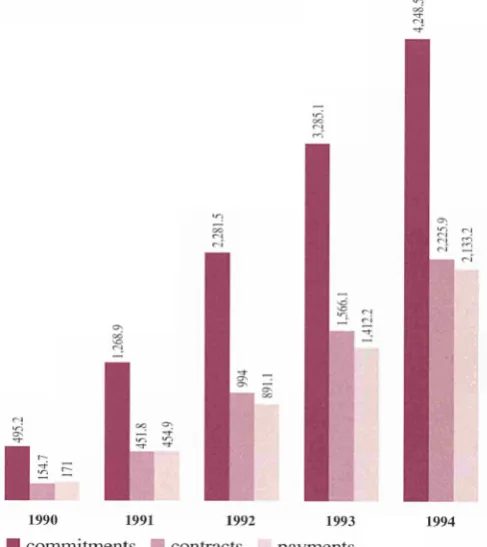
In its first five years of operation to 1994, Phare has made available ECU 4,248.5 million to 11 partner countries, making Phare the largest assistance programme of its kind.
The main priorities for Phare funding are common to all countries, although every one is at a different stage of transformation. The key areas include restructuring of state enteiprises including agriculture, private sector development, reform of institutions, legislation and public administration, reform of social services, employment, education and health, development of energy, transport and telecommunications infrastructure, and environment and nuclear safety.
For countries which have signed Europe Agreements, Phare funding is also focused on meeting the conditions required for membership of the European Community. In particular this concerns preparation for participation in the European Union's internal market and development of infrastructure, especially in border regions.
Phare works in close cooperation with its partner countries to decide how funds are to be spent, within a framework agreed with the European Community. This ensures that Phare funding is relevant to each government's own reform policies and priorities.
Contents
Commissioners' statement 2 Phare 1994 financial overview 3 1994 - a turning point for Phare 6 Political developments in 1994 6 Supporting a process of change 8 Consolidation and integration - a new role for Phare 10
Management of the Phare Programme 14
Albania 17 Bulgaria 18 The Czech Republic 19
Estonia 21 Hungary 22 Latvia 23 Lithuania 24 Poland 25 Romania 27 Slovakia 28 Slovenia 29 Phare funding by country 30
Commissioners' statement
The Phare Programme was set up as a response of theEuropean Union to the challenges that the countries of central and eastern Europe faced breaking free from totali-tarianism and 40 years of central economic planning. At the time, no one could foresee exactly what this would involve and how quickly each country would progress. Consequently, the Phare Programme was structured to work within the political and economic policies of the governments of the countries concerned, responding to their own requirements. In this respect, Phare is unique among the initiatives launched by the global community to support the changes taking place in central and eastern Europe.
In the early years of Phare, when the framework for politi-cal cooperation was still unclear, the focus was on the immediate and obvious objectives of economic transfor-mation. However, now that this process is underway, and in some instances almost nearing completion, the question of Phare's role in the wider political framework becomes more important. In this respect, 1994 was a highly signifi-cant year, culminating in the adoption by the European Council at Essen of a strategy for accession of the central and eastern European countries to the European Union.
The existence of Phare remains an important acknowl-edgement that striving for membership of the European Union is not a task that should be borne only by those countries seeking to join. The European Union itself has a responsibility to prepare the path to membership, both through the support it makes available through the Phare Programme and in making changes to it own structures to accommodate the countries of central and eastern Europe who wish to join.
The future for Phare and relations between the European Union and the countries of central and eastern Europe is an exciting one which holds both many challenges and many rewards. As the European Commissioners respon-sible for the Programme in 1994 and who will take the programme forward in 1995, we jointly commend this Annual Report to you.
The Phare Programme is one of the cornerstones of the accession strategy and important steps have been taken in 1994 to allow the Programme to focus on integration. In particular this has concerned the development of infra-structure, investment support and closer cross-border cooperation, both between the European Union and the countries of central and eastern Europe and between the countries themselves.
Hans van den Broek Member of
the European Commission
Sir Leon Brittan Vice-President of the European Commission
Phare 1994 financial overview
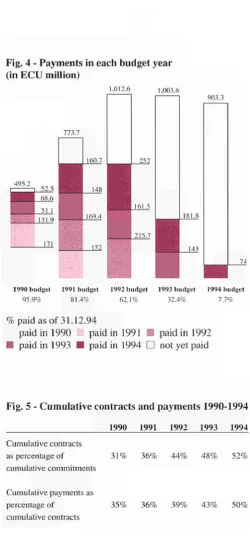
In 1994 the Phare Programme committed a total of ECU963.3 million to its partner countries. This brings the total of commitments over the life of the Programme to ECU 4,248.5 million.
During 1994 Phare contracted funds worth ECU 659.8 million - an increase of 15 per cent on the previous year. The Programme paid out ECU 721 million - an increase of 38 per cent from the previous year.
This means that of the total Phare commitments, 52.4 per cent has now been contracted and of the amount contracted, 95.8 per cent has been paid. This is an above average rate of disbursement for a programme of this type made up of a large number of small-scale know-how transfer projects as distinct from a limited number of major investment or loan operations.
The breakdown of the 1994 commitment of funds by country and by sector are shown below.
Phare funds committed from 1990-1994 ECU 4,248.5 million
1,012.6 1,003.6 „ , , yo3.3
495.2
1990-1994 funds committed by country (in ECU million)
Albania
Bulgaria
Czech Republic
Czechoslovakia
Estonia
GDR
Hungary
Latvia
Lithuania
Poland
Romania
Slovakia
119.5
1990 0
1991 0
1992 20
1993 1994 1990 1991 1992 1993 1994 1990 1991 1992 1993 1994 1990 0 1991 0 1992 0_ 199.1 1994 Slovenia
Former Yugoslavia
Multi-country programmes
1990 o 1991 ¿ 1992
1993 1994 1990 1991 1992 1993 1994 1990 1991 1992 1993
1990-1994 funds committed by sector (in ECU million)
Agricultural restructuring
Education, health, training and research
Environment and nuclear safety
Humanitarian and food aid
Infrastructure (energy, transport and
telecommuni-cations) Private sector development and enterprise support
Public institution and administrative reform
Social development and employment
Other sectors
1990 1991 1992 199 i 1994
199(1 ¡991 1992 1993 1994
1990 1991 1992 199 i 1994 I 9911 199 1 1992 1993 1994
1990 1991 1992 1993 1994 1990 1991 1992 1993 1994 1990 1991 1992 1993 ¡994
1990 199 1 1 9 9 ; 1993 1994 ¡99(1 199 1 1992 1993 1994
102.5
100
71,4
50
ik
1994 - a turning point for Phare
This is the fifth annual report of the Phare Programme-the European Community initiative which supports -the development of a larger democratic family of nations within a prosperous and stable Europe.
The year 1994 was perhaps the most significant year for Phare since the Programme's conception in 1989. It was the year in which a clear framework for the future devel-opment of Phare emerged, based on the develdevel-opment of a common political and economic agenda for relations between Phare and its partner countries in central and eastern Europe.
The Phare Programme developed initially as an immediate response to challenges facing the countries of central and eastern Europe as they sought to resume their central place in Europe's culture and civilisation and rejoin the economies and societies of Europe. A turning point came in June 1993 with the conclusion of the European Council at Copenhagen that the associated countries of central and eastern Europe that so desire shall become members of the European Union when they are able to assume the
obliga-tions of membership by satisfying the economic and political conditions required. This set a goal for the Euro-pean Union, Phare and its partners. The challenge during
1994 has been to set up a system to ensure that Phare can support its partners at every step necessary to achieve this goal.
What has emerged is that Phare is not a static instrument, designed exclusively to help in the transformation from centrally planned to market economies. It is now a flexible programme designed to support its partner countries through the process of economic transformation and strengthening of democracy to the stage where they are ready to assume the obligations of membership of the European Union.
Confirmation of Phare's central role in this process occurred at the end of the year, with the adoption by the European Council at Essen of a strategy for accession. The implementation of this strategy will involve some significant changes to the focus of the Phare Programme.
Political developments in 1994
The development of Phare is now intimately linked to theoverall development of political and economic relations between the European Union and the Phare partner coun-tries. This relationship has been cemented by Phare's role as the financing instrument of the Europe Agreements and its central position in the strategy for accession adopted at the Essen Council.
In this section the background to political and economic relations is outlined, together with the developments which took place in 1994 and an assessment of the conclu-sions of the Essen Council and its impact on Phare.
Background
Phare has always worked in tandem with the other Euro-pean Community initiatives which cover economic and political relations with the countries of central and eastern Europe. These initiatives initially covered establishing trade relations and developing market access and extending loan facilities. More recently they have developed a greater element of political, social and cultural cooperation. The process started in 1988 when Trade and Economic Cooperation Agreements were signed which established
favourable trade relations and aimed at significantly increasing trade between the European Community and these countries.
In 1990 the European Community developed a new form of agreement which went beyond just trade issues. These new agreements, known as Europe Agreements, established a framework whereby these countries can become more closely integrated with western Europe. They therefore covered political, economic and cultural cooperation in addi-tion to trade relaaddi-tions. The Agreements are based on shared understanding and values and set the path for integration. The European Community and its Member States have concluded Europe Agreements with six countries; Bulgaria, the Czech Republic, Hungary, Poland, Romania and Slovakia.
Thus the Europe Agreements became, in effect, a basic framework within which countries could work towards membership of the European Union. Phare is identified in these agreements as the financing instrument available to help countries meet the objectives set out within them.
Developments in 1994
In February 1994 the Europe Agreements entered into force with Poland and Hungary. These Agreements had been signed in December 1991 but were awaiting ratifica-tion by the parliaments of the individual Member States. While awaiting ratification Interim Agreements were in force which covered the basic trade-related aspects of the Agreements, thus ensuring that there was no delay in implementing this aspect. The Agreements with Bulgaria, the Czech Republic, Romania and Slovakia will come into force in February 1995.
Poland and Hungary also formally lodged an application for membership of the European Union.
In 1994 the Community also signed new Trade and Economic Cooperation Agreements with Estonia, Latvia and Lithuania. These agreements establish free trade with these countries. Negotiations for Europe Agreements with each of the Baltic states have started and similar negotia-tions with Slovenia are expected.
In 1994 a major step was taken which gave the process of cooperation, established by the Europe Agreements, a much clearer focus on the objective of achieving member-ship of the European Union. This was the adoption by the European Council at its Essen Summit meeting in Decem-ber of a strategy for accession prepared by the European Commission.
This strategy set out a route plan for the associated coun-tries as they prepare for accession. It encompasses the progressive preparation for integration into the internal market of the European Community, supported by imple-mentation of policies to promote
• integration through the development of infrastructure, including extension of trans-European transport networks
• intra-regional cooperation between the countries of central and eastern Europe
• environmental cooperation
• cooperation in the area of the common foreign and security policy
• cooperation in the areas of judicial and home affairs, culture, education and training.
The Essen strategy for accession and its
impli-cations for Phare
The Essen strategy states that "This integration will be supported by the European Union's Phare Programme which will develop on an indicative basis into a medium-term financial instrument with improved possibilities to promote infrastructure development and intra-regional cooperation".
In practical terms, Phare will devote a greater proportion of its funds to the co-financing of infrastructure develop-ment projects, with the limit on its annual budget for this type of spending being lifted from 15 per cent to 25 per cent. Infrastructure will also receive significant funding through the cross-border programme and through trans-port and environment projects. Phare will also introduce measures to promote cooperation between its partner countries and give a greater focus on investment support. It will also focus on supporting the partner countries in their steps to harmonise legislation, standards and prac-tices with the European Community in preparation for participation in the internal market. This will involve significant support to the system of public administration to ensure that the necessary legislation adopted can be implemented effectively.
The European Council agreed that the 1995 budget esti-mate for the Phare Programme will serve as a minimum level for the years up to 1999, in total ECU 5.5 billion. This will allow Phare to develop a comprehensive multi-annual programming framework for its operation through-out this period.
Supporting a process of change
The Essen strategy now presents Phare with the challengeof covering a very broad range of activities if it is to be flexible enough to meet the needs of all its partner coun-tries.
Phare has developed a range of approaches, many of them in close coordination with other sectoral European Commission programmes, which match the various stages a country will pass through on the road to eventual membership.
Phare's approach in the first stage covers support for basic macro-economic stabilisation, humanitarian assistance and the supply of basic imports necessary to sustain industry and agriculture.
The second stage covers broad-based sectoral assistance, largely in the form of know-how, designed to put in place the necessary structures for a market economy.
The third stage concerns consolidation where the supply of know-how becomes more tightly focused, in particular on areas of public administration and the mechanics of government. Investment support and infrastructure devel-opment also feature more prominently.
The fourth stage involves substantial support for the preparation for accession. It involves the development of infrastructure, physical integration in border regions with the European Union and the development and implemen-tation of the legislation necessary to participate in the internal market.
Consolidation and integration - a new
role for Phare
The past year has been an important one for Phare in terms of developing its capabilities in those areas which are linked to the consolidation of the reform process and closer integration with the European Union. These two areas will become increasingly significant for Phare and its partners as the move towards membership of the Euro-pean Union gathers pace and becomes a greater priority for each partner country.
Consolidation
The consolidation of reform has two basic focal areas. The first concerns developing the capability within govern-ment at all levels to manage and regulate a market-oriented system. One of the most profound changes which has occurred in the countries of central and eastern Europe has been the switch from a command system of govern-ment to a system based on regulation. This has also involved changes in the social security system which was previously linked to virtual full employment in state-owned enterprises. As many of these industries have now been restructured or transferred to private ownership establishing social security systems adapted to the needs of a market economy is an urgent priority.
Phare support is therefore focused on both the develop-ment of new institutions within governdevelop-ment and also non-governmental organisations which have a role to play in the operation and regulation of a democratic, market-oriented system. Support is also important in developing and implementing new legislation and other standards and practices.
The transfer of know-how remains an important element of Phare support because continued progress in this area depends on each partner country building a resource base of skills and experience - both inside and outside govern-ment and public administration.
The second area linked to the consolidation of reform is investment support. Now that many countries are complet-ing the basics of the transformation process in terms of restructuring state enterprises and establishing the condi-tions for the development of private enterprise there is an increasing need to provide or attract investment in order to maintain the momentum of economic development. Phare support in this area is therefore focused on creating the
Integration
Phare support for integration is covered under four broad areas of activity:
• co-financing investment in infrastructure
• elimination of border-crossing bottlenecks and estab-lishing customs corridors
• the cross border cooperation programme • multi-country and intra-regional cooperation.
Most of these areas focus on the development of transport infrastructure and contain a significant element of direct investment. However, the provision of know-how remains an important element, especially within some of the multi-country programmes and to support and complement investment projects.
Activities linked to consolidation and integration
A particular feature of Phare's work in 1994 has been the development of capabilities in areas which are of rele-vance to those partner countries which are entering the third or fourth stages of development on the road to even-tual membership of the European Union. These stages are the consolidation of reform and integration both with the European Union and with other central and eastern Euro-pean countries.
These capabilities are examined in more detail below. Legislative and public administration reform
The development of legal frameworks and the harmonisa-tion of laws with those of the European Community has always been an important element of Phare support. Phare already provides support in the following areas:
intellectual property consumer protection
harmonisation of standards and technical regulations customs and statistics
environment public procurement
competition and state aid, transport, post and telecom-munications
• banking sector, tax legislation and accounting.
The European Commission is currently preparing a White Paper which will provide detailed guidance on the adop-tion of the 'acquis communautaire' in the internal market area to be published before June 1995. This will build on the work on the harmonisation of legislation already accomplished by Phare in previous years.
However, in 1994, Phare took an important step in the development of a framework within which individual countries can develop their own programmes of legislative alignment. This was the launch, in June, of a framework contract to facilitate the approximation of laws in the Czech Republic. A consortium of three law firms and two training institutions is helping to draft and revise legisla-tion and regulalegisla-tions, providing training, hardware, soft-ware, books and documentation as well as translating large sections of legal documentation. A similar approach is being discussed with Hungary and Slovakia and has been proposed to Bulgaria, Romania and Poland.
In addition a framework programme of support to develop and approximate legislation has been set up for Latvia, Lithuania, Estonia, Slovenia and Albania.
Linked to the development of new legislation is the reform of the public administration system. This is because an effective public administration together with the appropri-ate administrative structures, staff and equipment is essen-tial to the actual implementation of any legislation that is developed.
Phare is supporting the necessary reform in the public administrations of central and eastern European countries by providing know-how to strengthen their administrative capacity. In 1994 Phare supported governments in their efforts to reform their public administration by providing support in the following areas:
• support for improvement in governance and manage-ment (known as SIGMA), a programme established in association with the Organisation for Economic Coop-eration and Development (OECD)
• reform of legal systems: drafting civil and penal codes and procedures, training of judges, reform of the Ministries of Justice and prosecution systems, training of the police
• institution-building: developing strategies, civil service policy and training, restructuring and upgrading of central administration, decentralisation policy and strengthening of local governments
• development of information technology.
Social restructuring
Phare support for the social sector is becoming increas-ingly important for those countries which are in the consolidation phase of reform. This is because establish-ing a system of social protection adapted to the needs of a market economy is a major undertaking which requires long-term action. Further progress in economic reform will also be hampered unless corresponding steps in social restructuring can be made.
Reflecting this need Phare support is now moving towards supporting long-term restructuring following up its initial focus on the immediate needs resulting from the first steps of reform. Phare is focusing on the following areas: • reform of the system for pension provision
• social security systems, to develop a new approach to social protection based on the experience gained in western Europe
• employment policies, to counteract the job losses resulting from the privatisation and restructuring of state-owned enterprises
• health care, in particular disease prevention, health services reorganisation and financing, training of health personnel and pharmaceutical policy.
Increasing investment support
Once the basic elements of economic transformation have been put in place the key to maintaining the momentum of economic development lies in achieving sustained high rates of investment.
The Phare Programme has always recognised the impor-tance of supporting investment and has therefore included initiatives to develop investment across the range of its programmes from the start of the Programme. However, in view of the increasing importance of attracting invest-ment as part of the integration process highlighted in the Essen strategy, Phare has focused on developing its investment support activities in a number of key areas: • improving the legal and regulatory frameworks. • continuing support to the investment promotion
agen-cies already set up under the Phare Programme. Such agencies have been set up in
The Czech Republic - Czechinvest
Estonia - Estonian Foreign Investment Agency
Hungary - Investment and Trade Development Agency Latvia - Latvian Development Agency
Lithuania - Lithuanian Investment Promotion Agency Poland - State Foreign Investment Agency
Romania - Romanian Development Agency
Slovakia - Slovak National Agency for Foreign Invest-ment and DevelopInvest-ment.
• providing finance across a wide spectrum of small businesses through established intermediaries. This is important both because it allows this important sector to have access to funding which it would otherwise be denied and because it serves as a model which the banking system can use to develop for its own lending to this sector.
• banking reform. The banking system is not yet struc tured to efficiently channel savings into investment, neither is the provision of venture capital highly devel oped. Phare will therefore intensify its efforts to support the reform of the banking sector and promote the provision of equity, including venture capital. - management training. A number of pilot operations
were started in 1994 and in the future the programme could support a large-scale industrial training attach ment programme.
Infrastructure investment
The decision of the Essen Council to raise the limit of the Phare budget that could be used to co-finance infrastruc ture investment reflects the importance of improving infrastructure as a major element in preparation for acces sion. This is because of the need to improve the physical links between the partner countries and the European Community and also because investment in infrastructure has a multiplier effect on economic growth.
While Phare may only finance a small percentage of a project's final costs its role can be crucial either to bridge the gap between the amount that international financing institutions can lend and the contribution required from government or because its status as provider of grant, rather than loan finance, improves the quality of the mix of a financial package.
This type of financing is provided by Phare in those cases where it mobilises more substantial loans from interna tional financing institutions or other investors or for projects supporting important integration objectives which would not otherwise go ahead.
Most of the projects co-financed to date have been within the transport sector. While Phare can finance any infra structure project within the terms of the Copenhagen Council decision, so far the projects have either been linked to the seven major projects in central and eastern Europe which have been identified as priorities under the development of trans-European networks or are linked to eliminating bottlenecks at key border crossings.
In 1994 ECU 100 million has been committed for the
co-financing of infrastructure investment in five countries (Poland, Hungary, Romania, Bulgaria and Albania). This covered eight projects (six transport, one gas pipeline project and a telecommunications project).
Cross-border programme
The cross-border programme is another important initiative linked to integration with a significant bias, at least in the initial stages, towards the development of infrastructure. The programme was first launched in 1994 on the initia tive of the European Parliament. It complements, and is closely linked to, the European Community's successful Interreg initiative. While Interreg is a programme aimed at cooperative development between regions on internal and external borders of the European Community, the Phare cross-border cooperation programme has the objective of developing networks and other forms of cooperation between border regions in partner countries with neigh bouring Interreg regions of the European Community. The principal fields of activity are transport, utilities, environ ment, economic development and human resources. Initially, in 1993, ECU 15 million from the Phare budget was set aside for interregional infrastructure cooperation. In 1994 this was extended to ECU 150 million. The coun tries eligible in 1994 were Albania, Bulgaria, the Baltic Republics, the Czech Republic, Poland and Slovenia. This will be extended to Hungary and Slovakia in 1995 as a result of the enlargement of the European Union to include Austria, Sweden and Finland.
During 1994 Phare worked closely with the Directorate General for Regional Policies which manages Interreg, to make sure that both address cross-border cooperation in a consistent way. In line with these efforts, and the Essen European Council conclusions, Phare is aiming to give a multi-annual perspective to the Cross-border cooperation programmes so that they correspond to the Operational Programmes for the Interreg Π programme which are decided on a multi-annual basis from 1995 to 1999. It is planned to prepare Multi-annual Indicative Programmes that mirror Interreg Operational Programmes and provide a framework for annual financing decisions.
the European Community concentrate on regional devel opment. To address these differences, Cooperation Agree ments between the neighbouring countries involved will be prepared. These will provide a framework including the settingup of joint programming and monitoring commit tees to agree objectives, implementation and monitoring. The first Cooperation Agreement was signed between Poland and Germany in December 1994.
Major projects launched under the 1994 Crossborder programme have concentrated on the following sectors:
transport environment energy education communications agriculture.
Phare funding was also made available for a smaller inter regional cooperation effort in the framework of the ECOS/Ouverture Programme, which supports cooperation on selected topics between cities and regions of the Euro pean Community and those of partner countries. Phare support enabled cities and regions of central and eastern Europe to take an active part in this programme.
Eliminating border-crossing bottlenecks
The third element of the Phare Programme which is concerned with integration are projects within the trans port sector developed either as part of partner countries' national programmes or under the transport multicountry programme.
Phare attention in this area has largely been focused on improving border crossings to eliminate bottlenecks. Following the collapse of the previous regimes and the opening of borders traffic across borders has increased well beyond the point with which border crossing facili ties were designed to cope. As a result delays, especially for freight traffic, can exceed 40 hours at some crossing points.
The problems that many of the partner countries have faced have stemmed from
• poor infrastructure and customs facilities at, or close to, the bordercrossings themselves
• outdated and inappropriate customs clearance and control procedures
■ lack of coordination between the authorities on both sides of the border.
Phare support has therefore focused both on improving practices through the transfer of knowhow and also on direct investments to improve the infrastructure. The focus of Phare activity in previous years had been on the transfer of knowhow providing advice on setting up the neces sary procedures and training customs staff. Now that most of the partner countries have put this in place, Phare support is placing greater emphasis on investment to improve the crossing points themselves. This can involve upgrading the roads and vehicleholding areas so that they can cope with the increased volume of traffic as well as restructuring or rebuilding the customs points themselves.
Phare has provided more than ECU 100 million for this area so far and by the end of 1995 more than 50 individual bordercrossing modernisation projects will have been implemented. Around ECU 80 million has been provided for the harmonisation and standardisation of documents and procedures as well as the computerisation of customs administrations.
An important new initiative in 1994 has been the develop ment of the customs corridor concept. This was first proposed in relation to establishing a corridor which could improve transport in the Balkans, disrupted by the conflict in the former Yugoslavia. Most of the planning for the Balkans customs corridor has now been completed, an exercise involving cooperation between five countries, coordinated by Phare with the support of the European Commission's Directorates General VII and XXI.
In March 1994 European transport ministers met in Crete for a panEuropean transport conference which identified nine priority transport corridors. Phare is financing most of the preinvestment feasibility studies as the first step towards developing these corridors. Phare has also started work on the development of a customs corridor in the Baltics.
Promoting multi-country and intra-regional cooperation
In this context Phare is actively supporting the Pact on Stability in Europe which aims to promote good relations between countries in central and eastern Europe and is one of the first joint actions of the Common Foreign and Secu rity Policy.
Phare funds totalling ECU 200 million are being used to fund projects submitted by the central and eastern Euro pean countries in the six main areas identified in the Pact as being the key themes for cooperation:
regional transborder cooperation questions relating to minorities
cultural cooperation, including language training regional economic cooperation
legal cooperation and administrative training environmental problems.
education and research, with the Commission's ACE and COSINE programmes which both received addi tional support
• public administration, with the SIGMA programme which received additional support and was extended to Albania, the Baltic States and Slovenia.
Preparatory work was also carried out in the areas of distance education and telecommunications.
Representatives in the group, which meets twice a year, are the National Aid Coordinators of the Phare partner countries. The group has a rolling presidency following the alphabetical order of country names. In 1994 Hungary had the presidency which was then passed to Poland at the end of the year.
A continuing emphasis was also placed on the develop ment of cooperation between the partner countries through Phare's multicountry programmes (previously called regional programmes) which were first set up in 1991. In 1994 multicountry programmes received an allocation of ECU 86 million and covered the following key areas: ■ energy, with specific emphasis on a clean coal strategy,
twinning and network programmes and the harmonisa tion of energy policies
• transport, with a continuing focus on the elimination of bordercrossing bottlenecks
statistics, in order to develop information systems to support and monitor economic reforms
An orientations paper for multicountry programmes was prepared and agreed for the first time in 1994, setting the priorities for multicountry funding during the course of the year.
Management of the Phare Programme
1994 was a significant turning point in the management ofthe Phare Programme. The new political and economic environment relating to accession and the experience gained over four years of programme implementation demanded a re-think of many aspects of the Programme's operation.
As a result, the Commission made some fundamental improvements to the way the Programme is structured, implemented and managed, as well as developing a new approach to the future management of the Programme. One of the most important areas of development concerned the strategy for accession adopted at the Essen Council. This involved preparing detailed working papers on how the Phare Programme could respond to the chal-lenges of supporting the countries of central and eastern Europe in their preparation for membership.
The production of these papers involved substantial devel-opment of policy and management covering both the nature of support provided and the way it could be deliv-ered. The areas which were developed, also covered in the previous section of this report, were infrastructure invest-ment, all forms of multi-country and cross-border coopera-tion, development of the internal market and the promo-tion of investment.
Linked to the Essen strategy are the developments in programming, in particular the agreement at Essen of multi-annual financial support up until 1999.
The issue of decentralisation, which has been acknowl-edged as an important step in the development of Phare, became more significant in the light of the Essen decisions and Phare has made substantial progress in the decentrali-sation of financial management as well as in determining how best to develop decentralisation of programme plan-ning and implementation.
Phare also launched an important initiative in financial management by establishing a common financial manage-ment system across all Programme Managemanage-ment Units which included systematic forms of monitoring and evalu-ation.
Finally, in recognition of the growing level of demand from many groups for information on the Programme, senior management seriously addressed the issue of communications for the first time.
Decentralisation
There is agreement between the Commission, the Parlia-ment and the Court of Auditors that Phare must continue its move towards greater decentralisation.
In the past, this had been viewed primarily from the point of view of technical and financial management and was related to establishing a system to allow Programme Management Units in the partner countries to have responsibility for the implementation and management of projects. However, the new focus on Phare as an instru-ment for accession has opened up a much broader perspective on what Phare should be seeking to achieve in terms of decentralisation. It has become clear that there is a need for partner countries to take the steps necessary to define and manage their own programmes to a greater extent, provided this is linked to specific conditions estab-lished by Phare, as well as to the more general objectives set out in the Europe Agreements.
This will have an impact on the structure of Phare. Many of the functions of task managers, currently being carried out in Brussels headquarters will be transferred to the partner countries, and activity in Brussels would focus more on strategic policy development and guidance. However, before this can be accomplished on a general basis, each partner country will have to have certain elements in place, such as rules for public procurement, a legal basis for tendering and an effective system of public administration and financial reporting. Hence the impor-tance of directing current Phare support to these areas.
Programming
Phare introduced multi-annual programming in the 1994 to 1996 Indicative Programmes which were negotiated in 1994 following adoption in the previous year of the 1993 to 1997 Phare Guidelines where the concept of multi-annual programming was first presented. This initiative is designed to ensure that Phare support more closely reflects each country's medium-term reform priorities, rather than being viewed as a series of one-off annual initiatives. At the time of its introduction the first concept of multi-annual programming was not supported by any multi-annual financial commitment, which hindered its implementation. Individual countries would indeed be reluctant to plan for Phare support in future years if there was no form of guarantee that funds would be available.
The lack of a multiannual financial commitment also slows project implementation because it is based on an annual budget which must be committed each year. This means going through the full programming cycle each year and the actual commitment of funds is condensed into the end of the year. It also means that management must devote a disproportionate amount of effort to the commit ment procedure, to the detriment of project management, implementation and monitoring and evaluation.
At the end of 1994, at the European Council meeting in Essen, the Council made a commitment to provide a minimum level of financial support for the period to 1999. The financial continuity necessary to construct medium term programmes for the use of Phare funds was thus provided. As a result future Indicative Programmes for the Czech Republic, Hungary, Poland and Slovakia will now be developed to cover the period from 1995 to 1999 and Indicative Programmes will cover the period 1996 to
1999 for the other partner countries.
Phare management in Brussels headquarters has also started to develop a new system of guidelines on programme management which reflect the new multi annual perspective and build in a greater element of moni toring and evaluation. These guidelines provide a more effective structure for planning a longerterm approach to the deployment of Phare funds.
It is anticipated that these guidelines will come into effect to cover a substantial part of 1995 programming.
Implementation
In 1994 Phare also launched an important initiative concerning the actual implementation of Phare programmes. This initiative was the introduction of a manual of procedures for the Decentralised Implementa tion System (DIS).
The DIS is a system which provides a single, consistent framework within which to manage projects. Its main component is an overall strategic plan, individual work plans and a system for reporting on monitoring and evalu ation over the life of a programme.
The key element of this system is the logical flramework matrix a system for establishing and measuring the objectives underlying any individual project
As part of the Decentralised Implementation System the financial accounting system which had been operating in Brussels headquarters for two years was adapted for, and extended to, the Programme Management Units.
The Decentralised Implementation System mnammaill further manual on contract and prccuHiamaat rates presented to all Programme MæraagEnjaiat Umãts irftimrïmg year, in association whh a arainnig pnograramæ.
These new mamiaK represent a naajsar step ffsarwardl ima streamlining the technical and fijimamriiai aspado; rf prasjjant management The manuals have been dfsãgmffd as fflksähåe systems which can be updated. Feedback leoeiraed ffircnmn the partner countries is being used to nnpiowe line system further.
Monitoring and
evaluation
Phare has introduced some impattami initiatives im moni toring and evaluation in 1994. These cower trattili 1 procedures as well as an assessment of how efflfcdrirse ι programme has been in meeting its objectives.
During 1994 Phare signed framework cxaair&dts mMh ¡a number of independent auditing finns. Their terieff ik tø conduct a detailed financial audit of seteetei projects. TTtte Phare units in the Commission's detegrÄams mm tine paramar countries have supplied lists of iinniiesffiate aimrfliittiinngr prjnaiji ties. but the ultimate aim of this aimditiüinig praaEss ik tø ensure that every Phare programme is ¡mÆm& at Ikrøtt twice during its life which is usually two tta tose years. The audit plan is given to the Gammi «sf Aiadfttonx aoiïfl Hanse torate General XX (Financial OaæUBnafl)) anoa t f e treparte «¡ff the audit teams are also maste ¡avaÜttfle tø tåesæ Q\w® bodies.
The results of these audits; are aJteaeïy prøwUBg ^^Udtìte im planning how to establish am esfifodtwe 3«aöÄ prørøess iin Φ future, more decentralised, «afserøtoiaim.
The advantage of this system is that, for the first time, one system of project management applies for all of the project implementers (the Programme Management Units} in the partner countries.
During 1994 a number «af commissioned to assess Programmes Hungary was investigation and so vrøte number of couiìtrìes.
æcrørts wwe ¡ite*» <eff i t e
The results of these studies have confirmed that the basic principles of Phare management are sound in that programme objectives match the partner countries' needs and results are meeting the objectives. However, the reports have highlighted areas where changes must be introduced to achieve more effective management. In particular these concern changes to financial and adminis-trative procedures to allow project implementers greater time to focus on the management of actual projects, rather than financial reporting.
The Decentralised Implementation System itself also introduces a more controlled approach to both technical and financial evaluation through the regular monitoring and evaluation reports which result from the operation of the logical framework matrix.
The next step in the area of evaluation is to establish a more systematic approach to the independent evaluation of programmes, in a similar way to that followed in 1994 with the financial audits.
Communications
The Phare Programme is almost unique among European Commission initiatives in the degree of legitimate interest that many groups, both in the Member States and the eleven partner countries, have in the Programme.
During 1993 it became clear that the resources devoted to satisfying the needs of these groups were not sufficient and that a more systematic approach was required. As a result, Phare management decided that a comprehensive communications strategy should be developed and resources devoted to communications should be increased. The strategy is based on a comprehensive research programme which identifies the information and commu-nication needs of key decision-makers and of those working for the Programme, both inside and outside the Commission.
The programme was launched from Brussels headquarters in mid-1994. The feedback has been sufficiently encourag-ing to step up the level of activity in 1995. Programmes have included: a major rethink on written and visual corpo-rate identity; a substantial publications programme in 22 languages, including timely release of contract information; and development of a communications database, which currently holds more than 40,000 names. The programme is now fully operational in Brussels, Warsaw, Prague and Budapest and during 1995 it will be extended to at least three and possibly five more partner countries. Other partner countries are involved on a more ad-hoc basis.
Albania
1994 was an important year for Albania and the Phare Programme. The emphasis of Phare support continued to move away from emergency assistance towards providing the knowhow necessary to put in place the structure of a market economy and democratic society.
This move reflects the steady improvement in the overall economic situation following the severe economic crisis which occurred in the wake of the collapse of the previous regime. Gross domestic product (GDP) grew by 6 per cent and the industrial output, which fell by 30 per cent in
1991, increased by 12 per cent in 1994.
This trend has enabled the government to put in place a longer term strategy for economic restructuring. Its medium term economic strategy for 1993 to 1996 and its public investment programme for 1994 to 1996 provide the basis for Phare's Indicative Programme which covers the period 1994 to 96.
Cooperation between Phare and the government has revealed a shared understanding of the main priorities for reform. As a result, the development of effective programmes which can be implemented efficiently has been possible.
The Indicative Programme for 1994 was signed in May and ECU 29 million was committed for five key areas: • sectoral restructuring (agriculture, health, SME devel
opment)
• infrastructure development ■ human resources development ■ institutional development • humanitarian aid.
In addition, ECU 20 million was allocated for cross border cooperation with the neighbouring countries of Greece and Italy. The focus is on the transport sector and, in particular, the improvement of road infrastructure and border crossings in the key eastwest and northsouth corridors.
At the end of the year a package of balance of payments support for ECU 35 million was also agreed. ECU 15 million of this will come under the 1994 budget with the remaining ECU 20 million provided in 1995.
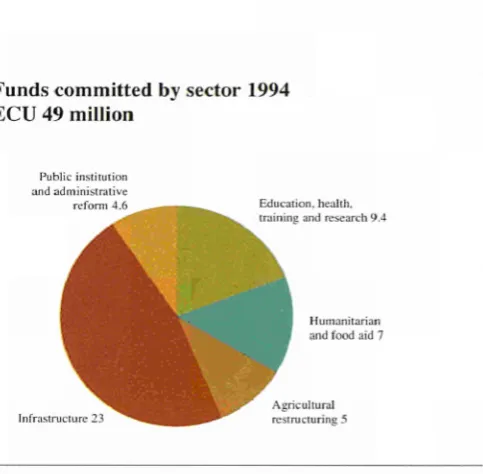
Funds committed by sector 1994 ECU 49 million
Public institution and administrative reform 4.6
Infrastructure 23
Education, health, training and research 9.4
Humanitarian and food aid 7
Agricultural restructuring 5
Agriculture continued to be a key priority for Phare support in 1994. The process of land reform is well advanced with 98 per cent of arable land now in private hands, although most of this is taken up by small subsist ence farms. In order to develop agriculture as a viable sector for private entrepreneurship, Phare activities include the promotion of an operational agricultural credit system, the development of agricultural extension services for private farming and support for land mapping. Phare provided training and equipment for three map production institutions responsible for the survey, mapping and regis tration of over 1.8 million parcels of land.
There is an increasing and urgent need to address the severe deficiencies in Albania's infrastructure, a fact recognised by the government and included in its public investment programme. Phare is therefore focusing on improving infrastructure, in particular roads and port development. Phare is also cofinancing the modernisation of the Dürres ferry terminal. The existing infrastructure has to be substantially improved to be able to respond to increased traffic in the last two years.
[image:19.595.303.545.107.344.2]Bulgaria
The foundations of a market economy and democratic society have been established in Bulgaria. However, the pace of economic reform and development in Bulgaria has slowed over the last two years due to the particularly diffi cult economic conditions, the embargo against Serbia and Montenegro and political changes. The country still faces high inflation and unemployment and a major budget deficit.
However, 1994 was a year when some positive signs emerged. The government put in place an ambitious economic plan and progress was made in several areas including the passage of the bankruptcy law and the intro duction of VAT which took effect from 1 April 1994. Trade with western markets has also increased signifi cantly in recent years.
Funds committed by sector 1994
ECU 85 million
Public institution and administrative reform 1.2
Private sector development and enterprise support 3
Infrastructure 62.6
Education, health, training and research 12
Environment and nuclear safety fi
Phare has played a significant role in the transformation of the Bulgarian economy. Phare funds have gone to the core areas of transformation, including privatisation and restructuring of state enterprises, private sector develop ment, modernisation of bank and financing services, labour market and social sector reform.
In addition, Phare has provided humanitarian aid and a specific supplementary budget for nuclear safety.
However, Phare has faced increasing difficulties in imple menting its programmes, in particular because the nature of support is shifting away from supply programmes and the provision of firststage knowhow towards more specialised support. This shift requires a greater level of cooperation with the government and progress on estab lishing legal and institutional restructuring in certain key areas. Such progress has been difficult due to several changes of government.
However, in 1994, the government introduced an ambi tious reform programme. Phare activities were adjusted to support this and at the same time became more focused on those areas where past experience has shown positive results:
• private sector development
■ human resources development and institutional reform • investment support.
In total ECU 85 million was committed to Bulgaria under the 1994 programme.
Of the overall amount of funds committed in Bulgaria since the beginning of the Programme in 1990, the percentage of contracted funds is slightly below the average (48 per cent against 52 for the whole Programme).
Disbursement rates over the period are about average for the Programme as a whole (with 51 per cent of funds contracted actually paid against 50 per cent for the average).
Some particular highlights of Phare's activities in 1994 included support to the energy sector, both to improve safety at nuclear facilities and to remove the reliance on nuclear power by upgrading coalpowered stations. In particular, Phare will participate in the financing of the installation of an emissions reduction system at the Maritsa East power station. This will enable the environ mental standards to be met which are necessary to unlock financing for plant modernisation from the European Investment Bank and the European Bank for Reconstruc tion and Development.
Phare is also participating in the financing of some impor tant infrastructure projects including the development of the E79 northsouth highway.
With the support of Phare work is also progressing on streamlining the Bulgarian telecommunications sector, both through training and the development of human resource policies and modernisation of the facilities of Bulgarian Post.
Under the crossborder cooperation programme with Greece, Phare also finances the reconstruction of several sections of the DupnitzaKulata railway line including electrification of railway over 114 km in one direction. Another project is helping to install a new telecommunica tion link from Kavala to Haskovo including the laying of a
120 km fibre optic cable and installing a digital transmis sion system in Sofia.
Czech Republic
1994 was a turning point for Phare in the Czech Republic. In the context of preparing the 1994 to 1996 multi-annual Indicative Programmes, a review of Phare activities was carried out. New orientations were established on the basis of which Phare was able to secure much greater support from the government based on a shared recognition of the importance of Phare in helping the Czech Republic move towards its desired membership of the European Union. The review also took account of the desire of the Czech government to shift the focus of Phare support from private sector development to support for public services, including infrastructure investment. The government also asked for less selective support for enterprise restructuring and for efforts in the private sector to be focused over the medium term on support for generalised services and busi-ness development programmes.
Funds committed by sector 1994 ECU 60 million
Public institution and administrative reform 1 1
Education, health, training and research 5.5
Agricultural restructuring 4.5
Social development and employment 1
Infrastructure 25
The Programme review showed that delays in implement-ing the 1991 to 1993 programmes caused by the split of the Czech Republic and Slovakia, combined with the rapid transformation of the Czech economy from a centrally-planned to a market economy, meant that fund-ing was gofund-ing to areas which were no longer necessarily priorities. Over 90 per cent of former state assets are now in private ownership, inflation is under control and unem-ployment is low. The decline in economic growth seems to have been reversed, with forecasts now predicting growth of around four per cent. The state budget is balanced and the country has a surplus on its current account.
Government priorities shifted to the consolidation of economic reform and the development of integration with the European Union. As a result Phare activity will become increasingly focused on legislative integration and the implementation of the Europe Agreement, as well as on developing infrastructure.
This new approach will be further developed in the 1995-1999 Indicative Programme.
ECU 60 million was allocated to the Czech Republic in 1994, of which ECU 25 million was allocated to projects under the new cross-border cooperation programme.
Some of the important initiatives of 1994 included the development of the Regional Investment Company in Ostrava and the National Training Fund. These initiatives represent an important development in decentralisation and greater involvement of Czech organisations in decid-ing where Phare funds are used. Two interestdecid-ing new initiatives, the Energy Conservation Fund and an Environ-ment Revolving Fund, are under preparation and are expected to be implemented during 1995 in cooperation with the EBRD.
The Regional Investment Company is an ECU 8 million fund for the development of high growth companies mainly in the Ostrava region. Phare has provided the capital and a chief executive who has been seconded from an investment company in the European Union. Financing decisions are approved by a board of local business people. Since the fund officially started operations in June
1994 it has invested ECU 1.1 million in four projects. A further investment of ECU 2.7 million has been approved by the Board and is being implemented.
The concept of establishing sectoral funds has been incor-porated in the new approach to Phare which will be launched in the 1995 to 1999 Indicative Programme. Within the framework of the programme for small and medium-sized enterprises support was given to more than 5,000 entrepreneurs by providing advisory services through a network of 20 regional centres and Business Information Centres.
The cross-border cooperation programme was the main innovation in 1994. Despite some initial reservations the programme is proving to be a popular and much-appreci-ated initiative. Six projects have been agreed concerning the improvement of transport infrastructure, the purifica-tion of water supplies, a steam pipeline for the improve-ment of heat distribution and the reduction of toxic emis-sions in the Czech - German border region.
In the area of foreign investment the Phare-supported investment promotion agency, Czechinvest, successfully developed its activities including the establishment of a local representatives network in Czech regions as well as a
foreign representation in London (France and Germany are at the stage of preparation). Czechinvest also directly secured six investments in 1994 amounting to the value of US$ 48 million, generating 1,250 new jobs.
Contracting and disbursement rates of the Czech Republic are far below the average of the Programme as a whole with only 13 per cent of funds committed actually disbursed and 21 per cent of funds contracted actually paid since the Programme started to support the country. This performance has not yet had serious consequences on project implementation as it only accounts for the Czech performance since 1993 when it became independent. Phare also took some important steps in the development of a proactive approach to communications. Research was carried out in the second half of the year to identify how best to improve communications with the Programme's key target audiences. The results of this research have been used to design a communications programme for 1995 which supports the overall communications strategy developed for Phare by the European Commission.
Estonia
Phare funds for Estonia in 1994 almost doubled from the 1993 level, increasing from ECU 12 million to ECU 22.5 million. The increase is based on the good performance of the Phare Programme and the firm commitment of the government to the reform process.
Cooperation between the Estonian government and Phare has resulted in effective project implementation and a correspondingly high contracting rate (55.5 per cent of total funds committed). Disbursements at the end of 1994 stood at 25 per cent of funds contracted. The ability of the government and of institutions to identify and implement programmes has thus improved, helped by the Phare Aid Coordination Unit established within the Ministry of Finance. With assistance from this unit, the different government and non-governmental organisations are now able to manage the majority of the programmes them-selves instead of relying on direct programme implemen-tation by the Phare services in Brussels.
The government has been successful in establishing a framework for an independent economy following the extreme economic disruption resulting from Estonia's independence from the Soviet Union. Trade has been focused towards the west. An important initiative in this respect was the signing of a free trade agreement with the European Community and the start of negotiations for a Europe Agreement.
Phare funding in 1994 has become more focused on key areas of reform such as privatisation and structural reform. The areas for Phare support, as outlined in the Indicative Programme signed in May, are economic reform, infra-structure development and institutional and human resources development.
Funds committed by sector 1994 ECU 22.5 million
Infrastructure 6
Environment and nuclear safety 2.5
Private sector development and enterprise support !
Education, health, training and research 4.5
Estonia had privatised almost half of its large state compa-nies by the end of August 1994 with 157 deals signed for a total sale value of approximately ECU 60 million. Phare supported this through the creation of the Estonian Privati-sation Agency, the drafting of relevant legislation, the preparation of pre-privatisation studies on key industries and training for board members and managers of privat-ised companies.
Phare also targeted the environment through the develop-ment of a national environdevelop-ment strategy and an allocation of ECU 4 million devoted to solving the problems of envi-ronmental hot spots.
Hungary
Hungary is well advanced in its economic transformation process and has put in place most of the basic elements of a market economy and democratic society.
Funds committed by sector 1994 ECU 85 million
It has therefore reached the stage in its relationship with Phare where support is becoming more focused on consoli-dation of reform and integration with the European Union. This is an important but difficult stage because it frequently involves tackling politically sensitive areas and making tough decisions. In Hungary some severe macro-economic problems, such as the high level of consump-tion, foreign debt and a current account deficit of around nine per cent of GDP, had not been tackled and threatened the momentum of reform.
Phare established some basic objectives with the new government elected in May 1994. These are
• to foster the conditions favourable for a resumption of economic growth consistent with maintaining external and internal balances
• to deepen and extend the reforms • to address pressing social issues.
In total ECU 85 million was allocated to Hungary in 1994 and the areas selected for Phare support were private sector development, infrastructure development and human resources development.
The rate at which Phare projects were implemented in Hungary is slightly above the average for Phare countries. At the end of 1994 55 per cent of the total committed to Hungary over the life of the Programme had been contracted. This compares to a figure of 52 per cent for the Programme as a whole. The disbursement rate stands at 62.5 per cent of funds contracted.
There is nevertheless a need to improve coordination between the Hungarian National Coordinators office and the Commission in order to identify projects which are relevant to the government's reform priorities and which can be implemented rapidly and effectively.
Nonetheless, there have been some very positive develop-ments during the year. The programme of support for small and medium-sized enterprises has been one of the most successful of any run in the Phare partner countries.
Infrastructure 29
Environment and nuclear safety 15.5
Private sector development and enterprise support 16.5
Education, health, training and research 24
Phare has also contributed to some major developments in the banking and finance sector - in particular the comple-tion of a second-round bank re-capitalisacomple-tion scheme. 1994 was also the first year that Phare made significant investment in infrastructure. Phare concentrated on the sectors of transport, environment, energy and on the modernisation of border crossings. In particular the Phare Management Committee approved in 1994 the co-financ-ing of two road rehabilitation projects (the E77 link to Slovakia and the M5 link with Romania) while five priority border crossings have been selected for improvement -three with Romania and one each with Slovakia and the Ukraine. These improvements are an urgent priority due to the increase in traffic caused by the Balkan conflict. Implementation of these projects should start in early 1995.
The Trans-European Mobility Programme for University Studies (Tempus) for the exchange of academic staff and students in higher education with institutions in the Euro-pean Union was also very successful and received a further ECU 16 million in 1994.
The year also saw a significant increase in the number of Hungarian organisations under contract to implement Phare projects. Hungarian organisations represent 80 per cent of the total number of contracts awarded between
1990 and 1994 by Phare.
Latvia
Phare substantially increased its funding for Latvia in 1994. From ECU 18 million in the previous year funding was raised to 29.5 million in 1994. This was due to Latvia's demonstration of its ability to implement projects effectively and therefore absorb a greater level of funding. This is also demonstrated by the Programme's financial performance. At the end of 1994 49 per cent of funds committed since Phare started to support Latvia were already contracted. Disbursement for the same period of time (19921994) is 25 per cent of funds contracted. The government is increasingly aware of the role that the Phare Programme can play in the development of the economy and in reaping the benefits of increased integra tion and trade with the European Community.
Funds committed by sector 1994
ECU 29.5 million
Private sector development and enterprise support 1 4 J
Education, health training and research 5
After a severe economic recession in the early 1990s, 1994 was a positive year for economic development in Latvia. There was a substantial improvement in the balance of payments, unemployment remained stable at 6.1 per cent and inflation decreased. The exchange rate for the new Latvian currency, the Lats, has remained stable against major currencies in the first quarter of 1994 and shows a persistent tendency to strengthen against the US dollar.
In the latter half of 1994 the government produced a National Indicative Programme to cover the period from
1995 to 1997 with the following priorities:
• economic stabilisation and development with particular emphasis on the banking and financial sector
• legal reform, including land reform, property registra tion and other issues necessary to facilitate privatisation ■ public administration reform, including development of
institutions and human resources development.
This will provide a useful guide for the development of the Phare Indicative Programme for 1995 to 1999.
The financial support from the Phare Programme for Latvia in 1994 concentrated on economic reform, institu tional and human resources development and infrastruc ture development.
Some of the major programme developments in 1994 included establishing a training programme for 10,000 central government civil servants. This programme will be expanded in 1995 to train 17,000 local government and police staff.
Phare has also been involved in the reform of the national education system in 1994. A supplementary allocation of ECU 3 million was made available in the third quarter of the year to support vocational training and educational reforms.