This is a repository copy of Modelling the Nonlinear Oscillations Due to Vertical Bouncing
Using a Multi-Scale Restoring Force System Identification Method.
White Rose Research Online URL for this paper:
http://eprints.whiterose.ac.uk/129015/
Version: Accepted Version
Article:
Guo, Y., Guo, L., Racic, V. et al. (2 more authors) (2018) Modelling the Nonlinear
Oscillations Due to Vertical Bouncing Using a Multi-Scale Restoring Force System
Identification Method. International Journal of Signal and Imaging Systems Engineering.
ISSN 1748-0698
https://doi.org/10.1504/IJSISE.2018.10011744
[email protected] https://eprints.whiterose.ac.uk/ Reuse
Items deposited in White Rose Research Online are protected by copyright, with all rights reserved unless indicated otherwise. They may be downloaded and/or printed for private study, or other acts as permitted by national copyright laws. The publisher or other rights holders may allow further reproduction and re-use of the full text version. This is indicated by the licence information on the White Rose Research Online record for the item.
Takedown
If you consider content in White Rose Research Online to be in breach of UK law, please notify us by
1
Modelling the Nonlinear Oscillations Due to
Vertical Bouncing Using a Multi Scale
Restoring Force System Identification Method
Yuzhu Guo1,2,3, Lingzhong Guo1,3, Vitomir Racic3,4,5, Shu Wang4, and S. A. Billings1,3
1 Department of Automatic Control and Systems Engineering
The University of Sheffield, Sheffield, UK
2 School of Automation Science and Electrical Engineering
Beihang University, Beijing, China
3 INSIGNEO institute for in silico Medicine
The University of Sheffield, Sheffield, UK
4 Department of Civil and Structural Engineering
The University of Sheffield, Sheffield, UK
5Department of Civil and Environmental Engineering
Politecnico di Milanok, Milan, Italy
Abstract
Human vertical bouncing motion is studied using a system identification method. A multi-scale
mathematical model is identified directly from real experimental data to characterise the nonlinear
oscillation associated with the vertical bouncing. A new method which combines the restoring force
surface method and the iterative orthogonal forward regression algorithm is proposed to determine
the model structure and estimate the associated parameters. Two types of sub-models are used to
study the nonlinear oscillations in different scales. Results show that the model predicted outputs
provide excellent predictions of the experimental data and the models are capable of reproducing the
nonlinear oscillations in both time and frequency domain.
Key words:
iterative orthogonal forward regression, iOFR, restoring force surface method, multi-scale, radial basis function, hybrid model1. Introduction
Studies of the induced dynamic load that arises from people walking and bouncing is an important
subject in many fields including biomechanics, medical science, sports science, robotics, control
systems, and also civil engineering. Many authors have studied the motion of the human body in
walking, jumping, and bouncing from different aspects (Blickhan, 1989; Ernesto & Tianjian, 2009;
2 Vitomir Racic & Chen, 2015; V. Racic & Pavic, 2010a, 2010b; V. Racic, Pavic, & Brownjohn, 2009;
Spägele, Kistner, & Gollhofer, 1999a, 1999b; van Werkhoven & Piazza, 2013).
A complete representation of body motion introduced by bouncing includes the modelling of vertical,
lateral, and longitudinal motions (Garcia, 1999). The vertical component is often studied as part of the
crowd-structure interaction in civil engineering while the lateral and longitudinal components are
often studied for the lateral stability of the human body during walking and bouncing. In this paper,
only the vertical motion due to human bouncing will be investigated.
In this paper, the motion of a marked point on the chest of a test subject during bouncing is recorded
and investigated using a system identification method. The modelling of the motion of human body
can be very complicated because of the following difficulties. Firstly, the human body is composed of
several connected segments: head, trunk, arms, legs, feet and so on. These segments are connected
by joints and interact with each other in motion. Each of these segments may have a complex effect
on the motion of a specific point and the effect is unknown. For instance, the motion of the head
depends on the movements of trunk, legs, ankles, and so on. In the robotics, especially in the
investigation of the stability of robots, the motion of a robot is often simplified as a multi-link inverted
pendulum. The movement of the top-end could be very complex because of the effects from the lower
segments of the system. Another source of complexity is that the mass of the human body is neither
lumped in a mass centre nor distributed uniformly. Therefore, modelling the motion of the marked
point using a first principles method can be very difficult. In this paper a system identification method
is used to study the motion of a marked point of human body which is on a relatively high position of
the human body and the motion of this point is of rich dynamics. In the investigation of complex
systems, a system identification method often has significant advantages. The system to be identified
is considered as a black box, which avoids the complex underlying mechanism in the system. The data
of interest are collected through experimental methods and the relationships between these
observations are studied.
In this paper, a continuous time model will be identified for the body motion in vertical bouncing by
studying the relationships between the displacement, velocity and accelerations. This method is
known as the restoring force surface method (RFS). Restoring force surface method as an ideal method
for the study of nonlinear dynamics has been widely used since the first introduction (Masri, Bekey,
Sassi, & Caughey, 1982; Masri & Caughey, 1979). Restoring force surface method which converts the
problem of modelling nonlinear dynamics into the surface fitting in the state space significantly
simplified the modelling process. The restoring force surface is usually reconstructed using the
3 yields insight into the physical system. This allows one to qualitatively study the primary difficulties
encountered in nonlinear system identification: what nonlinearities involve in the system and how
these nonlinearities affect the dynamics behaviours of the system. For some more complex cases
where the restoring force surface cannot be represented using a uniform nonlinear function, a
piecewise models (Allen, Sumali, & Epp, 2008) and local restoring force surface method have been
studied (S. W. R. Duym, Schoukens, & Guillaume, 1996). For a complete discussion of the restoring
force surface method, readers are referred W T (Worden & Tomlinson,
2001) and the related papers (Worden, 1990a, 1990b). Some quantitative methods have also been
intensively studied especially the direct parameter estimation methods (Worden & Tomlinson, 2001).
However, the problems that which set of nonlinearities are involved in the system dynamics and how
to get a minimum set of nonlinearities which is sufficient to represent the systems seems not to be
perfectly answered.
In this paper, a new method which combines the restoring force surface method with the iterative
orthogonal forward regression (iOFR) algorithm (Yuzhu Guo, L.Z. Guo, S. A. Billings, & H. L. Wei, 2015c)
will be introduced to try to give a satisfying answer to these problems. The orthogonal forward
regression algorithm (is also known as forward orthogonal least squares regression algorithm) and the
associated error reduction ratio (ERR ) have been proved to be powerful tools for determination of
nonlinear model structures in various ranges of applications (S. A. Billings, 2013). The OFR algorithm
has recently been used to identify nonlinear continuous time models (Yuzhu Guo, Guo, Billings, & Lang,
2015; Yuzhu Guo, Guo, Billings, & Wei, 2016). The iOFR algorithm is an improvement to the classic OFR
algorithm. The iOFR has been proved to work better under a non-persistent excited condition (Yuzhu
Guo, L. Z. Guo, S. A. Billings, & H. L. Wei, 2015b). In the application of the orthogonal forward
regression algorithm, a very wide range of terms can be used according the needs of the practical
systems, such as, polynomials, rational functions, spline functions, radial basis functions (RBFs),
wavelet functions, and so on (Stephen A. Billings, Wei, & Balikhin, 2007; Wei, Zhu, Billings, & Balikhin,
2007). Because of the complexity of the system under consideration, three different types of
regressors will be used in this paper to model the body motion due to vertical bouncing: the
polynomials, multi-scale radial basis functions (or wavelets) and the hybrid regressors which combine
the first two kinds of functions.
The iterative orthogonal forward regression restoring force surface method is capable to model a
complex restoring force surface. For example the non-uniform restoring force surface can be
identified using piecewise spline functions or radial basis functions as regressors to obtain a parsimony
4 functions (S. A. Billings & Wei, 2005) will be combined with the restoring force surface method to give
a coarse to fine representation of the nonlinear oscillation in body motion.
Since the body motion in this study is the source of the human-introduced dynamic forces the study
of the nonlinear oscillation is of a significant meaning in study of the ground reaction force. The
introduce method can also be directly used to study the relations between the body motion and the
ground reaction forces by replacing the measured restoring force with the ground reaction force(Y.
Guo et al., 2017). The nonlinear oscillation of the marked point on body trunk instead of the ground
reaction force is studied because experimental data show that the motion of body trunk is of a richer
dynamics compared with the ground reaction force. A direct recovering of the ground reaction forces
using the same method will be studied in a separate paper.
This paper is organised as follows: Section 2 briefly explained the experiment from which data were
collected and the preliminary analysis of these data. Section 3 introduced the new iterative orthogonal
forward regression restoring force surface method. Three different kinds of sub-models are used to
identify the body motion in section 4. The advantages and disadvantages of each model are discussed.
The conclusions are finally drawn in section 5.
2. Experiment and data analysis
2.1 Experiment
The experiment was conducted in the Department of Civil and Structural Engineering, the University
of Sheffield, Sheffield, UK. This study has been approved by the Research Ethics Committee of the
University of Sheffield and conforms to the ethical guidelines.
A test subject bounced on an AMTI BP-400600 force plate following a 1.2 Hz metronome beat. The
body motion was measured using optical motion capture technology. Two markers were attached on
the chest and pelvis of the test subject, respectively. Cameras recorder the movements
(displacements, velocities and accelerations) of the target markers in real time. The test last 35s and
the recorded signals were sampled at 200Hz. Figure 1 shows the recorded displacement, velocity, and
the acceleration signals of the chest marker.
In this paper the vertical motion of the marker on chest is studied. This point is studied because this
point is at a relatively high position of the human body. The effects from the lower parts of human
5 same time, since this point was chosen on the line of symmetry of the body the influent from the
lateral movement is small and negligible.
Figure 1 Recorded signals
2.2 Analysis of the experimental data
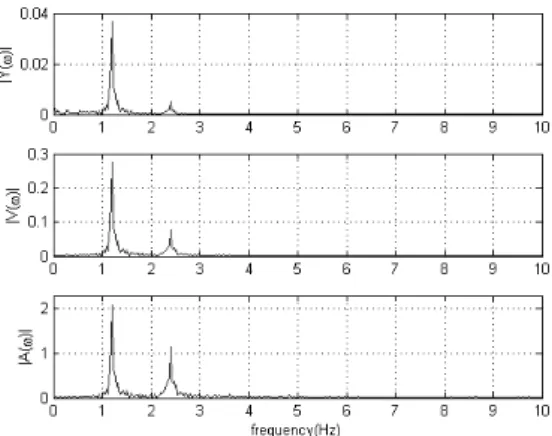
Fast Fourier transforms of the recorded displacement, velocity, acceleration series show that the main
spectral component of these signals is at 1.2 Hz and the second order harmonic at 2.4 Hz. The
higher-order harmonic components are small. The spectrum of the displacement at the frequencies over 3
Hz is very smooth and the higher-order harmonics can hardly be observed. This is because the
displacement signal is integratal of the velocity and acceleration and the integrands have typical low
pass property. Since there is no external excitation in this autonomous system the harmonics in these
signals are introduced by nonlinearities.
Figure 2 The frequency spectra of the displacement, velocity, and acceleration signals
The nonlinearities can obviously be observed in the phase portrait of these signals which are shown
in Fig 3, especially in the acceleration- displacement phase plane in Fig 3 (c). The system is nonlinear
6 dimensional plane. Namely, the displacement
y t
, velocityy t
and the accelerationy t
satisfya linear equation
0
my cy ky (1)
Rearrangeing equation (1) yields
my cy ky (2)
The right hand side of the equation represents the restoring force of a linear system composed of the
elastic force ky and the damping force cy, where
c
andk
are the dumping coefficient andstiffness, respectively. Fig 3 (b) shows that the scattering of data in the three-dimensional state space
is flat in the acceleration direction which forms a surface in the state space. However the scattering
of the data is far from a plane. That is the data does not satisfy the linear relationship (1) but a
nonlinear one. A general form for nonlinear second order systems can be given as
,
my
f y y
(3)where the internal restoring force is a nonlinear function of the displacement and the velocity.
Equation (3) shows the basic idea of the restoring force surface method (Masri & Caughey, 1979)
which will be used to identify the model of the system in the next section.
A further observation of Fig 3 (a), (d), and (b) shows that the phase portrait of the system is almost
symmetrical about the plane y0. That is the marked point moves at certain acceleration when the
displacement and the amplitude of velocity are specified disregarding the direction of the velocity.
Moreover, the change of acceleration along the velocity direction is insignificant. That is, the
directional derivative of the restoring force along the velocity is small. This means that the influence
of the velocity on the restoring force is insignificant and the restoring force mainly comes from a
nonlinear elastic force which is a function of displacement. As a result it is reasonable to assume that
the restoring force (or acceleration) does not depends on the value of the velocity and can be
described as a univariate function of displacement. This assumption simplifies the system
identification procedure in the next section. Under the above assumption the study of the restoring
force surface in a three dimensional state space reduces to a study of the nonlinear elastic restoring
force in the acceleration-displacement plane.
The nonlinear relationship between acceleration and displacement is shown in the projection of the
phase portrait on the acceleration-displacement plane. Fig 3 (c) shows that acceleration and
7 uniform nonlinear function in the whole phase plane. This nonlinear relationship will be studied in
next section using three different types of nonlinear terms: polynomial terms, multi-scale radial basis
functions, and the hybrid term set which combines the previous two kinds of terms.
(a) (b)
(c) (d)
Figure 3 Data in the phase space
3. Orthogonal forward regression restoring force surface method
T N
,
8 where
f y y
,
is the restoring force which is generally a non-linear function of the displacement andvelocity. A trivial re-arrangement of equation (4) gives
1 1
,
y u t f y y
m m
(5)
For a certain time instance ti , a triplet y t
i ,y ti ,y ti is specified where the first two valuesindicate a point in the phase plane and the third gives the height of the restoring force above that
point. The main idea of the restoring force surface method is to reconstruct the restoring force as a
function of velocity and displacement using measured force (or acceleration) and kinematic data at
discrete time instants.
In this paper, the orthogonal forward regression algorithm is employed to determine the structure of
the nonlinear restoring force surface. It is well known that the orthogonal forward regression
algorithm and the ERR criterion are very effective nonlinear system identification method and have
been successfully used to identify nonlinear systems in various applications. In this algorithm, a large
enough term dictionary is firstly constructed. Any type of linear and nonlinear terms and their
combination can be included in the candidate term set. The significant terms in the dictionary will be
selected into the final model one by one based on the ERR criterion until a stop criterion is satisfied.
The candidate terms are orthogonalised in each step to minimise the information redundancy in the
final model. The obtained models which include the least number of terms and possess a strong
descriptive power are often near to optimal.
By applying the orthogonal forward regression algorithm, various ranges of terms can be used to
recover the restoring force surface such as: polynomial terms, rational functions, radial basis functions,
wavelets functions, and so on, and also the hybrid models which combining different type of terms.
This will greatly extend the application of the restoring force surface method to the dynamic systems
with complex nonlinearities.
The new orthogonal forward regression restoring force surface method can then be summarised as:
(i) Design the experiment and prepare data. For example, select appropriate input signals to produce
good data for the next identification. Record all the displacement, velocity, and acceleration data or
obtain the data using a numerical integral or differentiation. This step is exactly same as the classical
restoring force surface method.
(ii) Construct a candidate term dictionary which should be large enough to cover all the correct
9 polynomials, wavelets, trigonometric functions, and so on. All these terms are function of either
displacement or velocity or both.
(iii) Apply the iOFR algorithm to select the significant terms from the dictionary and construct a
parsimony model.
(iv) Verify the obtained models using model validation methods or model perdition. A commonly used
model validation method is the high order correlation test method (S. A. Billings & Zhu, 1994; BlLlings
& Voon, 1986). Two kinds of predictions are often used for model validation: one-step-ahead
prediction and model predicted output. The model predicted output predicts the long term
behaviours of a system. A good model predicted output often means that the identify model can
represents the original system.
A very important issue encountered when applying the restoring force surface method is to design an
appropriate excitation signals. One of the important criteria is that the phase trajectory covers as
much of the phase plane as possible thus allowing one to construct a connected and continuous force
surface (S. Duym & Schoukens, 1995; Worden, 1990a). Therefore the restoring force surface method
is often used for the modelling of the nonlinear dynamical systems with external inputs. Directly
applying the restoring force surface method to an autonomous nonlinear system could be difficult(Y.
Guo, L. Z. Guo, S. A. Billings, & H.-L. Wei, 2015a). This is because the scattering points are sparse in a
three-dimensional state space for a nonlinear oscillation.
The nonlinear dynamics of the body motion which considered in this paper is autonomous and the
external force
u t
is zero. However, according to the assumption in subsection 2.2 that therestoring force is a univariate function of displacement, equation (5) can then be written as
1
y f y
m
(6)
This assumption makes the identification process enforceable since the data is sufficient for the
recovering of a restoring force curve in the two-dimensional displacement-acceleration plane (see fig
3 (c)) although the data scattering is sparse in a three dimensional state space.
It is worthy mentioning that this assumption seems not to be sufficiently supported because of the
sparseness of the data in the phase space. However, the identification results prove the correctness
of the assumption. That is a univariante restoring surface is adequate to represent the nonlinear body
10
4. Identification of the nonlinear oscillations
As what has been observed, the motion of the marked point in the vertical bouncing behaves as a
nonlinear oscillation. In this section, this nonlinear oscillation will be modelled using the new
introduced orthogonal forward regression restoring force surface method. Three different types of
candidate terms are used to represent the nonlinear system, including polynomial model, multi-scale
radial basis function model, and a hybrid model. The advantages and disadvantages of each model are
discussed in detail.
4.1 Identification of a polynomial model
Polynomial nonlinearities are widely used for the identification of nonlinear system because of the
inherent advantages of this kind of model. The nonlinear relationship between acceleration and the
displacement is firstly identified using this kind of model. Following the identification programme
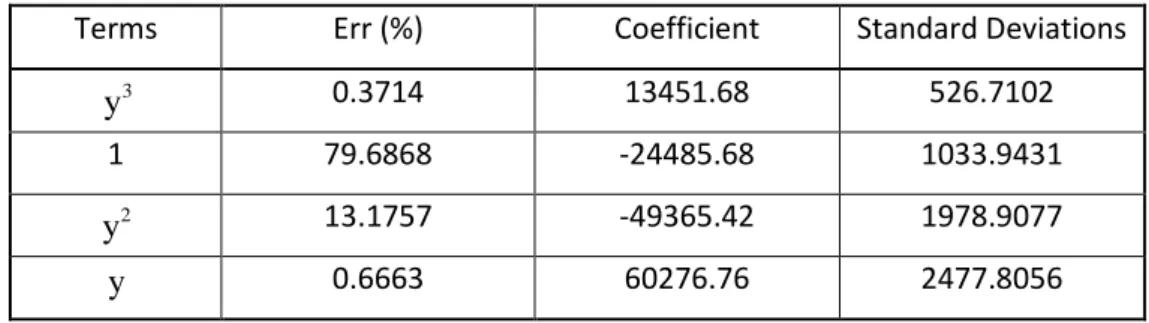
given in section 3, a third order polynomial model is obtained. The identified model is given as follows
and the results are shown in Table 1. A total number of four terms are selected in the final model.
2 3
24485.68 60276.76 49365.42 13451.68
y y y y (7)
It can be observed that, using the iOFR algorithm, the first select term does not have a very large ERR,
which is different from the classic OFR algorithm. A less dominant first term may make the term
selection less greedy and a better model structure can be obtained (Yuzhu Guo, Guo, et al., 2015c). In
the obtained model the constant term produced the greatest ERR because the restoring force curve
does not go through the origin of the acceleration-displacement plane.
Table 1 The results of the forward regression
Terms Err (%) Coefficient Standard Deviations
3
y 0.3714 13451.68 526.7102
1 79.6868 -24485.68 1033.9431
2
y 13.1757 -49365.42 1978.9077
y 0.6663 60276.76 2477.8056
11 (a) (b)
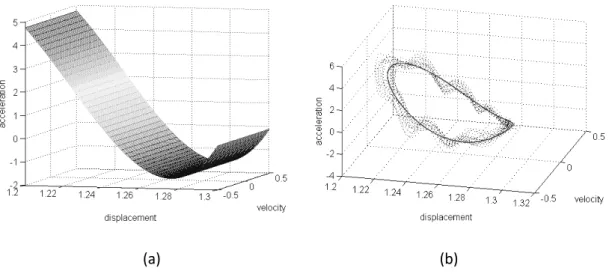
Figure 4 Reconstruction of the restoring force surface using the polynomial model
Simulating the polynomial model, the comparison of the model predicted outputs with the
experimental data is shown in Fig 5. Details of the predicted acceleration signal are shown in Fig 6 by
zooming in Fig 5. Figure 4 (b) shows the predicated trajectory in the phase space. Figure 4, 5 and 6
show that the obtained polynomial model captures the main morphology of the experimental data
but misses some details.
12 Fig 6 Enlarged plot of the acceleration signal
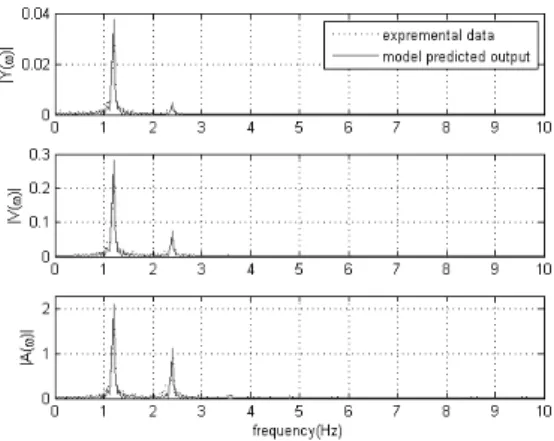
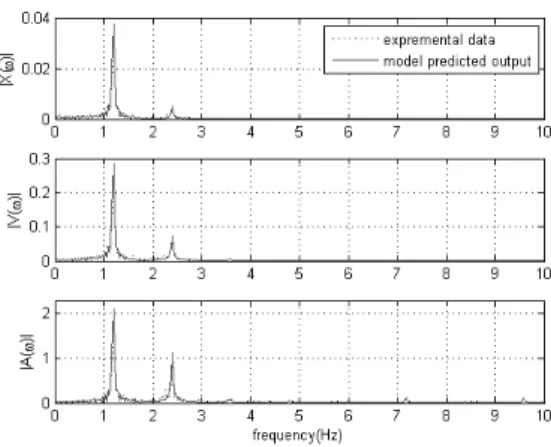
Fig 7 shows the comparison of the frequency spectra of the model predicted output and the
experimental data. It is shown that the simple polynomial model is capable to reproduce the basic
frequency component and the harmonics.
Fig 7 Frequency components of the model prediction output
The nonlinear terms in model (7) represent the nonlinear stiffness in the system, which plays a crucial
role in the generation of the harmonics. The polynomial models inherently possess many significant
advantages. (i) The polynomial model is of a very simple structure and easy to simulate and to realise
as a real physical system. (ii) Owing to the polynomial structure, the model can be easily used for
further analysis in both time and frequency domains. There are many mature techniques for the
analysis of systems with polynomial nonlinearities. For example, the perturbation method and
bifurcation analysis (Khalil, 2002), the describing function method (Kochenburger, 1950), and the
Volterra series theory and the associated generalised frequency response functions (Chua &
Yaw-Shing, 1982; Rugh, 1981). (iii) The output of the system is strictly harmonic signals. That is all the higher
frequencies are strict integer times of a basic frequency component.
However, problems start to occur when the restoring force surfaces are complex. This is simply
because the discontinuities and nonuniformities are very difficult to model using inherently smooth
polynomial terms. What make the condition worse is that the higher order polynomial model may
easily sink into the difficulty of instability. This is easy to explain. In order to satisfy the requirement
of a best fit some of the higher-order stiffness with negative coefficients may emerge in the final model
13
4.2 Radial basis function model
In order to characterise the system more accurately, radial basis functions are used as the term
dictionary of the iterative orthogonal forward regression restoring force surface method in this section.
Radial basis functions (RBF) whose value depends on the distance from the centre points can
efficiently characterise the position related local information. The radial basis functions should be a
good choice for the nonlinearity in this case.
The nonlinear restoring force surface is then represented as the linear combination of a series radial
basis functions
i
y
, (i= ), with the weights w1,w
2w
n, respectively .
1 n
i i i
f y w
y
(8)T G -scale radial basis functions.
2 2 2 ( ) i i x c
i x e
(9)
where is the norm to define the distance from
x
to the ith centre ci.According to the information show in the phase portrait the candidate term dictionary is constructed
as follows. The centres ci choose values between 1.2 and 1.3 for every 0.001 unit where the limits of
the centres are determined by the phase plane trajectory. The scales
i change from 0.001 to 0.020for every 0.001 unit to produce a sufficient cover to the range of the displacement, that is, the interval
[1.2, 1.3]. An appropriate choice of candidate term set is crucial for the identification process. A large
enough term set is needed to make sure that the underlying dynamics of the system can be well
approximated using the candidate model building blocks. However, a very large term set will make
the identification computationally intensive. The range of scales for the radial basis functions can be
efficiently determined through an iterative process. Initially, select a relatively small range of scales
in the dictionary and apply the orthogonal forward regression algorithm. Examine the obtained model
to check whether more than one RBF functions with the same centre but different scales are selected.
This often means that the dictionary is often not large enough because these RBF functions may be
approached by less RBFs of a larger scale. Enlarge the range of scales and repeat the process until this
14 The iOFR algorithm is then employed to select the significant terms from the term dictionary. The
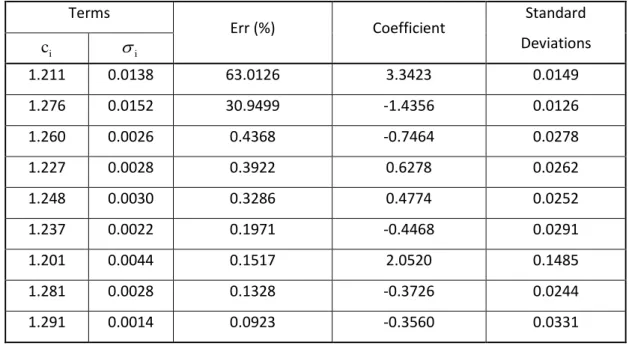
results are shown in Table 2. A total number of 9 terms are selected in the final model. These RBFs are
shown in Fig 8. Adding these weighted terms together yields the final model.
Table 2 Sub-models of the system
Terms
Err (%) Coefficient Standard Deviations
i
c
i1.211 0.0138 63.0126 3.3423 0.0149
1.276 0.0152 30.9499 -1.4356 0.0126
1.260 0.0026 0.4368 -0.7464 0.0278
1.227 0.0028 0.3922 0.6278 0.0262
1.248 0.0030 0.3286 0.4774 0.0252
1.237 0.0022 0.1971 -0.4468 0.0291
1.201 0.0044 0.1517 2.0520 0.1485
1.281 0.0028 0.1328 -0.3726 0.0244
1.291 0.0014 0.0923 -0.3560 0.0331
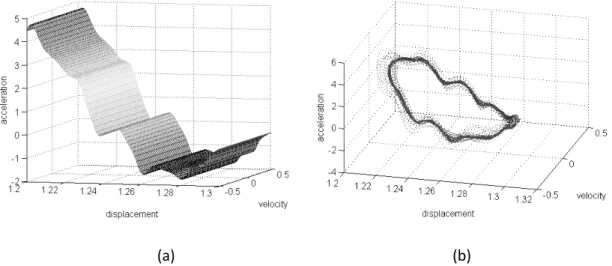
15 The model predicted outputs are shown in Fig 9. The restoring force surface and the phase trajectory
are show in Fig 10 (a) and (b), respectively. It is easy to observe that the RBF model represents the
nonlinear restoring force better than the polynomial model did.
Figure 9 The model predicted outputs of the RBF model
(a) (b)
Figure 10 Reconstruction of the restoring force surface using the RBF model
The spectral analysis of the model predictions is shown in Fig 11. Although the RBF model prediction
fits the experimental data better in the time domain and in the state space, the polynomial model
prediction fits the data better in the frequency domain. There are more energy leaks around the
16 Figure 11 The spectra of the model prediction outputs of the RBF model
Fig 9, 10 and 11 show that the model predicted outputs agree with the experimental data. The results
show that the radial basis functions successfully overcome the divergence problem which may happen
in the high order polynomial model fitting. This shows the powerful fitting ability of the radial basis
function model. Theoretically, the multi-scale radial basis functions are able to recover any complex
restoring force surface and the multi-scale radial basis function approximations are asymptotically
optimal, in the sense of convergence rate (Stephen A. Billings et al., 2007). This means a parsimonious
model can be obtained.
However one obvious disadvantage of the method is that the model is unphysical and the coefficients
obtained for the expansion cannot directly yield information about the physical quantities in the
system, such as the damping and stiffness of the structure. Another disadvantage, which was shown
in the spectral analysis of the reproduced signals, is that the reproduced signals may have much richer
frequency components than a harmonic signal. This is not what expected because additional
frequency components which are not in the experimental data may be introduced through the RBF
model.
4.3 Hybrid model combining the polynomial and radial basis functions
According to the analysis in the previous sections, a model which possesses the advantages of both
the polynomial model and the radial basis function model is expected. That is, the hybrid model can
not only give an accurate description of the nonlinear dynamics but also accurately characterise the
system in frequency domain. In this section a two-level hybrid model will be identified to describe the
nonlinear oscillations in multi-scale from coarse to fine (Stephen A. Billings et al., 2007; Wei et al.,
17 A hybrid model which includes both polynomial and RBF terms were used to describe the dynamics.
The iOFR algorithm is again used to select the significant terms from the mixed term dictionary consists
of polynomial and RBF candidate terms. This time, the centres of the radial basis functions keep same
however the scales of the RBF terms are selected in a relatively smaller range from 0.0005 to 0.0030
to avoid the information overlap with the polynomial terms. This is because the hybrid model
represents the behaviours of the nonlinear system in two different levels. The polynomials recover
the main shape of the system and generate harmonic signals while the RBFs to characterise the local
details. Therefore, the scale of the RBFs is chosen to focus on the local information and shield off the
global information. While the polynomial terms characterise the large-scale information but neglect
the local details. The determination of an appropriate scale range for the RBFs is easy to realise in the
identification. Choose a relatively larger scale range, for example, the maximum scale in Table 2, and
set the initial range as 0.0005 ~ 0.0152. Reduce the upper limit and apply the orthogonal forward
regression algorithm until the polynomial terms start to appear in the model. In this example the scale
range is chosen as 0.0005 ~ 0.0030.
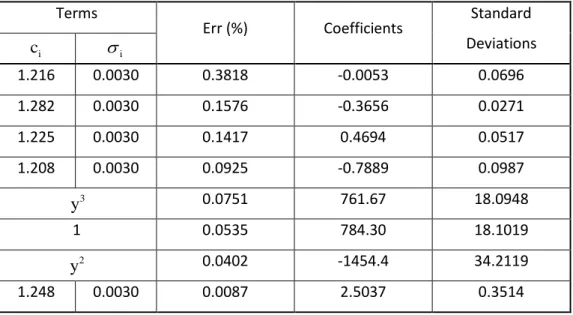
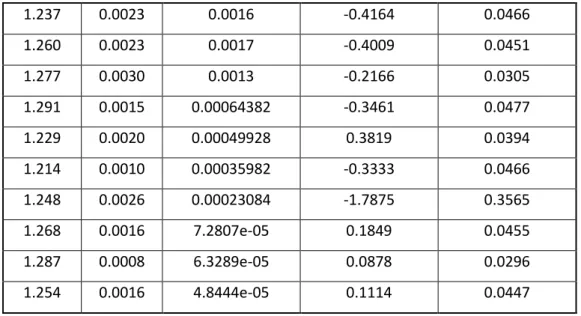
Apply the orthogonal forward regression algorithm and stop the forward selection process as the sum
of ERRs reaches 0.95 (Wei, Billings, & Liu, 2004). The obtained model structure and the associated
coefficients are given as Table 3. The list of the ERRs shows that the polynomial terms play important
roles in the final model. The comparison of the model predicted outputs and the real data is shown in
Fig 12. The comparison of the frequency spectra of the predicted outputs and the real data is show in
Fig 13. The results show that the model predicted outputs excellently agree with the experimental
data both in the time domain and also in frequency domain.
Table 3 Sub-models of the hybrid model
Terms
Err (%) Coefficients Standard Deviations
i
c
i1.216 0.0030 0.3818 -0.0053 0.0696
1.282 0.0030 0.1576 -0.3656 0.0271
1.225 0.0030 0.1417 0.4694 0.0517
1.208 0.0030 0.0925 -0.7889 0.0987
3
y 0.0751 761.67 18.0948
1 0.0535 784.30 18.1019
2
y 0.0402 -1454.4 34.2119
18 1.237 0.0023 0.0016 -0.4164 0.0466
1.260 0.0023 0.0017 -0.4009 0.0451
1.277 0.0030 0.0013 -0.2166 0.0305
1.291 0.0015 0.00064382 -0.3461 0.0477
1.229 0.0020 0.00049928 0.3819 0.0394
1.214 0.0010 0.00035982 -0.3333 0.0466
1.248 0.0026 0.00023084 -1.7875 0.3565
1.268 0.0016 7.2807e-05 0.1849 0.0455
1.287 0.0008 6.3289e-05 0.0878 0.0296
1.254 0.0016 4.8444e-05 0.1114 0.0447
Figure 12 Model predicted output of the hybrid model
Figure 13 Spectra of the model predicted output of the hybrid model
However the hybrid model has not shown significant advantages over the RBF model so far. It is
expected that the polynomial part of the hybrid model can also give an acceptable description of the
19 three polynomial terms in the hybrid model is exactly same as the first three terms in the purely
polynomial model.
Extracting the polynomial terms from the hybrid model yields a new polynomial model as
2 3
784.30 1454.4 761.67
y y y (10)
Plot the hybrid model and the extracted polynomial model (10) in the displacement-acceleration
phase plane. Fig 14 shows that model (10) fits the experimental data very well.
Fig 14 The fitness of the hybrid model in the displacement-acceleration phase plane
The model predicted output of the polynomial part (model(10)) and the spectra of the prediction are
shown in Fig 15 and 16 respectively. Although the model predicted outputs do not fit the data very
well after 6 seconds the model predictions perfectly reproduced the frequency spectra of the
experimental data, which is even better than the pure polynomial model (7) did. This means that the
polynomial part of the hybrid model is capable to represent the global behaviours neglecting some
local details. This is because the Fourier transform always gives average information of the whole time
20 Fig 15 The model predicted output of the polynomial part
Fig 16 Spectra of the model predicted outputs by model (10)
To sum up, the hybrid model successfully provides a two-level coarse-to-fine, representation of the
nonlinear systems. The polynomial terms give a coarse description which could characterise the main
frequency components of the nonlinear oscillations whereas the complete model gives a more
accurate description of both the local and global behaviours of the system.
5. Conclusions
The nonlinear oscillations existing in human bouncing has been investigated. A new system
identification method which combines the restoring force method and the iterative orthogonal
forward regression algorithm has been introduced. The system identification based method which
avoids the difficulties in a first principle method is simple to carry out in the practical applications.
The obtained models have been shown to be able to reproduce the nonlinear oscillation both in the
time and frequency domain. The new identification method itself extends the restoring force method
to a more wide class of system with complex nonlinearities. Although a special example where the
external input is zero and the effect of the velocity can be ignored has been studied in this paper this
does not prevent the new orthogonal forward regression restoring force surface method to be a
21
References
Allen, M. S., Sumali, H., & Epp, D. S. (2008). Piecewise-linear restoring force surfaces for semi-nonparametric identification of nonlinear systems. Nonlinear Dynamics, 54(1-2), 123-135. doi:10.1007/s11071-007-9254-x
Billings, S. A. (2013). Nonlinear System Identification : NARMAX Methods in the Time, Frequency, and Spatio-Temporal Domains. Hoboken, New Jersey: John Wiley & Sons Ltd.
Billings, S. A., Wei, H.-L., & Balikhin, M. A. (2007). Generalized multiscale radial basis function networks.
Neural Networks, 20(10), 1081-1094. doi:https://doi.org/10.1016/j.neunet.2007.09.017
Billings, S. A., & Wei, H. L. (2005). The wavelet-NARMAX representation: a hybrid model structure combining polynomial models with multiresolution wavelet decompositions. Intern. J. Syst. Sci., 36(3), 137-152. doi:10.1080/00207720512331338120
Billings, S. A., & Zhu, Q. M. (1994). Nonlinear model validation using correlation tests. International Journal of Control, 60(6), 1107-1120.
Blickhan, R. (1989). The spring-mass model for running and hopping. J Biomech, 22(11-12), 1217-1227. BlLlings, S. A., & Voon, W. S. F. (1986). Correlation based model validity tests for non-linear models.
International Journal of Control, 44(1), 235-244. doi:10.1080/00207178608933593
Chua, L., & Yaw-Shing, T. (1982). Nonlinear oscillation via Volterra series. Circuits and Systems, IEEE Transactions on, 29(3), 150-168. doi:10.1109/tcs.1982.1085129
Duym, S., & Schoukens, J. (1995). Design of excitation signals for the restoring force surface method.
Mechanical Systems and Signal Processing, 9(2), 139-158. doi:http://dx.doi.org/10.1006/mssp.1995.0012
Duym, S. W. R., Schoukens, J. F. M., & Guillaume, P. A. N. (1996). A local restoring force surface method.
Modal Analysis-the International Journal of Analytical and Experimental Modal Analysis, 11 (3-4), 116-132.
Ernesto, D., & Tianjian, J. (2009). Action of Individual Bouncing on Structures. doi:10.1061/(ASCE)0733-9445(2009)135:7(818)
Garcia, M. S. (1999). Stability scaling and chaos in passive-dynamic gait models. (Ph.D.), Cornell University.
Guo, Y., Guo, L. Z., Billings, S. A., & Lang, Z. Q. (2015). A New Efficient System Identification Method for Nonlinear Multiple Degree-of-Freedom Structural Dynamic Systems. Journal of Computational and Nonlinear Dynamics, 11(2), 021012-021012. doi:10.1115/1.4031488 Guo, Y., Guo, L. Z., Billings, S. A., & Wei, H.-L. (2015a). Identification of nonlinear systems with
non-persistent excitation using an iterative forward orthogonal least squares regression algorithm.
International Journal of Modelling, Identification and Control, 23(1), 1-7. doi:10.1504/ijmic.2015.067496
Guo, Y., Guo, L. Z., Billings, S. A., & Wei, H.-L. (2016). Identification of continuous-time models for nonlinear dynamic systems from discrete data. International Journal of Systems Science, 47(12), 3044-3054. doi:10.1080/00207721.2015.1069906
Guo, Y., Guo, L. Z., Billings, S. A., & Wei, H. L. (2015b). Identification of linear systems with non-persistent excitation using an iterative forward orthogonal least squares regression algorithm.
International Journal of Modelling, Identification and Control, 23(1), 1-7.
Guo, Y., Guo, L. Z., Billings, S. A., & Wei, H. L. (2015c). An iterative orthogonal forward regression algorithm. Int. J. Syst. Sci., 46(5), 776-789. doi:10.1080/00207721.2014.981237
Guo, Y., Storm, F., Zhao, Y., Billings, S. A., Pavic, A., Mazza, C., & Guo, L. Z. (2017). A New Proxy Measurement Algorithm with Application to the Estimation of Vertical Ground Reaction Forces Using Wearable Sensors. Sensors (Basel), 17(10). doi:10.3390/s17102181
22 Hof, A. L., Van Zandwijk, J. P., & Bobbert, M. F. (2002). Mechanics of human triceps surae muscle in walking, running and jumping. Acta Physiologica Scandinavica, 174(1), 17-30. doi:10.1046/j.1365-201x.2002.00917.x
Khalil, H. K. (2002). Nonlinear Systems (3rd ed ed.). London: Prentice Hall.
Kochenburger, R. J. (1950). A Frequency Response Method for Analyzing and Synthesizing Contactor Servomechanisms. American Institute of Electrical Engineers, Transactions of the, 69(1), 270-284. doi:10.1109/t-aiee.1950.5060149
Masri, S. F., Bekey, G. A., Sassi, H., & Caughey, T. K. (1982). Non-parametric identification of a class of nonlinear multidegree dynamic systems. Earthquake Engineering & Structural Dynamics, 10(1), 1-30. doi:10.1002/eqe.4290100102
Masri, S. F., & Caughey, T. K. (1979). A Nonparametric Identification Technique for Nonlinear Dynamic Problems. Journal of Applied Mechanics, 46(2), 433-447.
Racic, V., & Chen, J. (2015). Data-driven generator of stochastic dynamic loading due to people bouncing. Computers & Structures, 158, 240-250. doi:http://dx.doi.org/10.1016/j.compstruc.2015.04.013
Racic, V., & Pavic, A. (2010a). Mathematical model to generate near-periodic human jumping force signals. Mechanical Systems and Signal Processing, 24(1), 138-152. doi:http://dx.doi.org/10.1016/j.ymssp.2009.07.001
Racic, V., & Pavic, A. (2010b). Stochastic approach to modelling of near-periodic jumping loads.
Mechanical Systems and Signal Processing, 24(8), 3037-3059. doi:http://dx.doi.org/10.1016/j.ymssp.2010.05.019
Racic, V., Pavic, A., & Brownjohn, J. M. W. (2009). Experimental identification and analytical modelling of human walking forces: Literature review. Journal of Sound and Vibration, 326(1 ?), 1-49. doi:http://dx.doi.org/10.1016/j.jsv.2009.04.020
Rugh, W. J. (1981). Nonlinear System Theory: The volterra/Wiener Approach. London: Johns Hopkins University Press.
Spägele, T., Kistner, A., & Gollhofer, A. (1999a). Modelling, simulation and optimisation of a human vertical jump. Journal of Biomechanics, 32(5), 521-530. doi: http://dx.doi.org/10.1016/S0021-9290(98)00145-6
Spägele, T., Kistner, A., & Gollhofer, A. (1999b). A multi-phase optimal control technique for the simulation of a human vertical jump. Journal of Biomechanics, 32(1), 87-91. doi:http://dx.doi.org/10.1016/S0021-9290(98)00135-3
van Werkhoven, H., & Piazza, S. J. (2013). Computational model of maximal-height single-joint jumping predicts bouncing as an optimal strategy. Journal of Biomechanics, 46(6), 1092-1097. doi:http://dx.doi.org/10.1016/j.jbiomech.2013.01.016
Wei, H. L., Billings, S. A., & Liu, J. (2004). Term and variable selection for non-linear system identification. International Journal of Control, 77(1), 86-110. doi:10.1080/00207170310001639640
Wei, H. L., Zhu, D. Q., Billings, S. A., & Balikhin, M. A. (2007). Forecasting the geomagnetic activity of the Dst index using multiscale radial basis function networks. Advances in Space Research, 40(12), 1863-1870. doi:https://doi.org/10.1016/j.asr.2007.02.080
Worden, K. (1990a). Data-processing and experiment design for the restoring force surface method, part II. choice of excitation signal. Mechanical Systems and Signal Processing, 4(4), 321-344. doi:10.1016/0888-3270(90)90011-9
Worden, K. (1990b). Data processing and experiment design for the restoring force surface method, part I: integration and differentiation of measured time data. Mechanical Systems and Signal Processing, 4(4), 295-319. doi:http://dx.doi.org/10.1016/0888-3270(90)90010-I