White Rose Research Online URL for this paper:
http://eprints.whiterose.ac.uk/120307/
Version: Accepted Version
Article:
GC, Vijay Singh orcid.org/0000-0003-0365-2605, Suhrcke, Marc
orcid.org/0000-0001-7263-8626, Hardeman, Wendy et al. (2 more authors) (2018)
Cost-Effectiveness and Value of Information Analysis of Brief Interventions to Promote
Physical Activity in Primary Care. Value in Health. ISSN 1524-4733
https://doi.org/10.1016/j.jval.2017.07.005
[email protected] https://eprints.whiterose.ac.uk/
Reuse
This article is distributed under the terms of the Creative Commons Attribution-NonCommercial-NoDerivs (CC BY-NC-ND) licence. This licence only allows you to download this work and share it with others as long as you credit the authors, but you can’t change the article in any way or use it commercially. More
information and the full terms of the licence here: https://creativecommons.org/licenses/
Takedown
If you consider content in White Rose Research Online to be in breach of UK law, please notify us by
Cost-Effectiveness and Value of Information Analysis of Brief Interventions to Promote Physical Activity in Primary Care
Vijay S. GC, MPH1, Marc Suhrcke, PhD1-3, Wendy Hardeman, PhD4, Stephen Sutton, PhD5, Edward C.F.
Wilson, PhD1, 6, 7 on behalf of the VBI Programme Team
1 Health Economics Group, Norwich Medical School, University of East Anglia, Norwich, UK;
2 UKCRC Centre for Diet and Activity Research (CEDAR), University of Cambridge School of Clinical
Medicine, Cambridge, UK;
3 Centre for Health Economics, University of York, York, UK;
4 School of Health Sciences, University of East Anglia, Norwich, UK;
5 Behavioural Science Group, Primary Care Unit, Institute of Public Health, University of Cambridge
School of Clinical Medicine, Cambridge, UK;
6 Cambridge Centre for Health Services Research, Institute of Public Health, University of Cambridge
School of Clinical Medicine, Cambridge, UK;
7 Cambridge Clinical Trials Unit, Cambridge University Hospitals NHS Foundation Trust, Hills Road,
Cambridge, UK
Corresponding author: Vijay GC, Health Economics Group, Norwich Medical School, University of East
Anglia, Norwich Research Park, Norwich NR4 7TJ, United Kingdom. Phone: +44 (0)1603 597164, email:
Source of financial support: This paper presents independent research funded by the National Institute
for Health Research (NIHR) under its Programme Grants for Applied Research Programme (Grant
Reference Number RP-PG-0608-10079). The views expressed are those of the author(s) and not
necessarily those of the NHS, the NIHR or the Department of Health. The funder had no role in study
design, data collection, data analysis, data interpretation, the writing of the manuscript, and decision to
submit the manuscript for publication. EW is funded by the NIHR Cambridge Biomedical Research
Key words: brief intervention, physical activity, primary care, Health Checks, cost-effectiveness, value of
information
Running title: Cost-effectiveness of brief PA interventions
Acknowledgements: The authors would like to thank Mr. Richard Parker, University of Edinburgh for his
statistical advice in translating intervention effects into MET-hours and Dr Dena Bravata, Stanford
University for providing additional data on the pedometer meta-analysis. This study was conducted on
behalf of the Very Brief Interventions Programme team (see
http://www.phpc.cam.ac.uk/pcu/research/research-projects-list/vbi/vbi-research-team for team members).
Preliminary findings were presented in part at the first EuHEA PhD Student Supervisor and Early Career
Researcher Conference (poster presentation); September 1–3, 2014; Manchester, UK. The authors thank
conference participants for their thoughtful and helpful remarks on this work. Any errors or omissions are
those of the authors alone. The research presented in this paper was carried out on the High
Performance Computing Cluster supported by the Research and Specialist Computing Support service at
Cost-Effectiveness and Value of Information Analysis of Brief Interventions
to Promote Physical Activity in Primary Care
Abstract
Background: Brief interventions (BIs) delivered in primary care have shown potential to increase physical
activity levels and may be cost-effective, at least in the short term, when compared with usual care.
However, there is limited evidence on their longer-term costs and health benefits.
Objectives: To estimate the cost-effectiveness of BIs to promote physical activity in primary care and to
guide future research priorities using value of information analysis.
Methods: A decision model was used to compare the cost-effectiveness of three classes of BIs that have
been used, or could be used, to promote physical activity in primary care: (1) pedometer interventions, (2)
advice or counselling on physical activity and (3) action planning interventions. Published risk equations
and data from the available literature or routine data sources were used to inform model parameters.
Uncertainty was investigated with probabilistic sensitivity analysis, and value of information analysis was
conducted to estimate the value of undertaking further research.
Results: In the base-case, pedometer interventions yielded the highest expected net benefit at a
willingness-to-pay of £20,000 per quality-adjusted life-year. However, there was a great deal of decision
uncertainty: the expected value of perfect information surrounding the decision problem for the NHS
Health Check population was estimated at £1.85billion.
Conclusion: Our analysis suggests that pedometer-based BIs are the most cost-effective strategy to
promote physical activity in primary care, and that there is potential value in further research into the
cost-effectiveness of brief (i.e. less than 30 minutes) and very brief (i.e. less than 5 minutes) pedometer-based
Introduction
Physical inactivity is a major public health problem associated with a significant burden of chronic
disease, including type 2 diabetes, cardiovascular disease, some cancers and mental health problems
[1-3]. Despite the well-documented health benefits of physical activity [4-7], in 2010, 33% of adults aged 18
years and over in high-income countries were insufficiently active: i.e. they did not meet the current World
Health Organization (WHO) recommendations [8]. In England, using self-reported measures in 2012,
61% of adults aged 19 and over met the current UK guideline [9] for moderate/vigorous physical activity
[10], a figure virtually unchanged since the 2008 Health Survey for England (HSE), reporting 59%.
However, when physical activity was measured objectively using accelerometers, in 2008 only 6% of men
and 4% of women aged 16 and over met the recommended physical activity level [11].
Physical inactivity is also associated with a considerable economic burden, accounting for 1.5% to 3% of
total direct healthcare costs in high income countries [12]. The annual societal cost of physical inactivity in
England (comprising the National Health Service (NHS) costs plus the value of morbidity/premature
mortality-related lost productivity) is estimated at £8.2 billion per year, with an additional £2.5 billion for
the contribution of physical inactivity to obesity-related costs [1].
Intensive face-to-face physical activity interventions delivered in primary care or community settings
targeting sedentary adults can be effective at increasing activity levels [13]. They have been found to
represent good ‘value for money’ as they can increase self-reported physical activity at reasonable cost
[14, 15]. In recent years, there has been interest in brief interventions (BIs), defined as having a maximum
duration of 30 minutes [16, 17], to promote physical activity in a primary care setting [18-20]. Systematic
reviews and meta-analyses of randomised controlled trials (RCTs) showed that BIs, e.g. brief exercise
advice/counselling delivered in primary care, increase physical activity [20, 21] and are cost-effective [15,
22] over the short-term (twelve months or less). However, the evidence on the longer-term costs and
consequences of BIs has been sparse to date.
Findings from published RCTs of physical activity interventions are not sufficient on their own to inform
decision makers about the cost-effectiveness of intervention strategies [23]. Evidence on the long term
maximising health gains to the population from limited available resources [14]. Using a discrete event
simulation model, we aim to evaluate the long-term cost-effectiveness of BIs to promote physical activity
in adults eligible for an NHS Health Check in primary care.
If BIs are cost-effective, this raises the question of whether ‘very brief interventions’ (VBIs) could also be
cost-effective. VBIs, defined as lasting no more than five minutes [18], are of interest as they can be
delivered as part of a primary care consultation such as the NHS Health Check [24]. This is offered every
five years to all adults in England aged 40-74 years without known pre-existing vascular disease and is
intended to assess risk of certain conditions, including type 2 diabetes and heart disease, and provide
preventative advice and interventions where indicated [25].
In this paper we present an economic evaluation of three classes of BIs (plus no intervention), reporting
the incremental cost per quality-adjusted life-year (QALY) gained over 10 years. We also report a value of
information analysis, a method to predict the return on investment in further research [26-28]. This
information will inform the design of further research into the effectiveness and cost-effectiveness of VBIs
delivered as part of the NHS Health Checks.
Methods
Study population
We used data from the 2011 HSE to generate a simulated cohort of 10,000 adults aged 40-74 years who
do not have an existing diagnosis of diabetes, hypertension, cardiovascular or renal disease, representing
the NHS Health Check population [25].
The PACE model
We developed a discrete event simulation model, the Physical Activity Cost Effectiveness (PACE) model
in R [29] to estimate the cost-effectiveness of BIs. The model firstly generates a cohort of 10,000
representative individuals of the English population. It then follows each individual, predicting the
incidence of chronic disease, mortality and associated costs and outcomes over ten years, specified with
associated complications, heart disease, stroke and physical inactivity and obesity-related cancers
(breast, colorectal, lung or kidney cancer). Increased physical activity is assumed to influence risk factors
such as reduced blood pressure, cholesterol level and glycated haemoglobin (HbA1c). Modification of
these risk factors leads to changes in the risk of chronic disease and comorbidities, such as reduced risk
of cardiovascular disease. A decrease in chronic disease and comorbidities leads to a reduction in costs
and to the prevention of a decrease in quality of life (Fig. 1). Effectiveness data for each comparator are
entered in the model as an increase in metabolic equivalent (MET) hours per week compared with no
intervention, which in turn influences risk of chronic disease. The random search method [39] was used to
calibrate the model against seven calibration targets. Weighted mean deviation was used to assess the
goodness-of-fit of calibration results [40]. Full details of the model and calibration are in Appendix 1 in
Supplemental Materials.
Data inputs and sources
Model inputs
Data on demographic characteristics of individual participants (age, gender, ethnicity) were derived from
the UK Office for National Statistics [41, 42]. The risk factor profile (systolic blood pressure, total
cholesterol, high density lipoprotein cholesterol, body mass index, smoking status and HbA1c) and
prevalence of type 2 diabetes and cardiovascular events (ischaemic heart disease, myocardial infarction
(MI), stroke and heart failure) for individual participants in the cohort was generated using data from the
2011 HSE [43]. The severity of breast cancer was classified according to Nottingham Prognostic Index
(NPI) prognostic groups – ductal carcinoma in situ (DCIS), excellent, good, moderate and poor [44] – and
age-specific prevalence data for breast cancer was taken from the estimates for 2008 in the UK [45]. The
baseline parameter values for colorectal cancer were derived from Frazier et al [35] and applied to the
baseline population to generate prevalence data for colorectal cancer. The baseline prevalence data of
lung and kidney cancers were based on estimates from Cancer Research UK [37, 46].
Interventions
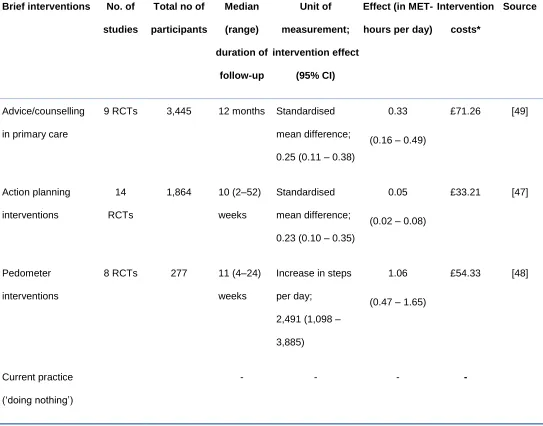
We selected three classes of BIs: pedometer interventions, advice/counselling in primary care, and action
[47-49]. The three classes are somewhat heterogeneous, therefore descriptions of the classes (and
associated costings) below reflect the scope of interventions included in the respective meta-analyses.
This selection of BIs was based on the strength of evidence of effectiveness and their relevance in a
primary care setting. Full details are provided in Appendix 2 in Supplemental Materials. We also included
current practice where no physical activity intervention is delivered.
Pedometer-based interventions: Participants were given a pedometer to wear and encouraged to view
and record their daily step counts. They were also asked to set a physical activity goal such as to walk 20
minutes on all or most days of the week, or walk 10,000 steps on five days per week. In some
interventions, participants received individualised exercise feedback or additional ‘behavioural
counselling’ from a nurse or physiotherapist.
Advice or counselling in primary care: Typically, participants received written materials with exercise
advice or an exercise prescription; and two or more sessions of advice or counselling on physical activity.
Advice or counselling was mostly delivered face-to-face, in some cases by phone (or both). In most
cases, the interventions were delivered by primary care doctors or nurses.
Action planning interventions: These BIs employed ‘implementation intentions’, a commonly used form of action planning. Participants were asked to formulate an action plan for physical activity in the format of
what, when and where, and to record their action plan in a logbook or calendar. In most interventions,
participants were encouraged to write down an action plan assisted by a trained interviewer.
Current practice: Participants received no intervention.
Short-term effectiveness of interventions
The intervention effects of the BIs were converted to MET-hours by estimating the time spent in activities
with higher MET intensities as a result of the intervention [50]. We extracted physical activity outcomes
from individual studies included in the three meta-analyses which were translated into MET-hours by
selecting the estimates from the compendium of physical activity [51]. Finally, we updated the
meta-analysis using translated values (MET-hours). However, it was not possible to translate intervention
interventions [47] as either these studies did not provide details on changes in intensity, duration and/or
frequency of activity required for MET-hours translation, or the outcome was expressed in composite units
(e.g. a sum of scores where responses were rated on a scale). Thus, we excluded those five studies.
Intervention costs
We first extracted resource use data based on the intervention description provided for individual studies
in the meta-analyses. We then costed each intervention based on the quantities of resources used
multiplied by the unit cost of each resource component. The cost per participant was then evaluated as
weighted average of intervention costs from each RCT in the meta-analysis (Table 1). Full details on
translating the intervention effects into MET-hours and costing of each intervention are provided in
Appendix 2 in Supplemental Materials.
Disease costs and health outcomes
The price year and currency of the study was 2011 UK pounds sterling (£). The annual costs associated
with each health state were derived from previous studies [33, 36, 52-63]. The health outcomes were
evaluated in QALYs. Utilities for health states included in the model were obtained from published
sources [64-69]. Details on costs and utilities related to comorbid disease conditions in the model are
available in Appendix 1 in Supplemental Materials. We performed the analysis from the English NHS
perspective to estimate the costs and benefits of BIs over a ten-year time horizon. All health outcomes
and costs were discounted at 3.5% per annum [70].
Probabilistic sensitivity analysis
We performed a Monte-Carlo simulation (n=10,000 iterations) to simultaneously account for uncertainty in
all input parameters (Appendix 1 in Supplemental Materials). The net monetary benefit (NB; UK 2011 £),
that is, the health effect (QALYs) multiplied by a societal willingness-to-pay (WTP) per QALY gained
minus the cost was calculated for each BI [71]. At any given WTP threshold, the cost-effective
intervention was identified as the one with the highest expected NB, which is mathematically identical to
sequentially identifying the most cost-effective intervention with an incremental cost-effectiveness ratio
cost-effectiveness acceptability curves (CEACs) to illustrate the decision uncertainty surrounding the adoption
of BIs, conditional on the WTP per QALY [72]. The NBs were estimated at a WTP of £20,000 per QALY.
Scenario analyses
The sustainability of intervention effects over time plays an important role in the cost-effectiveness
analysis. There is considerable uncertainty about the maintenance of any effects of BIs as very few
studies have follow-up measurement beyond one year. We performed sensitivity analysis with decay
rates for the intervention effect ranging between 0% (lifelong behaviour change) and 100% (behaviour
change reversed to baseline after the first year post-intervention). In the base case, we assumed that the
intervention effects were sustained for the first year, but decayed at a rate of 55% per annum thereafter.
We also evaluated the cost-effectiveness of BIs if they were repeated once every two, five and ten years,
and finally explored the direct impact of a short-term quality of life boost from increased physical activity.
Only a few studies have measured these short-term improvements in the general population [73, 74], as
most studies focus on older adults and people with chronic conditions [75]. A pragmatic RCT evaluating
the national exercise referral scheme in Wales estimated a utility boost of 0.03 +/- 0.023 [76]. We added
this in the first year of intervention to reflect the short-term benefits of physical activity.
Value of information analysis
We had originally intended to conduct a value of information analysis on the entire decision problem.
However, due to computational difficulties for such a complex model, we limited this to a comparison
between the pedometer BIs and current practice. This was chosen as we selected a pedometer-based
intervention as the most promising VBI for trial evaluation in our wider research programme [77]. Thus the
analysis established whether or not there was an economic case for a trial of a pedometer-based BI.
We estimated the expected value of perfect information (EVPI) as the difference between the expected
value of decision (i.e. the maximum expected NB) with perfect information and that with current
information [78]. As the value for additional information is related to the size of the eligible population, the
EVPI was multiplied with the estimated Health Check population to estimate the population EVPI. Given
Check population (i.e. adults aged 40-74) over 10-years equates to approximately 19.1 million. The
population EVPI provides the upper bound on the value of future research. To identify a parameter or
group of parameters that contribute to most of the overall decision uncertainty and for which future
research is the most promising, we estimated the expected value of partial perfect information (EVPPI)
[78, 80, 81]. For this, we grouped model parameters into the following six sub-groups: research on 1)
intervention effects, 2) health state utilities, 3) costs, 4) risk of MI, 5) risk of stroke, and 6) parameters
used in systolic blood pressure equation. The EVPPI was calculated using a two-level Monte-Carlo
sampling loop, in which the parameter(s) of interest were sampled 500 times in the outer loop, and for
every iteration the remaining parameters were sampled 1,000 times in the inner loop [82, 83]. Multiplying
the EVPPI values per patient with the eligible Health Check population resulted in the population EVPPI.
Results
Cost-effectiveness analysis
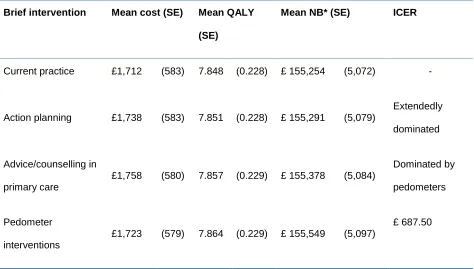
In the base-case, the point estimates for per person costs and QALYs for all interventions were similar
(Table 2). Pedometer BIs dominated both advice/counselling and action planning BIs, i.e. pedometer BIs
were both less expensive and more effective. When compared with current practice, all three BIs were
both more effective and more costly.
Analysis of Uncertainty
The scatterplot of incremental costs versus incremental QALYs (comparing each BI with current practice)
for the 10,000 iterations showed points scattered across all four quadrants of the cost-effectiveness
plane, with the majority of the points overlapping with each other (Fig. 2A). The CEAC (Fig. 2B) showed
that pedometer BIs were the optimal option in 56% of the 10,000 model simulations at a WTP of £20,000
per QALY. Advice/counselling intervention was optimal in 22% of the iterations at a WTP of £20,000 per
QALY. Current practice and action planning interventions had similar CEACs showing less than 13%
Scenario analyses
As the intervention decay rate increases, BIs become less cost-effective (Fig. 2C). At higher intervention
decay rates, the expected NBs of all interventions were quite similar, ultimately dropping below that of
current practice. This is to be expected as the treatment effect declines to that of current practice. For the
scenario analysis with the interventions being repeated once every two, five and ten years (Fig. 2D)
respectively, pedometer BIs were found to be the optimal option for all three repeat year scenarios. The
expected NB for pedometer interventions was highest when the intervention was repeated once every
two years.
The inclusion of short-term health gains (utility boost) from increased physical activity (Appendix Table 4.1
in Supplemental Materials) had similar results as the base-case analysis, with pedometer BIs as the most
cost-effective intervention. However, there was a parallel shift upwards for the three BIs. The probabilities
of pedometer and advice/counselling BIs being cost-effective at a WTP of £20,000 per QALY increased to
61% and 24%, respectively, up from 56% and 21% in the base-case scenario.
Value of information analysis
At a WTP of £20,000 per QALY, the base-case per person EVPI associated with a decision between
pedometer BIs and current practice was £97, or £1.85bn to the NHS Health Check population (Fig. 3A).
This means that, at a WTP of £20,000 per QALY, the upper limit for research into which intervention is
most cost-effective is £1.85 bn. Among the groups of different parameters, intervention effects had the
highest population EVPPI of £708 million followed by costs (£690) and risk of stroke (£684 million)
parameters at a WTP of £20,000 per QALY (Fig. 3B).
Discussion
What this study shows
In this study we estimated the expected long-term costs and health outcomes of BIs that could potentially
Checks in primary care in England. The health benefits of increasing physical activity levels were
simulated using effects of BIs reported in the meta-analyses of RCTs, and synthesised in a decision
analytic cost-effectiveness model. In the base-case analysis, we found that pedometer BIs were
dominant, i.e. they were less costly and had better outcomes (QALY gains) than other BIs. The value of
information analysis for pedometer BIs versus current practice showed that the expected value of
conducting further research to eliminate decision uncertainty was £1.85 billion, assuming a time horizon
of ten years, and that further research that would eliminate uncertainty in intervention effects for the NHS
Health Check population would be worth £708 million (Fig. 3B). We explored the impact of repeating the
BI, and repetition every two years seems to be the most efficient interval.
Care must be taken in interpreting the value of information statistics. A new study will not eliminate
uncertainty, but is expected to reduce it. Therefore, the expected value of sample information (EVSI) of
such a study will be less than the EVPI. We attempted to calculate the EVSI and the expected net gain of
sampling (ENGS, defined as the EVSI less the total cost of a proposed study) but due to computational
demands we were unable to generate meaningful and stable results. Nevertheless, given the size of the
EVPI, it may be reasonable to suggest that there is scope for further research to be efficient. Whilst all
parameter groups had a similar EVPPI, the highest was in intervention effectiveness.
Implications for policy
Our results show that pedometer BIs appear to be a cost-effective way of promoting physical activity
when compared with other BIs such as advice or counselling in primary care. Delivering the pedometer BI
once every two years appears to be the most efficient repeat interval. However, this is contingent on the
assumed ‘decay rate’ of the intervention effect, and the ability of repeat contacts to maintain physical
activity.
The value of information analysis suggests that there may be value in further exploring the effectiveness
of a general class of pedometer-based brief interventions: the population EVPI of £1.85bn is certainly
very much above the cost of any plausible design of a RCT, suggesting that further research could be
efficient. However, a definitive answer requires calculation of the expected net gain of sampling for a
is whether it is worth investigating whether a shortened VBI pedometer intervention, incorporated as part
of the NHS Health Check, would be of value. Given that (1) it is highly likely that future research into
pedometer-based BIs is efficient, and (2) less is known about the effectiveness and cost-effectiveness of
VBIs, it is reasonable to suggest that exploration of the effectiveness and cost-effectiveness of a
pedometer-based VBI is efficient.
Comparison with other studies
Our cost-effectiveness results were mostly more favourable than the Over et al [84] and Gulliford et al [85]
studies of pedometer and brief exercise advice/counselling interventions, respectively, but were not as
favourable as reported by Cobiac et al [86] for pedometer interventions. This could be because
intervention costs in our study were lower than in Over et al [84] and Gulliford et al [85]. However, Cobiac
et al [86] used much lower intervention costs per person than our model. In addition, differences in the
target population, modelling methods, inclusion of diseases/co-morbidities and short-term health gains,
and assumptions on intervention decay could explain the observed differences in the cost-effectiveness
results. Two modelling studies [85, 86] were driven by a disease burden modelling strategy and Anokye
and colleagues [87] included short-term mental health gains in their cost-effectiveness analysis. However,
in their analyses [85, 87] they did not take into account any decay in the intervention effects over time.
Strengths and limitations
Our model is comprehensive and complex in terms of the inclusion of physical activity dose-response
relationship and comorbidities related to physical inactivity and obesity. Our analysis was based on
meta-analyses of RCTs evaluating the effect of BIs on physical activity levels, incorporated into a
comprehensive decision model to project costs and outcomes associated with each intervention (plus
current practice) over the long term. We included interventions that are low cost and relevant to a primary
care setting.
However, there are limitations to our approach, including the structure of the model and data inputs. Not
all the data sources, e.g. transition probabilities and health state utilities were available for the NHS
for which dose-response evidence was available. Only one of the meta-analyses [49] focused on
interventions delivered in primary care, and all three meta-analyses included several studies in which
participants had a chronic condition. However, based on the intervention descriptions (Appendix 2 in
Supplemental Materials), many of them are arguably amenable to delivery in a primary care setting and
suitable for apparently healthy populations. Translating a wide range of physical activity measures used in
the primary studies into a common metric (here: MET hours) entails potential for error. It was not always
possible to translate intervention effects directly into MET-hours. Although we excluded five of the
nineteen studies included in the meta-analysis of action planning interventions [47], the intervention effect
size after excluding those five studies did not change.
The true rate of decline in intervention effects and how it differs across interventions over time is
unknown, as much of the evidence is based on studies with short (i.e. 12 months or less) follow-up [88,
89]. Moreover, the ‘active ingredients’ differ across interventions as well as the extent to which
interventions are able to prompt enactment of behaviour change techniques in daily life (e.g. goal setting,
action planning) and only the meta-analysis of advice/counselling interventions [49] included studies with
12 months or longer of follow-up.
In the base-case analysis, we assumed that the intervention effects are sustained for the first year and
decay at a rate of 55% per annum thereafter, irrespective of intervention duration and length of follow-up.
This assumption may have overestimated the intervention effects of pedometers and action planning
interventions, leading to an underestimation of the ICER. In addition, our assumptions on sustained
effects of intervention beyond one year is arbitrary and may be a strong assumption. However, previously
reported modelling studies [84, 86, 90] assumed similar base-case decay rates, varying between 50%
and 55%.
The effect of pedometers BI was based on a meta-analysis that included only 277 participants in total. In
addition, the pooled intervention effects of BIs included in this analysis are based on a broad range of
similar interventions and not all the included interventions are sufficiently brief to be used in primary care.
comparator in the studies included in the three meta-analyses, some of the studies evaluated the
intervention against a comparator intervention only (Appendix 2 in Supplemental Materials).
Conclusion
In conclusion, based on currently available data, pedometer-based BIs appear the most cost-effective
strategy to increase physical activity in primary care. However, there is substantial uncertainty, and BIs
yielded only relatively small health benefits. The sensitivity analysis suggests that repeating BIs once
every two years could be the most efficient repeat interval. If further research were to be conducted,
research on the effectiveness of brief and very brief pedometer BIs in primary care would be a worthwhile
investment.
References
[1] Department of Health. At least five a week: evidence on the impact of physical activity and its relationship with health. A report from the Chief Medical Officer. London: Department of Health, 2004.
[2] Lee IM, Shiroma EJ, Lobelo F, et al. Effect of physical inactivity on major non-communicable diseases worldwide: an analysis of burden of disease and life expectancy. Lancet 2012;380:219-29.
[3] Waxman A, World Health A. WHO global strategy on diet, physical activity and health. Food Nutr Bull 2004;25:292-302.
[4] Department of Health. UK physical activity guidelines. London: Department of Health, 2011.
[5] Warburton DE, Nicol CW, Bredin SS. Health benefits of physical activity: the evidence. CMAJ 2006;174:801-9.
[6] Warburton DE, Charlesworth S, Ivey A, et al. A systematic review of the evidence for Canada's Physical Activity Guidelines for Adults. Int J Behav Nutr Phys Act 2010;7:39.
[7] Penedo FJ, Dahn JR. Exercise and well-being: a review of mental and physical health benefits associated with physical activity. Curr Opin Psychiatry 2005;18:189-93.
[8] World Health Organization. Global status report on noncommunicable diseases 2014. Geneva: World Health Organization, 2014.
[9] Department of Health. Start active, stay active: a report on physical activity from the four home countries' Chief Medical Officers. Department of Health, 2011.
[10] Scholes S, Mindell J. Physical activity in adults. In: Craig R, Mindell J, eds., Health Survey for England 2012: Health, social care and lifestyles. Leeds: Health and Social Care Information Centre, 2013.
[11] Craig R, Mindell J, Hirani V. Health Survey for England 2008. Volume 1: Physical activity and fitness. Health Survey for England. London: The NHS Information Centre, 2009.
[13] Muller-Riemenschneider F, Reinhold T, Nocon M, et al. Long-term effectiveness of interventions promoting physical activity: a systematic review. Prev Med 2008;47:354-68.
[14] Muller-Riemenschneider F, Reinhold T, Willich SN. Cost-effectiveness of interventions promoting physical activity. Br J Sports Med 2009;43:70-6.
[15] Garrett S, Elley CR, Rose SB, et al. Are physical activity interventions in primary care and the community cost-effective? A systematic review of the evidence. Br J Gen Pract 2011;61:e125-33.
[16] National Institute for Health and Clinical Excellence. Four commonly used methods to increase physical activity: brief interventions in primary care, exercise referral schemes, pedometers and community-based exercise programmes for walking and cycling. Public Health Intervention Guidance No 2. London: National Institute for Health and Clinical Excellence, 2006.
[17] West D, Saffin K. Literature review: Brief interventions and childhood obesity. North West and London Teaching Public Health Networks, 2008.
[18] National Institute for Clinical Excellence. Physical activity: brief advice for adults in primary care [PH44]. Available from: https://www.nice.org.uk/guidance/ph44 [Accessed 10 July 2015].
[19] Matrix. NICE Rapid review of the economic evidence of physical activity interventions. London: Matrix Research and Consultancy, 2006.
[20] Campbell F, Blank L, Messina J, et al. National Institute for Health and Clinical Excellence (NICE) public health intervention guidance physical activity: Brief advice for adults in primary care. Review of effectiveness evidence. London: NICE, 2012.
[21] Lamming L, Pears S, Mason D, et al. What do we know about brief interventions for physical activity that could be delivered in primary care consultations? A systematic review of reviews. Prev Med 2017;99:152-63.
[22] Gc V, Wilson EC, Suhrcke M, et al. Are brief interventions to increase physical activity cost-effective? A systematic review. Br J Sports Med 2016;50:408-17.
[23] Sculpher MJ, Claxton K, Drummond M, et al. Whither trial-based economic evaluation for health care decision making? Health Econ 2006;15:677-87.
[24] Public Health England. NHS Health Check implementation review and action plan. Available from:
https://www.gov.uk/government/uploads/system/uploads/attachment_data/file/224805/NHS_Health_ Check_implementation_review_and_action_plan.pdf [Accessed 19 Nov 2014].
[25] Department of Health. What is an NHS Health Check? Available from:
http://www.nhs.uk/Conditions/nhs-health-check/Pages/What-is-an-NHS-Health-Check.aspx
[Accessed 19 Nov 2014].
[26] Eckermann S, Karnon J, Willan AR. The value of value of information: best informing research design and prioritization using current methods. Pharmacoeconomics 2010;28:699-709.
[27] Claxton K, Posnett J. An economic approach to clinical trial design and research priority-setting. Health Econ 1996;5:513-24.
[28] Tuffaha HW, Gordon LG, Scuffham PA. Value of information analysis in healthcare: a review of principles and applications. J Med Econ 2014;17:377-83.
[29] R Core Team. R: A Language and Environment for Statistical Computing. Vienna, Austria: R Foundation for Statistical Computing, 2013.
[30] Clarke PM, Gray AM, Briggs A, et al. A model to estimate the lifetime health outcomes of patients with type 2 diabetes: the United Kingdom Prospective Diabetes Study (UKPDS) Outcomes Model (UKPDS no. 68). Diabetologia 2004;47:1747-59.
[32] Schnabel RB, Sullivan LM, Levy D, et al. Development of a risk score for atrial fibrillation (Framingham Heart Study): a community-based cohort study. Lancet 2009;373:739-45.
[33] Wilson E, Fordham R. A model to estimate health impacts and costs of obesity in Norfolk over the next 10 years - Final Report. Norwich: NHS Health Economics Support Programme, Health Economics Group, University of East Anglia, 2005.
[34] Eastman RC, Javitt JC, Herman WH, et al. Model of complications of NIDDM. I. Model construction and assumptions. Diabetes Care 1997;20:725-34.
[35] Frazier AL, Colditz GA, Fuchs CS, et al. Cost-effectiveness of screening for colorectal cancer in the general population. JAMA 2000;284:1954-61.
[36] Johnston K. Modelling the future costs of breast screening. Eur J Cancer 2001;37:1752-8.
[37] Cancer Research UK. Cancer Research UK CancerStats. Available from:
http://info.cancerresearchuk.org/cancerstats/types/kidney [Accessed 8 January 2013].
[38] Office of National Statistics. UK Interim Life Tables, 1980-82 to 2009-2011. Available from:
http://www.ons.gov.uk/ons/rel/lifetables/interim-life-tables/2009-2011/rft-england.xls [Accessed 17 April 2013].
[39] Vanni T, Karnon J, Madan J, et al. Calibrating models in economic evaluation: a seven-step approach. Pharmacoeconomics 2011;29:35-49.
[40] Taylor DC, Pawar V, Kruzikas D, et al. Methods of model calibration: observations from a mathematical model of cervical cancer. Pharmacoeconomics 2010;28:995-1000.
[41] Office for National Statistics. Vital Statistics: Population and Health Reference Tables - Spring 2011 Update. Available from:
http://www.ons.gov.uk/ons/publications/re-reference-tables.html?edition=tcm%3A77-213289 [Accessed 1 December 2011].
[42] Office for National Statistics. 2011 Census: Key Statistics for local authorities in England and Wales. Available from: http://www.ons.gov.uk/ons/rel/census/2011-census/key-statistics-for-local-authorities-in-england-and-wales/ [Accessed 12 December 2012].
[43] Craig R, Mindell J. Health Survey for England 2011. Leeds: The Health and Social Care Information Centre 2012.
[44] Blamey RW, Ellis IO, Pinder SE, et al. Survival of invasive breast cancer according to the Nottingham Prognostic Index in cases diagnosed in 1990-1999. Eur J Cancer 2007;43:1548-55.
[45] Maddams J, Brewster D, Gavin A, et al. Cancer prevalence in the United Kingdom: estimates for 2008. Br J Cancer 2009;101:541-7.
[46] Cancer Research UK. Average Number of New Cases Per Year and Age-Specific Incidence Rates, UK, 2007-2009. Available from:
http://www.cancerresearchuk.org/cancer-info/cancerstats/types/lung/incidence [Accessed Jan 2, 2013].
[47] Belanger-Gravel A, Godin G, Amireault S. A meta-analytic review of the effect of implementation intentions on physical activity. Health Psychology Review 2013;7:23-54.
[48] Bravata DM, Smith-Spangler C, Sundaram V, et al. Using pedometers to increase physical activity and improve health: a systematic review. JAMA 2007;298:2296-304.
[49] Orrow G, Kinmonth AL, Sanderson S, et al. Effectiveness of physical activity promotion based in primary care: systematic review and meta-analysis of randomised controlled trials. BMJ
2012;344:e1389.
[50] Wu S, Cohen D, Shi Y, et al. Economic analysis of physical activity interventions. Am J Prev Med 2011;40:149-58.
[52] Godfrey C, Ali S, Parrott S, et al. Economic model of adult smoking related costs and consequences for England. York: Department of Health Sciences, University of York, April 2011.
[53] Thompson Coon J, Hoyle M, Green C, et al. Bevacizumab, sorafenib tosylate, sunitinib and
temsirolimus for renal cell carcinoma: a systematic review and economic evaluation. Health Technol Assess 2010;14:1-184, iii-iv.
[54] Tappenden P, Chilcott J, Eggington S, et al. Option appraisal of population-based colorectal cancer screening programmes in England. Gut 2007;56:677-84.
[55] Clarke P, Gray A, Legood R, et al. The impact of diabetes-related complications on healthcare costs: results from the United Kingdom Prospective Diabetes Study (UKPDS Study No. 65). Diabet Med 2003;20:442-50.
[56] Joint Formulary Committee. British National Formulary (BNF) 64. Pharmaceutical Press, 2012.
[57] Gordois A, Scuffham P, Shearer A, et al. The health care costs of diabetic nephropathy in the United States and the United Kingdom. J Diabetes Complications 2004;18:18-26.
[58] Ward S, Lloyd Jones M, Pandor A, et al. A systematic review and economic evaluation of statins for the prevention of coronary events. Health Technol Assess 2007;11:1-160, iii-iv.
[59] National Clinical Guideline Centre. Hypertension: clinical management of primary hypertension in adults (update). (Clinical guideline 127). National Clinical Guideline Centre, the Royal College of Physicians, 2011.
[60] National Institute for Health and Clinical Excellence. NICE clinical guideline 36 - Atrial fibrillation: the management of atrial fibrillation. London: National Institute for Health and Clinical Excellence, 2006.
[61] Ara R, Brennan A. Economic evaluation of sibutramine for the treatment of obesity in adults without other co-morbidities in the UK. Company submission to NICE (available in section 6 of NICE Guideline 43). 2005.
[62] Ara R, Pandor A, Stevens J, et al. Early high-dose lipid-lowering therapy to avoid cardiac events: a systematic review and economic evaluation. Health Technol Assess 2009;13:1-74, 75-118.
[63] Department of Health. Reference costs guidance for 2011-12. Available from:
http://www.dh.gov.uk/prod_consum_dh/groups/dh_digitalassets/@dh/@en/documents/digitalasset/d h_133719.pdf (accessed 22 October 2012) [Accessed 22 October 2012].
[64] Clarke P, Gray A, Holman R. Estimating utility values for health states of type 2 diabetic patients using the EQ-5D (UKPDS 62). Med Decis Making 2002;22:340-9.
[65] Sullivan PW, Slejko JF, Sculpher MJ, et al. Catalogue of EQ-5D scores for the United Kingdom. Med Decis Making 2011;31:800-4.
[66] Lidgren M, Wilking N, Jonsson B, et al. Health related quality of life in different states of breast cancer. Qual Life Res 2007;16:1073-81.
[67] Ness RM, Holmes AM, Klein R, et al. Utility valuations for outcome states of colorectal cancer. Am J Gastroenterol 1999;94:1650-7.
[68] Zhang P, Brown MB, Bilik D, et al. Health utility scores for people with type 2 diabetes in U.S. managed care health plans: results from Translating Research Into Action for Diabetes (TRIAD). Diabetes Care 2012;35:2250-6.
[69] Coffey JT, Brandle M, Zhou H, et al. Valuing health-related quality of life in diabetes. Diabetes Care 2002;25:2238-43.
[70] National Institute for Health and Clinical Excellence. Guide to the methods of technology appraisal. London: National Institute for Health and Clinical Excellence, 2008.
[72] Fenwick E, Claxton K, Sculpher M. Representing uncertainty: the role of cost-effectiveness acceptability curves. Health Econ 2001;10:779-87.
[73] Pavey TG, Anokye N, Taylor AH, et al. The clinical effectiveness and cost-effectiveness of exercise referral schemes: a systematic review and economic evaluation. Health Technol Assess 2011;15:i-xii, 1-254.
[74] Bize R, Johnson JA, Plotnikoff RC. Physical activity level and health-related quality of life in the general adult population: a systematic review. Prev Med 2007;45:401-15.
[75] Haskell WL, Lee IM, Pate RR, et al. Physical activity and public health: updated recommendation for adults from the American College of Sports Medicine and the American Heart Association.
Circulation 2007;116:1081-93.
[76] Murphy SM, Edwards RT, Williams N, et al. An evaluation of the effectiveness and cost effectiveness of the National Exercise Referral Scheme in Wales, UK: a randomised controlled trial of a public health policy initiative. J Epidemiol Community Health 2012;66:745-53.
[77] Pears S, Bijker M, Morton K, et al. A randomised controlled trial of three very brief interventions for physical activity in primary care. BMC Public Health 2016;16.
[78] Wilson EC. A practical guide to value of information analysis. Pharmacoeconomics 2015;33:105-21.
[79] Public Health England. NHS Health Check Single Data List Returns: A brief guide for local authorities. Available from: Available from http://www.healthcheck.nhs.uk/document.php?o=537
[Accessed 14 November 2014].
[80] Briggs A, Claxton K, Sculpher MJ. Decision Modelling for Health Economic Evaluation. Oxford University Press, 2006.
[81] Coyle D, Oakley J. Estimating the expected value of partial perfect information: a review of methods. Eur J Health Econ 2008;9:251-9.
[82] Tappenden P, Chilcott JB, Eggington S, et al. Methods for expected value of information analysis in complex health economic models: developments on the health economics of interferon-beta and glatiramer acetate for multiple sclerosis. Health Technol Assess 2004;8:iii, 1-78.
[83] Brennan A, Kharroubi S, O'Hagan A, et al. Calculating partial expected value of perfect information via Monte Carlo sampling algorithms. Med Decis Making 2007;27:448-70.
[84] Over EA, Wendel-Vos GW, van den Berg M, et al. Cost-effectiveness of counseling and pedometer use to increase physical activity in the Netherlands: a modeling study. Cost Eff Resour Alloc 2012;10:13.
[85] Gulliford MC, Charlton J, Bhattarai N, et al. Impact and cost-effectiveness of a universal strategy to promote physical activity in primary care: population-based cohort study and Markov model. Eur J Health Econ 2014;15:341-51.
[86] Cobiac LJ, Vos T, Barendregt JJ. Cost-effectiveness of interventions to promote physical activity: a modelling study. PLoS Med 2009;6:e1000110.
[87] Anokye NK, Lord J, Fox-Rushby J. Is brief advice in primary care a cost-effective way to promote physical activity? Br J Sports Med 2014;48:202-6.
[88] Marcus BH, Dubbert PM, Forsyth LH, et al. Physical activity behavior change: issues in adoption and maintenance. Health Psychol 2000;19:32-41.
[89] Roux L, Pratt M, Tengs TO, et al. Cost effectiveness of community-based physical activity interventions. Am J Prev Med 2008;35:578-88.
[90] Jacobs-van der Bruggen MA, Bos G, Bemelmans WJ, et al. Lifestyle interventions are cost-effective in people with different levels of diabetes risk: results from a modeling study. Diabetes Care
TABLES
Table 1 – Intervention effects and costs associated with implementing BIs promoting physical activity
Brief interventions No. of studies
Total no of participants Median (range) duration of follow-up Unit of measurement; intervention effect (95% CI)
Effect (in MET-hours per day)
Intervention costs*
Source
Advice/counselling
in primary care
9 RCTs 3,445 12 months Standardised
mean difference;
0.25 (0.11 – 0.38)
0.33
(0.16 – 0.49)
£71.26 [49]
Action planning
interventions
14
RCTs
1,864 10 (2–52)
weeks
Standardised
mean difference;
0.23 (0.10 – 0.35)
0.05
(0.02 – 0.08)
£33.21 [47]
Pedometer
interventions
8 RCTs 277 11 (4–24)
weeks
Increase in steps
per day;
2,491 (1,098 –
3,885)
1.06
(0.47 – 1.65)
£54.33 [48]
Current practice
(‘doing nothing’)
- - - -
Table 2 – Cost-effectiveness of brief interventions over 10 years (base-case costs, QALYs and NBs)
Brief intervention Mean cost (SE) Mean QALY (SE)
Mean NB* (SE) ICER
Current practice £1,712 (583) 7.848 (0.228) £ 155,254 (5,072) -
Action planning £1,738 (583) 7.851 (0.228) £ 155,291 (5,079)
Extendedly
dominated
Advice/counselling in
primary care
£1,758 (580) 7.857 (0.229) £ 155,378 (5,084)
Dominated by
pedometers
Pedometer
interventions
£1,723 (579) 7.864 (0.229) £ 155,549 (5,097)
£ 687.50