This is a repository copy of Cardinal characteristics at in a small u (κ) model.
White Rose Research Online URL for this paper:
http://eprints.whiterose.ac.uk/103970/
Version: Accepted Version
Article:
Brooke-Taylor, AD, Fischer, V, Friedman, SD et al. (1 more author) (2017) Cardinal
characteristics at in a small u (κ) model. Annals of Pure and Applied Logic, 168 (1). pp.
37-49. ISSN 0168-0072
https://doi.org/10.1016/j.apal.2016.08.004
© 2016. This manuscript version is made available under the CC-BY-NC-ND 4.0 license
http://creativecommons.org/licenses/by-nc-nd/4.0/
Reuse
Unless indicated otherwise, fulltext items are protected by copyright with all rights reserved. The copyright exception in section 29 of the Copyright, Designs and Patents Act 1988 allows the making of a single copy solely for the purpose of non-commercial research or private study within the limits of fair dealing. The publisher or other rights-holder may allow further reproduction and re-use of this version - refer to the White Rose Research Online record for this item. Where records identify the publisher as the copyright holder, users can verify any specific terms of use on the publisher’s website.
Takedown
If you consider content in White Rose Research Online to be in breach of UK law, please notify us by
Cardinal characteristics at
κ
in a small
u
(
κ
) model
A. D. Brooke-Taylora, V. Fischerb,∗, S. D. Friedmanb, D. C. Montoyab
a
School of Mathematics, University of Bristol, University Walk, Bristol, BS8 1TW, UK. b
Kurt G¨odel Research Center, W¨ahringer Strasse 25, 1090 Vienna, Austria.
Abstract
We provide a model where u(κ) = κ+ < 2κ for a supercompact cardinal
κ. [10] provides a sketch of how to obtain such a model by modifying the construction in [6]. We provide here a complete proof using a different mod-ification of [6] and further study the values of other natural generalizations of classical cardinal characteristics in our model. For this purpose we gen-eralize some standard facts that hold in the countable case as well as some classical forcing notions and their properties.
Keywords: generalized cardinal characteristics, forcing, supercompact cardinals
2000 MSC:03E17, 03E35, 03E55
1. Introduction
Cardinal invariants on the Baire spaceωω have been widely studied and
understood. Since 1995 with the Cummings-Shelah paper [5], the study of the generalization of these cardinal notions to the context of uncountable cardinals and their interactions has been developing. By now, there is a wide literature on this topic. Some key references (at least for the purposes of this paper) are [2], [5] and [13].
In [6] Dˇzamonja and Shelah construct a model with a universal graph at the successor of a strong limit singular cardinal of countable cofinality. A variant of this model, as pointed out by Garti and Shelah in [10], witnesses the consistency ofu(κ) =κ+<2κ (Hereu(κ) = min{|B|:B is an base for a
uniform ultrafilter on κ}). See also [4].
∗
Corresponding author
Here we present a modification of the forcing construction used by Dˇzamonja and Shelah, which allows us to prove that if κ is a supercompact cardinal andκ < κ∗withκ∗ regular, then there is a generic extension of the universe in which cardinals have not been changed andu(κ) =κ∗. The idea of our construction originates in [8] and states that if after the iteration κ is still supercompact (which can be guaranteed by using the Laver preparation) and we take a normal measure U on κ in the final extension, then there is a set of ordinals of order type κ∗ such that the restrictions of U to the corresponding intermediate extensions coincide with ultrafilters which have been added generically (see Lemma 10). In addition, to obtainu(κ) =κ∗ we further ensure that each of these restricted ultrafilters contains a Mathias generic for its smaller restrictions, yielding then an ultrafilter generated by these κ∗-many Mathias generics.
Moreover our construction allows us to decide the values of many of the higher analogues of the known classical cardinal characteristics of the continuum, as we can interleave arbitrary κ-directed closed posets cofinally in the iteration. The detailed construction of our model is presented in Section 3, while our applications appear in Section 4.
Thus our main result, states the following:
Theorem 1. Suppose κ is a supercompact cardinal,κ∗ is a regular cardinal withκ < κ∗ ≤Γ and Γ satisfiesΓκ= Γ. Then there is forcing extension in
which cardinals have not been changed satisfying:
κ∗ =u(κ) =b(κ) =d(κ) =a(κ) =s(κ) =r(κ) = cov(Mκ)
= add(Mκ) = non(Mκ) = cof(Mκ)and2κ = Γ.
If in additionγ < κ∗ →γ<κ < κ∗, then we can also provide that i(κ) =κ∗. If in addition(Γ)<κ∗
≤Γthen we can also provide thatp(κ) =t(κ) =h(κ) =
κ∗.
In addition, we establish some of the natural inequalities between the invariants (in the countable case these are well known).
2. Preliminaries
Let κ be a supercompact cardinal. Recall that this means that for all
λ≥κ there is an elementary embeddingj :V →M with critical point κ,
j(κ)> λand Mλ ⊆M.
which makes the supercompactness ofκindestructible by subsequent forcing withκ-directed-closed partial orders.
Theorem 2 (Laver, [12]). If κ is supercompact, then there exists a κ-cc partial orderingSκ of sizeκsuch that inVSκ,κis supercompact and remains
supercompact after forcing with any κ-directed closed partial order.
The main lemma used to obtain this theorem is the statement that for any supercompact cardinalκthere exists aLaver diamond. That is, there is a function h:κ→Vκ such that for every setx and every cardinalλ, there
is an elementary embedding j : V → M with critical point κ, j(κ) > λ,
Mλ ⊆M and j(h)(κ) =x.
Given such a function, the Laver preparation Sκ is given explicitly as a
re-verse Easton iteration (Sα,R˙β :α ≤κ, β < κ), defined alongside a sequence
of cardinals (λα :α < κ) by induction onα < κas follows.
• Ifα is a cardinal andh(α) = ( ˙P , λ), whereλis a cardinal, ˙P is anSα
name for a< α-directed closed forcing, and for all β < α, λβ < α, we
let ˙Rα:= ˙P and λα=λ.
• Otherwise, we let ˙Rα be the canonical name for the trivial forcing and
λα = supβ<αλβ.
One of the main forcing notions we will use is the following:
Definition 3 (Generalized Mathias Forcing). Let κ be a measurable cardi-nal, and letF be aκ-complete filter onκ. The Generalized Mathias Forcing
Mκ
F has, as its set of conditions, {(s, A) : s ∈ [κ]<κ and A ∈ F}, and the
ordering given by (t, B) ≤(s, A) if and only if t⊇s, B ⊆A and t\s⊆A. We denote by 1F the maximum element of MκF, that is 1F = (∅, κ).
In our main forcing iteration construction we work exclusively with gen-eralized Mathias posets Mκ
U, where U is a κ-complete ultrafilter. In our applications however, we will be working with arbitraryκ-complete filters.
Definition 4. A partial orderP is:
• κ-centered if there is a partition {Pα |α < κ} of P such that for each
α < κ, every pair of conditions p, q ∈Pα has a common extension in
Pα;
3. The small u(κ) model
Let Γ be such that Γκ = Γ. We will define an iteration hP
α,Q˙β :α ≤
Γ+, β <Γ+iof length Γ+ recursively as follows:
Ifα is an even ordinal (abbreviatedα∈EVEN), let NUF denote the set of normal ultrafilters onκinVPα. Then letQ
αbe the poset with underlying
set of conditions {1Qα} ∪ {{U} ×M κ
U : U ∈ NUF} and extension relation stating that q ≤ p if and only if either p = 1Qα, or there is U ∈ NUF
such that p = (U, p1), q = (U, q1) and q1 ≤Mκ
U p1. If α is an odd ordinal
(abbreviated α ∈ ODD), let ˙Qα be a Pα-name for a κ-centered,κ-directed
closed forcing notion of size at most Γ.
We define three different kinds of support for conditionsp∈Pα,α <Γ+:
First we have theUltrafilter Support USupt(p), that corresponds to the set of ordinals β ∈dom(p)∩EVEN such thatp↾β Pβ p(β)6=1Qβ. Then the
Essential Support SSupt(p), which consists of all β∈dom(p)∩EVEN such that ¬(p ↾β Pβ p(β) ∈ {1ˇQβ} ∪ {(U,1U) : U ∈ NUF}) (for the definition
of 1U see Definition 3). Finally, theDirected Support RSupt(p), consists of allβ ∈dom(p)∩ODD such that¬(p↾βp(β) =1Q˙β).
We require that the conditions in PΓ+ have support bounded below Γ+
and also that given p ∈ PΓ+ if β ∈ USupt(p) then for all α ∈ β∩EVEN,
α ∈USupt(p). Finally we demand that both SSupt(p) and RSupt(p) have size< κand are contained in sup(USupt(p)), i.e. Supt(p) (the entire support ofp) and USupt(p) have the same supremum.
Now, we want to ensure that our iteration preserves cardinals. LetP:=
PΓ+.
Lemma 5. Pis κ-directed closed.
Proof. We know that Mκ
U, as well as all iterands Qα for α ∈ ODD, are
κ-directed closed forcings. Take D = {pα : α < δ < κ} a directed set of
conditions inP. We want to define a common extension p for all elements inD. First define dom(p) =S
α<δdom(pα). Forj ∈dom(p) define p(j) by
induction onj. We work inVPj and assume thatp↾j ∈P j.
We have the following cases:
• if j is even and j /∈ S
α<δSSupt(pα), then using compatibility we
can find at most one normal ultrafilter U such that for some α < δ,
pα ↾ j pα(j) = (U,1U). If there is such a U define p(j) = (U,1U), otherwisep(j) =1Qj.
• If j is even and j ∈ SSupt(pα) for some α < δ, then again using
α < δ withj ∈ SSupt(pα), pα ↾j pα(j) ∈ U ×MκU, and Pj M κ
U is κ-directed closed. In the extensionVPj we can find a conditionq such
thatq≤pα(j) for all α < δ. Definep(j) =q.
• Ifjis odd, use the fact that in thePj extensionQj isκ-directed closed
on the directed set Xj ={pα(j) :α < δ < κ} to find p(j) a condition
stronger than all the ones inXj.
For anyp∈Pβ ,β <Γ+ letPβ ↓p denote the set{q∈Pβ :q≤p}.
Lemma 6. Let p ∈ PΓ+ and let i = supUSupt(p) = supSupt(p). Then
Pi↓(p↾i) is κ+-cc and has a dense subset of size at most Γ.
Proof. It is enough to observe that Pi ↓ (p ↾ i) is basically a < κ-support
iteration of κ-centered, κ-directed closed forcings of size at most Γ. Then the proof is a straightforward generalization of Lemma V.4.9 – V.4.10 in [11].
Lemma 7. Let {Aα}α<Γ be maximal antichains inPbelowp∈P. Letj∗ = supSupt(p). Then there is q ∈ P such that q ↾ j∗ = p, Supt(q)\Supt(p) ⊆
USupt(q) and for all α <Γ, the set Aα∩(Pi∗ ↓ q) is a maximal antichain
in Pi∗ ↓q (and hence in P↓q), where i∗= supSupt(q).
Proof. Let ¯P:=Pj∗ ↓pand letw∈P¯. Then there is a conditionrextending
bothw and an element ofA0 and we can findp1 such that p1 ↾j∗ =p and r ∈ Pj1 ↓ p1, where j1 = sup Supt(p1). Since ¯P has a dense subset of size
at most Γ, in κ+-steps we can find q0 such that q0 ↾ j∗ = p and every condition in ¯P is compatible with an element of A0 ∩(Pj∗
0 ↓ q0), where
j∗
0 = sup Supt(q0).
Since we have only Γ many antichains{Aα}α<Γ in Γ steps we can obtain the desired conditionq.
Corollary 8. If pX˙ ⊆κ for some P-name X˙, then there are q ≤p and
j <Γ+ such that X˙ can be seen as a Pj ↓q-name.
Proof. For each α < κ fix a maximal antichain Aα of conditions below p
deciding ifα belongs to ˙X. Then, let q be the condition given by Lemma 7 and takej:= sup Supt(q). Thenq≤pand ˙X can be seen as aPsupSupt(q)↓
Corollary 9. Letpf˙is aP-name for a function fromΓinto the ordinals. Then there is a function g ∈ V and q ≤ p such that q f˙(α) ∈ g(α) for
α <Γ and|g(α)|≤κ for all α. In particular, P preserves cofinalities and so cardinalities.
Proof. LetAαbe a maximal antichain of conditions belowpdeciding a value
for ˙f(α). Use Lemma 7 to find q ≤p such that Aα∩P ↓ q is a maximal
antichain inP↓q for allα <Γ. Finally define the functiong∈V as follows:
g(α) ={β :∃r ≤q such that rf˙(α) =β}.
We now present the key lemmas that will allow us to construct the witness foru(κ) =κ∗.
Lemma 10. Letκbe a supercompact cardinal andκ∗be a cardinal satisfying κ < κ∗ ≤Γ, κ∗ regular. Suppose that p∈P is such that pU˙ is a normal ultrafilter on κ.1 Then for some α < Γ+ there is an extension q ≤ p such thatq ( ˙Uα= ˙U ∩V[Gα]). Moreover this can be done for a set of ordinals
S ⊆ Γ+ of order type κ∗ in such a way that ∀α ∈S( ˙U ∩Vα ∈ V[Gα]) and
˙
U ∩V[GsupS]∈V[GsupS]. HereU˙α is the canonical name for the ultrafilter
generically chosen at stage α.
Proof. Letα0 = sup USupt(p). ThenPα0 ↓pisκ+-cc and has a dense subset
of size at most Γ. Thus there are just Γ-manyPα0 ↓p-names for subsets of
κ. Let ¯X = ( ˙Xi:i <Γ) be an enumeration of them.
We view each condition inP as having three main parts. The first part corresponds to the choice of ultrafilters in even coordinates — the “U”s of
r = (U, r1) for iterand conditions r; we call this the Ultrafilter Part. The next part corresponds to the coordinates where we have in addition non-trivial Mathias conditions (coordinates in SSupt), we call it the Mathias part. Finally the odd coordinates, where the forcing chooses conditions in an arbitrary κ-centered, κ-directed closed forcing (coordinates in RSupt), we call theDirected Part.
Extendp0 =pto a condition p1 deciding whether ˙X0 ∈U˙, and letp′1 be the condition extendingp0 with the same ultrafilter part asp1 and no other change fromp0. Then extendp′1 again to a condition p2 which also makes a decision about ˙X0 but either its Mathias or directed parts are incompatible with the ones corresponding to p1; and correspondingly extend p′1 on its ultrafilter part top′
2.
Continue extending the ultrafilter part, deciding whether or not ˙X0∈U˙ with an antichain of different Mathias and directed parts until a maximal antichain is reached. This will happen in less than κ+-many steps. If the resulting condition is called q1 and has support α1 < Γ+ (without loss of generality it is an odd ordinal), then the set of conditions inPα1 ↓q1 which
decide whether or not ˙X0 belongs to ˙U is predense in Pα1 ↓q1.
Repeat this process Γ-many times for each element in ¯X until reaching a conditionq2 with the same property for all such names. Then do it for all Pα1 ↓q2 names for subsets of κ and so on. Letq be the condition obtained
once this overall process closes off with a fixed point. It follows, that ifGis
Pgeneric containingqthen ˙UG∩V[G
α] is determined byGαand therefore it
is a normal ultrafilterUαon κinV[Gα]. Now extendq once more to length
α+ 1 by choosing ˙Uα to be the name forUα= ˙UG∩V[Gα].
This argument gives us the desired property for a singleα <Γ. To have it for allα ∈S∪ {supS} we just have to iterate the processκ∗-many times (this is possible because κ∗ <Γ), and then by cofinality considerations we see that moreover ˙U ∩V[GsupS]∈V[GsupS].
Remark: Note that we can choose the domains of our conditions such that they have size Γ.
Take S to be a set with the properties of the lemma above; this set will be fixed for the rest of the paper.
Now, using our Laver preparation Sκ and Laver functionh we choose a
supercompactness embedding j∗ : V → M with critical point κ satisfying j∗(κ) ≥ λ where λ ≥ |Sκ ∗P|, Mκ ⊆ M and j∗(h)(κ) = (P, λ). Then
j∗(Sκ) = Sκ∗P˙ ∗S˙∗ for an appropriate tail iteration ˙S∗ in M. Also if we
denoteP′ =j∗(P) applyingj∗ toS
κ∗P˙ we getj∗(Sκ∗P˙) =Sκ∗P∗S˙∗∗(P′)M.
Consider then j0 : V[GSκ] → M[GSκ][GP][H] where GSκ ∗ GP ∗ H
is generic for j(Sκ ∗ P˙). We want to lift again to j∗ : V[GSκ][GP] → M[GSκ][GP][H][GP′] whereP′ =j0(P). We will do this by listing the
maxi-mal antichains below some master condition inP′ extending every condition of the form j0(p) for p ∈ GP. The obvious master condition comes from
choosing a lower boundp∗
0 ofj0[GP].2
This condition has support contained in j[Γ+] and for eachi <Γ+ odd chooses the filter name ˙Uj(i) to be j0( ˙Ui) as well as a j(κ)-Mathias name
with first component ˇxi, the Mathias generic added by GP at stage i of
the iteration. However we will choose a stronger master conditionp∗ with
2This exists becausej
support contained inj[Γ+] as follows.
(∗) Ifi <Γ+ is an even ordinal and for eachA∈U
i there is aGPi -name
˙
Xsuch thatA=XGPi and a conditionp∈GP
isuch thatj0(p)κ∈j0( ˙X),
then p∗(j(i)) is obtained from p∗0(j(i)) by replacing the first component xi
of itsj(κ)-Mathias name byxi∪ {κ}.
Otherwise p∗(j(i)) =p∗ 0(j(i)).
Lemma 11. The condition p∗ is an extension on p∗0. If GP′ is chosen to
contain p∗, j∗ is the resulting lifting of j
0 and U is the resulting normal
ultrafilter on κ derived from j∗, then whenever Ui is contained in U, we
have that xi ∈ U
Proof. To show the first claim, it is enough to show that for all i <Γ+ the conditionp∗i defined asp∗but replacingxj(l)byxj(l)∪{κ}forl < isatisfying (∗) extends p∗0. We do this by induction on i. The base and limit cases are immediate. For the successor one, suppose we have the result fori and we want to prove it for i+ 1. Let GP∗
j(i) be any generic containing p
∗
i ↾ j(i)
and extend it to a generic GP∗ containing p∗
i. Hence, using the induction
hypothesisGP∗ also containsp∗
0 and therefore gives us a liftingj∗ of j0. Now, any p ∈ GP can be extended (inside GP) so that the Mathias condition it specifies at stageiis of the form (s, A)∈Mκ
Ui wheres⊆xi and A ∈ Ui. Then using (∗) we infer A = XGPi where j0(q) κ ∈ j0( ˙X) for
someq∈GPi.
But then, since p∗
0∈GP∗,j0(q) is an element ofGP∗
j(i) and therefore κ∈j0( ˙X)
GP∗
j(i) =j∗(A).
It follows that the j(κ)-Mathias condition specified by p∗i+1(j(i))GP∗j(i)
with first componentxi∪ {κ}does extend
(xi, j∗(A)) = (xi, j0( ˙X)
GP∗
j(i))≤(s, j
0( ˙X)
GP∗ j(i)).
This means that p∗i ↾ j(i) p∗i+1(j(i)) ≤ (s, j0( ˙X)) = j0(p)(j(i)) and thusp∗
i+1 extendsj0∗(p) for eachp∈GP and then also extends p∗0.
To see the second claim, note that if Ui ⊆ U, then κ ∈ j∗(A) for all
A ∈ Ui which implies that (∗) is satisfied at i. Then κ ∈ j∗(xi) and so
xi ∈ U.
Theorem 12. Suppose κ is a supercompact cardinal and κ∗ is a regular cardinal with κ < κ∗ ≤Γ, Γκ = Γ. There is a forcing notion P∗ preserving
cofinalities such that VP∗ |=u(κ) =κ∗∧2κ= Γ.
Proof. We will not work with the whole generic extension given by P. In fact we will chop the iteration in the stepα= sup(S) (as in the Lemma 10) this is an ordinal of cofinalityκ∗. Define P∗ =P
Take G to be a P∗-generic filter, the fact that 2κ = Γ is a consequence
of the fact that, the domains of the conditions obtained in Lemma 10 can be chosen in such a way that they all have size Γ.
To prove u(κ) = κ∗ we consider the ultrafilter U∗ on κ given by the restriction ofU (Lemma 10). Then by the same lemma note that for alli∈S
the restriction of U to the model V[Gi] belongs to V[Gi+1] and moreover, this is the ultrafilterUG
i chosen generically at stage i.
Furthermore by our choice of Master Conditions theκ-Mathias generics ˙
xi belong toU. ThenU∗ is generated by ˙xi fori∈S.
The other inequalityu(κ)≥κ∗ is a consequence ofb(κ)≥κ∗ and Propo-sition 13.
Proposition 13. b(κ)≤r(κ) andr(κ)≤u(κ).
Proof. The first is the consequence of the following property that can be directly generalized from the countable case: there are functions Φ : [κ]κ→
κ↑κ and Ψ :κ↑κ →[κ]κ such that whenever Φ(A)≤∗f then Ψ(f) splits A. For the second one, it is just necessary to notice that if Bis a base for a uniform ultrafilter onκ, thenBcannot be split by a single setX. Otherwise neitherX nor κ\X will belong to the ultrafilter.
4. The generalized cardinal characteristics
In the following subsections 4.1 - 4.6 we systemize those properties of the generalized cardinal characteristics which will be of importance for our main consistency result.
4.1. Unbounded and Dominating Families in κκ
Definition 14. For two functions f, g ∈ κκ, we say f ≤∗ g if and only
if there exists α < κ such that for all β > α, f(β) ≤ g(β). A family F
functions fromκ toκ is said to be
• dominating, if for all g∈κκ, there exists an f ∈F such that g≤∗f.
• unbounded, if for allg∈κκ, there exists an f ∈F such thatf ∗ g.
Definition 15. The unbounding and dominating numbers, b(κ) and d(κ)
respectively are defined as follows:
• b(κ) = min{|F|:Fis an unbounded family of functions from κ toκ}.
Definition 16 (Generalized Laver forcing). Let U be a κ-complete non-principal ultrafilter on κ.
• AU-Laver tree is aκ-closed tree T ⊆κ<κ of increasing sequences with
the property that∀s∈T(|s|≥ |stem(T)|→SuccT(s)∈ U)}.
• The generalized Laver Forcing Lκ
U consists of all U-Laver trees with
order given by inclusion.
Proposition 17. Generalized Laver forcingLκ
U generically adds a
dominat-ing function fromκ toκ.
Proof. LetGbe aLκ
U-generic filter. The Laver generic function inκκ,lG, is
defined as follows: lG=∩{[T] :T ∈G} where [T] is the set of branches in
T.
To show that lG is a dominating function it is enough to notice that,
for all f ∈κκ and all T ∈Lκ
U, the set Tf ={s ∈T :∀α((|stem(T)|≤ α <
|s|) → s(α) > f(α))} is also a condition in Lκ
U and Tf ≤ T. By genericity
we conclude that V[G]|=∀f ∈V ∩κκ(f ≤∗ l
G).
Lemma 18. If U is a normal ultrafilter on κ, then Mκ
U and LκU are forcing
equivalent.
Proof. The main point that we will use in this proof is that, when U is normal we have the following “Ramsey”-like property: For allf : [κ]<ω→γ
whereγ < κ, there is a set inU homogeneous forf.
Also it is worth to remember that in the countable case ifU is a Ramsey Ultrafilter M(U) ≃ L(U). Thus, we want to define a dense embedding
ϕ:Mκ
U →LκU. Take (s, A) a condition inMκU and define the treeT =T(s,A) as follows:
• σ= stem(T) will be the increasing enumeration of s.
• If we already have constructedτ ∈Tα, withτ ⊇σ, thenτahαi ∈Tα+1 if and only ifα∈A andα≥sup{τ(β) :β < α}.
• In the limit steps just ensure thatτ ∈Tα if and only if τ ↾β ∈Tβ.
Note thatT is a condition in Lκ
U. For the limit steps note that ifτ ∈Tα
forα limit, then the set SuccT(τ)⊇Tβ<αSuccT(τ ↾β).
Now, consider the map ϕ: (s, A)→T(s,A). Since this map preserves≤, it is enough to prove that the trees of the formT(s,A) are dense inLκU. For that, take an arbitrary T ∈Lκ
f({α, β}) =
1 if∀s∈T withα≥sup{s(γ) :γ <|s|} (α≤β →β ∈SuccT(s))
0 otherwise
Using the Ramsey-like property we can find a setB ∈ Uhomogeneous for
f. The color ofBcannot be 0 becauseT is a Laver tree. Now, knowing that
f′′[B]2 ={1}, we can defines= ran(stem(T)) andA=B∩SuccT(stem(T))
and conclude thatT(s,A)≤T as we wanted.
Corollary 19. IfU is a normal ultrafilter on κ thenMκ
U always adds
dom-inating functions.
4.2. κ-maximal almost disjoint families
Definition 20. Two sets A and B ∈ P(κ) are called κ-almost disjoint if A ∩B has size < κ. We say that a family of sets A ⊆ P(κ) is κ -almost disjoint if it has size at least κ and all its elements are pairwise
κ-almost disjoint. A family A ⊆[κ]κ is called a κ-maximal almost disjoint (abbreviatedκ-mad) if it isκ-almost disjoint and is not properly included in another such family.
Definition 21. a(κ) = min{|A|:Ais a κ-mad family}
Proposition 22. b(κ)≤a(κ)
Proof. Suppose a(κ) = λ, let A = {Aα : α < λ} be a κ-almost disjoint
family where λ < b(κ). For each α < κ, let ˜Aα = Aα \Sδ<α(Aα∩Aδ).
SinceAis κ-ad, we have|A˜α|=κ, also ˜Aα∩A˜β =∅ for allα, β < κ. Thus,
˜
Aα=∗ Aα. (Here ∗means modulo a set of size < κ).
Whenever g ∈ κκ, define eαg = next( ˜Aα, g(α)), the least ordinal in ˜Aα
greater than g(α). Let Eg ={eαg :α < κ}. Then Eg contains one element
of each ˜Aα, so it is unbounded in κ. Also |Eg∩Aα|< κ, for all α < κ.
Now when κ ≤ α < λ. Each Aα∩Aγ, has size less than κ, so we can
fix fα such that for all γ < κ all elements of Aα∩Aγ are less than fα(γ).
Wherefα(γ) = sup(Aα∩Aγ) + 1.
Now consider {fα : α < λ}, which is a family of λ < b(κ) functions,
therefore there existsg∈κκ with the propertyf
α <∗ g, for all α.
As consequence we have that Eg ∩Aα has size less than κ, for all α
because if eγg ∈Eg∩Aα theneγg ∈A˜α and eγg > g(α), so fα(γ)> eγg > g(γ)
Definition 23. LetA={Ai}i<δ be aκ-almost disjoint family. LetQ¯(A, κ)
be the poset of all pairs (s, F) where s∈2<κ andF ∈[A]<κ, with extension
relation stating that(t, H)≤(s, F) if and only if t⊇s, H ⊇F and for all
i∈dom(t)\dom(s) with t(i) = 1 we have i /∈S
{A:A∈F}
Note that the poset ¯Q(A, κ) is κ-centered and κ-directed closed. If G
is ¯Q(A, κ)-generic then χG = S{t : ∃F(t, F) ∈ G} is the characteristic
function of an unbounded subsetxG of κ such that∀A∈ A(|A∩xG|)< κ.
Proposition 24. IfY ∈[κ]κ\I
A, whereIA is theκ-complete ideal generated
by theκ-ad-family A, then Θ(A,κ)|Y ∩x˙G|=κ.
Proof. Let (s, F)∈Q¯(A, κ) and α < κ be arbitrary. It is sufficient to show that there are (t, H) ≤ (s, F) and β > α such that (t, H) β ∈ Yˇ ∩x˙G.
Sinceκ\S
F is unbounded andY /∈ IA, we have that|Y\SF|=κ. Take any β > αinY\S
F and definet′ =t∪{(β,1)}∪{(γ,0) : sup(dom(t))< γ < β}. Then (t′, H) is as desired.
4.3. The Generalized Splitting, Reaping and Independence Numbers
Definition 25. ForAandB ∈℘(κ), sayA⊆∗ B (Ais almost contained in B) ifA\B has size< κ. We also say thatAsplitsB if bothA∩B andB\A
have sizeκ. A familyA is called a splitting family if every unbounded (with supremum κ) subset of κ is split by a member of A. Finally A is unsplit if no single set splits all members ofA.
• s(κ) = min{|A|:Ais a splitting family of subsets of κ}.
• r(κ) = min{|A|:A is an unsplit family of subsets of κ}.
Definition 26. A family I = {Iδ : δ < µ} of subsets of κ is called κ
-independent if for all disjoint I0, I1 ⊆ I, both of size < κ, Tδ∈I0Iδ ∩
T
δ∈I0(Iδ)
c is unbounded in κ. The generalized independence number i(κ)
is defined as the minimal size of aκ-independent family.
Proposition 27.Ifd(κ)is such that for everyγ <d(κ)we haveγ<κ<d(κ),
thend(κ)≤i(κ)
Lemma 28. Suppose C = (Cα : α < κ) is a ⊆∗-decreasing sequence of
unbounded subsets ofκ and A is a family of less thand(κ) many subsets of
κ such that each set in A intersects every Cα in a set of size κ. Then C
has a pseudointersection B that also has unbounded intersection with each member ofA.
Proof. Without loss of generality assume that the sequenceCis⊆-decreasing. For any h ∈ κκ define B
h = Sα<κ(Cα∩h(α)), clearly Bh is a
pseudoint-ersection of C. Thus, we must find h ∈ κκ such that |Bh∩A|=κ for each
A∈ A.
For each A ∈ A define the function fA ∈ κκ as follows: fA(β) = the
β-th element ofA∩Cβ. The set{fA:A∈ A}has cardinality<d(κ), then
we can find h ∈ κκ such that for all A ∈ A, h ∗ f
A (i.e. XA ={δ < κ:
fA(δ)< h(δ)} is unbounded).
Then Bh will be the pseudointersection we need. Note that Bh∩A =
S
α<κ(Cα∩A)∩h(α)⊇Sα∈XA(Cα∩A)∩fA(α) which is unbounded.
Proof of Proposition 27. Suppose that I is an independent family of car-dinality < d(κ), we will show it is not maximal. For this purpose choose
D= (Dα:α < κ)⊆ I and letI′ =I \ D.
For eachf :κ→2 consider the setCα=Tβ<αD f(β)
β whereD0 =Dand
D1=Dc, also defineA={T
I0\SI1 :I0 and I1 are disjoint subfamilies of
I of size < κ}. Since|I|<κ<d(κ), the family Ahas size <d(κ).
Then, using the lemma before there exists a pseudointersection Bf of
the family (Cα :α < κ) that intersects in an unbounded set all members of
A. Then iff 6=gwe have|Bf∩Bg|< κ(Moreover, we can suppose they are
disjoint).
Now, fix two disjoint dense subsetsXand X′ of 2κ. TakeY =S
f∈XBf
and Y′ =S
f∈X′Bf, note that Y ∩Y′ =∅. Then it is enough to show that
bothY andY′ have intersection of sizeκwith each member ofA. We write the argument forY (forY′ i is analogous).
\
J0\
[
J1 =
\
J0′ \[J1′ ∩ \
{β:Dβ∈J0∪J1}
Dfβ(β)
⊇\J0′ \[J1′ ∩ \
β<α
Dβf(β)
∗ ⊇\
J0′ \[J1′ ∩Bf which is unbounded. (1)
Lemma 29. Let I be an independent family of size κ. Then there is a
κ-centered forcing notion Qˆ(I, κ) that adds a set Y ∈[κ]κ such that:
1. in VQˆ(I,κ), I ∪ {Y} is independent;
2. ∀Z ∈V ∩[κ]κ such that Z /∈ I, VQˆ(I,κ) |=I ∪ {Z, Y} is not
indepen-dent.
Proof. Let BI be the Boolean algebra generated by I. Note that BI is κ-complete. Since I is not maximal, there is X0 ⊆ κ such that for all B ∈ BI both B ∩X and B ∩Xc are of size κ. Thus in particular, I ∪
{X0}is independent. Recursively construct an increasing chain {Iα}α<δ of
independent families and a family X ={Xα}α<δ ⊆[κ]κ such that
1. Iα+1=Iα∪ {Xα}; ifα is a limit then Iα=Sβ<αIα;
2. ∀α < δ∀B ∈ BIα we have |Xα∩B|=|X c
α∩B|=κ.
Then in particularX forms aκ-complete filter base. ExtendX to aκ-filter
G, which is maximal with respect to the following property:
∀X∈ G∀B ∈ B(I)(|B∩X|=|B∩Xc|=κ).
Thus in particular for allX /∈ G either there isZ ∈ G such thatX∩Z is of size< κ, or there is B ∈ BI such that either |Y ∩B|< κ, or|Yc∩B|< κ.
Let ˆQ(I, κ) := Mκ
G and let G be Q-generic. Then Y := xG = S{s :
∃F(s, F)∈G}is as desired. Indeed. To see (a) note that it is enough to show that for allB ∈ B(I) both xG∩B and xcG∩B are forced to be unbounded
in κ. That |x˙c
G∩Bˇ| = κ follows from the fact that given B ∈ B(I),
Xˇ ∩Bˇ ⊆∗ x˙c
G∩Bˇ for arbitrarily X ∈ G. To see that |xG∩B| = κ,
proceed by contradiction. That is suppose there isB ∈ BI, (s, A)∈Qˆ(I, κ) and α < κ such that (s, A) x˙G ∩Bˇ ⊆ αˇ. Since B ∩A is unbounded
(s∪ {β}, A\(β+ 1))≤(s, A) and (s∪ {β}, A\(β+ 1))β ∈x˙G∩Bˇ which
is a contradiction.
To see part (b), take Z ∈ (V ∩[κ]κ)\ I. If Z ∈ G, then x˙
G ⊆∗ Z
and so |x˙c
G∩Z| < κ. If Z /∈ G, then either there is X ∈ G such that
|X∩Z|< κand so|x˙G∩Zˇ|< κ, or there isB ∈ BI such that|X∩B|< κ or|Xc∩B|< κ. Therefore(I ∪ {Z,x˙
G}is not independent).
4.4. The generalized pseudointersection and tower numbers
Definition 30. Let F be a family of subsets of κ, we say that F has the strong intersection property (SIP) if any subfamilyF′ ⊆ F of size < κ has
intersection of size κ, we also say that A ⊆κ is a pseudointersection of F
isA ⊆∗ F, for all F ∈ F. A tower T is a well-ordered family of subsets of κ that has no pseudointersection of size κ.
• The generalized pseudointersection numberp(κ) is defined as the min-imal size of a family F which has the SIP but no pseudointersection of size κ.
• The generalized tower numbert(κ) is defined as the minimal size of a tower T of subsets of κ.
Lemma 31. κ+ ≤p(κ)≤t(κ)≤b(κ)
Proof. First we prove κ+ ≤p(κ): Take a family of subsets of κ, B= (Bα :
α < κ) with the SIP. Then we can construct a new familyB′ = (B′
α:α < κ)
such that B′α+1 ⊆ Bα′ and Bα′ ⊆ Bα for all α < κ. Simply define B0′ = B0, B′α+1 = Bα+1∩Bα′ and for limit γ, Bγ′ =
T
α<γBα′. Note that this
construction is possible thanks to the SIP.
Then, without loss of generality we can findκ-many indexes β where it is possible to choose aβ ∈Bα′ \Bα′+1. Hence the set X ={aβ :β < κ} is a
pseudointersection of the family B′ and so of B.
p(κ)≤t(κ) is immediate from the definition and,t(κ)≤b(κ) was proven in Claim 1.8, [9].
4.5. The generalized distributivity number
Definition 32. The Generalized Distributivity Number h(κ) is defined as the minimal λ for which P(κ)
< κ is not λ+-distributive. A poset P is λ+-distributive if any intersection of≤λ-many dense open sets of Pis open dense.
Proof.
•t(κ)≤h(κ): Letδ <t(κ) andDαforα < δopen dense sets in P(κ)< κ.
FixA ∈[κ]κ and recursively define A
α,α ≤δ withA0 =A and Aβ ⊆∗ Aα
for all β > α and Aα+1 ∈ Dα. (In the limit steps this is possible because
δ <t(κ)). FinallyAδ ∈
T
α<δDα.
•h(κ)≤s(κ): LetS be an splitting family of subsets ofκ. For eachS ∈ S, the setDS ={X∈[κ]κ:X is not split byS}is dense open. Because S is a
splitting family we obtainT
S∈SDS =∅.
4.6. Cardinals from Cich´on’s diagram at κ
When κ is uncountable and satisfiesκ<κ=κ, it is possible to endow 2κ
with the topology generated by the sets of the form [s] ={f ∈2κ :f ⊇s},
fors∈2<κ. Then it is possible to define nowhere dense sets and meager sets
asκ-unions of nowhere dense sets. Hence, we can consider the Meager Ideal
Mκ and study the cardinal invariants associated to this ideal. Specifically
we are interested in the cardinals in Cich´on’s Diagram.
• add(Mκ) = min{|J |:J ⊆ Mκ and ∪J ∈ M/ κ}
• cov(Mκ) = min{|J |:J ⊆ Mκ and∪J = 2κ}
• cof(Mκ) = min{|J |:J ⊆ Mκ and∀M ∈ Mκ∃J ∈ J s.t.M ⊆J}
• non(Mκ) = min{|X|:X⊂2κ and X /∈ Mκ}
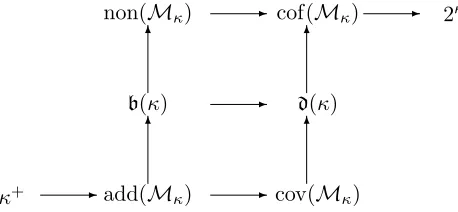
If in addition κ is strongly inaccessible we have a similar diagram as in the countable case (For specific details about these properties see [3]):
-6 6 6
6
2κ
cof(Mκ)
d(κ)
cov(Mκ)
add(Mκ)
b(κ) non(Mκ)
[image:17.612.217.446.495.601.2]κ+
Figure 1: Generalization of Cich´on’s diagram (forκstrongly inaccessible)
Lemma 34.
add(Mκ) = min{b(κ),cov(Mκ)} and cof(Mκ) = max{d(κ),non(Mκ)}.
5. Applications
Until the end of the paper let κ, κ∗, Γ, α and P∗ be fixed as in Theo-rem 12.
Theorem 35. LetGbeP∗-generic. ThenV[G]satisfiesadd(M
κ) = cof(Mκ) =
non(Mκ) = cov(Mκ) =s(κ) =r(κ) =d(κ) =b(κ) =κ∗.
Proof. Note that b(κ) ≥ κ∗ because any set of functions in κκ of size <
κ∗ appears in some initial part of the iteration (by Lemma 8) and so is dominated by the Mathias generic functions added at later stages. On the other hand, any cofinal sequence of lengthκ∗ of the Mathias generics forms a dominating family. Thus d(κ) ≤ κ∗ and since clearly b(κ) ≤ d(κ), we obtain VP∗ b(κ) =d(κ) =κ∗.
To see thats(κ)≥κ∗, observe that the Mathias generic subsets ofκ are unsplit and that every family of κ-reals of size < κ is contained in VPβ for
someβ < α. On the other hand any cofinal sequence of lengthκ∗ofκ-Cohen reals forms a splitting family and soVP∗ s(κ)≤κ∗. ThusVP∗
s(κ) =κ∗. That r(κ) =κ∗ follows from Proposition 13.
To verify the values of the characteristics associated to Mκ, proceed as
follows. Sinceb(κ) ≤non(Mκ), VP ∗
κ∗ ≤non(M
κ). On the other hand
any cofinal sequence ofκ-Cohen reals of lengthκ∗is a witness to non(Mκ)≤
κ∗, since this set of κ-Cohen reals is non-meager. By a similar argument and the fact that d(κ) = κ∗ inVP∗
, we obtain that VP∗ cov(Mκ) = κ∗.
Now, Lemma 34 implies that add(Mκ) =κ∗= cof(Mκ).
Now, we are ready to prove our main theorem.
Theorem 36. Supposeκis a supercompact cardinal,κ∗ is a regular cardinal withκ < κ∗ ≤Γ and Γ satisfiesΓκ= Γ. Then there is forcing extension in
which cardinals have not been changed satisfying:
κ∗ =u(κ) =b(κ) =d(κ) =a(κ) =s(κ) =r(κ) = cov(Mκ)
= add(Mκ) = non(Mκ) = cof(Mκ)and2κ = Γ.
If in additionγ < κ∗ →γ<κ < κ∗, then we can also provide that i(κ) =κ∗.
If in addition(Γ)<κ∗
≤Γthen we can also provide thatp(κ) =t(κ) =h(κ) =
Proof. We will modify to iteration P∗ to an iteration ¯P∗ by specifying the iterands ˙Qj for every odd ordinal j < α. It is easy to verify that those
cardinal characteristics which were evaluated in the model of Theorem 35 will have the same valueκ∗ inV¯P. Let ¯γ =hγiii<κ∗ be a strictly increasing
cofinal in α sequence of odd ordinals. The stages in ¯γ will be used to add a κ-maximal almost disjoint family of size κ∗, as well as a κ-maximal independent family of sizeκ∗.
If Γ<κ∗
≤ Γ, then using an appropriate bookkeeping function F with domain the odd ordinals in α which are not in the cofinal sequence ¯γ we can use the generalized Mathias poset to add pseudointersections to all filter bases of size< κ∗ with the SIP. In case Γ<κ∗
6≤Γ, just take for odd stages which are not in ¯γ arbitraryκ-centered,κ-directed closed forcing notions of size at most Γ.
To complete the definition of ¯P∗ it remains to specify the stages in ¯γ. For each i < κ∗, in VP¯∗
γi the poset ˙Qγi will be defined to be of the form Qγi = Q
0
γi ∗ Q˙
1
γi. Fix a ground model κ-ad family A0 of size κ and a
ground model κ-independent family I0 of size κ. Let Q0γ0 = ¯Q(A0, κ) (see
Definition 23) and inV¯P∗γ0∗Q˙0γ0 letQ1
γ0 = ˆQ(I0, κ) (see Lemma 29). Now, fix
any i < κ∗ and suppose that ∀j < i, Q0
γj = ¯Q(Aj, κ) adds a generic subset
¯
xγj ofκ whereAj =A0∪ {x¯γk}k<j and that the posetQ
1
γj = ˆQ(Ij, κ) adds
a subset ˆxγj of κ where Ij = I0 ∪ {xˆγk}k<j. In V
¯
P∗
γi let Q0
γi = ¯Q(Ai, κ)
where Ai = A0 ∪ {x¯γj}j<i and in V
¯
P∗
γi∗Q˙0γi let Q1γ
i = ˆQ(Ii, κ) where Ii =
I0∪ {xˆγj}j<i.
With this the recursive definition of the iteration ¯P∗is defined. InV¯P∗
let
A∗=A0∪ {x¯γj}j<κ∗ and letI∗=I0∪ {xˆγj}j<κ∗. We will show thatA∗and
I∗ are a κ-mad and aκ-maximal independent families respectively. Clearly
A∗ isκ-ad andI∗ isκ-independent. To show maximality ofA∗, consider an arbitrary ¯P∗-name ˙X for a subset ofκ and suppose¯
P∗ ({X˙} ∪ A∗is κ-ad).
By Lemma 8 ˙X can be viewed as a ¯P∗
β-name for someβ < α. Then forγj >
β, by Lemma 24 we obtainVP¯∗β |=|x¯
γj ∩X˙|=κ, which is a contradiction.
Thus A∗ is indeed maximal and so a(κ) ≤κ∗. However inV¯P
∗
, b(κ) =κ∗
and since b(κ)≤a(κ) we obtain V¯P∗ a(κ) =κ∗.
To see that I∗ is maximal, argue in a similar way. Consider arbitrary ¯
P∗-name ˙X for a subset ofκ such that ¯
P∗ {X˙} ∪ I∗ is independent. Then
there isβ < α such that we can see ˙X as a ¯P∗
β-name. Letγj > β. Then by
Lemma 29, inVP¯ ∗
γj+1 the family{xˆ
γj} ∪ Iγj∪ {X}is not independent, which
if wheneverγ < κ∗ we haveγ<κ < κ∗, thend(κ)≤i(κ) (by Lemma 27) and since inVP¯∗,d(κ) =κ∗, we obtainVP¯∗
i(κ) =κ∗. Suppose Γ<κ∗
≤Γ. In this case, every filter of size < κ∗ with the SIP has a pseudointersection in VP¯∗. Thus in the final extension p(κ) ≥ κ∗. However p(κ) ≤ t(κ) ≤ s(κ) and since V¯P∗ s(κ) = κ∗, we obtain that p(κ) = t(κ) = κ∗. By Proposition 33, h(κ) ≤ s(κ) = κ∗ and κ∗ = t(κ) ≤ h(κ). Thus h(κ) =κ∗.
The above iteration can be additionally modified so that in the final extension the minimal size of a κ-maximal cofinitary group, ag(κ), is κ∗.
Indeed, one can use the stages in ¯γ and [7, Definition 2.2.] to add a κ -maximal cofinitary group of sizeκ∗. The fact that κ∗ ≤ag(κ) follows from
b(κ)≤ag(κ) (see [2]).
Acknowledgements: The first author would like to thank for their gen-erous support both the Japan Society for the Promotion of Science (JSPS) through a JSPS Postdoctoral Fellowship for Foreign Researchers and JSPS Grant-in-Aid 23 01765, and the UK Engineering and Physical Sciences Research Council through an EPSRC Early Career Fellowship, reference EP/K035703/1. The last three authors would like to thank the Austrian Science Fund (FWF) for their generous support through grants number M1365 - N13 (V. Fischer) and FWF Project P25748 (S. D. Friedman and D. Montoya).
References
[1] A. Blass Combinatorial cardinal characteristics of the continuum, Handbook of set theory. Vols. 1, 2, 3, 395–489, Springer, Dordrecht (2010).
[2] A. Blass, T. Hyttinen and Y. Zhang,MAD families and their neighbors
preprint.
[3] J. Brendle, A. D. Brooke-Taylor, S. D. Friedman and D. Montoya, On Cich´on’s diagram for uncountableκ in preparation.
[4] A. D. Brooke-TaylorSmall uκ and large 2κ for supercompact κ, RIMS
Kˆokyˆuroku, 1851 (2013), 14–24.
[6] M. Dˇzamonja, S. Shelah,Universal graphs at the successor of a singular cardinal J. Symbolic Logic, 68:2 (2003), 366–388.
[7] V. Fischer, Maximal cofinitary groups revisited, Mathematical Logic Quarterly, accepted.
[8] S. D. Friedman, Cardinal Characteristics in the Uncountable, lecture notes 2014.
[9] S. Garti, Pity on λ, arXiv:1103.1947v1, 2011.
[10] S. Garti, S. ShelahPartition calculus and cardinal invariants J. Math. Soc. Japan 66(2014), no.2, 425–434.
[11] K. Kunen, Set theory Studies in Logic (London), 34. College Publica-tions, London, 2011, viii+401 pp.
[12] R. Laver, Making the supercompactness of κ indestructible under κ -directed closed forcing Israel J. of Mathematics, 29:4, 1978, 385–388.