Guided by Evolution: Biology-Oriented Synthesis of Bioactive
Compound Classes
George Karageorgisa,b Herbert Waldmann*a 0000-0002-9606-7247
aMax-Planck-Institute of Molecular Physiology,
Department of Chemical Biology, Otto-Hahn-str. 11, 44227 Dortmund, Germany
bCurrent address: School of Chemistry, University of
Leeds, Woodhouse Lane, Leeds, LS2 9JT, UK
Published as part of the 50 Years SYNTHESIS – Golden Anniversary Issue
N R2
O R1
N O N R1
R2
N H
N
Natural products: biologically prevalidated evolutionary conserved molecular scaffolds
Structurally simplified NP-inspired scaffolds
NP-derived fragments Libraries with enriched bioactivity Novel small molecule modulators
Received: 29.08.2018 Accepted: 03.09.2018 Published online: 11.10.2018
DOI: 10.1055/s-0037-1610368; Art ID: ss-2018-z0577-sr
License terms:
Abstract Biology-oriented-synthesis (BIOS), is a chemocentric ap-proach to identifying structurally novel molecules as tools for chemical biology and medicinal chemistry research. The vast chemical space can-not be exhaustively covered by synthetic chemistry. Thus, methods which reveal biologically relevant portions of chemical space are of high value. Guided by structural conservation in the evolution of both pro-teins and natural products, BIOS classifies bioactive compound classes in a hierarchical manner based on molecular architecture and bioactivi-ty. Biologically relevant scaffolds inspire and guide the synthesis of BIOS libraries, which calls for the development of suitable synthetic method-ologies. These compound collections have enriched biological rele-vance, leading to the discovery of bioactive small molecules. These po-tent and selective modulators allow the study of complex biological pathways and may serve as starting points for drug discovery pro-grams. Thus, BIOS can also be regarded as a hypothesis-generating tool, guiding the design and preparation of novel, bioactive molecular scaffolds. This review elaborates the principles of BIOS and highlights selected examples of their application, which have in turn created fu-ture opportunities for the expansion of BIOS and its combination with fragment-based compound discovery for the identification of biologi-cally relevant small molecules with unprecedented molecular scaffolds. 1 Introduction
2 Structural Classification of Natural Products
3 Implications and Opportunities for Biology-Oriented Synthesis 4 Applications of Biology-Oriented Synthesis
4.1 Chemical Structure and Bioactivity Guided Approaches 4.2 Natural-Product-Derived Fragment-Based Approaches 5 Conclusions and Outlook
Key words natural products, bioorganic chemistry, stereoselective synthesis, high-throughput screening, combinatorial chemistry
1 Introduction
Small molecules are excellent tools for chemical biology research and the analysis of complex biological mecha-nisms. Their effect is acute, yet not permanent and can be tuned, e.g., by dosage, to work reversibly and rapidly,1 in
contrast to most genetic approaches. Thus, the develop-ment of selective small molecule as probes for protein tar-gets is of high value for studying and understanding
biolog-Herbert Waldmann studied chemistry at the University of Mainz, where he received his PhD in organic chemistry in 1985 under the guid-ance of Prof. Horst Kunz. After a postdoctoral appointment with Prof. G. Whitesides at Harvard University, he completed his habilitation at the University of Mainz in 1991. In 1999 he was appointed Director at the Max Planck Institute of Molecular Physiology, Dortmund, and Full Professor of Biochemistry at the University of Dortmund. His research focuses on the syntheses of signal-transduction modulators and natu-ral-product-inspired compound libraries and their biological evaluation.
ical phenomena. It is estimated that drug-like chemical space may accommodate ca. 1060 small molecules,2
render-ing its investigation by means of synthesis alone an unfeasi-ble task.
On the other end of the scale, nature has circumvented this issue by conserving the structural and chemical prop-erties of protein-binding sites during their selection and evolution. There are more than 10390 combinations possible
for a protein of an average size of 300 amino acids, synthe-sized from 20 different amino acids.2 However, an
estimat-ed 25,000 proteins may be encodestimat-ed even in the complicatestimat-ed human genome, containing subdomains that are conserved within protein classes. This restriction may be attributed to thermodynamic stability rather than function, which im-poses physical and chemical evolutionary pressure on pro-tein formation.3,4 The arrangement of secondary structures
(α helices and β sheets) determines the three-dimensional structure of proteins, which leads to the formation of char-acteristic fold classes of the individual protein domains. These folds determine the size and shape of binding sites for ligands or substrates, whilst the chemical structure of amino acid residue side chains determines the kind of li-gand (e.g., polar, nonpolar) that can be bound. Additionally, these ligand-accommodating sites within single domain proteins can be represented by about 1300 binding pock-ets.3 This fact suggests that a given fold type may be formed
by different amino acid sequences and thus even protein domains with low primary sequence homology can have very similar folds.5
In direct analogy, natural products (NPs) have a limited number of core scaffolds, which are distinguished by differ-ent groups decorating the cdiffer-entral scaffold. NPs are small-molecule secondary metabolites and have been a major source of inspiration for chemists and chemical biologists.6
NPs are intrinsically different from compounds resulting from conventional combinatorial synthesis, due to their in-creased three-dimensional character, which also correlates with higher success rates in drug discovery projects.7 NPs
have evolved to interact with more than one protein, as they are typically formed through sequential binding of biosynthetic intermediates to different enzymes and also display different biological effects, either within the pro-ducing organism or across different species.8 The diverse
substitution patterns in NPs of related molecular scaffolds result in different bioactivity profiles, suggesting that NPs define evolutionary selected structures, which can interact with multiple proteins, whilst selectivity is finely tuned by the functional groups of each individual molecule. NPs de-fine biologically relevant portions of vast chemical space.
These principles can be applied in the design and prepa-ration of novel small molecules which modulate the func-tion and activity of proteins. NP molecular scaffolds can be analyzed to identify the relevant features for bioactivity and subsequently applied to the synthesis of NP-inspired com-pound libraries with simplified, more synthetically
attain-able structures. Systematic and structure-based approach-es, which can serve as the basis and guide the development of small molecules with novel bioactivities, are of high val-ue in chemical biology and medicinal chemistry research. Biology-oriented synthesis (BIOS) is based on the structural analyses of NPs and their respective protein targets and abides to the evolutionary conservatism and functional-group diversity principles encountered in nature. Develop-ing collections of NP-inspired compounds with diverse sub-stitution patterns around a common core scaffold may re-sult in matching the diversity of amino acid side chains oc-curring within otherwise similar protein subfolds. Thus, BIOS is a chemocentric approach taking advantage of prevalidated, biologically relevant starting points offered by NP structure. The resulting compound collections are en-riched in bioactivity and can be used for the development of molecular tools for the study of protein function and to decipher complex biological phenomena.
2 Structural Classification of Natural
Prod-ucts
To chart the chemical space covered by NPs, a chemoin-formatic tool termed ‘structural classification of natural products’ (SCONP) was developed.9 By using SCONP, the
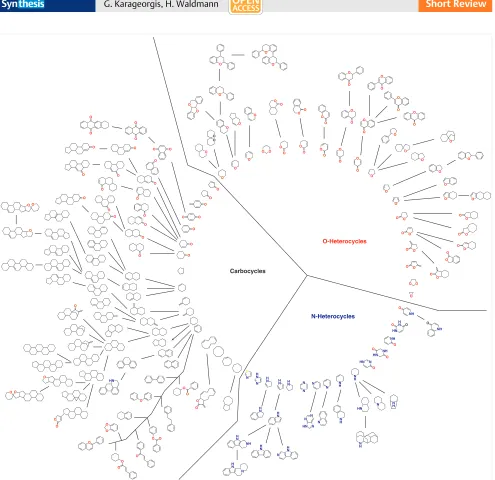
highly complex NP structures can be reduced, by classifying and arranging the core scaffolds in a hierarchical manner, resulting in the generation of a branch for each scaffold. In each branch, each parent scaffold is a substructure of its offspring and branches merge together to generate a scaf-fold tree (Figure 1). Initially, the chemical space covered by natural products contained gaps where certain substruc-tures had not been discovered yet or had not emerged through nature’s evolutionary process. Virtual scaffolds were thus generated in silico, derived from the iterative de-construction process itself. These scaffolds have not yet been reported and they provide excellent starting points for the syntheses of NP-inspired compounds.
Moving along the branches of the scaffold tree, starting from the outer, more complex structures to the inner, struc-turally more simplified scaffolds is a process termed ‘bra-chiation’. This linear movement along the branches of a scaffold tree suggests that the bioactivity encoded in the derived substructures is partially retained, e.g., potency may be lowered, and proceeds with the retention of biolog-ical relevance. This principle is analogous to fragment-based drug discovery,10 and is based on the assumption that
smaller scaffolds may transfer their biologically relevant characteristics to the resulting molecules into which they are incorporated. As such, scaffold trees may be alternative-ly constructed on the basis of bioactivity instead of chemi-cal structure.11 These biology-guided scaffold trees offer
bioactivi-ty as the branch-constructing principle, and can lead to mo-lecular scaffolds in which a particular kind of bioactivity is retained.
3 Implications and Opportunities for
Biolo-gy-Oriented Synthesis
BIOS can be applied through SCONP to identify un-known, biologically relevant regions of chemical space. As bioactivity is guiding the selection of scaffolds, the result-ing compound collections may be enriched in bioactivity, which in turn suggests that the size of the compound
[image:3.595.52.547.73.553.2]col-lections to be synthesized can be reduced. This principle compensates for the fact that the preparation of these com-pounds may be more elaborate compared to combinatorial libraries. Additionally, NP-inspired compounds may be less structurally complex when compared to the guiding NPs, resulting in reliable and efficient synthetic routes and re-tained bioactivity. Ultimately, BIOS aims to provide com-pounds which can be used to develop optimized structures based on a biologically relevant scaffold. This optimization can be achieved through established approaches and strate-gies of medicinal chemistry and may improve the potency or physicochemical properties of selected candidates de-pending on their intended use as lead for drug development
Figure 1 The classification of NP core scaffolds into a ‘scaffold tree’ as calculated by the SCONP algorithm S
N HN
or tool compounds for chemical biology.12 Thus, BIOS relies
on the continuous development of novel and robust chemi-cal methods that can be subsequently applied in the paral-lel preparation of compound collections with structurally complex scaffolds in a modular manner.
Preparing structurally simplified scaffolds, by following the BIOS process, may lead to the resulting molecules en-gaging multiple protein targets with similarly shaped li-gand-binding sites. This potential promiscuity can be garded as an advantage, as biological networks are often re-dundantly interconnected, suggesting that several modulating interactions are necessary for the desired bio-logical effect. NPs have been selected and evolved for their ability to interact in a dynamic manner with such systems and these properties can be passed down to NP-inspired compounds through their chemical structures. Any selec-tivity issue which may arise can be addressed through es-tablished medicinal chemistry approaches, suggesting that BIOS offers unique opportunities for the preparation of molecules which may display poly-bioactivity profiles, and as such can be proven ideal tools for systems biology re-search (Scheme 1). To take full advantage of these poly-bio-active compounds, target-agnostic and cell-based pheno-typic screenings can be undertaken; it is essential that these are coupled with effective strategies for target decon-volution, identification, and validation.8 Finally, the BIOS
principles can be applied to non-natural-derived bioactive scaffolds and compound classes, as the approach is guided by the biological relevance itself and not its occurrence in nature.
4 Applications of Biology-Oriented Synthesis
The principles of BIOS can be applied to guide the de-sign and preparation of NP-inspired molecular scaffolds employing different aspects of NPs as the guiding principle. For example, following the chemical structure of the core scaffold as the guiding principle may result in a distinct bio-logically relevant compound class compared to when utiliz-ing bioactivity as a guidutiliz-ing principle. Employutiliz-ing these as-pects in a complementary manner can result in the effi-cient preparation of biologically enhanced compound libraries and can lead to the discovery of structurally un-precedented bioactive small molecules.
4.1 Chemical Structure and Bioactivity Guided
Approaches
Polycyclic scaffolds with a high degree of three-dimen-sionality can be prepared by the utilization of chemical cas-cade reactions. These scaffolds are useful synthetic tools to investigate the hypotheses generated by the application of the SCONP algorithm and the scaffold tree. Due to their
modularity, cascade reactions facilitate the preparation of compound collections that are large enough for the applica-tion of BIOS, as the resulting scaffolds are already biologi-cally relevant. Cascade reactions producing polycyclic scaf-folds or fusing fragments require the use of structurally simple starting materials, in reduced quantities as well as in fewer handling and purification steps. As an example, a twelve-step reaction cascade sequence, including nine dis-crete chemical transformations,13 was used in the
prepara-tion of the structurally complex tetracyclic tetrahydroin-doloquinolizines (Scheme 2, A). This scaffold resembles a
Scheme 1 BIOS overview. NPs are used to select simplified scaffolds that guide the preparation of compound libraries with enriched bioac-tivities, leading to the identification of novel small molecule modula-tors, which may be used as tools in chemical biology research.
Scaffold tree classification
N H
N
Structurally simplified NP-inspired scaffolds
BIOS
number of polycyclic indole alkaloid structures.14 This
cas-cade was further utilized to prepare a focused compound collection, which was screened for mitosis modulation, as previously reported indole-alkaloid-based molecules were reported to affect this process.15,16 Arrested mitosis and
multipolar mitotic spindles were observed using confocal microscopy imaging of recombinant cells, revealing at least two compounds with low micromolar effective concentra-tions. The centrosomal protein NPM1, which is a centro-some duplication regulator,17 and its associated nuclear
ex-port factor Crm118 were identified as the biological targets
through a chemical proteomics investigation using activity-based pull-down probes followed by MS determination or immunoblotting. Further evidence of target engagement was demonstrated by using knockdown cell lines. These novel inhibitors were used to guide the design of a focused structurally simplified collection, prepared by a newly de-veloped enantioselective synthetic route (Scheme 2, B).19
Subsequent screening for mitosis modulation led to the identification of an analogue with a fourfold increased po-tency. This finding provided further evidence that BIOS can be applied in non-naturally occurring yet biologically rele-vant molecules as well.
Alternative, yet complementary to linear cascades, branching reaction cascades are highly efficient synthesis tools, which can be used for the preparation of diverse mo-lecular scaffolds using only a few common precursors.20
In-tra- or intermolecular reactions can be used, involving a number of complexity generating branching cascades re-sulting in the formation of diverse and complex molecular architectures in a rapid and concise manner.21 Thus,
branching cascades are fitting tools for the preparation of compound collections guided by BIOS. For example, a range of bi-nucleophilic reagents were used with a common starting material bearing multiple electrophilic positions.
Their reaction resulted in the formation of twelve discrete and structurally diverse unprecedented molecular scaffolds (Scheme 3), some of which were NP-related.22
Iridoids are a class of structurally complex NPs, which have been reported to exhibit neuroprotective or neurite-growth-promoting properties.23,24 The BIOS approach was
applied to the iridoid scaffold in order to develop small molecules aimed at the study and treatment of neurode-generative diseases.25–27 A sequence involving a [3+2]
cyclo-addition and a regioselective Baeyer–Villiger oxidation gave
Scheme 2 Cascade reactions are ideal for the application of BIOS. A) A structurally complex polycyclic scaffold was prepared by using a twelve-step reaction cascade. B) An enantioselective reaction was developed to prepare structurally simplified analogues resulting in the identification of mitosis modulators with up to a four-fold increase in potency.
O O
O
RO2C R4
R1
R2
R3
R5
N H
NH2
PPh3, CSA
via 12-step reaction cascade
R5
N H
N
O OH
RO2C R4
R1
R2
R3
O O
CO2Me
N
enantioselective inverse electron demand
imino-Diels-Alder N
O OH
MeO2C
A
B
H
structurally simplified scaffold four-fold potency increase
Scheme 3 Branching cascades are equally useful synthetic tools for the preparation of diverse and structurally complex molecules.
O O
O R3
R4
O R1
R2
N N
H
R3
R4
O O
N N H N
O R4
X
N N Y
R4
R N
O R
R4
X
N H
N H
Y R
4
O O
O O
O R4
OH
access to two molecular scaffolds of the general iridoid class (Scheme 4).28 Subsequent development of an
enantioselec-tive route, followed by individual scaffold derivatization steps, led to the preparation of a collection of 54 molecules This collection was screened for activity by using a primary hippocampal neuron outgrowth assay and a mouse embry-onic stem cell motor neuron growth assay, leading to the identification of novel active compounds with neurite-growth-promoting properties. These compounds displayed different patterns of neurite growth promotion and may be used as biological tools to investigate these neurodevelop-mental processes further.
Scheme 4 Irridoid-inspired design and preparation of a neurite-growth-promoting compound class: A. examples of iridoid NPs; B. chemical synthesis of iridoid scaffold analogues and related molecules; C. compounds that display neurite growth properties.
Similarly, secoyohimbane NPs (Scheme 5) have also been reported to possess neurite-growth-promoting prop-erties.29–31 Their core scaffold is characterized by a high
de-gree of three-dimensionality and consists of four connected rings and a spiral center. The development of an organocat-alytic, enantioselective synthetic route towards secoyohim-bane analogues gave access to a collection of 56 com-pounds. Although structurally simplified compared to the guiding NPs, five of these compounds exhibited neurite-growth-promoting properties when using either the hippo-campal neurite outgrowth or the mouse embryonic stem cell motor neurite growth assays.32 These findings provided
further validation for BIOS as a chemocentric hypothesis-generating approach, which can lead to the identification of bioactive small molecules.
4.2 Natural-Product-Derived
Fragment-Based
Approaches
Fragments are molecules with low molecular weight33
that have been shown to expedite the exploration of chemi-cal space.34 Earlier attempts at fragment-based drug
discov-ery10 utilized compound libraries where the fragments are
derived from known drugs, covering already known por-tions of chemical space35,36 and including a low number of
molecular structures with a high degree of three-dimen-sionality.37
Natural products are characterized by a high degree of three-dimensional character. Furthermore, they occupy bi-ologically relevant portions of chemical space that are often not covered by synthetically accessible compounds,38 as
NPs are biologically prevalidated by nature. Additionally, NP-derived fragments may display different biologically rel-evant profiles compared to synthetically accessible frag-ments, as suggested by the chemoinformatic analyses of natural product structures based on fragment likeness.39,40
Suitable NP-derived fragments can be selected by the SCONP algorithm using additional filtering algorithms. A virtual set of NP-derived fragments was shown to have a high degree of three-dimensional character, structural complexity, and diversity, and occupied different portions of chemical space compared to a set of commercially avail-able fragments.41 Additionally, their distribution of physical
properties was found to be similar to that of the guiding O
R1O
R2O
O
OHOH OR4
H OR3
Silphienes Harpagides
O R5
• R6
[3+2]
O R5 R6
CO2Et
Baeyer–Villiger oxidation O
O
CO2Et
R6
R5
O O
CO2Et
O H
Br F
O
CO2Et
OH OH H O
O
O
Iridoid scaffold analogues
(neurite growth promoters)
A
B
C
CO2Et
PR3
+
Scheme 5 Neurite-growth-promoting compounds inspired by the sec-oyohimbane scaffold: A) rychnophylline: a secsec-oyohimbane alkaloid; B) accessing the secoyohimbane scaffold through an organocatalytic, en-antioselective synthesis; C) secoyohimbane analogues with neurite growth properties.
N H
N
O
CO2Me
O
H H
N H
N CO2Me
O O
O
N H
N CO2Me
O O
Rychnophylline
(secoyohimbane scaffold)
Secoyohimbane scaffold analogues acting as neurite growth promoters N
H HN
O CO2Me
Br
O
R
N
H OTMS Ph
Ph
CsOAc
N H
N CO2Me
O O
R
A
B
C
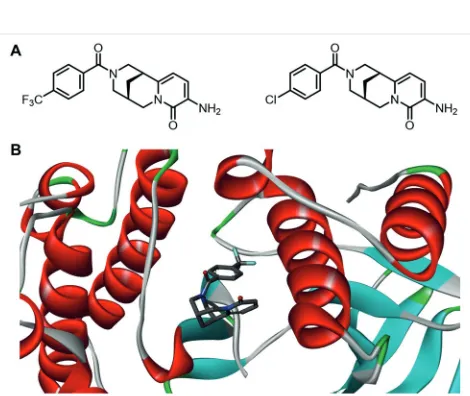
NPs. Thus, NP-derived fragments can be used to identify compounds with unprecedented chemotypes, which act as modulators of known biological targets. For example, deriv-atives of the structurally complex, bicyclic cytisine– sparteine scaffold were found to be allosteric inhibitors of the p38a MAP kinase (Figure 2).41 These findings suggested
that the BIOS principles can be expanded to include NP-derived fragments as simplified substructures of NPs, with applications in fragment-based ligand discovery. These fragments are synthetically more tractable when compared to the guiding NPs, which may require multistep proce-dures for their preparation. Thus, compound libraries com-prised of NP-derived fragments can be used to overcome limitations associated with synthetic tractability of certain NPs and efficient methodologies for the preparation of such fragments are in high demand.
Molecular scaffolds which include NP-derived frag-ments may result in compound collections with limited structural diversity, due to their predefined structures. To overcome this potential limitation, a common starting ma-terial can be used that combines an embedded NP fragment with orthogonally reactive functional groups. These groups can undergo different chemical transformations when treated with different catalysts or reagents and afford struc-turally diverse compounds which include NP-derived frag-ments in their molecular scaffolds. Versatile chemical methodologies which have the potential to proceed via multiple divergent reaction pathways are needed for the successful application of this approach. These reagent-directed syntheses can give access to compound collections with enhanced structural complexity and diversity as well as additional biological relevance instilled by the incorpora-tion of the NP-derived fragment.
The oxindole fragment forms part of a number of di-verse NPs exhibiting different bioactivities42,43 and is also
incorporated in a number of compounds included in medic-inal chemistry and drug discovery projects.44,45 Harnessing
the versatility of gold-catalyzed reactions, a common oxin-dole-derived 1,6-enyne starting material was used to give rise to three distinct molecular scaffolds with NP features (Scheme 6, A). The regio-reactivity of the enyne functional-ity was modulated by the source of gold and the properties of the ligand used in each case,42,46,47 allowing the
orthogo-nal preparation of each scaffold on demand leading to the divergent formation of a skeletally diverse collection of 60 compounds. In order to investigate the biological relevance and potential activity of these compounds, cellular assays monitoring biological pathways, rather than individual tar-gets, were employed.
The Hedgehog (Hh) pathway is a conserved signaling pathway involved in a number of processes such as cell pro-liferation and differentiation and tissue regeneration and repair, and has been associated with conditions such as birth defects and cancer.48 Equally important, the Wnt
sig-naling pathway is implicated in processes such as cell pro-liferation and migration, tissue regeneration, cell polarity, as well as stem cell renewal, playing a key role in the prolif-eration of malignant tissue.49 Autophagy is a catabolic
cess playing an integral part in cell homeostasis. This pro-cess involves the self-degradation of cellular components such as damaged organelles and denatured proteins, and is thought to act as a survival mechanism for cancer cells un-dergoing metabolic stress caused by a lack of nutrients or oxygen and increased energy demand. Inhibition of the au-tophagy process has recently emerged as a potential strate-gy for targeting cancer.50 By utilizing cellular assays that
monitor these processes, structurally unprecedented and selective inhibitors of the Hedgehog and Wnt signaling pathways, the autophagy process, as well as cellular prolif-eration were revealed. Two compounds displayed low mi-cromolar inhibitory activity of the Hh pathway, yet did not interfere with cell viability (Scheme 6, B). Additional bio-logical characterization demonstrated that these com-pounds act as reversible binders of the transmembrane pro-tein Smoothened (Smo), which is an activator of the Hh pathway. A different oxindole-derived compound was shown to have low micromolar inhibitory activity against the Wnt pathway. This selective and structurally novel in-hibitor did not interfere with the Hh pathway (Scheme 6, B). A structurally distinct compound was revealed to inhibit the autophagy process selectively. Additionally, a novel can-cer cell proliferation modulator was also identified by using an imaging assay which monitors cell confluency. This structurally distinct compound did not exhibit any activity in the Hh and Wnt or autophagy assays.
[image:7.595.52.287.90.288.2]Following a different synthetic approach and working towards the application of these principles, an asymmetric 1,3-dipolar cycloaddition of azomethine ylides with various
olefins was employed to prepare a compound collection with a bicyclic scaffold containing the pyrrolizidine frag-ment.51 This NP-derived fragment is encountered in
com-pounds with bioactivities ranging from insecticides to car-cinogens and other alkaloid NPs.52,53 Employing
glutamate-derived imines and maleimide derivatives in the presence of a chiral copper–ferrocene catalyst complex, followed by an intramolecular lactamization, this new synthetic meth-odology gave access to a collection of 30 compounds. Se-lected compounds of this collection exhibited antibacterial activity, inhibiting the growth of the pathogen P. falciparum
whilst others were revealed to act as Hedgehog pathway in-hibitors with activities in the low micromolar range (Scheme 6, B). These findings demonstrate that synthetic approaches which incorporate NP-derived fragments can
be applied to prepare biologically relevant compound col-lections. These distinct and structurally diverse small mole-cules may act as selective modulators of different biological processes and signaling pathways, with direct applications in chemical biology research.
The preparation of compound libraries with molecular scaffolds that have only certain common fragments, yet do not share the whole core scaffold with the guiding NPs, may still lead to the identification of biologically relevant small molecules. This observation suggests that novel molecular scaffolds may inherit the physiochemical and bioactive properties of NPs, if they incorporate combinations of NP-derived fragments. These combinations may give rise to novel chemical matter that is biologically relevant, but not linked to specific biological targets. Thus, the resulting
Scheme 6 NP-derived fragments may enhance biological relevance when embedded in molecular scaffolds. A) Scaffold-divergent synthesis led to the identification of skeletally different compounds from a common starting material, with diverse bioactivities. B) The enantioselective preparation of scaffolds containing pyrrolizidine fragments resulted in the identification of compounds with antibacterial properties.
N R2
O R3
O R4
R1 N O
R2
O R4
R3
H
N O R
4
R3
O R2
H N
O O
R3
R4
R2
R1
R1
R1
Novel small molecules with divergent biological activities
N O O Me
Cl
N O
O Ph H
Cl N
O
O Ph H
N O
O O
Hh pathway inhibitor IC50 = 2.75 μM autophagy inhibitor
IC50 = 4.8 μM
cell proliferation inhibitor IC50 = 15.4 μM Wnt pathway inhibitor
IC50 = 4.2 μM
A B
MeO2C
N R1
CO2Me
N O
O R2
NH N
O
O H
H R1
CO2Me
CO2Me
R2
N N
O
O H
H R1
CO2Me
R2
O
NH MeO2C
CO2Me N MeO2C
O BnO2C
BnO2C
O BnO2C
BnO2C
N
P. falciparum growth inhibitors
chemotypes can be used to explore portions of chemical space which cannot be reached by NPs, since such fragment combinations may not be obtainable through biosynthetic pathways. Similar to the biological evaluation of newly dis-covered NPs, these compounds require more elaborate screening efforts and their potential would be best explored by the use of target agnostic cellular assays which follow phenotypic changes rather than individual biological tar-gets.
These novel NP-derived fragment combinations require the development of enantioselective synthetic methods for the preparation of enantiopure compounds at will, since bioactivity is often correlated with the absolute configura-tion of specific NPs. For example, a hybrid scaffold with eight stereocenters, combining the tropane and pyrrolidine fragments, was accessed through a catalytic enantioselec-tive cycloaddition in an enantiodivergent fashion.54 The
tro-pane fragment has been the focus of medicinal chemistry studies and biological research,55,56 since it is abundantly
encountered in a plethora of alkaloid NPs that exhibit a range of diverse biological effects.57–59 Similarly, the
pyrroli-dine fragment can be found in a variety of biologically rele-vant NPs – alkaloids and others – and forms part of ap-proved drugs as well as research compounds.60 A chiral
cop-per(I)–phosphine catalyst was used to kinetically resolve the racemic tropane starting material, which reacts with an azomethine ylide to form this pyrrotropane scaffold. The unreacted enantiomer of the tropane starting material can then be converted into a distinct analogue of the
pyrrotro-pane scaffold in the presence of a different azomethine ylide and a racemic copper(I)–phosphine in a one-pot man-ner. The two analogues can then be purified via chromatog-raphy with only one purification step resulting in the isola-tion of two distinct compounds. Furthermore, reversing the addition of the two azomethine ylides leads to the forma-tion of the opposite enantiomers, which can also be ob-tained on demand (Scheme 7, A). In a different example, the combination of the tropane and oxindole fragments was achieved in an enantioselective fashion by utilizing a bime-tallic relay catalysis approach.61 Oximino-derived cyclic
azomethine ylides reacted with oxindole-bearing olefins leading to the formation of spiro-tropoxindoles (Scheme 7, B). This specific fragment combination is precedented in NPs, which exhibit diverse bioactivities such as antiplasmo-dials and vasorelaxants.58,62 However, a catalytic
enantiose-lective method for the preparation of this biologically rele-vant and structurally complex molecular scaffold had not been reported previously. Such methods provide the oppor-tunity to explore adjacent portions of chemical space to those covered by the guiding NPs, through the preparation of analogues which cannot be obtained through biosynthe-sis alone.
By extension, non-natural yet NP-inspired scaffolds may also be prepared by minimal chemical modifications of the guiding NPs. For example, the use of regioselective ring contractions or expansions or intramolecular transforma-tion of functransforma-tional groups can give access to new molecular scaffolds from NPs in a direct manner. These compounds
Scheme 7 A) One-pot enantiodivergent synthesis of hybrid NP-derived fragment scaffolds enabled by the kinetic resolution of tropanes with azome-thine ylides catalyzed by a chiral copper(I)–phosphine complex. B) Enantioselective preparation of spiro-tropoxindoles, by means of bimetallic relay catalysis.
O
O N
N R
R
N O
O R1
O
O N
N R
R
NH CO2Me
R1
N O
O R2
racemic copper(I)– phosphine complex`
O
N R
NH CO2Me
R1
O
N
R NH CO2Me
R2
kinetic resolution A
B
stereodiverse pyrrolidine-tropanes
N Boc
O R2
R1 R4
O N2
N R3O
N Boc
N O
O R2
R4
R3O
R1
RhII NdIII
bimetallic relay catalysis
spiro-tropoxindoles
may retain their biological relevance and properties63,64 and
have the potential to fill in gaps in chemical space that have remained unexplored by nature. Due to their existing struc-tural diversity, NPs can be used as the starting materials for such chemocentric approaches and they can prove to be ideal substrates for regio- and stereoselective transforma-tions.65 The application of these principles was
demonstrat-ed by Hergenrother and co-workers, who utilizdemonstrat-ed a ring-distortion strategy to prepare diverse, structurally complex, and distinct small molecules directly from guiding NPs in a rapid manner.66 This strategy allows the capitalization of
NP properties, such as biologically relevant structural fea-tures, already bestowed by nature.65 In a similar manner, an
[image:10.595.52.289.446.629.2]oxazatwistane scaffold can be prepared directly from cchona alkaloids via ring distortion. This class of NPs in-cludes bioactive molecules such as quinine and quinidine (Figure 3).67 By utilizing late-stage C–H functionalization,
transformations to the resulting oxazatwistane scaffold, as well as metal-catalyzed coupling reactions allowed the preparation of a collection of about 50 analogues. These compounds were subjected to phenotypic and target-agnostic cellular assays leading to the identification of sub-micromolar inhibitors of starvation-induced autophagy (Figure 3). These compounds represent structurally unprec-edented autophagy modulators68 and their bioactivity
pro-file is distinct from that of the guiding NPs, as none of qui-nine, quinidine, or the unsubstituted oxazatwistane scaf-fold was found to exhibit this inhibitory activity at the tested concentration.
Figure 3 Cinchona alkaloid natural products such as quinidine can be directly transformed into novel scaffolds such as the oxazatwistane. Late-stage functionalization enabled the preparation of substituted oxazatwistanes, which were identified as submicromolar inhibitors of autophagy.
5 Conclusions and Outlook
Small molecules are excellent tools for the study and elucidation of complex biological mechanisms, as their mode of action can be conditional, tunable, reversible, and rapid. Thus, design principles and methodologies facilitat-ing the chartfacilitat-ing and qualitative analysis of chemical space in a systematic manner enable the identification of biologi-cally relevant chemical matter and unprecedented bioactive chemotypes. The ‘structural classification of natural prod-ucts’ (SCONP) algorithm enables the structural analyses of NP scaffolds, which represent prevalidated and biologically relevant spots in chemical space. As such, SCONP can be a hypothesis-forming tool, guiding the design and prepara-tion of compound libraries which have been demonstrated to possess enriched bioactivity and give rise to potent and selective modulators for established biological targets. These compounds have also been used as tools for chemical biology research, leading to the identification of novel bio-logical targets, or may be used as tools for the development of lead compounds for medicinal chemistry research. While BIOS collections may contain fewer members, the com-pounds prepared following BIOS design principles exhibit a higher degree of three-dimensional character compared to conventional combinatorial libraries. Furthermore, their concise syntheses enable the modular modification of func-tional groups, resulting in sufficient substituent diversity, which is crucial for the development of specific selectivity profiles of the corresponding small molecule modulators. Although additional synthetic effort is required for their preparation, BIOS collections display higher hit rates com-pared to combinatorial libraries, due to their enhanced bio-logical relevance. Evidently, the development and applica-tion of novel synthetic methodologies granting access to NP-inspired molecular scaffolds in an efficient and reliable fashion lie at the core of BIOS, which is a chemocentric ap-proach for the identification of biologically relevant chemi-cal matter.
These principles were also applied to fragments that have been shown to expedite the exploration of chemical space and are significantly more synthetically tractable. Specifically NP-derived fragments were included in the SCONP algorithm, thus expanding the scope of BIOS and merging this approach with fragment-based compound discovery. This combination provides an additional tool for the identification of biologically relevant compounds. The full potential of these unprecedented molecules can be demonstrated by the use of unbiased screening methods, such as cell-based and target-agnostic phenotypic assays, as demonstrated by the identification of novel and selective modulators of the Hedgehog and Wnt signaling pathways, or the autophagy process.
Lastly, BIOS is an approach inspired by the evolutionary conservation of molecular architectures observed in nature, and relies on the biological relevance and prevalidation of N
OH
N
O
quinidine
N O
N
O F
N O
N
O F
CF3
NPs. BIOS libraries have been shown to have enhanced bio-logical relevance, leading to the discovery of small molecule modulators with unprecedented chemotypes with high hit rates. Therefore, following the BIOS design principles en-ables overcoming limitations such as synthetic tractability in the study of NP-inspired compounds and provides new opportunities for organic synthesis aligned with biological research.
References
(1) Zamir, E.; Bastiaens, P. I. H. Nat. Chem. Biol.2008, 4, 643.
(2) Dobson, C. M. Nature2004, 432, 824.
(3) Gao, M.; Skolnick, J. PLoS Comput. Biol.2013, 9, e1003302.
(4) Patel, S. C.; Bradley, L. H.; Jinadasa, S. P.; Hecht, M. H. Protein Sci.
2009, 18, 1388.
(5) Sadreyev, R. I.; Grishin, N. V. BMC Struct. Biol.2006, 6, 6. (6) Newman, D. J.; Cragg, G. M. J. Nat. Prod.2007, 70, 461.
(7) Lovering, F.; Bikker, J.; Humblet, C. J. Med. Chem.2009, 52, 6752.
(8) Ziegler, S.; Pries, V.; Hedberg, C.; Waldmann, H. Angew. Chem.
Int. Ed.2013, 52, 2744.
(9) Koch, M. A.; Schuffenhauer, A.; Scheck, M.; Wetzel, S.; Casaulta,
M.; Odermatt, A.; Ertl, P.; Waldmann, H. Proc. Natl. Acad. Sci.
U.S.A.2005, 102, 17272.
(10) Murray, C. W.; Rees, D. C. Nat. Chem.2009, 1, 187.
(11) Renner, S.; van Otterlo, W. A. L.; Dominguez Seoane, M.; Mocklinghoff, S.; Hofmann, B.; Wetzel, S.; Schuffenhauer, A.; Ertl, P.; Oprea, T. I.; Steinhilber, D.; Brunsveld, L.; Rauh, D.;
Waldmann, H. Nat. Chem. Biol.2009, 5, 585.
(12) Frye, S. V. Nat. Chem. Biol.2010, 6, 159.
(13) Dückert, H.; Pries, V.; Khedkar, V.; Menninger, S.; Bruss, H.; Bird, A. W.; Maliga, Z.; Brockmeyer, A.; Janning, P.; Hyman, A.; Grimme, S.; Schürmann, M.; Preut, H.; Hübel, K.; Ziegler, S.;
Kumar, K.; Waldmann, H. Nat. Chem. Biol.2012, 8, 179.
(14) Ishikura, M.; Yamada, K.; Abe, T. Nat. Prod. Rep.2010, 27, 1630.
(15) Hung, D. T.; Jamison, T. F.; Schreiber, S. L. Chem. Biol.1996, 3,
623.
(16) Peterson, J. R.; Mitchison, T. J. Chem. Biol.2002, 9, 1275.
(17) Lim, M. J.; Wang, X. W. Cancer Detect. Prev.2006, 30, 481.
(18) Hutten, S.; Kehlenbach, R. H. Trends Cell Biol.2007, 17, 193.
(19) Eschenbrenner-Lux, V.; Küchler, P.; Ziegler, S.; Kumar, K.;
Waldmann, H. Angew. Chem. Int. Ed.2014, 53, 2134.
(20) Enders, D.; Grondal, C.; Hüttl, M. R. M. Angew. Chem. Int. Ed.
2007, 46, 1570.
(21) Nielsen, T. E.; Schreiber, S. L. Angew. Chem. Int. Ed.2008, 47, 48. (22) Liu, W.; Khedkar, V.; Baskar, B.; Schürmann, M.; Kumar, K.
Angew. Chem. Int. Ed.2011, 50, 6900. (23) Butler, M. S. Nat. Prod. Rep.2008, 25, 475. (24) Prisinzano, T. E. J. Nat. Prod.2009, 72, 581.
(25) Jessen, H. J.; Schumacher, A.; Shaw, T.; Pfaltz, A.; Gademann, K.
Angew. Chem. Int. Ed.2011, 50, 4222.
(26) Kuai, L.; Wang, X.; Madison, J. M.; Schreiber, S. L.; Scolnick, E. M.; Haggarty, S. J. ACS Chem. Neurosci.2010, 1, 325.
(27) Bauer, A. J.; Stockwell, B. R. Chem. Rev.2008, 108, 1774. (28) Dakas, P.-Y.; Parga, J. A.; Höing, S.; Schöler, H. R.; Sterneckert, J.;
Kumar, K.; Waldmann, H. Angew. Chem. Int. Ed.2013, 52, 9576.
(29) Praveen Kumar, V.; Gajendra Reddy, R.; Vo, D. D.; Chakravarty,
S.; Chandrasekhar, S.; Grée, R. Bioorg. Med. Chem. Lett.2012, 22,
1439.
(30) Cheng, X.; Harzdorf, N.; Khaing, Z.; Kang, D.; Camelio, A. M.;
Shaw, T.; Schmidt, C. E.; Siegel, D. Org. Biomol. Chem.2012, 10,
383.
(31) Rawat, M.; Gama, C. I.; Matson, J. B.; Hsieh-Wilson, L. C. J. Am.
Chem. Soc.2008, 130, 2959.
(32) Antonchick, A. P.; López-Tosco, S.; Parga, J.; Sievers, S.; Schürmann, M.; Preut, H.; Höing, S.; Schöler, H. R.; Sterneckert,
J.; Rauh, D.; Waldmann, H. Chem. Biol.2013, 20, 500.
(33) Chessari, G.; Woodhead, A. J. Drug Discov. Today2009, 14, 668.
(34) Roughley, S. D.; Hubbard, R. E. J. Med. Chem.2011, 54, 3989.
(35) Siegel, M. G.; Vieth, M. Drug Discov. Today2007, 12, 71.
(36) Babaoglu, K.; Shoichet, B. K. Nat. Chem. Biol.2006, 2, 720. (37) Hung, A. W.; Ramek, A.; Wang, Y.; Kaya, T.; Wilson, J. A.;
Clemons, P. A.; Young, D. W. Proc. Natl. Acad. Sci. U.S.A.2011,
108, 6799.
(38) Grabowski, K.; Baringhaus, K.-H.; Schneider, G. Nat. Prod. Rep.
2008, 25, 892.
(39) Congreve, M.; Carr, R.; Murray, C.; Jhoti, H. Drug Discov. Today
2003, 8, 876.
(40) Köster, H.; Craan, T.; Brass, S.; Herhaus, C.; Zentgraf, M.;
Neumann, L.; Heine, A.; Klebe, G. J. Med. Chem.2011, 54, 7784.
(41) Over, B.; Wetzel, S.; Grütter, C.; Nakai, Y.; Renner, S.; Rauh, D.;
Waldmann, H. Nat. Chem.2013, 5, 21.
(42) Furstner, A. Chem. Soc. Rev.2009, 38, 3208.
(43) Blunt, J. W.; Copp, B. R.; Munro, M. H. G.; Northcote, P. T.; Prinsep, M. R. Nat. Prod. Rep.2005, 22, 15.
(44) Galliford, C. V.; Scheidt, K. A. Angew. Chem. Int. Ed.2007, 46,
8748.
(45) Ding, K.; Lu, Y.; Nikolovska-Coleska, Z.; Wang, G.; Qiu, S.; Shangary, S.; Gao, W.; Qin, D.; Stuckey, J.; Krajewski, K.; Roller, P. P.; Wang, S. J. Med. Chem.2006, 49, 3432.
(46) Pérez-Galán, P.; Martin, N. J. A.; Campaña, A. G.; Cárdenas, D. J.;
Echavarren, A. M. Chem. Asian J.2011, 6, 482.
(47) López-Carrillo, V.; Huguet, N.; Mosquera, Á.; Echavarren, A. M.
Chem. Eur. J.2011, 17, 10972.
(48) Briscoe, J.; Therond, P. P. Nat. Rev. Mol. Cell Biol.2013, 14, 416. (49) Anastas, J. N.; Moon, R. T. Nat. Rev. Cancer2013, 13, 11. (50) Choi, K. S. Exp. Mol. Med.2012, 44, 109.
(51) Jia, Z. J.; Shan, G.; Daniliuc, C. G.; Antonchick, A. P.; Waldmann, H. Angew. Chem. Int. Ed.2018, 1.
(52) Edgar, J. A.; Molyneux, R. J.; Colegate, S. M. Chem. Res. Toxicol.
2015, 28, 4.
(53) Robertson, J.; Stevens, K. Nat. Prod. Rep.2014, 31, 1721. (54) Xu, H.; Golz, C.; Strohmann, C.; Antonchick, A. P.; Waldmann, H.
Angew. Chem. Int. Ed.2016, 55, 7761; Angew. Chem. 2016, 128, 7892.
(55) Singh, S. Chem. Rev.2000, 100, 925.
(56) Carroll, F. I.; Runyon, S. P.; Abraham, P.; Navarro, H.; Kuhar, M. J.; Pollard, G. T.; Howard, J. L. J. Med. Chem.2004, 47, 6401.
(57) Grynkiewicz, G.; Gadzikowska, M. Pharmacol. Rep.2008, 60,
439.
(58) Cheenpracha, S.; Ritthiwigrom, T.; Laphookhieo, S. J. Nat. Prod.
2013, 76, 723.
(59) O’Hagan, D. Nat. Prod. Rep.1997, 14, 637.
(60) O’Hagan, D. Nat. Prod. Rep.2000, 17, 435.
(61) Jia, Z. J.; Takayama, H.; Futamura, Y.; Aono, H.; Bauer, J. O.; Strohmann, C.; Antonchick, A. P.; Osada, H.; Waldmann, H.
J. Org. Chem.2018, 83, 7033.
(62) Zaima, K.; Koga, I.; Iwasawa, N.; Hosoya, T.; Hirasawa, Y.; Kaneda, T.; Ismail, I. S.; Lajis, N. H.; Morita, H. J. Nat. Med.2013,
67, 9.
(63) Rafferty, R. J.; Hicklin, R. W.; Maloof, K. A.; Hergenrother, P. J.
(64) Garcia-Castro, M.; Zimmermann, S.; Sankar, M. G.; Kumar, K.
Angew. Chem. Int. Ed.2016, 55, 7586.
(65) Morrison, K. C.; Hergenrother, P. J. Nat. Prod. Rep.2014, 31, 6. (66) Huigens, R. W.; Morrison, K. C.; Hicklin, R. W.; Flood, T. A.;
Richter, M. F.; Hergenrother, P. J. Nat. Chem.2013, 5, 195.
(67) Amirkia, V.; Heinrich, M. Phytochem. Lett.2014, 10, xlviii. (68) Laraia, L.; Ohsawa, K.; Konstantinidis, G.; Robke, L.; Wu, Y.-W.;