This is a repository copy of
Robust quantum entanglement generation and
generation-plus-storage protocols with spin chains
.
White Rose Research Online URL for this paper:
http://eprints.whiterose.ac.uk/116920/
Version: Accepted Version
Article:
Estarellas, Marta P., D'Amico, Irene orcid.org/0000-0002-4794-1348 and Spiller, Timothy P.
orcid.org/0000-0003-1083-2604 (2017) Robust quantum entanglement generation and
generation-plus-storage protocols with spin chains. Physical Review A. 042335. pp. 1-7.
ISSN 1094-1622
https://doi.org/10.1103/PhysRevA.95.042335
[email protected] https://eprints.whiterose.ac.uk/
Reuse
Items deposited in White Rose Research Online are protected by copyright, with all rights reserved unless indicated otherwise. They may be downloaded and/or printed for private study, or other acts as permitted by national copyright laws. The publisher or other rights holders may allow further reproduction and re-use of the full text version. This is indicated by the licence information on the White Rose Research Online record for the item.
Takedown
If you consider content in White Rose Research Online to be in breach of UK law, please notify us by
with Spin Chains
Marta P. Estarellas, Irene D’Amico, and Timothy P. Spiller
Department of Physics, University of York, York, YO10 5DD, United Kingdom
Reliable quantum communication/processing links between modules are a necessary building block for various quantum processing architectures. Here we consider a spin chain system with alternating strength couplings and containing three defects, that impose three domain walls between topologi-cally distinct regions of the chain. We show that – in addition to its useful, high fidelity, quantum state transfer properties – an entangling protocol can be implemented in this system, with optional localisation and storage of the entangled states. We demonstrate both numerically and analytically that, given a suitable initial product-state injection, the natural dynamics of the system produces a maximally entangled state at a given time. We present detailed investigations of the effects of fabrication errors, analyzing random static disorder both in the diagonal and off-diagonal terms of the system Hamiltonian. Our results show that the entangled state formation is very robust against perturbations of up to∼10% the weaker chain coupling, and also robust against timing injection errors. We propose a further protocol which manipulates the chain in order to localise and store each of the entangled qubits. The engineering of a system with such characteristics would thus provide a useful device for quantum information processing tasks involving the creation and storage of entangled resources.
I. INTRODUCTION
Entanglement is one of the most important quantum phenomenon for quantum technologies and constitutes an essential resource for many applications in quantum information processing, e.g. teleportation protocols [1, 2] or one-way quantum computation architectures [3, 4]. Moreover, the idea of generating entanglement between two separated qubits is a strategic ingredient for a modu-lar approach to quantum processing architectures [5]. Ion traps [6, 7], NV-centers [8], and superconducting qubits [9] processing architectures require a ‘quantum commu-nication link’ between the modules. Several proposals have been made to design such links [10–13]. However, all these approaches exploit photons to create and com-municate entanglement and, when short distances are in-volved, the decoherence and losses introduced by having to inter-convert the quantum information between the different physical realisations and flying qubits can lead to inefficiencies and thus low data transfer rates. While optical devices and systems are widely regarded as the most applicable candidates for long range quantum com-munication, spin chains have acquired significant interest within the field of quantum information processing as a means of efficiently transferring information over short distances [14–16], and for creating and/or distributing entanglement [17–20]. Such model devices can be ex-perimentally implemented for any ensemble of two-level systems where it is possible to engineer the couplings be-tween the systems (sites). Examples include electrons and excitons trapped in nanostructures [21–23], nanome-ter scale magnetic particles [24], or a string of fullerenes [25]. The use of spins (where ’spin’ is used in this wider sense) for both processing and communications avoids some of the pitfalls of using photonics, such as the al-ready mentioned encoding and decoding of information into states of light and the corresponding decoherence
and losses associated with these processes.
Spin chains are in general very versatile and can be engineered for different purposes, e.g. to allow for “per-fect state transfer” (PST, with exactly unit fidelity of transfer) [23, 26–28] or to be tuned to present localised protected states [29–32]. Hardware in which the chain defects can be engineered to generate localised protected states are the edges of graphene ribbons [33], the edges of honeycomb arrays of microcavity pillars [34], or Bose-Einstein condensates of Rb87 atoms in suitable optical
lattice potentials [35, 36], as well as optical silicon waveg-uides [37]. Previous works have shown spin chains en-gineered for ‘PST’ to be good candidates for entangle-ment formation [15] and the knitting of distributed clus-ter states [38–41]. Nonetheless, in these proposals to achieve such behaviour requires all the couplings of the chain to be individually tuned, potentially introducing difficulties in experimentally engineering such systems, and high sensitivity to fabrication errors.
The introduction of errors, or decoherence, generally has the effect of damaging PST and reducing it to (pro-vided that the damage is not too extensive) high fidelity quantum state transfer (QST). Given that defects and/or decoherence are always present in physical realisations, and given also that protocols exist for error-correction and purification, what is really of interest from a prac-tical and useful device perspective is delivery of high fi-delity QST, or generation of high entanglement (close to unity for a pair of qubits). It is this practical and use-ful approach that forms the focus of our work presented here.
2
now on we will refer to these as ‘topological defects’. We first explain the physical model and present both numerical and analytic results for the dynamics and en-tanglement formation of the system. Clearly, any physi-cal implementation of this protocol will always be subject to errors and imperfections, due to the presence of field fluctuations and fabrication errors, which can be mod-eled by random static disorder. We therefore investigate in detail the effects of introducing such fabrication errors. In order to consider different types of disorder, so that our work can be applied to the wide range of physical systems described by the spin chain model, we simulate disorder both on the chain sites and on the couplings, by tuning the diagonal and off-diagonal terms of the Hamil-tonian. We show that the entanglement of formation re-mains very robust against significant levels of off-diagonal disorder and moderate levels of diagonal noise. Robust-ness of the entanglement against injection timing errors is also demonstrated.
In the second part of the paper we show the possibility of localizing and storing the two entangled qubits in two topologically protected modes, by using a modified ver-sion of this chain and performing further transformations to it in an extended version of our protocol.
Our work represents a new protocol to create and ex-tract and/or store entanglement, that can be potentially implemented in a large range of physical devices, and could be then used towards building efficient quantum communication/processing links.
II. THE MODEL
The system considered here is a spin chain of N = 7 sites with staggered weak (δ) and strong (∆) couplings, in a distribution such that there are three sites (A, B and C) weakly coupled to the rest of the chain as shown in Fig.1. We refer to a pair of strongly coupled sites as a “dimer” and we term the A, B and C sites as the rele-vant sites because (i) these present localised eigenstates, (ii) the A and C sites hold the initial state injection, and (iii) the three localised states can be reduced to an effec-tive three-state system which presents a set of particular characteristics, as we further explain later. The coupling energies have been set to be in a ∆/δ = 10 ratio in or-der to provide both localised states at A, B and C, along with useful overlap between these localised states. This ensures that the system dynamics is propitious for our protocols.
The spin chain can be described by the following time independent Hamiltonian,
H=
N
X
i=1
ǫi|1ih1|i+ NX−1
i=1
Ji,i+1[|1ih0|i⊗ |0ih1|i+1+h.c.],
with Ji,i+1 equal to either ∆ or δ depending on the
site (see Fig.1). The on-site energies, ǫi, are considered
to be site independent (set to zero for convenience) until we add diagonal disorder later on. At any site, in our en-coding, a single excitation |1i indicates an “up” spin in a system initially prepared to have all the spins “down”, |0i. In previous literature [29, 42, 43] it has been demon-strated that related dimerized chains have high fidelity QST properties, which we will exploit in our protocol.
A. Entanglement generation protocol
The entanglement generation protocol presented here is sketched in Fig.1, and starts with the initial injection at sites A and C of two|+i= 1
√
2(|0i+|1i) initial states.
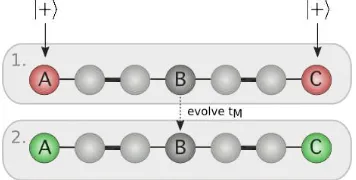
[image:3.612.351.529.306.396.2]We then let the system naturally evolve to the mirror-ing time (tM), that is the time needed for an arbitrary initial single-excitation state to propagate to its mirror position in the system. At this time, the injected product state becomes maximally entangled, and the two entan-gled qubits can be extracted – if desired – from sites A and C.
FIG. 1: Entangling protocol: (1) Initial injection of two |+i= 1
√
2(|0i+|1i) qubit states at site A and C (red) of
an ABC type spin chain withN=7 sites and alternate couplings, being ∆ the strong coupling (thick line) and
δthe weak coupling (thin line). (2) Time evolution of the system under natural dynamics, until the mirroring
time (tM) is reached. At this time qubits A and C are maximally entangled (green).
III. RESULTS
A. Entanglement creation
The protocol is initiated att= 0, with the injection of two initial|+i states at the chain ends (sites A and C). We can write the initial state in the standard basis as
|Ψ(0)i=1 2
α|0iA|0iC+β|1iA|0iC+γ|0iA|1iC+
κ|1iA|1iC
⊗ |0irest−of−chain (1)
general case of mixed states because although the initial state is pure, due to entanglement with the rest of the chain at later times, the state of just sites A and C is in general mixed (and is calculated from the full chain state by tracing out all the other sites). For a pair of qubits A and C, theEoF is defined by,
EoFAC =ξ(CAC), (2)
being ξ(CAC) =h(1+√1−τ
2 ) and h=−xlog2x−(1− x) log2(1−x) [45]. This can be computed by obtaining
the square roots of the four eigenvalues,λi=√εi, of the matrix ρA,CρACg (with ρAC being the reduced density matrix of sites A and C, andρACg = (σA
y ⊗σCy)ρ∗AC(σyA⊗ σC
y)), and arranging these λi in decreasing order. Then τ is obtained as
τ= (max(λ1−λ2−λ3−λ4,0))2. (3)
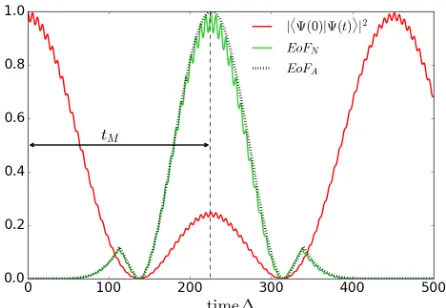
As shown in Fig.2, the fidelity of the initial state (red profile), which is the probability of recovering the initial overall state as a function of time (F =|hΨ(0)|Ψ(t)i|2),
peaks up to unity at twice (and even multiples of) the mirroring time, so at 2tM etc.. In between, at the mir-roring time, the two qubits A and C become maximally entangled (EoF ∼ 1) with the following approximated state:
|Ψ(tM)i ≈12α|0iA|0iC−β|1iA|0iC−γ|0iA|1iC−
κ|1iA|1iC
[image:4.612.337.560.63.217.2]
⊗ |0irest−of−chain, (4)
FIG. 2: Fidelity of the initial state |Ψ(0)i(red -dark gray- profile) and numerically calculatedEoFN (green
-ligth gray- profile) for aN=7 ABC spin chain and ∆/δ= 10. Black dashed profile is the analytically
obtained EoFA of the system.
This behavior can be understood analytically if we con-sider the Hamiltonian of an effective, reduced ‘toy model’ with just three sites ABC equally coupled (JA,B =
JB,C=η),
H =
0η η0 0η
0 η 0
. (5)
The trimer eigenstates resulting from the Eq.5 diago-nalization are given by
|φ−i=1 2
√−12
−1
|φ0i=
1 √ 2
10
−1
|φ+i=
1 2
√12
1
,
(6) with|φ−ihaving energyE− =−
√
2η,|φ0ihaving energy, E0= 0, and |φ+ihaving energyE+=
√ 2η.
We can write the initial state (Eq.1) in terms of these eigenstates and time evolve each of them through its propagator (e−iEt). It is then easy to show that all the
terms of our initial state (except the inert|0iA|0iCstate)
will acquire a−1 phase factor, giving the overall state of Eq.4.
We wish to analytically characterize the EoF profile. Our overall state for this trimer system at any time can be written as
|Ψ(t)i=1 2
|0iA|0iC+cos(
√
2ηt) |1iA|0iC+|0iA|1iC+|1iA|1iC
|0iB− i
√ 2sin(
√
2ηt)|0iA|0iC+
1
2|1iA|0iC+ 1
2|0iA|1iC
|1iB.
(7)
4
ρAC=|αACihαAC|+|βACihβAC| (8)
where the unnormalised components are given by
|αACi=1 2
|0iA|0iC+ cos(
√
2ηt) |1iA|0iC+|0iA|1iC
+|1iA|1iC
(9)
and
|βACi=−√i 2sin(
√
2ηt)|0iA|0iC
+1
2|1iA|0iC+ 1
2|0iA|1iC
.
(10)
AttM, sin(√2ηt) = 0 and cos(√2ηt) =−1 and Eq.8 reduces to the pure state given by Eq.9, which at this point is maximally entangled due to the additional −1 phase factors. We compute the EoF for such an ap-proximated state at all times, by considering η as the effective coupling between A-B and B-C of the origi-nal N = 7 site chain. Its value can then be obtained by the eigenvalues immediately above (or below) zero of the overall spectrum and the equation E+ =
√ 2η
(−E− =
√
2η). In terms of the chain parameters, this
gives η = √
∆2+3δ2−√∆4+6∆2δ2+δ4
2 . After scaling the
state dynamics against ∆, we obtain an approximate pro-file to the full numerical result, as shown by the black dashed line of Fig.2. Clearly this approximation ac-curately reproduces the overall entanglement evolution, without though the fine oscillations that are due to the full chain dynamics.
The mirroring time can also be analytically obtained as
tM =π/√2η, as it only depends on the effective coupling
ηbetween the relevantA, B, Csites. We thus provide a valid analytic interpretation of our system behavior that demonstrates the importance of the presence of sites A, B and C for the operation of our protocol.
We also note that the chain length in this model can be increased by adding sets of four sites (two dimers, one either side of siteB to preserve the symmetry) and the system still supports the protocol presented here. How-ever, this chain growth would increase the time taken for entanglement creation, exponentially with chain length, due to the exponential decrease ofη with length.
B. Robustness
Any practical application of such a protocol will be subject to the presence of fabrication errors in the con-struction of the device. We have therefore investigated the effects on the entanglement generation of introduc-ing two different types of random static disorder into our
system. By considering two different types of such per-turbations we aim to simulate a wide range of physical systems subject to different noise.
The first approach to model local fabrication errors is to consider energy perturbations affecting the sites them-selves, and we do this by adding random diagonal disor-der to the Hamiltonian. We therefore set ǫi = Ediδ, where di is a random number from a uniform distribu-tion between −1/2 and 1/2, and E is a dimensionless parameter that sets the scale of the disorder weighted against the weak couplingδ.
In our second approach to model fabrication errors we consider static coupling errors, by introducing off-diagonal random noise to the Hamiltonian; this is, ran-dom disorder in the couplings of the chain. To do so, we set Ji,ief f+1 = Ji,i+1+Ediδ, with Ji,i+1 ∈ (∆, δ) and E
being again a dimensionless parameter weighted against
δanddi defined as before.
In order to have an understanding of the practical impact of these two types of fabrication errors on the system, we also consider the case where both disorders are present. We simulate this by adding a randomized perturbation simultaneously to both diagonal and off-diagonal terms of the Hamiltonian.
In the following we compare two scenarios. In the first, given the stochastic nature of these calculations, we present an (ensemble) average over 1000 realisations (EoF1000) of theEoF computed at exactly the
mirror-ing time,tM, that is expected for the perfect system. Of course in the disordered systems there may well be an er-ror in the actual time at which theEoF peaks; however, in this first scenario we assume that this timing error is unknown and we take the entanglement at the expected time for it to peak, and average this.
The second scenario corresponds to cases where the timing error could be known in advance, e.g. through calibration of individual devices. The maximum EoF
over a window of 500 units of time is then calculated and, again, the (ensemble) average over 1000 realizations presented.
To begin we consider results from the first scenario (Fig.3, blue symbols and shades). These show that the entanglement of the state, at the extraction timetM pre-dicted for the perfect device, and with disorders smaller than 10% of the weak couplingδ, is very high (EoF1000>
0.9) for both types of noise. However, when the disor-der levels increase, for the case of diagonal disordisor-der the
EoF drops sharply, reaching EoF1000 ∼0.2 with a
dis-order level at 50% of the weak coupling. Nevertheless, at this same level of off-diagonal disorder the averaged entanglement is still surprisingly high (EoF1000∼0.6).
ex-FIG. 3: Averaged EoF attM (blue -lower- line) and maximum EoF over a 500 units of time window (black -upper-line) for different levels of off-diagonal (a), diagonal (b) and both (c) disorders weighted against the weak coupling (δ). Black and blue shadows represent the standard deviation, black and blue bars represent the standard error of the mean. The inset on the left panel presents the averaged energy spectrum for a chain with a off-diagonal disorder
of 100% the weak coupling (black dots). The standard deviation of each of its eigenvalues corresponds to the red shadow. The dots within the red box correspond to the four exactly zero-energy states.
act specifications. Calibration would enable the state extraction to be performed at the time when theEoF is maximum, for each individual (disordered) device. For this reason there is also significant value in considering the maximum EoF over a time window. The ensemble average of this entanglement then specifies the average entangling performance on a device selected at random from the ensemble, on the basis that it can then be cali-brated for its evolution time scale prior to use. As seen in Fig.3 ((b) panel, black symbols and gray shades), when considering diagonal disorder, the maximum entangle-ment over a time window of 500 does not go lower than
EoF1000 = 0.4 even with noise perturbations at 50% of
the weak coupling.
For disorder added to the couplings this second sce-nario is extremely robust, with maximum average en-tanglement value over the time window always above
EoF1000 = 0.9 even for noise perturbations at 50% of
the weak coupling (Fig.3, (a) panel, black symbols and gray shades).
When both disorders are added (panel (c) of Fig.3, where we plot up to 25% disorder), we get a similar trend to the one obtained with the effect of diagonal disorder only in bothEoF measurements. We can conclude from this that diagonal fabrication errors will be dominant for this system, and so reduction of these is the most impor-tant practical challenge with regard to fabrication errors. The robustness of the system against off-diagonal dis-order is remarkably high. This type of noise only af-fects the upper and lower band of the energy spectrum in a symmetrical way, leaving the genuinely zero-energy states at zero. Once again, this can be understood con-sidering our trimer ‘toy model’ with disorder added to the couplings, such thatη+dandη+eare the off-diagonal
terms in the Hamiltonian
H =
η+0 d η+0 d η+0 e
0 η+e 0
,
which yields the eigenvalues
ε=±p2η2+ 2ηd+ 2ηe+d2+e2, 0. (11)
As seen in Eq. (11), the diagonalization of such per-turbed Hamiltonian leaves the zero-energy state undis-turbed.
[image:6.612.60.555.53.228.2] [image:6.612.318.559.338.436.2]6
two-excitation states in the gap can be understood an-alytically as products of a single-excitation state from the upper band with a single-excitation state from the lower band state. The sublattice (or chiral) symmetry of our system imposes mirror symmetry about zero en-ergy on the spectrum; hence, when taking products of single-excitation upper and lower band states we obtain in the gap two exactly zero-energy states and two states with very small energy, equal to the energy difference be-tween the two single-excitation states in a band, which is of the order ofη. We therefore have four exactly zero-energy states (in a rectangular red box in Fig.3) in the gap, along with three states at very small positive en-ergy and three states at very small negative enen-ergy, but still clearly within the gap. As already mentioned, the off-diagonal disorder perturbs the system spectrum sym-metrically; consequently the exactly zero-energy states contained in the box in Fig.3 are completely protected. At zero energy, the single-excitation and two-excitation (single ‘hole’) trimer states do not move in energy accord-ing to Eq. (11), while the two saccord-ingle excitation product band states suffer cancelling shifts.
[image:7.612.328.552.119.384.2]We can now also understand from this analysis why theEoF, even though very robust, does decrease some-what as the off-diagonal disorder is increased. Despite the four exactly zero-energy states in the middle of the energy gap being protected against this type of noise, the dynamics of the entangling protocol also involves other states in the energy gap (which do suffer small effects due to off-diagonal noise). The states forming the bands also contribute small amplitudes to the protocol dynamics, as the initial states are prepared as site, rather than energy, eigenstates.
FIG. 4: Entanglement of formation at exactly the mirroring time (tM) against the input delay as a fraction of the mirroring time, for aN=7 ABC spin chain with two initial|+iinjections at the ends (site A
and C).
To consider another practical form of error with this model, we also investigate how the asynchronous injec-tion of the two initial|+istates at sites A and C affects the EoF value found at exactly tM. The effect of this error on the protocol is shown in Fig.4. We observe that
even with an injection time delay of 10%tM, the EoF
is still at the high value of 0.91, and for few % error it is substantially higher. We can conclude that our pro-tocol is therefore also robust against asynchronous state injections.
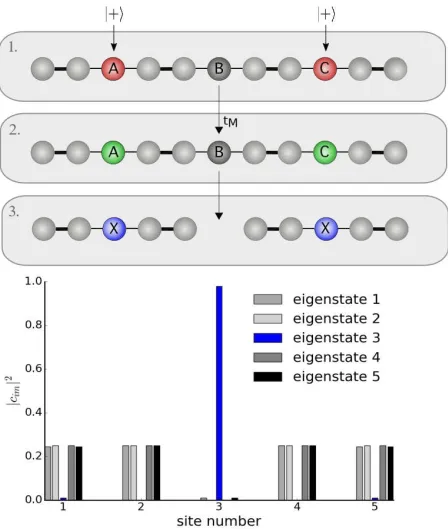
FIG. 5: Entanglement generation-plus-storage protocol: (1) Initial injection of two|+i= 1
√
2(|0i+|1i) qubit
states at site A and C (red). (2) Time evolution of the system until the mirroring time (tM) is reached: qubit
A and C are now entangled (green). (3) AttM, decouple siteB completely: the two extangled qubits then localise at the two equivalent sitesX in the two now independent chains. The lower panels show the
occupation probability distributions for the 5 eigenstates of one of the newly separated chains. The
eigenstate peaking at siteX is highlighted in blue.
C. Entanglement generation-plus-storage protocol
For quantum processing purposes a very useful facility to control is the production of entanglement and its stor-age until the rest of the system needs to utilise it. The
ABC-type chains indeed offer this flexibility.
[image:7.612.67.286.443.584.2]additional step of the generation-plus-storage protocol incorporates a ‘switching off’ (decoupling) of site B at
tM. This separates the system into two independent but equivalent chains, whose single-excitation spectra each contain a topologically protected, strongly localised eigenstate at siteX (see the lower panel of Fig.5). The presence of this state can be explained by considering site
X as a defect between two topologically distinct configu-rations, giving rise to a spatially localised state at zero en-ergy within an enen-ergy gap [29]. The occupation probabil-ity distributions of the five single-excitation eigenstates for the new separated chain are presented in Fig.5. Note that the middle site contains almost the entire occupa-tion probability of the localised eigenstate (highlighted in blue); this state is basically completely localised at site
X with negligible contributions at other sites.
To model the decoupling we assume that this can be performed on a time scale much shorter than tM and so employ the sudden approximation to decompose the state of the fully coupled system into the eigenstates of the new decoupled system(s). From our previous asyn-chronous injection studies we can deduce that the errors caused by time delays on the decoupling of site B will have a minor effect to the overall protocol. We also note that efficient experimental methods to perform similar types of decoupling have been proposed, i.e. applied to molecular spin-chain systems [46].
Now at t = t−
M, immediately before decoupling site B, the full coupled dynamics generates two entangled qubits that are indeed localised at the sites A, C, that is the twoX sites of the newly decoupled chains at time
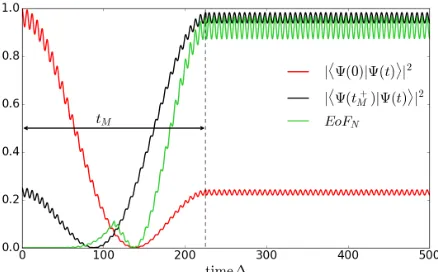
t=t+M, immediately after decoupling. It is therefore ex-pected that the entangled state will inherit the topolog-ical localisation of the two shorter and equivalent chains after site B is decoupled. Indeed this is confirmed by our numerical simulation based on the sudden approx-imation and shown in Fig.6. The dynamics of such a protocol show that the fidelity of the overall state att+M
(F =|hΨ(t+M)|Ψ(t)i|2), once site B has been decoupled,
does not reach values lower than 0.9. For extraction pur-poses, the entanglement will be most useful if it is lo-calised at just the sitesX shown in Fig.6. Therefore we calculate theEoF just for those two sites, by tracing out the rest of the chain. We show that the resultant EoF
does not drop below 0.9 either, meaning that the proba-bility of finding the two entangled qubits localised at sites
X is basically constant and very high with time after site
B is decoupled. This type of localisation is also shown to be extremely protected against disorder, as already shown in previous work [29].
IV. CONCLUSIONS
[image:8.612.329.548.54.190.2]We have presented a robust entangling gate protocol using spin chains, as well as proposing a protocol to lo-calise and store the two resulting entangled qubits. We have shown numerically and analytically that, after a
FIG. 6: Overall dynamics of the entanglement generation-plus-storage protocol with the fidelity of the system against the initial state,|Ψ(0)i, (red -dark gray-profile) and against the overall entangled state attM,
|Ψ(tM)i,(black profile) along with the numerical calculation of theEoFN for the whole chain (green
-lower light gray- profile).
suitable initial state injection, the natural dynamics of a three-defect,ABC-type chain gives rise to the formation of two maximally entangled qubits. These two entangled qubits can be either extracted at a known timetM, or localised and stored, so that the extraction and usage of such a resource can be done at any desired time. The resulting entanglement of formation has been shown to be very robust against two potential fabrication errors of the chain, and also time delay errors on the state injec-tion. We conclude that diagonal errors are more dam-aging than off-diagonal disorder (against which there is excellent robustness), so in practical implementations di-agonal disorder is the fabrication error to focus on reduc-ing. We also conclude that timing injection errors at the few % (of tM) level also have a very small effect on the performance of the protocol.
8
ACKNOWLEDGMENT
This work was supported by the EPSRC (Grant No. EP/I038683/1).
[1] D. Bouwmeester, J.-W. Pan, K. Mattle, M. Eibl, H. We-infurter, and A. Zeilinger, Nature390, 575 (1997). [2] A. Furusawa, J. L. Sørensen, S. L. Braunstein, C. A.
Fuchs, H. J. Kimble, and E. S. Polzik, Science282, 706 (1998).
[3] R. Raussendorf and H. J. Briegel, Phys. Rev. Lett. 86, 5188 (2001).
[4] P. Walther, K. J. Resch, T. Rudolph, E. Schenck, H. We-infurter, V. Vedral, M. Aspelmeyer, and A. Zeilinger, Nature434, 169 (2005).
[5] G. Gualdi, S. M. Giampaolo, and F. Illuminati, Phys. Rev. Lett. 106, 050501 (2011).
[6] D. Kielpinski, C. Monroe, and D. J. Wineland, Nature
417, 709 (2002).
[7] C. Monroe, R. Raussendorf, A. Ruthven, K. R. Brown, P. Maunz, L.-M. Duan, and J. Kim, Phys. Rev. A 89, 022317 (2014).
[8] K. Nemoto, M. Trupke, S. J. Devitt, A. M. Stephens, B. Scharfenberger, K. Buczak, T. N¨obauer, M. S. Everitt, J. Schmiedmayer, and W. J. Munro, Phys. Rev. X 4, 031022 (2014).
[9] M. R. Geller and A. N. Cleland, Phys. Rev. A71, 032311 (2005).
[10] R. Nigmatullin, C. J. Ballance, N. de Beaudrap, and S. C. Benjamin, New Journal of Physics 18, 103028 (2016).
[11] D. Hucul, I. V. Inlek, G. Vittorini, C. Crocker, S. Deb-nath, S. M. Clark, and C. Monroe, Nat Phys 11, 37 (2015).
[12] W. Pfaff, B. J. Hensen, H. Bernien, S. B. van Dam, M. S. Blok, T. H. Taminiau, M. J. Tiggelman, R. N. Schouten, M. Markham, D. J. Twitchen, and R. Hanson, Science
345, 532 (2014).
[13] A. Narla, S. Shankar, M. Hatridge, Z. Leghtas, K. M. Sliwa, E. Zalys-Geller, S. O. Mundhada, W. Pfaff, L. Frunzio, R. J. Schoelkopf, and M. H. Devoret, Phys. Rev. X 6, 031036 (2016).
[14] S. Bose, Contemp. Phys.48, 13 (2007). [15] A. Kay, Int. J. Quantum Inf.8, 641 (2010).
[16] G. M. Nikolopoulos, I. Jex,et al.,Quantum State Trans-fer and Network Engineering (Springer, 2014).
[17] T. P. Spiller, I. D’Amico, and B. W. Lovett, New J. Phys.9, 20 (2007).
[18] S. Sahling, G. Remenyi, C. Paulsen, P. Monceau, V. Saligrama, C. Marin, A. Revcolevschi, L. P. Reg-nault, S. Raymond, and J. E. Lorenzo, Nat Phys 11, 255 (2015).
[19] L. Banchi, A. Bayat, P. Verrucchi, and S. Bose, Phys. Rev. Lett. 106, 140501 (2011).
[20] T. J. G. Apollaro, S. Lorenzo, A. Sindona, S. Paganelli, G. L. Giorgi, and F. Plastina, Physica Scripta , 014036 (2015).
[21] I. D’Amico, “Relatively short spin chains as building blocks for an all-quantum dot quantum computer archi-tecture,” in Semiconductor Research Trends, edited by K. G. Sachs (Nova Science Publishers, 2007) Chap. 9, p. 281.
[22] I. D’Amico, Microelectron. J.37, 1440 (2006).
[23] G. M. Nikolopoulos, D. Petrosyan, and P. Lambropoulos, J. Phys. Condens. Matter16, 4991 (2004).
[24] J. Tejada, E. M. Chudnovsky, E. del Barco, J. M. Hernan-dez, and T. P. Spiller, Nanotechnology12, 181 (2001). [25] J. Twamley, Phys. Rev. A67, 052318 (2003).
[26] M. Christandl, N. Datta, A. Ekert, and A. J. Landahl, Phys. Rev. Lett.92, 187902 (2004).
[27] M. Christandl, N. Datta, T. C. Dorlas, A. Ekert, A. Kay, and A. J. Landahl, Phys. Rev. A71, 032312 (2005). [28] M. B. Plenio, J. Hartley, and J. Eisert, New J. Phys.6,
36 (2004).
[29] M. P. Estarellas, I. D’Amico, and T. P. Spiller, Scientific Reports7, 42904 EP (2017).
[30] A. Saket, S. R. Hassan, and R. Shankar, Phys. Rev. B
82, 174409 (2010).
[31] A. Saket, S. R. Hassan, and R. Shankar, Phys. Rev. B
87, 174414 (2013).
[32] V. Srinivasa, J. Levy, and C. S. Hellberg, Phys. Rev. B
76, 094411 (2007).
[33] P. Delplace, D. Ullmo, and G. Montambaux, Phys. Rev. B84, 195452 (2011).
[34] T. Jacqmin, I. Carusotto, I. Sagnes, M. Abbarchi, D. Sol-nyshkow, G. Malpuech, E. Galopin, A. Lematre, J. Bloch, and A. Amo, Phys. Rev. Lett.112, 116402 (2014). [35] E. J. Meier, F. A. An, and B. Gadway, arXiv:1607.02811
(2016).
[36] M. Atala, M. Aidelsburger, J. T. Barreiro, D. Abanin, T. Kitagawa, E. Demler, and I. Bloch, Nat Phys9, 795 (2013).
[37] A. Blanco-Redondo, I. Andonegui, M. J. Collins, G. Harari, Y. Lumer, M. C. Rechtsman, B. J. Eggleton, and M. Segev, Phys. Rev. Lett.116, 163901 (2016). [38] R. Ronke, I. D’Amico, and T. P. Spiller, Phys. Rev. A
84, 032308 (2011).
[39] S. R. Clark, C. M. Alves, and D. Jaksch, New J. Phys.
7, 124 (2005).
[40] S. R. Clark, A. Klein, M. Bruderer, and D. Jaksch, New J. Phys.9, 202 (2007).
[41] M.-H. Yung and S. Bose, Phys. Rev. A71, 032310 (2005). [42] M. X. Huo, Y. Li, Z. Song, and C. P. Sun, EPL
(Euro-physics Letters)84, 30004 (2008).
[43] G. M. A. Almeida, F. Ciccarello, T. J. G. Apollaro, and A. M. C. Souza, Phys. Rev. A93, 032310 (2016). [44] W. K. Wootters, Phys. Rev. Lett.80, 2245 (1998). [45] W. K. Wootters, Quantum Info. Comput.1, 27 (2001). [46] G. A. Timco, S. Carretta, F. Troiani, F. Tuna, R. J.