Iranian journal of educational Sociology
(Interdisciplinary Journal of Education) Available online at: http://www.iase-idje.ir/
Volume 2, Number 1, March2019
Curriculum planning requirement of philosophy of education for
Students
Tahereh Nezamian poor1, Ladan Salimi2, Vahid Fallah3
1. PhD student, Philosophy of Education, Islamic Azad University, Sari, Iran.
2.Faculty member, Department of Curriculum Planning, Islamic Azad University, Sari, Iran. 3.Assistant Professor, Department of Educational Sciences, Islamic Azad University, Sari, Iran.
Article history:
Received date: 20 October 2019 Review date: 24 November 2019 Accepted date: 27 November 2019
Abstract
Purpose: Today, countries around the world have come to realize that a wide range of skills, thinking skills and basic skills are needed to prepare students for an unpredictable future. To achieve this, learners must expand their awareness of themselves as thinkers and learners, practice strategies for effective thinking, and develop the thinking skills they need throughout their lives, because thinking and thinking are at the beginning of any Production and construction in the human world. The new education is trying to provide children with the necessary curriculum preparation through the various curricula. Teaching philosophy to children is one of the ways that has been considered in recent years for
thinking and reasoning. Methodology: The purpose of this study was
fundamental and in terms of data collection, it was a descriptive survey and it was a qualitative research in terms of content analysis and foundation data method. All elementary school students in the city of Sari were the community of research experts who had at least one elementary school teacher. Semi-structured interviews were conducted with 12
people using snowball sampling. Findings: The results of the content
analysis and dimensional data analysis method showed that teaching philosophy included teaching how to think, teaching to ask, how to ask. Emphasis on the rightness of thought, on right thinking, on the transfer of philosophical thoughts to learners. Conclusion: Involving children in teaching philosophy has both cognitive effects and increased self-esteem, self-efficacy, social intelligence, emotional intelligence and perhaps transferable skills. It is effective in reducing anxiety, enhancing positive behaviors in the classroom, promoting positive self-concept, cultivating emotional adjustment, and reducing irrational thinking.
Keywords:
Curriculum planning, philosophy of education, Students.
Please cite this article as: Nezamianpour T, Fallah V, Salimi L. (2019). Curriculum planning requirement of philosophy of education for Students. Iranian journal of educational Sociology. 2(1):143-149.
Corresponding Author Email:[email protected]
1. Introduction
One of the goals of any educational system is to educate conscious people. Therefore, it is necessary to consider such a goal in the curricula (Zarghami, 2008). Therefore, education should teach students to think properly and train them to be purposeful and futuristic. These goals are set in the form of fictional and narrative content and are provided to the teacher and student. Early books in this area included stories, stories and novels. At present, any subject can be included in the curriculum of teaching philosophy to children (Ghaedi, 2004). The content is often in the form of stories, as the child compares himself to fictional characters. It is more rational and intellectual and less emotional. Children speak and think about the story's characters and characters. The stories use language that resembles the child's actual language and is consistent with the child's cognitive developmental stages (Abbasi anabad & Seadatee Shamir ,2016). Teaching Philosophy to Children: Teaching children philosophy is the golden key that can help children develop the most important aspect of their child's thinking. By designing and implementing a philosophy program for children, Lipmann briefly calls it "Teaching Philosophy to Children," trying to bring philosophy back to its true position as Socrates intended it. In his opinion, philosophy is not for adults and children can do it. He applied philosophy in the sense of philosophizing, something that children can do and are inherently inclined to do (Seifi Gandmani, Shafaghi, and Kalantari Meybodi, 2011).
The program of teaching philosophical thinking to children has clear cognitive goals; it compels the mind to do so through challenges, principled thinking, and structural interaction (Haynes, 2002). In this program, students become young and skilled explorers. Exploration is the core concept of this model, and it refers to active exploration and questioning of Egypt and a constant awareness of observation and communication, and a constant readiness to compare, contrast, analyze and present hypotheses, experiences, observations, assessments and examinations. The philosophy of deep understanding and the search for valuable evaluations are questions that people have about their lives and their destinies, from the beginning and the fulfillment of the world, and above all from their immortality and survival. Understanding the root cause of human love is thinking and thinking. Philosophy is not about learning from the perspective of others, it is a form of activity and striving to know (Hassani, dortaj, bagheri, seadatee Shamir, ,2019).
The research community or research circles are one of the key concepts in the philosophy education program for children. The research community has a dual structure: first, it is a society that fosters a spirit of cooperation, attention, trust, safety and a sense of purpose, and second, it is a research that is also self-correcting, albeit based on the need for change. And understanding misleading concepts is complex and ambiguous (Jafari Sani, Keshavarzi, Seadatee Shamir ,2017). Children and teachers sit around to participate in reading and listening. Children spend time thinking and asking questions. In this circle of thought, the people in the group constantly meet. The questions they ask become more, more research, and more thoughtful. Their discussions become more disciplined and precise as well as more creative. In this program, the classroom becomes a research community in which children learn to listen to each other respectfully, to challenge each other for the sake of unsupported comments, to derive what has been said. Help each other and seek to identify each other's assumptions that can be the best way to teach emotional virtues (Brahman& et al., 2017).
According to Krist jansson, teachers who are interested in raising their students morally and emotionally have a lot to learn from the philosophy education movement for children, and especially Lipman (Krist jansson, 2000). lotfi, Seadatee Shamir (2016), Marzi, Seadatee Shamir (2019). Naseri, & Seadatee Shamir, (2014) Indicates that approximately 30 percent of children and adolescents will experience a recognizable psychiatric disorder during their lifetime, but 70 to 80 percent of them will not receive appropriate intervention. These disorders lead to performance deficits in a variety of areas, including family and schooling, which may eventually lead to academic failure or delinquent behavior (Evans, Mullet, Whist, 2011). In recent years, attention has been paid to the mental disorders of children and its high importance and many valuable achievements have been made, but there are still many shortcomings and deficiencies in
this regard and research on different ways of treating children with behavioral problems. It is very important. In particular, research into teaching philosophy to children is useful because it has no side effects. Philosophy curriculum for elementary school children may in general improve students' abilities and reduce problems (Arabgol, Mahmoudi, Gharai, and Hakim Shushtari, 2005). On the other hand, the philosophy program for children as a subject is not for children, but rather to teach children through class discussions the philosophical method - the modeling and logical research method often referred to as the Socratic method. He is taken away (Naderi, Tajalinia, Shariatmadari and Saif Naraghi, 2012). On the other hand, the effectiveness of teaching philosophy to children in the development of students' philosophical thinking (Khadem Sadegh & Fereydooni, 2015), reducing the irrational thinking of female students in children's spiritual education (Kalantari, Bani Jamali, and Khosravi, 2013).
2. Methodology
The purpose of this study was fundamental and in terms of data collection it was a descriptive survey and it was a qualitative research in terms of content analysis and foundation data method. The research population consisted of all knowledge. The elementary school students in Sari were about 1,800 students, according to a request from the Sari Department of Education. All students were studied as research environment. The community of research specialists consisted of all elementary teachers who taught at least one elementary level. The sampling method was snowball sampling that reached theoretical saturation by interviewing 12 people. The method of data gathering was first collected using semi-structured interview and then classified and coded using content analysis method.
3. Findings
Philosophy for Children is a program that emphasizes positive conversations with peers and conscious discussion. Teaching children philosophy encourages children to be more alert to their thinking and learning, that is, to be aware of what they think and learn and, in other words, to encourage metacognition. In addition, this process requires social and communication skills and emotional empathy and sensitivity to others' emotions. As a result, engaging in the teaching of philosophy to children as well as cognitive effects as well as self-esteem, self-efficacy, social intelligence, emotional intelligence, and perhaps transferable skills may also have many social-emotional effects. (Seadatee Shamir, Sanee'I Hamzanlouyi ,2017, Seadatee Shamir, Saniee Zare 2019, Seadatee Shamir, Najmi, Rezaiee Haghshenas,2018, Taheri, dortaj delavar, Seadatee Shamir, 2019). It may also be effective in reducing anxiety, enhancing positive behaviors in the classroom, positive self-concept, fostering emotional adjustment, and reducing irrational thinking (Tricky & Topping, 2005).
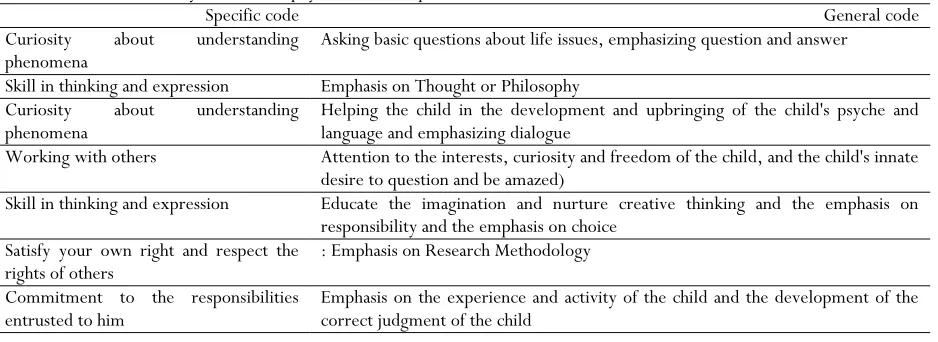
Table 1. content analysis of Philosophy Education requirement extracted from teacher’s interview
General code Specific code
Asking basic questions about life issues, emphasizing question and answer Curiosity about understanding
phenomena
Emphasis on Thought or Philosophy Skill in thinking and expression
Helping the child in the development and upbringing of the child's psyche and language and emphasizing dialogue
Curiosity about understanding phenomena
Attention to the interests, curiosity and freedom of the child, and the child's innate desire to question and be amazed)
Working with others
Educate the imagination and nurture creative thinking and the emphasis on responsibility and the emphasis on choice
Skill in thinking and expression
: Emphasis on Research Methodology Satisfy your own right and respect the
rights of others
Emphasis on the experience and activity of the child and the development of the correct judgment of the child
Commitment to the responsibilities entrusted to him
Lipman and her assistants devote two to four hours a week to children in and out of school, and the class, as a research community in which children discuss stories read in class and talk, are managed (Fisher, 2006). Philosophy curriculum for children Philosophy curriculum for children seeks all elements of a curriculum, such as: purpose, content, role of teacher and student, teaching method, Consider the principles of designing and organizing a syllabus (GHazavi, 2007). The teaching of thinking is the most general and general purpose of this syllabus. The main goals of this program are to teach children thinking. The overall goals of the program, which cover the whole of the curriculum, including Grades 1 to 12, are: 1) Improvement of reasoning; 2) Individual and interpersonal development; 4) fostering moral understanding; and 5) fostering the ability to conceptualize experience. Firstly, the goal is to enhance basic and basic skills such as comparison, differentiation, relevance, question formulation, reasoning and storytelling. At this base, emphasis is placed on learning in terms of implicit forms of children's daily conversations (Lipman 1980 Quoted by ghaedi 2009). The program is in the form of a story and its content is derived from educational goals resulting from the inference of philosophical, psychological, sociological, and elementary goals as well as the goals of teaching philosophy to children from the point of view of Lippman. "Philosophy for children", both the cooperative skills and thinking skills that are developed in this program, improve communication and social responsibility.
In fact, by partnering with children in the search for meaning and development of their perceptual powers and their understanding of the content, their powers of reasoning and abstract thinking are enhanced and they improve their self-esteem, which helps the child to improve the quality of their judgments. Improve everyday life and thus build healthier interpersonal relationships. (Tanhaye Reshvanloo, keramati, Seadatee Shamir 2016). The goal of "Philosophy for Children" is to radically change education, with an approach that emphasizes the role of the teacher in activating child thinking and is based on thinking that centers the child on learning through discovery, experimentation and the structure of science. Emphasizes. Thus, the hierarchical relationship between adult and child is lost and the child is freed from the constraints of school systems (Zahmatkesh, Hosseini Nassab, Seadatee Shamir, 2016). The Lipman program is based on the idea that the role of teachers is not to prepare children to be swallowed by children, but to provide a model of expert thinking for classroom students and to ensure that high-level thinking is maintained in the classroom (Ghaedi, 2004). Participates in all class discussions on philosophical topics. Through this program, teachers encourage children to think more deeply about the ideas behind their schoolwork.
This is mainly done in a classroom research community. The research community is a space within the classroom for children themselves. Participants sit face to face with each other and hear each other's voices. Some of the rules for class management are in the design and modification group. These rules are initially defined, but are gradually internalized by the members and become indicators of real community, intellectual participation and healthy interpersonal relationships. Some of these rules include meditating, listening carefully, avoiding harm, respecting each other, and not being ridiculed (Ghaedi, 2009). When all the materials are read and read, they need time to think. This time may be spent silently or talking with a handgun, depending on the age and manner of the child. Children are encouraged to ask questions. Investigating and tracking children's questions is an essential part of the research community. It is best for the teacher not to ask the question from the beginning, although it may be asked by children for questioning. The questions are then communicated so that the children can draw analogies. Usually the best questions that arouse children's curiosity are usually selected. Then the ideas and answers of the members are written on the board with their names. In this section, children are encouraged to listen carefully to the ideas of others as they come up with conclusions and conclusions, while expressing their ideas with reflection and thoughtfulness. Finally, children are asked to say the last word. Sometimes the discussion does not convene in one session and the children have opposing ideas, so they are asked to think about and think about the
distance between sessions. It is not necessary for everyone to come to a common concept, but rather to make changes in their minds (Seadatee Shamir, Tahergholami, Jalai, sh 2017).Philosophical fiction is an attempt to encourage children to explore philosophical concepts and practices. This persuasion occurs by incorporating philosophical concepts and practices during the events of the story. Events that are directly related to children's experiences. In other words, the story presents philosophy in the form of experiences of imaginary characters (Seadatee Shamir, Mazbohi, 2018).
4. Discussion
Teaching children philosophy is the golden key that can help children develop the most important aspect of their child's thinking. By designing and implementing a philosophy program for children, Lipman briefly calls it "Teaching Philosophy to Children," trying to bring philosophy back to its true position as Socrates intended it. In his opinion, philosophy is not for adults and children can do it. He applied philosophy in the sense of philosophizing, something that children can do and are inherently inclined to do (Seif Gandmani, Shafaghi, and Kalantari Meybodi 2011).
The program of teaching philosophical thinking to children has clear cognitive goals; it compels the mind to do so through challenges, principled thinking, and structural interaction (Haynes, 2002). The philosophy program for children is a successful way of thinking. Global experience and evidence from more than 50 countries show that philosophy has helped children develop their thinking skills. By providing many exercises for finding good reasons for refereeing, this program teaches children something that broadens their horizons and teaches children how to think better (Safai & et al., 2006). . The program also has a social purpose and is to educate the democratic decision-making process. The program has a definite stake in fostering regular participation and fostering one's self-awareness. For Lipman, the main purpose of the philosophy training program for children is to help children learn how to think (Haynes, 2002). One needs countless abilities to respond to the diverse demands of today's complex world. Hence, according to the necessities imposed upon him, mechanisms, whether spontaneous or self-made, form in him that distinguishes him from other animals. Philosophy for children is a kind of applied philosophy. The goal is to get students to philosophize and help them move from normal to thoughtful, indifferent to critical thinking, and from ordinary to critical thinking. In this method an exploratory approach is considered. Collective exploration and the use of Socratic dialogue are defined as working methods (Hatami, Karimi, and Nouri, 2010).
In this program, students become young and skilled explorers. Exploration is the core concept of this model, and it refers to active exploration and questioning of Egypt and a constant awareness of observation and communication, and a constant readiness to compare, contrast, analyze and present hypotheses, experiences, observations, assessments and examinations. The philosophy of deep understanding and the search for valuable evaluations are questions that people have about their lives and their destinies, from the beginning and the fulfillment of the world, and above all from their immortality and survival. Understanding the root cause of human love is thinking and thinking. Philosophy is not about learning from the perspective of others, it is a kind of activity and striving to know (Akwan 2009; quoted by Hatami, Karimi, and Nouri, 2010).
The research community or research circles are one of the key concepts in the philosophy education program for children. The research community has a dual structure: first it is a society that fosters a spirit of cooperation, attention, trust, safety and a sense of purpose, and the second is research that is also self-correcting, albeit based on the need for change. And understanding the misleading concepts is complex and vague (Marashi, 2009). Children and teachers sit around to participate in reading and listening. Children spend time thinking and asking questions. In this circle of thought, the people in the group constantly meet. The questions they ask become more, more research, and more thoughtful. Their discussions become more disciplined and precise as well as more creative. In this program, the classroom becomes a research
community in which children learn to listen to each other respectfully, to challenge each other for the sake of unsupported comments, to derive what has been said. Help each other and seek to identify each other's assumptions that can be the best way to teach emotional virtues (Brahman & et al., 2017). According to Krist jansson, teachers who are interested in raising their students morally and emotionally have a lot to learn from the philosophy education movement for children, and especially Lipman (Krist jansson, 2000). Thirty percent of children and adolescents will experience a recognizable psychiatric disorder during their lifetime, but 70 to 80 percent of them will not receive appropriate intervention. These disorders lead to performance deficits in a variety of areas, including family and schooling, which may eventually lead to academic failure or delinquent behavior (Evans, Mullet, Whist, 2011). In recent years, attention has been paid to the mental disorders of children and its high importance and many valuable achievements have been made, but there are still many shortcomings and deficiencies in this regard and research on different ways of treating children with behavioral problems. It is very important. In particular, research into teaching philosophy to children is useful because it has no side effects. Philosophy curriculum for elementary school children may in general improve the level of empowerment and reduce the problems of students (Arabgol, Mahmoudi Gharai and Hakim Shushtari 2005). The goal is to teach children the philosophical approach through class conversations; the philosophical method is the model research and logical analysis, often referred to as the Socratic method (Naderi, Tajalinia, Shariatmadari & Seif Naraghi, 2012). On the other hand, research on the effectiveness of teaching philosophy to children in the development of students' philosophical thinking (Khadem Sadegh & Fereidouni, 2015). They have shown improvement in social skills and self-esteem in students (Almasi Hosseini, 2012). Philosophy for Children is a program that emphasizes positive conversations with peers and conscious discussion. Teaching children philosophy encourages children to be more alert to their thinking and learning, that is, to be aware of what they think and learn and, in other words, to encourage metacognition. In addition, this process requires social and communication skills and emotional empathy and sensitivity to others' emotions. As a result, engaging in teaching children philosophy as well as cognitive effects as well as increased self-esteem, self-efficacy, social intelligence, emotional intelligence, and perhaps transferable skills may also have many socio-emotional effects. It may also be effective in reducing anxiety, enhancing positive behaviors in the classroom, promoting positive self-concept, cultivating emotional adjustment, and reducing irrational thinking.
References
Abbasi anabad A, Seadatee Shamir, A. (2016). The effect of meta cognitive strategies instruction on secondary school male students working memory capacity and verbal short term memory. Science and Education.12: 452-456. [in Persian].
Arabgol F, Mahmoudi Garai J, Hakim Shooshtari M. (2005). The effect of life skills training program on performance of fourth grade students. Cognitive Science News. 7 (3):51-57. [in Persian].
Brahman M, Khodabakhshi F, Abadi P. (2017). Teaching Philosophy for Children, Journal of Modern Advances in Behavioral Sciences. 9:10-60. [in Persian].
Evans S,Mullett E,Weist M. (2011). Feasibility of the mind matters school mental health promotion program in American schools. Journal of Youth and Adolescence. 34:51-58.
Fisher R. (2006). Education and Thought, Translated by Forough Kianzadeh, Ahwaz. [in Persian].
Ghaedi Y, Soltani S. (2011). Wittgenstein's Philosophy and Philosophy Program for Children. Journal of Child Thought Research. Institute for Humanities and Cultural Studies. 2 (1): 91-107. [In Persian].
Ghaedi Y. (2009). Philosophy curriculum for secondary school children and guidance. Culture (especially philosophy for children and adolescents). Research Institute of Humanities Twenty-two years. Number one, successive 69. [In Persian]
GHazavi KH. (2007). "A Review of the Philosophy Education Program for Elementary Third-graders, Pixie, Based on the Curriculum Principles." Master thesis. Master thesis. [In Persian].
Hassani F, Dortaj F, bagheri F, Seadatee Shamir. (2019). The Effectiveness of Teaching Academic Engagement on psychological Capital Female Students Secondary School. Journal of Instruction and Evaluation. 12(46): 123-140. [In Persian].
Hatami H, Karimi Y, Noori Z. (2010). The Effect of Implementing a Philosophy for Children on Emotional Intelligence Enhancement in Girl Students of the First Grade of Tehran Shahid Azad School of Thought and Children in the academic year of 89-88 (Humanities and Cultural Studies Institute). 1 (2): 3-22 [in Persian].
Haynes J. (2002). Children as philosophers. London: Routledge Flamer.
Jafari Sani S, Keshavarzi Z, Seadatee Shamir A. (2017). The effects of train composition with brain learning approach based on the Educational self-efficacy and written ability of students. Iranian journal of educational sociology, 1(3):56-65. [In Persian]. Kalantari S, Bani Jamali Sh, Khosravi Z. (2014). The Effectiveness of Implementing a Philosophy Education Program on Reducing
Irrational Thoughts in First Grade Female Students in Borujen. Journal of Clinical and Personality Psychology (Daneshvar Behavior).21(11):37-48.
Khadem Sadegh M, Fereydooni Sh. (2015). The Effectiveness of Teaching Children Philosophy on the Development of Philosophical Thinking in Sixth Grade Students. Conference Title: International Conference on Innovation and Research in the Arts and Humanities.
Krist jansson K. (2000). The Didactics of Emotion Education, Analytic Teaching. 21(1):125-135.
Lotfi N, Seadatee Shamir A. (2016).The relationship between personality characteristics and attachment styles and emotional breakdown. Research in clinical psychology and counseling .6(1):98- 112. [In Persian].
Marzi S, Seadatee Shamir A. (2019). The Role of Self-efficacy and Happiness in Predicting Self-criticism/reassurance among Teachers. frooyesh. 8 (5) :153-162. [In Persian].
Naderi E, Tajali nia A, Shariatmadari A, Seif naraghi M.(2012). HE EFFECT OF P4C PROGRAM ON CREATIVITY OF HIGH SCHOOL BOYS IN TEHRAN. Journal of tafakkor va kudak (thinking and children). 3(1):91-117.
Naseri M, Seadatee Shamir A. (2014). Self-directed skills enhancement through cognitive skills training. International journal of education and applied sciences. 1(5): 235- 240.
Seadatee Shamir A, Mazbohi S. (2018). Predicting the Responsibility of Secondary School Girl Students Based on self-efficacy and spiritual intelligence. Educational Psychology. 14(48):127-145. [In Persian].
Seadatee Shamir A, Najmi M, Rezaiee Haghshenas M. (2018). The Effectiveness of Reality Therapy Training on Responsibility and Encouragement. Marriage in married students of Azad University. Journal of research in educational systems 12: 563-669. [In Persian].
Seadatee Shamir A, Sanee’I Hamzanlouyi R. (2017). Relationship between Intelligence Beliefs and Achievement Motivation with Self-Regulated Learning in Students with Veteran Parents Injured More than 40%. Iranian Journal of War & Public Health.; 9(4):205-210. [In Persian].
Seadatee Shamir A, Saniee M, Zare E. (2019). Effectiveness of Couple Therapy by Gotman Method on Family Function and Marital Adjustment in Divorce Applicant Couples. IJRN. 5 (2) :10-17. [In Persian].
Seadatee Shamir A, Tahergholami R, Jalai sh. (2017). The Impact of Metacognitive Skills Training on the Reduction of Academic Procrastination and Test Anxiety. Quarterly journal of family & research 14 (1): 89-102. [In Persian].
Seifi Gandmani M, Shaghaghi F, Kalantari Meybodi S. (2011). The Effectiveness of Philosophy Education Program on Female Students on Self-Esteem and Problem Solving Ability. Journal of Applied Psychology. 5 (2):66-83. [in Persian].
Taheri F, dortaj F, delavar A, Seadatee Shamir A. (2019). The Effectiveness of Mindfulness Program on Academic Engagement: The Mediating roles of Academic Stress and Academic Burnout. Journal of Psychological Studies. 14(4):157-174. [In Persian]. Tanhaye Reshvanloo F, keramat, R, Seadatee Shamir A. (2016). Optimism and self-esteem in adolescent girls: The role of identity
stylesJournal of Applied Psychology. 6(22): 73-90. [In Persian].
Tricky S, Topping H. (2005). ‘Philosophy for Children, a Systematic Review’, Research Papers in Education. 19(3):110-125. Zahmatkesh Z, Hosseini Nassab S D, Seadatee Shamir A. (2016) Examining the Relationship between Working Memory and
Intelligence with Female Students` Academic Achievement in Monolingual and Bilingual High School of Tehran. Journal of Instruction and Evaluation . 8(32): 111-134.[In Persian].
Zarghami S. (2008) The Relationship between Philosophy of Education and Philosophy for Children, Humanities and Cultural Studies Institute, Tehran. [In Persian].