in the evocation of environmenta
l responsibilit
y
in the creation of Respon
s
ive
En•"ir<~nrnP
,
nt<
'
A thesis submitted
the degre
e
of Doctor of Philosophy
of
The Australian National University
Josh
WC)d21K
Humanities Research
r
P
l
ntrP
Appendix B: Josh Wodak Curriculum Vitae
Born August 16 1979, London, England. Lives and works Canberra/Sydney.
Education
2004–2010 Doctor of Philosophy, Humanities Research Centre, Research School of Humanities and Arts, ANU.
2002 Honours in Anthropology (1st Class), Sydney University (SU).
1998‐2001 Bachelor of Arts (Double Major in Anthropology and Philosophy), SU. 1998‐1999 Bachelor of Law, SU.
Select Awards, Residencies and Grants
2009 Spanish Cultural Cooperation Program between ANU and Ministry of Culture, Spain awarded for Sketches of Spain photography project.
2008 ANU Centre for European Studies (CES) Art Prize for CES photography exhibition.
2004‐2008 ANU College of Arts & Social Sciences PhD Scholarship.
2006 Australian Film and Television Radio School artist residency grant for Laboratory for Advanced Media Production residential workshop on Hawskbury Island. 2006 Australia Council for the Arts New Media Arts Board (group recipient) for New
Work: Development & Presentation of Emergence with The Synarcade Collective. 2006 ANU Travel Grant for fieldwork research at electronic art festivals, symposia and
conferences in Germany, Austria, Switzerland, Italy, England and Holland.
2004 ANU Visiting Scholars Program scholarship to attend Thinking with a Video Camera workshop.
2002 SU Film Society (FS) and SU Broadcasting Services (BS) granted equipment sponsorship of Kali Yuga.
2002 SU Union (SUU) Cultural Grant for Kali Yuga.
2001 SUFS and SUBS granted equipment sponsorship of Dawn Of Ham. 2001 SUU Cultural Grant for Dawn Of Ham.
2001 SUFS and SUBS granted equipment sponsorship of Corkscrewed. 2001 SUU Cultural Grant for Corkscrewed.
Appendix C:
Emergence
v1
Emergence v1, which was called Demophobic, was staged three times at Balmain Town Hall Hybrid Happenings Festival from November 24-26 2004.
Demophobic was staged after each staging of my StilmS and marked the
transition between my solo and collaborative practice of making Responsive Environments.842 v1 is an Appendix as it was a prototypical proof-of-concept which was staged so we could use the insight to completely overhaul v1 to make v2 and v3.843
v1 was a collaboration between key members of Synarcade, many of whom were integrally involved in v2 and v3. Although technically simple and economical, it was more sophisticated and demanding than previous
Synarcade productions. v1 was initiated and Directed by Mark Bolotin. My
pre-production roles were Associate Producer and co-contributing to the concepts and narratives with Bolotin. My production roles were Multimedia Coordinator and AV Operator.
v1 concerned a protagonist, Karkus (played by Richard Cartwright) dealing with demophobia. Demophobia and agoraphobia have particular relevance for Responsive Environments with multiple co-participants, as they denote social anxiety of groups and public spaces. This was embodied in v1 as Artist-Artwork-Audience interactivity resembled an agora. Karkus had become a reclusive musician, which preventing fulfilling his desire to perform in public places. The narratives concerned his reluctant interaction with Sinray, the only other character (played by Rhys Turner). Sinray was a psychotherapist who attempted to treat him. Attendees were presented with a series of decisions between encouraging the psychotherapist’s treatment or letting the patient deal with his disorder himself.
The installation design interrelated form and content, partly by using my 4forfour installation design.844 3forthree (a.k.a StilmS) formed a semi-immersive triptych with screens at 60 degrees from one another. After staging
842 The reasons for moving from StilmS to Emergence are discussed in the conclusion of Chapter 5 on p241. 843 This is the subject of Chapter 6 and Appendix E.
3forthree Bolotin and I moved the screens into their 4forfour configuration to
form a cube enclosing attendees. This ambiguously immersive/claustrophobic environment connected the layout with the agora-like interactivity and subject matter of demophobia. Participants chose between successively bifurcating narrative pathways which developed different narratives. As a parody of Pavlovian interactivity, options were selected by the first participant to ring a bell in front of each screen during the intervals when options were presented.
v1 involved participant, actor and participant-artwork interactivity. It used two live actors with two microphones and a stereo PA, while four AV Operators on four laptops controlled all AV media that was projected on four screens by four projectors. All filmed scenes had pre-determined paths, with the only variable being whether they were selected. A minority of scenes were manipulated in real-time by all four AV Operators responding to observational analysis of participant interaction. These ‘dialogical’ scenes provided a countervailing force against the rigid interactivity of selecting pathways by ringing a bell.
Deliberating or debating options was impossible due to the ‘first in best dressed’ and ‘might-is-right’ approach that allowed impulsive and/or dominant people to unilaterally determine decisions. As the work itself lacked measures to hold decision makers accountable, this created burdensome responsibility for fellow participants to do so. This exacerbated power disparities between participants, as those unable to register their preferences were further disadvantaged if desiring to negotiate with those who spoke on their behalf.
In our reflective analysis following v1, Bolotin conceded his Interaction Design impeded artwork-audience interactivity. He then asked me to direct Interaction Design for v2 as an entirely new work.845 This was fortuitous for both, as I sought to lessen control over content co-creation in favour of creating contexts which maximised Artist-Artwork-Audience interaction. This benefited Bolotin, who was inundated with directing the non-interactive components of v2. The ensuing work, Emergence, is the subject of Chapter 6 and Appendix E.
845 Even by early 2005, Emergence was collaboratively conceived as an artwork that would require two
Conference and Seminar Presentations
2008 ‘Interactive Art and Interaction Design.’ Dorkbot Seminar Series, Canberra Contemporary Art Space, Canberra.
2007 ‘Politics of Interaction and Interface Design.’ Presentation to Emergence v3 production team, Sydney.
2007 ‘Interaction and Interface Design for Emergence.’ Dorkbot Seminar Series, Sydney.
2006 ‘Interrogating Interactive Interfaces: Power, Politics, Performance in Electronic Installation Art.’ ANU Centre for Cross‐Cultural Research (CCR) Seminar Series. 2005 ‘Interrogating Interactive Interfaces: Power, Politics, Performance in New
Media Art.’ CCR Postgraduate Conference.
2005 ‘Visual‐Audio and Audio‐Visual: Intermediary Translation of a Motion Picture.’ Sounds in Translation Conference, ANU School of Music.
2005 ‘Interrogating Interactive Interfaces: Power, Politics, Performance in New Media Art.’ ANU Centre for New Media Arts Postgraduate Conference.
2004 ‘Ways of Seeing, Being, Going and Knowing: Pilgrimage and Progress in the Garhwal Himalaya.’ ANU CCR Postgraduate Conference.
2004 ‘Sound Samples, Slides and Interactivity In Anthropology.’ Data Sets Colloquium, ANU School of Art.
Select Exhibitions and Screenings
2010 Access All Areas. Group photography exhibition at PhotoAccess, ACT.
2009 Royal Bank of Scotland Emerging Artist Award. Group exhibition at Renzo Piazo Gallery, Sydney.
2009 The Idea of [NT+FNQ]. Solo photography exhibition at Photospace, ANU SoA. 2009 Access All Areas. Group photography exhibition at PhotoAccess, ACT.
2009 Hang It Yourself. Group photography exhibition at PhotoAccess, ACT.
2009 Above US Only Sky's the Limit. Group photography exhibition at Freilich Foundation Summer School in Religion and Bigotry at RSH, ANU.
2008‐2009 The Rights to Which we are All Entitled. Commissioned acquisitive solo photography exhibition at ANU CES.
2008 Kali Yuga V2. Group exhibition with Dorkbot CBR at Canberra Contemporary Art Space, ACT.
Interactive Audiovisual Installations
2007 Emergence (full version) with Synarcade at The Sydney Opera House Studio; The Street Theatre, Canberra; and Arts House, North Melbourne Town Hall.
2005 Emergence (prototype) with Synarcade at The Sydney Opera House Studio. 2005 Reflection with Synarcade at Cockatoo Island Festival, Sydney. Roles: Project
Coordinator, Cinematographer.
2004 Demophobic with Synarcade at Balmain Hybrid Happenings (BHH) Festival. Roles: Associate Producer, Multimedia Coordinator and Audiovisual Operator. 2004‐2005 Grim Repercussions; Down to Earth Up in the Himalayas; and A Day in the Life of
the City of Death. Three interactive audiovisual installations at BHH Festival, Sydney; The Magical Theatre, Sydney; RSHA, ANU; and ANU School of Art. Roles: Director, Producer, Photographer, Editor, Sound Engineer, Sound Designer, Interface Designer, Performer.
Select Films
2004‐5 Kali Yuga (15mins). Roles: Producer, Director, Writer, Editor, Cinematographer, Sound Designer.
2001 Dawn of Ham (10mins). Roles: Producer, Director, Co‐writer, Editor, Music Producer, Sound Engineer, Co‐Composer, Co‐Performer (music).
2001 Corkscrewed (13mins). Roles: Producer, Director, Editor, Cinematographer, Co‐ writer, Music Producer, Sound Engineer, Co‐Composer, Co‐Performer (music)
Select Audiovisual Performances
2007 Live video art performance with Synarcade in AV performance for FBI 94.5FM Night at Becks Festival Bar, Sydney Festival.
2006 Live video art performance with Synarcade in AV performance for Jamie Liddell at Becks Festival Bar, Sydney Festival.
2005 Live video art in Gadget: Experimental Sound+Vision AV performance with Warwick Lynch and Alex Thorogood (audio) at The Australian Choreography Centre, ACT.
2005 Live video art in Free Association AV performance with Warwick Lynch and Alex Thorogood (audio) at Toast Nightclub, ACT.
2005 Live video art in Free Association AV performance with Warwick Lynch and Alex Thorogood (audio) at Electrofringe Festival, Newcastle.
2005 Live video art with Synarcade in AV performance for Captains Package album launch at the Mandarin Club, Sydney.
2005 Live video art with Synarcade in AV performance for Gauche album launch at The Basement, Sydney.
2004 Still Philm. Audiovisual performance with live choreography. Roles: Writer, Producer, Director, Sound Designer, Lighting Designer and AV Operator. Magical Theatre, Sydney.
Select Music+Sound Art Composition and Performance
2008 Psychedelicatessence (45mins). Solo LP album released on Experimedia label. Roles: Principal Writer, Principal Performer, Producer, Editor, Sound Engineer and Sound Mixer.
2002 Love and Satisfaction on the Duna 25 (65mins). Group LP album with The Magic Doughnuts. Roles: Co‐writer and Co‐performer.
2002 Five Steps to Peace (7 minute film). Music Producer, Sound Engineer, Co‐ Performer (music).
Novels
1999‐2007 come 2 0/‘angin I I quiet desperation (‘alf an ‘age of dibbled pine): LANOVELLA IN 1789 PARTS.
2000‐2004 From C2R: The Big Boom Theory. 2003‐2005 To See the Source: Don’t Look Back.
Appendix D:
Still Philm
Still Philm is representative of the audiovisual performance art I practiced in, before I began the shift, documented in this dissertation, to performative-installations and installations.
Still Philm was an experimental performance-installation staged on
January 25 2004 at Magical Theatre in Sydney. I was Writer, Producer, Director, Sound Designer, Lighting Designer and AV Operator. Phillip Wood was the sole Performer. Like StilmS it had three parts, with Part 1 beginning the evening, Part 2 the first act following intermission and Part 3 ending the evening. Part 1 involved two slide projectors facing each other from opposite stage sides. Wood performed choreographed martial arts around the middle of the stage. Both sides of his body had different images projected onto his costume of all white cloth. The images moved in and out of focus as the projection length changed between him and the projectors. The corresponding images on the side walls appeared to change size due to the changing size of his shadow. This technique was subsequently developed during Stilm III v3 at the ANU School of Art.846
I performed with both slide projectors and live Digital Signal Processing of both projectors amplified through a PA. This created a prompt-response dialogue with Wood’s movement. We communicated through the visual rhythms from sequencing the images and the audio rhythms from both projectors. Subjecting both audio signals to unpredictable rhythms from Digital Signal Processing created an open cybernetic feedback loop with Wood’s choreography. This technique was subsequently developed for StilmS III v3. Part 1 ended when both carousels reached the last slide.
Part 2 involved Wood sitting in stage middle on the floor typing on a 50 year old manual typewriter. Each keystroke was amplified alongside the recorded sounds from Part 1 being played back. I directed Wood to observe the relationship between the typewriter rhythms and the recorded rhythms from Part 1. This created an open cybernetic feedback loop between Wood’s live typing which reciprocally influenced the soundscape as I intermittently
processed his typing. I projected the same abstract/impressionist/ expressionist slides onto two screens at stage rear, facing the audience. These were all in focus, so the previously abstracted images were now ‘representational.’ Part 2 ended when both carousels reached the last slide.
Appendix E:
Emergence
v3
E.1 Introduction 314
E.2 Contributions and Collaboration 315
E.3 Project Development 316
E.4 Interaction and Interface Design 321
E.4.1 Design#13 326
E.4.2 Design#15 331
E.5 Implementation and Presentation: Design#11 336
E.6 Summary 339
E.1 Introduction
As the definitive version, v3 production used triple the pre-production time for v2. This appendix discusses three of my Interaction Designs for Quantitative Interactivity in v3 to demonstrate the project development and response from evaluating v2. These Designs are contextualised via a brief overview of creating v3 as companion to Chapter 6, as aspects of creating and implementing v3 are incorporated into the discussion of v2 in Chapter 6. My 13 other Interaction Designs for Quantitative Interactivity, extensive Designs for Qualitative Interactivity, and re-conceiving and re-writing the form and content are not recounted as they are beyond the scope of this dissertation.
Following the success of v2, v3 was Co-Produced by Sydney Opera House (SOH) Studio and awarded a grant from Australia Council for the Arts (OzCo) for “the creation and implementation of a nuanced and interactive system”847 including extensive “revision of the script, scenes, shooting procedures etc. via integration into the work”848 which would “vastly expand the
amount of narrative possibilities (almost double) and increase the interactive options of the work.”849 Bolotin and I submitted to OzCo in October 2005 that “audience[s] will be able to control the work…through a number of different quantitative and qualitative interfaces” related to “the nature of the subject matter – biotechnology, group psychology, democratic decision making” such that Interaction Design explored “these themes via technologies central to these fields of practice and the merging age of ‘the post-human.’”850 Interactivity was distinctly developed from v2, which “primarily involved triggering areas of coloured light” whereas v3 would “significantly rework the interfaces with the support of this New Media Grant.”851 The following concentrates on these aspects, as the majority of my work on v3 was in these areas.
E.2 Contributions and Collaboration
Alongside continuing all my roles and responsibilities outlined on p253 of Chapter 6, my v3 contributions increased substantially in:
1) Overhauling, re-writing, expanding and developing the concepts, themes, narratives and structure
2) Logistical, administrative and technical domains of co-organising a prospective 2007 tour to 22 regional, remote and metropolitan venues around Australia
3) Recruiting and training pre-production computer scientists, mechanical engineers, electrical engineers and technologists to build my Interaction and Interface Design and AVMS
4) Recruiting and training production personnel to operate and tour my Interaction and Interface Design and AVMS as well as all other technical aspects of staging and touring v3.
E.3 Project Development
Work on the performance component chiefly concerned whether to re-write the work from scratch in light of attendees’ and reviewers’ criticisms of the overly deterministic binary structure and limited options in v2, or to develop the v2 format further. When Nick Curnow, who played Ram, opted to leave the project in December 2006, it appeared all pre-recorded v2 materials could not be re-used. In Bolotin’s solution, Curnow’s Ram transmogrified into a ‘more-human’ male or female Ram after which the live actors playing Ram engaged attendees in dialogical interaction like Punishment and Interrogation from v2. Bolotin’s premise for transmogrifying was that Ram required further ‘humanisation’ of his volition or imposed by Parents according to pre-determined paths for this scenario. The ‘humanised’ Rams were one male and two females, each impersonating Curnow’s mannerisms. Curnow temporarily returned to film the intermediary scenes explaining his transmogrification. Other narrative and structural aspects of the implemented v3 were substantially the same as those discussed in relation to v2, with the exception of periodically employing the ternary structure I designed for v2.852
I undertook an additional role as Cross-Media and Multi Platform Narrative Designer, involving co-developing the meta-narrative across pre-performance, performance and post-performance components. The same writers who wrote v2 all wrote for the performance component of v3, while Bolotin and I also wrote extensively on pre- and post-performance components. Pre- and post-performance components were substantially developed when Bolotin, Tabone and I attended a Laboratory for Advanced Media Production (LAMP) residency with the Australian Film and Television Radio School (AFTRS) in June 2006. LAMP consisted of eight days of intensive production on an island in NSW, along with other selected groups from around Australia. We developed our ideas under the tutelage of AFTRS staff, culminating in presenting the rapid prototype of pre- and post-performance components to national and international figureheads from media, industry,
Universities, Governmental Cultural Institutions and NGOs on the last day.853 The following two screengrabs illustrate a proof-of-concept in partially incorporating the online environment of Second Life into a Mixed Reality version of the performance:
Figures E‐241, E‐242: Proof‐of‐concept constructed during LAMP
Figure E‐243: Screengrab of the online pre‐performance component,
where participants could begin to vote for the ‘pre‐birth’ genetic modification of their Being
853 Chris Winter and Tim Kobin were the moderators for this presentation and for the feedback offered by the
[image:14.595.166.431.104.272.2]
Figure E‐244: Screengrab of the online post‐performance component, where participants select the Being built during their performance, and continue to engage with it via the website section for each Being built
Figure E‐245: Screengrab of the online post‐performance component, showing which genetic modifications and proportional split of voting for the Being built on the 3:30 pm staging on September 23 2007.
At the bottom of the screen is a button, ‘Interact with your Being,’ which lead to a forum where participants could continue to engage with it and Parents from their staging
LAMP was “to realise the cross-platform interactivity of the work so that it expands the scope and subject matter of the performative component most effectively.”854 Bolotin maintained “this cross-platform expansion of the work would not only reflect the increased interactivity of the work but perfectly suit the subject matter” regarding real-world pre-birth genetic screening and audiences “setting preconditions for the ‘building of the being’ online before
the actual show”855 (Figure E-243). He maintained such cross-platform expansion addressed “one of the underlying aims of the work,” being “to give audiences, who might be traditionally adverse to technology and ‘interactivity,’ the opportunity to shape and control the story in an engaging and exciting way.” One of the “main goals for the LAMP residence” was “to make this interactive technology accessible to a broad public audience.”856 Elizabeth Bentley’s review summarised how this was implemented:
Figure E‐246: Elizabeth Bentley review in Drum Media. 28 August 2007.
As Interaction Designer for pre- and post-performance components as well, the following outlines how I constructed consistent Artist-Artwork-Audience relations across the disparate domains of the online and theatrical components:
Contextualising the staging by interacting with pre- and post-performance components encourages sustained and meaningful interaction with the meta-work.857 The cross-platform interaction modalities complement one-another, despite disparities between solo-online versus group-theatrical interaction. The meta-story constructs continuous interactivity and responsibility connecting all three components. In pre-performance, Pre-Parents collaboratively determine base personality and behavioral predispositions of their Being to be built during the staging (Figure E-243). These fundamentals affect evolutionary trajectories for each Being. To inform
855 Bolotin 2006:2. As an example, Andrew Taylor’s review, Try Your Hand at Creating an Ideal Human Being,
described his pre‐performance activity as having “chosen to have a son who will be screened for ‘genetic abnormalities’ like diabetes, autism, sarcasm and romanticism so he can live a long, but not too exciting life and hopefully care for me in my old age.” Sydney Morning Herald, August 13 2007.
856 Bolotin 2006:1‐2.
857 ‘Story’ refers to the performance narrative. ‘Meta‐story’ refers to performance with pre‐ and post‐
Parents of their responsibilities, the website offers serious and satirical analysis of the topical issues within ‘Emergence.’ It also illustrates some parameters of the staging via allusions to different political platforms, voting, forms of government and more backstory about the DBS and the rationale for the experiment. This aims for Parents to inform one another about the ‘Outside’ world when they are ‘Inside’ the artwork-as-Environment, as those who participated in the pre-performance component may take it upon themselves to enlighten fellow Parents who did not engage with the pre-performance component. Pre-pre-performance establishes interest in the cross-media nature as it continues post-performance in the same medium (the internet) as it began.
Online interactivity disallows one-on-one interaction between a Pre-Parent and an embryonic ‘Ram,’ to avoid Pre-Parents interacting without the collective responsibility required during the staging. Pre- and post-performances allow individual input in collaboration with other Parents. Pre-birth influences are exerted by Parents’ aggregate interactions, subject to
self-organising and self-administering by other Parents, such as determining
‘Ram’s’ gender and related psycho-physiological attributes.858 This presages their ‘coerced cooperation’ during the staging, so 10 Pre-Parents advocating adjustment A but 20 advocating adjustment B results in adjustment B subject to the variable Rules.
In Post-performance, Parents continue raising their Being by interacting with it online. Each ‘Ram’ released during its’ staging is sent to the
online environment of the post-performance component (Figures E-244, E-245).
For consistent Interaction Design, interaction is collaboratively moderated with fellow Parents from the same performance, subject to the semi-autonomous behaviour of their Being. The Being continues to report back on their state of socialisation in the ‘Outside’ environment, which is subject to what genetic
858 In numerous pitches, workshops, grant applications, sponsorship requests and applications to venues, a high
modifications they received from Parents during the staging in which they were built.859
E.4 Interaction and Interface Design
In April 2006 Bolotin supplied his only design brief for Interaction and Interface Design and the AVMS. It re-affirmed the same requirements regarding developing interactivity and interfaces as those we submitted in our OzCo grant provided primarily for this area. Bolotin’s brief desired “evaluation [of DaP profiles] during the performance and post-performance on the website” which “will require some more developed technology” such as “evaluation consoles, psychological test consoles, PDAs” or “mobile phone technology.”860 Before discussing how my Designs embodied these criteria, the following briefly illustrates my production and collaborative process.
Designs were made in three distinct groupings. In Phase#1 (October 2005 - August 2006) and Phase #2 (September 2006 - January 2007) I was the only person in Interface, AVMS and Technical Departments. Recruiting was not possible during Phases#1 and #2 as Tabone was not able to provide a budget, production schedule or touring dates, due to variations in the premiere season as part of organising a national tour. In February 2007 the last postponement confirmed the premiere to be August 2007 and Tabone confirmed a ballpark budget for my areas. I was then able to recruit the personnel by the beginning of Phase#3 (February 2007 - May 2007). Phase#1 (Designs#1-4) were relatively simple due to the premiere being scheduled for August 2006. Phase #2 (Designs#5-10) were facilitated by extending the premiere till February 2007. Phase#3 (Designs#11-16) completed all Interaction Design and completed all my other pre-production from securing all appropriate personnel to implement my Interface and AVMS. All Designs incrementally built on previous Designs, with recourse to differing combinations of the Tools and Rules outlined in
859 The implementation of this, including the post‐performance component, can be seen on the website for the
project at http://buildyourownbeing.com/lab/1.html.
Chapter 6.861 The following briefly outlines Phase#3 production, as these Designs benefited from having the full production team on board.
Between February and May 2007 I conducted intensive group sessions with recruited computer scientists, electrical engineers, mechanical engineers and technologists. I also obtained frequent feedback from other relevant Departments, as well as from external consultants.862 Determining the Tools and Rules had to be finalised by May. To obtain feedback on my nominated Designs, in March I gave a 90 minute presentation on ‘Politics of Interaction and Interface Design in Emergence’ to all key personnel, key creatives and external consultants. Their diverse backgrounds and knowledge about
Emergence tested the intelligibility of my nominated Designs for people
‘Inside’ and ‘Outside’ the project. I presented the critical issues of Interaction and Interface Design in Emergence to solicit opinions about interacting with these Designs. Feedback was in person, phone conversations, email and in the internal online forums of the project’s Wiki. Having incorporated this feedback, I gave a public presentation at the Sydney Dorkbot Seminar Series in April. Feedback was highly insightful, as Dorkbot discusses works-in-progress at the intersection of art, science and technology and is attended by eclectic people working in-between these fields.863 This presentation critically evaluated the following three Designs.
Design#13 and Design#15 were my two nominated Designs for the national tour. They were two of the most complex and sophisticated Designs which most comprehensively responded to the evaluation of v2. Although well received by co-creators and audiences at the above two presentations, they could not be implemented as the national tour did not eventuate. My Design#11 was implemented as it was the best fit between available resources and the funding derived for the three seasons it was built for. Design#11 is discussed in the context of being staged in the three 2007 theatrical seasons and is also demonstrated in the video documentation of an entire v3 staging
861 See p268.
862 I informally but regularly consulted friends and collaborators Somaya Langley, Keir Smith, Warwick Lynch,
Alex Thorogood, Benjamin Forster and James Sheridan.
863 It was also instrumental to the project, as Andrew Goodman‐Jones, an electrical engineer in the Interface and
on Appendix E. The following first discusses the shared properties of Design#13 (Figure E-249, E-250) and Design#15 (Figure E-253) before discussing them individually.
Design#13 and Design#15 heighten the depiction of the experiment taking place in a futuristic police state. Each voter has a Unique Voting Identification (UVI) coded into RFID tags they are issued with. An automated system records every vote from every voter from every staging to reflect back cumulative patterns of different peoples’ preferences. Design#13 assigns everyone a UVI but cannot obtain Demographic and Psychographic (DaP) profiles. Design#15 constructs UVIs with attached DaP profiles via an additional process that commences each staging.
The RFID readers are embedded in floor-mounted terminuses which emanate from ‘Podium.’ Terminuses do not obstruct voters’ mobility or views of the projection screens and are quickly and easily assembled and disassembled within the skills, resources, time and ability of all co-creators. Voters choose which voting area to enter and which terminus to queue at, wherein they can expediently vote by bringing their RFID tag to within 5cm of voting terminuses. RFID only needs to pass within range for a fraction of a second to be read. As voters queue they can watch those in front vote to learn from them if they are unsure about the process. This information transmission creates another avenue for voters to interact with one another. Terminuses throb red and fade in and out (referring to heartbeat and blood pumping) to indicate when voting is possible. To know their vote has counted, the area immediately surrounding the terminus exterior turns green for two seconds, with red indicating an active state without any registered presence of RFID.864 UV lights embedded inside the terminuses also illuminate the RFID tag when it is brought within range of the RFID reader. A tally projected onto the screen corresponding to that voting option provides a live update of each vote as it is counted. Having voted, they can exit the voting area so they do not have to remain in the voting area for the duration as in ‘v2.’ This facilitates movement around ‘Room Womb’ before and after voting to increase contact between opposing voters.
864 This green and red colour scheme was called watermelon/melonwater, in reference to Ecosocialist political
RFID tags are embedded in a Hardware Audience Voting Identification Costume (HAVIC), a hybrid between a sash, necktie, harness and stethoscope
that is made of cotton, Velcro and plastic (Figures E-247, E-248). HAVIC is easy
and quick to put on and take off.865 The information pamphlet issued on arrival
[image:20.595.97.500.202.403.2]
Figure E‐247: A preliminary sketch for HAVIC, showing the two Velcro straps around the neck, the vertical strip going down towards the belly button and embrIO sticking out over the belly button, Josh Wodak
Figure E‐248: Sash, harness and vest versions of HAVIC and embrIO, Josh Wodak
865 Taking other peoples’ HAVIC or swapping HAVIC’s during the staging would be unlikely as Velcro makes a
very loud noise when separated, which would attract the attention of fellow Parents and/or Hoster‐Drones
[image:20.595.98.499.460.675.2]
instructs how to wear it. One ‘Hoster-Drone’ roams the male area and another the female area to assist attendees. HAVIC is a metre long piece of flexible yet durable material shaped like a stethescope. The top has two 30cm long bifurcating sections with Velcro on one side and cotton on the other. Attendees wear the top as a collar by connecting the Velcro sections around their neck (Figure E-247). Velcro components are first attached at the front of the neck, where the knot in a neck tie goes. HAVIC is then rotated 180 degrees so the cotton component travels down the chest area, finishing where the belly button is on men and women of average height, depending on how tight attendees wear the collar. The collar size is adjustable for different body sizes, according to where the Velcro sections intersect. At the bottom is ‘embrIO,’ a 3x3x3cm red Perspex cube with the embedded RFID tag. ‘embrIO’ faces away from the body. To vote attendees pick up ‘embrIO’ and bring it to a terminus, as described in the paragraph above.
HAVIC and ‘embrIO’ evoke the following themes of the artwork:
1) Attendees wear a similar ‘controlling’ device to ‘Ram’s’ harness
and circular dial, as ‘embrIO’ resembles the position and form of ‘Ram’s’ circular dial and harness (Figure E-247).
2) ‘embrIO’ positioned over the belly button refers to ‘Ram’s’ umbilical cord, a woman’s womb and fetus ultrasounds when ‘embrIO’ is scanned.
3) ‘Imprisoning’ attendees by physically connecting them to the interface ironically provides close and faithful information back to attendees about themselves. This heightens awareness of monitoring attendees, as analysing everyone’s ‘genetic footprint’ indicates everyone is being tracked.
4) Representing attendees by a code mirrors how government
bureaucracy classifies citizens according to numbers, such as Social Security and Medicare. Ironically, reducing attendees to codes makes it possible to offer qualitative information about attendees.
5) HAVIC evokes a cross between jewellery/aesthetic decoration
banding together regarding flock mentality, swarm behaviour and pigeon-holing people while critiquing consumerism, military Dog Tags and prisoner foot bracelets, especially for house-arrest prisoners.866
The following discusses the application of this technology, protocols and processes in the different configurations and methods for Design#13 and Design#15.
E.4.1 Design#13
Design#13 constructs the above described voting process in 16 bollard- like terminuses distributed across ‘Room Womb.’867 Male attendees are issued male HAVICs and females are issued female HAVICs by ‘Hoster-Drones’ as they enter ‘Room Womb.’ Each HAVIC has a UVI, but no DaP information is obtained from voters.
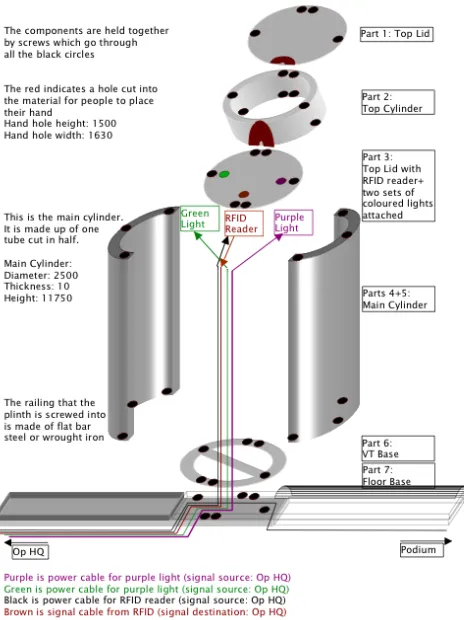
The RFID readers are embedded in vertical Perspex cylinders placed
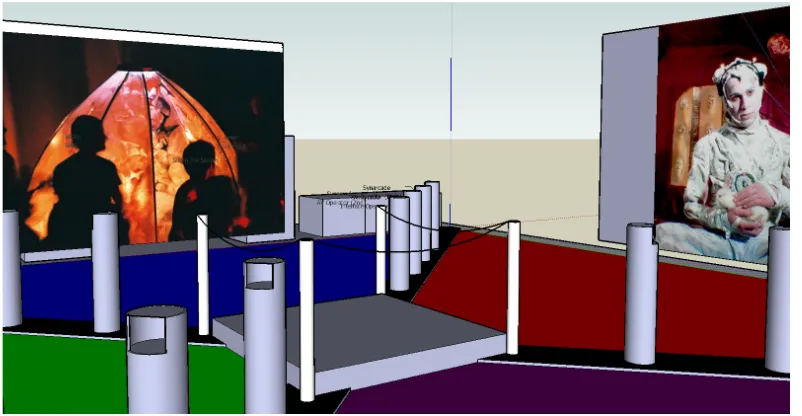
along both diagonal axes, marking each quadrant boundary (Figures 249,
E-250, E-251, E-252). At the top of each cylinder is an open cube where attendees bring their ‘embrIO’ to vote. This section is lined inside with red carpet so when voters put their hands in to be scanned, they feel the texture and form of the red Turkish carpets depicted on the projection screens. Each cylinder is hollow, 5mm thick, 25cm wide, 120cm tall and 100cm apart. This thickness allows the internal glowing red and green lights to shine through the translucent Perspex and out the open top.
Power, lighting and data cables run between each bollard under a 16 metre long curved flat bar steel platform running diagonally along the floor
866 The animal motif is also important for the political overtones inspired by George Orwell’s Animal Farm and
Pink Floyd’s Animals which frequently mention sheep, as both were major influences on the socio‐political tone of the work.
867 Previous Designs included terminuses within rectangular boxes, cubic boxes, triangular boxes, within an arch,
[image:23.595.101.497.144.376.2]
Figure E‐249: Design#13 with the cylindrical bollards emanating from Podium, Josh Wodak. The two film sets are to the right of the diagram, next of which is where the two AVMS Operators and Interface Operators sat. The wall between them and Room Womb is invisible in this diagram.
[image:23.595.99.500.471.679.2]
Figure E‐251: Side on view of voting terminus on mounting platform compartments, Josh Wodak
Figure E‐252: The intersection of all four quarters underneath Podium, Josh Wodak
under ‘Podium’ (Figure E-251, E-252). This platform is 5cm wide and 2cm high
[image:24.595.190.401.504.619.2]
caught on when stepping over the platform. All bollards are structurally reinforced by being fixed to the platform, to ensure they cannot be tipped over if attendees lean against them. Each bollard is made of two vertical halves so for transport each is divided into two components which slot into one another. The structure is modular, lightweight and portable, so assembly is a straightforward process of screwing together the sections of each terminus, then each terminus to each platform segment, then all platform segments to one another. Disassembly is the exact opposite. All components stack into one another when in transit.
Attendees vote by funneling into the ‘open’ end of their chosen quadrant, that is the terminus closest to the screens. In walking past a terminus to vote, attendees move from the crowded quadrant interior to relatively empty neighbouring quadrants, as the two active quadrants are always opposite eachother. Bollards form temporary walls during ‘Sessions.’ They are only accessed from inside an active quadrant as voters cannot vote from the exit side due to the steady stream of voters exiting through the spaces between bollards.
Returning HAVICs is an instrumental part of ‘Finale,’ where voters take off their HAVIC to hang on a left or right arm of either ‘Hoster-Drones,’ who stand on opposite sides next to ‘Podium,’ with the Being standing inside ‘Podium,’ awaiting its’ judgment. As voters have to approach the Being to hang their HAVIC on their preferred ‘Hoster-Drone,’ they literally face their Being, even if voting to kill it. Both ‘Hoster-Drones’ act as manual balance scales, as they tip (semi-humorously) in the direction of their arm with the most HAVICs hanging off it. ‘Head’ declares the winner by visually observing which arm of which ‘Hoster-Drone’ has the most HAVICs. Everyone being likely to vote in ‘Finale’ maximises the proportion of HAVICs returned before the staging ends, which is essential for evenings when the work is staged twice in succession. It also symbolically ends their embodied involvement, as they arrive unencumbered and begin by ‘strapping themselves in for the ride’ and unstrap themselves to finish.
Design#13 has the following meanings and references:
2) ‘Fishing around’ with a hand inside when voting refers to mixing
chemicals in analogue photography development rooms, where images are ‘born’ from interactions between the chemicals and the paper.
3) When it is off, the cube refers to a ‘black box’ as “any complex piece of equipment, typically a unit in an electronic system, with contents that are mysterious to the user”868 and magicians’ ‘black magic’ regarding Parents and the DBS ‘playing god’ in genetically engineering the Being.
4) When it is off, the cube refers to a foreboding sense of probing
the unknown, such as museums which have static objects (stuffed lizards, rocks and so on) inside black boxes which they get children to put their hands in to describe the object via touch. This asks voters to physically and intimately connect with a strange box that emits strange lights and sounds.
5) Such tactile and haptic nurturing via the interface is surrogate for caressing their Being in ‘Screen Womb.’ This comments on
how human-human relationships are increasingly
technologically mediated so that literal and metaphorical distances between humans can seem to be ‘diminished’ by technological intimacy and immediacy, such as screening ‘impure’ parents from insulated sick babies that require development time in plastic boxes and can only be touched through plastic gloves.
6) Placing a naked hand on a surface can register every persons’ unique biometric data. Obtaining data by RFID reinforces how the DBS wants detached and depersonalised Government census type data, rather than in intimate, physiological data such as DNA from contact with a naked hand.
[image:27.595.107.487.154.413.2]
E.4.2 Design#15
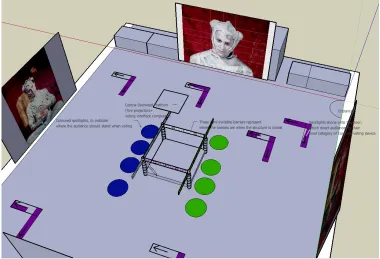
Figure E‐253: Design#15, showing the projections of the bifurcating questions along the purple rectangles, and the arrows they used to direct attendees, Josh Wodak. Question one is on the right of the diagram at the North‐ East entrance and the last questions are on the left at the opposite walls. The voting terminuses are shown emanating from Podium. The four blue and green circles represent the places to stand to swipe one’s embrIO.
As Design#13 could not incorporate DaP profiles, Design#15 re-conceived the spatial use of Room Womb to create a process by which DaP profiles were established and incorporated at the beginning of each staging.
DaP profiles are instrumental for individual and cumulative stagings as they allow for comparisons during and between stagings. Given the logistical and ethical issues involved, DaP profiles are obtained and analysed without offering trite and tokenistic understandings of attendees’ values and opinions. This relates to re-conceiving the form and content via the Tools and Rules,869 as establishing majority versus minority in binary decisions at fixed pre-defined points does not reflect the complex relationship between attendees’ DaP profile and their preferences for the Being.
As DaP profiles cannot be reliably established prior to the staging (by internet registration, telephone booking, or asking attendees to fill in their information at computer kiosks in the foyer), Design#15 comprehensively solves the challenges of obtaining DaP profiles while developing attendee engagement. Everyone is matched to their corresponding DaP profile by physically navigating bifurcating questions that shepherd attendees when they enter. Asking everyone the same questions as they enter symbolically levels the ‘playing field’ between all Parents. The process informs everyone of their parameters of interactivity and responsibility irrespective of having interacted with the pre-performance component, attended before, or having spontaneously walked-in off the street. The process chaperones attendees while they become acquainted with the ‘Room Womb’ atmosphere. To minimise distraction during this scene, ‘Room Womb’ is in a restive state with dim deep red light throughout and a projected mosaic red texture on the screens that expands and contracts in time with the sound of ‘Ram’ breathing while he and
‘Head’ sleep (Figure 6-180). Each successive answer filters them into
progressively refined categories which lead on to their corresponding HAVIC. The purple rectangles in Figure E-253 show where the questions are placed. Questions are written in LED lights on right-angled signs hanging from the ceiling at 1.5 metres height. The signs are automatically winched into the ceiling once all attendees have finished answering the questions so they do not obstruct ‘Room Womb’ for the remainder of the staging. Removing the signs completes the scene, after which the filmic exposition begins. Three metres from the entrance the first sign says: “Are you male?” on the right side of the sign, with an arrow pointing right, indicating to walk right to the next sign if that attendee is male. “Are you female?” is written on the left side of the sign, with an arrow pointing left. Each question directs attendees from the entrance to areas along the opposite walls that correspond to the cumulative combination of their answers.
possible paths, past and futures as a 3D kinetic sculpture of fate and
determinism (Figures 6-212, 6-213, 6-214, 6-215, 6-216). Everyone roams the
narrative structure in two opposing ways: no co-operation is required when answering DaP questions, but in ‘Session’ questions voters negotiate as groups navigating pathways together. Temporarily separating attendees from those they attend with explores the extent to which those who come together vote similarly. The DaP questions show how to exert influence by moving through ‘Room Womb,’ which presages the crowd control protocols for moving around during ‘Sessions.’ Attendees’ collective predicaments are also presaged due to posing DaP questions that, like the collective questions, do not have clear cut answers. As an example, one DaP question is: “Do you have free will?” – with an arrow pointing left if you do, and right if you do not. Everyone exercises ‘free will’ in responding to these forking paths, depending on if they exercise their free will to lie and take ‘incorrect’ paths to construct a different identity, given attendees’ role playing as Parents. This yields patterns of emergent behaviour according to the variable probability of responses demonstrating bell curve propensities according to the proportion who voluntarily/truthfully answer each DaP question versus those who selectively lie versus those who abstain.
only stagings.870 Having donned their HAVIC attendees may roam around,
including recongregating with the people they came with.
Voting in Design#15 uses substantially less equipment, less costs, quicker assembly and disassembly and easier portability as it only uses infrastructure embedded in and emanating from ‘Podium.’ This gives the widest and least encumbered space to move around in. It achieves this by embedding 16 terminuses on moveable two metre horizontal rods that run between the metre high vertical poles at each ‘Podium’ corner. Each terminus on each rod is used in each ‘Session’ as the rods pivot 90 degrees (Figure
E-253). The 10cm wide solid wrought iron vertical poles are fixed and
immovable. The 5cm thick transparent Perspex horizontal poles are relatively light. Both are extremely strong, being structurally reinforced by a connecting
X grid under ‘Podium’ (Figure E-252). As each rod only moves 90 degrees there
is no cable slack. Cabling distances are extremely short, as all voting terminuses are near ‘Podium.’ One bundle of data, power and lighting cables runs vertically from the top of the NW pole through a clear 6cm diameter hollow Perspex tube to the roof and then to computers which process all votes. This cable bundle forms part of the set as the microphone participants use when interrogating and punishing the Being is mounted onto the vertical Perspex tube.
In-between ‘Sessions’ all rods are closed so there are no protruding rods. This square border around ‘Podium’ indicates that the focus in-between ‘Sessions’ is on the audiovisual media on the screens and PA, although necessary rods are opened and closed during ‘Punishment,’ ‘Interrogating’ and ‘Finale’ to allow climbing onto ‘Podium.’ When each ‘Session’ begins, Drones’ manually open the necessary rods. The manual cogs require ‘Hoster-Drones’ to insert a key to unlock each rod so they can push it into place. Rods are locked open or closed so they do not buckle even if leaned on, to prevent any rod movement other than by ‘Hoster-Drones.’
Locking and unlocking rods to move them into their active position symbolically and theatrically creates walls and corridors between opposing sides. This refers to opening and closing a polling station on an election day. When options are in North-South quadrants the rods pivot so the terminuses
run East-West, with the terminuses parallel to the screens they correspond to. When options are in East-West quadrants, the poles pivot so terminuses run North-South. Each rod has two embedded coloured lights which match the two Screens that rod corresponds to. When it belongs to Screen North it lights up with the colour of Screen North and is parallel to Screen North. When it belongs to Screen East it lights up with the colour of Screen East and is parallel to Screen East (and the same for Screen South and West).
During ‘Sessions’ flat terminus rows divide ‘Room Womb’ into halves, affording the largest possible voting area for both halves. Eight terminuses face outward for each option. The number of terminuses can be doubled by placing them on the inside and outside of the poles, so voters access them from inside and outside of ‘Podium.’ This brings voters into close contact with their opposition as there is no separation between those voting from inside the ‘Podium.’ Voters move into their chosen area and join a queue leading to one of the terminuses. For crowd control, coloured spotlights indicate where to queue. ‘Head’ and ‘Hoster-Drones’ also shepherd voters to form four parallel queues (like a school assembly). Attendees vote by bringing ‘embrIO’ to within 5cm of the terminus. The same visual and graphic feedback as in Design#13 indicates their vote has been counted. With one metre between each terminus there are sufficient corridors for voters to exit after having voted.
E.5 Implementation and Presentation: Design#11
Figures E‐254, E‐255: The Interface Operator observing the computer monitor which calculated the number of votes according to the volume of green and red halo light in active areas during Sessions. E‐254 is taken during the strobe flashes that immediately preceded the assessment, which is the instant captured in E‐255.
[image:32.595.99.504.167.282.2]
Figure E‐256: The Interface Operator observing the computer monitor which shows the overhead perspective of
Room Womb and the proportion of red and green halos in the different sectors
Figure E‐257: The live projection of the voting tally is shown to the left of the photo. This tally showed the results for each Session and all Sessions combined, throughout the staging.
[image:32.595.103.491.556.706.2]
Figure E‐260: Shelley Winters. Emergence at the Street Theatre review871
Winters’ review describes the voting design as used in v3 stagings. Over 1700 people attended the full theatrical seasons at The Sydney Opera House Studio; The Street Theatre, Canberra; and Arts House, North Melbourne Town Hall in 2007. In Design#11, the implemented design, Hoster-Drones assigned thin cylindrical red glow sticks to men and green sticks to women as they entered Room Womb. The glow sticks were worn as halos for the duration of the staging. Participants voted by moving into their chosen area and standing during a Session they wanted to vote in. Voters remained in respective areas as it was not specified when the tally would be taken. As it was impossible to simultaneously fit more than 50 people per quadrant, voting areas occupied half of Room Womb when there were two simultaneous options. When there were three options, a ‘Swinging Vote’ or ‘Undecided’ sector was created in-between the two active quadrants (Figure 177, 178, 232, 6-233). The computer did not count the light emitted from the halos in these sections, as they were ‘donkey votes.’ A strobe light flashed in the three seconds before an arbitrary still frame was taken from cameras positioned above (Figure E-254), from which computers assessed the total amount of both
871 Shelley Winters. ‘Emergence’ at the Street Theatre review. Loadedog. www.loadedog.com. Accessed March 17
glow stick colours in all active area (Figures E-255, E-256). A live graphical tally indicated the number of votes for each session, as well as the results of each
Session, so attendees could better judge Ram according to the genetic
alterations they made over the course of the staging (Figure E-257).
Design#11 did not establish any UVI or DaP information, although gender proportions were obtained by calculating the amount of green and red halo light in active areas. The following are some examples of the quantitative data it produced for all 22 v3 stagings:
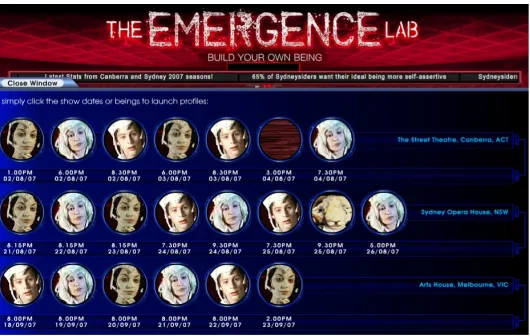
1) “71% of Melbournians wanted their being to be more critical as well - this is compared to only 50% of Sydneysiders.
2) Sydneysiders chose their ideal being to be more empathetic (54%) whilst people in Canberra overwhelmingly preferred their being to be more critical (61%).
3) Sydneysiders very strongly wanted their ideal being to be an explorer (71%) whilst Canberrans strongly preferred a life-path of ‘questioner.’ 4) 67% of Canberrans, when given the choice, wanted their being to be
more independent. However, for young people under the age of 17, this was only 55%.”872
872 ‘Emergence ‐ Build Your Own Being’ Project Website. http://buildyourownbeing.com/lab/1.html. Accessed
[image:35.595.243.393.150.370.2]
E.6 Summary
Figure E‐260: Clare Morgan. Playing God is a Serious Game on the Dawn of a New Creation review,
Sydney Morning Herald, September 12 2007
As v3 was not a work-in-progress, it did not solicit responses from attendees as v2 had done. However the pre- and post-performance components on the website solicited hundreds of comments and postings from Parents’ to their Beings, as each Being from each staging kept communicating with its parents in the online post-performance component. While not providing evaluative feedback, these comments indicate sustained engagement and empathy between many attendees, who desired to continue their experience online after their staging had finished.873
As it was much more widely publicised than v2, v3 was reviewed in premiere Australian newspapers such as The Sydney Morning Herald, The Age and The Australian. As v3 was so similar to v2, these reviews are interspersed in evaluating v2 in Chapter 6, as the work-in-progress nature of v2 was more amenable to comprehensive evaluation via the multiple sources of co-creators, SOH Studio staff, reviews, observation and participation in the feedback sessions and patterns of responses from over 400 Feedback Forms.
873 The 22 separate components (one for each staging) “received 2208 visits” as of December 2007. ‘Emergence ‐
Bibliography
Aarseth, Espen (1997). Cybertext: Perspectives on Ergodic Literature. Baltimore: Johns Hopkins University Press.
Anderson, Benedict
(1983). Imagined Communities: Reflections on the Origin
and Spread Of Nationalism. London: Verso.
Armstrong, Keith (1999). ‘Transmute Collective: Transit Lounge - Version 1.’ Brisbane: QUT E Prints. http://eprints.qut.edu.au/9016. Accessed 14 October 2008.
(2002). Towards an Ecosophical Praxis of New Media Space Design. PhD Dissertation. Faculty of Creative Industries, Queensland University of Technology.
(2003). ‘Towards an Ecosophical Praxis of New Media.’ In Proceedings of Melbourne Digital Arts and Culture 2003 Conference, edited by Adrian Miles, 91-99. Melbourne: Royal Melbourne Institute of Technology.
(2004). ‘Investigating Ecological Subjectivity: Intimate Transactions (Shifting Dusts).’ Paper presented at PixelRaiders 2: Interdisciplinary
Art/Design Conference, Sheffield, April 6-8 2004.
(2005). ‘Intimate Transactions: The Evolution of an Ecosophical Networked Practice.’ Fibreculture Journal Volume 7. http://journal.fibre culture.org/issue7/issue7_armstrong.html. Accessed March 12 2006. (2006). ‘Towards a Connective and Ecosophical New Media Art Practice.’ In ‘Intimate Transactions’: Art, Exhibition and Interaction Within
Distributed Network Environments, edited by Jillian Hamilton, 12-34.
Brisbane: Australasian CRC for Interaction Design Press.
(2007). ‘Interview with Liz Baker.’ http://embodiedmedia.com/ projects/intimate_t/bakerconv.htm. Accessed 14 October 2008.
Ascott, Roy (1966). ‘Behaviorist Art and the Cybernetic Vision.’ Journal of the
(2003). Telematic Embrace: Visionary Theories of Art, Technology, and
Consciousness, edited by Edward Shanken. California: University of
California Press.
Barthes, Roland (1984). Image, Music, Text, translated by Stephen Heath. London: Fontana Paperbacks.
Bateson, Gregory (1972). Steps to an Ecology of Mind. New York: Ballantine Books.
Benjamin, Walter (1969). ‘The Work of Art in the Age of Mechanical Reproduction.’ In Illuminations, edited by Walter Benjamin and Hannah Arendt, 217-252. New York: Schocken.
(2006). ‘On the Concept of History.’ In Selected Writings
Volume 3: 1935-1938, translated by Dennis Redmond, edited by Howard Eiland. Massachusetts: Harvard University Press.
Bentley, Elizabeth (2007). ‘Emergence Review.’ Drum Media, 28 August 2007.
Bentley, Ian, Alan Alcock, Paul Murrain, Sue McGlynn and Graham Smith (1985).
Responsive Environments: A Manual for Designers. London: The
Architectural Press.
Bird, Jon (2004). ‘Containing Reality.’ In Impossible Nature: The Art of Jon
McCormack, edited by Jon McCormack. Melbourne: Australian Centre for
the Moving Image.
Boal, Augusto (1985). ‘Games for Actors and Non-Actors.’ In Theatre Of The
Oppressed, translated by Maria Leal McBride and Charles Odilia, 132-156.
New York: Theatre Communications Group.
Borges, Jorge Luis (1998). ‘The Garden of Forking Paths.’ In Jorge Luis Borges –
Collected Fictions, translated by Andrew Hurley, 119-128. New York:
Penguin Books.
Bourriaud, Nicolas (1998). Relational Aesthetics. Dijon: Les Presse Du Reel.
Bower, Sam (2007). A Profusion of Terms. www.greenmuseum.org:generic_ content.php%3Fct_id=306. Accessed 19 July 2007.
Braeckman, Johan (1995). Review of The Garden in the Machine: The Emerging Science of Artificial Life, by Claus Emmeche. Cultural Dynamics Volume 7:265-269.
Broker, David (2009). Dorkbot Canberra. Catalogue essay for Dorkbot CBR exhibition, November 7-15 2009, Canberra Contemporary Art Space, Canberra.
Bullivant, Lucy (2006). Responsive Environments: Architecture, Art and Design. London: Victoria and Albert Museum.
Burgess, Anthony (1986). A Clockwork Orange. New York: W. W. Norton and Company.
Burvill, Tom (2006a). ‘Unassumable Responsibility: Watching Mike Parr.’ In Being There: After-Proceedings of the 2006 Conference of the
Australasian Association for Drama, Theatre and Performance Studies,
edited by Ian Maxwell. http://ses.library.usyd.edu.au/handle/2123/2470. Accessed September 5 2008.
(2006b). ‘Unassumable Responsibility: Watching Mike Parr - Abstract.’ http://ses.library.usyd.edu.au/handle/2123/2485. Accessed September 5 2008.
Burnham, Jack (1968). Beyond Modern Sculpture: The Effects of Science and