Republic of Botswana
European Community
Joint Report 2003
Table of Contents
1. EXECUTIVE SUMMARY...4
2. THE POLICY AGENDA OF THE PARTNER COUNTRY ...5
2.1 The Long Term Vision (Vision 2016) ...5
2.2 9th National Development Plan (NDP9) ...6
2.3 Recent Policy Initiatives...6
3. UPDATE ON THE POLITICAL, ECONOMIC AND SOCIAL SITUATION...8
3.1 Political Situation ...8
3.2 Economic and Social Situation...9
3.2.1 Economic situation, structure and performance...9
3.2.2 External Environment including regional co-operation ... 11
3.2.3 Social development... 12
3.2.4 Environment ... 14
3.2.5 Major challenges in Botswana’s development... 15
4. OVERVIEW OF PAST AND ON-GOING CO-OPERATION ... 16
4.1 Focal sector: Human Resources Development ... 17
4.2 Non Focal sectors... 20
4.2.1 The Micro-Projects Programme (MPP) – EDF 7 and 8 ... 20
4.2.2 Natural resource utilisation and conservation... 21
4.2.3 HIV/AIDS – EDF 7 ... 22
4.2.4 Private sector development ... 22
4.2.5 Enhance government's implementation and absorption capacity ... 22
4.2.6 Support to Fiscal Reform in Botswana ... 23
4.3 Utilisation of resources for Non-State Actors (NSAs) ... 24
4.4 4.4 Utilisation of Envelope B ... 24
4.5 Other Instruments ... 25
4.5.1 The European Investment Bank ... 25
4.5.2 The Centre for Development of Enterprises (CDE) ... 26
4.5.3 Regional co-operation ... 26
4.5.4 SYSMIN ... 27
4.6 Use of EDF resources... 28
4.6.1 The speeding up of the use of old EDF resources ... 28
4.6.2 Forecasts for individual commitments and payments in 2004 and 2005... 29
5. PROGRAMMING PERSPECTIVES FOR THE FOLLOWING YEARS ... 29
5.2 Proposal on a review and adaptation of the CSP ... 31
5.2.1 Orientations and allocations of the CSP ... 31
5.2.2 Appropriateness in 2004 of the initial CSP orientations and allocations... 32
5.2.3 Programming of Envelope A. ... 32
5.2.4 Envelope B ... 33
6. CONCLUSIONS ... 34
6.1 Political, economic and social developments... 34
6.2 Non State Actors... 35
6.3 Cross-cutting issues ... 35
6.4 Integration of new EC/EU policy initiatives and commitments ... 36
6.5 Performance appraisal... 36
6.6 Commission position on a possible revision of the country financial allocation ... 40
Annexes Annex 1. EDF 6, 7 and 8 NIP financial implementation by sector... 41
Annex 2. Non-programmable resources in Botswana under EDF6, 7 and 8 ... 46
Annex 3. Project summaries ... 48
Annex 4. Government commitments in Education and Training under 8th and 9th EDF NIPs ... 61
Annex 5. EDF 6 – 9 (NIP+Sysmin) - Evolution in 2003 of the Remaining to Pay (RAP), Remain to Contract (RAC) and their sum (RAL) ... 64
Annex 6. Achievements of the 2003 forecasts and 2004 and 2005 forecasts... 65
Annex 7. EDF9 intervention framework - EC Support to the Human Resource Development Sector in Botswana (CSP) ... 66
Annex 8. EDF9 updated chronogramme of activities and indicative commitment and expenditure schedule... 69
Annex 9. Selected economic and social parameters and indicators of Botswana ... 70
Annex 10. Recent EC/EU Policy initiatives and commitments... 73
Annex 11. Botswana Environmental Profile. ... 78
Annex 12. Botswana Migration Profile... 81
1.
Executive Summary
During the period 2003 in review, as in the previous decades, Botswana has enjoyed peace, political stability, and unbroken democratic rule. Next elections are scheduled in 2004.
Real economic growth in 2003/04 is estimated at 5.0 %, versus 6.7% in the previous year. The economy remains driven by the mining sector, particularly diamonds (mineral revenue accounts for 44% of total revenue). Botswana maintained in the year large foreign exchange reserves (2 years of imports), low public debt, and a strong currency. The Botswana Pula appreciated against major currencies and was devaluated by 7.5% in February 2004. Public finances remain healthy due to tight control of deficits, and in particular cuts in recurrent as well as development expenditure. Inflation declined to 6.4% towards the end of the year when the impact of VAT introduction in July 2002 phased out. The 2004/05 budget presents a small but precarious surplus.
Botswana has strong trading links with the EU which accounts for 89% of its exports and 12% of its imports. Negotiations for a Free Trade Area between SACU and the USA, initiated in 2003, should be completed in 2004. Consultations on regional configuration for EPAs negotiations under the Cotonou Agreement continued throughout 2003. Botswana, together with other BLNS partners, Tanzania and Angola, has explicitly opted for negotiations under the SADC flag.
The country adopted in December 2002 its 9th National Development Plan’s. Its
theme is “Towards realisation of Vision 2016: Sustainable and Diversified Development through Competitiveness in Global Markets”, acknowledging that global competitiveness and trade are critical for a small sized country as Botswana. Focus will be on the implementation of policies and strategies in agriculture and rural development, tourism, science and technology, privatisation and enterprise development, in particular citizen entrepreneurship. The development budget is largely (90%) financed from own resources, the rest being equally shared between external grant assistance and borrowing. Privatisation is being gradually implemented and public sector reforms undertaken to improve efficiency and productivity.
appropriate indicators, which will be the subject of a study in the first half of 2004.
Studies for Human Resource Development in Botswana, and appraisal of support to the first - the single focal sector under EDF9 attracting 80% of NIP resources or 32 MEUR- , was undertaken from mid 2003 and should be completed by June 2004. Two projects were launched in 2003: the Economic Diversification of the Mining Sector (Sysmin– EDF9 B envelope, 30 M€) and a 3.88 M€ project to support Vocational Education and Training (EDF8 unallocated resources – EDF9 programming). A 4.2 M€ fourth Micro-Projects Programme was prepared.
It has been agreed that support to HRD under EDF9 will be in the form of an Education and Training Sector Policy Support Programme, channeling resources as sectoral budget support. The selection of appropriate indicators with targets will be critical and will be given the required attention.
Further preparation of EDF 9 interventions, progress in the implementation of EDF8 projects, evaluations/reviews/audits, strengthening of the dialogue in the field, review of EDF 9 focal sector indicators will be undertaken in 2004 in respect of EDF development co-operation. The review of the CSP concludes that the sectoral orientations and allocations are relevant to the country situation in 2004 and that it does not need revision. It is consistent with major EC/EU commitments and initiatives in the field of development policies. Interventions are planned which will use all NIP funds, including those to be decommitted from old projects.
The Commission will maintain its close political dialogue with Government in line with the objectives of economic diversification, poverty reduction, equity and community development.
2.
The policy agenda of the partner country
2.1 The Long Term Vision (Vision 2016)
Botswana’s long-term development plan, “Vision 2016”, “Prosperity for All”, adopted in 1996, is a multi-dimensional perspective of where the country should be by 2016, socially, economically, politically and spiritually. It re-affirms the country’s four development objectives of sustained development, rapid economic growth, economic independence, and social justice. Although Botswana has achieved, over the past decades, rapid economic growth through mining and in particular diamonds, economic diversification is critical to secure sustainable development and to address persistent high unemployment and poverty levels. Strategies to achieve these objectives are articulated around private sector development as the new engine of growth. Vision 2016’s emphasis is on Human Resource Development (HRD), productivity and innovation, as well as the fight against HIV/AIDS.
2.2 9th National Development Plan (NDP9)
The 8th National Development Plan, whose theme was “Sustainable Economic
Diversification”, came to an end on 31.03.2003.
The theme of NDP9, “Towards Realisation of Vision 2016: Sustainable and Diversified Development through Competitiveness in Global Markets”, acknowledges that global competitiveness and trade are critical for a small-sized country such as Botswana. The policy thrust of NDP9 includes:
- Economic diversification, employment creation and poverty alleviation; - Macro-economic stability, financial discipline and public sector reforms;
- Environmental protection, rural development, HRD, the fight against HIV/AIDS, Science & Technology development, and disaster management.
2.3 Recent Policy Initiatives
Following the adoption in 2002 of the Revised National Policy for Rural Development and corresponding implementation plan, the National Strategy for Poverty Reduction was adopted in 2003. It will guide and co-ordinate the various anti-poverty programmes and initiatives. The strategy rests, besides macro-economic policies fostering stability, macro-economic growth, foreign and domestic investment, on: pro-poor spending; protection of essential items (food, clothing, shelter) from inflationary pressures; promotion of tourism (in particular eco-tourism) with a view to increasing employment opportunities for the poor based on existing resources; more sustainable, efficient and targeted safety nets packages; the effective participation of the poor in the planning of anti-poverty schemes; the fight against HIV/AIDS; and monitoring mechanisms including poverty surveys and capacity building of the Central Statistics Office (CSO). Half-yearly reports to Cabinet on the implementation of the strategy are planned. It is not a “Poverty Reduction Strategy Paper” (PRSP) in its usual meaning and bearing; the reference development plan and expenditure framework remains the one of NDP9.
The “Botswana National HIV/AIDS Strategic Framework 2003-09” (NSF) was approved in 2003. It aims at radically addressing the epidemic to “eliminate the incidence and reduce the impact of AIDS in Botswana”. It emphasises management, identifies responsibilities of various actors and sectors, at various levels, and defines basic packages for different levels that address the most immediate needs. A Botswana HIV/AIDS Information Management System (BHRIMS) will monitor and guide the national response. The NSF also includes indicators and targets. Indicative costs (close to 12.5 bln Pula over 6 years), to be met by Government, development partners and the private sector, are provided for each of the five keys areas of intervention1. Prevention of infection is the first priority and would, if successful, over the next 10 years, save at least 10 bln Pula in treatment and care. Increased predictability in funding would facilitate implementation. The development or revision of important health policies, strategies and regulations to
1
improve public health and safety, and indirectly increase labour productivity, has also been undertaken 2.
In order to improve the management and co-ordination of education at its various levels, the Ministry of Education has taken responsibility for the Community Junior Secondary Schools and the Brigades. Government now assumes total responsibility of Education and Training (E&T).
In recognition of the ability of a growing number of Batswana to pay substantial amounts for their children’s education, specific cost recovery schemes are being put in place for different levels 3. Equity schemes complement cost-recovery
concerns, to preserve access to education to less advantaged strata or groups of the society. Cost-sharing mechanisms are also high on the policy agenda in the field of transport.
With NDP9, environment was given for the first time a prominent place in a national development plan. Government proposes in 2004/05 to review a number of important existing environmental policies, legislation and strategies and complete those in preparation 4. Two important bills will be presented to Parliament:
- The Environmental Management Act will ensure a global coherent approach by grouping the various pieces of environmental legislation;
- The Environmental Impact Assessment legislation will render EIA compulsory for major projects.
Plans and strategies are also being prepared for wastewater and sanitation, Okavango Management, and bio-diversity. The Forestry Act needs to be amended to be fully compliant with the provision of the CITES regarding flora.
Botswana’s development, as the one of every single country, is guided by a “policy mix”, requiring careful attention to the balance between various policies, such as environmental protection and management, tourism and agriculture development (in particular, livestock development and beef exports). The President in 2003 directed that a comprehensive study on the long-term viability of the Livestock sub-sector be undertaken, leading to the formulation of a long term development strategy to promote a viable, affordable, competitive and sustainable livestock sub-sector. The study, carried out by the World Bank, is expected to be completed mid 2004.
In terms of economic diversification, the Government of Botswana sees its role as limited to that of creating an environment conducive for private initiative and innovation.
Following the establishment in 2001 if the Citizen Entrepreneurial Development Agency (CEDA), aiming at supporting the development of citizen-owned SMEs, the CEDA Venture Capital Fund was created in 2003 to provide financial assistance to joint ventures between citizens and foreign investors.
2 Amendment of the Public Health Act (1971) to align it with current environmental and developmental changes, drafting of the Chemical Substances and Products Bill to protect human health and the environment from chemical hazards from industries and households, and of a Traditional Medical Practice Bill.
3
School fees (including boarding fees), in particular in secondary schools; loan / grant system at tertiary level. The proportion of grant/loan ranges from 100% for those study subjects considered necessary for the economy to 0% which are considered of importance for individuals rather than the nation.
4
A whole range of complementary measures and policies are prepared to facilitate domestic and foreign investment 5 and support the development of financial markets.
The Privatisation Master Plan drafted by the Public Enterprises Evaluation and Privatisation Agency (PEEPA) is expected to be ready for implementation early 2004. Its implementation will be preceded by extensive diagnostic reviews.
After having introduced a 10% Value Added Tax (VAT) in July 2002, Government has finalised the Botswana Unified Revenue Services (BURS) Bill which has been tabled in Parliament mid February 2004. The BURS will merge the Department of Excise and Customs and Department of Taxes with the objective of increasing cost-efficiency of revenue collection. The latter is expected to amount to 11 bln Pula in 2004/05 while the two merging departments collected together some 8 bln Pula last year.
The restructuring of the Central Tender Board into a Public Procurement and Asset Disposal Board initiated in 2002 has been further operationalised through the establishment of a Committee advising the MFDP on the Board’s operations and an Independent Complaint Review Committee. Tender Committees are being established within Ministries and District Administration to accelerate the decision process, and increased transparency is being sought through the publishing, since December 2003, of various Board decisions.
3.
Update on the political, economic and social situation
3.1 Political Situation
Botswana has a long-standing record of peace and political stability. The country has a multiparty constitutional democracy and free and fair elections are contested every five years. The next elections are scheduled for October 2004.
The President has executive powers and is chosen by the newly elected National Assembly. Cabinet is nominated by the President from the National Assembly 6. Draft National Assembly bills of tribal concern must be referred to the House of Chiefs, representing subgroups of the Botswana tribes, for advisory opinion. Other leaders preside over customary courts. All persons have the right to request that their case be considered under the formal British-based legal system. The roots of Botswana’s democracy lie in Setswana traditions, exemplified by the Kgotla, or
5 A Local Entreprise Agency will be established, to co-ordinate training of local entrepreneurs. A Competition law will be presented in 2004, aiming at improving market efficiency through effective competition. The National Policy on Incomes, Employment Prices and Profits is being reviewed with a view to relaxing controls and allowing prices, wages and salaries to respond better to market forces and send appropriate signals to the economy. Various policy initiatives also aim at increasing predictability, transparency and efficiency of various sectors. The anti-money laundering legislation was adopted in March 2003, requiring financial organisations to put preventive and detection measures in place. A revision of Pension and Provident Fund, promoting private sector participation, and a Securities Bill, regulating all activities on the Botswana Stock Exchange, will be drafted in 2004/05.
6
Village Council, in which the powers of traditional leaders are defined and limited by custom and law.
Civil and political rights are entrenched under the Constitution. The latter has a code of fundamental human rights enforced by the courts. There is freedom of association, of worship and of expression. The country is party or signatory to core treaties on human rights, with the exception of the UN Convention on Economic, Social and Cultural Rights. Botswana signed in 2003 a bilateral agreement with the USA preventing the extradition of US citizens present on the national territory to the International Criminal Court. Concerns are expressed about the fact that homosexuality is illegal; about the dominant position of Government in relation to the media 7; about the death penalty, applied in specific murder cases. It is recognised that dialogue between Government and communities such as the San (or Basarwa) needs to be intensified on their aspirations for their own development, and on ways to enhance programmes that will empower them socio-economically.
Government, civil service and judiciary are effectively separated. The legal system functions well. The Office of the Ombudsman demonstrates independence and effectiveness. Standards of conduct in political, civil and commercial life are high in Botswana. Allegations of corruption or misuse of position are not common and appear to be systematically pursued by the independent Directorate for Corruption and Economic Crime. Botswana now occupies the 24th rank world-wide in terms of
the “corruption perception index”, up from 26th in 2002 8.
3.2 Economic and Social Situation
3.2.1 Economic situation, structure and performance
The recovery of Botswana’s economy, initiated in 2002/03 (6.7% real GDP growth vs. 2.1% in 2001/02) levelled off in 2003/04, with a real GDP growth estimated at 5.0 % 9. The same growth is projected for 2004/05.
While the 2002/03 budget was in deficit by 1.6 bln Pula, the 2003/04 overall revised budget is essentially balanced (marginal deficit of 20 mln Pula). This however results from various measures to adjust expenditure and net lending pattern (5% reduction in recurrent budget, scaling down of development budget from 4.43 to 4.00 bln Pula, sale of PDSF loan, etc.) to a much lower revenue than anticipated (-14%).
In 2003 indeed, the depreciation of the USD and appreciation of the Rand, against the Pula and major currencies, resulted in a substantial drop in mineral revenue (as well as an increase in real terms of costs of imports from South Africa). The extent to which an increase in mining outputs has compensated losses in relative terms is yet to be assessed once final figures are available.
In spite of sustained efforts towards economic diversification, the economy remains fairly stable and largely driven by the mining sector (Annex 9, table 9.1). Services represent close to 50% of GDP. Agriculture has shrunk over the past decade due to low productivity, recurring droughts and more recently a series of FMD outbreaks. Constraints to economic diversification are: inadequate levels of investment, small
7
The planned “Mass Media Communication” Bill is currently being circulated among stakeholders
8 Botswana scored 6.4 in 2002, up from 6.0 in 2001. The CPI ranges between 10 (highly clean) and 0 (highly corrupt). “Global Corruption 2003, Data and Research, Transparency International, 2003.
9
domestic market, mismatch between labour skills and the needs of the market, low productivity, non competitive production costs (landlocked situation, high utilities costs), remoteness from export markets, etc.
Inflation remained high in 2003 at 9.2% in average while a decline was initiated mid year (8.7% in July) as the impact of the introduction of VAT a year before phased out. This downward trend was maintained to the end of the year (6.4% in December, close to the target of 4-6%), assisted by a decline in domestic demand and in government expenditure, and lower external inflationary pressures, in particular in South Africa. The Botswana Pula10 appreciated against major currencies11 and was devaluated by 7.5% on 5th February 2004. This is expected to
boost exports and domestic production, in specific export sectors, such as textiles, mining, and tourism.
Botswana’s balance of payments recorded in 2003 a large surplus (1 bln Pula vs. 0.3 bln Pula in 2002). Foreign exchange reserves declined by 5%, standing at 5.3 bln USD (24 bln Pula) at the end of the year, providing for some 26 months of imports. Results of public enterprises and parastatals for 2003/04 are not yet published. The worst performing, Botswana Telecommunications Corporation, seems to be turning round, recording profit in the first half of the year in review. Privatisation of Air Botswana has not been completed following the withdrawal of potential candidates.
Total revenue and grants for 2004/05 12 are estimated at 18.21 bln Pula, with Mineral Revenue, Excise, Non-Mineral Income Tax and VAT accounting for respectively 44%, 18%, 14% and 11%. The first two components depend crucially on the evolution of the USD and Rand in international markets, factors over which Government has no control. Income tax and VAT are expected to increase by over 20%, facilitated by the creation of the BURS, full enforcement of the VAT legislation and enhanced VAT auditing.
Total expenditure proposed is 18.14 bln Pula (a 6% growth over the revised 2003/04 expenditure), of which 3.61 bln for development (a 10% reduction over the revised 2003/04 development budget). The budget presents therefore a small and precarious surplus of 70 mln Pula. It provides for an increase in public salaries, as recommended by the Pay Structure Review Commission, but not for a growth in public manpower.
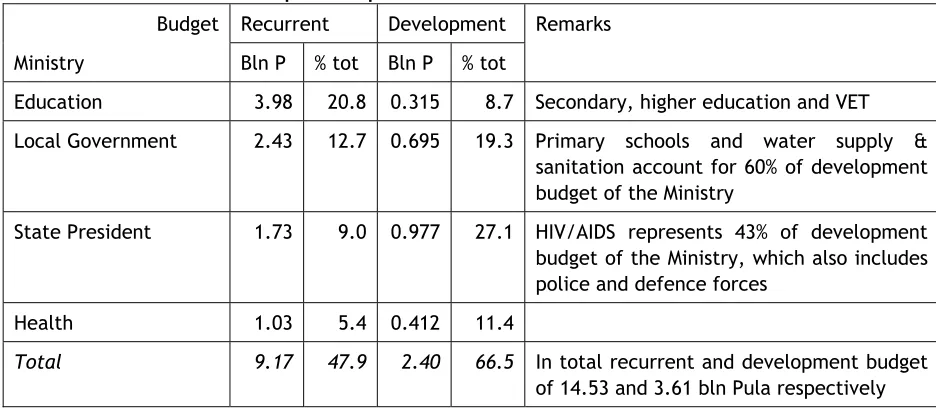
Expenditure on social services represents a very significant proportion of the total proposed expenditure in 2004/05 (Table 1).
Government places considerable emphasis on performance improvement of public services, and efficiency gains and cost savings and costs control in public expenditure for development projects. Cost recovery mechanisms are introduced in education and transport.
Official Development Assistance (ODA) received has shrunk to some 31 million USD in 2000, i.e. 0.6% of GDP 13.
10 Pegged to a basket of currencies consisting of ZAR, USD, Euro, GBP and Japanese Yen. 11
In nominal terms + 12% against the basket, 23% against the USD, 11% against the GBP but –6% against the ZAR (0% in real terms).
12 Budget Speech 2004/05, presented by the Minister of Finance to the National Assembly on 09.02.2004 13
Table 1. Proposed expenditure on social services in 2004/0514
Budget Recurrent Development Remarks
Ministry Bln P % tot Bln P % tot
Education 3.98 20.8 0.315 8.7 Secondary, higher education and VET
Local Government 2.43 12.7 0.695 19.3 Primary schools and water supply &
sanitation account for 60% of development budget of the Ministry
State President 1.73 9.0 0.977 27.1 HIV/AIDS represents 43% of development
budget of the Ministry, which also includes police and defence forces
Health 1.03 5.4 0.412 11.4
Total 9.17 47.9 2.40 66.5 In total recurrent and development budget
of 14.53 and 3.61 bln Pula respectively
3.2.2 External Environment including regional co-operation
External trade relations are complex. Botswana, given its small population and landlocked situation, has opted for regional integration and open market policies in order to benefit from foreign investments, free trade and economies of scale. It is however acknowledged that quality products are a pre-requisite to penetrate well- established markets.
Botswana pursues very actively the implementation of the Kimberley diamond certification scheme15, of particular importance to the national economy, since the publishing early January 2003 its “Export and import of rough diamonds regulation – 2003”.
The country is an active member of various regional, continental and world organisations and institutions such as the SADC 16, SACU 17, African Union, Africa Development Bank, United Nations, Commonwealth, and signatory to global partnership agreements such as the ACP-EU Cotonou Partnership Agreement and NEPAD 18
The SACU Agreement was revised and renewed in 2002 on more favourable terms for Botswana in terms of the determination of customs tariffs and formula for the share of customs revenue among SACU members. In spite of globalisation and specific agreements of other SACU partners (e.g. TDCA19 between the EU and South Africa), the market remains important, even more so in the context of the SACU-USA Free-Trade Area whose negotiation, initiated in 2003, should be completed by
14
Budget Speech 2004/05, presented by the Minister of Finance to the National Assembly on 09.02.2004 15 Whose implementation in the EU is regulated by the EU Council Regulation EC 2368/2002 of 20.12.02 16
Southern Africa Development Community. SADC has currently 13 members: Angola, Botswana, the Democratic Republic of the Congo, Lesotho, Malawi, Mauritius, Mozambique, Namibia, South Africa, Swaziland, Tanzania, Zambia and Zimbabwe. The Seychelles decided to withdraw from the SADC with effect from mid 2004. The extent to which the on-going negotiations for a revision of the formula for contributing to the SADC would affect this decision is not known.
17
Southern Africa Customs Union, common customs area between South Africa, Botswana, Lesotho, Namibia and Swaziland.
18 New Partnership for Africa’s Development. 19
the end of 2004. Benefits – in terms of sourcing raw materials from anywhere in the world - accessible to least developed countries under the AGOA-II with the USA, have been extended to Botswana until 2004.
Botswana has strong trading links with the EU which accounts for 89% of its exports (in particular the UK, and mostly raw diamonds) and 12% of its imports. Consultations on the regional configuration in Southern Africa of the Economic Partnership Agreements (EPAs) negotiations under the Cotonou Agreement were launched in September 2002 and continued throughout 2003. There are concerns that the SADC will not negotiate with its full strength as a regional organisation as some SADC members20 have opted to negotiate in the context of “ESA” and RSA has already a major specific agreement with the EU. The Minister of Trade, Industry and Commerce of Botswana has been appointed to lead the SADC/EU negotiations for EPAs.
The SADC Regional Indicative Strategic Development Plan (RISDP), adopted in 2003, identifies strategies and programmes in various areas of intervention, the major ones being poverty eradication, the fight against HIV/AIDS, gender equality and development, Science, Research & Technology (SRT), and Information Communication and Technology, ICT. The RISDP will guide both SADC Member States and Development Partners, and assist in the identification of regional projects.
Following several years of drought and resulting low agricultural outputs, the SADC region has suffered in 2003 food shortages. Cereal deficits were estimated at some 5.5 million tons in 2002 and by January 2004 about 7 million people in the region needed food relief.
A migration profile is included in Annex 12. The resident population of Botswana consists of some 96.6% own nationals and 3.4% immigrants, mostly from neighbouring and other SADC countries. Most Batswana migrating (close to 3% of the population) go to South Africa (many are employed in mines, though to a decreasing extent or study there), and other neighbouring countries. Cross-border traffic between South Africa and Botswana has tremendously increased over the past decade.
Concerns are expressed over the large number of illegal immigrants from Zimbabwe (which has dramatically increased over the recent years, as the political and economical situation deteriorated in the latter), without legal status and income, and potential consequences on crime and sanitary threats from uncontrolled movements of animals and their products across the border.
3.2.3 Social development
Botswana population was estimated at 1.68 million in 2001 and population growth at 2.4% per annum (2001 census). The country is highly urbanised (49% of the population in 2000, from 12.8% in 1975)21. With 48% of the population below the
20 Malawi, Mauritius, Zambia and Zimbabwe have opted out. The DRC attended the launch in Mauritius of the EPA negotiations for ESA in February 2004. The BLNS (Botswana, Lesotho, Namibia and Swaziland), together with Angola and Tanzania, have explicitly opted for negotiations “under the SADC flag”.
21
age of 10 and 3% above the age of 64, Botswana’s population has a dependency ratio of some 105% 22.
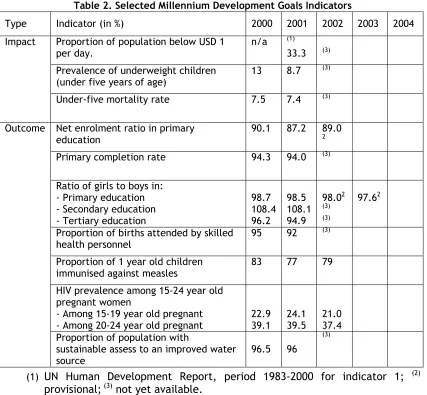
[image:13.595.85.512.224.619.2]Table 2 shows the evolution between 2000 and 2002 of the ten indicators selected among those of the Millennium Development Goals (MDGs) to reflect achievements towards development. All data are from Central Statistics Office (CSO) unless otherwise specified. At the time of formulation of the present report, the 2002 values are still missing for many indicators. Additional indicators and their values are found in Annex 9, including values of the above ten MDGs indicators for the period 1990 to 2000.
Table 2. Selected Millennium Development Goals Indicators
Type Indicator (in %) 2000 2001 2002 2003 2004
Impact Proportion of population below USD 1
per day.
n/a (1)
33.3 (3)
Prevalence of underweight children
(under five years of age) 13 8.7
(3)
Under-five mortality rate 7.5 7.4 (3)
Outcome Net enrolment ratio in primary education
90.1 87.2 89.0
2
Primary completion rate 94.3 94.0 (3)
Ratio of girls to boys in: - Primary education - Secondary education - Tertiary education
98.7 108.4 96.2
98.5 108.1 94.9
98.02 (3) (3)
97.62
Proportion of births attended by skilled health personnel
95 92 (3)
Proportion of 1 year old children immunised against measles
83 77 79
HIV prevalence among 15-24 year old pregnant women
- Among 15-19 year old pregnant
- Among 20-24 year old pregnant 22.9 39.1 24.1 39.5 21.0 37.4 Proportion of population with
sustainable assess to an improved water
source 96.5 96
(3)
(1) UN Human Development Report, period 1983-2000 for indicator 1; (2)
provisional; (3) not yet available.
Remarkable improvement in service delivery such as health care, access to safe water and education, has been achieved since independence, when Botswana was one of the poorest countries in the world. Botswana’s public expenditure in social services has been, and remains very significant, with 2.5 % GDP spent in health in 1998 and 20.6% of total public expenditure in education in 1995-97 23.
Exemplary progress has been made towards achievement of outcome indicators such as education enrolment at all levels of education. In general, disaggregated
22 Botswana Education For All National Action Plan, 2002. 23
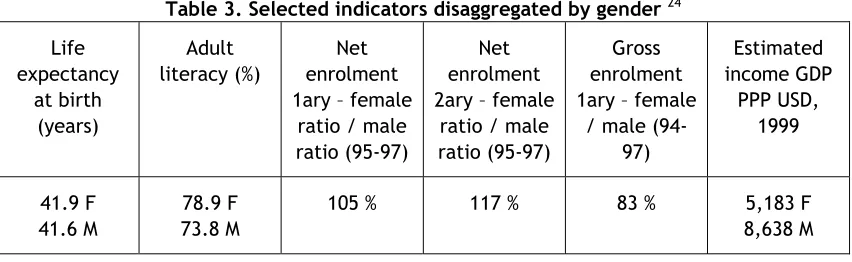
indicators show good achievements for gender equity. The disparity in income remains however important (Table 3).
Table 3. Selected indicators disaggregated by gender 24
Life expectancy at birth (years) Adult literacy (%) Net enrolment 1ary – female
ratio / male ratio (95-97)
Net enrolment 2ary – female
ratio / male ratio (95-97)
Gross enrolment 1ary – female
/ male (94-97) Estimated income GDP PPP USD, 1999 41.9 F 41.6 M 78.9 F 73.8 M
105 % 117 % 83 % 5,183 F
8,638 M
F= female; M = male
Figures for life expectancy from CSO (57.4 and 52.0 for females and males respectively, in average 55.6) differ significantly from those of the UN (Table 3). Reasons for these discrepancies are being discussed between CSO and UNDP.
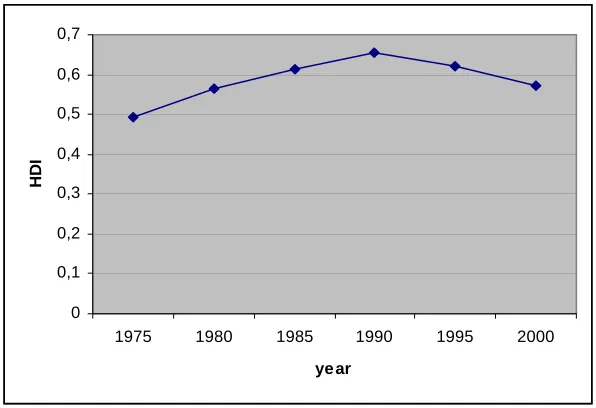
Results in terms of health services delivery remain high. Worsening of indicators such as life expectancy and under-five mortality rate, however, reflects the devastating effects of HIV/AIDS. The Human Development Index of Botswana, HDI, has steadily increased between 1975 (0.494) and 1990 (0.653), declining thereafter to the 1980 level in 2000 (0.572) due to the dramatic shortening of life expectancy25 due to HIV/AIDS (figure 9.4 in Annex 9).
In spite of being drought prone and of a high incidence of poverty, Batswana have been mostly protected from hunger through the implementation of specific feeding programmes and adequate social safety nets financed by government budget.
3.2.4 Environment
Botswana’s environmental profile (Annex 11) reviews the major environmental constraints of the country: (semi-) arid climate, increase in temperatures and decline in annual rainfall over the past decades, meagre ground and surface water resources, indiscriminate dumping of waste and widespread littering, rapid population growth and resulting pressure on natural resources. The elephant population (123,000) is twice the national carrying capacity (60,000), resulting in increasing human-elephant conflicts and alteration to the vegetation cover in some areas. Poverty is identified as a major cause and consequence of environmental degradation and natural resources depletion. Community-based Natural Resources Management is one of the strategies adopted to address poverty reduction through sustainable use of natural resources.
This environmental profile also lists major legislation and plans, as well as key-ministries and institutions involved, alongside with the Ministry of Environment, Wildlife and Tourism, as well as NGOs, CBOs and private sector operators, involved in environmental matters, and schemes, international, African and regional conventions and protocols to which Botswana is a party.
24 Human Development Report, 2002. UNDP. 25
3.2.5 Major challenges in Botswana’s development
Botswana faces, in improving the living standards of its citizens, various challenges:
Poverty
GDP per capita was USD 3,300 in 2001, and in 93/94 constant Pula prices, it has increased by 25% over the past decade 26. While Botswana is a “middle income country” , one third of the population however lives in poverty (income of less than 1 USD / day). Botswana has defined a Poverty datum Line PDL of 1.23 USD/day and the proportion of the population living below the PDL was estimated at 36.7% in 2002.
Factors of vulnerability include: remoteness (rural areas), lack of education / skills or inadequacy of skills for the labour market, lack of access to productive assets and to markets, HIV/AIDS, which all contribute to un-/under-employment. Weakening of traditional solidarity mechanisms exacerbates the impact of vulnerability factors 27. Updated data on poverty are expected from the release in 2004 of the results of the 2002 Household Income and Expenditure Survey. A comprehensive review of previous anti-poverty schemes was carried out in 2002 and its results fed back in the development of the National Strategy for Poverty Reduction of 2003.
Unemployment
Besides difficulties related to the interpretation of statistics from different sources and important fluctuations hidden by trends over a period of time, persistent high levels of unemployment (rising from 13.9 to 19.5% between 1991 and 2001 28) remain an area of serious concern for Government. Growth in formal employment has been in average sluggish in the ‘90s and recent years (1.5% p.a. vs. 9.7% p.a. in the 80’s) while total employment increased by 2.7% over the past decade. Two third of the new jobs are created in the private sector 29.
Employment is influenced by a multitude of factors, including economic growth, demographics, and education enrolment. Economic growth is mostly based on the mining sector, capital-intensive, while the agricultural sector, highly labour-intensive, has shrunk over the years (to less than 3% in 2001/2002) 30. Retrenchment in some sections of the economy may have contributed to unemployment. Employment is increasingly skill-intensive and many of the unemployed are relatively young people with low education and no skills. One of the priorities of Government remains, as in the past, heavy investment in Education and Training (E&T) to address the problem of lack of skills31.
26
Annual Economic Report 2003. 27 Botswana MDG report 2004 (final draft) 28
Data from the corresponding Population and Housing Censi 29
In 2000, the private sector / parastatals, government, the informal sector and agriculture accounted respectively for 33, 22, 27 and 19% of the jobs respectively. (National Manpower Projections, Botswana Institute for Development Policy Analysis, June 2001).
30 The country’s agricultural development programme, NAMPAAD, could however boost jobs in agro-processing industry and manufacturing.
31
HIV/AIDS
Botswana is one of the most affected in the world, with levels of infection of 35 % in the [15 – 49] age group. It is estimated that almost 28,000 adults and children had developed AIDS by the end of 2002 and a total of close to 38,000 were registered as orphans at the end of 2003. HIV/AIDS-related illnesses accounts for 50-70% of hospital bed occupancy rates. The pandemic shows so far no consistent signs of being checked and is currently reversing Botswana’s achievements in the economic and social spheres. It erodes gains in health (under-five mortality rate, life expectancy at birth, eradication of tuberculosis, etc.) and threatens the viability of the country’s development strategies in education and skills development. By affecting both labour supply and productivity, it jeopardises efforts directed at attracting Foreign Direct Investment 32.
Government implements since 2002 an Anti-Retroviral (ARV) drug programme that is currently being rolled out, as part of the National HIV/AIDS Strategic Framework 2003-09 (see page 6). Lack of human resources in terms of numbers and specific skills, reluctance of the population to behaviour change, and persistence of a strong social stigma attached to the disease are important constraints to its implementation. This led H.E. President F. Mogae to declare in November 2003 “We have often spoken of the HIV/AIDS pandemic as a war that needs to be won. Yet in this war, we remain our worst enemies” Acknowledging the role of external assistance, he emphasised further “But it is we, and we alone who through behaviour change, must achieve our victory”.
The Botswana Millennium Development Goals Status Report of 2004, besides HIV/AIDS and the need to building a national technological capability, and raising productivity and competitiveness in the non-mining sectors, identifies two additional key development challenges for the country:
1. Empowering Batswana everywhere to be viable agents of their own
development”, through successful human resource development producing
“functionally global workers and citizens” and deliberate measures to increase sense of responsibility by individuals and communities for own development, with Government acting as facilitator and engaging in a truly consultative dialogue;
2. “Ensuring that policies and programmes are fully implemented”, in particular
strengthening of Monitoring and Evaluation capacities. Data should be disaggregated for key-factors, times series available for basic indicators, and the capacity for analysis and feed back into policy-making and planning strengthened.
4.
Overview of past and on-going co-operation
Botswana received grants totalling 70 M€ in development financing under the National Indicative Programmes (NIPs) from the 7th and 8th European Development
Fund (EDF). Programmable resources under the 9th EDF (Envelope A) amount 39 M€
while Envelope B, covering unforeseen needs amounts 52 M€.
32
The 8th EDF strategy 33 for Botswana aimed at sustainable development and poverty reduction, by supporting the Government’s efforts towards: (i) Economic diversification and regional/international economic integration; (ii) Employment creation and more equitable income distribution; and (iii) Protection and sustainable use of (renewable) natural resources. It had two focal sectors: Private Sector Development and Training, and Natural Resources Utilisation and Conservation.
The Country Strategy Paper / Indicative Programme (CSP/IP) for the 9th EDF singled
out Human Resources Development as the sole focal sector, aiming at private sector development and enhancing labour skills needed to sustain economic growth. Potential candidates for the Non Focal Sectors were:
. Community development through the successive Micro-Project Programmes; . Natural resources (wildlife and forestry) conservation and management,
including community-based initiatives;
. Capacity building in the Ministry of Finance and Development Planning, fiscal reform, tourism and trade promotion, HIV/AIDS.
Botswana also benefited, and still does, from SYSMIN support and loans from the European Investment Bank (EIB). The EC has directly financed interventions in the field of natural resources, from environment conservation in developing countries and Non-Governmental Organisation (NGO) co-financing Commission’s budget lines. In addition, Botswana has benefited from some of the EDF regional funding for Southern Africa, channelled mostly via SADC.
The distribution across sectors of projects financed under the Botswana NIPs of EDF 6 to 9, and under non-programmable resources is shown in Annex 1 (p. 41) and Annex 2 (p. 46) respectively. Progress with implementation for major EDF projects, which were, as of December 2003, just completed, on going and about to be launched is summarised in Annex 3 (p. 48).
4.1 Focal sector: Human Resources Development
The Commission’s policy is, whenever possible and in particular in the social sectors, to shift support from project-type interventions towards Sector-Wide Approach (SWAp) and budget support. While EDF-financed interventions in Botswana have so far been on a project mode, the principle of channelling resources for HRD under EDF9 through budget support has now been agreed.
EDF 7 34 and 8 35 Vocational Training Programmes were designed as a response to the shortage of technical colleges training places, the mismatch between skills acquired and those required by the labour market, and the low level of skills for self-employment. They aimed to address the severe shortage of sufficient numbers of skilled technical and vocational teachers required for the Vocational Education and Training Expansion Programme, and of college places in areas relevant to the economy, with particular emphasis on equity of access.
33
Some EDF7 projects, launched in the late 90’s, were already in line with the 8th EDF strategy and its focal sectors.
34 Construction of Gaborone Technical College, GTC and expansion of the Automotive Trades Training College, ATTC, co-financed by Government and a 15 MEUR grant from EDF.
35
a) Results
Government’s commitments, sectoral policies and their level of achievement, under the 8th and 9th EDF NIPs, as well as indicators and targets under EDF9 are
reviewed in details in Annex 4, and summarised below.
a.1. 8th EDF NIP
Targets were exceeded in terms of enrolment during the period of EDF8. Further increase in places will be achieved through the expansion of GTC/ATTC, and several projects for large colleges (at least 1,000 students) at Francistown (for which works are currently being launched), Oodi and Selebi-Phikwe. The Botswana Technical Education Programme (BTEP) should be generally available in all colleges by the end of 2005. Very significant progress has been made in women enrolment in programmes (50% of total students), including in traditional “male fields”. Equity in access is further pursued through specific efforts aiming at a geographical balance in enrolment and access to disadvantaged groups (specific ethnic groups and students with physical or learning disabilities). Government’s commitment to projects co-financed with the EDF is exemplified by its substantial financial contribution (over 50%).
The Botswana Training Authority (BOTA) was established with some delay and respective responsibilities of the MoE and BOTA are being progressively clarified.
Training projections are available since 2001 (instead of 1996), concluding to the need for annual outputs of some 40,000 trained citizens. Programmes developed under the BTEP address several of the priorities identified. BTEP programmes are currently being developed at two higher levels to address the shortage of technicians. Training needs at craft level will be addressed by the development of a National Skills Development Strategy during NDP9.
a.2. 9th EDF NIP
NDP9 allocates 10.4% and 26.7 % of the total government development and recurrent budget to E&T. Relative budget allocations to MoE have remained fairly stable since 2001 and reflect the high priority given to E&T, even more so if allocations to Ministry of Local Government for primary schools are considered (see Table 1 , page 11).
Relevant stakeholders, including the private sector, are involved in the development, quality and expansion of the tertiary education / E&T through their participation in various fora and Councils (Botswana Examination Council since 2002, Tertiary Education Council and Technical and Vocational Education Consultative Forum since 2003).
Achievements in terms of expanding of the E&T system have been reviewed under a.1.
Indicators and targets measuring progress in relevance, quality and efficiency under the CSP for 9th EDF may need a thorough revision:
- For some, data are not collected on a regular basis but require specific surveys, not yet carried out (E.g. BTEP graduates finding employment within 6 months); - Targets appear to be excessively high (the target for the above indicator may
need to be adjusted to a much lower level of 40%),
- Due to the small value of the indicators, the significance of differences is difficult to demonstrate (repetition and drop-out rates),
- The current inspectorate system is not meeting its targets and support to this area will provide a good indicator of improvement in the quality of the general education system if targets proposed for a new system are met.
- Progression from junior to post-compulsory secondary education is another indicator that measures improvement in the performance of the education sector.
Since the release of funds under budget support is closely related to performance indicators, the choice of the latter is of critical importance. Additional studies into E&T indicators are planned in the preparation of the EDF9 HRD component.
b) Progress in activities
• Vocational Training Programme (VTP) - EDF 6 & 7 36
Launched in February 1997, the VTP was completed in February 2003, with the end of the technical assistance component, at a final total cost of some € 25 million. (Details on implementation in Annex3, p. 49).
• Francistown College of Technical and Vocational Education and Technical College Programme - EDF 8 37
While delays in both tendering processes for design and works have been experienced, the works contract was awarded late October 2003 and works are expected to start early 2004. The project has been extended to 31.12.2008 for a more efficient phasing in of the technical assistance team, from six months prior to works completion. Needs in technical assistance have been reviewed in 2003 and the pre-qualification procedure will be initiated in the first half of 2004. (Details on implementation in Annex 3, p. 51).
• Augmentation of GTC/ATTC facilities –EDF 8 38
The financing agreement of this project was signed in May 2003 providing for 11.8 M€ (3.9 M€ from EDF8 and 7.9 M€ from Government’s own resources) to increase training places from 900 to 1500, allowing for larger quotas of disadvantaged groups, and of students with learning difficulties and/or disabilities. The project was launched in July 2003 (Details on implementation in Annex 3, p. 53)
36
6 ACP BT 047, 7 ACP BT 048 and 049 37 8 ACP BT 003
38
Government’s commitment in terms of policy, financing and implementation indicates good prospects for sustainability. Important experience acquired recently (VTP 6-7th EDF) has been fed back into project design and implementation. EDF
support to TVET is still too recent to allow for an appropriate impact evaluation. Relevance of the GTC and success of the 6-7th VTP in terms of infrastructures have
been confirmed. Efficiency, effectiveness, impact and sustainability will be assessed through evaluations to be carried out in 2004.
• Financial implementation in 2003
The single most important factor for the difference in the 2003 individual commitments and payments forecasts for the focal sector (Annex 6) is the delay in awarding the contract for works (11.48 M€) under 8 ACP BT 003 which will be reflected in the Q1/2004 accounts instead of Q4/2003, and payments in Q2/2004. Delays in obtaining final invoices under the 7th VTP account for a shortfall of some
0.34 M€ in payments in 2003. Payments will be effected in Q1/2004.
c) Cross-cutting issues
Cross-cutting issues are deeply rooted in vocational training programmes. HIV/AIDS education is an integral component of all TVET learning programmes, and focuses on an active learning approach. Results are internalisation of the dangers of risk behaviours, freer discussions on subjects such as sexuality, prevention, risk and exposure. Under both the 7th and 8th EDF Vocational Training Programmes,
increased access to training for women and disadvantaged persons are explicit results, specifically monitored. Capacity building is addressed through the provision of technical assistance.
4.2 Non Focal sectors
4.2.1 The Micro-Projects Programme (MPP) – EDF 7 and 8 39
Three MPPs have been successively funded since 1993 for a cumulative amount of 4
M€, with as purpose to improve communities’ livelihoods, particularly in rural
areas. The emphasis progressively shifted from the provision of basic services, infrastructure and community development, towards greater social and economic integration and self-reliance. Income generation and education are the main sectors of intervention. MPP3 has been extended by one year to 31.10.04. The MPP confirmed itself as a route for non-state-actors to take up their own development, and is considered as a successful scheme, in high demand from communities and NGOs. Following the completion of the review of the MPP and the finalisation of a strategic framework for MPP4 in 2003, identification and appraisal will lead to the submission of a financing proposal by the end of Q1/2004. MPP 4 will have an even clearer poverty reduction focus than earlier programmes. (Details on implementation in Annex 3, p. 54).
39
4.2.2 Natural resource utilisation and conservation
Support from EDF 7 and 8 focuses on conservation, management and sustainable utilisation of rangelands, forests and wildlife, and maximisation of benefits accruing to the rural communities in areas of the country with limited alternative sources of employment and income. Under EDF8 two major interventions have been planned, one in support to wildlife and the other in support of forestry.
Review and evaluations concluded that support from the EDF and other donors to wildlife has had an added value and a real impact on wildlife conservation. Concerns expressed on over-dependence on foreign technical expertise, and to an extent on foreign management, justified the focus of EDF8 on capacity-building.
• Wildlife Conservation and Utilisation in Central & Southern Botswana – EDF 7 40
Implementation of activities under EDF funding (6.4 M€)was completed at the end of 2001, having achieved most of its anticipated results in terms of drafting management plans, establishing parks (Kgalagadi Transfrontier Park), improvement of park facilities, enhanced tourism capacity and opportunities, strengthened research base within the Department of Wildlife and National Parks (DWNP), and opportunities for economic and social benefits of local communities. The Chobe, Central Kalahari and Khutse Game Reserves management plans have however yet to be formally approved. Tourist and management facilities in the Khutse and Central Kalahari Game Reserves are currently being improved under the Domestic Development Fund (DDF) as per the Financing Agreement.
• Wildlife Conservation and Management Project – EDF 8 41
Redesign of the project in 2001 gave a prominent position to institutional strengthening of the DWNP 42 and to community-based initiatives (through a financing window of € 1 million ear-marked for small-scale interventions). The
technical assistance was fielded from September 2002 onwards while various equipment was procured. A slow start and persistent constraints in management necessitated in 2003 a reshuffle of the technical assistance team and change in senior staff. It is hoped that these measures will facilitate project implementation (Details in Annex 3, p. 55)
• The decision of discontinuing the “Community Forestry Development Project” 43 was made early 2002 due to serious under-performance, with little hope for improvement. Contributing factors were poor design, inappropriate solutions to ill-identified problems, deficiencies in the policy and institutional framework of the project. The project is due for closure in 2004.
40 7 ACP BT 022 41
8 ACP BT 010
42 Initially identified for financing by the Department for International Development (DFID, UK) 43
4.2.3 HIV/AIDS – EDF 7 44
The fight against HIV/AIDS in Botswana has been supported, between 1995 and 2001 (instead of 1998), by the EDF (0.8 M€). In spite of a slow implementation and
important delays, the project achieved its results through the establishment and operationalisation of a Sexually-Transmitted Diseases (STDs) Resource Centre for STDs control, and education in the workplace, with support to support NGOs involved in health education and awareness, with a focus on women and AIDS. The project is due for closure.
4.2.4 Private sector development
• The Botswana Tourism Development Programme 45 was evaluated in 2001. In
spite of various constraints related to relevance and implementation (technical assistance contract, staffing of the Department), major achievements are the development of the Botswana Tourism Master Plan and of the Eco-Tourism Strategy, launched in 2002. The latter, aiming at diversifying tourism activities from the current nearly exclusive focus on wildlife, and promoting community participation, is complemented by community-based activities in support of local tourism development. The project has been closed in 2003.
4.2.5 Enhance government's implementation and absorption capacity
• Support to the Ministry of Finance and Development Planning - EDF 8 46
The project aims at improving the capacity of Government of Botswana (GoB) to manage and co-ordinate external assistance, through support to programming (CSP/IP development for EDF9), aid management (preparation, implementation and monitoring of EDF-financed projects), and training in various areas of the project cycle. The project mid-term review was fielded mid 2003. Its two major recommendations were (i) to undertake a comprehensive training need assessment and (ii) to improve Government Monitoring and Evaluation systems. These will be considered under the project below. (Details on implementation in Annex 3, p. 56).
• EDF9 preparatory activities - EDF 8 47
Following the signing of the financing agreement in November 2002 and a tendering procedure, a one-year consultancy was launched in July 2003 to carry out studies in various areas and feed back results into the definition of HRD under NDP9, and EDF9 support to the latter. A financing proposal for EDF9 of approximately 32 MEUR is expected in March – April 2004. A consultancy will be contracted early 2004 looking into the involvement of Non-State Actors in EDF9 implementation. Workshops and study tours in specific areas are organised under a one-year work programme. (Details on implementation in Annex 3, p. 57).
44 7 ACP BT 034 45
6 ACP BT 44 and 7 ACP BT 46. 46 8 ACP BT 009
47
4.2.6 Support to Fiscal Reform in Botswana
Preparatory and legislation work for the launch of the VAT in Botswana was undertaken from late 2000 onwards, marked by the enactment of the VAT Act early 2001, the passing of the VAT Amendment Bill in May 2002 and the launch of the VAT in July 2002. GoB further develops its plans for a reform of tax administration and management, primarily through the establishment of the Botswana Unified Revenue Services (BURS). Drafting the legislation establishing the BURS was completed in 2003 and enactment of the corresponding bill is expected early 2004. In anticipation of its launch mid 2004, a Project Team based in MFDP spearheads its preparation.
The EDF has supported the process of fiscal reform and VAT administration in Botswana under three EDF8-financed decisions (details in implementation in Annex 3, p. 58) and will extend assistance under EDF9:
• A - somewhat disappointing – consultancy by KPMG to “Facilitate tax administration reform” 48.
• This however laid the basis for the recent decision under EDF9 49 to “Support tax administration reform”. The latter will facilitate the launch and implementation of the BURS through the provision of mostly long-term expertise for a period of 2 to 3 years from mid 2004 onwards.
• An “Adviser to the Secretary for Financial Affairs” 50 has assisted the MFDP from December 2000 to February 2004 with the preparation for introducing VAT and, since July 2002, with its implementation and monitoring, as well as a progressive shift in focus on tax administration reform, preparatory work for the BURS, fiscal policy issues and related capacity-building.
• A “VAT Administration Expert” 51 assisted for 11 months from April 2002 the Department of Customs & Excise in VAT implementation, administration and auditing. Strengthening VAT auditing remains an important area for training.
Financial implementation in the non focal sectors
Forecasts in terms of individual commitments and payments in the non focal sectors have been mostly achieved (Annex 6), with the exception, due to implementation constraints, of payments in respect of the work programme under 8 ACP BT 010, and of the service contract under 8 ACP BT 012. It is anticipated that measures put in place late 2003 and/or early 2004 for these projects aiming at improved management and co-ordination, will smoothen implementation and the disbursement pattern.
Cross-cutting issues relevant to the various projects currently implemented under non-focal sectors are briefly summarised in Table below.
48 8 ACP BT 008 49
9 ACP BT 002 50 8 ACP BT 006 51
Cross-cutting issue Projects
Capacity-building
Environmen t
Gender HIV/Aids
Micro-project programmes
Ì Ì Ì
Wildlife conservation projects
Ì Ì
Support to the MFDP
Ì Ì
EDF9 preparatory activities
Ì Ì Ì
Support to Fiscal Reform
Ì
While HIV/AIDS did not explicitly appear as an important crosscutting issue under EDF8 support (with the exception of the project supporting the fight against HIV/AIDS), it is essential under EDF9 support currently prepared. Equity (including gender) and capacity building have a prominent place in the preparation of all EDF9 interventions. Training of selected Ministries staff in environmental matters is planned as part of the current support to the MFDP.
4.3 Utilisation of resources for Non-State Actors (NSAs)
A substantial share of the activities undertaken in the context of the Micro-Projects Programmes and the 7th EDF wildlife programme has been carried out through NSAs
until 2003. Community-based initiatives have largely focused on tourism-related activities or small-scale commercial activities using locally available natural products. Projects are implemented by communities, often with support from a local NGO. They have a value ranging from € 4,000 to € 80,000. Experience
highlighted the need for close monitoring of project activities and for technical support to implementation, particularly where specialised skills are required. Due to implementation constraints experienced by the project 8 ACP BT 010 in 2003, only limited progress has been made in the formulation of a strategy for the implementation of its 1 M€ window for community-based interventions. It is
anticipated that these constraints will be lifted in 2004 and that substantial progress be made in the development and approval of a strategy, eligibility criteria and procedures, and the effective dissemination and launch of this activity on the ground.
The formulation of the ToRs for a scoping study has taken longer than anticipated, awaiting for guidelines from the Commission and the ACP Secretariat, and consulting NSAs in country. The study will be launched in Q1/2004. Various areas for involvement of NSAs in the implementation of EDF9, as partners, implementers and/or beneficiaries, will be identified. Following this scoping study, specific support would be appraised, as required.
4.4 4.4 Utilisation of Envelope B
4.5 Other Instruments
Financial implementation of projects financed in Botswana under other EDF instruments, such as the European Investment Bank (EIB), SYSMIN, Emergency Aid, and others is found in Annex 2 (p. 46). Regional co-operation is now dealt under a separate report; only highlights are presented here.
4.5.1 The European Investment Bank
• The EIB's role and activity in Botswana
The Bank's objective is to contribute to the long-term sustainable development of Botswana by providing funding, at very attractive terms, to private or public sector borrowers for economically, financially, technically and environmentally viable projects in all key sectors of the economy.
Loan amounts to be made available for viable investment projects can be substantial: during the 10-year period of the Lomé IV Convention (1st and 2nd Protocols), total commitments in Botswana amounted to EUR 86.4 million (see details in Annex 2).
EIB activity during that period has been focused on two main areas, public sector infrastructure and support to small and medium-scale private enterprises. In the area of infrastructure investments, two loans for a total of € 13.6 million were made available to the Botswana Power Corporation (BPC) for the reinforcement of Botswana’s interconnections with its neighbouring countries and BPC’s high voltage network, and three loans for a total of € 62.9 million to the Water Utilities Corporation (WUC), for the expansion of water supply facilities to the country's major urban centres. These include a € 12.5 million loan agreement signed with the WUC in February 2003 for the Francistown Water Supply project, aimed at the extension of bulk water supply facilities to Botswana’s second largest city.
In the area of private sector support, three lines of credit for a total of € 6.5 million were signed with the Botswana Development Corporation (BDC) for the provision of long-term funding to private sector SMEs. A renewed facility could be put in place as and when demand for such funds materialises.
• Outlook
Following signature of the Francistown water supply project at the beginning of 2003, discussions regarding the fulfilment of conditions precedent continued throughout the year. Assuming that these will be concluded soon, project implementation and loan disbursement will start in 2004. The Bank also pursued the discussions concerning a private sector agro-industrial project that had been initiated in 2002; these are now expected to come to fruition in 2004.
projects in the private sector. However, the Bank’s approach in supporting investments in Botswana will be demand driven and the extent to which it will be able to commit resources to private sector operations will depend on the macro-economic framework and the continued provision of a business environment which is conducive to private sector initiatives, including the successful implementation of the Government's privatisation policy.
4.5.2 The Centre for Development of Enterprises (CDE)
An agreement has been signed in 2003 between GoB and the CDE on the opening of a local CDE Office in Gaborone.
The Centre for Development of Enterprises (CDE) supports the creation, expansion, diversification and rehabilitation of industrial companies by providing its own expertise or making a non-reimbursable financial contribution, and helping to mobilise financial resources for investments. The CDE supported ten projects in 2002, for a total amount of some € 403,000, mostly in the meat (61%, ostrich
farming, meat processing, donkey meat) and textiles (survey on clothing and textiles) sectors, as well as agriculture (rose farming, 20%) and manufacturing (11% food processing).
4.5.3 Regional co-operation
The overall objective of the regional cooperation programmes is to raise the standard of living and improve the quality of life in the region through sustained economic development and growth, which, in the long term, should eradicate poverty and secure peace and structural stability throughout the SADC region.
• Technical co-operation
The EDF has since 1987 supported regional co-operation in Southern Africa through SADC with a total amount of € 492 million.
Thus, SADC received € 141 million under the 6th EDF; € 121 million under the 7th EDF which was subsequently increased to € 129 million; € 121 million under the 8th EDF under the Lomé IV bis Convention, which came into force upon ratification of the Convention in June 1998 and, € 101 million under the 9th EDF with the signing of the Regional Indicative programme (RIP) 2002-2007 in November 2002. For maximal synergy and efficiency, SADC’s regional projects may be supported by funds from the European Programme for Reconstruction and Development for South Africa (EPRD) as South Africa is a member of SADC but not eligible for EDF funding.
Whereas activities under the 6th and 7th EDF are mostly completed, programming and implementation of projects under the 8th EDF slowed down considerably due to notably SADC’s decision in 2001 to restructure the Organisation. Thus, only about 65% of the amount available was per October 2003 committed. For the same reason programming of the 9th EDF has hardly begun which may lead to a decrease of the budget allocation following the Mid Term Review. Timing of the latter (2nd
half of 2004 or early 2005) is yet to be confirmed.