
This is a repository copy of
Identification of a 6.6 microsecond isomeric state in 175Ir
.
White Rose Research Online URL for this paper:
http://eprints.whiterose.ac.uk/147144/
Version: Published Version
Article:
Gillespie, S. A., Andreyev, A. N. orcid.org/0000-0003-2828-0262, Monthery, M. Al et al. (30
more authors) (2019) Identification of a 6.6 microsecond isomeric state in 175Ir. Physical
Review C - Nuclear Physics. 064310. ISSN 1089-490X
https://doi.org/10.1103/PhysRevC.99.064310
[email protected] https://eprints.whiterose.ac.uk/ Reuse
Items deposited in White Rose Research Online are protected by copyright, with all rights reserved unless indicated otherwise. They may be downloaded and/or printed for private study, or other acts as permitted by national copyright laws. The publisher or other rights holders may allow further reproduction and re-use of the full text version. This is indicated by the licence information on the White Rose Research Online record for the item.
Takedown
If you consider content in White Rose Research Online to be in breach of UK law, please notify us by
Identification of a 6
.
6
µ
s isomeric state in
175Ir
S. A. Gillespie,1,2,*A. N. Andreyev,1,3M. Al Monthery,1C. J. Barton,1S. Antalic,4K. Auranen,5,†H. Badran,5D. Cox,5,‡
J. G. Cubiss,1D. O’Donnell,6T. Grahn,5P. T. Greenlees,5A. Herzan,5,§E. Higgins,7R. Julin,5S. Juutinen,5J. Klimo,8
J. Konki,5,¶M. Leino,5M. Mallaburn,5J. Pakarinen,5P. Papadakis,5,7J. Partanen,5P. M. Prajapati,8P. Rahkila,5
M. Sandzelius,5C. Scholey,5J. Sorri,5S. Stolze,5,†R. Urban,8J. Uusitalo,5M. Venhart,8and F. Weaving7
1Department of Physics, University of York, York YO105DD, United Kingdom
2TRIUMF, Vancouver, British Columbia V6T 2A3, Canada
3Advanced Science Research Center (ASRC), Japan Atomic Energy Agency (JAEA), Tokai-mura, Naka-gun, Ibaraki 319-1195, Japan
4Department of Nuclear Physics and Biophysics, Comenius University in Bratislava, 84248 Bratislava, Slovakia
5University of Jyvskyla, Department of Physics, P.O. Box 35, FI-40014 Jyvaskyla, Finland
6School of Computing, Engineering and Physical Sciences, University of the West of Scotland, Paisley PA1 2BE, United Kingdom
7Oliver Lodge Laboratory, University of Liverpool, Liverpool L69 7ZE, United Kingdom
8Institute of Physics, Slovak Academy of Sciences, SK-84511 Bratislava, Slovakia
(Received 8 April 2019; revised manuscript received 26 April 2019; published 7 June 2019)
An experiment has been performed to study excited states in the neutron-deficient nucleus175Ir via the use of
the JUROGAM II high-purity germanium detector array and the RITU gas-filled separator at JYFL, Jyväskylä. By using isomer tagging, an isomeric state with a half-life of 6.58(15)μs has been observed in175Ir for the first time. It has been established that the isomer decays via a 45.2 (E1)–26.1 (M1) keV cascade to new states below the previously reported ground state in175Ir withIπ =(5/2−
). We now reassign this (5/2−
) state to the isomeric state discovered in this study.
DOI:10.1103/PhysRevC.99.064310
I. INTRODUCTION
The neutron-deficient nuclei in the lead region provide a rich interplay of different nuclear structure phenomena, including low-energy shape coexistence [1,2]. In-beamγ-ray spectroscopy is one of the most extensively used methods to study excited states, and usually works well for even-even nuclei. However, the application of this technique to odd-A (and odd-odd) nuclei is often hampered by the presence of multiple competing bands and their complexity, in compari-son to even-even nuclei. Furthermore, due to the existence of isomeric states with lifetimes longer than the typical “prompt” time window usually applied in the analysis of γ-ray data, so-called floating bands are often observed, whereby the inter-connecting band transitions and/or transitions to the ground state are unobserved. As a result it is difficult to perform a quantitative analysis of the bandhead energy systematics in odd-Aand odd-odd nuclei.
*Present address: TRIUMF, Vancouver, BC V6T 2A3, Canada;
†Present address: Physics Division, Argonne National Laboratory,
Argonne, Illinois 60439, USA.
‡Present address: Department of Physics, University of Lund,
Lund, Sweden.
§Present Address: Department of Nuclear Physics and Biophysics,
Comenius University in Bratislava, 84248 Bratislava, Slovakia.
¶Present address: CERN, CH-1211 Geneva 23, Switzerland.
This work concentrates on 175Ir, which has been studied previously via prompt in-beam spectroscopy by means of fusion-evaporation reactions and the use of the high-purity germanium (HPGe) γ-ray detector arrays POLYTESSA [3] and CAESAR [4]. The results of the two investigations mostly agree with each other, and they identified several bands, some of which are floating, for example a strongly coupled π9/2−
[514] band with the 9/2−
bandhead. While some disagreement remains about the exact configurations of these bands, a Iπ =(5/2−
), π1/2−
[541] ground state was proposed by both studies and is also quoted by NNDC [5]. This assignment was based on the systematic properties of odd-proton nuclei in this mass region, on measured angular anisotropies for the strongestγ rays, and on total-Routhian-surface calculations [3,4]. The in-beam investigations were, however, insensitive to delayed transitions, and the possi-bility that some of the observed bands are built on top of isomeric states cannot be excluded. Indeed, earlier β-, γ-, and α-decay studies have suggested the existence of long-lived isomeric states in this nucleus. Two β-decay studies of 175Ir deduced comparable half-lives of of 13(2) s [6] and 11(3) s [7]. Somewhat shorter values were obtained via α
decay measurements:T1/2 =4.5(10) s [8] and 7.2(13) s [7].1
1Based on combined β- and α-decay data, a mean half-life of
T1/2(175Ir)=8(1) s was derived for theIπ =(5/2−) ground state in
S. A. GILLESPIEet al. PHYSICAL REVIEW C99, 064310 (2019)
The discrepancy between half-lives measured by different techniques was suggested to be due the existence of two isomeric states, a low-spin and a high-spin state, which pref-erentially decay via α decay and β decay, respectively [6]. We note that the tabulated half-life,T1/2(175Ir)=9(2) s [5], was evaluated from the weighted average of all measurements quoted above. To our knowledge, the most recent α-decay study of 175Ir identified decays from two states with the following properties: theEα=5395(5) keV,T1/2=8.1(5) s, originating from a 9/2−
state and the new decay at Eα= 5745 keV, T1/2=4.9(4) s from the (5/2−) state [9]. The study [9] suggested that these states should be associated with the same (5/2−
) and 9/2−
states as proposed by in-beam investigations [3,4], but reassigned the previously known 5395 keV decay, proposed to decay from the (5/2−
) state by the earlier work [7], to proceed from the 9/2−
state. However, the most recent electron-capture/β+-decay study of 175Ir claims the observation of a 33(4) sβ-decaying state, which could correspond to the 9/2−
bandhead [10]. The afore-mentioned inconsistencies between different studies show that the low-energy decay pattern of 175Ir is far from being understood.
Furthermore, and relevant to the present discussion, a recent α-decay and hyperfine structure study of179Au, per-formed at ISOLDE, unambiguously established the ground state as Iπ(179Au)=1/2+ [11]. Based on the unhindered nature of the 5848 keVαdecay179Augs→175Ir [12], a spin and parity of Iπ =1/2+
must be attributed to the state in 175
Ir fed by this decay. Therefore, a question arises about the relative position of this 1/2+
state in175Ir identified by
α decay and the (5/2− ), 9/2−
states proposed by earlier studies.
In order to investigate the low-energy structure of 175Ir, we have performed an investigation of 175Ir which allowed a search for low-energy isomeric transitions.
II. EXPERIMENT
An experiment was performed at the K-130 cyclotron at the Accelerator Laboratory of the University of Jyväskylä to study excited states in 175Ir using the complete-fusion evap-oration reaction88Sr+92Mo → 180Hg∗, in which175Ir was produced in theα,pevaporation channel. A 381 MeV beam of 88
Sr, with an average beam current of 6 pnA over 6 days, im-pinged on a 600μg/cm2thick self-supporting enriched92
Mo target (of 98% isotopic enrichment). Evaporation residues (ERs) were separated from the primary beam and fission prod-ucts using the gas filled separator RITU [13] and implanted in the double-sided silicon detector (DSSD) of the GREAT spectrometer [14]. A segmented planar germanium detector (hereafter referred to as PGD) was used to detect x rays and low-energyγ rays at the focal plane of RITU. The promptγ
rays from the deexcitation of ERs at the target position were detected with the JUROGAM II array (JGII) comprising 23 EUROGAM clover detectors [15] and 15 EUROGAM phase-one detectors [16]. The data were collected and timestamped using a total data readout (TDR) data acquisition system [17]
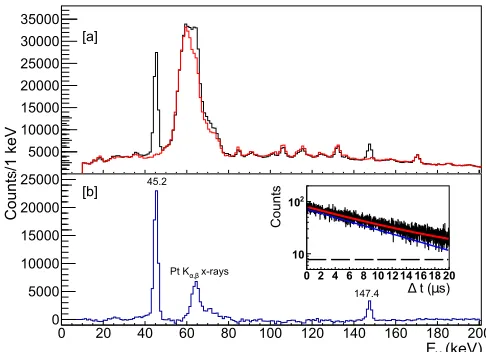
FIG. 1. (a) Recoil-gated isomeric PGDγ-ray energy spectrum observed within 3–20μs of the implantation of an ER in the DSSD (black). In red are the time-random events observed within a time interval of−5 to 0μs before the recoil implantation and normalized with respect to the black spectrum, based on the ratio of widths of the time intervals. (b) Background subtracted PGD energy spectrum ofγrays observed within 3–20μs of the implantation of an ER. The peak at 147.4 keV is a known transition in177Pt. The inset shows the
decay curve of the 45.2 keV transition together with the fit (in red) which consists of a exponential (in blue) plus a constant background (dashed black).
and sorted with the GRAINsoftware [18] to correlate events detected with the JGII and PGD.
III. DATA AND ANALYSIS
A. Identification of a 6.6µs isomer in175Ir
As the statistics collected in our experiment for175Ir was lower in comparison to the dedicated in-beam studies [3,4], we could not improve on the prompt in-beam decay scheme known from previous studies. However, the JGII data were useful for the assignment of the new isomeric state in175Ir, identified in our study, as shown below.
As a first step in our analysis, we concentrated on the identification of microsecond isomeric transitions at the focal plane of RITU, which were measured with the PGD within a specific time interval after the ER’s implantation in the DSSD. The respectiveγ-ray spectra are dubbed “recoil-gated isomeric” spectra in the following text.
One of the most abundantly produced reaction products in this study is 179Au, produced in the (1p,0n) channel, for which an 89.5 keV isomeric state with a half-life of 328(2) ns is known [19]. To remove the sub-μs isomeric transitions from the analysis and to get cleaner PGD γ-ray spectra, we exclude events detected within 3μs of a recoil implantation in the DSSD. Figure1(a)shows the recoil-gated isomeric γ-ray singles PGD spectrum (black line) with the requirement that events occur within the time interval of
T(PGD−DSSD)=3–20μs after the implantation of an ER in the DSSD. The spectrum drawn by a red line shows the background time-randomγ-ray decays in the PGD which
[image:3.590.303.546.67.243.2](a)
(b)
(c)
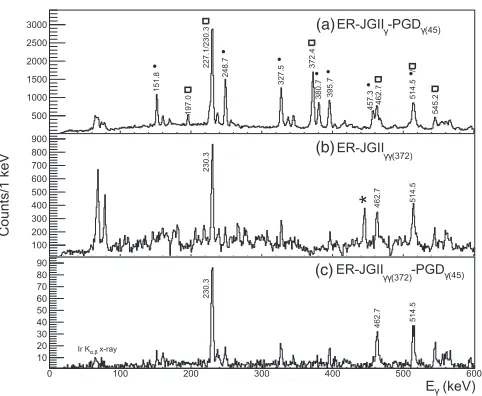
FIG. 2. (a) Recoil-gated singles JGIIγ-ray spectrum tagged with the 45.2 keV isomeric transition detected in the PGD. A timing condition ofT(ER−45.2 keV)=3–20μs was also applied for the PGD. Transitions in the (1/2+)[660] and (1/2−)[541] bands are marked with a dot and open box respectively. (b) Projection of a recoil-gatedγ-γmatrix for events detected in JGII with a gate on the 372.4 keV transition. A contaminant transition is seen at 444 keV and is marked as *. (c) Same as (b), but tagged on the 45.2 keV transition in the PGD. The transitions used to calculateαtot,exp(45.2) are labeled
in the panels (b) and (c).
occur prior to an ER implantation in the DSSD. Figure1(b)
provides the background subtracted spectrum, in which, apart from two peaks at 45.2(2) and 147.4(4) keV, a somewhat broad structure with the strongest contribution at ≈66 keV is seen. The 147 keV isomeric transition is known in the isotope 177Pt [20], produced in the (2p,0n) channel of the studied reaction. By applying an exponential fit of the time distribution between an ER implantation in the DSSD and the detection of a 147 keV γ ray in the planar detector, a half-life value of T1/2(147 keV)=2.35(4)μs was deduced. It is consistent with the literature value of 2.2(3)μs [20], but more precise. The 66 keV peak corresponds to the PtKαx rays due to the internal conversion of the 147 keV decay; the less intense Kβ x rays are masked by the incompletely subtracted background around these energies.
By using the same fitting procedure as applied for the 147 keV decay of177Pt, a half-life value ofT1/2(45.2 keV)= 6.58(15)μs was extracted for the 45.2 keV transition within the time interval of 3–20μs after the implantation of an ER in the the DSSD. The fit function consists of an exponential function and a constant background, with the result shown in the inset of Fig.1(b). The constant background in the fit function is used to account forγrays not correlated to an ER and which have a flat time distribution.
[image:4.590.44.285.65.263.2]To assign the transition to a specific nucleus, we used the isomer decay tagging (IDT) [21] method in which isomeric decays detected in the PGD are correlated to promptγ-ray transitions detected in JGII. Figure2(a)shows the promptγ -ray singles spectrum detected in JGII, tagged on the 45.2 keV isomeric transition in the PGD. A time gate of T(ER−
FIG. 3. Simplified partial level scheme of175Ir showing states
relevant to this work, based on the new data from this study and on the previous decay schemes (cf. Fig. 4 in Ref. [4] and Fig. 1 in Ref. [3]). For convenience we use the decay energies, to the nearest keV, as deduced by Dracouliset al.[4], for which our values are in good agreement. All states and transitions above the (5/2−
) state, known from the previous studies, are shown in black; the bands are labeled as in the previous works:Kπ[N,n
z, ] in Ref. [4] and (1–6)
in Ref. [3]. The (9/2−
)→(5/2−
) transition is unobserved in this work and is shown as a dashed transition. The states and transitions in red show the newly observed 45.2–26.1 keV cascade from the 6.6μs isomeric state. The dashed 145 keV transition from the (13/2+) state shows schematically the decay to the (5/2+
)[402] band which is unobserved in the IDT spectra. The decay scheme also includes the (9/2−
)[514] band which is unobserved in the IDT spectra.
45.2 keV)=3–20μs was also applied for the PGD. The spectrum shows a large number ofγ rays previously assigned to 175Ir, above the (5/2−
) state that was proposed as the ground state [3,4]. The above arguments unambiguously es-tablish 175Ir nuclide as the origin of the 45.2 keV isomeric decay.
Figure 3 shows a partial decay scheme, based on the drawings of [3,4], for states relevant to the present discussion. Despite the lower statistics in our data, relative to [3,4] our decay scheme above the (5/2−
) state is consistent with the previous studies (cf. Fig. 4 in Ref. [4] and Fig. 1 in Ref. [3]). We clearly see the (1/2−
)[541] and (1/2+
)[660] bands2 [4],
which decay to the previously proposed (5/2−
) ground state. Furthermore, the observation of the 197 and 231 keV transi-tions, which are the lowest-lying observed transitions in the bands and both decay to the (5/2−
) state according to [3,4], suggest that the isomeric state which decays via the 45.2 keV transition must be situated below the (5/2−) state.
Based on the energy sum balance between differentγ ray transitions, the previous studies [3,4] deduced the necessity for the (9/2−
) state at 49 keV above the (5/2−
) state, but did
2Hereafter we will use in the text the band notations by Dracoulis
[image:4.590.304.549.68.245.2]S. A. GILLESPIEet al. PHYSICAL REVIEW C99, 064310 (2019)
(keV) γ E
0 50 100 150 200 250 300
Counts/1 keV
5 − 0 5 10 15 20 25 30 35
26.1 keV
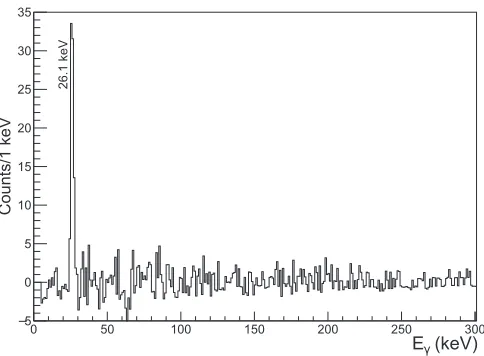
FIG. 4. Background subtracted PGD energy spectrum forγ rays in prompt coincidence (t(γ-γ)50 ns) with the 45.2 keV transi-tion. All events must occur within 3–20μs of an ER implantation in DSSD.
not report the direct observation of such a transition. Based on our data, namely that the isomer sees the whole 1/2−
[541] band, including the lowest 230 keV transition, such a branch should indeed exist. However, due to its strong conversion (αtot(49,E2)=117.7(17) [22]) and very low efficiency at this energy in JGII, we were unable to observe this transition, therefore it is shown in Fig.3by the dashed arrow.
On the other hand, the (9/2−
)[514] and (5/2+ )[402] bands [4] are unobserved in Fig.2(a). Transitions within these bands are observed, however in the ER-JGIIγ γspectra without a PGD energy gate, notably the 145 keV transition. There is disagreement between the placement of this transition in the previous studies, Cederwall et al.[3] assigns thisγ-ray transition to the deexcitation of the (13/2+
) state into the (5/2+
)[402] band, whereas Dracoulis et. al [4] places this transition within the band. Irrespective of this ambiguity, we consider this transition as a signature of the (5/2+
)[402] band. In our work the 145 keV transition is seen with intensity equal to the 161 keV transition (17/2+ →
17/2−
in Fig.3) in the ER-JGIIγ γ spectra, but is absent in the [ER-JGIIγ γ ]-PGDγ(45.2) spectra, which shows that the (5/2+)[402] band does not feed the state decaying by the isomeric 45.2 keV decay.
Further analysis of the 45.2 keV decay was performed by searching for coincident transitions within the PGD, with the time conditionsT(ER−45.2 keV)=3–20μs and
T(γ-γ)50 ns. Figure4shows the projection of thisγ-γ
matrix with a gate on the 45.2 keV decay, in which a transition at 26.1(4) keV is clearly seen. This coincidence establishes an isomeric cascade of 45.2–26.1 keV transitions in 175Ir. The relative order of these transitions will be discussed in the next section.
IV. DISCUSSION
A. Multipolarities of new transitions
Multipolarity determination for the 45 and 26 keV tran-sitions was performed by measuring their total internal
con-TABLE I. αtot,exp(45.2) values (third column) deduced from
Eq. (1) by using the respective numbers of counts in Figs. 2(b)
and2(c)for transitions shown in the second column, gated on the
γrays shown in the first column.
Gateγ1 γ2 αtot,exp(45.2)
248.7 160.4 0.65(13)
248.7 372.4 0.78(17)
372.4 230.3 0.72(13)
372.4 462.7 0.74(12)
version coefficients,αtot. They are determined from the ratios of intensities of selected prompt transitions within the excited bands of175Ir measured in JGII with and without a gate on the isomeric transition in PGD. Moreover, to improve the cleanliness of the spectra, we used the recoil and promptγ-γ
gating in JGII with a gate on the 249 or 372 keV transition, which also allow the selection of a specific part of the decay scheme. For example, for the case of the 372 keV transition, we compared the projections from the ER-γ-γ(372,JGII) and [ER-γ-γ(372,JGII)]-γ(45.2 keV, PGD) matrices, shown in Figs.2(b)and2(c), respectively. The two strongest transitions at 230.3 and 462.7 keV seen in both spectra belong to the 1/2−
[541] band [4]. These transitions are considered to be uncontaminated in the analysis applied below.
Following this approach, and by using the 372 keV tran-sition in JGII, an experimental value ofαtot,exp(45.2) can be determined from
αtot,exp(45.2)=
Nγ γ(372)×ǫ(45.2)
Nγ(372)γ(45.2)
−1, (1)
whereNγ γ(372)is the number of counts for a specific prompt
γ ray in JGII with a gate on 372 keV without an isomeric gate in PGD [Fig.2(b)], andNγ(372)γ(45.2)is the same number, but with a gate on the 45.2 keVγ-ray transition in the PGD [Fig.2(c)]. A value ofǫ(45.2)=0.225(20) is the efficiency of the planar detector at 45.2 keV, taken from simulations [23].
TableI shows the deduced αtot,exp(45.2) values based on numbers of counts in Figs.2(b) and2(c) for the 230.3 and 462.7 keV decays. All values of αtot,exp(45.2) are corrected by ∼4% in order to account for in-flight decay of the iso-mer through RITU. We also used the same method with a prompt gate on the 249 keV transition in JGII; respective values are also shown in Table I. All four values are in agreement with each other within the experimental uncer-tainties with the weighted average of αtot,exp(45.2 keV)= 0.72(7). This experimental value matches well to the the-oretical value of αtot,th(45.2 keV)=0.676(13) for an E1 multipolarity, calculated from [22]. For comparison, all other multipolarities would lead to much higher values, e.g.,
αtot,th(45.2 keV,M1)=10.92(21). Based on this value, an
E1 multipolarity was unambiguously assigned to the 45.2 keV transition.
This conclusion is further confirmed by comparison with the reduced transition probabilities B(σL). For a 45.2 keV transition the experimentally deduced value of B(E1)= 2.12×10⁻⁷ W.u. is in agreement with systematics where
[image:5.590.43.285.65.243.2] [image:5.590.303.549.112.185.2]E1 transitions are typically hindered (B(E1)=1×10⁻⁷ to 1×10⁻⁶W.u. [24]).
Similarly, we can a assign a multipolarity to the 26.1 keV transition by calculating its αtot from the expected number of 45.2–26.1 keV coincidences using a modified version of Eq. (1):
αtot,exp(26.1)=
Nγ(45.2)×ǫ(26.1)
Nγ(45.2)γ(26.1)
−1, (2)
where Nγ(45) is the number of observed 45.2 keV events in the recoil-gated singles spectrum of the PGD in Fig. 1,
and Nγ(45.2)γ(26.1) is the number of 26.1 keV events in
coincidences with the 45.2 keV transition as shown in Fig.4. From Eq. (2), a valueαtot,exp(26.1 keV)=76(14) was deduced.
A comparison to the theoretical values αtot,th(E1)= 3.02(14),αtot,th(M1)=56(3),αtot,th(E2)=2620(220) [22], establishes anM1 assignment for the 26.1 keV transition. A comparison of the experimental reduced transition probability B(M1)=3.3×10⁻⁶ W.u. with systematics [B(M1)=1× 10⁻³to 1×10⁻² W.u.] [24] shows that a 26.1 keVM1 tran-sition cannot directly depopulate the 6.58(15)μs isomer. As noted above, however, a 45.2 keVE1 transition depopulating the isomer is in agreement with systematics [24]. For this reason we establish the 6.58(15)μs isomer to decay via the 45.2–26.1 keV sequence.
B. Proposed low-energy level scheme of175Ir and comparison to179Au
The observation of the isomeric 45.2–26.1 keV cascade below the (5/2−
) state previously assigned as the ground state, suggests that this level is in fact an excited isomeric state. Therefore, the previously-reported excited bands of175Ir de-exciting via this state ((1/2−
)[541] and (1/2+
)[660] bands in Refs. [3,4]) must be shifted up in energy by 71.3(6) keV to accommodate this cascade.
As mentioned in Sec.I, the unhinderedαdecay of the 1/2+ ground state in 179Au established the existence of the state withIπ =1/2+
in the daughter175Ir nucleus with the same structure as in the parent nuclide. Based on the multipolarities deduced for the 45.2 and 26.1 keV transitions beingE1 and M1, respectively, we note that these two γ ray transitions would fit the possible decay sequence (5/2−)→1/2+via an intermediate 3/2+
state at 26.1 keV above the 1/2+ state. On these grounds, we propose that this isomeric cascade feeds to the same 1/2+
state as was identified in the α -decay study, as shown in the -decay scheme drawn in Fig.3. Tentatively, the 1/2+state could be the ground state in175Ir, but no further arguments could be provided to support this statement.
It is interesting to stress a striking similarity between the decay of the 89.5 keV, 328 ns isomeric state in179Au [19,25] and of the 71.3 keV, 6.6μs isomeric state in175Ir, which is shown in Fig.5. In both cases, a cascade of E1-M1 γ rays was observed, with the second decays in the cascade from the, presumably, (3/2+
) excited states at 27.1 keV (179Au) and 26.1 keV (175Ir) being of the (3/2+→
1/2+
[image:6.590.338.511.69.173.2]),M1 character. This fact might further strengthen the suggestion that both the
FIG. 5. A comparison of the decay of the 6.6μs isomer observed in175Ir with the decay of a 326 ns isomer in179Au [19], showing the
similar decay paths.
1/2+
ground state of179Au and the 1/2+
state in175Ir have the same structure, as was already proposed based on unhindered
αdecay between both states.
V. OUTLOOK
The rather long-half life of the 71.3 keV state is the most probable reason for the nonobservation of its decay in the pre-vious prompt in-beam studies [3,4], which presumably used a much narrower time window forγ-γ coincidences.3
Fur-thermore, due to their low energies, bothγ rays suffer from internal conversion (especially the 26.1 keV transition) and re-ducedγ-ray detection efficiency. The use of a highly efficient segmented planar germanium detector in our study allowed us to overcome the latter issue, while also providing γ-γ
coincidences.
The low-energy part of the excitation spectrum of 175Ir is, however, still far from being understood, as was already stressed by the studies [3,4] and further reiterated in Sec.I. In the present study, the excited states within three out of six bands proposed by the previous studies could be observed built on top of the newly reassigned (5/2−) state, which is now recognized as a 6.6μs isomeric state at 71.3 keV above the presumed 1/2+
ground state. While the transitions within the floating band built on the high-Iorbital (9/2−
in Ref. [4], 11/2−
in Ref. [3]) are also seen in prompt recoil-gatedγ-γ
data in JGII, they are not observed when gating on the 45.2 keV isomeric transition. This fact might indicate that the decay of this band either bypasses this isomer, or it ends up in a long-lived α and/or β-decaying state with a spin value very different from the tentatively proposedIπ =1/2+ ground state in175Ir. The latter was also hinted at byβ-decay studies of 175Ir [7] where a strong 105.6 keV transition is observed in 175Os [6,7]. This γ ray was also seen in an in-beam study of175Os and assigned to a (7/2+
)→(5/2− ) transition [27], which suggests the existence of a high spin
β-decaying state in 175Ir that could potentially correspond to the 9/2−[514] bandhead; see also the results of the most recent electron-capture/β+
-decay study [10].
3In Ref. [4], forγ-γcoincidences a time gate of±0.5μs was used,
S. A. GILLESPIEet al. PHYSICAL REVIEW C99, 064310 (2019)
We also note that our study yields further insight into the most recentα-decay study of175Ir [9], which reassigned the earlier known 5395 keVα decay to the 9/2−
state (instead of 5/2−
), and proposed a new 5745 keV decay as originating from the (5/2−
) state. In view of the results of the present work, one would need to assume that the 5745 keV decay actually originates from the 1/2+
state, rather than from (5/2−
) state.
Questions also remain about the (5/2+
)[402] band [4] (band 6 in [3]). The previous studies disagree about the level ordering within this band, and the current study is unable to resolve these discrepancies.
A further investigation of this interesting nucleus is in order, including dedicatedα- andβ-decay studies.
ACKNOWLEDGMENTS
The authors wish to thank the technical staff at the Ac-celerator Laboratory at the University of Jyväskylä for their excellent support. This work was supported by the STFC (UK), the EU 7th Framework Programme “Integrating Ac-tivities - Transnational Access,” Project No. 262010 (EN-SAR), the Academy of Finland under the Finnish Centre of Excellence Programme 2012-2017 (Nuclear and Accelerator Based Physics Programme at JYFL), the Slovak Research and Development Agency under Contracts No. APVV-15-0225 and No. APVV-14-0524, and the Slovak Grant Agency VEGA (Contracts No. 2/0129/17 and No. 1/0532/17). The authors also acknowledge the support of GAMMAPOOL for the loan of the JUROGAM detectors.
[1] K. Heyde and J. L. Wood,Rev. Mod. Phys.83,1467(2011). [2] R. Julin, T. Grahn, J. Pakarinen, and P. Rahkila,J. Phys. G43,
024004(2016).
[3] B. Cederwall, B. Fant, R. Wyss, A. Johnson, J. Nyberg, J. Simpson, A. M. Bruce, and J. N. Mo,Phys. Rev. C43,R2031
(1991).
[4] G. D. Dracoulis, B. Fabricius, T. Kibédi, A. M. Baxter, A. P. Byrne, K. P. Lieb, and A. E. Stuchbery,Nucl. Phys. A534,173
(1991).
[5] NNDC Evaluated Nuclear Structure Data File (ENSDF), April 10, 2019.
[6] A. Bouldjedriet al.,Z. Phys. A342,267(1992). [7] W.-D. Schmidt-Ottet al.,Nucl. Phys. A545,646(1992). [8] A. Siivola,Nucl. Phys. A92,475(1967).
[9] T.-M. Goon, Alpha and Gamma-ray spectroscopic studies of Au, Pt, and Ir nuclei near the proton dripline, Ph.D. thesis, University of Tennessee, Knoxville, 2004 (unpublished). [10] W. Hua-Leiet al.,Chin. Phys. Lett.27,022301(2010). [11] J. G. Cubisset al.,Phys. Lett. B786,355(2018). [12] R. Hardinget al.(unpublished).
[13] M. Leinoet al.,Nucl. Instrum. Methods Phys. Res., Sect. B99,
653(1995).
[14] R. D. Pageet al.,Nucl. Instrum. Methods Phys. Res., Sect. B
204,634(2003).
[15] G. Duchêneet al.,Nucl. Instrum. Methods Phys. Res., Sect. A
432,90(1999).
[16] C. W. Beausanget al.,Nucl. Instrum. Methods Phys. Res., Sect. A313,37(1992).
[17] I. H. Lazaruset al.,IEEE Trans. Nucl. Sci.48,567(2001). [18] P. Rahkila,Nucl. Instrum. Methods Phys. Res., Sect. A595,637
(2008).
[19] M. Venhartet al.,Phys. Lett. B695,82(2011). [20] E. Hagberget al.,Nucl. Phys. A318,29(1979).
[21] C. Scholeyet al., Exotic nuclei and atomic masses, in Proceed-ings of the Third International Conference on Exotic Nuclei and Atomic Masses ENAM 2001 Hämeenlinna, Finland, 2–7 July 2001(Springer, Berlin, 2003), p. 494.
[22] T. Kibédiet al.,Nucl. Instrum. Methods Phys. Res., Sect. A
589,202(2008).
[23] A. N. Andreyevet al.,Nucl. Instrum. Methods Phys. Res., Sect. A533,422(2004).
[24] P. M. Endt,At. Data Nucl. Data Tables26,47(1981). [25] M. Venhartet al.,J. Phys. G44,074003(2017).
[26] G. D. Dracoulis, B. Fabricius, R. A. Bark, A. E. Stuchbery, D. G. Popescu, and T. Kibédi,Nucl. Phys. A510,533(1990). [27] B. Fabricius, G. D. Dracoulis, R. A. Bark, A. E. Stuchbery,
T. Kibédi, and A. M. Baxter, Nucl. Phys. A 511, 345
(1990).
![FIG. 5. A comparison of the decay of the 6.in 1756 μs isomer observedIr with the decay of a 326 ns isomer in 179Au [19], showing thesimilar decay paths.](https://thumb-us.123doks.com/thumbv2/123dok_us/1839989.140237/6.590.338.511.69.173/comparison-decay-isomer-observedir-decay-isomer-showing-thesimilar.webp)
