ORIGINAL ARTICLE
Understanding Democracy and Development Traps
Using a Data-Driven Approach
Shyam Ranganathan,1,* Stamatios C. Nicolis,1Viktoria Spaiser,1and David J.T. Sumpter1
Abstract
Methods from machine learning and data science are becoming increasingly important in the social sciences, providing powerful new ways of identifying statistical relationships in large data sets. However, these relation-ships do not necessarily offer an understanding of the processes underlying the data. To address this problem, we have developed a method for fitting nonlinear dynamical systems models to data related to social change. Here, we use this method to investigate how countries become trapped at low levels of socioeconomic devel-opment. We identify two types of traps. The first is a democracy trap, where countries with low levels of eco-nomic growth and/or citizen education fail to develop democracy. The second trap is in terms of cultural values, where countries with low levels of democracy and/or life expectancy fail to develop emancipative values. We show that many key developing countries, including India and Egypt, lie near the border of these develop-ment traps, and we investigate the time taken for these nations to transition toward higher democracy and so-cioeconomic well-being.
Key words:big data analytics; mathematics; predictive analytics
Introduction
As more data becomes available, we increase our un-derstanding of processes and dynamics we observe in societies. One phenomenon that has received some attention in the economics and political science re-search is development traps. Under certain conditions countries can get stuck in these traps and experience a period of stagnation of the socioeconomic develop-ment on a low level. Data provided by the World Bank or the United Nations (UN) may give some in-sight into this phenomena. Data mining and machine learning techniques,1,2 for instance, could facilitate pre-dictions about the risk of countries getting trapped in low development, and the time required for countries to move out of development traps. This can be a useful approach if predictions are the ultimate goal. However, such an approach is limited in terms of providing understanding2–6of the dynamics and mechanisms of development traps.
Data scientists are now discussing ways to extend or find new methods in machine learning that would allow modeling of causality, detecting mechanisms or including social and economic theory in data sci-ence approaches.7–9In an earlier article,10we propose a data-driven dynamical systems approach to deriving differential equation models from panel data. Our ap-proach is inspired by machine learning apap-proaches, to the extent that model building is data driven. How-ever, our approach differs from a pure machine learn-ing approach, in that we do not merely fit models to make best possible predictions but derive a set of equations that describe the underlying processes. The hope is that these equations will aid understanding of the underlying process.
One question where understanding is just as important as prediction is in the change of cultural values, develop-ment, and democracy.11–14In Spaiser et al.15 we applied our method to look at how democracy, socioeconomic
1
Department of Mathematics, Uppsala University, Uppsala, Sweden.
*Address correspondence to:Shyam Ranganathan, Department of Mathematics, Uppsala University, PO Box 480, Uppsala 75180, Sweden, E-mail: [email protected]
ªShyam Ranganathanet al.2015; Published by Mary Ann Liebert, Inc. This Open Access article is distributed under the terms of the Creative Commons License (http://creativecommons.org/licenses/by/4.0), which permits unrestricted use, distribution, and reproduction in any medium, provided the original work is properly credited.
development, and cultural values have changed across different countries in the last 30 years. We fitted differ-ential equations for the rate of change of six indicators as a function of the level of the indicator itself and the level(s) of other predictors in the previous year. The re-sult of this work was a general dynamical model of the interactions between democracy, cultural values, and socioeconomic indicators that provided the best fit to the available data. Figure 1 summarizes the dynamic relations we found between the various indicators.15 In brief, we found that a critical level of the Human Development Index (HDI) triggers democratization and then the emancipation of the population. However, while emancipative values contribute to equal access to education and a healthy life, they do not lead to further accumulation of wealth. Thus once countries reach high levels of democracy and emancipation, they tend toward equilibrium in terms of economic growth.
The next step, and the question we address here, is to use our model to understand the underlying process of human development. This is an essential step if we are to address the issue of mechanisms and causality.7–9 It is also essential if we are to disentangle the conse-quences of the interactions between values, democracy, and development shown in Figure 1. While this flow di-agram indicates positive and negative feedbacks, the picture becomes complicated when we consider the un-derlying nonlinear differential equations (presented in detail below). From these we can see various threshold effects, where interactions change sign depending on the level of interacting variables. In particular, these thresholds suggest the possibility of ‘‘development traps,’’ where countries can become ‘‘trapped’’ with low levels of democracy and/or socioeconomic
devel-opment. The question is how these traps interact to de-termine the course of socioeconomic and political development in the world.
Development traps are widely discussed in the econom-ics literature. For instance, Nelson16 and Azariadis and Drazen17examined causes such as endogenous population growth or technological externalities with a ‘‘threshold’’ property, for persistently low rates of growth or relatively low levels of economic development of countries. More re-cently, Sachs18analyzed causes for poverty traps in terms of misbalances in different types of capital, for instance, undersupply of human capital in terms of education.19 A poverty trap is generally seen as a self-reinforcing mech-anism that causes poverty to persist, usually from genera-tion to generagenera-tion.20 Low growth and poverty traps are closely linked, since they represent different perspectives on underdevelopment.16,21
Rather than concentrating solely on economic growth traps, we look at development traps with respect to both democratization and socioeconomic develop-ment. Our starting point is the empirical relation-ships summarized in Figure 1, and our aim is to clarify the implications of these relationships in terms of development traps. To do this we employ two tools. The first is dynamical systems style22 mathemat-ical analysis of the nonlinear equations that best fit the data. The second is stochastic simulation of the equa-tions. We model inherent variability in development using independent Gaussian noise variables and ac-count for the unpredictability by performing stochastic integrations to obtain estimates of future probability distributions in the socioeconomic, political, and cul-tural values indicators.
Data and Methods
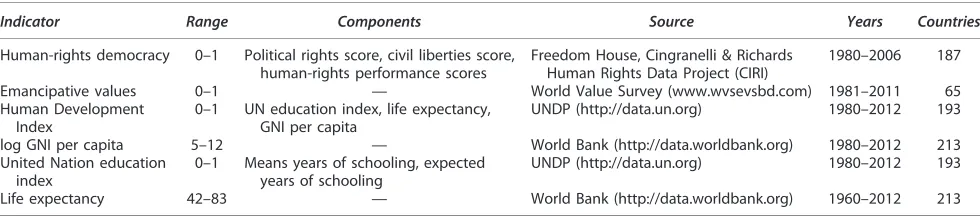
We used six different indicators in our analysis: four socioeconomic indicators and one democracy and one cultural values indicator. The analysis has been done for the time period 1981–2006 for 65 countries (for details on data availability, see Table 1 and Spaiser et al.15). HDI,H, is our main socioeconomic indicator. HDI is a composite index, consisting of measures for education (composite measure of average years of schooling and expected years of schooling)I, life expec-tancy (in years)L, and gross national income (GNI) per capita (in $)G23,24As in our earlier article, we perform analysis with HDI and additionally with the single HDI components.
[image:2.612.60.303.540.665.2]In our article,Drepresents human-rights democra-cy; that is, the democracy index consists of indicators FIG. 1. Dynamic model of interactions between
measuring civil liberties and political rights provided by Freedom House25,26 and of human right indices provided by the Human Rights Data Project.27Finally, cultural values refer to the World Values Survey28 emancipative values index E, which measures prefer-ences for ‘‘decision making freedom of the individual human being and the equality of all human beings in this decision-making freedom’’29on the aggregate level. These six indicators were chosen because the analy-ses in this article build on results we have published in an earlier article.15Originally, the selection of these in-dicators was inspired by the Human Development Sequence Theory11,12that assumes that socioeconomic development, cultural change, and democracy are interrelated. We have tested alternative indicators for democracy (effective democracy), cultural change (self-expressive values), and socioeconomic development (GDP per capita, female education) in our two earlier article, and the six indicators that were selected for an-alyses in this article proved to be best predictors. The results are also consistent over different indicators, with some exceptions for the democracy indicators, which we have discussed in the previous article.15
The variables H, D, I, and E were scaled from the original data to be values between 0 and 1. The other two variablesGandLwere rescaled to values between 0 and 1. L is restricted to be positive and scaled such that a value of 1 corresponds to actual life expectancy of 100 years. Realistic values ofLare between 0.3 and 0.9. ForGwe first computed the logarithm of a coun-try’s per capita GNI, which results in aGrange between 5 and 12. In the second step we rescaleGby dividing the logarithmic values in the data by the maximum 12. As a resultGranges between 0.46 and 1, which corresponds to around $260 and $160,000, respectively (for more de-tails on scaling and data generally, see Spaiser et al.15). In our previous article, we already identified rela-tionships between the five variables. Specifically, we
fit the changes (dG,dl,dL,dD, anddE) as differential equations with polynomial terms of the indicator vari-ables themselves, that is,G,I,L,D, andE. For the five variables, these were
dG
dt =0:002
G(t)
E(t) (1)
dl
dt=0:007 (2)
dL
dt =0:028E(t)(1
0:887 L(t) )þ
0:004
L(t) (3)
dD
dt =0:11D(t)(G(t)I(t)1:08D(t))þ0:025G(t)
2 (4)
dE
dt =0:028D(t)(L(t)0:585) (5)
The methodology used in the model selection is de-scribed in detail in Ranganathan et al.10and the steps taken to obtain these specific models are described in Spaiser et al.15
In this article, we first use phase portraits based on the equations above to identify different patterns of be-havior such as trap regions where the yearly changes slow down to very small values. Second, we look at sto-chastic integrations of the model.
[image:3.612.62.552.98.207.2]In order to incorporate stochastic dynamics, we use discrete time versions of equations and include a noise term estimated from the data. For a simplified two-variable model, these are Equations (6) and (7) below, while for the five-variable model these are Equa-tions (11)–(15) below. The deterministic terms in these models are precisely the same as described above, al-though now expressed in discrete time. The noise term in each variable at each time step is a constant multiplied by an independent normally distributed random vari-able with mean zero and standard deviation 1. The Table 1. Six Development Indicators We Use in Our Analysis and Other Details About the Data
Indicator Range Components Source Years Countries
Human-rights democracy 0–1 Political rights score, civil liberties score, human-rights performance scores
Freedom House, Cingranelli & Richards Human Rights Data Project (CIRI)
1980–2006 187
Emancipative values 0–1 — World Value Survey (www.wvsevsbd.com) 1981–2011 65
Human Development Index
0–1 UN education index, life expectancy, GNI per capita
UNDP (http://data.un.org) 1980–2012 193
log GNI per capita 5–12 — World Bank (http://data.worldbank.org) 1980–2012 213
United Nation education index
0–1 Means years of schooling, expected years of schooling
UNDP (http://data.un.org) 1980–2012 193
Life expectancy 42–83 — World Bank (http://data.worldbank.org) 1960–2012 213
noise constant is the standard deviation of the error in the model fit, that is, the square root of the residual sum of squares divided by number of observations.
The stochastic integrations were performed starting from a set of four different initial conditions in the five variables corresponding to values for Egypt, India, Jordan, and Ukraine in 2006. At each time step we predict the yearly change using the model and add this to the current levels in the indicator variables along with independently generated observations from Gaussian noise variables corresponding to the descrip-tion above. SinceH,D,I, andEonly take values from 0 to 1, we force the boundary conditions so that any value over 1 is taken to be 1 and any value below 0 is taken to be 0. The lower boundary condition also applies to the variableLand we assume that it applies also toG, effec-tively imposing a minimum GNI per capita of 1 dollar.
Results
Democracy and development
Before we deal with the full model from Figure 1, we start by analyzing the interactions of just two indica-tor variables: human-rights democracy and HDI. This analysis will pave the way for the more complex model established between the five indicator variables in the full model. The best fit model relating democracy and HDI is
Dtþ1Dt=0:0709Ht20:0658Dtþ0:08D (6)
Htþ1Ht=0:0045þ0:004H (7)
The noise terms eD (t) and eH (t) are independent
normally distributed random variables with mean 0 and standard deviation 1 and scaled by the estimated error standard deviation. All parameters are estimated from the data as described in the Data and Methods section.
The model of HDI is straightforward to interpret. HDI grows at a constant rate, plus or minus a random term, and is unaffected by democracy. The democracy equation is more complicated. Democracy only in-creases in countries where
H > 0:96pffiffiffiffiD (8)
For smaller values ofH,Ddecreases and we say that a country with these values is caught in a democracy trap. Until socioeconomic development reaches a suffi-cient level, democracy does not tend to develop in countries below this threshold.
The democracy trap condition [Eq. (6)] is quantitative, since it is estimated directly from the available data. It does not imply that every country below the line fails to increase in terms of democracy. Rather, it reflects the fact that over the last 30 years those countries that have not fulfilled the HDI condition have generally experi-enced decreases in democracy, while those above it have experienced increases. We can, and later in this article do, speculate why such a trap exists, but for now we sim-ply note that it is an empirical pattern in the available data that can be summarized in terms of a single equation.
For this two-variable model, we can go on to obtain a full solution to the equations, in the absence of noise. Equation (7) can be solved directly to give
Ht=0:0045tþH0 (9)
where H0 is the initial level of HDI. Replacing
Equa-tion (9) into EquaEqua-tion (6) and solving the continuous time version of the equation we get (10).
Dt=1:08H020:15H0þ0:01(1þH0t)
6:63·104tþ2:18·105t2
þ exp (0:066t) (D01:08H02þ0:15H00:01)
(10)
where D0 is the initial level of democracy. Equation
(10) allows us to determine the time needed for the sys-tem to reach a particular value ofDgiven a particular initial condition,H0andD0.
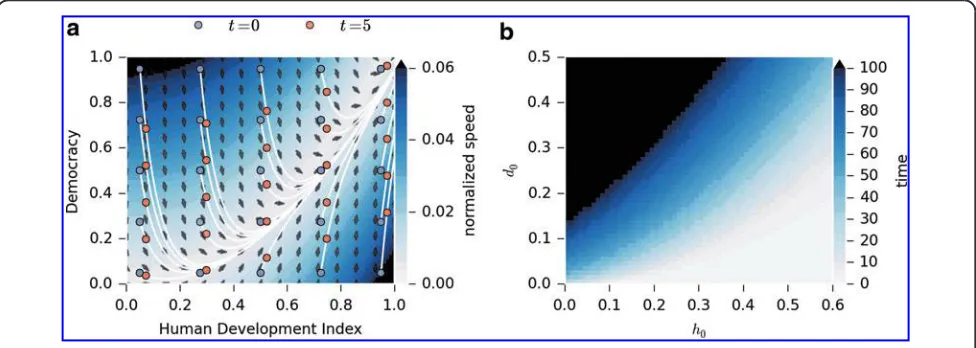
Figure 2a provides a full-phase portrait of Equa-tions (6) and (7) (in the absence of noise). There are two time scales involved in the evolution of H, and
Dt. First the trajectories evolve rapidly toward a slow
manifold, defined by the democracy trap condition H=0:96pffiffiffiffiD. Then on the slower time scale, democracy and HDI evolve upward along this manifold. Figure 2b gives the time needed for a country to increase its de-mocracy index by 20% as a function of initial conditions
H0andD0.
To provide a specific example, we take initial condi-tions corresponding to India in 1990, the first year the data is available (H0=0.404, D0=0.281 in 1990). We
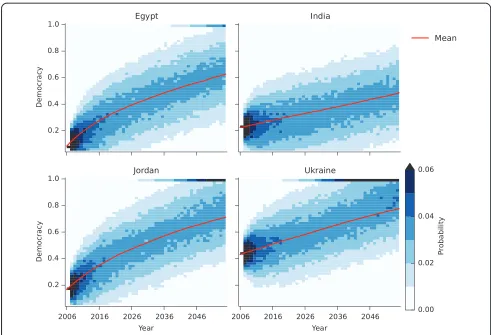
The prediction that Indian democracy will grow slowly does not take in to account intrinsic and external noise or variability in the process of democratization and socioeconomic development. Noise and uncer-tainty is of course inherent in this process. While it is impossible to account completely for the uncertainty in future events, we can use the error in our model fit to account for some of this variability. Figure 3 shows example evolutions of a stochastic integration of Equa-tions (6) and (7), including the noise term, for four dif-ferent initial conditions corresponding respectively to Egypt, India, Jordan, and Ukraine.
Figure 4 shows a range of different possible democ-racy outcomes for India over a 50-year time scale, from long periods with continued low levels of democracy to increases to levels comparable with United States in 2006. For Ukraine, and also Egypt and Jordan, democ-racy levels comparable with countries in Western Europe, that is, greater than about 0.8, are plausible outcomes within 50 years. These are seen as the darker band at the top of Figure 4. In general, the noise in de-mocracy is large, making it difficult to make reliable predictions using the two-variable model.
Including HDI components and cultural values
The full model includes five variables. HDI is replaced by its three compound variables: GNI per capita Gt,
educationIt, and life expectancyLt. We also add
eman-cipative values, Et, as measured by the World Values
Survey. The best-fit five-variable model is given by
Gtþ1Gt=0:002
Gt
Et
þ0:0042eG(t) (11)
Itþ1It=0:007þ0:0053eI(t) (12)
Ltþ1Lt=0:028Et(1
0:887 Lt
)þ 0:004
Lt
þ0:0033eL(t)
(13)
Dtþ1Dt=0:11Dt(GtIt1:08Dt)þ0:025G2tþ0:083eD(t)
(14)
Etþ1Et=0:028Dt(Lt0:585)þ0:0062eE(t) (15)
whereeG(t), etc., are Gaussian random variables with
0 mean and variance 1. All parameters including the noise constants are estimated from the data as de-scribed in the Data and Methods section.
There are several insights that can be gained directly from these equations. First, the values for all the com-ponents of HDI generally increase over time or reach a stable equilibrium. In the case of life expectancy, this equilibrium is around 90 years old. Two of the HDI components, GNI and life expectancy, interact with FIG. 2. (a)Phase plane for the explicit solution of the two-variable model. The arrows represent the
emancipative values. This interaction is different for GNI, where countries with high emancipative values experience slow economic growth, than for life expec-tancy, which increases with emancipative values.
Democracy and emancipative values both have potential development traps. In the case of emanci-pative values, E increases only if L‡0.585; that is, life expectancy is greater than 58.5 years. Figure 5 shows how L and E interact. The point (L*, E*)= (0.585, 0.473) is a steady state for this pair of equa-tions in the absence of noise. Near to the solution ofLt+1=Lt, that is,
E= 1
7(0:887L) (16)
the change in bothEtandLtis small. It is here we can
think of emancipative values being caught in a trap, al-though a temporary one. The scatterplot of data shows that in recent history most countries are moving away
from the right edge of the ‘‘trap’’ region. The excep-tions to this rule tend to have decreasing emancipative values. India and Ukraine are both in a region where change is slow. Eventually, countries will move away from this region, but this development happens slowly (velocity of change is color in Fig. 5). In the case of South Africa, we would predict a decrease in emanci-pated values before an increase is seen again.
To calculate the time it takes countries to increase their indicator values by a certain amount, we can do a further analysis of the system of equations. The steady state (L*,E*)=(0.585, 0.473) is a saddle node, since one
eigenvalue of the Jacobian is positive and given by 0.028D and the other eigenvalue is given by 0.0145. Countries to the right of the characteristic curves (which showLt+1=LtandEt+1=Et) in Figure 5
con-tinuously increase in bothLandE.
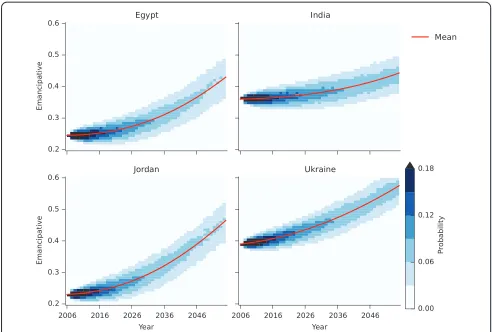
[image:6.612.62.550.86.388.2]Using the eigenvalues we can infer the time needed to increase the values of E and D. The positive FIG. 3. Stochastic integrations over a period of 50 years for initial conditions corresponding to Egypt,
eigenvalue 0.028Dis the rate at which countries near to the steady state (L*, E*)=(0.585, 0.473) move away from it. Thus, countries with high values of democracy
D move faster out of the trap region than countries with small D. Stochastic simulations of the model for Egypt, India, Jordan, and Ukraine show how these countries accelerate out of the trap (Fig. 6). Increases in emancipative values are slow over the first 20 years, especially in India and Ukraine, which are close to the trap region, but then accelerate. The varia-tion between simulavaria-tions is relatively small and these predictions are stable in the presence of noise.
The dynamic for democracy is similar to the two-variable model in the previous section, but now with an interaction between GNI and education. Specifi-cally,D increases when
D < G(IþpffiffiffiffiffiffiffiffiffiffiffiffiffiffiffiffiffiffiffiI2þ0:98)=2:16 (17)
Democracy requires both high levels of educa-tion and economic growth in order to increase. Since education and GNI tend to be correlated, the five-variable model makes similar predictions as the two-variable model. The main difference appears to be in the speed with which democracy increases. Figure 7 shows how democracy is predicted to change in our four example countries. Here we see India reaching higher levels of democracy faster than in the two-variable model. Again, the variation in the prediction for demo-cracy is high, and it is plausible that India reaches full democracy within 50 years.
[image:7.612.61.552.84.419.2]Figure 8 shows a phase plane for democracy and GNI for two different cases: one in which education is relatively low I=0.42 (Fig. 8a) and the other for high educationI=0.77 (Fig. 8b). The condition for in-creases in democracy, given by Equation (17), depends onI. Lower levels of education shift the condition for FIG. 4. Heatmaps showing the evolution of the distribution ofDvalues in a set of 10,000 stochastic
increasing democracy downward. By classifying the countries into those with education below the mean (Fig. 8a) and above the mean (Fig. 8b), we can see whether we predict an increase or decrease in democ-racy. India, Ukraine, Jordan, and Egypt all lie in an area where democracy is predicted to increase relatively rapidly in the near future. This observation is consis-tent with the simulations in Figure 7. These countries are on their way out of the trapped region and should move toward greater democracy in the future.
On the other hand, certain countries with excep-tional levels of democracy are predicted to experience decreases. For instance, Mali and Ghana have excep-tionally high levels of democracy given their levels of GNI. The suggestion here is that these countries would require extra support, in order to avoid the fate of those countries in the past (like Nigeria or
Ban-gladesh, for instance), which experienced a decrease in democracy. Since the time the data was collected in 2006, Mali has followed the path suggested by the model, experiencing civil unrest and decreases in democracy.
Finally, we can calculate the rate at which points near the line given by Equation (17) move away from it, using the eigenvalue for these points. This eigenvalue is 0.002/E. Thus, a higher value ofEactually results in slower movement through the ‘‘trap’’ region. This is be-cause Eslows down growth inG.
Conclusions
[image:8.612.62.551.84.375.2]In this article, we have extended the theoretical and empirical concept of the development trap studied in economics3,17,18to the political dimension in terms of political regime development (democratization) and FIG. 5. The phase portrait ofLandE. The arrows show the direction of yearly change in the (L,E) vector and the color shows the magnitude of change (assumingDt=1). The black curve corresponds to the solutions of
political culture development (emancipation). In line with more recent research,30–33 our analysis suggests that the development trap is a multidimensional phe-nomenon, because the economic and political spheres are closely linked and a development trap in the eco-nomic sphere necessarily translates into a development trap in the political sphere. Our contribution to this re-search field is the attempt to use the available data to quantify the development trap and factors causing it as well as factors contributing to overcome it. More-over, we use the data to make probabilistic predic-tions about the time that would be necessary for a given country to overcome a certain development trap given its initial situation.
In this regard, we show how data-driven modeling and analysis can go beyond ‘‘black box’’ analysis and pre-dictions.3,6The analysis we do here reveals how different
indicators interact and the implications of these interac-tions. This provides a step toward a method for elucidat-ing theories about development directly from data.
[image:9.612.61.553.85.417.2]It is widely recognized that the last 30 years have seen a global trend toward democratization, in terms of regime change and emancipation, where people be-come more tolerant of the rights of others.12,13,34–36 Despite this general trend, this article has shown that some countries may not experience democratization in the near future. They are caught in a development trap with respect to democracy and/or emancipation. Although in the long run (50–100 years) we expect to see democratic and emancipation changes in these countries too, in the near future these changes will happen only very slowly, with possible setbacks due to noisy fluctuations that are caused by various uncertainties.
a b
FIG. 8. The phase portrait of theGandDsubsystem with a scatter plot of the gross national income (GNI) per capita and democracy values for all countries in 2006 in the available dataset. The arrows show the direction of yearly change in the (G,D) vector and the color shows the magnitude of change assumingEt=0.473 the fixed point forEt. In(a)we show countries whose education indicator valuesIare below the global average of 0.621 and in(b)we show countries withIabove 0.621. The phase portrait shows the estimated velocities in any year. The black lines show the characteristic curves forDgiven by (17) with points above the curve corresponding to negative change inDvalues and points below corresponding to positive changes, and these are computed by taking the average values ofIfor the countries in(a)and(b), respectively.
[image:10.612.69.549.413.602.2]Our analysis shows that countries are caught in a de-mocracy trap if they have low levels of GNI and/or ed-ucation. We quantified the democracy trap condition, Equation (17), and visualized the rate of change as a phase portrait (Fig. 8). Countries near the trap con-dition experience slow increases, or even decreases, in democracy. It is difficult to say for sure what will hap-pen in a particular country, but the phase portrait, combined with the stochastic simulations, shows that these traps are a real possibility. For example, simulations for Egypt showed that full democracy is a possibility within the next 20 years, but so too is a long period of autocracy (low levels of democracy indicator).
We also found evidence for emancipation traps. Emancipation may be seen as the cultural representa-tion of democratizarepresenta-tion.12,34,37 The data suggests that emancipation can only increase if life expectancy is above a certain threshold. As emancipation depends on both life expectancy and democracy, higher values of democracy contribute to a country’s faster move through the trap region. This is an example of how being caught in one trap, that is, lack of democracy, can lead to a country being caught in another, that is, lack of emancipation.
Indicators can interact in other ways too. For exam-ple, an interesting result is that high levels of emancipa-tion, prior to democratizaemancipa-tion, may actually slow down movement out of the trap region for democracy. This is because high emancipative values tend to slow down economic growth. However, since high levels of de-mocracy are required for emancipation to grow, this may not prove possible in practice.
Given these dynamics and accounting for uncertainty in future events, we made probabilistic predictions about future democracy trajectories of four exemplary countries: Egypt, Jordan, India, and Ukraine. The five-variable model gives relatively ‘‘optimistic’’ pre-dictions for all four countries in terms of democratiza-tion. The predictions generally suggest that all four countries are likely to become largely democratic within the next 50 years, but the trajectories are likely to be characterized by temporary setbacks. At certain points the changes may be extremely slow and give the im-pression that the country is stuck.
Author Disclosure Statement
No competing financial interests exist.
References
1. Rasmussen CE, Williams CKI. Gaussian Processes for Machine Learning. The M.I.T Press: Cambridge, MA, 2006.
2. Bishop CM. Pattern Recognition and Machine Learning. New York: Springer, 2006.
3. MacKay DJC. Information Theory, Inference and Learning Algorithms. Cambridge, UK: Cambridge University Press, 2003.
4. Breiman L. Statistical modeling: the two cultures. Stat Sci. 2001;16: 199–215.
5. Hedstrom P. Dissecting the Social: On the Principles of Analytical Soci-ology. Cambridge, UK: Cambridge University Press, 2006.
6. Coleman JS. Social theory, social research and a theory of action. Am J Sociol. 1986;91:1309–1335.
7. Mullainathan S. Bugbears or legitimate threat? (social) scientists’ criticism of machine learning. Keynote at ACM KDD 2014 Conference, 2014. 8. Conway D. Data science through the lens of social science. Invited Talk
at ACM KDD 2014 Conference, 2014.
9. Etzioni O. The battle for the future of data mining. Keynote at ACM KDD 2014 Conference, 2014.
10. Ranganathan S, Spaiser V, Mann RP, Sumpter DJ. Bayesian dynamical systems modelling in the social sciences. PLoS ONE. 2014;9:e86468. 11. Inglehart R. Modernization and Postmodernization: Cultural, Economic,
and Political Change in 43 Societies. Princeton, NJ: Princeton University Press, 1997.
12. Welzel C, Inglehart R. Liberalism, postmaterialism, and the growth of freedom. Int Rev Sociol. 2005;15:81–108.
13. Welzel C, Inglehart R. Emancipative values and democracy: response to Hadenius and Teorell. Stud Compar Int Dev. 2006;41:74–94.
14. Welzel C. Freedom Rising. Human Empowerment and the Quest for Emancipation. Cambridge, UK: Cambridge University Press, 2013. 15. Spaiser V, Ranganathan S, Mann RP, Sumpter DJ. The dynamics of
de-mocracy, development and cultural values. Plos ONE. 2014;9:e97856. 16. Nelson RR. A theory of the low-level equilibrium trap in underdeveloped
economies. Am Econ Rev. 1956;46:894–908.
17. Azariadis C, Drazen A. Threshold externalities in economic development. Q J Econ. 1990;105:501–526.
18. Sachs J. The End of Poverty. Penguin Books: London, UK, 2006. 19. Mayer-Foulkes D. The human development trap in mexico. World Dev.
2008;36:775–796.
20. Azariadis C, Stachurski J. Poverty traps. In: Handbook of Economic Growth. Aghion P, Durlauf SN (eds.). Melbourne: Elsevier, 2005, p. 326. 21. Berthelemy JC. Convergence and development traps: how did emerging
economies escape the underdevelopment trap. In: The Oxford Handbook of Political Behaviour. Dalton RJ, Klingemann HD (eds.). Oxford, UK: Oxford University Press, 2006, chapter 10, pp. 127–156.
22. Strogatz SH. Nonlinear Dynamics and Chaos: With Applications to Physics, Biology, Chemistry and Engineering. Boulder, CO: Westview Press, 2000.
23. UNDP. Human Development Report 2010. 20th Anniversary Edition. The Real Wealth of Nations: Pathways to Human Development. United Nations: Geneva, 2010.
24. UNDP. Human Development Report 2011—Technical Notes. United Nations: Geneva, 2011.
25. FreedomHouse. Freedom in the world. 2008 report. www.freedomhouse .org
26. FreedomHouse. Freedom in the world. 2010 report. www.freedomhouse .org
27. Cingranelli J, Richards DL. CIRI dataset 2008. ciri.binghamton.edu/index .asp
28. WorldValueSurvey. World Value Survey questionnaire, root version, 2005–2006 wave. 2006. www.worldvaluessurvey.org
29. Welzel C. Individual modernity. In: Annual World Bank Conference on Development Economics: Growth and Integration. Bourguignon F, Pleskovic B (eds.). Washington, DC: The World Bank, 2006, pp. 185–205. 30. Collier P. The Bottom Billion. Why the Poorest Countries Are Failing
and What Can Be Done About It. Oxford, UK: Oxford University Press, 2007.
32. Cox GW, North DC, Weingast BR. The violence trap: a political-economic approach to the problem of development. SSRN Working Papers Series, 2013.
33. Weingast BR. Why developing countries prove so resistant to the rule of law. In: Global Perspectives on the Rule of Law. Heckman JJ, Nelson RL, Cabatingan L (eds.). New York: Routledge, Taylor and Francis Group, 2010, pp. 28–51.
34. Huntington S. The Third Wave: Democratization in the Late 20th Century. Norman, OK: University of Oklahoma Press, 1993.
35. Vanhanen T. Democratization: A Comparative Analysis of 170 Countries. New York: Routledge, 2003.
36. Teorell J. Determinants of Democratization: Explaining Regime Change in the World, 1972–2006. Cambridge, UK: Cambridge University Press, 2010. 37. Welzel C. Democratization as an emancipative process: the neglected role
of mass motivations. Eur J Pol Res. 2006;45:871–896.
Cite this article as:Ranganathan S, Nicolis SC, Spaiser V, Sumpter DJT (2015) Understanding democracy and development traps using a data-driven approach.Big Data3:1, 22–33, DOI: 10.1089/ big.2014.0066.