This is a repository copy of Long-Distance Trust-Free Quantum Key Distribution. White Rose Research Online URL for this paper:
http://eprints.whiterose.ac.uk/85019/ Version: Accepted Version
Article:
Piparo, NL and Razavi, M (2015) Long-Distance Trust-Free Quantum Key Distribution. IEEE Journal of Selected Topics in Quantum Electronics, 21 (3). 6600508. - . ISSN 1077-260X
https://doi.org/10.1109/JSTQE.2014.2364129
[email protected] https://eprints.whiterose.ac.uk/ Reuse
Unless indicated otherwise, fulltext items are protected by copyright with all rights reserved. The copyright exception in section 29 of the Copyright, Designs and Patents Act 1988 allows the making of a single copy solely for the purpose of non-commercial research or private study within the limits of fair dealing. The publisher or other rights-holder may allow further reproduction and re-use of this version - refer to the White Rose Research Online record for this item. Where records identify the publisher as the copyright holder, users can verify any specific terms of use on the publisher’s website.
Takedown
If you consider content in White Rose Research Online to be in breach of UK law, please notify us by
Long-Distance Trust-Free Quantum Key Distribution
Nicol´o Lo Piparo1 and Mohsen Razavi1
1School of Electronic and Electrical Engineering, University of Leeds, Leeds, UK
Abstract
The feasibility oftrust-freelong-haul quantum key distribution (QKD) is addressed. We combine
measurement-device-independent QKD (MDI-QKD), as an access technology, with a quantum
re-peater setup, at the core of future quantum communication networks. This will provide a quantum
link none of whose intermediary nodes need to be trusted, or, in our terminology, a trust-free QKD
link. As the main figure of merit, we calculate the secret key generation rate when a particular
probabilistic quantum repeater protocol is in use. We assume the users are equipped with imperfect
single photon sources, which can possibly emit two single photons, or laser sources to implement
decoy-state techniques. We consider apparatus imperfection, such as quantum efficiency and dark
count of photodetectors, path loss of the channel, and writing and reading efficiencies of quantum
memories. By optimizing different system parameters, we estimate the maximum distance over
which users can share secret keys when a finite number of memories are employed in the repeater
setup.
I. INTRODUCTION
Future quantum communications networks will enable secure key exchange among
re-mote users. They ideally rely on user friendly access protocols in conjunction with a reliable
network of core nodes [1–3]. For economic reasons, they need to share infrastructure with
existing and developing classical optical communication networks, such as passive optical
networks (PONs) that enable fiber-to-the-home services [4, 5]. The first generation of
quan-tum key distribution (QKD) networks are anticipated to rely on a trustedset of core nodes
[6, 7]. This approach, although the only feasible one at the moment, may suffer from
secu-rity breaches over the long run. In the future generations of quantum networks, this trust
requirement can be removed by relying on entanglement in QKD protocols [8, 9]. This can
be facilitated via using the recently proposed measurement-device-independent QKD
(MDI-QKD) [10–13] at the access nodes of a PON [14] and quantum repeaters at the backbone of
the network, as we consider in this paper. The former enables easy access to the network via
low-cost optical sources and encoders, whereas the latter may rely on high-end technologies
for quantum memories and gates. Both systems, however, rely on entanglement swapping,
which makes them naturally merge together. More importantly, in neither systems would we
need to trust the intermediary nodes that perform Bell-state measurements (BSMs). In this
paper, we study the feasibility of such a trust-freehybrid scheme by finding the relationship
between the achievable secret key generation rate as a function of various system
parame-ters. We remark that this setup does not provide full device-independence but it removes
the trust requirement from the intermediary network nodes that perform measurement
op-erations. Our work provides insights into the feasibility of such systems in the future. The
system proposed in [15] combines MDI-QKD with quantum repeaters by using time reversed
all photonic quantum repeaters. However, [15] requires single photon sources as well as large
cluster states. Instead, our scheme relies on conventional quantum repeaters, where
entan-gled quantum memories are used to store qubits which are teleported to large distances
through entanglement swapping. Moreover, users can use imperfect single-photon sources
or lasers. MDI-QKD is an attractive candidate for the access part of quantum networks.
First, it provides a means to secure key exchange without trusting measurement devices.
This is a huge practical advantage considering the range of attacks on the measurement
driven by weak laser pulses. That not only makes the required technology for the end users
much simpler, but also it implies that the costly parts of the network, including detectors
and quantum memories, are now shared between all networks users, and are maintained by
service providers. One final advantage of MDI-QKD is its reliance on entanglement
swap-ping, which makes its merging with quantum repeaters, also relying on the same technique,
straightforward. This will help us develop quantum networks in several generations, where
the compatibility of older, e.g. trusted-node, and newer, e.g., our trust-free, networks can
be easily achieved.In
Quantum repeaters are the key ingredients to trust-free networks. They traditionally rely
on quantum memories (QMs) to store entangled states. In order to avoid the exponential
decay of rate with channel length, in quantum repeaters, entanglement is first distributed
over shorter distances and stored in QMs. Once we learn about the establishment of this
initial entanglement, we can perform BSMs to extend entanglement over longer distances
[20]. Considering the complexity of joint operations needed for BSMs, as well as possible
purification thereafter, quantum repeaters are anticipated to be developed in several stages.
The first generation of quantum repeaters may rely on probabilistic approaches to BSMs,
which can be implemented using linear optics devices [21–24]. These systems expect to cover
moderately long distances up to around 1000 km without the need for purification. In order
to go farther we need to develop efficient tools for purification and deterministic BSMs
as was initially envisaged in [25]. Such deterministic quantum repeaters will replace the
probabilistic setups once their technology is sufficiently mature. Finally, the most advanced
class of repeaters are the recently proposed no-memory ones [15, 26, 27], in which, by
using extensive error correction, one can literally transfer quantum states from one point to
another.
In this paper, we focus on the probabilistic setups for quantum repeaters, and, among all
possible options, we use the protocol proposed in [28], which relies on single-photon sources
(SPSs). In an earlier work [29], we compared the performance of this protocol, which we
refer to as the SPS protocol, in the context of QKD, with several other alternatives, once
imperfections in the SPSs are accounted for. We found that under realistic assumptions,
this protocol is capable of providing the best (normalized) key rate versus distance behavior
as compared to other protocols considered in [29]. The particular setup that we are going to
BB84
Encoder BSM L BSM
rep
Ls Ls
Memories entangled by a quantum repeater
BB84 Encoder
Core network
[image:5.612.184.427.74.109.2]Alice Bob
FIG. 1. A general scheme for trust-free QKD links. Entangled states are created between internal
nodes of the core network using quantum repeaters. The two BSMs will then enable an end-to-end
MDI-QKD protocol.
improved by incorporating a repeater setup, as above, in between the two users. It is worth
noting that the easiest way to improve rate-vs-distance behavior is to add two quantum
memories in the MDI-QKD setup [30–32]. This approach will almost double the distance
one can exchange secret keys without trusting middle nodes, but it is not scalable the same
way that quantum repeaters are. It, nevertheless, provides a practical route toward building
scalable quantum-repeater-based links.
The paper is structured as follows. In Sec. II, we describe the main ingredients of our
setup including the phase encoding MDI-QKD and the SPS-based quantum repeaters. In
Sec. III, we present our methodology for calculating the secret key generation rate for our
hybrid system, followed by numerical results in Sec. IV. We draw our conclusions in Sec. V.
II. SETUP DESCRIPTION
In this section we first introduce the general idea behind our trust-free architecture and,
then, explain particular MDI-QKD and quantum-repeater protocols considered for its
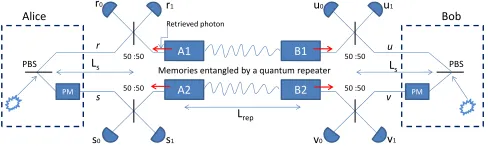
im-plementation. Let us first consider the ideal scenario considered in Fig. 1. In this scheme, by
using quantum repeaters, we distribute (polarization) entanglement between two memories
apart by a distance Lrep. This operation is part of the core network and is facilitated by
the service provider. On the users’ end, each user is equipped with a BB84 encoder, which
sends polarization-encoded single photons to a BSM module at a short distanceLs from its
respective source. This resembles the access part of the network, where the BSM module is
located at the nearest service point to the user. For each transmitted photon by the users,
we need an entangled pair of memories to be read, i.e., their states need to be transferred
into single photons. These photons will then interact with the users’ photons at the two
A1
A2
B1
B2
Lrep
Memories entangled by a quantum repeater
PM PM
50 :50 50 :50
50 :50 50 :50
PBS PBS
r0 r1
s0 s1
u0 u1
v0 v1
r
s v
u
Alice Bob
Ls Ls
[image:6.612.184.428.73.146.2]Retrieved photon
FIG. 2. Schematic diagram for a trust-free QKD link based on phase encoding. Memories are
entangled using the SPS repeater protocol. Here, PBS stands for polarizing beam splitter and PM
stands for phase modulator.
The setup of Fig. 1 effectively enables an enlarged MDI-QKD scheme. In MDI-QKD,
the two photons sent by Alice and Bob are directly interacting at a BSM module [10].
Here, by the use of entangled memories, it is as if the Alice’s photon is being teleported
to the other side, and will interact with the Bob’s photon at the second BSM. The overall
effect is, nevertheless, the same, and once Alice and Bob consider the possible rotations
in the memory states corresponding to the obtained BSM results, they can come up with
correlated or anti-correlated bits for their sifted keys. Post processing is then performed to
convert these sifted keys to secret keys.
The same idea as in Fig. 1 can be implemented via phase-encoding techniques as shown
in Fig. 2. Here, for simplicity, we have considered the dual-rail setup. The equivalent,
and more practical, single-rail setup can also be achieved by time multiplexing as shown
in [11]. In Fig. 2, the quantum repeater ideally leaves memories Ai-Bi, for i = 1,2, in the
state|ψentiAiBi =|0iAi|1iBi+|1iAi|0iBi, where we have neglected normalization factors, and
|niK represents n excitations in memory K. The implicit assumption is that the memory
is of ensemble type so that it can store multiple excitations [33]. The phase encoding that
matches this type of entangled states is as follows. Alice and Bob encode their states either
in thezor in thexbasis. Alice encodes her bits in thezbasis by sending, ideally, a photon in
the r or in thes mode. This can be achieved by sending horizontally or vertically polarized
pulses to the polarizing beam splitter (PBS) at the encoder. The same holds for Bob and
his u and v modes. As for the x basis, we can send a +45◦
-polarized signal through the
PBS to generate a superposition of r(u) ands(v) modes for Alice (Bob) state. Alice (Bob)
encodes her (his) bits by choosing the phase value of the phase modulator (PM), φA(φB),
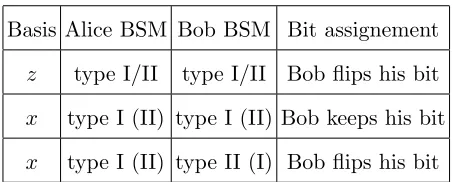
Basis Alice BSM Bob BSM Bit assignement
z type I/II type I/II Bob flips his bit
x type I (II) type I (II) Bob keeps his bit
[image:7.612.192.418.75.166.2]x type I (II) type II (I) Bob flips his bit
TABLE I.Bit assignment protocol depending on the results of the two BSMs.
The BSMs used in the scheme of Fig. 2 are probabilistic ones. They will be successful
if exactly two detectors, one from the top branch, and one from the bottom one, click. We
recognize two types of detection. For the Alice’s side (and, similarly, for the Bob’s side),
type I refers to getting a click on r0-s0 or on r1-s1. Type II refers to the case when r0-s1 or
r1-s0 click. In order to get one bit of sifted key, Alice and Bob must use the same basis and
both BSMs in Fig. 2 must be successful. Depending on the results of these BSMs and the
chosen basis by the two parties, Alice and Bob may end up with correlated or anti-correlated
bits, where in the latter case, Bob will flip his bit. Table I summarizes the bit assignment
procedure for our scheme. Note that these BSMs can be performed by untrusted parties.
The repetition rate for our scheme is a function of several factors. In order to do a proper
BSM, for each photon sent by the users, there must be two entangled pairs of memories
ready to be read. In principle, the fastest that we can repeat our scheme is the minimum of
the maximum source repetition rate, RS, and half the entanglement generation rate of the
quantum repeater, Rrep/2. The latter is a function of the number of memories in use [34].
We therefore consider two regimes of operation. If RS > Rrep/2, we then run our encoders
at a rate equivalent to Rrep/2 and will look at the achievable key rate per QM used. If
RS < Rrep/2, i.e., when for every photon sent, there will be more than two entangled pairs
ready, then we run our scheme at the rateRS and will look at the key rate per transmitted
pulse as a figure of merit.
In the following, we describe the quantum repeater protocol used in our scheme as well
as different types of (imperfect) sources that users may use. Later, we look at the above
h h
50:50
QM QM
0
L
[image:8.612.207.405.73.184.2]SPS SPS
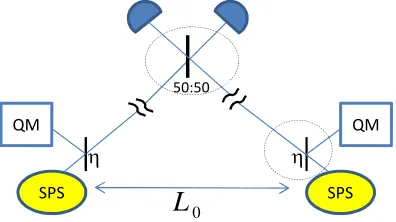
FIG. 3. The SPS protocol for entanglement distribution.
A. Source Imperfections
In our work, we consider two types of sources for the end users. The first type, which
we will use as a point of reference for comparison purposes, is an imperfect SPS, with the
following output state
ρ(SPS)j = (1−p)|1ijjh1|+p|2ijjh2|, j =A, B (1)
where p is the probability to emit two, rather than one, photons. In practical regimes
of operation, p ≪ 1, hence, in our analysis, we neglect the simultaneous emission of two
photons by both sources. The second type of source considered is a phase-randomized
coherent source, which will be used in the decoy-state version of the protocol. In this case,
Alice (Bob) will sendµ=|α|2 (ν =|β|2) photons on average for her (his) main signal states.
Other values will be used for decoy pulses. Our analysis here only considers the case when
there are infinitely many decoy states in use, although in practice we expect to achieve the
same performance by using just a small number of decoy states [12].
B. SPS Repeater Protocol
The SPS protocol, proposed in [28], attempts to reduce the contribution of multi-photon
errors by using single-photon sources. The SPS setup for its initial entanglement distribution
is shown in Fig. 3. In order to entangle two QMs at a distance L0, corresponding to the
shortest segment of the repeater setup, we send single photons through identical beam
splitters with transmission coefficients η. The photons can be reflected and stored in the
QM or go through the quantum channel and be coupled at a 50:50 beam splitter. If exactly
0
rep 2 L
[image:9.612.181.428.72.158.2]L n
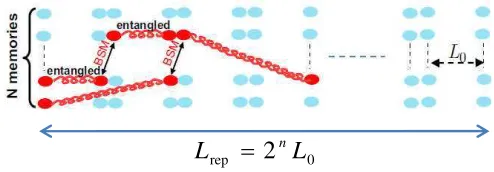
FIG. 4. Multi-memory configuration for quantum repeaters.
entangled state and a spurious vacuum term, where the latter can be selected out in later
stages. For the entanglement swapping stage, we again use the 50:50 beam splitter followed
by two single-photon detectors to perform a partial BSM. In [29], we calculate the secret
key generation rate for the SPS protocol assuming that, instead of perfect SPSs, we are
equipped with imperfect sources as in Eq. (1). This is particularly a fundamental source of
error, if one uses ensemble-based memories and the partial readout technique for generating
single photons [28]. Without loss of generality, we assume ensamble-based QMs with Λ−
level configuration and infinite decoherence time. The effect due to a finite decoherence
time has been already considered in a previous paper [32]. By considering writing and
reading efficiencies for the QMs in use, respectively, denoted by ηw and ηr, here we use
the results of [29] to find the relevant density matrices, ρAiBi for i = 1,2, for memories
entangled by the SPS protocol for different values of p and for different nesting levels n.
Other sources of imperfections considered throughout the paper are the path loss given by
ηch(l) = exp(−l/Latt) withLatt being the attenuation length of the channel, photodetectors’
quantum efficiency, ηd, and photodetectors’ dark count per pulse given by dc.
In order to improve the entanglement generation rates in probabilistic quantum repeaters,
it is essential to make use of multiple memories and/or multi-mode memories. Here, we
assume a multi-memory structure as shown in Fig. 4 withN memories per node, and employ
the cyclic protocol proposed in [20]. In this protocol, at each cycle of duration L0/c where
c the speed of light in the channel, we try to entangle, here using the SPS protocol, all the
unentangled pairs of QMs at distance L0. At each cycle, we also perform as many BSMs as
possible at the intermediate nodes. The main requirement for such a protocol is that, at the
stations that we perform BSMs, we must be aware of establishment of entanglement over
r
K
d
K
d
K
ch(Ls)
K
source 50:50 QM
50-50 BS
[image:10.612.200.411.71.151.2]ɻb ɻa
FIG. 5. BSM module with generic transmission coefficient represented by fictitious beam splitters.
In our setup, ηa is the path loss;ηb is the reading efficiency andηd is the detection efficiency.
[20] to calculate the generation rate of entangled states per memoryused, which is given by
Rent(L) = N PS(L0)PM(1)P (2) M ...P
(n)
M /T0N2n+1
=PS(L0)PM(1)P (2) M ...P
(n)
M /(2L/c)
(2)
where T0 is the duration of each cycle and PS(L/2n) is the probability that the
entangle-ment distribution protocol succeeds over a distance L0, PM(i), i = 1...n, is the BSM success
probability at nesting level i for a quantum repeater with n nesting levels. In our analysis,
we use the expressions for PS andPM(i) up to two nesting levels as found in [29]. Finally, the
total generation rate of entangled states in the limit of N Rent(L)L/c≫1 is given by
Rrep(L) =NQMRent(L), (3)
where NQM= 2n+1N is the total number of logical memories in Fig. 4.
III. SECRET KEY GENERATION RATE
In this section, we find the secret key generation rate,RQKD, per logical memory used, for
the scheme of Fig. 2 under the normal mode of operation when no eavesdropper is present.
We consider two types of sources as discussed in Sec. II A.
A. Imperfect SPSs
Here, Alice and Bob each use an SPS with the output state as given by Eq. (1) in their
encoder. In the limit of an infinitely long key and a sufficiently large number of QMs, their
normalized secret key generation rate per employed memory is lower bounded by
RQKD = min(RNSQM,Rrep/2)
×max
Qz
11(1−h(ex11))−Qzppf h Eppz
where Qz
11 = (1−p)2Y11z, with Y11z being the probability of a successful click pattern in the
z basis when Alice and Bob send exactly one photon each; ex
11 is the quantum bit error
rate (QBER) in the x basis, provided that Alice and Bob are each sending exactly a single
photon;Qz
ppis the probability of a successful click pattern in thez basis when Alice and Bob
use sources with outputs as in Eq. (1), with the corresponding QBER given byEz
pp;f is the
error correction inefficiency, and h(x) = −x log2(x)−(1−x) log2(1−x) is the Shannon
binary entropy function.
Appendix A provides us with the full derivation of the relevant terms in Eq. (4). Our
general approach to find these terms is as follows. For any basis Φ =x, z and any possible
encoded stateρΦ
enc =ρrs⊗ρuv by Alice and Bob, the initial state of the system for memories
A1-B1 and A2-B2 is given by
ρΦin =ρΦenc⊗ρA1B1 ⊗ρA2B2 (5)
where ρAiBi has been obtained in [29]. Once memories are read, their states will be
trans-ferred to photonic states, which we denote by the same label as their original memories. In
that case, optical fields corresponding to modes r and A1, as well as the other three pairs
of modes in Fig. 2, would undergo through the setup shown in Fig. 5, where ηa =ηrηd and
ηb =ηch(Ls)ηd. The equivalent sub-module in Fig. 5 is what we refer to as an asymmetric
butterfly module, whose operation is denoted by Bab
ηaηb when it acts on two incoming modes
aandb. In [32], we have derived the output states of a butterfly module for relevant number
states at its input. Using those results, we can then find the pre-measurement state right
before the photodetection at the BSM modules by
ρΦout =BrA1 ηaηb⊗B
sA2 ηaηb⊗B
uB1 ηaηb⊗B
vB2 ηaηb(ρ
Φ
in). (6)
Note that we have already accounted for the quantum efficiency of photodetectors in our
butterfly modules. The probability for a particular pattern of clicks on detectors ri, sj, uk,
and vl, for i, j, k, l= 0,1, is given by
Prisjukvl(ρ
Φ
enc) = tr ρ
Φ
outMriMsjMukMvl
, (7)
where for x=r, s, u, v
Mx0 = (1−dc) [(Ix0 − |0ix0x0h0|)⊗ |0ix1x1h0|
+dc|0ix0x0h0| ⊗ |0ix1x1h0|]
is the measurement operator to get a click on detector x0 but not on x1. Here, Ix0 denotes
the identity operator for the mode entering detector x0. One can define a similar operator
Mx1 by swapping subscripts 0 and 1 in the above equation. Hence, for example, looking at
Fig. 2 the measurement operator corresponding to a click on detector r0 and no click on r1
is given by
Mr0 = (1−dc) [(Ir0 − |0ir0r0h0|)⊗ |0ir1r1h0|
+dc|0ir0r0h0| ⊗ |0ir1r1h0|]
(9)
The relevant terms in Eq. (4) can now be calculated by using Eq. (7) as shown in Appendix
A.
B. Coherent sources
In this section we replace the SPSs with lasers sources and use the decoy-state technique
to exchange secret keys. This is a more user friendly approach as the complexity of the
required equipment for the end users would be minimized. In the limit of infinitely many
decoy states, infinitely long key, and sufficiently large number of memories, the secret key
generation rate per logical memory used is lower bounded by
RQKD = min(RNS,Rrep/2) QM
×max
Qz
11(1−H(ex11))−Qzµνf H Eµνz
,0 , (10)
whereQz
µν is the probability of a successful click pattern in the z basis when Alice and Bob
send phase-randomized coherent pulses, respectively, with mean photon number µ = |α|2
and ν =|β|2 and Ez
µν is the QBER in thez basis in the same scenario.
The procedure to find Qz
µν and Eµνz is the same as what we outlined in Eqs. (5)-(8). The
only difference here is that in our butterfly modules, we now need to know the output of
the module to coherent states in one input port, for the signal coming from the users, and
number states in the other, representing the state of QMs. Table III in Appendix A provides
us with the input-output relations for a range of relevant input states. We can then find the
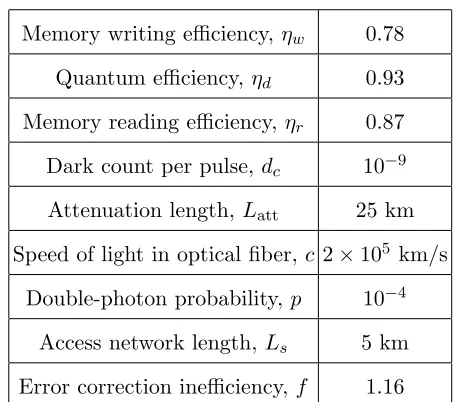
Memory writing efficiency, ηw 0.78
Quantum efficiency,ηd 0.93
Memory reading efficiency,ηr 0.87
Dark count per pulse,dc 10−9
Attenuation length, Latt 25 km
Speed of light in optical fiber,c 2×10⁵ km/s
Double-photon probability, p 10−4
Access network length,Ls 5 km
[image:13.612.190.417.73.274.2]Error correction inefficiency, f 1.16
TABLE II.Nominal values used in our numerical results.
IV. NUMERICAL RESULTS
In this section, we present numerical results for the secret key generation rate of our
long-haul trust-free QKD link versus different system parameters. We look at two regimes
of operation; thesource-limitedregime when memories are abundant and we are slowed down
by source rates, i.e., 2RS < Rrep, versus therepeater-limitedregime when the rate limitations
come from the quantum repeater side, i.e., 2RS > Rrep. In the latter case, we should still
satisfy the condition N Rent(L)L/c ≫ 1 in order that Eqs. (2)-(3) remain valid. We have
used Maple 15 to analytically derive expressions for Eqs. 4 and 10. Unless otherwise noted,
we use the nominal values summarized in Table II.
The first thing to obtain is the optimum intensity for our decoy-state scheme. Let us
assume that in the symmetric scenario, as considered in this paper, Alice and Bob both use
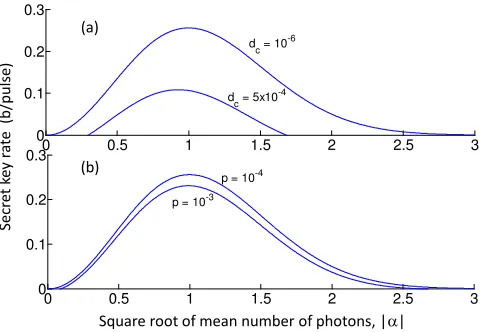
the same intensity value µ = |α|2 = ν for their coherent signal states. Figure 6 shows the
secret key generation rate per pulse versus|α| for (a) different values ofdc and (b) different
values of p of the quantum repeater at Lrep = 100 km. We assume that 2RS < Rrep and
the plotted curves represent RQKDNQM/RS in Eq. (10). It can be seen in both figures that
|α|= 1 almost gives us the maximum rate in most scenarios. The optimal value is to some extent a function of dc as can be seen in Fig. 6(a). By increasing dc, the optimal intensity
slightly decreases. Dark count represents the main source of error in the z basis, therefore,
0 0.5 1 1.5 2 2.5 3 0
0.1 0.2 0.3
0 0.5 1 1.5 2 2.5 3
0 0.1 0.2 0.3
d c= 10
-6
p = 10-4
p = 10-3 d
c= 5x10 -4
S
e
cr
e
t
ke
y
ra
te
(b
/p
u
ls
e
)
Square root of mean number of photons, |D| (a)
[image:14.612.186.428.72.238.2](b)
FIG. 6. Secret key generation rate per pulse versus |α|=|β|for different values of (a) the dark
count and (b) the repeater’s double photon probability. Here,Lrep= 100 km and the other values
are as in Tab. II.
hence the maximum allowed value of|α|will go down as well. This leads to a slightly shifted
curve and therefore lower values for the optimal values of |α|. On the contrary, Ez
µν is not
affected much by the double-photon probability p and there is not much difference in the
optimal intensity when pincreases as shown in Fig. 6(b). We also obtain the same optimal
values of |α| for nesting levels one and two in the repeater-limited regime. Throughout this
section, we then use |µ|=|ν|= 1 in our calculations.
A. Rate versus distance
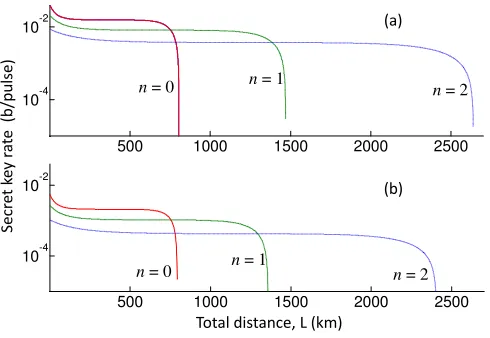
Figures 7 and 8 show the secret key generation rate, at the optimal value of intensity,
versus the total distance, L = 2Ls +Lrep, between Alice and Bob. In both figures, we
assume Ls is a fixed short distance resembling the length of the access network. We vary
Lrep then to effectively increase the link distance. Figure 7 shows the secret key generation
rate per transmitted pulse in the source-limited regime, whereas Fig. 8 represents the key
rate per logical memory used in the repeater-limited regime. In both cases we consider
SPSs at p = 10−4 as well as coherent decoy states. The difference in the performance
of the systems relying on these sources, as expected, is low, and that again confirms the
possibility, and practicality, of using the decoy-state technique for end-user devices. The
500 1000 1500 2000 2500 10-4
10-2
500 1000 1500 2000 2500 10-4
10-2
S
e
cr
e
t
ke
y
ra
te
(b
/p
u
ls
e
)
Total distance, L (km) (a)
(b)
n= 2
n= 1
n= 0
n= 2
n= 1
[image:15.612.184.429.72.241.2]n= 0
FIG. 7. Secret key generation rate per transmitted pulse, in the source-limited regime, versus distance
when (a) imperfect SPSs and (b) decoy coherent states are used.
almost doubles every time we increase the nesting level so long as memories decoherence
rates are correspondingly low. This distance at n = 0 is about 800 km, similar to the
no-memory case for the parameter values used and at n = 1 and n = 2, respectively, reaches
around 1500 km and 2500 km. Security distances are slightly higher for the SPSs than
coherent-state sources.
The slope of the curves in Fig. 7 is different than that of Fig. 8. In Fig. 7 curves are
almost flat until they reach their cut-off distances. That has two reasons. First, in the
source-limited regime, RQKD is proportional to the constant RS, whereas, it scales with
Rent, which exponentially decays with L0 [29], in the repeater-limited regime. Second, and
this is common in both figures, in the absence of the decoherence, the fidelity of the entangled
states generated by our probabilistic repeater effectively reaches a constant value once we
increase the distance [22]. That means that the double-photon-driven error terms in the key
rate are almost fixed until dark count becomes significant and the rate goes down.
The implications on the achievable key rate is also different in the two figures. In Fig. 7,
at a nominal distance of L= 1000 km and a source rate of RS = 1 GHz, the key rate is in
the region of Mb/s. The assumption 2RS < Rrep, however, implies that we need something
on the order of 1015 QMs in our core network to work in the source-limited regime, which
seems, at the moment, quite impractical. In the repeater-limited regime, we still need many
memories to obtain a decent rate. For instance, at L= 1000 km, we would need around 1
500 1000 1500 2000 2500 10-9 10-6 10-3 100 103
500 1000 1500 2000 2500
10-9 10-6 10-3 100 103
Total distance, L (km)
S e cr e t ke y ra te (b /s /Q M ) (a) (b)
n= 2
n= 2 n= 1
n= 1 n= 0
[image:16.612.186.427.71.244.2]n= 0
FIG. 8. RQKD, in the repeater-limited regime, versus distance when (a) imperfect SPSs and (b) decoy
coherent states are used.
0.10 0.2 0.3 0.4 0.5 0.6 0.7 0.8 0.9 1 200 400 600 800 1000 C ro s s o v e r d is ta n c e (k m )
Memory reading efficiency,Kr
decoy state imperfect SPS
0 100 200 300 400 500 600 700 800 900 1000 0 100 200 300 400 O p ti m u m L0
Kr= 0.3 0 -->1 nesting level
1 -->2 nesting level
Total distance, L (km)
FIG. 9. (a) Crossover distance versus QM’s recall efficiency in the repeater-limited regime. (b) Optimum
spacingL0 between adjacent nodes of a quantum repeater atηr= 0.3.
for the current technology of QMs. This is in fact the same number of memories in use in
our classical computers, which was perhaps inconceivable a few decades ago. Progress in
solid-state QMs is much needed to meet the above requirements.
B. Crossover distance
The different slopes in Figs. 7 and 8 result in appreciably different values for crossover
distances, i.e., the distances where one nesting level outperforms its previous one. In the
[image:16.612.184.425.315.477.2]than around 750 km. The crossover distance to nesting level 2 is then around 1400 km.
These are quite large distances, which imply thatL0, the spacing between adjacent nodes in
our quantum repeater, could be as large as 700 km. This sparse location of memories in the
system has some advantages in the sense that resources are more or less centralized, rather
than distributed, but at the same time it imposes harder conditions on maintaining phase
and polarization stability over such long distances. In the repeater-limited regime of Fig. 8,
the nodes are much closer as now the crossover distance is around/below 500 km. This
implies that the optimum architecture of our core network relies on, among other things,
how many QMs are available at the time of development.
The crossover distance is also a function of the efficiency of various system parameters. In
Fig. 9(a), we have looked at the crossover distance as a function of the recall efficiency,ηr, in
the repeater-limited regime. This is particularly important, because ηr implicitly accounts
for the amplitude decay in memories. As expected, the crossover distance decreases with
the recall efficiency as there would be less of rate reduction because of the BSM operation.
Figure 9(b) shows this effect on the optimal value of L0. It can be seen that at ηr = 0.3
the optimal spacing is much wider than what can be obtained from Fig. 8 at ηr = 0.87. It
can be seen that the curve for optimal L0 is non-continuous as we have limited our study to
the case when the number of segments in a repeater setup is a power of 2. By developing
new repeater protocols for arbitrarily number of segments, one can get a smoother curve for
optimal L0. At ηr = 0.3, L0 is on average around 250 km for the set of parameters as in
Table II.
V. CONCLUSIONS
In this paper we combined MDI-QKD with a quantum repeater setup in order to obtain
a long-distance key exchange scheme without the need to trust any of the intermediate
nodes or measurement tools. This trust-free network could be used in future generations of
quantum networks, where the easy cost-efficient access to the network would be facilitated
by laser-based encoders and the repeater technology, at the backbone, would be maintained
by the service provider. We considered a particular entanglement distribution scheme for our
quantum repeater, which relied on imperfect single-photon sources. We merged memories
two users via two BSM modules. We showed that it would be possible to exchange secret
keys up to over 2500 km using repeaters with two nesting levels. It turned out that in order
to get a key rate on the order of 1 kb/s, one may need to employ and control billions of
memories at the core network. We also showed that the network architecture depends on the
number of memories at stake. In the limit of infinitely many memories, the repeater nodes
would be sparsely located, although each node may contain a large number of memories.
Our results showed how challenging it would be to build trust-free quantum communication
networks.
Appendix A: Derivation of key rate terms
In this Appendix, we derive the key rate terms in Eqs. (4) and (10) under the normal
mode of operation when no eavesdropper is present. We use the formulation developed in
Eqs. (5)-(8) to obtain Γz
11 =Y11z, ǫx11=ex11, Γzpp=Qzpp, ǫzpp =Eppz , Γzµν =Qzµν, andǫzµν =Eµνz ,
where new unifying notations Γ and ǫ are used in this section.
LetρΦ
enc(mn) denote the output state of Alice and Bob’s encoders for, respectively, sending
bits m and n, for m, n= 0,1, in basis Φ. With the above notation, the probability that an
acceptable click pattern occurs in basis Φ, ΓΦ
γδ, is given by
ΓΦ γδ =
X
i,j,k,l,m,n=0,1
Prisjukvl(ρ
Φ
enc(mn))/4, (A1)
whereγ =δ= 1 refers to the case when Alice and Bob are sending exactly one photon each;
when γ =δ =p, imperfect SPSs are used and when γ =µ and δ =ν coherent states with
mean photon number µ and ν, are, respectively, in use. In above, some of the successful
click patterns would result in errors in the end, while the other in correct sifted key bits.
By separating these two components, we obtain
ΓΦγδ = ΓΦγδ;C + ΓΦγδ;E, (A2)
where ΓΦ
γδ;C(E) represents the click terms that result in correct (erroneous) inference of bits
by Alice and Bob. In the z basis,
Γzγδ;C = X
i,j,k,l,m,n=0,1;m+n=1
Prisjukvl(ρ
z
ρAB tr Mx0B AB ηaηb(ρAB)
|α0ihα0| (1−dc)
h
e−ηa
2 µ
1−e−ηa
2 µ
+dce−ηaµ
i
|α1ihα1| (1−dc)
h
ηb
2e
−ηa
2 µ 1 +ηa 2µ
+e−ηa
2 µ(1−ηb)
1−e−ηa
2 µ
+dc(1−ηb) (1−e−ηaµ)]
|α2ihα2| (1−dc)
nη2
b
4 e
−ηa
2 µ[1+
+η2a
4µ2
1 2 −8e
−ηa
2µ
+ηaµ]
+ηbe−
ηa
2µ(1−ηb) 1 + ηa
2 µ
+e−ηa2 µ(1−ηb)2
1−e−ηa2µ
+dc
hη2
aηb2
2 e
−ηaµ
µ2+e−ηaµ
(1−ηb)2
io
|α1ihα0| (1−dc)
1
2√ηaηbαe
−ηa
2 µ
|α0ihα1| (1−dc)
1
2√ηaηbαe
−ηa
2 µ
|α1ihα2| (1−dc)
q
ηaηb
2 α ηb
2 − ηaηb
8 −1
|α2ihα1| (1−dc)
q
ηaηb
2 α ηb
2 − ηaηb
8 −1
[image:19.612.183.428.75.392.2]
TABLE III. The input-output relationship for a butterfly module with coherent states in one input and
number states in the other. The column on the right represents the probability that the output state causes
a click on detectorx0, but notx1, assuming that detectorx0measures the left output port andx1the right
one. The expression tr Mx1B
AB
ηa,ηb(ρAB)
will give the same results as above for symmetrical input states;
a minus sign correction is needed for asymmetrical input states. Here,µ=|α|2.
and ΓΦ
γδ;E = ΓΦγδ−ΓΦγδ;C. In the xbasis,
Γx γδ;C =
X
i,k,m,n=0,1;m⊕n=0
(Prisiukvk(ρ
x
enc(mn))/4
+Prisi⊕1ukvk⊕1(ρ x
enc(mn))/4
+ X
i,k,m,n=0,1;m⊕n=1
Prisiukvk⊕1(ρ x
enc(mn))/4
+Prisi⊕1ukvk(ρ
x
enc(mn))/4
,
(A4)
where ⊕ denotes addition modulo two. Finally, all QBER terms can be obtained from the
following.
ǫΦγδ = Γ
Φ γδ;E
ΓΦ γδ
[1] H. J. Kimble, Nature 453, 1023 (2008).
[2] B. Fr¨ohlich, J. F. Dynes, M. Lucamarini, A. W. Sharpe, Z. Yuan, and A. J. Shields, Nature
501, 69 (2013).
[3] M. Razavi, IEEE Trans. Commun.60, 3071 (2012).
[4] K. A. Patel, J. F. Dynes, I. Choi, A. W. Sharpe, A. R. Dixon, Z. L. Yuan, R. V. Penty, and
A. J. Shields, Phys. Rev. X 2, 041010 (2012).
[5] I. Choi, R. J. Young, and P. D. Townsend, New J. Phys. 13, 063039 (2011).
[6] M. Peev et al., New J. Phys.11, 075001 (2009).
[7] M. Sasaki, M. Fujiwara, H. Ishizuka, W. Klaus, K. Wakui, M. Takeoka, A. Tanaka, K. Yoshino,
Y. Nambu, S. Takahashi, A. Tajima, A. Tomita, T. Domeki, T. Hasegawa, Y. Sakai,
H. Kobayashi, T. Asai, K. Shimizu, T. Tokura, T. Tsurumaru, M. Matsui, T. Honjo,
K. Tamaki, H. Takesue, Y. Tokura, J. F. Dynes, A. R. Dixon, A. W. Sharpe, Z. L. Yuan,
A. J. Shields, S. Uchikoga, M. Legre, S. Robyr, P. Trinkler, L. Monat, J.-B. Page, G. Ribordy,
A. Poppe, A. Allacher, O. Maurhart, T. Langer, M. Peev, and A. Zeilinger, Opt. Exp. 19,
10387 (2011).
[8] A. K. Ekert, Phys. Rev. Lett. 67, 661 (1991).
[9] E. Biham, B. Huttner, and T. Mor, Phys. Rev. A54, 2651 (1996).
[10] H.-K. Lo, M. Curty, and B. Qi, Phys. Rev. Lett. 108, 130503 (2012).
[11] X. Ma and M. Razavi, Phys. Rev. A86, 062319.
[12] X. Ma, C.-H. F. Fung, and M. Razavi, Phys. Rev. A 86, 052305 (2012).
[13] Y. Liu, T.-Y. Chen, L.-J. Wang, H. Liang, G.-L. Shentu, J. Wang, K. Cui, H.-L. Yin, N.-L.
Liu, L. Li, X. Ma, J. S. Pelc, M. M. Fejer, C.-Z. Peng, Q. Zhang, and J.-W. Pan, Phys. Rev.
Lett. 111, 130502 (2013).
[14] M. Razavi, N. Lo Piparo, C. Panayi, and D. E. Bruschi, inIran Workshop on Communication
and Information Theory (IWCIT) (Tehran, Iran, 2013) pp. 1–7.
[15] K. Azuma, K. Tamaki, and H.-K. Lo, arXiv:1309.7207 [quant-ph] (2013).
[16] B. Qi, C.-H. F. Fung, H.-K. Lo, and X. Ma, Quant. Inf. Comput.7, 073 (2007).
[18] C. Wiechers, L. Lydersen, C. Wittmann, D. Elser, J. Skaar, C. Marquardt, V. Makarov, and
G. Leuchs, New Journal of Physics 13, 013043 (2011).
[19] H. Weier, H. Krauss, M. Rau, M. F¨urst, S. Nauerth, and H. Weinfurter, New Journal of
Physics 13, 073024 (2011).
[20] M. Razavi, M. Piani, and N. L¨utkenhaus, Phys. Rev. A80, 032301 (2009).
[21] L.-M. Duan, M. D. Lukin, J. I. Cirac, and P. Zoller, Nature414, 413 (2001).
[22] J. Amirloo, M. Razavi, and A. H. Majedi, Phys. Rev. A 82, 032304 (2010).
[23] N. Sangouard, C. Simon, H. de Riedmatten, and N. Gisin, Rev. Mod. Phys.83, 33 (2011).
[24] D. E. Bruschi, T. M. Barlow, M. Razavi, and A. Beige, arXiv:1407.3362 (2014).
[25] H.-J. Briegel, W. D¨ur, J. I. Cirac, and P. Zoller, Phys. Rev. Lett.81, 5932 (1998).
[26] W. J. Munro, A. M. Stephens, S. J. Devitt, K. A. Harrison, and K. Nemoto, Nature Photon.
6, 771 (2012).
[27] S. Muralidharan, J. Kim, N. L¨utkenhaus, M. D. Lukin, and L. Jiang, Phys. Rev. Lett. 112,
250501 (2014).
[28] N. Sangouard, C. Simon, J. c. v. Min´aˇr, H. Zbinden, H. de Riedmatten, and N. Gisin, Phys.
Rev. A 76, 050301 (2007).
[29] N. Lo Piparo and M. Razavi, Phys. Rev. A88, 012332 (2013).
[30] S. Abruzzo, H. Kampermann, and D. Bruß, Phys. Rev. A 89, 012301 (2014).
[31] C. Panayi, M. Razavi, X. Ma, and N. L¨utkenhaus, New Journal of Physics16, 043005 (2014).
[32] N. Lo Piparo, M. Razavi, and C. Panayi, arXiv:1407.8016 (2014).
[33] M. Razavi and J. H. Shapiro, Phys. Rev. A 73, 042303 (2006).
[34] M. Razavi, K. Thompson, H. Farmanbar, M. Piani, and N. L¨utkenhaus, in Proc. SPIE, Vol.