This is a repository copy of Doping ruthenium complexes into a molecular spin-crossover material.
White Rose Research Online URL for this paper: http://eprints.whiterose.ac.uk/83015/
Version: Accepted Version
Article:
Kershaw Cook, LJ and Halcrow, MA (2015) Doping ruthenium complexes into a molecular spin-crossover material. Polyhedron, 87 (17). 91 - 97. ISSN 0277-5387
https://doi.org/10.1016/j.poly.2014.10.021
Reuse
Unless indicated otherwise, fulltext items are protected by copyright with all rights reserved. The copyright exception in section 29 of the Copyright, Designs and Patents Act 1988 allows the making of a single copy solely for the purpose of non-commercial research or private study within the limits of fair dealing. The publisher or other rights-holder may allow further reproduction and re-use of this version - refer to the White Rose Research Online record for this item. Where records identify the publisher as the copyright holder, users can verify any specific terms of use on the publisher’s website.
Takedown
If you consider content in White Rose Research Online to be in breach of UK law, please notify us by
Doping Ruthenium Complexes into a Molecular Spin-Crossover Material
Laurence J. Kershaw Cook and Malcolm A. Halcrow*
School of Chemistry, University of Leeds, Woodhouse Lane, Leeds LS2 9JT, UK
Tel +44 113 343 6506
Fax +44 113 343 6565
email [email protected]
Submission for the Special Issue for the 14thInternational Conference on Molecular
Magnetism (ICMM), St Petersburg, Russia
Keywords
Iron; Ruthenium; N-donor ligands; Spin-crossover; Magnetic measurements; X-ray powder
ABSTRACT
Two ruthenium compounds, [Ru(3
C,N,C-bip)2][BF4]2(bip =
2,6-di{1-methylimidazol-2-ylidene-3-yl}pyridine) and [Ru(terpy)(3
N,N,C-terpy*)][BF4]2(terpy = 2,2':6',2"-terpyridine
and terpy* = 2,2':6',4"-terpyridine), have been investigated as dopants for the spin-crossover
lattice [Fe(bpp)2][BF4]2(bpp = 2,6-di{pyrazol-1-yl}pyridine). While [Fe(bpp)2][BF4]2and
[Ru(bip)2][BF4]2did not co-crystallize, five different compositions of solid solutions
[Fe(bpp)2]x[Ru(terpy)(terpy*)]1–x[BF4]2 were prepared, with 0.96 ≥ x ≥ 0.13. The materials
with intermediate compositions (0.58 ≥ x ≥ 0.28) contained a mixture of crystalline and
amorphous material by powder diffraction. The spin-crossover midpoint temperature (T½) in
[Fe(bpp)2]x[Ru(terpy)(terpy*)]1–x[BF4]2decreases smoothly withx, as the larger ruthenium
dopant expands the host lattice and stabilizes its high-spin state. That contrasts with our
previously published materials [Fe(bpp)2]z[Ru(terpy)2]1–z[BF4]2, which show a more
INTRODUCTION
The continued world-wide interest in thermally and optically switchable spin-crossover
compounds [1-3] reflects their use as switching centers in nanoscience [4], as contrast agents
for magnetic resonance imaging [5], as reported groups in solid state and solution-phase
sensors [6, 7], and in thermochromic devices [8]. A current challenge is to prepare
multifunctional materials, that use spin-crossover switching to modulate another physical
property in a bulk material, or at the molecular level [9]. Thus, for example, spin-crossover
complexes or hybrid materials exhibiting semiconductor [10], fluorescence [11], magnetic
ordering [12] and mesophase functionalities [13] have all been obtained. In some of these
cases the effect of spin-crossover on the ancillary property is small, but this remains a
promising method for the production of switchable molecule-based materials.
Five years ago we introduced a new approach to this goal, of doping molecular
spin-crossover materials with other functional complexes. Our initial work has produced
homogeneous solid solutions of [Fe(bpp)2][BF4]2(bpp = 2,6-di{pyrazol-1-yl}pyridine) [14]
with [M(terpy)2][BF4]2complexes (terpy = 2,2':6',2"-terpyridine; M = Ru [15, 16], Co [16,
17] or Cu [18]; Scheme 1). This work afforded solid materials exhibiting both spin-crossover
with fluorescence, albeit at different temperatures [15], and the first observation of allosteric
switching of two different spin-crossover centers in the same material [17]. The
[Fe(bpp)2][BF4]2host and [M(terpy)2][BF4]2dopants are particularly suited to each other
because they have the same molecular symmetry and charge balance; their cations are similar
(but not identical) in size and shape; and, although they are not isostructural, the two
Scheme 1. The compounds referred to in this work.
As a continuation of this work, we were interested to see what other dopant complexes we
could incorporate into [Fe(bpp)2][BF4]2. We report here an investigation of two other dopant
compounds, [Ru(bip)2][BF4]2(bip = 2,6-di{1-methylimidazol-2-ylidene-3-yl}pyridine) [19]
and [Ru(terpy)(terpy*)][BF4]2(terpy* = 2':6',4"-terpyridine; Scheme 1) [20]. These dopants
were selected because they are significantly more emissive than [Ru(terpy)2]2+at room
temperature, which could lead to doped materials showing improved fluorescence properties.
In addition, although they have the same symmetry and charge, the shapes of these dopant
molecules differ more strongly from [Fe(bpp)2]2+than the [M(terpy)2]2+dopants we have
used up to now. Hence this study also provides an important test of the flexibility of our
EXPERIMENTAL
The syntheses of 2,6-di(1’-methylimidazolium-3’-yl)pyridine dibromide ([bipH2]Br2) [19],
2,2':6',4"-terpyridine (terpy*) [20], [RuCl3(terpy)] [21] and [Fe(bpp)2][BF4]2[15] followed
the literature procedures. All other manipulations were carried out in air, using reagent-grade
solvents.
Synthesis of [Ru(bip)2][BF4]2
A solution of RuCl3.3H2O (0.10 g, 0.39 mmol) and [bipH2]Br2 (0.31 g. 0.78 mmol) in
ethylene glycol (7 cm3) was held at 190 °C for 4 h. After cooling water was added (10 cm3),
and the solution was then saturated with NaBF4. Stirring for 30 mins yielded a yellow
precipitate which was collected, washed in succession with H2O, MeOH and Et2O and dried
in vacuo. Yield 0.12 g, 41%. Found: C, 40.8; H, 3.40; N, 18.3 %. Calcd for
C26H26B2F8N10Ru.H2O: C, 40.5; H, 3.66; N, 18.2 %. ES MSm/z290.1 [Ru(bip)2]2+.1H NMR
(CD3NO2) 2.74 (s, 12H, CH3), 7.02 (d, 2.3 Hz, 4H, ImH5), 7.91 (d, 8.3 Hz, 4H, Py H3/5),
8.04 (d, 2.3 Hz, 4H, Im H4), 8.28 (t, 8.1 Hz, 2H, Py H4). 13C NMR (CD3NO2) 36.4 (4C,
CH3), 107.0 (4C, Im C5), 117.5 (4C, PyH3/5), 125.4 (4C, Im C4), 138.9 (4C, PyC2), 153.0
(2C, Py H4), 192.0 (4C, Im C2). UV/vis (MeCN) max, nm (max, 103 dm3mol−1cm−1) 236
(45.3), 273 (34.9), 280 (sh), 345 (14.1), 383 (19.0), 415 (sh). Fluorescence (MeCN, excitation
wavelength 383 nm)maxem531 nm.
Synthesis of [Ru(terpy)(terpy*)2][BF4]2
Solid terpy* (0.18 g, 0.78 mmol) was added to a suspension of [RuCl3(terpy)] (0.34 g, 0.78
mmol) in ethylene glycol (15 cm3) and the mixture was then heated to reflux for 30 mins.
After cooling to room temperature the solution was filtered, and saturated aqueous NaBF4
(150 cm3) was added to the filtrate which resulted in precipitation of the complex which was
0.45 g, 77 %. Found: C, 45.2; H, 3.00; N, 11.2 %. Calcd for C30H22B2F8N6Ru.MeNO2.H2O:
C, 45.4; H, 3.32; N, 10.8. ES MSm/z284.0 [Ru(terpy)(terpy*)]2+, 567.1
[Ru(terpy)(terpy*−H)]+.1H NMR (CD
3CN) 7.05 (s, 1H,H2’’*), 7.06 (ddd, 1.3, 5.6 and 7.3
Hz, 2H,H5), 7.17 (ddd, 1.3, 5.2 and 7.3 Hz, 1H,H5*), 7.29 (ddd, 0.9, 1.7 and 5.6 Hz, 2H,
H6), 7.52 (ddd, 0.9, 1.7 and 5.2 Hz, 1H,H6*), 7.82 (pseudo-td, 1.7 and 7.3 Hz, 2H,H4), 7.93
(pseudo-td, 1.7 and 7.7 Hz, 1H,H4*), 7.95 (dd, 1.3 and 6.0 Hz, 1H,H6’’*), 8.17 (d, 6.0 Hz,
1H,H5’’*), 8.22 (t, 8.1 Hz, 1H,H4), 8.25 (t, 8.1 Hz, 1H,H4’*), 8.43 (ddd, J = 0.8, 1.6 and 8.2
Hz, 2H,H3), 8.51 (ddd, 0.9, 1.2 and 8.3 Hz, 1H,H3*), 8.61 (dd, 0.9 and 8.1 Hz, 1H,H5’*),
8.65 (d, 8.1 Hz, 2H,H3’/5’), 8.67 (dd, 0.9 and 8.1 Hz, 1H,H3’*), 13.11 (br s, 1H,NH).13C
NMR (CD3CN) 120.5 (1C,C5’’*), 124.1 (2C,C3), 124.5 (1C,C5*), 124.8 (1C,C3’*), 124.9
(2C,C3’/5’), 125.2 (1C,C3*), 128.0 (2C,C5), 128.2 (1C,C5’*), 133.3 (2C,C4), 134.7 (1C,
C6’’*), 136.3 (1C,C4*), 137.6 (1C,C4’), 139.4 (1C,C4’*), 146.3 (1C,C2’’*), 152.1 (1C,C6’*),
152.6 (2C,C6), 155.2 (2C,C2), 156.9 and 157.4 (both 1C,C2* andC2’*), 158.4 (2C,C2’/6’),
160.9 (1C,C6*), 167.0 (1C,C4’*), 182.4 (1C). UV/vis (MeCN)max, nm (max, 103
dm3mol−1cm−1) 235 (31.9), 274 (27.0), 312 (33.2), 360 (4.8), 435 (sh), 509 (8.3).
Fluorescence (MeCN, excitation wavelength 354 nm)maxem783 nm.
Synthesis of the solid solutions
The appropriate mole ratios of [Fe(bpp)2][BF4]2(98 mg, 0.15 mmol) and
[Ru(terpy)(terpy*)2][BF4]2were dissolved in MeNO2(5 cm3), and filtered. Diffusion of
diethyl ether vapor into the filtered solutions afforded microcrystalline materials which were
collected by filtration, washed with diethyl ether and driedin vacuo. Crystallized yields
ranged from 55-77 %.
x = 0.96: [Fe(bpp)2][BF4]2 (98 mg, 0.15 mmol) and [Ru(terpy)(terpy*)2][BF4]2 (12
mg, 0.02 mmol) yielded a purple red-powder. Found: C, 40.8; H, 2.80; N, 21.0 %. Calcd for
x = 0.85: [Fe(bpp)2][BF4]2 (78 mg, 0.12 mmol) and [Ru(terpy)(terpy*)2][BF4]2 (30
mg, 0.04 mmol) yielded a dark powder. Found: C, 41.6; H, 2.90; N, 19.5 %. Calcd for
[C22H18B2F8FeN10]0.85[C30H22B2F8N6Ru]0.15C, 41.9; H, 2.81; N, 19.8 %.
x = 0.58: [Fe(bpp)2][BF4]2 (52 mg, 0.08 mmol) and [Ru(terpy)(terpy*)2][BF4]2 (59
mg, 0.08 mmol) gave a dark microcrystalline solid. Found: C, 42.9; H, 2.95; N, 16.4 %.
Calcd for [C22H18B2F8FeN10]0.58[C30H22B2F8N6Ru]0.42∙H2O C, 43.1; H, 3.09; N, 16.5 %.
x = 0.28: [Fe(bpp)2][BF4]2 (26 mg, 0.04 mmol) and [Ru(terpy)(terpy*)2][BF4]2 (88
mg, 0.12 mmol) yielded a dark polycrystalline material. Found: C, 45.2; H, 3.10; N, 13.3 %.
Calcd for [C22H18B2F8FeN10]0.28[C30H22B2F8N6Ru]0.72∙H2O C, 45.4; H, 3.14; N, 13.6 %.
x= 0.13: [Fe(bpp)2][BF4]2(8 mg, 0.01 mmol) and [Ru(terpy)(terpy*)2][BF4]2(84 mg,
0.11 mmol) yielded large dark purple crystals. Found: C, 45.7; H, 3.15; N, 12.1 %. Calcd for
[C22H18B2F8FeN10]0.13[C30H22B2F8N6Ru]0.87∙2H2O C, 45.4; H, 3.35; N, 11.9 %.
Single crystal X-ray structure determination
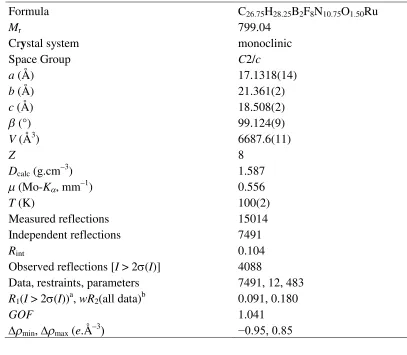
Single crystals of formula [Ru(bip)2][BF4]2∙0.75CH3NO2were obtained by slow diffusion of
diethyl ether vapor into a nitromethane solution of the complex. Experimental details of the
structure determination are given in Table 1. The crystals have a high mosaicity, which
accounts for the highRintandR1parameters in the table and the low precision of the
refinement. Diffraction data were collected with an Agilent Supernova dual-source
diffractometer using monochromated Mo-K radiation radiation (= 0.71073 Å). The
diffractometer is fitted with Oxford Cryostream low-temperature devices. The structure was
solved by direct methods(SHELXS97[22]), and developed by full least-squares refinement
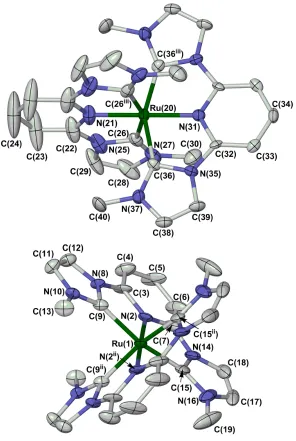
The asymmetric unit contains two half-molecules of the complex dication, with Ru(1) lying
on theC2axis 0,y, ¼ and Ru(20), N(21), C(24), N(31) and N(34) all lying on theC2axis ½,
y, ¼. There are also two BF4−ions lying on general crystallographic sites, and a nitromethane
molecule that was modelled over two orientations with occupancies 0.5 and 0.25. The fixed
restraints C−N = 1.45(2), N−O = 1.22(2), O...O = 2.09(2) and C...O = 2.30(2) Å were applied
to the solvent molecules. All non-H atoms except the minor partial solvent residue were
refined anisotropically, and H atoms were placed in calculated positions and refined using a
riding model. Large displacement ellipsoids on C(23) and C(24) probably reflect
librational disorder in that pyridyl ring, caused by a short intermolecular contact to the
disordered solvent site [C(23)...C(51Bi) = 3.08 Å; symmetry code (i) = ½+x, ½+y,z].
Attempts to refine that ligand disorder did not afford a sensible model, however, and did not
significantly improve the residuals.
Other measurements.
Electrospray mass spectra were obtained using a Waters Micromass LCT TOF spectrometer,
in a MeOH matrix. CHN microanalyses were performed by the University of Leeds
Department of Chemistry microanalytical service. Magnetic susceptibility measurements
were obtained using a Quantum Design SQUID/VSM magnetometer, in an applied field of
1000 G and a temperature ramp of 2 Kmin−1. Diamagnetic corrections were estimated from
Pascal’s constants [24]. X-ray powder diffraction measurements used a Bruker D8 Advance
A25 diffractometer, using Cu-Kradiation (= 1.5418 Å). Thermogravimetric analyses
Table 1. Experimental details for the single crystal structure determination of
[Ru(bip)2][BF4]2∙0.75CH3NO2.
Formula C26.75H28.25B2F8N10.75O1.50Ru
Mr 799.04
Crystal system monoclinic
Space Group C2/c
a(Å) 17.1318(14)
b(Å) 21.361(2)
c(Å) 18.508(2)
(°) 99.124(9)
V(Å3) 6687.6(11)
Z 8
Dcalc(g.cm–3) 1.587
(Mo-K, mm–1) 0.556
T(K) 100(2)
Measured reflections 15014
Independent reflections 7491
Rint 0.104
Observed reflections [I> 2(I)] 4088
Data, restraints, parameters 7491, 12, 483
R1(I> 2(I))a,wR2(all data)b 0.091, 0.180
GOF 1.041
min,max(e.Å–3) −0.95, 0.85
a
R=[Fo–Fc] /Fo bwR= [w(Fo2–Fc2) /wFo4]1/2
RESULTS AND DISCUSSION
The dopant complexes [Ru(bip)2]2+and [Ru(terpy)(terpy*)]2+have both been previously
prepared, as salts with PF6−or BPh4−counterions [19, 20]. We needed the BF4−salts of the
compounds in this work, for compatibility with the [Fe(bpp)2][BF4]2host lattice. Both
[Ru(bip)2][BF4]2and [Ru(terpy)(terpy*)][BF4]2were prepared by the same literature
procedures, but using excess aqueous NaBF4to precipitate the final products. Both
lattice solvent, and showed that the compound does not adopt the same “terpyridine embrace”
crystal packing [25] adopted by [Fe(bpp)2][BF4]2and [Ru(terpy)2][BF4]2. That might make it
a less compatible dopant for [Fe(bpp)2][BF4]2, based on our previous arguments [15].
Although the precision of the refinement is low, the molecular geometry of the [Ru(bip)2]2+
complex is similar to other ruthenium complexes of this class ofbis-carbenyl chelate ligand
(Fig. 1) [19, 26]. The Ru−N bond lengths range from 2.010(8)-2.020(6) Å, while the Ru−C
distances are 2.035(8)-2.045(8) Å. Single crystals of [Ru(terpy)(terpy*)][BF4]2were not
obtained, but the solid compound contains a mixture of amorphous and crystalline material
by X-ray powder diffraction, and is not isostructural with [Ru(terpy)2][BF4]2(see below).
As a preliminary test to rule out ligand exchange between the iron and ruthenium centers
during their co-crystallization, solutions of [Fe(bpp)2][BF4]2and either [Ru(bip)2][BF4]2or
[Ru(terpy)(terpy*)][BF4]2in CD3NO2were analysed by1H NMR at daily intervals. No
change in the spectra was observed over three days, which is the typical time required for
these compounds to crystallize. Afterca.5 days the spectra began to broaden however, with
weak new resonances appearing in the diamagnetic region (Fig. 2). It is unclear whether this
reflects exchange of tridentate ligands between the iron and ruthenium ions, or simply
decomposition of the organometallic ruthenium complexes (some precipitation of the intact
[Ru(terpy)(terpy*)][BF4]2occurred afterca.1 week, which may be a contributing factor to
those spectral changes). None-the-less, it is clear that the host compound and the two dopant
complexes retain their integrity during the 1-2 days required for the synthesis of the solid
Figure 1The two unique complex molecules in the crystal structure of
[Ru(bip)2][BF4]2∙0.75CH3NO2. Displacement ellipsoids are at the 50 % probability level, and
H atoms are omitted for clarity. The large displacement ellipsoids on C(23) and C(24) reflect
librational disorder, caused by a close intermolecular C…C contact to the disordered solvent.
Figure 2The diamagnetic, aromatic region of the1H NMR spectra of a 1:1 mixture of
[Fe(bpp)2][BF4]2and [Ru(terpy)(terpy*)][BF4]2in CD3NO2at 293 K. The spectra were run 1
day (top), 5 days (center) and 19 days (bottom) after mixing the complexes.
Following our previous protocol [15, 17, 18], nitromethane solutions containing
[Fe(bpp)2][BF4]2and either of the two dopants in pre-defined mole ratios were recrystallized
by slow diffusion of diethyl ether antisolvent at room temperature, over a period of 1-2 days.
When [Ru(bip)2][BF4]2was used as the dopant, the resultant polycrystalline solid was clearly
heterogeneous, containing two types of crystal which were manually separated, and identified
as pure [Fe(bpp)2][BF4]2and [Ru(bip)2][BF4]2by1H NMR. Therefore, solid solutions of
these complexes do not form under these conditions, and [Ru(bip)2][BF4]2was not
[Fe(bpp)2][BF4]2and [Ru(terpy)(terpy*)][BF4]2was visually homogeneous, and was
therefore investigated further. Five different compositions were prepared of formula
[Fe(bpp)2]x[Ru(terpy)(terpy*)]1−x[BF4]2∙yH2O, withx= 0.96, 0.85, 0.58, 0.28 and 0.13. In
contrast to our previous work [15-18],xwas consistently higher by microanalysis than
expected from the mole ratios of the complexes in the crystallization solutions. That may
reflect a higher solubility of the ruthenium dopant compared to the iron complex, which
therefore crystallizes preferentially. The water content of the materials (y) is 0 whenxis large
but increases at higher concentrations of the ruthenium complex (which also contains lattice
solvent in its pure form). The presence of this lattice water in the solid solutions was
[image:14.595.149.446.417.660.2]confirmed by TGA analyses (Fig. 3).
Figure 3Thermogravimetric analyses of [Fe(bpp)2]x[Ru(terpy)(terpy*)]1−x[BF4]2∙yH2O,
showing the increased presence of lattice solvent (y) with increasing ruthenium content. Loss
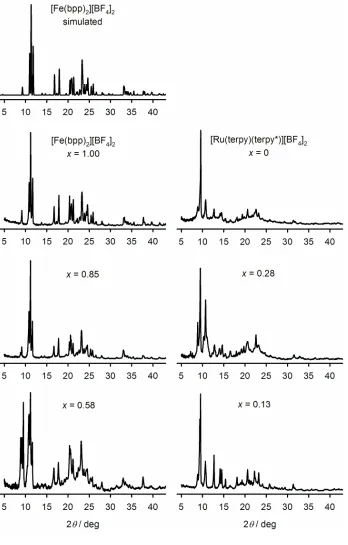
X-ray powder diffraction showed that the solid solutions withx= 0.96 and 0.85 were
homogeneous, crystalline and isostructural with pure [Fe(bpp)2][BF4]2(Fig. 4). Conversely
the ruthenium-rich material withx= 0.13 is also phase pure, and isostructural with the pure
ruthenium complex. However, the two intermediate compositions were less crystalline and
contain a mixture of both crystal phases and some amorphous material, with the
[Fe(bpp)2][BF4]2phase predominating whenx= 0.58 and the [Ru(terpy)(terpy*)][BF4]2
structure being in the majority whenx= 0.28 (Fig. 4). This is comparable to the
[Fe(bpp)2]z[Ru(terpy)2]1−z[BF4]2system where mixed-phase materials were obtained for 0.75
≥ z ≥ 0.28, although the intermediate compositions in that system were more crystalline than
in this work by powder diffraction [15].
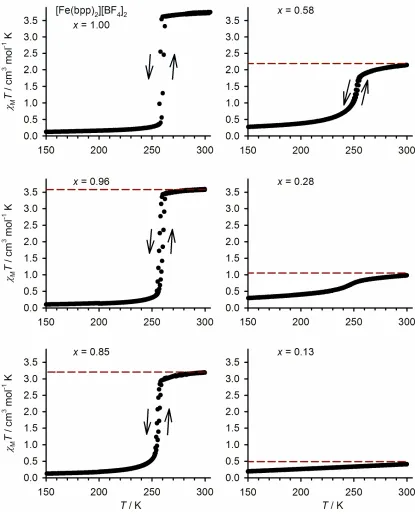
Pure [Fe(bpp)2][BF4]2exhibits an abrupt spin-transition at 260 K, with a small hysteresis
loop (T= 2-3 K [14, 15]). Spin-crossover in [Fe(bpp)2]x[Ru(terpy)(terpy*)]1−x[BF4]2∙yH2O
follows two consistent trends, according to magnetic susceptibility data (Fig. 5 and Table 2).
First, the transition midpoint temperatureT½gradually decreases with increasing mole
fraction of ruthenium. That is the expected trend, since the dopant molecule is larger than the
iron complex, which is in turn larger in its high-spin state. Thus, a higher dopant
concentration expands the crystal lattice [16] and stabilizes the high-spin state of the host
material [27]. Second, the transition becomes less cooperative asxdecreases. Whenx ≥ 0.85
this manifests as a narrowing of the transition hysteresis, but at higher dopant concentrations
the transition broadens considerably, to the extent that no defined spin-crossover event is
detectable forx= 0.13 (Fig. 5). That is again typical behavior for spin-crossover materials
containing inert dopants, which disrupt the elastic interactions between the iron centers in the
solid lattice [28]. Moreover, the abrupt spin-transitions in these solid solutions are
superimposed upon an underlying, more gradual spin-crossover equilibrium which becomes
Figure 4 X-ray powder diffraction data for different compositions of solid solution
[Fe(bpp)2]x[Ru(terpy)(terpy*)]1–x[BF4]2 at 298 K. A simulation derived from the crystal
structure of the pure [Fe(bpp)2][BF4]2 phase is also given [15]. The data forx= 0.96 are not
Figure 5Variable temperature magnetic susceptibility data for different compositions of
solid solution [Fe(bpp)2]x[Ru(terpy)(terpy*)]1–x[BF4]2. All data were measured with coling
and warming temperature ramps. The dashed lines show the predictedMTvalue for each
sample in its fully high-spin state, based on its microanalytical composition. Data for
Table 2. Spin-crossover parameters for the [Fe(bpp)2]x[Ru(terpy)(terpy*)]1−x[BF4]2∙yH2O
solid solutions. No spin-transition is detectable whenx= 0.13 (Fig. 3).
x T½ (K) T½ (K) T½(K)
1.00 258 261 3
0.96 257 260 3
0.85 255 256 1
0.58 253 254 1
0.28 251 251 −
0.13 − − −
crystalline:amorphous nature of these solid solutions, which is evident by powder diffraction
(Fig. 4). Iron centers in the amorphous material would be expected to undergo less
cooperative spin-crossover than in a crystalline phase, as observed. Notably co-existing
abrupt and gradual spin-transitions were not apparent in our earlier systems
[Fe(bpp)2]z[M(terpy)2]1−z[BF4]2(M = Ru, Co), which are also fully crystalline by powder
diffraction [15, 17].
The relationship between composition andT½shows some differences between
[Fe(bpp)2]x[Ru(terpy)(terpy*)]1−x[BF4]2∙yH2O and [Fe(bpp)2]z[Ru(terpy)2]1−z[BF4]2, however.
At low dopant concentrations (x,z ≥ 0.75) the two sets of compounds behave similarly, in
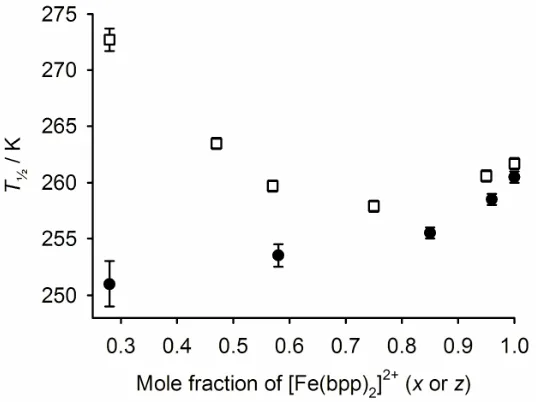
thatT½decreases with increasing dopant at a similar rate (Fig. 6). However,T½in
[Fe(bpp)2]z[Ru(terpy)2]1−z[BF4]2begins to increase whenz< 0.75, which is also the
composition where the materials begin to contain a mixture of crystal phases (Fig. 6) [15].
Hence, [Fe(bpp)2]2+doped into [Ru(terpy)2][BF4]2exhibits a higherT½than in its pure form;
that is, the [Ru(terpy)2][BF4]2lattice stabilizes the low-spin state of a [Fe(bpp)2]2+center to a
greater extent than its native [Fe(bpp)2][BF4]2structure [15]. Clearly [Fe(bpp)2]2+doped into
[Ru(terpy)(terpy*)][BF4]2does not behave the same way, and the
Figure 6Variation in spin-crossover midpoint temperatureT½with composition for
[Fe(bpp)2]x[Ru(terpy)(terpy*)]1–x[BF4]2 ( ) and [Fe(bpp)2]z[Ru(terpy)2]1–z[BF4]2 ( ) [15].
The absorption and emission spectra of the ruthenium compounds in this work resemble the
previous reports of those complexes [19,20]. In particular, both the dopant compounds
fluoresce intensely in MeCN solution at room temperature with emission maxima at 531 nm
([Ru(bip)2][BF4]2) and 783 nm ([Ru(terpy)(terpy*)][BF4]2). Neither compound showed an
observable emission in the solid state upon irradiation at 254 or 365 nm at 298 K, however.
The [Fe(bpp)2]x[Ru(terpy)(terpy*)]1−x[BF4]2∙yH2O solid solutions similarly did not fluoresce
at room temperature.
CONCLUSION
This work has demonstrated both flexibility and limitations to our dopant approach to
multifunctional spin-crossover materials. On one hand, [Fe(bpp)2][BF4]2and
[Ru(terpy)(terpy*)][BF4]2were successfully co-crystallized, despite there being no apparent
relationship between the structures of the pure solids by X-ray powder diffraction. The
at the periphery of the (formally zwitterionic) terpy* ligand, also has no bearing on its ability
to intercalate into the [Fe(bpp)2][BF4]2lattice. In contrast, we observed no evidence for the
co-crystallization of [Fe(bpp)2][BF4]2and [Ru(bip)2][BF4]2, despite the closer similarity
between the shapes of their heterocyclic ligand backbones. That may reflect the methyl
substituents on the bip ligands, which could sterically hinder the formation of…
interactions between [Ru(bip)2]2+and nearest neighbor [Fe(bpp)2]2+molecules. Such
interactions are an important component of the terpyridine embrace lattice type adopted by
the iron compound [25]. In summary, the most important factor determining whether a
dopant complex is suitable for intercalation into [Fe(bpp)2][BF4]2appears to be the shape of
the dopant molecule.
SUPPLEMENTARY DATA
CCDC 1010801 contains the supplementary crystallographic data for
[Ru(bip)2][BF4]2∙0.75CH3NO2. These data can be obtained free of charge via
http://www.ccdc.cam.ac.uk/conts/retrieving.html, or from the Cambridge Crystallographic
Data Centre, 12 Union Road, Cambridge CB2 1EZ, UK; fax: (+44) 1223-336-033; or e-mail:
ACKNOWLEDGEMENTS
The authors thank Dr O. Cespedes (School of Physics and Astronomy, University of Leeds)
for help with the magnetic susceptibility measurements, and Dr. T. P. Comyn (School of
Process, Environmental and Materials Engineering, University of Leeds) for assistance with
the X-ray powder diffraction experiments. This work was supported by the EPSRC
REFERENCES
[1] P. Gütlich, H. A. Goodwin (Eds.) Spin Crossover in Transition Metal Compounds I-III.
Top. Curr. Chem. vols. 233-235, Springer Verlag, Berlin, Germany (2004).
[2] M. A. Halcrow (Ed.) Spin-crossover materials - properties and applications, John Wiley
& Sons, Chichester, UK (2013).
[3] a) P. Gütlich, Eur. J. Inorg. Chem. (2013) 581;
b) P. Gütlich, A. B. Gaspar, Y. Garcia, Beilstein J. Org. Chem. 9 (2013) 342.
[4] a) A. Bousseksou, G. Molnár, L. Salmon, W. Nicolazzi, Chem. Soc. Rev. 40 (2011)
3313;
b) M. Cavallini, Phys. Chem. Chem. Phys. 14 (2012) 11867.
[5] J. Hasserodt, J. L. Kolanowski, F. Touti, Angew. Chem. Int. Ed. 53 (2014) 60.
[6] a) J. Linares, E. Codjovi, Y. Garcia, Sensors 12 (2012) 4479;
b) O. S. Wenger, Chem. Rev. 113 (2013) 3686.
[7] a) Z. Ni, M. P. Shores, J. Am. Chem. Soc. 131 (2009) 32;
b) M. C. Young, E. Liew, R. J. Hooley, Chem. Commun. 50 (2014) 5043.
[9] A. B. Gaspar, V. Ksenofontov, M. Seredyuk, P. Gütlich, Coord. Chem. Rev. 249
(2005) 2661.
[10] a) C. Faulmann, K. Jacob, S. Dorbes, S. Lampert, I. Malfant, M.-L. Doublet, L. Valade,
J. A. Real, Inorg. Chem. 46 (2007) 8548;
b) K. Takahashi, H.-B. Cui, Y. Okano, H. Kobayashi, H. Mori, H. Tajima, Y. Einaga,
O. Sato, J. Am. Chem. Soc. 130 (2008) 6688;
c) M. Nihei, N. Takahashi, H. Nishikawa, H. Oshio, Dalton Trans. 40 (2011) 2154;
d) W. Xue, B.-Y. Wang, J. Zhu, W.-X. Zhang, Y.-B. Zhang, H.-X. Zhao, X.-M. Chen,
Chem. Commun. 47 (2011) 10233;
e) K. Fukuroi, K. Takahashi, T. Mochida, T. Sakurai, H. Ohta, T. Yamamoto, Y.
Einaga, H. Mori, Angew. Chem. Int. Ed. 53 (2014) 1983.
[11] a) M. Matsuda, H. Isozaki, H. Tajima, Chem. Lett. 37 (2008) 374;
b) L. Salmon, G. Molnár, D. Zitouni, C. Quintero, C. Bergaud, J.-C. Micheaud, A.
Bousseksou, J. Mater. Chem. 20 (2010) 5499;
c) Y. Garcia, F. Robert, A. D. Naik, G. Zhou, B. Tinant, K. Robeyns, S. Michotte, L.
Piraux, J. Am. Chem. Soc. 133 (2011) 15850;
d) S. Titos-Padilla, J. M. Herrera, X. W. Chen, J. J. Delgado, E. Colacio, Angew.
Chem. Int. Ed. 50 (2011) 3290;
e) R. González-Prieto, B. Fleury, F. Schramm, G. Zoppellaro, R. Chandrasekar, O.
[12] a) M. Clemente-León, E. Coronado, C. Martí-Gastaldo, F. M. Romero, Chem. Soc.
Rev. 40 (2011) 473;
b) J. H. Yoon, D. W. Ryu, S. Y. Choi, H. C. Kim, E. K. Koh, J. Tao, C. S. Hong,
Chem. Commun. 47 (2011) 10416;
c) O. Roubeau, M. Evangelisti, E. Natividad, Chem. Commun. 48 (2012) 7604;
d) E. Coronado, M. Giménez-Marqués, C. Martí-Gastaldo, G. M. Espallargas, E.
Navarro-Moratalla, J. C. Waerenborgh, Inorg. Chem. 52 (2013) 8451.
[13] a) S. Hayami, M. R. Karim, Y. H. Lee, Eur. J. Inorg. Chem. (2013) 683;
b) A. B. Gaspar, M. Seredyuk, Coord. Chem. Rev. 268 (2014) 41.
[14] a) J. M. Holland, J. A. McAllister, Z. Lu, C. A. Kilner, M. Thornton-Pett, M. A.
Halcrow, Chem. Commun. (2001) 577;
b) J. M. Holland, J. A. McAllister, C. A. Kilner, M. Thornton-Pett, A. J. Bridgeman,
M. A. Halcrow, J. Chem. Soc. Dalton Trans. (2002) 548.
[15] C. A. Tovee, C. A. Kilner, J. A. Thomas, M. A. Halcrow, CrystEngComm 11 (2009)
2069.
[16] G. Chastanet, C.A. Tovee, G. Hyett, M. A. Halcrow, J.-F. Létard, Dalton Trans. 41
(2012) 4896.
[18] R. Docherty, F. Tuna, C. A. Kilner, E. J. L. McInnes, M. A. Halcrow, Chem.
Commun. 48 (2012) 4055.
[19] S. U. Son, K. H. Park, Y.-S. Lee, B. Y. Kim, C. H. Choi, M. S. Lah, Y. H. Jang, D.-J.
Jang, Y. K. Chung, Inorg. Chem. 43 (2004) 6896.
[20] E. C. Constable, A. M. W. Cargill Thompson, J. Cherryman, T. Liddiment, Inorg.
Chim. Acta, 235 (1995) 165.
[21] E. C. Constable, A. M. W. Cargill Thompson, D. A. Tocher, M. A. M. Daniels, New J.
Chem. 16 (1992) 855.
[22] G. M. Sheldrick, Acta Cryst. Sect. A 64 (2008) 112.
[23] L. J. Barbour, J. Supramol. Chem. 1 (2001) 189.
[24] C. J. O’Connor, Prog. Inorg. Chem. 29 (1982) 203.
[25] J. McMurtrie, I. Dance, CrystEngComm 7 (2005) 216.
[26] a) H.-J. Park, K. H. Kim, S. Y. Choi, H.-M. Kim, W. I. Lee, Y. K. Kang, Y. K. Chung,
b) H.-J. Park, Y. K. Chung, Dalton Trans. 41 (2012) 5678.
[27] A. Hauser, N. Amstutz, S. Delahaye, A. Sadki, S. Schenker, R. Sieber, M. Zerara,
Struct. Bonding 106 (2004) 81.

![Figure 3 Thermogravimetric analyses of [Fe(bpp)2]x[Ru(terpy)(terpy*)]1−x[BF4]2∙yH2O,](https://thumb-us.123doks.com/thumbv2/123dok_us/7889630.185826/14.595.149.446.417.660/figure-thermogravimetric-analyses-fe-bpp-ru-terpy-terpy.webp)
![Table 2. Spin-crossover parameters for the [Fe(bpp)2]x[Ru(terpy)(terpy*)]1−x[BF4]2∙yH2O](https://thumb-us.123doks.com/thumbv2/123dok_us/7889630.185826/18.595.69.524.104.219/table-spin-crossover-parameters-for-the-terpy-terpy.webp)