www.studiapaedagogica.cz DOI: 10.5817/SP2015-4-8
EMPLOYABILITY AND LEARNING
TRANSFER:
WHAT DO STUDENTS EXPERIENCE
DURING THEIR PLACEMENTS?
1GISELA OLIVEIRA
Abstract
This article examines learning transfer as an alternative framework for investigating transitions of students between higher education and the workplace. It highlights some of the shortcomings of the current framework provided by human capital theory and employability concepts and describes the learning transfer model as an alternative that focuses on the transition and continuity of students’ work-placements experiences. Drawing on the findings of an empirical study that gathered qualitative data from interviews, observation and written reflections of undergraduate students during and after their one year work-placement, this paper draws attention to the problems of narrow views of learning transfer and the limitations of human capital theory to explain current professional paths.
Keywords
higher education, workplace, transition, learning transfer
1 This research is cofunded since March 2015, by the European Social Fund and the
Introduction
Nowadays universities face great national and international pressures to adapt to more economical aims and to promote graduates’ employability (Tymon, 2013). These pressures come from different stakeholders (Atkins, 1999; Jackson, 2014), including governments, students and employers, all of which have specific agendas. The overall expectation of these groups regarding higher education is that it should bring social and economic benefits to individuals and society and increased productivity and competiveness to companies and, consequently, to their nations (Jackson, 2014).
The theoretical support for these expectations comes from human capital theory (Becker, 1993). Becker posits that education contributes to the development and increased competitiveness of national economies through the preparation of the general workforce with knowledge and skills that are relevant for productivity of enterprises. Within this view, which has been widely used in educational policy (Tan, 2014), education is regarded as an investment in the (future) increased market value of the educated individual (Brown & Sessions, 2005). Therefore, it is also expected that individuals invest in education since it will result in a larger benefit than the actual costs of getting that education (Weiss, 1995).
At this point, it becomes relevant to consider the empirical evidence that supports human capital theory and, in doing so, we observe that it derives from studies and policy recommendations from organizations such as OECD and the European Commission (Education and Training Monitor, 2014;
Education at a Glance 2014 – Highlights. OECD Indicators, 2014; What are the social benefits of education?, 2013). They argue for the private and social benefits of more education (Education at a Glance 2014 – Highlights. OECD Indicators, 2014;
What are the social benefits of education?, 2013), and, more recently, they make the link between technology, skills and competitiveness (Better Skills, Better Jobs, Better Lives: A Strategic Approach to Skills Policies, 2012; Education and Training Monitor, 2014) to highlight that education is the driving force for employability and economic growth. Moreover, in the recent highlights of Education at a
Glance (2014), OECD claims that the impact of education on life chances of
individuals has increased.
2011). For example, within the University of Leeds, these work placements are described as opportunities for the students to gain practical experience related to their degree, in any type of organisation, in the UK or abroad. They are usually paid by the employers as they occur between the second and third academic year. Still, not every student has the opportunity to have a work placement since they have to search, apply and secure it by themselves in a market that is becoming more and more competitive.
This focus on employability is not consensual and there are critical views on the marketization of higher education (Harvey, 1998; Readings, 1996; Wolf, 2002), questioning if this is an aim that universities should follow. For example, Knight and Yorke (2003, p. 8) argue that “higher education is primarily about developing advanced understandings of worthwhile subject matter, not about employability.” Also, the benefits of higher education are often criticized (inter alia, Barr, 2005; Chevalier, Conlon, Galindo-Rueda, & Ncnally, 2003; Holmes, Keep, & Mayhew, 2012; Weiss, 1995; Williams, 1999), and highlight, for example, differences in returns based on gender (Chevalier et al., 2003) or subject of study (Williams, 1999). Both these areas are addressed in my ongoing doctorate work from which this paper derives and they are both relevant topics of discussion. However, for now, the focus is on understanding the possible shortcomings of the notion of employability within human capital theory’s framework to understand students’ transitions between university and the workplace.
Understanding the concept of employability in higher education
education are easily applied in the workplace (Atkins, 1999), meaning that transfer would occur in an easy and straight forward way as a direct application of knowledge (Bransford & Schwartz, 1999). This view also relates to Beach’s (1999, 2003) definition of a lateral transition. A lateral transition is an upward movement between two activities. Beach (1999, 2003) explains that the first activity is considered as a preparation and the transition from the first to the second is understood as progress, hence, unidirectional.
Following these critical views on how employability is conceptualized in higher education, more recent research on the topic is calling for a different understanding of the link between higher education and the workplace (Knight & Yorke, 2003; Tomlinson, 2012; Tymon, 2013). One that focuses on process rather than on application of skills and that would prepare students for transitions rather than for specific job descriptions. Consequently, this paper aims to discuss students’ work-placement experiences in the light of a conceptual framework that focuses on process and development and assess its usefulness as an analytical tool to understand the transition between university and the workplace.
Proposing a conceptual framework based on learning transfer
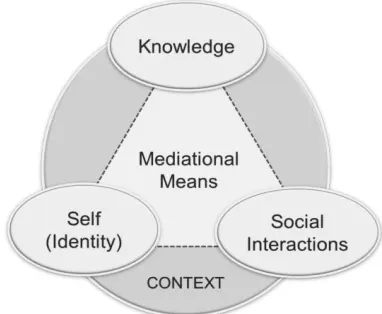
The learning transfer process model was developed as an analytic tool that can mediate our understanding of students’ transitions between higher education and the workplace. Within the framework, learning transfer is defined as a consequential and developmental process of transformation experienced by individuals which regards their knowledge, their interactions and their identities, as they occur in the transition between contexts. This process is consequential in the sense that Beach (1999, p. 114) described transitions as “consciously reflected on, often struggled with, and (when) the eventual outcome changes one’s sense of self and social positioning.” Therefore, within this framework, students assume an active role of sense making and construction of their own experiences making the process also developmental, which means that there is a sense of individual progress in these transitions.
The development of this conceptual framework was a relevant part of the research itself. The dimensions were developed from literature on transfer and from an attempt to integrate relevant contributions from classical, cognitive and situated perspectives on learning transfer, aiming at a holistic approach to the concept. The framework was then used to inform the data collection process by providing areas of questioning for interviews and cues for observation and also for data analysis by the development of theory driven codes (DeCuir -Gunby, Marshall & McCulloch, 2011).
Figure 1
Learning Transfer Process Model
Conceptual Framework Dimensions
The knowledge dimension aimed to look at what type of knowledge transfers between university and the workplace, but also at what barriers and enablers students encounter in their transitions. To operationalize this concept for the research, knowledge was framed resorting to Lundvall’s (Lundvall, 1996; Lundvall & Johnson, 1994) typology of know-what (factual knowledge), know-why (knowledge about rules and laws), know-how (practical knowledge) and know-who (knowledge about gatekeepers in the community). This typology enabled the integration of codified knowledge (Eraut, 2004), deriving from books and data-bases and tacit knowledge (Eraut, 2004) which is developed through social interactions and provided specific areas of questioning for the research.
in that space. Eraut’s (2004, 2007, 2011) work on workplace learning presented some important cues as to what could be more relevant to frame students’ experiences. His research highlights the need to learn from other people, either by supervisors, mentors, shadowing experiences, or some combination of them (Eraut, 2004, 2007). Looking at social interactions in the placement also enables the understanding of the students positioning in the community and the development of his or hers professional identity.
Consequently, the dimension of self was introduced to address issues of participation (Lave & Wenger, 1991; Wenger, 1998), negotiation (Lave & Wenger, 1991), membership (Lave & Wenger, 1991; Wenger, 1998) and becoming (Beach, 1993, 1999, 2003; Wenger, 1998). The fact that learning transfer is defined as a dynamic concept that places agency within the individual required some focus on how the students themselves change with these placement experiences and how their professional identities begin to develop. Therefore, professional identity is, here, described as resulting from a certain position within a community, the interaction with others in that community and the individual’s interpretations of those interactions (Sutherland, Howard, & Markauskaite, 2010), which refers back to the idea of social positioning that Beach referred to (1999).
The last two aspects present in the conceptual framework are artifacts and the context. Artifacts are described as tools, physical and conceptual that mediate students’ actions (Holland, Lachicotte, Skinner, & Cain, 1998) and context is understood as, not only the university and the placement, but also the transition between both places. The two key concepts used to understand context in this research were communities of practice (Wenger, 1998; Wenger, McDermott, & Snyder, 2002), and intercontextuality (Engle, 2006; Engle, Lam, Meyer, & Nix, 2012).
Methodology
The research that supports this paper is being developed through a longitudinal case study with three instrumental cases (Stake, 1994). The overall focus of the research is the process of learning transfer that students experience when they move from university to the workplace and it was bounded (Stake, 1994) within students’ transitions between their second and third years of university, in a one-year work-placement, which acts as a mediated transition for the workplace (Beach, 1999, 2003).
research by participating in interviews and, if possible, placement observation. The following step required the selection of participants based on maximum variation (Patton, 2002), regarding their school, degree and type of placement. However, only four students responded to the e-mail request sent through the Schools and all became participants. One extra participant was recruited through an emergent sample (Patton, 2002), during a job shadowing activity as practice for placement observation. The research started with five participants, all from different schools, different degrees and in different placement organisations. Unfortunately, two participants were unable to continue their collaboration after the first interview and the final sample was reduced to three cases – Daniel, Maggie and Julie.
The aim was to understand how these students navigated the figured world of work presented by the placement. The concept of figured world was developed by Holland and colleagues (1998) and describes the ‘‘socially produced, culturally constructed activities’’ (Holland et al., 1998, p. 40–41) that shape individuals actions and identity development. This concept is used within this research as an umbrella theme that explains how students integrate and shape all the dimensions from the learning transfer process in their understanding of the context. The figured world and its navigation is a construction and the better students are able to develop it, in terms of knowledge, tasks, relevant people, physical spaces, explicit and implicit rules, the better they will navigate the world of work and shape their experiences.
With this purpose of understanding the students’ navigation of the workplace in mind, each of them was interviewed five times while they were in their placement year and one time after it, when they returned to the University of Leeds. The interviews were semi-structured and lasted between 45 minutes and 1 hour and 15 minutes. For Maggie and Julie, the data sets also comprised of three days of placement observation and following field notes and, for Julie it further included weekly placement reflections.
Data was analysed through the suggested stages of Braun and Clarke`s (2006, 2012) thematic analysis, namely: familiarising with the data, through transcription of interviews and note-taking; generating initial codes, searching for themes and, reviewing and defining final themes. The coding process was assisted by the development of a codebook, used as a strategy to ensure higher consistency in coding data and providing information about the codes, their correct interpretation, and examples of coded material (DeCuir et al., 2011; MacQueen, McLellan, Kay, & Milstein, 1998), and the use of the qualitative data analysis software NVivo, in version 10.
account of events detailing students’ reasons for having a placement, placement tasks, interactions and learning, but also, the students’ development within the placement experience and transition back to university.
Participants
Daniel was a student of Mechanical Engineering at the University of Leeds. He was 23 when we had the first interview and he is considered by the University a mature student. He would not agree with this definition in our first interview and used humour to refer to it: “technically classed as a mature student but, at 23, I don´t think it´s too bad though” (Daniel, Interview 1). Before going to university, Daniel had some engineering unrelated work experiences in order to figure out what he wanted to do. While in university Daniel had a good balance between social and academic life and was able to get a first for both years. The placement at a Sugar Factory was a last minute decision, spurred by realising most of his friends were having a placement or a year abroad. For him, it was just the case of anticipating getting some practical experience.
Maggie’s professional aspiration is to work in publishing. She entered Higher Education because she wanted to learn more about English and Literature and not necessarily to get a job. She doesn’t think a publishing career requires a degree as much as relevant work experience. She was 20 years old at the time of our first interview and in between the second and third year of an English Language and Literature degree at the University of Leeds. Maggie was no stranger to part-times, which she had since she was 17 years old: “I’ve always liked the idea of having work experience, hum, I´ve always kind of tried to work ever since I was 17, I think, when I had my first job” (Maggie, Interview 1). Consequently, the placement was a natural decision for her, but she justified it with financial reasons, the pursuing of practical experience and the desire to take a break from education. Overall, she applied for the placement in a Student’s Union Employability Office because “it was useful for (her) my future” (Maggie, Interview 1).
Findings
This section presents some findings related to the students’ views on their transition between university and the workplace, specifically focusing on how they experienced this transition and the learning transfer between university and the workplace.
Data revealed that the student’s construction of the figured world of work included some level of transfer of learning between university and the workplace, but not just unidirectional, as expected if it were a lateral transition (Beach, 1999, 2003).
All three students, Julie, Maggie and Daniel, experienced some transfer between university and their placement, mostly related to academic knowledge that would suit the placement as background information.
“Because a lot of, hum, a lot of the knowledge that we use on site is expected. So, whether it is working with tools, materials strengths, machinery, a lot of different things. It´s kind of a pre-requisite, so they expect you to know how gear boxes and clutches, how different materials react under stress.” (Daniel, Interview 1)
“Like, mostly to work you do need that background university knowledge, the theory behind it, but it’s quite different, I mean, that’s completely practical. And, you must put into place some things that you learn in university but you’re not really putting in place all the things. But, I think it’s good for that background knowledge to have.” (Julie, interview 2)
“Yeah, cause one of the criteria for this job is that I can, hum, I proofread CV’s for international students so, a lot of that is based on my knowledge of English, hum, and the language itself so, a lot of the courses that I have done, quite a lot of stuff to do with, hum, looking at grammar and spelling and, pronunciation and things like that, so, hum, that kind of stuff does come in useful.” (Maggie, Interview 1)
However, the data also seemed to portray that the students had a very narrow view of transfer. The students’ views described ideas about near transfer and often failed to understand how their degree was relevant for their placement, beyond some direct application of knowledge or the failure to directly apply knowledge. Quotes of transfer always relate to similar tasks that students performed before the placement and Daniel often illustrated how much he transferred from university to the workplace with percentages ranging from 10 to 30 %.
“I’m using some of it, hum, not all of it. Hum, I’ll say maybe 10 %.” (Daniel, Interview 1)
they were not using it at the time. This concept was usually followed by describing the need to learn things again before going back to university, hinting that the students experienced the transition from university to the placement within a compartmentalization of the type of knowledge and tasks they perform in both settings.
“Hum, one of the things that I am worried about it that I am just going to forget everything (laughing) and then go back next year and go like “I don’t remember any of this,” so I’m going to have to start next semester, hum, actually, doing some more reading and doing some more, sort of, like, critical theory, while I’m actually off for the year.” (Maggie, Interview 2) However, along with the fear of forgetting, several comments by the students showed that they expected some learning transfer to occur from the placement back to university. Learning transfer was, then, understood in the data as multidirectional, meaning that the placement experience might not be best described as a lateral transition, but rather as a collateral transition (Beach, 1999, 2003). This type of transition is multidirectional and does not entail an explicit notion of progress, which, looking at the data collected is presented in students’ accounts of little transfer and on the fear of forgetting. Data also presented evidence that, beyond concern with skills and knowledge, students engaged in a negotiated process of belonging to the new communities of practice of the placement that had implications on their identities as students and as professionals. All three students believed to have changed with the placement experience and generally described a process of becoming more confident.
“Yeah, yeah, I would say I’ve changed. More, my attitude towards work, and my future. Hum, I thought I had a good idea of what I wanted to do a year ago. And now, I’m probably more confused than ever.” (Daniel, Interview 5) “Yeah, I was very unaware, cause I was very unsure in myself, my, and ability, whereas now I feel much more confident in my ability to do that work and do it well.” (Maggie, Interview 6)
“I think I’m probably more confident and, you know, I’m also, less, I’m more confident to ask for help, and I’m more confident to, do some tasks that have been assigned to me, rather than being, being scared, “oh, can I do it, can I not.” (Julie, interview 5)
“I shadowed him for about a week, hum, helping him do different things, but at the same time just asking when he was going through risk assessments, “can I come along just to see how it works?”. Hum, and just asking every time, when he would go out to do something that would normally be by himself with somebody, so him and a contractor, or him and, I don’t know, one of the engineers, I would ask, you know, “can I come along just to see how it works?” (Daniel, Interview 2)
For Daniel, that strategy led to a better understanding of the factory and how it worked, but also, to an acknowledgement of the projects he wanted to participate in, which was not possible in the beginning.
“But after being there for, say, two, three months, I didn’t have a clue what technical projects there were out there. It’s at the stage that I’m at now that I could actually, maybe pick out some really good projects.” (Daniel, Interview 3)
At the end of the placement, Daniel felt and was seen in the factory as a professional. He told me how, many colleagues would actually forget during the day to day work that he was a placement student and he had to remind them of that fact. When looking back, Daniel would want that level of knowledge of the people, the projects, the content and the physical factory to be provided to him faster.
Julie had a different experience of the construction of her figured world of work. She made a continued choice to maintain her identity has a student during the placement. She decided to work in the postgraduate cluster instead of her research office and she would look for the company of students rather than PhD students and research colleagues.
“Yeah, it´s just that, in my office there’s not really that many people, and also, they’re all PhD students. So I just like to work in the post-grad. Because, I just told you, a lot of undergrads come there. So, sometimes I just see my friends and it’s like, “hi,” “hello.” I just get to see more people.” (Julie, Interview 2)
However, and despite having distinct constructions of their own figured world of work, all the students considered the placement experience worthwhile and relevant for their future life, both for the immediate year of university, their last as an undergraduate, or for their quests as recent graduates, either in the marketplace or still in academia.
Discussion
The previous section presented some data on students’ transitions from university to the placement. It shortly described how they engaged with the setting, the people, including themselves and the knowledge. All three found the placement worthwhile and a valuable experience to have for a year. However, the crucial question at this point is if their experiences confirm or conflict the view promoted by human capital theory and employability frameworks of that transition as lateral (Beach, 1999, 2003).
Lateral transitions imply a unidirectional, vertical progress between two adjacent activities (Beach, 1999, 2003), while the data tells stories about the participants moving back and forth in their interpretations of the placement, the knowledge and of their positioning. This is more in line with a collateral transition (Beach, 1999, 2003) based on constant negotiation or with an encompassing transition (Beach, 1999, 2003) in which students become full-participants of the new community of practice (Wenger, 1998).
In the transitions portrayed in the data nothing seemed to be easy or straightforward and, especially, transfer of learning was not just a direct application of knowledge. The main reflections to draw from data on this point is that, although students find it hard to talk and experience transfer of learning beyond knowledge, they talk of the relevance of people for learning (Eraut, 2004, 2007; Lundvall, 1996), like Daniel shadowing his colleagues. They also talk about how learning transfer is multidirectional and, therefore, we can conclude, intercontextual (Engle, 2006), meaning that it is possible to “create connections between settings” that will promote transfer.
Moreover, the students’ transitions present in the data are often struggled with, in a process of becoming, in which students take an active role in developing their positioning (Beach, 1999). Such an example can be Julie choosing her work setting based on her defining her identity as a student even in the professional setting.
Conclusions
This paper aimed to question current views of employability in higher education, starting from the introduction of a conceptual framework that can provide useful reflections on the question of what students experience during their placements. Placements were presented as an instrument used by universities to promote students’ employability in an effort to cope with the consequences of educational policy recommendations and other stakeholders expectations based on human capital theory and studies on the returns on education. The picture presented by human capital theory and supported by those studies was that students would become more employable and productive because of their education. However, human capital theory lays on a widespread assumption that learning transfer between university and the workplace is easy and straightforward.
By presenting a new conceptual framework based on learning transfer as a consequential and developmental transition, this paper aimed to argue that the transition between higher education and workplace might be better described as a continued negotiation of belonging to a new community of practice and that current perceptions of transfer by the students between the two contexts could be improved.
References
Allen, J. I. M., & De Weert, E. (2007). What do educational mismatches tell us about skill mismatches? A cross-country analysis. European Journal of Education, 42(1), 59–73.
Atkins, M. J. (1999). Oven-ready and self-basting: Taking stock of employability skills. Teaching in Higher Education, 4(2), 267–280.
Barr, N. (2005). The benefits of education: What we know and what we don´t. In N. Barr & I. Crawford (Eds.), Financing Higher Education: Answers from the UK. London: Routledge. Beach, K. (1993). Becoming a bartender: The role of external memory cues in a work-directed
educational activity. Applied Cognitive Psycholog y, 7(1), 191–204.
Beach, K. (1999). Chapter 4: Consequential transitions: A sociocultural expedition beyond transfer in education. Review of Research in Education, 24(1), 101–139.
Beach, K. (2003). Consequential Ttransitions: A developmental view of knowledge propagation through social organizations. In T. Tuomi-Grèohn & Y. Engestrèom (Eds.), Between School and Work: New Perspectives on Transfer and Boundary Crossing. Bingley: Emerald Group Publishing.
Becker, G. S. (1993). Human Capital: A Theoretical and Empirical Analysis with Special Reference to Education. USA: University of Chicago Press.
Better Skills, Better Jobs, Better Lives: A Strategic Approach to Skills Policies (2012). Paris: OECD Publishing.
Bransford, J. D., & Schwartz, D. L. (1999). Rethinking transfer: A simple proposal with multiple implications. Review of Research in Education, 24(1), 66–100.
Braun, V., & Clarke, V. (2006). Using thematic analysis in psychology. Qualitative Research in Psycholog y, 3(2), 77–101.
Braun, V., & Clarke, V. (2012). Thematic analysis. In H. Cooper, P. M. Camic, D. L. Long, A. T. Panter, D. Rindskopf, & K. J. Sher (Eds.), APA handbook of research methods in psycholog y. Washington, DC: American Psychological Association.
Brown, S., & Sessions, J. G. (2005). Signaling and screening. In G. Johnes & J. Johnes (Eds.), International handbook on the economics of education. Cheltenham: Edward Elgar.
Chevalier, A., Conlon, G., Galindo-Rueda, F., & Ncnally, S. (2003). The Returns to Higher Education Teaching. London: Centre for the Economics of Education.
Cole, D., & Tibby, M. (2013). Defining and developing your approach to employability: A framework for higher education institutions. Heslington: The Higher Education Academy.
Decuir-Gunby, J. T., Marshall, P. L., & McCulloch, A. W. (2011). Developing and using a codebook for the analysis of interview data: An example from a professional development research project. Field Methods, 23(2), 136–155.
Education at a Glance 2014 – Highlights. OECD Indicators (2014). Paris: OECD Publishing. Engle, R. A. (2006). Framing interactions to foster generative learning: A situative explanation
of transfer in a community of learners classroom. Journal of the Learning Sciences, 15(4), 451–498. Engle, R. A., Lam, D. P., Meyer, X. S., & Nix, S. E. (2012). How does expansive framing
promote transfer? Several proposed explanations and a research agenda for investigating them. Educational Psychologist, 47(3), 215–231.
Eraut, M. (2007). Professional knowledge and learning at work. Knowledge, Work and Society, 4(3), 45–62.
Eraut, M. (2011). Informal learning in the workplace: Evidence on the real value of work-based learning (WBL). Development and Learning in Organizations, 25(5), 8–12.
Education and Training Monitor 2014 (2014). Brussels: European Commission. Retrieved from http.//ec.europa.eu/education/monitor
Gallagher, P. (2015). Graduate transition into work: The bridging role of graduate placement programmes in the small- and medium-sized enterprise workplace. Journal of Education and Work, 28(5), 461–480.
Harvey, D. (1998). University, Inc. The Atlantic Monthly, 282(4), 112–116.
Healy, A., Perkmann, M., Goddard, J., & Kempton, L. (2014). Measuring the Impact of University-Business Cooperation, Final Report. European Commission. Luxembourg: Publications Office of the European Union.
Holland, D., Lachicotte, W., Skinner, D., & Cain, C. (1998). Identity and Agency in Cultural Worlds. Harvard: Harvard University Press.
Holmes, C., Keep, E., & Mayhew, K. (2012). Ten big questions for higher education. SKOPE Issues Paper, 31(1). Retrieved from http://www.skope.ox.ac.uk/publications/ten-big-questions-higher-education.
Jackson, D. (2014). Modelling graduate skill transfer from university to the workplace. Journal of Education and Work, 1–33.
Knight, P. T., & Yorke, M. (2003). Employability and good learning in higher education. Teaching in Higher Education, 8(1), 3–16.
Lave, J., & Wenger, E. (1991). Situated Learning: Legitimate Peripheral Participation. Cambridge: Cambridge University Press.
Lundvall, B. Å. (1996). The Social Dimension of the Learning Economy. DRUID Working Papers. Aalborg: Aalborg University, Department of Business Studies.
Lundvall, B. Ä., & Johnson, B. (1994). The learning economy. Journal of Industry Studies, 1(2), 23–42.
Macqueen, K. M., McLellan, E., Kay, K., & Milstein, B. (1998). Codebook Development for Team-Based Qualitative Analysis. Field Methods, 10(2), 31–36.
Patton, M. Q. (2002). Qualitative Research & Evaluation Methods. California: SAGE Publications. Readings, B. (1996). The University in Ruines. Harvard: Harvard University Press.
Stake, R. E. (1994). Case Studies. In N. K. Denzin & Y. S. Lincoln (Eds.), Handbook of qualitative research. London: Sage Publications.
Støren, L. A., & Aamodt, P. O. (2010). The Quality of higher education and employability of graduates. Quality in Higher Education, 16(3), 297–313.
Sutherland, L., Howard, S., & Markauskaite, L. (2010). Professional identity creation: Examining the development of beginning preservice teachers’ understanding of their work as teachers. Teaching and Teacher Education, 26(3), 455–465.
Tan, E. (2014). Human capital theory: A holistic criticism. Review of Educational Research, 84(3), 411–445.
Tomlinson, M. (2012). Graduate employability: A review of conceptual and empirical themes. Higher Educational Policy, 25(4), 407–431.
Weiss, R. S. (1995). Learning from Strangers: The Art and Method of Qualitative Interview Studies. New York: The Free Press.
Wenger, E. (1998). Communities of Practice: Learning, Meaning, and Identity. Cambridge: Cambridge University Press.
Wenger, E., McDermott, R. A., & Snyder, W. (2002). Cultivating Communities of Practice: A Guide to Managing Knowledge. Harvard: Harvard Business School Press.
What are the Social Benefits of Education? (2013). Paris: OECD Publishing.
Williams, G. (1999). State finance of higher education: An overview of theoretical and empirical issues. In M. Henkel & B. Little (Eds.). Changing Relationships Between Higher Education And The State. Jessica Kingsley Publishers.
Wilton, N. (2011). The impact of work placements on skills development and career outcomes for business and management graduates. Studies in Higher Education, 37(5), 603–620. Wolf, A. (2002). Does Education Matter? Myths about education and economic growth. London: Penguin
Books.
Yorke, M., & Knight, P. T. (2014). Learning & Employability: Embedding employability into the curriculum. Heslington: The Higher Education Academy.
Corresponding author
Gisela Oliveira