1
Achieving Quality Teaching in Developing
Countries.
Identifying factors that influence the delivery of quality
teaching in primary schools in rural Cambodia.
A research project presented in partial fulfilment of the requirements for the degree of Master of International Development.
Institute of Development Studies Massey University
Manawatu, New Zealand
2
Abstract
At a global level the Education for All focus has shifted from years of schooling to the quality of education being attained. The delivery of quality education is dependent upon quality teaching. While there is no clear definition of quality teaching there are recognised characteristics which lend themselves to quality teaching and therefore are used as proxies to identify what constitutes a quality teacher. Of importance to this study is the fact these same recognised characteristics of what constitutes quality teaching and a quality teacher are reflected in the Ministry of Education, Youth and Sport in Cambodia (MoEYS) goals and teachers in Cambodia clearly identify with these characteristics.
Drawing on a case study of Cambodia this research examines the influences that work upon a teacher to either positively influence the delivery of quality teaching or to negatively influence the same.
3
Acknowledgements
This thesis would never have been completed if it wasn’t for the patience and wisdom of Dr Rochelle Stewart-Withers. I have needed a lot of her time and attention and I am very grateful. The guidance of Dr Regina Scheyvens throughout this project and also in fielding all manner of questions is much appreciated. The whole Development Studies team at Massey University has had a role to play.
I would like to acknowledge the Ministry of Education, Youth and Sport (MoEYS) in Cambodia. This project could not have happened without the cooperation and engagement of the staff of MoEYS and, through MoEYS, the teachers and School Directors in Cambodia. Thank you.
I also wish to recognise the teams that have been a part of achieving this research. These are the Cambodian team of The Cambodia Charitable Trust being our Country Manager, Ouch Soeun, and our staff of Nget Samboeun, Im Kanovuth, Nget Srey Mom, Meas Samnang and Ouch Soeun Vibol. Without these wonderful people this research would not have been possible, let alone all the other amazing things we are achieving together in Cambodia.
4
Table of Contents
Abstract ... 2
Acknowledgements ... 3
Chapter One: Introduction ... 11
1.1 Background to this research ... 11
1.1.1 The value of education: The Right to Education for All (EFA): ... 11
1.1.2 Quantity education versus quality education ... 12
1.1.3 The challenge of achieving quality education in Cambodia ... 14
1.2 My personal interest in education in Cambodia ... 16
1.3 Research aim. ... 17
1.4 Research questions ... 17
1.5 Approach to undertaking the research. ... 17
1.6 Overview of this report. ... 18
Chapter Two: Cambodia and Formal Education ... 21
2.1 Introducing this chapter. ... 21
2.2. The Khmer Rouge’s destruction of the education system ... 21
2.3 The resumption of formal education in the wake of the Khmer Rouge ... 22
2.4 Present day education in Cambodia. ... 24
2.5 Educational reform in Cambodia. ... 25
2.6 Conclusion ... 28
Chapter Three: Literature review - Conceptualising the quality education Cambodia nexus. ... 30
3.1 Introducing this chapter ... 30
3.2 The measurement of quality education ... 31
3.3 Examining which factors have the greatest impact on quality. ... 33
3.4 The characteristics of a quality teacher ... 37
3.5 Influences on the delivery of quality teaching: Reflections on Cambodia ... 44
3.5.1 Introduction ... 44
3.5.2 Teachers feeling valued and supported ... 44
3.5.3 The impact of salary ... 47
3.5.4 The use of incentives ... 48
3.5.5 Challenges for rural schools ... 49
3.5.6 Informal fees and the teacher community relationship ... 50
3.5.7 Socio-economic status of family ... 51
5
3.5.9 Teacher training ... 53
3.5.10 Teaching resources ... 53
3.5.11 Health of the children and the teacher ... 54
3.5.12 The school environment ... 55
3.6 View of the Ministry of Education, Youth and Sport ... 55
3.7 Chapter summary ... 56
Chapter Four: Fieldwork and collecting the data. ... 57
4.1 Introducing the chapter ... 57
4.2 Ethics ... 58
4.3 Selecting the schools and the participants ... 58
4.4 Data collection methods. ... 59
4.4.1 Surveys ... 59
4.4.2 Semi structured interviews with School Directors. ... 62
4.5 Limitations to the study ... 62
4.6 Concluding points ... 63
Chapter Five: Research Findings ... 65
5.1 Introducing this chapter ... 65
5.2 Question 1: The characteristics of a quality teacher ... 65
5.3 Question 2: Positive influences on the delivery of quality teaching. ... 74
5.4 Question 3: Negative influences on the delivery of quality teaching. ... 81
5.5 Interview results ... 89
5.6 Health and nutritional status of children ... 91
5.7 Do teachers have a sense of being valued? ... 91
5.8 Chapter summary ... 92
Chapter Six: Discussion and Conclusion ... 94
6.1 Introducing this chapter ... 94
6.2 The characteristics of a quality teacher. ... 94
6.3 The factors with the greatest influence on the delivery of quality teaching. . 95
6.4 Recommendations for policy and practice ...101
6.4.1 Resourcing education ...101
6.4.2 Developing towards teachers as professionals ...101
6.4.3 Determine a measure of quality teaching and set goals ...102
6.4.4 Link health to education ...103
6.5 Recommendations for further research ...104
6
6.5.2 The differing experiences in supported and unsupported schools ....104
6.5.3 Factors which influence students’ achieving a quality education ...105
6.5.4 The different perspectives of Primary and Secondary teachers ...105
6.5.5 The relationship between positive and negative influences ...105
6.6 Closing comments ...106
References: ... 107
Appendices ... 114
MoEYS Model Exam Answers ... 114
7
List of Tables
Table Description Page
Table 1
Enrolment rates in primary schools in Cambodia 23
Table 2
Characteristics of a Quality Teacher 38
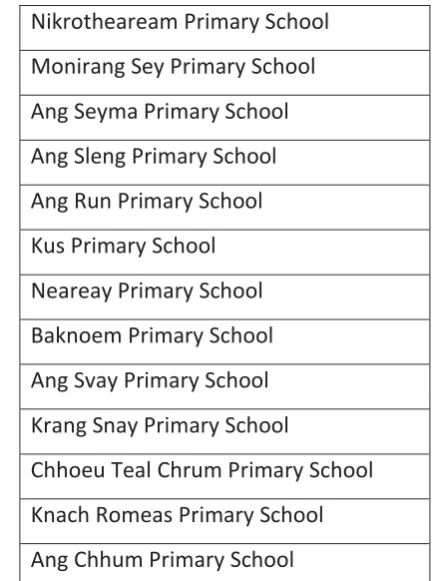
Table 3 Schools where teachers chose to participate in the survey 60
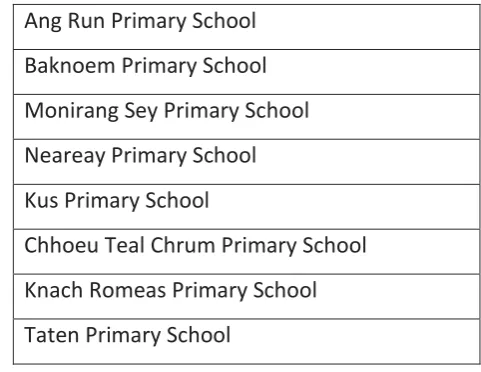
Table 4 Schools where School Directors chose to complete the survey 61
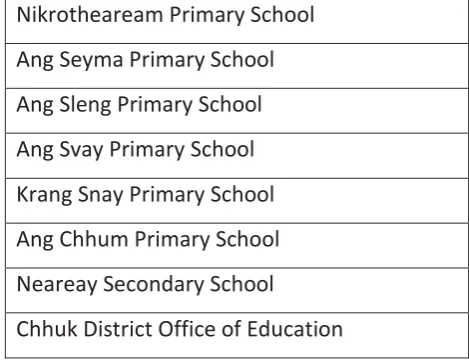
Table 5 Schools where School Directors chose to be interviewed 62
Table 6
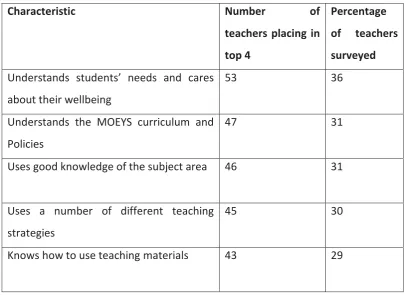
The highest ranking characteristics of a quality teacher 68
Table 7
The lowest ranking characteristics of a quality teacher 69
Table 8 The top four ranked characteristics of a quality teacher as against
the MOEYS model answers
71
Table 9
Factors with a very strong positive influence on quality teaching 77
Table 10 The highest ranking factors with the most positive impact on the
delivery of quality teaching.
78
Table 11 The lowest ranking factors with the most positive impact on the
delivery of quality teaching.
80
Table 12 Factors with a very strong negative influence on quality teaching 84
Table 13 The highest ranking factors with the most negative influence on the
delivery of quality teaching
85
Table 14 The lowest ranking factors with the most negative influence on the
delivery of quality teaching
8
Abbreviations
CCT – The Cambodia Charitable trust (www.cctnz.org.nz) EFA – Education for All
9
[image:10.595.107.530.122.418.2]List of Figures
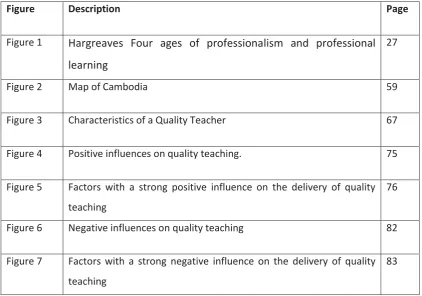
Figure Description Page
Figure 1 Hargreaves Four ages of professionalism and professional learning
27
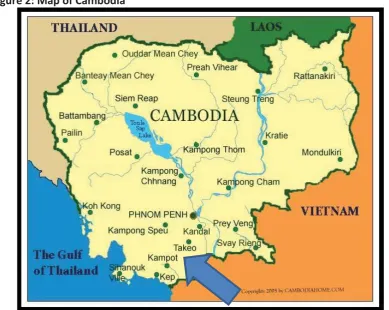
Figure 2 Map of Cambodia 59
Figure 3 Characteristics of a Quality Teacher 67
Figure 4 Positive influences on quality teaching. 75
Figure 5 Factors with a strong positive influence on the delivery of quality
teaching
76
Figure 6 Negative influences on quality teaching 82
Figure 7 Factors with a strong negative influence on the delivery of quality
teaching
10
List of Appendices
Appendix A MoEYS Exam questions and model answers
11
Chapter One: Introduction
1.1 Background to this research
Since the 1990s we have seen the recognition of the importance of education as a driver towards economic growth and human development. As a result there has been an unprecedented call for universal education. The initial focus was quantity education, i.e. the number of years in education or girls enrolled in school, as opposed to provision of education which was top quality. The focus was very much about more, rather than better. As of late there has been a growing recognition of the idea that education must be of sufficient quality if it is to contribute towards economic growth and human development; access to good education is also argued to be a human right (UNICEF 1999).
This idea of education as a human right and the contribution education makes to development will now be discussed.
1.1.1 The value of education: The Right to Education for All (EFA):
12
Furthermore Asokumar & Kumar (2011) discuss the dual contribution of education, reminding us that education is “treasured” for both its intrinsic value, as it enhances the lives of individuals, and its functional value in contributing to the development of the human capital of a nation. Consequently they promote education as a “powerful tool for reducing poverty, unemployment and inequality, improving health and nutrition” (Asokumar & Kumar 2011, 48).
The important role education plays in the development of a country and its people culturally and economically was therefore at the heart of the United Nations report ‘The State of the World’s Children’ in 1999 (UNICEF 1999). The report reviewed the rights of children to an education and identified that the denial of education to over 130 million children, mostly in developing countries, was “a violation of rights and a loss of potential and productivity that the world can no longer tolerate” (UNICEF 1999).
In response to this report the Millennium Development Goals (MDGs) (UN Millennium Project, 2002) were formed and with respect to education MDG2 focuses achieving Primary Education for All. As the initial focus on achieving the goal was access to education, the measurement of progress was very quantitative. The primary mechanism for assessing the rate of access to primary school education for children sought to measure the enrolment in primary school. However, there was growing recognition that attending school and completing primary school was not enough. There is a need for the education provided to also be quality education, necessitating the delivery of quality teaching (Courtney 2007, Chimombo 2005). This issue of quantity as opposed to quality will be discussed further.
1.1.2 Quantity education versus quality education
13
school with MDG 2 – Universal Primary Education and MDG 3 – the Empowerment of Women and Girls through gender parity in education. As mentioned the indicators for the achievement of these goals are quantitative, requiring that every child be enrolled in primary school, and eventually secondary school, and that 50% of the students enrolled be girls.
In many developing countries the push for mass enrolment of children focussed on enrolling children and drew attention away from ensuring that the schools had the “capacity to retain the children once they were enrolled and to provide them with a positive and beneficial school experience” (Kim & Rouse 2011, 416). In the period between 1999 and 2007, the number of children out of school globally dropped from 105 million to 72 million (UNESCO 2008). However the financing of basic education did not grow fast enough to enable countries to meet the EFA goals, nor the MDGs. Much of the international aid provided for education focussed on higher education scholarships and not primary education (Steer & Wathne 2010). There was not sufficient financial support to enable the necessary resources in terms of infrastructure, staff, training and materials for the delivery of quality teaching. As enrolments climbed, already limited resources were stretched further (Kim & Rouse 2011).
14
Recognising the limitations of focusing on enrolment alone, the Dakar Education For All Conference in 2000 sought to direct the focus on to quality education, rather than prioritising enrolments. Global standards and accountability were introduced (UNESCO 2004, Courtney 2007). As such the focus became one of student achievement and the quality of the schools (Glewwe 2014). Quality education was linked to learning outcomes and whether student achievement met defined minimum standards (World Bank 2002, Courtney 2007, Hanushek & WoBmann 2007). A distinction was made between schooling and quality education.
While this shift in direction was commendable, the drive for quality education is also dependent upon the delivery of quality teaching. This is true both for developing countries where resources are limited and developed countries where resources are plentiful. The difference is that in developing countries quality teaching is harder to achieve due to the lack of resources and human capital. As will be shown, this is certainly the case in Cambodia.
1.1.3 The challenge of achieving quality education in Cambodia
Despite this global focus on education, education is “beyond the reach of many” in Cambodia (Sok et al., 2010, 9) and the education of those who do manage to get to school is of a poor quality (Pearson 2011, Courtney 2007, Chimombo 2005). Because there is an explicit relationship between quality education and quality teaching if any gains are to be made regarding the quality of education being delivered a greater understanding of teaching quality is thus required. Specifically we need to understand what quality teaching is and what makes a quality teacher. We also must identify what the key factors which influence the delivery of quality teaching are and which factors enable, or inhibit, the delivery of quality teaching. There are also specific challenges which rural schools face (Mulkeen 2006) of particular relevance to Cambodia which will be discussed in more depth in Chapter Three.
15
system under the Khmer Rouge (Kim & Rouse 2011), led by Pol Pot, in the process of the reversion of the country to an agrarian society (also see Hattori 2009). The murder of almost all educated people during Pol Pot’s reign robbed Cambodia of a generation of its intellectuals and, as a result, its cultural diversity, social networks, development potential and economic future, plunging the country into poverty and setting its development back decades both economically and socially (Pearson 2011, Sok et al. 2010). This will be discussed further in Chapter Two.
The loss of these intellectuals robbed Cambodia of its leaders and role models. The loss of a significant proportion of a whole generation included the loss of parents, community leaders, cultural ambassadors and independent thinkers. More than 40 years later the loss of these human resources continues to affect Cambodia (Hattori 2009).
In an effort to stabilise and rebuild the country, emergency relief was provided in the 1980s. However financial support was at times withdrawn in response to political instability and it was not until the late 1990s that a more systematic approach was taken to rebuilding the education system (Hattori 2009, Tan 2007). Consequently, the reestablishment of education has been extremely slow and complex.
16
1.2 My personal interest in education in Cambodia
I have a vested interest in this research project because in 2008 I established The Cambodia Charitable Trust (CCT). The mission of CCT is to improve education outcomes and strengthen communities in Cambodia. CCT advocates that education is key to breaking the poverty cycle, keeping children safe from trafficking and is a basic human right denied to many children in developing countries, particularly girls. However, as noted in the literature, it is not just about providing more education. It is also about ensuring what is provided is quality education. Hence I have a personal interest in the delivery of quality teaching in an effort to achieve quality education. CCT aims to achieve quality ‘Education for All’ by supporting existing government schools and the Provincial Teachers Training Colleges in the Kampot and Takeo Provinces.
CCT’s support is provided on multiple levels. Firstly, CCT looks to support ways in which barriers to children being able to access education are removed, for example by providing school uniforms and stationery, and bikes which make the journey to school possible.
The second aspect seeks to improve teacher capacity and the ability of the teacher to teach through the provision of teaching materials, teaching workshops and supporting the training of teacher trainees. CCT provides a range of support to the teachers including wage subsidies and, as mentioned, the provision of teaching materials and workshops for learning. It also funds classroom improvements; for example, providing whiteboards, desks and chairs, repairing of concrete floors, painting walls and setting up library corners. In addition CCT enables school improvements and infrastructure to be built; for example, provision of toilets and drinking water, playgrounds, vegetable gardens, preschool classes, textbooks and library books.
17
school. This is underpinned by the notion that increasing the education levels of poor children, and in particular rural girls, will open up formal employment opportunities and place them less at risk of being exploited (Sachs 2005).
Having now presented the background and my personal interest in this research the section to follow outlines the main research aim and research questions and gives a brief overview in terms of how the research was to be undertaken.
1.3 Research aim.
The aim of this research is to identify what factors influence the delivery of quality teaching in primary schools in rural Cambodia.
1.4 Research questions
In undertaking this research I will answer the following three questions:
Question 1: What are the characteristics of a quality teacher?
Question 2: What factors have a positive influence on the ability of a teacher to deliver quality teaching?
Question 3: What factors have a negative influence on the ability of a teacher to deliver quality teaching?
1.5 Approach to undertaking the research.
18
With respect to drawing on primary data this research utilises data which was collected as part of a wider study. In 2014 the Cambodia Charitable Trust (CCT) conducted research to identify the factors that had the most influence on the delivery of quality teaching from the teachers’ perspective, with particular focus on teachers working in rural schools. These teachers face different challenges than those who work in urban areas (Mulkeen 2006). This is discussed further in Chapter Three.
As a result, this research draws on the survey responses of 170 primary school teachers in rural Cambodia where they are asked to consider the characteristics of a quality teacher and identify the most influential factors on the delivery of quality teaching.
1.6 Overview of this report.
Chapter One provided the background to this research. The drive towards EFA was introduced and the importance of education both intrinsically and in a development context was highlighted. The concept that education provides returns for a developing country both economically and socially was advanced. I introduced a summary of the recent history of Cambodia and discussed the impact of this in relation to the importance of education in Cambodia. My personal interest in education in Cambodia was disclosed and the work of the CCT was presented. Finally I presented the research aim and questions.
19
In Chapter Three I conduct a review of literature relating to the importance of quality in the provision of education and the search for innovative ways to achieve quality in education. I examine the proposition that quality teaching is an integral part of quality education and I explore the concept of quality teaching both internationally and in the Cambodian context. I draw together common threads from international and Cambodian discourse. The various influences that impact on quality teaching at the delivery level are examined and discussed with a particular reference to the view of MoEYS.
In Chapter Four I introduce the methodology used in conducting this research and explain the survey and interview process. I introduce the schools that chose to take part in the survey and the school directors who elected to discuss matters through an informal interview are listed. My experience in the initial conduct of the survey is discussed where the teachers’ answers provide insufficient differentiation between the various factors, marking all factors as being very important, and the adaptions made to enable me to obtain data that enabled differentiation and ranking of factors are discussed.
Following on from the completion of the survey and interviews introduced in Chapter Four, Chapter Five examines the results of the survey and interviews. The highest ranking characteristics of a quality teacher are examined and all characteristics are listed with their respective percentage of rankings. I see a common theme emerging where the top characteristic of a quality teacher is their ability to understand the needs of their students. Following from that, the factors with the most positive influence on the delivery of quality teaching are ranked, as are the factors with the most negative influence. These rankings are examined with a view to understanding how these factors have become the highest ranked factors which have the most influence on the delivery of quality teaching.
20
21
Chapter Two: Cambodia and Formal Education
2.1 Introducing this chapter.
The 20th Century was one of extreme conflict for Cambodia. As will be shown, this conflict has had a serious impact on human development. Furthermore, as mentioned in the introduction to this report, this conflict has impacted not only the education system in its entirety, particularly people’s ability to gain access to education, but had enormous and long lasting consequences for the teaching profession and teacher training, and therefore quality teaching (Hattori 2009).
This section will provide a brief overview of recent conflict in Cambodia, the destructive force of the Khmer Rouge and the devastation of the education system. It will go on to introduce the steps towards the resumption of education and the challenges facing the development of a quality education system in Cambodia.
2.2. The Khmer Rouge’s destruction of the education system
Initially part of Indochina, Cambodia gained independence from the French in 1953. However, peace was relatively short lived. Less than 15 years after independence, in the late 1960s, Cambodia was bombed during the Vietnam War to disrupt the movement of the Viet Kong throughout the country. Triggered in part by the activities taking place in Vietnam, Cambodian Government forces fought against royalist forces between 1970 and 1975 (Kim & Rouse 2011, Tan 2007).
22
the right of the organisation “Angkar”. The banking system was shut down and all commerce banned. Money was forbidden. Education and all other social services ceased. Foreigners were expelled and embassies were closed. Newspapers and television channels were shut down, radios destroyed and all forms of postal or communication services were banned. Hospitals were closed and all patients forcibly evicted. The country’s borders were closed. Professionals were sought out and killed (Kim & Rouse 2011, Tan 2007, Hattori 2009). Urban and educated people were specifically targeted, particularly teachers. An estimated 75% of teachers, 67% of primary and secondary students and 96% of university students were killed (Kim & Rouse 2011, Pearson 2011, Sok et al. 2010).
In 1979 the country was “liberated” by the Vietnamese. By then the infrastructure of the country had been destroyed. With reference to education, only approximately 200 people who could teach grade 5 (age 11) and above were alive (Kim & Rouse 2011). Individuals who had attended primary school were selected as teachers, many of whom had completed only a few years education themselves and had no teacher training. As noted by Sok et al. (2010) many existing teachers from that period were “rugged survivors who have had minimal, some no, pedagogical training” (p. 7).
2.3 The resumption of formal education in the wake of the Khmer Rouge
Even though much of the country was liberated, fighting continued between the Khmer Rouge and Government soldiers until amnesty was declared in 1993. Hence, education continued to be disrupted due to these political struggles (Tan 2007, Hattori 2009) and in rural areas due to mortar bombings. Although education in a very limited form had resumed, the result of the abovementioned conflict meant there were still very few experienced teachers and the schools continued to be badly damaged or destroyed. Today over 70% of primary teachers have only lower secondary education or less (Kim & Rouse 2011).
23
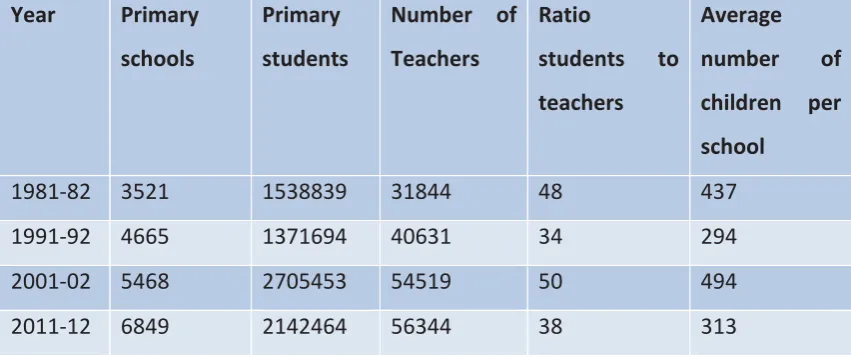
[image:24.595.108.534.337.516.2]swelled. The biggest increase in enrolment rates occurred in the first decade of the EFA campaign as this period coincided with the period immediately following the demise of the Khmer Rouge (Kim & Rouse 2011). (See Table 1: Enrolment rates in primary schools in Cambodia). From a primary school student roll of 1,371,694 in 1991 the number of children had doubled to 2,705,453 by 2001. During this same period while the number of teachers also increased by 34% from 40,631 to 54,519 it was not enough. The ratio of teachers to students dropped from one teacher per 34 students to one teacher per 50 students. Moreover while the number of schools increased by 15%, the average number of children per school climbed from 294 per school to 494 per school. The Cambodian education system was severely under resourced and severely under pressure.
Table 1: Enrolment rates in primary schools in Cambodia
Source: Ministry of Education Youth and Sport (MOEYS 2014)
Despite an increase in the number of teachers and schools since 2001, to the present day overcrowded classrooms, textbook shortages, an overtaxed teaching workforce, and declining levels of instructional quality remains (Tan 2007, Nonoyama-Tarumi & Bredenberg 2008). School Directors have limited managerial or leadership skills, teaching capacity is low, the budget is limited and there is a lack of school facilities (Kim & Rouse 2011, Courtney 2007a). Despite high enrolment rates, success in school also remains low with dropout rates at almost 50%, meaning only half of the students who are enrolled go on to complete primary school (Kim & Rouse 2011).
Year Primary
schools
Primary
students
Number of
Teachers
Ratio
students to
teachers
Average
number of
children per
school
1981-82 3521 1538839 31844 48 437
1991-92 4665 1371694 40631 34 294
2001-02 5468 2705453 54519 50 494
24
2.4 Present day education in Cambodia.
Many Cambodians are actively seeking an education but the education system is desperately under resourced and heavily overloaded (Tan 2007, Nonoyama-Tarumi & Bredenberg 2008). The challenges facing children in achieving quality education are hence enormous. According to the Human Development Report (UNDP 2014), 46.8% of the population of Cambodia live in multidimensional poverty, with 18.6% living below $1.25 US a day. At least 85% of the poor are concentrated in rural areas. Families do not have the resources required for their children to attend school and so they send them to work, with child labour rates at 36.1% (UNDP 2014).
The Cambodian Government recognises that education plays a very important role in growing the country’s economy and achieving the country’s strategic development plans for integration into regional and international economies (Tan 2007, Kim & Rouse 2011). It is also seen as a critical component for reducing poverty (Chen et al. 2007). Responsively, the Cambodian government has prepared a realistic pro-poor national education plan, the Education for All (EFA) National Policy 2003-2015.
25
2.5 Educational reform in Cambodia.
While education reform has dramatically increased participation rates among children with enrolment rates climbing significantly (Kim & Rouse 2011), efficiency and qualitative indicators show further work needs to be done to achieve quality education. This is challenging policy makers (Dhaliwal & Tulloch 2012).
There have been some structural changes. The Cluster school system was introduced as a way to coordinate central government support, strengthen school management, manage scarce school resources, increase the capacity of local staff and enhance teaching and learning (Hattori 2009, Tan 2007). To some extent this has worked (Pellini 2005, Phin 2014). MoEYS has stated it also intends to revise the school curriculum, introduce more effective remedial classes, and impose regular student assessment and standards monitoring, recruit trainees and provide them incentives to work in remote areas. It will also introduce merit-driven support programmes (Tan 2007, Tan & Ng 2012, Phin 2014).
To rebuild the education system in Cambodia also requires an investment in the infrastructure of the schools to provide drinking water, toilets, desks and chairs. The schools need resources including library books, text books, teaching materials and consumable materials. Basic institutional structure is in desperate need and critical for the delivery of quality teaching (Glewwe 2014). Having a fully functioning school is a basic necessity, with quality roofs, walls, desks, chairs, and teaching materials (Glewwe et al. 2014b). Teachers need to learn teaching techniques and have access to teaching materials. Teachers’ Training Colleges need consumable materials and improved living conditions for the trainees. Teachers need to earn a living wage as teachers. The demands on resources are enormous.
26
abolish the informal payment system, which is a barrier to education and creates an environment that enables exploitation (Asia-South Pacific Education Watch 2007).
Despite the fact that teachers play a significant role in keeping the children at school MOEYS policies do not focus on the actual role of the teacher in delivering quality education. Most of the government’s proposals relate to increased inputs. As a result the teacher’s role has been somewhat side-lined by the focus of achieving EFA (Kim & Rouse 2011). There are genuine problems with the qualifications of many Cambodian teachers that must be addressed as the teachers are the most critical component to achieving quality education (Hanushek & WoBmann 2007). Positive results could come from emphasising the teacher’s role in achieving the wider goals of the education system and society by being a quality teacher. Whilst teachers recognise that being a competent teacher is critical to student learning and the delivery of a quality education, they have little confidence in their ability to deliver quality teaching and require in-service training and support to enable them to do so (Phin 2014).
There has been a limited engagement of teachers in the discussions relating to improving the delivery of quality education. There is an increasing call for the involvement and active participation of teachers in furthering the EFA goals (Kim & Rouse 2011). With reference to Cambodia, MOEYS policies may suffer if the delivery is not aligned and scarce resources may be wasted. It is therefore critical to engage the teachers so as to ensure that policy changes are taken on board and increasing inputs do not fail at the point of delivery.
27
Figure 1: Hargreaves Four ages of teacher professionalism and professional learning
Pre-professional
age
Teachers struggle alone in classroom with few textbooks or resources and little reward or recognition. Teaching and learning depends on reference to resources. Methodology includes recitation or lecturing, note-taking, question and answer and seatwork. Funnelling of the classroom talk through the teacher controls conversations and keeps them structured. The class is treated as a whole student rather than being oriented to the needs of individual students. There is a concern with order and control. Didactic teaching methods are used. It is subject-centred.
Age of the
autonomous
professional
Status and standing of teachers improves. Teacher education becomes embedded in university education, and teaching moves to an all graduate profession. Teachers enjoy autonomy over the curriculum and decision-making. Educational innovation encourages teachers to take on new approaches to student-centred learning. Teachers are given licensed autonomy; they are encouraged to exercise initiative and discretion. Teacher individualism and lack of feedback leads still to isolation and loss of confidence.
Age of the
college
professional
28
Post-professional
or postmodern
age
Currently still developing. Could result in a broader, more flexible, open approach which is democratically inclusive of groups outside teaching and their concerns. May alternatively result in teachers being subjected to detailed measurement and control under narrowly conceived competence frameworks. Globalisation impacts on education weakening state autonomy and increasing competition in a now global labour market. Electronic and digital communications provide instantaneous and unlimited access to information. Schools are measured in economic terms. Centralised curricula is possible.
The professionalism of the teachers in Cambodia based on Hargreaves’ Four Ages of Teacher Professionalism and Professional Learning (Hargreaves 2000) indicates that Cambodian teachers are at the first stage being the pre-professional age. The Cambodian Government aims to advance the profession to the autonomous professional, being the second of the four identified stages (Tan & Ng 2012). The state of the teaching profession in Cambodia is understandable considering the lack of structural support, limited interaction and feedback among teachers, and teacher individualism (Tan & Ng 2012). These assumptions are tested in the survey conducted as part of this report. The results will be discussed in Chapter Five.
2.6 Conclusion
Whilst the education system in Cambodia was significantly damaged as a result of the Khmer Rouge, progress has been made. The education system is now functioning, however the demand for education exceeds the resources available to ensure that education is of sufficient quality.
29
to be used more efficiently. Others are policy based. MoEYS is working to develop a quality education system and an inherent component of quality education is quality teachers. With limited resources it is important to effectively engage teachers in the drive towards quality education and focus on what resources are required to enable teachers to deliver quality teaching.
There are also specific challenges which face teachers in rural communities. This research focuses on those rural teachers by examining their view of the characteristics of a quality teacher and the factors which influence the delivery of quality teaching. These are discussed further in the next Chapter.
30
Chapter Three: Literature review - Conceptualising the
quality education Cambodia nexus.
3.1 Introducing this chapter
One of the main issues with delivering quality education and identifying where to invest time, energy and resources relates firstly to how quality education is conceptualised and measured. This next section looks to explore some of the critiques surrounding the aforementioned. Whilst quality education is very difficult to measure we can identify some components of quality education. I explain that recognising these components provides an appreciation of the various factors which co-exist and an opportunity to understand where the biggest gains in quality can be made.
The impact of the ability of the teacher delivering the education programme is introduced as one of the single biggest impacts on the achievement of quality education. The delivery of quality education is dependent upon quality teaching. This requires the examination of the characteristics of a quality teacher, both from an international perspective and from a Cambodian perspective. From this examination I draw together a number of characteristics of a quality teacher that are commonly recognised. I conclude by referring again back to the Cambodian context by discussing the characteristics identified also by the MoEYS and I conclude that these are consistent with international commentator’s views.
In drawing on literature regarding the core factors that influence the delivery of quality teaching I discuss the application of those factors in the Cambodian context. These factors can have both positive and negative influences on the delivery of quality teaching. From this discussion I draw out essential characteristics of a quality teacher and a list of factors influencing the delivery of quality teaching. These factors formed the basis of the survey of primary school teacher’s in rural Cambodia.
31
3.2 The measurement of quality education
Education can only drive sustainable economic development and contribute towards societal development if it is to an appropriate level of quality. Quality is linked to learning outcomes (World Bank 2002, Courtney 2007). What students actually learn (the quality of education) rather than how many years of schooling they complete (the quantity of education) is the relevant measure. A lift in the level of the educational standards in a developing country is one of the prime opportunities to provide economic growth (Glewwe 2014) and improve social returns (Asokumar & Kumar 2011). Developing countries must strive for educational quality to drive development and strengthen civil society.
Quality in education has been primarily measured in terms of output for resource inputs on a production basis. That approach dictates that education quality is defined in terms of inputs delivering outcomes (Cheng & Tam 1997). Education production theory has been used to study educational achievement in developing countries, and to understand the relationship between inputs and outputs of a production process (Hanushek 1997). This theory assumes that an increase in inputs would improve the quality of education (Hanushek & WoBmann 2007, Cheng & Tam 1997) and that most education decisions can be made on the basis of a cost-benefit analysis (Dhaliwal et al. 2014). Based on this production approach, proxy indicators have been used to measure quality education. These indicators included class sizes and qualifications of teachers. Research in the past has focussed on the need for more inputs to improve quality of education (Hanushek & WoBmann 2007, Hanushek 2003).
32
a growing recognition that quality is very difficult to measure (Courtney 2007). “Simply putting more resources into schools – pure spending, reduced class sizes, increased teacher training, and the like – will not reliably lead to improvements in student outcomes” (Hanushek & WoBmann 2007, 3).
The ongoing research into the determinants of quality and how to define quality has led to debates about policy and the acknowledgement that quality is virtually impossible to dictate through policy (Looney 2011, Leu & Price-Rom 2006, Cornelius-White 2007, Hanushek & WoBmann 2007). Ambiguities about policy have formed as the result of ongoing debate about the determinants of quality education (Hanushek 2003).
Research has focussed on different attributes that represent the outcomes of educational quality in an attempt to identify proxies for the measurement of educational quality. Some of these attributes include assessing cognitive skills learned by students; whether pupils are improving their knowledge, skills and abilities; whether pupils are widening their experience and growing socially morally or not; the ability to work with others; the ability to problem solve; readiness to accept responsibility and to work with the public. All are good characteristics valued in school leavers. However, assessment tools do not test for such skills (Asokumar & Kumar 2011). In addition, some research suggests quality indicators differ for internal and external stakeholders; existing students and front line staff as opposed to employers, government bodies, prospective students and professional bodies (Chen et al. 2007).
33
conducive to learning (UNICEF 2009). MOEYS has adopted the Child Friendly School Policy. This provides a standard to aim for, with EFA being central to the policy.
Using this multi-dimensional view of quality education it is recognised that there are a number of influences on the delivery of quality education. The difficulty has been twofold; establishing a clear measure of quality and identifying which of the various influences have the most impact in order to focus efforts on addressing those influences.
3.3 Examining which factors have the greatest impact on quality.
Policy makers are now seeking clear evidence to provide guidance as to which programmes deliver impacts to poor communities and there is a commitment to more effective public service delivery (Dhaliwal & Tulloch 2012, Dhaliwal et al. 2012). As a consequence, reforms are subjected to rigorous evaluations of their impacts and cost effectiveness as different programmes produce varying results despite being targeted at the same policy outcome.
34
One strategy is to use incentives, but this is often ineffective as will be discussed in Chapter Three. Other strategies relate to increasing the efficiency of teacher training and reducing the cost to the state to train teachers. These strategies include reducing the length of teacher training, recruiting teacher trainees who have already achieved a higher education and increased in-service professional development (Mulkeen 2006, Verspoor 2004).
The quality of the teacher has a powerful impact on student outcomes (Hanushek & WoBmann 2007). The cost of training and employing teachers is often one of the largest public expenditure items in the budgets of less developed countries. With expanding enrolments and increasing pressure to achieve quality education, developing countries are struggling to pay teachers, expand the teaching workforce and adequately resource those teachers (UNESCO 2004). At the same time education systems are expected to be more accountable for results.
The UNESCO ESA global monitoring report reiterates “what goes on in the classroom, and the impact of the teacher and teaching, has been identified in numerous studies as the crucial variable for improving learning outcomes. The way teachers teach is of critical concern in any reform designed to improve quality” (UNESCO 2004, 152). The report identifies five areas that are critical to teacher quality. These are finding the right recruits, teacher training, ongoing professional development, teacher salary and conditions of service (UNESCO 2004, 152).
35
negative impact on student achievement (Bransford et al, 1999; Rubie-Davis et al 2006; Rubie-Davis, 2007).
However, finding a definition of quality teaching is a challenge (Croninger et al, 2005, Hanushek & Rivkin 2006). A clear set of standards and competences needs to be established for any system of evaluation to link to agreed standards (Looney 2011). Pedagogical content knowledge is a crucial determinant of student success (Rivkin et al 1998, Hanushek 1997). Unfortunately, pedagogical content knowledge is very difficult to measure as it can only be measured within the classroom environment. Classroom observations are difficult to rely on as they involve judgements made in specific contexts which vary widely between other classroom experiences (Looney 2011).
There have been attempts to define quality using many variables, including structural quality (management and resource allocation), process quality (educational processes) and results quality (pupil’s learning, knowledge, skills and attitudes) (Courtney 2007). In some instances teacher quality has been defined by measurable factors such as numbers of years of experience and level of certification (Akiba et al 2007).
As a result, the main strategy employed in qualitative studies is to use teacher background measures as proxies for teacher quality, such as test scores, years of teaching, and years of college education. The common finding of these studies is that teacher quality is significant in determining the educational outcomes of students and teachers who show they care about student’s learning and set challenging goals for learning are particularly effective (Hanushek 1997, Ngo 2013).
36
the discussions relating to the importance of equality education and the overarching goals of EFA. The assumption that teachers know what is expected of them, and why, does not give the teachers room to engage with their role and their responsibilities in the delivery of quality teaching (Kim & Rouse 2011).
In the context of developing countries there is a lack of research as to what teachers consider to be quality teaching. There is also a lack of appreciation of the challenges faced by teachers in the delivery of quality teaching to their students beyond the formation of delivery policy. Policy is only one factor. In Cambodia written policies are sometimes not evidenced in actual delivery. There is no engagement of teachers or promotion of the role they play in addressing the social, economic and political challenges in Cambodia (Kim & Rouse 2011). The teachers have no voice. The lack of education and ability of these teachers has constantly been identified as an issue, but conversely their participation in setting policy is non-existent.
In the Cambodian context this is especially important. The teachers are paid very low wages, have significant doubts as to their ability and have very limited support structures. As noted prior, many have had little education themselves (Kim & Rouse 2011). To compound matters, even if teachers do apply themselves and achieve quality teaching, the lack of accountability in schools and the difficulty in ensuring transparency makes it very difficult to ensure promotion based on merit (Tan 2007). This further compounds the teachers’ sense of futility, disengagement and lack of recognition (Cambodian Independent Teachers Association (CITA) 2011).
37
Accepting that teacher quality is hard to define it is therefore critical to develop an understanding of what it means, as teacher quality stands out as a significant predictor of student achievement.
3.4 The characteristics of a quality teacher
International literature promotes teachers as being the most important element in determining educational quality (Kim & Rouse 2011, Cornelius-White 2007, Leu & Price-Rom 2006, Looney 2011). With teaching quality as the goal, there needs to be clear standards of competency in order to evaluate the standard of teaching being achieved by teachers in an environment where the criteria and standards are not unanimous (Kim & Rouse 2011). Reflecting this dynamic environment, standards of competency are difficult to set. As an alternative, research has focussed on the characteristics of a quality teacher as an indicator of quality teaching.
The goal of improving educational quality is dependent on the teacher to create “a collaborative, motivated, and effective teaching and learning community” (Leu 2005; 22). The key factors are more than the teachers’ teaching skills, but extend to include the individual teacher’s professional attitudes, motivation and the energy they invest in teaching. There are many interacting factors that, together, create quality of learning (Leu 2005, Looney 2011).
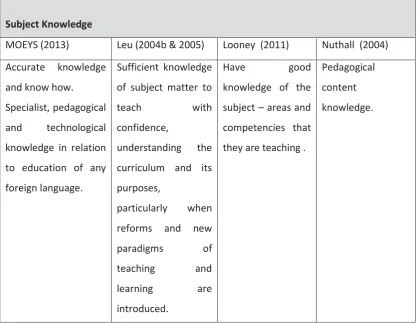
Certain qualities or behaviours have been clearly associated with and act as key indicators for teaching quality (Looney 2011) predicting also effectiveness (Croninger et al 2005). Nuthall (2004) discusses the abundant literature describing the characteristics of excellent teachers derived from classroom observation, reputation or student achievement scores. These are summarised in Table 2.
38
the development of education in Cambodia, and in terms of increasing the professionalism of teaching. A full translation of the questions and model answers is attached as Appendix A.
These exams divide teachers into A and B grade teachers, impacting directly on the salary band the teacher is in and also career advancement opportunities. The exams were also the first formal steps towards addressing issues such as the quality of education and teaching, and a first step in actually engaging with the teachers to discuss these issues.
[image:39.595.108.529.427.752.2]In both Tenure Type A and Type B exams there is a clear focus on quality teaching. Both exams contained questions that relate directly to the concepts of quality teaching and the characteristics required of a teacher to deliver quality education. MOEYS model answers are compared to the international research in Table 2 below.
Table 2. Characteristics of a Quality Teacher
Subject Knowledge
MOEYS (2013) Leu (2004b & 2005) Looney (2011) Nuthall (2004)
Accurate knowledge
and know how.
Specialist, pedagogical
and technological
knowledge in relation
to education of any
foreign language.
Sufficient knowledge
of subject matter to
teach with
confidence,
understanding the
curriculum and its
purposes,
particularly when
reforms and new
paradigms of
teaching and
learning are
introduced.
Have good
knowledge of the
subject – areas and
competencies that
they are teaching .
Pedagogical
content
39
Methodology
MOEYS (2013) Leu (2004b & 2005) Looney (2011) Nuthall (2004)
Good method and
plan for leading
teaching activities.
Make lesson plans
and determine
specific objectives of
lessons.
Know how to use
teaching materials in
line with pedagogical
standards.
Knowledge and skills
in a range of
appropriate and
varied teaching
methodologies.
A broad repertoire
of teaching
methods and
strategies to meet
the diverse
students’ needs.
Uses of a variety of
models of teaching
and learning.
Communication
MOEYS (2013) Leu (2004b & 2005) Looney (2011) Nuthall (2004)
Good communication
with students and
colleagues in the
entities, communities
and relevant
stakeholders. Fairly
and transparently
communicates with
students, colleagues
and other members of
the community.
Knowledge of the
language of
instruction. The
ability to
communicate
effectively and with
sensitivity to others.
Are intellectually
able with good
verbal skills.
Knowing how to
identify, present
and explain key
40
Understanding the Students Needs
MOEYS (2013) Leu (2004b & 2005) Looney (2011) Nuthall (2004)
Be aware of student’s
special learning
method and
understand student’s
difficulties, pay
attention to the
different abilities of
students and praise
their intelligent
growth and
development.
Knowledge of,
sensitivity to, and
interest in young
learner, interest in
students as
individuals, sense of
caring and
responsibility for
helping them learn
and become good
people, and a sense
of compassion.
Develop positive
relationships with
students, recognise
the crucial role of
motivation and
emotions in
learning. Ability to
understand the students’ perspective, feelings, cultural background, challenges and needs. Passionate and commitment to
doing the very best
for their students.
Positive Relationships
MOEYS (2013) Leu (2004b & 2005) Looney (2011) Nuthall (2004)
Provide students with
encouragement.
Participate on a
regular basis in
community work as a
bridge to build good
relationships between
school/ community
and community/
teachers.
Ability to work with
others and to build
good relationships
within the school
and the community.
Works
collaboratively with
peers to develop a
positive skill
climate, to improve
overall skill
performance, and
to engage in
mutual support
and professional
learning.
Has a collaborative
working style with
other teachers to
plan, observe, and
discuss each
41
Self-Assessment
MOEYS (2013) Leu (2004b & 2005) Looney (2011) Nuthall (2004)
Is self-evaluating and
conducts research on
the teaching
profession on a
regular basis. Regular
self-study and
research of new
knowledge for capacity development, self-assessment, acknowledge their own shortcomings
and able to make
improvements.
Ability to modify
teacher – learning
approaches as a
result of reflection.
The ability to reflect
on teaching practise
and children’s responses. Are skilled assessors, use assessment “formatively” to monitor students
and provide timely
and specific
feedback on what
they need to do to
improve
performance and
meet learning
goals. They adapt
teaching to meet
better identified
learning needs.
Constant
questioning of,
reflecting on, and
modifying their
own practise.
Learning Environment
MOEYS (2013) Leu (2004b & 2005) Looney (2011) Nuthall (2004)
Create a joyous
atmosphere for
students (freedom,
equality, democracy).
Provide instructions,
education, and advice
to students to actively
participate in learning
processes. Managing
disciplines, order and
educating student
personalities. Create a
Ability to create and
sustain an effective
learning
environment
general
professionalism,
good morale, and
dedication to the
goals of teaching.
Ability to
communicate
enthusiasm for
Good knowledge of
typical learner
misconceptions
and patterns for
progression in the
subjects they are
teaching .
Have strong
classroom
management skills,
including clarity
and presentation of
Love of children
enacted in warm,
42 pleasant learning
environment for
students, properly
using teaching
materials and tools in
accordance with
learning objectives.
learning to students. ideas,
well-structured lessons
and appropriate
pacing.
Professionalism
MOEYS (2013) Leu (2004b & 2005) Looney (2011) Nuthall (2004)
High professional
ethics, high
professional
consciousness. Be
strict and soft. Act as
a good role model for
students. Help
improve and evaluate
study activities.
Professional
consciousness and
good personality. Pay
great attention to
students and do all
the tasks in the
interests of students
and the nation and
show mutual sincere
respect, indicate/
model positive
behaviour.
Good character,
sense of ethics and
personal discipline
43
Hence, the model answers provided by MOEYS are closely aligned with the characteristics identified by Leu, Looney and Nuthall, showing the universality of these characteristics. MOEYS has clearly indicated that the view of the Cambodian Government closely resembles contemporary thinking in relation to the importance of quality teaching, the characteristics of a quality teacher and the influences on the delivery of quality teaching. This enables those same indicators and characteristics identified by MOEYS, Leu, Looney and Nuthall to be used in the survey.
The characteristics of a quality teacher recognised in Table 2 break down into several areas. These are:
x Subject knowledge x Methodology x Communication
x Understanding the students’ needs x Positive relationships
x Self-assessment
x Learning environment, and x Professionalism
As there is a strong overlap between the view of MoEYS and the international commentary on the requisite characteristics of a quality teacher, it is therefore appropriate to use these characteristics to survey the teachers in rural Cambodian primary schools about their view of which characteristics they most identify with.
44
3.5 Influences on the delivery of quality teaching: Reflections on Cambodia
3.5.1 Introduction
The focus of this research is to identify the factors which influence the delivery of quality teaching in the context of rural primary schools in Cambodia. The context is critical as the factors that influence the delivery of quality teaching are country and environment specific and their relative impact varies between contexts. Furthermore, the factors do not remain static and the relative importance and the manner in which those factors influence, and can be themselves be influenced, constantly changes.
There has been some attempt in the research to measure quality in terms of the students experience and the relative importance of factors influencing quality from the student’s point of view (Tsindou, Gerogiannis & Fitsilis 2010, Chen et al. 2007) but limited research into the teachers experience or view of quality education (Phin 2014). In keeping with various calls for the gathering of data of best practices from within classrooms that can be shared (O’Sullivan 2005), this is the approach that underpins this research. The sections to follow very much flesh out the issues drawing on what is experienced and what is occurring in Cambodia.
3.5.2 Teachers feeling valued and supported
The most important influences are not necessarily monetary ones but can be the job satisfaction of the teacher or their self-esteem. In addition to the qualities of the teacher, the environment within which they are teaching is also influential on the delivery of quality teaching. Teachers need a positive and supportive environment. They are part of a social network, both with their students and within the school community. Teacher performance is influenced by factors such as the teacher’s self-esteem, their relationships with the families and with other teachers, their sense of isolation and the lack of engagement in planning and decision-making.
45
education (Leu & Price-Rom 2006, Looney 2010), ongoing, relevant professional development activities are necessary for a teaching force to be effective (Verspoor 2004). Adequate time and resources are needed for programmes in which teachers have a say in the content of any training activity and which new skills can be learned, practised, reflected upon, and improved over time. An iterative teacher learning process of this kind involving all teachers takes place most effectively at the school level or in clusters of nearby schools working together (Leu 2004a).
Teacher engagement is crucial as any government can plan for education reform but needs to obtain the buy in and support of teachers to achieve its educational goals as it is the teachers who implement change (Tan & Ng 2012). Regrettably the teachers in Cambodia have been seen to be variables for educational policies to manipulate rather than being critical to the success of those policies. Research shows that where countries have a large percentage of lowly educated teachers steps are often made at a policy level to bypass them. This exacerbates the problem (Kim & Rouse 2011).
A study undertaken in 2011 by the Cambodian Independent Teachers Association found that teachers in Cambodia are not happy in what they do (CITA 2011). They do not feel appreciated or important. Teachers have a low level of involvement in decision-making and are not sufficiently involved in policy decisions relating to educational quality (CITA 2012).
46
The low pay, lack of care in when they are paid and apparent disrespect about their welfare means teachers feel generally undervalued and unimportant (CITA 2011). This frustration, hopelessness and grief of teachers needs to be addressed. “Teaching is an emotional practice because emotions are at the heart of teaching” (Tan & Ng 2012, 131). There is no guarantee of promotion based on effort and ability. Poor performing teachers are just as likely to be promoted to management positions as teachers that are performing well due to the closed selection process, lack of involvement of teachers in the process and a hierarchical society promoting ageism (CITA 2011).
There is a lack of accountability on the part of the School Directors with school spending rarely being publicised. This is an influence on job satisfaction (Lee 2006). As well as the difficulties with accountability of the School Directors many teachers face challenges that relate to the lack of teacher support and limited interaction and feedback provided between teachers. There is no sense of collegiality as teachers are working autonomously. There are no incentives or opportunities to collaborate with other teachers to improve teaching skills. Meetings are imposed on teachers by senior management rather than in response to requests from the teachers. The strict hierarchical structure within schools, which is apparent at these meetings, discourages discussion or questions from junior teachers (Tan & Ng 2012).
47
3.5.3 The impact of salary
In Cambodia many teachers live in poverty and suffer very poor working conditions. A trainee’s income during training is $2.50 US per month. The conditions at the teachers training college are rudimentary, crowded and at times unsanitary.
Newly qualified teachers earn $80 a month. Their salary is paid several months after they commence work and as a result many are forced to borrow money to survive. The rate of $80 a month means teachers cannot provide sufficient food for their needs each month. Teachers in urban areas fare worse than their counterparts in rural areas due to the higher cost of living in the city (CITA 2011).
In Cambodia only young people from relatively poor families tend to apply to become teachers. Many teacher trainees become teachers because other options are not open to them. Their family cannot afford to send them to University. They may not have any particular desire to be a teacher or the necessary personality or skills (CITA 2011).
With reference to the developing context, one of the most significant factors in the delivery of quality education is the teacher’s salary (CITA 2012, Lee 2006). “Based on my experiences working with the teachers for more than twenty years, I have found
that the main factor which influences the delivery of quality education the most is the
Teacher salary” (Ouch 2013). Low salary impacts on teaching quality in a number of ways. The salary is not enough for the teacher to support themselves, let alone a family. The teacher must supplement their income through other means or by obtaining a second job. This means less time for the preparation of lesson plans and the general fatigue of the teacher, both of which have a direct negative impact on the quality of teaching delivered by the teacher.
48
profession of experienced and skilled teachers and undermines the development of the profession further.
3.5.4 The use of incentives
A conceptual framework developed by Kemmerer (1990) has been used to measure the relationship between incentives and job satisfaction in developing countries, using job satisfaction as a proxy for the delivery of quality education (Chapman et al. 1993). The Kemmerer framework has been extended in the context of developing countries to include measures such as community support, recognition and approval as these are significant influences on educational quality and teacher performance (Chapman et al 1993).
Seeking innovative ways to improve the quality of teaching often leads to considering incentives as a way to modify teacher behaviour (Leu 2004a). However incentive systems are challenged by the difficulty in linking incentives to desired behaviours, a lack of consensus as to what behaviours increase teaching quality and the difficulties in measuring impact and teacher performance (Chapman et al 1993, Lavy 2007). The search for appropriate incentives is an on-going one, reflecting the differing needs of students, the dynamic environment in which education is delivered and the cultural differences between countries. Another complicating issue is that humans are adaptive creatures and as a result incentives become expectations. This reduces the impact of those incentives.
49
of the characteristics of quality teaching. In this environment these types of incentives are not an option.
Incentives are often measured only in terms of teacher subsidy payments but this form of subsidy alone does not transform performance. One reason may be that the level of incentive is not sufficient to make any significant change in the circumstances of the teacher. Any supplement to the teachers’ income needs to be enough to allow the teacher to give up their second job (Kim & Rouse 2011).
3.5.5 Challenges for rural schools
As noted in the global literature, developing countries education resources are most often scarce and infrastructure is poor. Management of resources is haphazard and there is competition for those resources. In addition, schools that are more remote are less visible, resulting in less transparency and accountability towards those schools. Resources destined for those areas may be waylaid or diverted for more visible areas impacting on rural schools more than urban schools.
It is difficult to attract teachers to rural schools. There is a perception that there are more opportunities for advancement in urban schools, the quality of life in rural areas is lower and there are greater perceived health risks in the rural environment with less access to health care (Mulkeen 2006). However it is critical that quality teachers be placed in rural schools as the children in those communities are the most vulnerable (Phin 2014). While all of the above-mentioned speaks to developing countries as a whole these issues are also very applicable to Cambodia.
50
Teachers in rural areas often have less support, fewer opportunities for ongoing professional development, and greater difficulty in accessing books and materials (Mulkeen 2006). At the same time these teachers are working with children from vulnerable communities. The vast majority of the Cambodian population living in poverty come from rural Cambodia.
3.5.6 Informal fees and the teacher community relationship
Excellence at the school level means more than an individual excellent teacher or even a collection of excellent teachers. A strong school community and strong school leadership are of overriding importance in bringing teachers together as a community of learning at the school level (Leu 2005, Fredericksson 2004, Leu 2004B).
The low salary paid to teachers’ means the teachers’ have to supplement their income by charging students for after school tutorials, or in some cases, to charge the children for classes that should be free. These informal fees become a barrier to EFA (Asia-South Pacific Education Watch 2007). Despite the target to eradicate all such informal payment systems under EFA, the rate of payments is increasing rather than decreasing. This poses problems for dedicated teachers as the education system not only tolerates this practice, it, to a large degree, relies upon it. In Cambodia, families have to spend almost 9% of their annual income per child paying informal education fees (CITA 2011, Asia-South Pacific Education Watch 2007). The charging of these informal fees and the low salaries received by teachers creates an environment that enables exploitation (Asia-South Pacific Education Watch 2007). Children who are unable to pay for extra tuition have to repeat years at school or drop out.