Rochester Institute of Technology
RIT Scholar Works
Theses
Thesis/Dissertation Collections
9-23-2011
Wireless body area network platform utilizing
energy-efficient routing of physiological data
Alvaro Prieto
Follow this and additional works at:
http://scholarworks.rit.edu/theses
This Thesis is brought to you for free and open access by the Thesis/Dissertation Collections at RIT Scholar Works. It has been accepted for inclusion in Theses by an authorized administrator of RIT Scholar Works. For more information, please [email protected].
Recommended Citation
Wireless Body Area Network Platform Utilizing
Energy-Efficient Routing of Physiological Data
by
Alvaro Prieto
Master of Science Thesis
in
Electrical Engineering
Approved by:
(Gill Tsouri, Ph. D.)
(Andres Kwasinski, Ph. D.)
(Nirmala Shenoy, Ph. D.)
(Sohail A. Dianat, Ph. D.)
Electrical and Microelectronic Engineering Department
Kate Gleason College of Engineering
Rochester Institute of Technology
Rochester, New York
Contents
Table of Contents 2
Abstract 4
List of Figures 5
1 Previous Work 7
1.1 Time Synchronization . . . 7
1.2 Synchronized Sampling . . . 10
1.3 Routing and Relaying . . . 10
2 Software Libraries 12 2.1 Project History . . . 12
2.2 Design Choices . . . 13
2.3 CC430 Device . . . 13
2.4 MSP430-RF2500 Device . . . 14
3 Wireless ECG Application 14 3.1 Description . . . 14
3.2 TinyOS Platform . . . 15
3.3 CC430 Platform . . . 15
3.4 Time Synchronization . . . 15
3.5 Scheduling . . . 16
3.6 Host Interface . . . 18
4 Algorithm Development Platform 18 4.1 Initial Development . . . 18
4.2 Hardware Coupling . . . 19
4.3 Simulation Output . . . 20
5.2 Proposed Cost Function . . . 23
5.2.1 Device Energy . . . 23
5.2.2 Link Cost . . . 23
5.2.3 Assumptions . . . 24
5.3 Performance Analysis . . . 24
5.3.1 Algorithm Implementation . . . 24
5.4 Simulation . . . 24
5.5 Hardware Implementation . . . 26
5.5.1 Hardware Platform . . . 26
5.5.2 Cycle of Operations . . . 26
5.5.3 Details . . . 27
5.6 Results . . . 29
Abstract
Wireless Body Area Networks (WBANs) consist of several wireless sensors located around a human
body. These sensors may measure several biological signals, movement, and temperature. Due to
major improvements in power consumption and constantly shrinking devices, WBANs are becoming
ubiquitous. As a side effect present because of the small form factor of these devices, the battery
size is limited. While the sensors themselves may be extremely power efficient, all of the measured
data must be transmitted over a much less efficient wireless link. One benefit of WBANs is that
they rarely include more than a dozen wireless devices over a small area. This constraint allows for
the use of routing techniques not suitable for larger wireless sensor networks(WSNs).
Presented in this work is a novel global routing algorithm link-cost function to maximize network
lifetime in WBANs. Also included are a basic software framework for developing WBANs, a
sam-ple Wireless Electrocardiogram (ECG) application, and a simsam-ple link cost algorithm development
List of Figures
1 RBS Multi-Hop Network Layout. From [6]. . . 8
2 EZ430-RF2500 with Battery Pack . . . 14
3 Test Network Layout . . . 16
4 Synchronization Test . . . 17
5 System Schedule . . . 18
6 Sample Measurement from Single ECG Lead . . . 19
7 Sample Network Visualization . . . 20
8 Sample Run-time Output . . . 21
9 Experimental Setup (Not all links shown) . . . 22
10 Walking environment. . . 27
11 Subject with devices for RSSI capture . . . 28
12 Sitting M=0 . . . 29
13 Sitting M=100 . . . 30
14 Walking M=0 . . . 31
15 Walking M=100 . . . 31
Summary of Contributions
The following is a list of contributions presented in this work.
• Software platform for WBAN research. - The software platform was developed using
only free and open source software (FOSS) tools. Radio libraries for the Texas Instruments
(TI) CC430 device were ported over from TI reference code, while libraries for the CC2500
radio were written from scratch. Other features include timer control for scheduling and
time-stamping, serial communication, some digital I/O, and analog input. Included in the platform
were limited software tools for data capture and visualization on a host computer.
• Wireless ECG platform- In order to test and demonstrate the WBAN platform, a wireless
ECG system was implemented. The system included three wireless devices, an access point,
and a host computer. Software for synchronized sampling was developed and tested successfully
using the WBAN platform. Three ECG leads were sampled at 300Hz and displayed on a host
computer in real-time.
• Software platform for routing algorithm development - In order to develop a novel
routing algorithm, a platform to test and compare with others was developed. The application
uses Dijkstra’s algorithm for best path selection, and allows for the testing of various link-cost
functions. Both simulation and real-time operation are supported. One unique feature is the
generation of routing graphic generation for network visualization.
• Specialized cost function for maximizing WBAN lifetime using global routing
al-gorithms- A novel routing algorithm is developed that focuses not on single devices, but the
network as a whole. Current methods focus on maximizing individual device lifetime or
min-imizing the energy-per-bit. While those are generally good goals, certain systems require all
devices functioning to be considered operational. Keeping that in mind, the proposed system
maximizes the network lifetime by normalizing power use across the network. For the purpose
of this paper, network lifetimeis defined as the time it takes any single node to deplete its
energy source.
• Publication A. Prieto, G. R. Tsouri, ”Efficient Global Routing Algorithm for Prolonging
Network Lifetime in Body Area Networks”, in preparation IEEE Wireless Communication
1
Previous Work
1.1
Time Synchronization
Time synchronization has been the subject of research for many years.
There are robust and time-tested synchronization methods, such as the Network Time Protocol
(NTP) [10], which are currently in use around the world. Unfortunately these methods were designed
for wired systems, and do not perform well once power consumption, latency, and other wireless
effects taken into account.
One of the first synchronization protocols designed specifically for wireless networks is Reference
Broadcast Synchronization (RBS) [6]. The main idea behind RBS is to synchronize all wireless
sensor nodes to each other. This creates a local time, within the network of nodes, where all clocks
are synchronized. For many applications, sensor nodes do not need to know the actual time, as
long as they are synchronized to one another. [6] lists an example application that measures the
time-of-flight of sound. If needed, RBS can be extended to use an external global time source to
provide a relate the local and global times.
There are several sources of nondeterminism in a wireless network. [6] and [9] decompose the
sources of nondeterminism into several components. These components account for the delays due
to the sending and receiving of a message in a wireless network. These components(from [6]) are:
• Send Time – Time the sender takes to construct a message. Includes delays incurred by the operating system and time required to transfer the message from the host to the network
interface.
• Access Time – Time spent waiting for access to transmit channel.
• Propagation Time – Time taken by the message to physically travel from sender to receiver. • Receive Time – Time spent processing a message and notifying the host of its arrival. As suggested by its name, RBS uses broadcast messages to synchronize wireless nodes to one
another. RBS does not synchronize a set of wireless nodes to a reference clock. Because of this
property, RBS effectively eliminates the Send Time and Access Time as sources of error. The
assumption if all nodes are equidistant from the broadcast message source. As stated in [14], the
main benefit of RBS was due to high transmission nondeterminism. With new radio technology, this
is no longer the main problem.
RBS is expandable for multi-hop networks, but has several requirements to do so. The first is
that there must be multiple broadcast transmitters in order to cover the whole network. This creates
several sub-networks of synchronized nodes, but does not synchronize them all together. The second
requirement is that there must be a sort of overlap between broadcast transmitters. A sensor node
receiving broadcasts from two different transmitters can compute the offset between the local times
[image:9.612.248.400.279.442.2]of both networks.
Figure 1: RBS Multi-Hop Network Layout. From [6].
Another time synchronization protocol introduced in [7] is the Timing-sync Protocol for Sensor
Networks (TPSN). In contrast to RBS, TPSN synchronizes a set of notes to a single global time
source. A hierarchical structure is established before synchronization can take place. Once the
structure is in place, the root node begins to synchronize all nodes directly connected to it. Those
nodes then do the same for their children nodes, etc...
TPSN utilizes the sender-receiver approach [10] to synchronize a pair of nodes. A two-way
message exchange provides enough information to calculate the clock difference and propagation
delay between a pair of nodes. In order to synchronize the whole network, the root node initiates
the process. In order to reduce packet collisions, each child node waits for a random amount of time
are all synchronized. Due to the very structured nature of TPSN, special protocols are provided for
dealing with dying nodes, as well as newly introduced ones.
One of the costs of using TPSN over RBS is that theSend Time is once again a source of error in the system. This is, however, mitigated by closely integrating TPSN at the Medium Access Control
(MAC) layer. TPSN requires that both incoming and outgoing messages be timestamped at the
MAC level in order to minimize uncertainties in transmit and receive times.
The Flooding-Time Synchronization Protocol (FTSP) [9] is another protocol specifically designed
for resource limited wireless platforms. Like TPSN, FTSP relies on MAC-layer time-stamping, along
with several other new techniques, to synchronize devices. FTSP uses a single message to synchronize
the clocks of to wireless nodes. By comparison, RBS uses a single message to synchronize the clocks of
several devices to one-another, but not to the senders clock. TPSN uses two messages to synchronize
two device clocks. Because of this, FTSP needs to account to other sources of error, such as the
Byte Alignment Time. All three protocols are susceptible to the jitter inInterrupt Handling Time. In FTSP, each device sends a broadcast message with its clock time. Devices in the vicinity
listen to the broadcast and calculate the difference between their local and received times. In order
to reduce jitter, FTSP records multiple times to compute a singe, more accurate time-stamp. This
occurs on both the sending and receiving sides.
Another important contribution from FTSP is a method to deal with clock drift. Due to
dif-ferences in the exact frequency between local clocks, the time-difference between them grows over
time. [9] proposes a solution that takes place off-line. In the short-term, the clock drift is fairly
linear. Because of the linear fashion of clock drift, linear regression can be used to distribute the
error over a period of time. If clocks are being synchronized everyX seconds, and clocks drift some amountY, the algorithm distributes the driftY over all samples in aX second interval. The reason this must be done off-line is becauseY can only be computed after each synchronization.
FTSP scales well to multi-hop wireless networks. Reference points are utilized to keep track of
the time differences between the root node and the local node. FTSP is also resistant against losing
nodes as it includes root re-election protocols in case the root node fails. According to [14], FTSP
is currently thede factotime synchronization protocol in wireless sensor networks.
The Gradient Time Synchronization Protocol (GTSP) [16] focuses on synchronization of close-by
nodes in multi-hop networks. If two physically nearby nodes are part of two different synchronization
order to provide a more accurate time in relation to close-by nodes.
There are certain disadvantages to each of these methods. RBS requires additional messages
for time synchronization across multi-hop networks. TPSN does not account for the clock drift of
sensor nodes. Both RBS and TPSN are vulnerable to jitter in interrupt handling and decoding
times. While FTSP accounts for interrupt handling jitter, it does not take propagation time into
account. This is not a problem if nodes are physically close, but can affect performance in long
distance cases. GTSP and RBS are also vulnerable to propagation delay errors.
1.2
Synchronized Sampling
There are several applications, such as monitoring an active volcano [2], structural monitoring [18]
and counter sniper systems [15], which rely on synchronized measurements across sensor networks.
Currently there is not much research focusing specifically on synchronized sampling in low-power
WSNs. Apart from [17], most research utilizes the previously described time synchronization
protocols to keep device clocks aligned. With synchronized clocks, synchronized sampling is no
longer a complex problem.
1.3
Routing and Relaying
Due to power and physical constraints, sensor nodes placed along the body may not be able to
communicate with the main node directly. Even when sensor nodes are able reach the main node,
the power required to do so could be prohibitive. The use of relays to re-transmit the data has been
shown to dramatically reduce power consumption in body sensor networks [13].
There are several routing protocols currently used in WSNs [1], unfortunately, most are not well
suited for WBANs. Several of the protocols focus on mobility, Quality of Service (QoS), scalability
and reliability, among other things. In general, WBANs do not have the same requirements as other
WSNs. For example, in WBANs, scalability is no longer a problem since networks are limited to a
human body. In most cases, power consumption becomes the main limiting factor for overall system
performance.
Some routing protocols are specifically designed with WBAN constraints in mind. One example
is the Wireless Autonomous Spanning tree Protocol (WASP) [3]. Braem et al. describe the WASP
The main idea is that each node sends a “WASP-scheme” through a broadcast message that both
parent and children nodes receive. This scheme contains the time allotments for each node for the
current time frame. The children of the current node need the scheme to know when they are allowed
to transmit data. The scheme also informs the parent of the current node as to how many children
each node has, which allows it to allocate enough time slots for that branch. This method allows
for a distributed time-allocation protocol. Each time frame also includes contention periods where
new nodes can join the network. Routing is simple as data from sensor nodes is just sent up the
network tree and broadcast messages are used to send configuration down from the root node. The
main disadvantage of the WASP is the need to send the scheme packets from the root node down
the tree during every time frame.
An improvement over the WASP is the Cascading Information retrieval by Controlling Access
with Distributed slot Assignment (CICADA) protocol [8]. The improvement over the WASP has
to do with the separation of control and data subcycles. The WASP re-configures the time slots
during every frame, which produces a significant time delay. The information has to move from the
root node to all the children and back. The CICADA protocol configures the network in a separate
subcycle and later transfers data. The data transfer is initiated from the bottom of the tree, so there
is no delay waiting for the root node to send configurations down during each data subcycle.
Other WBAN routing methods focus on postural mobility [12]. Quwaider et al. propose a
protocol tolerant to constant network changes due to body/sensor movement. When sensor nodes
are located in body extremities, the wireless links vary with body position changes. The proposed
protocol uses a store-and-forward method to transfer data from sensor nodes to the main node.
While the protocol is well suited for dealing with mobile nodes, it requires more energy to do so.
“Hello” packets are constantly sent by each node to determine what the current neighboring nodes
are. A neighbor table is generated using this information and is necessary to determine where
packets will be sent to. Another problem with the method is due to multiple copies of packets being
transmitted to increase the probability of delivery. Finally, the main node transmits at full power
in order to poll each sensor node, increasing its energy consumption.
Most current routing methods for WBANs use network trees. One of the main problems present
with network trees is that the nodes closer to the main node deplete their energy supply faster than
children nodes. This is due to the fact that all trafic from children nodes has to be relayed through.
Using dedicated relays increases the individual sensor life, with the added cost of more devices.
So far, most WBANs have used tree-like networks to join nodes together. Tree networks, while
simple, are negatively affected by node failures and movement. Nabi et al. use a gossiping data
routing strategy along with TDMA based MAC to transmit information to the main node [11]. Each
node receives and stores the last sample data from every neighboring node. During transmission, it
sends its own sampled data, along with one or more of the stored packets from other nodes. This
method maximizes the likelihood of a packed reaching the main node, while consuming more power
due to retransmissions of the same data. Timestamps are used to decide whether or not a received
packed will be stored or discarded. The main node is assumed to have higher battery capacity and
transmission range. It is required to be able to reach all nodes with a single transmission. It is
in charge of sending a synchronization beacon to use as a time reference for TDMA frames. This
method is not always feasible, for example, when two nodes are on opposite sides of the body.
Another valuable contribution from [11] deals with Transmit Power Adaptation (TPA). The goal
for TPA is to minimize power consumption while maintaining a specific link quality. It achieves
this goal by adjusting Tx power according to link quality. Unlike the link quality metric in [12],
which was bidirectional, nodes have both inlink and outlink qualities. The outlink metric is then
maintained within predefined thresholds by varying Tx power. Inlink quality is stored and later
transmitted in order to share the information with neighboring nodes.
2
Software Libraries
One of the primary contributions of this project consists of software libraries for working with
WBANs. Due to the project requirements, a choice was made to use free and open source tools,
as opposed to proprietary software. Because of this choice, most of the radio libraries had to be
either ported or re-written from scratch. There were two main hardware devices that were targeted
in these libraries. The first consisted of a CC430 device, which has a built in 915MHz radio. The
second was an MSP430 with an external CC2500 2.4GHz radio.
2.1
Project History
The first software libraries were initially developed by Corey Provencher, a student at RIT, for a
movements and the corresponding software to use it. All of his software development was done using
the Texas Instruments (TI) software tools on Windows(TM).
Jeffery Robble, another student, took over and ported most of the code to use Linux based
open source tools. The code ported over by Robble used TI’s radio stack SimpliciTI. Unfortu-nately, SimpliciTI was too complex and resource heavy to do time-sensitive operations, like clock
synchronization, over the radio. It also required the use of other TI software libraries in order to
work.
After Robble left, the work continued. The main goal of the project at the time was to develop
wireless electrocardiogram(ECG)(Section 3). While planning for the wireless ECG, a decision was
made to develop an entire WBAN platform that could later be used for other projects. The new
platform would be developed in-house and included both hardware and software. Because of this,
the entire library was to be written from the ground up. This would prevent any rights issues from
coming up if published.
2.2
Design Choices
The decision to write all software libraries from scratch was not an easy one. Initially the SimpliciTI
libraries were modified to try and meet the project needs, but this proved to be a complex task. Due
to the simple nature of the planned WBAN, a much less complex approach could be used. The main
application only required streaming data from various wireless sensors. This could be accomplished
with a very minimal radio library.
2.3
CC430 Device
The first device used in this project was Provencher’s initial hardware platform. Due to the limited
quantities of that device, a new version of the hardware platform was developed. The new device
removed all unused sensors from the board to minimize its footprint. It included a CC430 device
with a 32.768Khz crystal oscillator for precise timekeeping. The analog-to-digital(A/D) ports were
used to attach any needed sensors. The actual CC430 model used was the CC430x6137.
Libraries were written for serial communication, visual indicators, analog measurements, time
synchronization and radio communications. The serial communication was used to transmit data to
2.4
MSP430-RF2500 Device
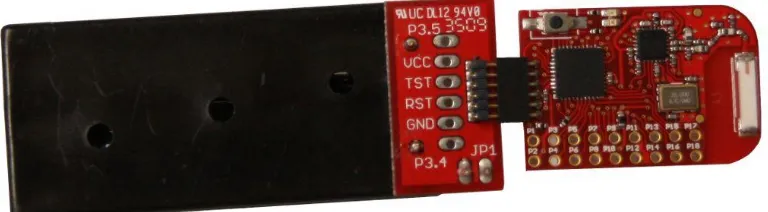
The second major hardware platform was the MSP430-RF2500. This device is manufactured by
TI and sold as a development platform. The MSP430-RF2500 device consists of an MSP430F2274
microcontroller and a CC2500 radio. There were several reasons why this device was used. The
primary use for the MSP430-RF2500 was to develop the libraries to use the CC2500 radio. The
next planned hardware platform for the project consisted of a CC430 with a CC2500. The previous
software libraries would need to be expanded to include a second radio for communication.
Unlike the CC430, which has a radio core built in, the CC2500 is a standalone unit. In order
to expedite the software development process, a working platform was needed. Software
develop-ment new, untested, hardware is not a feasible option. Debugging both hardware and software
simultaneously is not a good idea.
The previously developed CC430 libraries were ported to work with the MSP430 microcontroller
and expanded to use the CC2500 radio. Features of the new radio libraries include power control,
[image:15.612.135.519.399.505.2]addressing and channel switching.
Figure 2: EZ430-RF2500 with Battery Pack
3
Wireless ECG Application
3.1
Description
The main goal of the Wireless ECG application is to produce the equivalent output of a traditional,
The three main parts of the wireless ECG project are:
• Developing the analog front-end to measure the biopotential signals from the subject.
• Developing the software/firmware libraries to measure, store, and transmit the data from the
EDs to the host.
• Developing the lead reconstruction algorithms to convert the 3 measurements back to a
physi-cian friendly 12-lead display.
The work presented here focuses on the software/firmware development for the application.
3.2
TinyOS Platform
The first wireless ECG platform was developed using the Imperial College London BSN Motes,
which use the TinyOS operating system. These devices are programmed in a derivative of the C
language called NesC. While working with these devices and operating system was not particularly
simple, the hardware worked, and had been used in other projects. A full 3-sensor wireless ECG
application (minus the lead reconstruction) was implemented with these devices. Since the devices
run an operating system, several, non-ideal, modifications were required to obtain precise time
synchronization.
3.3
CC430 Platform
After demonstrating the system using the TinyOS devices, the development of the in-house system
continued. After several hardware implementations, a similar 3-sensor wireless ECG application was
developed. In contrast to the TinyOS system, the CC430 platform only used hardware and software
that was developed by the team.
3.4
Time Synchronization
The method used compensates for time offsets between samples and minimizes the effect of clock
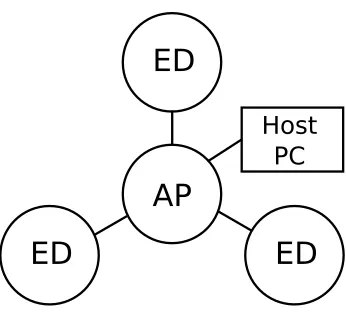
drift by periodically synchronizing independent clock sources together. Figure 3 shows an example
system consisting of three end devices (EDs), one access point (AP) and one host computer. All devices have a timer used for time-stamping and synchronization. All events, including samples and
AP
ED
ED
ED
[image:17.612.238.411.84.247.2]Host
PC
Figure 3: Test Network Layout
value of the timer cannot be altered, it can only be reset to zero. This does not, in any way, affect
the synchronization of devices.
The timer inside theAP can be considered the primary, or global, timer. The goal is to synchro-nize allED, or local, timers with the global timer. Whenever the global timer reaches its maximum value, and rolls over back to zero, theAP sends a broadcast synchronization beacon instructing each end device it is time zero. When anED receives this message, it compares its current timer value to zero, to calculate the clock drift, and resets it to zero. This ensures that allED timers are aligned, which then allows measurements to occur at close to the same time.
While many, more precise, time synchronization methods are available [9], it was determined
that they were not needed. Due to the low sampling rate and the use of crystal oscillators to run
the timers, the precision obtained with this simple method was good enough for the system. More
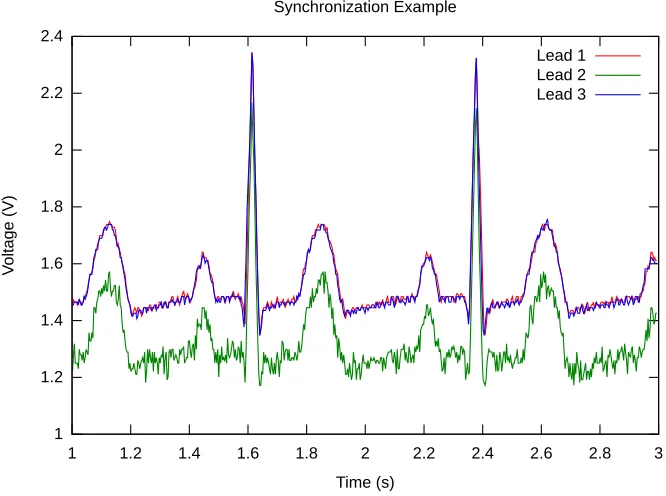
complex methods would not have significantly improved results. Figure 4 shows the result of three
separate wireless devices measuring the same signal. This method was used to confirm that the
samples were aligned.
3.5
Scheduling
A round robin-like scheme is used to poll devices in the network. It focuses on simplicity and
portability.
1 1.2 1.4 1.6 1.8 2 2.2 2.4
1 1.2 1.4 1.6 1.8 2 2.2 2.4 2.6 2.8 3
V
oltag
e (
V
)
Time (s) Synchronization Example
[image:18.612.154.487.101.349.2]Lead 1 Lead 2 Lead 3
Figure 4: Synchronization Test
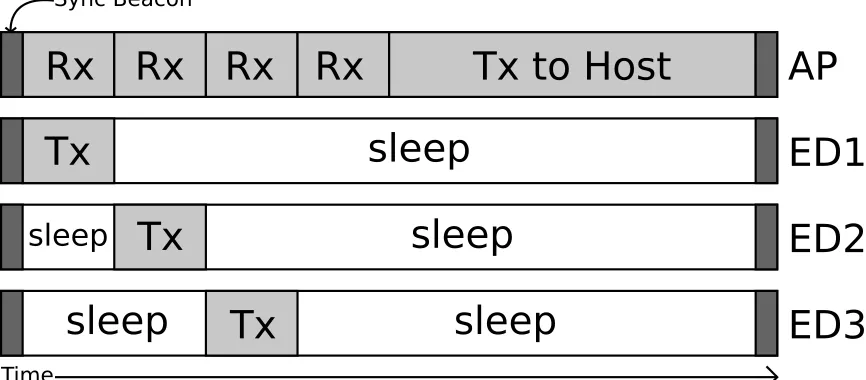
will wake up when they are scheduled to transmit and send the required data automatically. This
method greatly reduces the power consumption of bothAP and EDs. After initialization, the AP
only needs to send a periodic time synchronization beacon and the collected data back to the host
computer. Once synchronized, end devices will only need to turn their receiver on around the time
the synchronization beacon is expected.
Figure 5 shows a sample system schedule. The figure shows the time each device is on, and the
state of each radio. The “sleep” time for eachED does not show when a device wakes up to sample data. In this specific case, theAP has one extra time-slot allotted for a fourthED.
Certain devices can further reduce power consumption by sampling without using the main
AP
ED1
ED2
ED3
Tx
Tx
Tx
Rx Rx Rx
Tx to Host
Time
sleep
sleep
sleep
sleep
sleep
Rx
[image:19.612.108.541.95.285.2]Sync Beacon
Figure 5: System Schedule
3.6
Host Interface
The primary focus of this project was to obtain synchronized samples from several wireless devices.
A secondary, but important, goal was to display the data in real time. To speed up development, the
live-plotting tool kst(http://kst-plot.kde.org/) was used. A application, written in C, communicated
via a USB-to-Serial link with the AP and received all of the ED data. It then output the data to
CSV files, which were then used as an input for kst. Figure 6 shows an ECG lead wirelessly measured
from a human subject.
4
Algorithm Development Platform
A platform for testing and analyzing new cost functions for global routing algorithms was developed
in C. The platform allows for a network of nodes and links between the nodes to be created. It
computes the best path from any node to a central source node. Finally, it produces various statistics,
such as energy use, routing maps, and graphical visualizations.
4.1
Initial Development
Initially, the goal of the platform was to test and compare routing with various link costs in an
0.4 0.6 0.8 1 1.2 1.4 1.6 1.8 2
0 0.2 0.4 0.6 0.8 1 1.2
V
oltag
e (
V
)
Time (s) ECG Lead
[image:20.612.154.488.97.349.2]Lead 1
Figure 6: Sample Measurement from Single ECG Lead
microcontroller and used. This did not turn out to be the case. The first problem encountered
dealt with the network structure used for testing. The program required a list of nodes and a list of
links between the nodes, along with the link costs. Developing a simulated network and links that
accurately represented a real network was unfeasible. The choice was then made to closely couple
the hardware design and the simulator.
4.2
Hardware Coupling
The best way to come up with a network for simulation was to get all of the node and link information
from a real network. The WBAN platform was then used to develop a system for measuring RSSI
data between all nodes in a network. This system allowed for the capture of real network data,
both nodes and links, that could later be used to run routing simulations. The new program
auto-generated a list of nodes, links, and link costs from the previously-measured RSSI data. This new
4.3
Simulation Output
In order to better understand how the new routing system performed, a series of output files were
generated during simulation. The program was set up to account for the energy use of each node
as it routed packets through the network. Visualizing the energy use was vital for the analysis of
network lifetime. Other available data included the routing information itself, which allowed for the
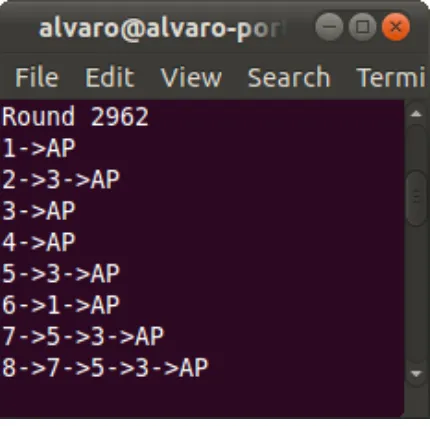
analysis of the routes as the algorithm runs. During run-time, the program prints out text-based
routing information in a terminal window(Figure 8). This provided real-time feedback that was
useful during hardware debugging.
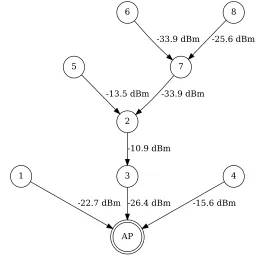
AP 1
-22.7 dBm 2
3
-10.9 dBm
-26.4 dBm
4
-15.6 dBm 5
-13.5 dBm 6
7 -33.9 dBm
-33.9 dBm 8
[image:21.612.196.452.261.521.2]-25.6 dBm
Figure 7: Sample Network Visualization
Finally, the program produced a graphical output. The graphical output began as a simple
experiment to see a visual representation of the network. It was later expanded to generate graphs
of the network, and all available connections, as the RSSI data was sampled. Due to the large
number of links between all of the nodes, this graphic was not useful. The final implementation,
which can be seen in Figure 7, only displayed the links used in a specific round of routing. The link
labels display the transmit power required by each node to meet the specific link. The generated
sample video of the generated routing animation can be seen inhttp://www.youtube.com/watch?
[image:22.612.217.432.134.347.2]v=5Mpn-_FFJaw&hd=1.
Figure 8: Sample Run-time Output
5
Specialized Cost Function for Maximizing Body Area
Net-works Lifetime Using Global Routing Algorithms
5.1
Introduction
There are several routing protocols designed specifically for WBANs. Braem et al. developed
the CICADA protocol, which consists of a spanning tree architecture with a time-division scheme
for transmission scheduling [8]. The primary downside to this method is that nodes closer to the
root will deplete their energy source faster due to the need to relay messages from children nodes.
Other protocols focus on the reliability of the network [12]. Dynamic networks are a problem with
WBANs. If sensors are placed in the extremities, the network will change as the body changes
positions. Quwaider et al. developed a protocol tolerant to network changes [12]. They propose a
store-and-forward method that maximizes the likelihood of a packet reaching its destination. Each
packet is stored by multiple devices and retransmitted, which consumes more power. One solution
nodes with larger power sources. While this method increases the network lifetime, it requires more
hardware. Finally, Nabi et al. propose a similar store-and-forward method, but integrates Transmit
Power Adaptation (TPA) [11]. Nodes keep track of neighbors and use power control to use the
smallest transmit power while maintaining a specific link quality.
In order to provide accurate channel conditions, RSSI measurements of an eight ED network
were used as input to our simulations(5.4). Real-time hardware implementations were also run to
demonstrate the algorithm(5.5). The new cost function succeeded in improving network lifetimes
when run in a dynamic environment. Static environments did not produce successful results.
6
AP
8
7
5
3
4
2
1
α
7,5
C
7,5
7
[image:23.612.219.430.257.636.2]5
5.2
Proposed Cost Function
In the proposed system, we define a new link cost function that is then used in a routing algorithm.
Traditionally, the power required to make a link possible is used as the link cost. In this case, the
total energy used by a device is factored into the equation. If a device has used more energy than
the others, its use as a relay will be discouraged.
5.2.1 Device Energy
Each device’s normalized energy use is calculated as shown in Equation 2, wherejdenotes the device
ID,iis the current polling round,αj,kis the channel attenuation for the selected link, andRSSIT
is the target RSSI. The current energy used is incremented by the energy used to transmit a single
packet while maintaining RSSIT. The channel attenuation for the selected link,α
j,k, can be seen
in Equation 1, where RSSI is the received power measured by device kand Ptx is the transmitted
power used by devicej.
5.2.2 Link Cost
The actual link cost is computed by calculating the energy used by the device,if that link is selected, and multiplying by a cost factor(Equation 3). The cost factor calculation takes the energy used by
the destination device,Eik, and divides it by the current energy minimum,Eimin, which is the energy
used by the device with the minimum energy used by roundi. This ratio is then raised to the power
M, which determines how strong the effect will be. If a device’s energy is much greater than the
current minimum, it will be avoided as a relay. TheM factor in Equation 3 can be any number in
0 < M < ∞. The cost factor is normalized so when M = 0, it returns to the traditional cost of
required power to meet the link.
Since the link costs are directly related to the destination device, they are calculated during the
routing algorithm computation. For this paper, Dijkstra’s algorithm [4] is used to select the best
route.
αj,k= RSSI
Ptx
(1)
E(ji)=E(ji−1)+RSSI
T
Cj,ki =RSSI
T
αj,k
×
1 + Eik Emin
i
M
2
(3)
5.2.3 Assumptions
This algorithm works under several assumptions. The first being that this is a centralized network
with one Access Point (AP) with virtually unlimited energy and computing power. The second is
that each wireless sensor, or End Device(ED), can act as a relay for messages from other nodes. The
Third is that the link quality, or channel attenuation, between all EDs and AP is known. Finally,
all EDs begin with an equal energy used, that is, they all have the same energy stored. All routing
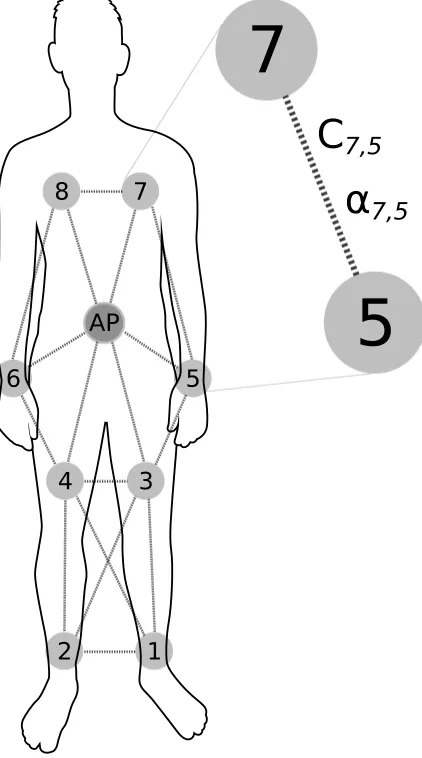
calculations take place in the AP. Figure 9 shows a sample network with EDs labeled 1 through 8,
and one AP.
5.3
Performance Analysis
In what follows, we analyze the performance of the proposed cost function. The new cost function
was tested in both simulated and experimental environments. In order to gauge the efficiency of the
cost function, it will be compared to an identical system which uses a traditional link cost function.
The traditional link cost function consists of the required power to meet a link with the desired
RSSIT. This can be achieved by setting a value ofM = 0 in the new link cost function.
Performance is determined by the time it takes any node’s accumulated normalized energy to
cross an arbitrary threshold. The threshold could be equivalent to the amount of energy stored in
a device battery, but for this experiment, is purely arbitrary.
5.3.1 Algorithm Implementation
Detailed pseudo-code for the routing algorithm can be found in Algorithm 1. Similarly, code for
energy used calculation can be found in Algorithm 2.
5.4
Simulation
In order to test the new cost function in an efficient manner, a simulation was used. Measurements
of real channel data were acquired by running the procedure described in 5.5.2 without the routing
Algorithm 1Dijkstra’s Algorithm with new cost function
1: fori= 1 to # of Nodesdo
2: nodei.visited←0
3: nodei.distance← ∞
4: nodei.previous←nodei
5: end for
6: nodeAP.distance←0
7: energymin =min(node.energy)
8: while unvisited nodes availabledo
9: nodesource ←node with smallest distance
10: fori= 1 to # of Linksdo
11: if linki.source=nodesource then
12: nodedest←linki.destination
13: if nodedest.visited= 0then
14: cost←linki.power∗(1 +nodedest.energy/energymin)M/2
15: newdistance←nodesource.distance+cost
16: if distance < nodedest.distancethen
17: nodedest.distance←newdistance
18: nodedest.previous←nodesource
19: end if
20: end if
21: end if
22: end for
23: nodesource.visited←1
24: end while
Algorithm 2Energy Used Calculation
1: fori= 1 to # of Nodesdo 2: nodeptr =nodei
3: if nodeptr.previous=nodeptr then
4: No path tonodei
5: else
6: while nodeptr.previous6=nodeptr do
7: linkptr←link betweennodeptr andnodeptr.previous
8: nodeptr.energy+ =linkptr.power
9: nodeptr ←=nodeptr.previous
10: end while
11: end if
12: end for
transmitted it to the host.
Two experimental setups were used to capture RSSI data. For the first, the subject(See Figure 11)
remained relatively static in a sitting position. The second consisted of a more dynamic environment,
where the subject walked around a room as seen in Figure 10.
A set of captured RSSI tables (as seen in Table 1) were fed into the simulation, which proceeded
and routes taken for all devices.
5.5
Hardware Implementation
In order to verify the new cost function in a real environment, a hardware platform was developed
and used. The system function in a similar fashion to the simulation, except that the actual routing
and power control data was fed back to the ED’s.
5.5.1 Hardware Platform
The hardware platform used for this test consists of the Texas Instruments (TI) EZ430-RF2500. This
device includes both an MSP430F2274 microcontroller along with a CC2500 2.4GHz transceiver. The
CC2500 is configured to run at 250kbps. A single device, labeled the Access Point (AP), is connected
via a USB to Serial link, running at 115200 BAUD, to the host computer. All other devices, labeled
End Devices (EDs), are battery powered. In this implementation, the AP acts only as a bridge
between the host and the end devices. All routing and power control calculations are done on the
host.
The host is a laptop computer with an Intel(R) Core(TM) i5-2410M CPU and 4GB of RAM.
Eight EDs were placed on a 170cm, 70kg male subject as shown in Figure 9. The host was carried
on a backpack and connected to the AP via a USB cable. The data was sampled, and the routing
algorithm was run, at a rate of 5Hz. This sampling rate is appropriate as long as the subject, or
its environment, does not move faster than this. If data needs to be sampled at a faster rate, some
hardware and firmware changes might be necessary, but the host software will still work.
For both simulation and hardware experiments, the target RSSI (RSSIT) was arbitrarily chosen
to be−60dBm.
5.5.2 Cycle of Operations
A normal cycle of operations withndevices works as follows:
1: AP sends synchronization beacon which includes routing and power control tables.
2: Each ED transmits its own RSSI table back to the AP, while simultaneously listening to other ED messages and storing the received power from each.
Figure 10: Walking environment.
4: The host uses the RSSI table to compute the routes along with the required powers to meet the selected links.
5: The host sends both routing and power tables back to the AP so that a new cycle may begin.
AP ED1 ED2 ED3 ED4 ED5 ED6 ED7 ED8
AP - -60 -60 -60 -60.5 -60.5 -60.5 -60 -79.5
ED1 -66 - -62 -75 -63.5 -69 -75.5 -73 -67.5
ED2 -72 -61.5 - -80 -69 -70 -74 -75 -66
ED3 -77.5 -74.5 -80.5 - -67.5 -70 -72.5 -70.5 -70
ED4 -39 -63 -69.5 -67 - -82.5 -74.5 -69 -65.5
ED5 -67.5 -68 -71 -69.5 -84 - -55.5 -51.5 -62
ED6 -67 -75 -75 -72.5 -75 -55.5 - -44.5 -53
ED7 -46 -70 -77.5 -70.5 -69 -50.5 -45 - -51.5
ED8 -78 -67.5 -66.5 -71 -66 -62 -54 -51.5
-Table 1: Sample RSSI -Table
5.5.3 Details
To minimize the number of control packets from being transmitted, the EDs are not individually
polled. The only control packet that is sent is the synchronization beacon, which also carries the
[image:28.612.158.490.430.557.2]schedule to avoid collisions. Each ED has a network ID ranging from 1 to n. The time between
synchronization packets is divided into time-slots than are used by each ED. The time slot used
depends on the network ID of each device. This removes the need to come up with time schedules
during runtime.
The routing table is a simple array which lists the destination for each ED packet. The ED does
not need to know the entire route its packets will take, but only next device in the path. Similarly,
the power table lists the transmit power setting each device needs to use. The size of these tables is
[image:29.612.231.416.244.638.2]directly proportional to the number of devices in the network.
5.6
Results
Due to the similarities between the simulation and hardware implementation (they both use real
RSSI data), the results were fairly similar. If fed with the same RSSI data, the algorithm will always
produce the same results. The only difference with the hardware implementation is that the RSSI
table is reduced due to the use of power control. Since each ED only uses enough transmit power
to reach a specific ED, others might not receive the message. This was not a problem when the
hardware experiment was run.
0 0.05 0.1 0.15 0.2 0.25 0.3 0.35 0.4
0 50 100 150 200 250 300
A ccum ula te d E ne rgy ( uJ) Time (s)
Accumulated Energy vs. Time (M=0)
[image:30.612.165.480.255.486.2]ED1 ED2 ED3 ED4 ED5 ED6 ED7 ED8
Figure 12: Sitting M=0
Figures 12 and 13 show the resulting accumulated energies while the subject was in a sitting
position. The experiment was run with both anM = 0 as a reference, andM = 100. Unfortunately,
the results with a static subject were rather neutral. All EDs consume energy at different rates for
both M = 0 and M = 100. A possible explanation for this is that the links between EDs remain
close to the same as time passes. This can become a problem because certain EDs may only have
a single path to choose from. If this is the case, they have no choice but to use the same link
continuously. Not having a choice of paths impairs the ability of the routing algorithm to distribute
0 0.05 0.1 0.15 0.2 0.25 0.3 0.35 0.4
0 50 100 150 200 250 300
A ccum ula te d E ne rgy ( uJ) Time (s)
Accumulated Energy vs. Time (M=100)
[image:31.612.163.480.104.334.2]ED1 ED2 ED3 ED4 ED5 ED6 ED7 ED8
Figure 13: Sitting M=100
Figures 14 and 15, on the other hand, show an increase in network lifetime. For example, at
the end of the 5 minute sampling run withM = 0, the device which consumed the most power was
ED7 with approximately 1.06 µJ. On the other hand, with M = 100, all EDs consume power in
a uniform fashion and end up with less than 0.81µJ each. One important observation is that the
network withM = 0 consumed less overall power ( 6µJ) than the one withM = 100 ( 6.31µJ). This
is expected, due to the fact that the new cost function specifically avoids the most efficient path
for a specific node in favor of the most efficient path for the whole network. While more energy is
consumed overall, no single ED consumes much more power than others.
Another way of interpreting these results is that energy use in the network is more efficient.
When a single ED depletes its energy source using the traditional link cost, there is a significant
amount of energy left unused in the network. At the same time, when an ED dies in a network using
the new link cost, there should be much less energy left in the rest of the network.
To demonstrate the network lifetime improvement, an ED will be considered have depleted it’s
power source after consuming 0.625 µJ of energy. In the previous example, the trial with M = 0
reaches 0.625µJ after approximately 175 seconds, while the case with M = 100 reaches it around
0 0.2 0.4 0.6 0.8 1 1.2
0 50 100 150 200 250 300
A ccum ula te d E ne rgy ( uJ) Time (s)
Accumulated Energy vs. Time (M=0)
[image:32.612.164.480.105.339.2]ED1 ED2 ED3 ED4 ED5 ED6 ED7 ED8
Figure 14: Walking M=0
0 0.1 0.2 0.3 0.4 0.5 0.6 0.7 0.8
0 50 100 150 200 250 300
A ccum ula te d E ne rgy ( uJ) Time (s)
Accumulated Energy vs. Time (M=100)
[image:32.612.162.481.122.556.2]ED1 ED2 ED3 ED4 ED5 ED6 ED7 ED8
A good example of the algorithm working was a result of hardware problems. During of the
experiments, a single ED went off-line for several seconds and was manually restarted. Figure 16
shows the effect the ED failure had on the network. Because a device that is powered off does not
consume power, it became the one with the least energy used. When it returned to the network, it
was immediately used as a relay by other nodes.
0 0.1 0.2 0.3 0.4 0.5 0.6 0.7 0.8 0.9 1
0 100 200 300 400 500 600
A ccum ula te d E ne rgy ( uJ) Time (s)
[image:33.612.164.480.216.435.2]Accumulated Energy vs. Time (M=100) ED1 ED2 ED3 ED4 ED5 ED6 ED7 ED8
Node Fails
Node Restored
Figure 16: Walking M=100
6
Conclusion
The developed WBAN software libraries were successfully used to implement both the wireless ECG
system and the full-body routing system. The wireless ECG system was able to sample data at a
rate of 300Hz and display in real-time through the host computer. The routing algorithm testing
platform facilitated the development of the new link cost function to maximize network lifetime.
After analyzing the results, the new link cost function successfully improved network lifetime.
The new cost function outperformed the traditional one in trials dealing with a dynamic environment,
where the subject was walking. When the subject was not moving, both link costs performed about
overall power consumption.
While the new link cost was successful, there is room for improvement. One improvement that
can be done deals with the example from Figure 16. While the failed ED was not part of the network,
it was still taken into account when it came to link cost calculation. A better implementation would
not include off-line devices in the calculation. A second modification would relate actual battery,
or other power source, charge to the algorithm. This would allow for devices to join and leave the
network while maintaining proper operation. It would also allow devices with different power sources
to be included and used.
The use of power control, coupled with this new link cost function, should allow WBANs to
run efficiently for long periods of time, while maximizing the network lifetime. Networks requiring
all devices to be on-line to function will greatly benefit from this routing method. Other networks
can also benefit. Due to the normalization of energy use in the network, devices will deplete their
energy sources at similar times. This could be beneficial as all devices can be recharged or replaced
simultaneously, instead of constantly monitoring and replacing individual devices.
References
[1] J. N. Al-Karaki and A. E. Kamal. Routing techniques in wireless sensor networks: a survey.
IEEE Wireless Communications, 11(6):6–28, December 2004.
[2] Geoffrey W. Allen, Konrad Lorincz, Matt Welsh, Omar Marcillo, Jeff Johnson, Mario Ruiz, and
Jonathan Lees. Deploying a Wireless Sensor Network on an Active Volcano. IEEE Internet Computing, 10(2):18–25, March 2006.
[3] Bart Braem, Benoit Latre, Ingrid Moerman, Chris Blondia, and Piet Demeester. The wireless
autonomous spanning tree protocol for multihop wireless body area networks. InThe Wireless Autonomous Spanning tree Protocol for Multihop Wireless Body Area Networks, pages 1–8, July 2006.
[5] Aida Ehyaie, Massoud Hashemi, and Pejman Khadivi. Using relay network to increase life time
in wireless body area sensor networks. InUsing relay network to increase life time in wireless body area sensor networks, pages 1–6, June 2009.
[6] Jeremy Elson, Lewis Girod, and Deborah Estrin. Fine-grained network time synchronization
using reference broadcasts. SIGOPS Oper. Syst. Rev., 36(SI):147–163, December 2002. [7] Saurabh Ganeriwal, Ram Kumar, and Mani B. Srivastava. Timing-sync protocol for sensor
networks. In Proceedings of the 1st international conference on Embedded networked sensor systems, SenSys ’03, pages 138–149, New York, NY, USA, 2003. ACM.
[8] Benoit Latre, Bart Braem, Ingrid Moerman, Chris Blondia, Elisabeth Reusens, Wout Joseph,
and Piet Demeester. A low-delay protocol for multihop wireless body area networks. In A Low-delay Protocol for Multihop Wireless Body Area Networks, pages 1–8, 2007.
[9] Mikl´os Mar´oti, Branislav Kusy, Gyula Simon, and ´Akos L´edeczi. The flooding time
synchro-nization protocol. InProceedings of the 2nd international conference on Embedded networked sensor systems, SenSys ’04, pages 39–49, New York, NY, USA, 2004. ACM.
[10] D. L. Mills. Internet time synchronization: the network time protocol. IEEE Transactions on Communications, 39(10):1482–1493, Oct 1991.
[11] Majid Nabi, Twan Basten, Marc Geilen, Milos Blagojevic, and Teun Hendriks. A robust
protocol stack for multi-hop wireless body area networks with transmit power adaptation . In
BodyNets’10, September 2010.
[12] Muhannad Quwaider and Subir Biswas. On-body packet routing algorithms for body sensor
networks. InOn-body Packet Routing Algorithms for Body Sensor Networks, pages 171–177, 2009.
[13] Adrian Sapio and Gill R. Tsouri. Low-Power body sensor network for wireless ECG based on
relaying of creeping waves at 2.4GHz. InLow-Power Body Sensor Network for Wireless ECG Based on Relaying of Creeping Waves at 2.4GHz, pages 167–173, June 2010.
[14] Thomas Schmid, Prabal Dutta, and Mani B. Srivastava. High-resolution, low-power time
Con-ference on Information Processing in Sensor Networks, IPSN ’10, pages 151–161, New York, NY, USA, 2010. ACM.
[15] Gyula Simon, Mikl´os Mar´oti, ´Akos L´edeczi, Gy¨orgy Balogh, Branislav Kusy, Andr´as N´adas,
G´abor Pap, J´anos Sallai, and Ken Frampton. Sensor network-based countersniper system. In
Proceedings of the 2nd international conference on Embedded networked sensor systems, SenSys ’04, pages 1–12, New York, NY, USA, 2004. ACM.
[16] Philipp Sommer and Roger Wattenhofer. Gradient clock synchronization in wireless sensor
networks. In Proceedings of the 2009 International Conference on Information Processing in Sensor Networks, IPSN ’09, pages 37–48, Washington, DC, USA, 2009. IEEE Computer Society. [17] Makoto Suzuki, Shunsuke Saruwatari, Narito Kurata, Masateru Minami, and Hiroyuki
Morikawa. A quantitative error analysis of synchronized sampling on wireless sensor networks
for earthquake monitoring. In Proceedings of the 6th ACM conference on Embedded network sensor systems, SenSys ’08, pages 417–418, New York, NY, USA, 2008. ACM.
[18] Ning Xu, Sumit Rangwala, Krishna K. Chintalapudi, Deepak Ganesan, Alan Broad, Ramesh
![Figure 1: RBS Multi-Hop Network Layout. From [6].](https://thumb-us.123doks.com/thumbv2/123dok_us/114164.10856/9.612.248.400.279.442/figure-rbs-multi-hop-network-layout-from.webp)