RESEARCH NOTE
Healthcare waste management current
status and potential challenges in Ethiopia:
a systematic review
Teshiwal Deress Yazie
*, Mekonnen Girma Tebeje and Kasaw Adane Chufa
Abstract
Objective: During the healthcare delivery process, hazardous wastes can be generated from the health facilities. Improper healthcare waste management is responsible for the transmission of more than 30 dangerous bloodborne pathogens. The aim of this systematic review was to evaluate the healthcare waste management practice and poten-tial challenges in Ethiopia.
Results: Electronic databases and direct Google search yielded 1742 articles from which 17 studies met the inclu-sion criteria. The proportion of hazardous waste generated in Ethiopian healthcare facilities was unacceptably high which ranged from 21 to 70%. Most studies indicated the absence of proper waste segregation practice at the source of generation. Treatment of the healthcare waste using low combustion incinerator and/or open burning and open disposal of the incinerator ash were very common. Lack of awareness from the healthcare staff, appropriate waste management utilities and enforcement from the regulatory bodies were mainly identified as a common factor shared by most of the studies. The healthcare waste management practice in Ethiopian healthcare facilities was unsatisfac-tory. There should be close supervision of the waste disposal process by the regulatory bodies or other stakeholders.
Keywords: Healthcare waste, Waste management, Healthcare facility, Ethiopia
© The Author(s) 2019. This article is distributed under the terms of the Creative Commons Attribution 4.0 International License (http://creat iveco mmons .org/licen ses/by/4.0/), which permits unrestricted use, distribution, and reproduction in any medium, provided you give appropriate credit to the original author(s) and the source, provide a link to the Creative Commons license, and indicate if changes were made. The Creative Commons Public Domain Dedication waiver (http://creat iveco mmons .org/ publi cdoma in/zero/1.0/) applies to the data made available in this article, unless otherwise stated.
Introduction
During the healthcare delivery process, healthcare facili-ties (HCFs) can generate wastes and by-products [1]. Currently, there are several terms used to explain the waste generated from the HCFs such as; health facil-ity waste, clinical waste, healthcare waste, medical waste, and biomedical waste. However, healthcare waste (HCW) is most frequently used by the articles published so far [2–24]. In this study, we used the term HCW to represent the total waste generated from the HCFs.
Healthcare waste is categorized as general and haz-ardous waste types [25–27]. General waste is the largest portion [26] which is originated from food preparation, administrative and housekeeping activities. Whereas, the
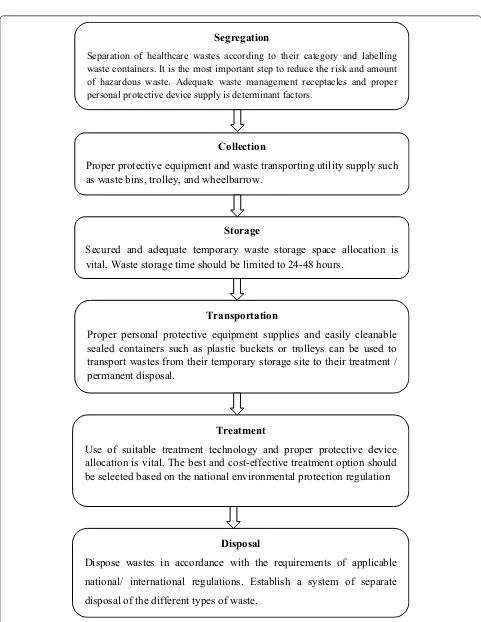
hazardous waste is generated throughout the healthcare delivery process [19]. It includes laboratory wastes, path-ological, body fluids, and sharp wastes [25, 26]. Accord-ing to the guidelines, six consecutive healthcare waste management (HCWM) steps should be implemented by the HCFs [26, 28–31]. This successful management pro-cess includes segregation, collection, storage, transpor-tation, treatment, and end up with final disposal [17, 26, 32] (Fig. 1).
Proper disposal of the HCW has become a global con-cern due to its public health hazards [17, 25, 33]. Accord-ing to the WHO estimation, 10–25% of the HCW is hazardous [26]. However, this proportion is varied from country to country which ranged between 16 and 75% [6, 8, 12, 14, 21, 23, 34, 35]. Globally over two million healthcare workers are exposed to infections [26]. The HCW can transmit more than 30 dangerous bloodborne pathogens [36]. Poor HCWM is a problem particularly in most developing countries [5, 12, 37–40]. Several studies indicated that HCWM is still at infancy stage [3, 7, 15,
Open Access
*Correspondence: [email protected]; [email protected] Unit of Quality Assurance and Laboratory Management, School
Segregation
Separation of healthcare wastes according to their category and labelling waste containers. It is the most important step to reduce the risk and amount of hazardous waste. Adequate waste management receptacles and proper personal protective device supply is determinant factors.
Collection
Proper protective equipment and waste transporting utility supply such
as waste bins, trolley, and wheelbarrow.
Storage
Secured and adequate temporary waste storage space allocation is
vital. Waste storage time should be limited to 24-48 hours.
Disposal
Dispose wastes in accordance with the requirements of applicable
national/ international regulations. Establish a system of separate
disposal of the different types of waste.
Treatment
Use of suitable treatment technology and proper protective device
allocation is vital. The best and cost-effective treatment option should
be selected based on the national environmental protection regulation
Transportation
Proper personal protective equipment supplies and easily cleanable
sealed containers such as plastic buckets or trolleys can be used to
transport wastes from their temporary storage site to their treatment /
permanent disposal.
[image:2.595.57.538.73.695.2]16] and particularly it is a neglected activity in Ethiopia [31]. Therefore, the aim of this systematic review was to evaluate the HCWM practice and potential challenges in Ethiopia.
Main text
Methods
Ethiopia is a highly populated country in Africa. Dur-ing 2012 the Ethiopian population was predicted to be 84,320,987 [41]. In parallel with the rapid population growth, the number of HCFs is increasing [13, 42]. The healthcare management is categorized as primary, sec-ondary and tertiary levels. During 2011 there were 125 hospitals, 2999 health centers, 15,668 health posts and more than 4000 private clinics in the country [43]. The health post, health center, and primary hospitals serve a population of 3000–5000, 40000 and 60,000–10,000, respectively. General and specialized hospitals serve 1 to 1.5 and 3.5–5.0 million population, respectively [44].
A qualitative research design was employed to develop this systematic review. The study was conducted accord-ing to the PRISMA (Preferred Reportaccord-ing Items for Sys-tematic Reviews and Meta-Analyses) guidelines to ensure the inclusion of relevant information in the study [45]. Studies were eligible only if they were published in the English language in peer-reviewed journals, carried out in the Ethiopian context, and accessed in the full-text format.
Published articles were searched in PubMed and Google Scholar by two investigators (TD and MG). The search strategy was employed using a combination of keywords and Boolean functions; “healthcare waste” OR “medical waste” OR “clinical waste” OR “infectious waste” OR “hospital waste” OR “healthcare facility waste” OR hazardous waste” OR “biomedical waste” OR “medi-cal waste” AND “Ethiopia”. In addition, a direct Google search was also employed. Then, the searched articles from the two investigators were compiled together and screened for duplication. Finally, reference lists cited by each eligible study were assessed to identify additional articles. We used an endnote X9 version citation man-ager software to manage the citation.
Two authors (TD and KA) independently extracted data using the predefined data extraction sheet. Incon-sistent data between the two data abstracters were resolved by discussion and involvement of a third co-author (KA). Data were abstracted containing first co-author and year of publication, setting, key findings (availability of waste management utilities/devices, waste segregation practice, hazardous waste proportion, waste treatment, final disposal, potential challenges) and additional rel-evant findings were paraphrased.
Before starting data extraction, selection process of the relevant studies was explained under the characteristics of included studies using texts and graphical presenta-tion. After data extraction, the findings were grouped together into three thematic areas ‘waste generation, seg-regation and use of proper waste management utilities’, ‘waste treatment and disposal practices’, and ‘potential challenges. Finally, data were presented using texts.
To ensure reliability, articles were searched systemati-cally using a combination of key terms and Boolean func-tions by two authors independently. The quality of the data was assured through extracting by two authors inde-pendently using the predefined data extraction checklist. Any inconsistent data from the two data extractors were resolved by discussion and involvement of a third co-author (Kasaw). In addition, the review process was done using the PRISMA guidelines.
Results
Characteristics of the included studies
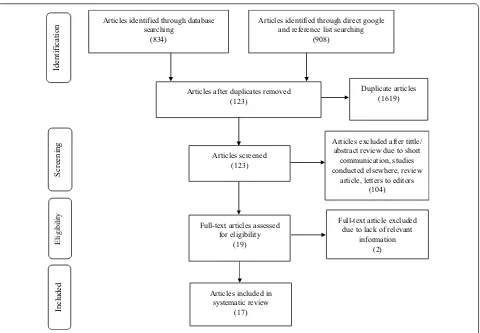
This systematic review was conducted on published stud-ies which were conducted among the Ethiopian health-care facilities. An online electronic search was done using Google Scholar and PubMed databases and we identified 834 articles. In addition, from reference lists of the included studies and direct Google search, we iden-tified 908 articles. From a total of 1742 articles, 1619 data files were removed due to duplication. Further, 123 articles were refined by their title and abstract and 104 studies were excluded due to short communication, lack of relevant data with respect to this systematic review, unpublished student thesis, studies conducted elsewhere in another country, a review article on the legal frame-work, and letters to editors. Nineteen full-text articles were reviewed and two of them were excluded due to lack of relevant information for this systematic review as one study was conducted on developing new models for HCWM and the other was conducted on the prevalence of injuries associated with the mismanagement of HCWs among the waste collectors. Finally, we included 17 full-text articles (Fig. 2).
Waste generation, segregation and use of utilities
segregation [5, 9]. General and infectious wastes were mixed together [9]. Plastic buckets were used to store the HCW temporarily [17, 27]. Disinfection of waste storage and/or transporting utilities was uncommon [6, 17].
Waste treatment and disposal practices
Low combustion incinerator was used to treat all the HCW types [2, 8, 9, 12, 14, 21, 46]. In other cases, stud-ies indicated the use of incineration and open burning methods to treat hazardous and general wastes, respec-tively [5, 6, 8, 14, 17, 20, 27]. With respect to disposal of the treated waste by-products, some studies used burial pit [2, 6] while other studies disposed of in an unsanitary way simply by open dumping [8, 12, 27].
Potential challenges
In the Ethiopian context, there was no separate regula-tion specific for the HCFs to enforce them for the proper management of the hazardous waste. Though currently they are not updated and lacked proper compliance on their implementation, there are three HCWM guide-lines prepared by the Federal Ministry of Health (FMoH),
Food, Medicine and Healthcare Administration and Con-trol Authority (FMHACA), and Federal Environmental Protection Authority (FEPA) independently [29, 30, 46]. In addition, studies indicated lack of training, awareness, staff resistance, managerial poor commitment, lack of adequate resources, negligence, and unfavorable attitude of the healthcare staff were the main identified challenges [8, 10, 12–14, 46, 47]. Most studies measured the afore-mentioned potential factors either quantitatively or qual-itatively that could affect HCFs to implement the proper waste management practices.
Discussion
Currently, HCWM is a public health and environmental concern worldwide particularly in the developing coun-tries [4, 48]. Hazardous waste mismanagement affects all individuals particularly healthcare providers. The general and hazardous waste types should be properly segre-gated at their source of generation [25, 49–51]. However, in this systematic review, studies mentioned the absence of waste segregation practices [2, 5, 12, 14, 17, 20, 21, 32, 44]. Probably this could be due to lack of the appropriate Articles identified through database
searching (834)
Screenin
g
Include
d
Eligibility
Identificatio
n Articles identified through direct google and reference list searching (908)
Articles after duplicates removed (123)
Articles screened (123)
Articles excluded after tittle/ abstract review due to short
communication, studies conducted elsewhere, review
article, letters to editors (104)
Full-text articles assessed for eligibility
(19)
Full-text article excluded due to lack of relevant
information (2)
Articles included in systematic review
(17)
Duplicate articles (1619)
[image:4.595.60.540.85.418.2]waste segregation utilities, lack of awareness or lack of enforcing laws and/or regulations. It is also a continent-wide problem by which a systematic review in the Afri-can region indicated that 47% of the studies mentioned the absence of waste segregation [52]. The proportion of hazardous HCW is varied in Ethiopia which ranged from 21 to 70% [14, 44]. This proportion is higher than the haz-ardous waste threshold (10–25%) predicted by the WHO [26]. In one study, even the amount of hazardous waste was higher than the general waste [14]. This could be due to the fact that during the segregation process even a very small amount of hazardous waste is added to the general waste category, then the entire mass of the general waste can be unnecessarily polluted by the hazardous waste.
The segregated HCW types are required to be collected separately using waste collecting utilities designed for each type of HCW [26, 31]; however, in this systematic review, studies indicated the aggregate collection of the different HCW types using a single container [9, 17, 21]. This could be due to the lack of awareness of the health hazards associated with the aggregate collection of all the HCW types by the waste collectors because in Ethiopian context waste collectors are mostly recruited from the low educational level and they might not provide ade-quate training as the healthcare professionals.
According to WHO guidelines, all hazardous HCW types generated from the HCFs should be stored in util-ity rooms prepared for cleaning equipment, dirty linen and waste storage [26]. If these facilities are not available, the HCW can be stored in other secured locations [31, 53]. However, studies indicated hazardous waste storage practices using the primary waste segregation containers stationed around the corridors [27, 44]. This unaccepta-ble waste storage practice could probably due to the lack of sufficient and isolated waste storage spaces away from direct public access.
Incineration is the most widely used waste treatment method to treat hazardous HCW before the final disposal particularly in most developing countries. In Ethiopia, incineration and open burning are common treatment methods to treat hazardous and general waste types, respectively. However, incinerators are often operated under sub-optimal conditions mostly with untrained per-sonnel [4]. Thus, due to inadequate incineration harmful substances can be released into the environment [27]. Regarding disposal of the HCW, incinerator ash is com-monly disposed of in burial pit or open dumping. Most studies showed HCWM noncompliance with the require-ments of the national and international guidelines [2, 5, 6, 8, 9, 12, 14, 18, 21, 27, 44]. This could be due to lack of the appropriate quantity and/or type of waste management utility supply, adequate financial allocation, specific laws, and regulations.
Healthcare waste management is a complex and chal-lenging process and in this systematic review lack of training [2, 5], accessible guideline [2, 6, 12, 21, 46], regu-lar supervision, appropriate utility supply, management support, and specific rules/regulations are identified as a major challenge for having effective waste manage-ment system [5, 13, 17, 23, 24, 27, 44, 46] that needs establishment of an immediate strategy to reduce the potential problems associated with the mismanagement of the hazardous wastes emanated from the healthcare establishments.
In conclusion, the HCW generation rate was high but its management very poor. Lack of accessible guideline, waste management utility, adequate training, financial constraint, and poor managerial supports were identi-fied as the main challenges. There should be sufficient resource allocation, periodic training, and strict supervi-sion by the stakeholders.
Limitations
In this systematic review, liquid waste management was not considered. In addition, recycling practices of the reusable materials from the HCWs were not considered.
Abbreviations
HCW: healthcare waste; HCFs: healthcare facilities; HCWM: healthcare waste management.
Acknowledgements
Not applicable.
Authors’ contributions
TD and MG participated during collecting relevant articles from the databases. After articles have been collected, KA and TD extracted data and prepared the draft manuscript. Then, MG revised the manuscript. Finally, TD and MG final-ized the manuscript and TD communicated with the journal. All authors read and approved the final manuscript.
Funding
Not applicable.
Availability of data and materials
Not applicable.
Ethics approval and consent to participate
Not applicable.
Consent for publication
Not applicable.
Competing interests
The authors declare that they have no competing interests.
Received: 3 January 2019 Accepted: 18 May 2019
References
waste (BMW) management with a preliminary intervention in an aca-demic hospital. Int J Med Public Health. 2014;4:91–5.
2. Abebe S, Raju R, Berhanu G. Health care solid waste generation and its management in Hawassa Referral Hospital of Hawassa University, South-ern, Ethiopia. Int J Innov Res Dev. 2017;6:126–32.
3. Alagoz AZ, Kocasoy G. Determination of the best appropriate manage-ment methods for the health-care wastes in Istanbul. Waste Manage. 2008;28:1227–35.
4. Asante OB, Yanful E, Yaokumah EB. Healthcare waste management; its impact: a case study of the greater Accra Region, Ghana. Int J Sci Technol Res. 2014;3:106–12.
5. Azage M. Healthcare waste management practices among healthcare workers in healthcare facilities of Gondar town, Northwest Ethiopia. Health Sci J. 2013;7:315–26.
6. Azage M, Kumie A. Healthcare waste generation and its management system: the case of health centers in West Gojjam Zone, Amhara Region, Ethiopia. Ethiop J Health Dev. 2010;24:119–26.
7. Bendjoudi Z, Taleb F, Abdelmalek F, Addou A. Healthcare waste management in Algeria and Mostaganem department. Waste Manag. 2009;29:1383–7.
8. Debalkie D, Kumie A. Healthcare waste management: the current issue in Menellik II Referral Hospital, Ethiopia. Curr World Environ. 2017;12:42–52. 9. Debere MK, Gelaye KA, Alamdo AG, Trifa ZM. Assessment of the health
care waste generation rates and its management system in hospitals of Addis Ababa, Ethiopia, 2011. BMC Public Health. 2013;13:28.
10. Doylo T, Alemayehu T, Baraki N. Knowledge and practice of health work-ers about healthcare waste management in public health facilities in Eastern Ethiopia. J Community Health. 2018;43:1–8.
11. Esubalew T. Assessment of health care waste generation rate and evalu-ation of health care waste management in Debre Birhan zonal hospital. M.Sc. Thesis, School of public health, Addis Ababa University, 12, 2007. 12. Haylamicheal ID, Dalvie MA, Yirsaw BD, Zegeye HA. Assessing the man-agement of healthcare waste in Hawassa city, Ethiopia. Waste Manage Res. 2011;29:854–62.
13. Haylamicheal ID, Desalegne SA. A review of legal framework applicable for the management of healthcare waste and current management practices in Ethiopia. Waste Manage Res. 2012;30:607–18.
14. Hayleeyesus SF, Cherinete W. Healthcare waste generation and manage-ment in public healthcare facilities in Adama, Ethiopia. J Health Pollut. 2016;6:64–73.
15. Manga VE, Forton OT, Mofor LA, Woodard R. Healthcare waste manage-ment in Cameroon: a case study from the south-western region. Resour Conserv Recycl. 2011;57:108–16.
16. Mbongwe B, Mmereki BT, Magashula A. Healthcare waste management: current practices in selected healthcare facilities, Botswana. Waste Man-age. 2008;28:226–33.
17. Meleko A, Adane A. Assessment of health care waste generation rate and evaluation of its management system in Mizan Tepi University Teaching Hospital (MTUTH), Bench Maji Zone, South West Ethiopia. Ann Rev Res. 2018;1:1–9.
18. Mesfin A, Worku W, Gizaw Z. Assessment of health care waste segrega-tion practice and associated factors of health care workers in Gondar University Hospital, North West Ethiopia, 2013. Univ J Public Health. 2014;2:201–7.
19. Patil AD, Shekdar AV. Health-care waste management in India. J Environ Manage. 2001;63:211–20.
20. Sahiledengle B, Gebresilassie A, Hiko K, Getahun T. Healthcare waste segregation, treatment and disposal practice in governmental health-care facilities in Addis Ababa, Ethiopia. Ethiop J Environ Stud Manage. 2018;11:73–85.
21. Tadesse ML, Kumie A. Healthcare waste generation and management practice in government health centers of Addis Ababa, Ethiopia. BMC Public Health. 2014;14:1221.
22. Tesfahun E, Kumie A, Beyene A. Developing models for the predic-tion of hospital healthcare waste generapredic-tion rate. Waste Manage Res. 2016;34:75–80.
23. Tesfahun E, Kumie A, Legesse W, Kloos H, Beyene A. Assessment of com-position and generation rate of healthcare wastes in selected public and private hospitals of Ethiopia. Waste Manage Res. 2014;32:215–20. 24. Yenesew MA, Moges HG, Woldeyohannes SM. A cross sectional study
on factors associated with risk perception of healthcare workers toward
healthcare waste management in healthcare facilities of Gondar Town, Northwest Ethiopia. Int J Infect Control. 2012;8:1–9.
25. Olufunsho A, Aishat AA, Azuka CO. Assessment of medical waste management in seven hospitals in Lagos, Nigeria. BMC Public Health. 2016;16:269.
26. Chartier Y, Emmanuel J, Pieper U, Prüss A, Rushbrook P, Stringer R, et al. Safe management of wastes from health-care activities. Geneva, Switzer-land: World Health Organization; 2014.
27. Derso S, Taye G, Getachew T, Defar A, Teklie H, Amenu K. Biomedical waste disposal systems of health facilities in Ethiopia. Environ Health Eng Manage J. 2018;5:1–9.
28. Bokhoree C, Beeharry Y, Makoondlall CT, Doobah T, Soomary N. Assess-ment of environAssess-mental and health risks associated with the manage-ment of medical waste in mauritius. APCBEE Procedia. 2014;9:36–41. 29. The Federal Environmental Protection Authority (FEPA). Technical
guide-lines on the environmentally sound management of biomedical and healthcare wastes. Addis Ababa: The Federal Environmental Protection Authority (FEPA); 2004.
30. Food, Medicine and Healthcare Administration and Control Author-ity (FMHACA). Healthcare waste management directive. Addis Ababa: Food, Medicine and Healthcare Administration and Control Authority (FMHACA); 2005.
31. Federal Ministry of Health (FMoH). Healthcare waste management national guidelines, hygiene and environmental health development. Addis Ababa: Federal Ministry of Health (FMoH); 2008.
32. Manyele SV, Lyasenga TJ. Factors affecting medical waste manage-ment in low level health facilities in Tanzania. Afr J Environ Sci Technol. 2010;4:304–18.
33. Chakraborty S, Veeregowda B, Gowda L, Sannegowda SN, Tiwari R, Dhama K, et al. Biomedical waste management. Adv Anim Vet Sci. 2014;2:67–72.
34. Bassey BE, Benka-Coker MO, Aluyi HS. Characterization and management of solid medical wastes in the federal capital territory, Abuja Nigeria. Afr Health Sci. 2006;6:59–63.
35. Sarkar SK, Haque MA, Khan TA. Hospital waste management in Sylhet city. ARPN J Eng Appl Sci. 2006;1:32–40.
36. Sawalem M, Selic E. Hospital waste management in Libya: a case study. Waste Manage. 2009;29:1370–5.
37. Hossain MS, Santhanam A, Norulaini NN, Omar AM. Clinical solid waste management practices and its impact on human health and environ-ment—a review. Waste Manage. 2011;31:754–66.
38. De Titto E, Savino AA, Townend WK. Healthcare waste manage-ment: the current issues in developing countries. Waste Manag Res. 2012;30:559–61.
39. Townend B, Vallini G. Healthcare waste management—the global para-dox. Waste Manage Res. 2008;26:215–6.
40. Diaz LF, Fisher S. Management of healthcare wastes. Waste Manage. 2005;25:567–74.
41. Federeal Democratic Republic of Ethiopia Ministry of Health, Health and Health Related Indicators 2004 E.C 2011/12.
42. Eshetie S, Gizachew M, Dagnew M, Kumer G, Woldie H, Ambaw F, et al. Multidrug resistant tuberculosis in Ethiopian settings and its association with previous history of anti-tuberculosis treatment: a systematic review and meta-analysis. BMC Infect Dis. 2017;17:219.
43. Federal Democratic Republic of Ethiopia. Health and health related indicators. Ethiopia: Federal Democratic Republic of Ethiopia; 2011. 44. Abebe A. Study of hazardous biomedical waste management practices
and development of hazardous biomedical waste management guide-lines in Addis Ababa. Int J Sci Eng Sci. 2017;1:19–32.
45. Moher D, Liberati A, Tetzlaff J, Altman DG, Group P. Preferred reporting items for systematic reviews and meta-analyses: the PRISMA statement. PLoS Med. 2009;6:e1000097.
46. Demissie F. Hazardous waste management by healthcare institutions, Addis Ababa: implementation of laws and regulation. Ethiop J Environ Stud Manage. 2014;7:134–41.
•fast, convenient online submission
•
thorough peer review by experienced researchers in your field
• rapid publication on acceptance
• support for research data, including large and complex data types
•
gold Open Access which fosters wider collaboration and increased citations maximum visibility for your research: over 100M website views per year
•
At BMC, research is always in progress.
Learn more biomedcentral.com/submissions
Ready to submit your research? Choose BMC and benefit from:
F. Perception and practices of healthcare workers in Southwestern Nigeria towards healthcare waste management. Br J Med Health Res. 2015;2:19–26.
49. Longe E, Williams A. A preliminary study of medical waste management in Lagos metropolis, Nigeria. J Environ Health Sci Eng. 2006;3:133–9. 50. Ngwuluka N, Ochekpe N, Odumosu P, John SA. Waste management in
healthcare establishments within Jos Metropolis, Nigeria. Afr J Environ Sci Technol. 2009;3:459–65.
51. Ola-Adisa EO, Mangden YE, Sati YC, Adisa JO. Knowledge, Attitudes/ beliefs and practices in medical waste management—an appraisal of Jos North LGA, Plateau State, Nigeria. Int J. 2015;2:43–56.
Afr J Environ Sci Technol. 2015;9:244–54.
53. Ruth S. Medical waste and human rights. Health care without harm; Submission to the UN human rights council special rapporteur. 2011.
Publisher’s Note