R E S E A R C H A R T I C L E
Open Access
The effectiveness of computerized clinical
guidelines in the process of care:
a systematic review
Gianfranco Damiani
1*, Luigi Pinnarelli
2, Simona C Colosimo
1, Roberta Almiento
1, Lorella Sicuro
1, Rocco Galasso
3,
Lorenzo Sommella
2, Walter Ricciardi
1Abstract
Background:Clinical practice guidelines have been developed aiming to improve the quality of care. The implementation of the computerized clinical guidelines (CCG) has been supported by the development of computerized clinical decision support systems.
This systematic review assesses the impact of CCG on the process of care compared with non-computerized clini-cal guidelines.
Methods:Specific features of CCG were studied through an extensive search of scientific literature, querying electronic databases: Pubmed/Medline, Embase and Cochrane Controlled Trials Register. A multivariable logistic regression was carried out to evaluate the association of CCG’s features with positive effect on the process of care.
Results:Forty-five articles were selected. The logistic model showed that Automatic provision of recommendation in electronic version as part of clinician workflow (Odds Ratio [OR]= 17.5; 95% confidence interval [CI]: 1.6-193.7) and Publication Year (OR = 6.7; 95%CI: 1.3-34.3) were statistically significant predictors.
Conclusions:From the research that has been carried out, we can conclude that after implementation of CCG significant improvements in process of care are shown. Our findings also suggest clinicians, managers and other health care decision makers which features of CCG might improve the structure of computerized system.
Background
Clinical practice guidelines have been developed to improve the quality of care, patient access, treatment outcomes, appropriateness of care and achieve cost con-tainment by improving the cost benefit ratio [1-4].
At the same time many healthcare organizations have widely promoted the development of computerized clin-ical decision support systems (CDSS) with the aim of improving practitioners’performance [5-7].
According to the indications of regulatory systems, professional bodies and consumer organizations, CDSS can also support the implementation of the computer-ized clinical guidelines (CCG) [8].
An effective model of CCG consists of computer accessibility, patient-specific reminders in the clinician’s
workflow and its integration with medical records, as demonstrated by Wang et al. [9].
Even though different studies in literature are focused on demonstrating that CDSS can have an impact on physicians’ behaviour regarding to patients’ care [6,10-12], there are very little evidence about the effec-tiveness of electronic guidelines [13-15] and impact of computerized support on implementing of clinical recommendations. In a qualitative systematic review, Shiffman et al. [13] highlighted higher effect of CCG versus non-electronic systems. Due to the lack of studies containing quantitative evaluation, research was focused on a systematic review of available literature about the impact of CCG upon the process of care compared with non-computerized clinical guidelines (NCCG) (such as paper guidelines, peer-to-peer consultation and previous experience.). Moreover, were analysed specific features
* Correspondence: [email protected]
1Department of Public Health-Università Cattolica Sacro Cuore-Rome, Largo
Francesco Vito 1, 00168, Rome, Italy
of the computerized guidelines which are potentially linked with the improvement of the process of care.
Methods Search strategy
An extensive search of scientific literature was carried out querying electronic databases to identify relevant stu-dies: Pubmed/Medline, Embase and Cochrane Controlled Trials Register. The search covered the period from Janu-ary 1992 to March 2006. The search of articles were car-ried out using the following key words, related to:
1. Exposure variables: computerized clinical guide-lines, computer-based guideguide-lines, computerized clini-cal recommendations, computer decision support aids, software guidelines, computerized clinical path-ways, computerized critical pathpath-ways, computer-based pathway*, electronic care map, electronic care pathways, electronic clinical pathways, electronic cri-tical pathways, integrated care pathway, electronic clinical reminder, electronic clinical reminders, tronic reminder AND practice guidelines AND elec-tronic medical record, computerized reminders AND guidelines;
2. Effect variables: medical outcomes, organisation’s outcomes, patients’outcomes; process of care 3. Population variables: medical doctors, health personnel.
The search in grey literature was carried out using general purpose search engines (GOOGLE, VIVISIMO) in order to identify missing articles. Rest of the articles were identified through the analysis of bibliographic citations.
Inclusion and exclusion criteria
Considering study’s design, only experimental or analyti-cal studies were included while descriptive studies were excluded. The main exposure variable in our research was the comparison between CCG and NCCG (such as paper guidelines, peer-to-peer consultation and previous experience). Papers which did not contain comparison between CCG and NCCG were excluded from analysis. So, only the papers in which the guidelines were coming from a scientific society recommendations or approved by a National body, a scientific society, union or cor-poration of physicians or universities were included in this study. Articles not matching these criteria were excluded. Also, only articles focusing on adult patients (age ≥18 years) were taken into consideration. Studies involving children and adolescents (age <18 years) were excluded due to the fact that there are specific factors linked with the paediatricians adherence to guidelines in this specific age group [16-18].
Study selection
Titles and abstracts of the selected studies were reviewed independently by two authors (C.S.C and A.R.) and were rated as“potentially relevant”or“not relevant” using search strategies based on study design, subjects and type of intervention. If one of the reviewers consid-ered a reference potentially relevant, full-text articles were retrieved and examined independently, using the full set of inclusion and exclusion criteria to select the final number of studies for research. Disagreements between reviewers were resolved by discussion or by third author (G.D.).
Data extraction
Two reviewers (C.S.C. and A.R.) assessed whether the use of computerized guidelines was going to improve the process of care and evaluated the positive or nega-tive impact of computerized guidelines on the process of care.
Afterwards, the outcomes were distributed in two groups: favouring CCG and favouring NCCG based on evaluation of results of inference analysis. Then, the effect of computerized guidelines was defined as positive when reported improvement was more than 50% of the outcomes. Effect was defined as negative when the improvement was equal or less than 50% of the out-comes. Positive or negative effects of computerized guidelines were confirmed according to the authors’ judgment in the conclusions’ section of each single paper. Finally, were analysed the variables potentially linked to positive effect on the process of care. Some variables were not included in the analysis because it was not possible to obtain them from most studies (patients’age, health care givers’age, health care provi-ders’degree, duration of observation). The analysed sys-tem’s features were identified referring to Kawamoto [12] or they were extracted by the authors from the stu-dies. So, 21 features related to the following categories were analysed:
•General system features;
•Clinician-system interaction features; •Communication content features; •Auxiliary features;
•Guidelines features.
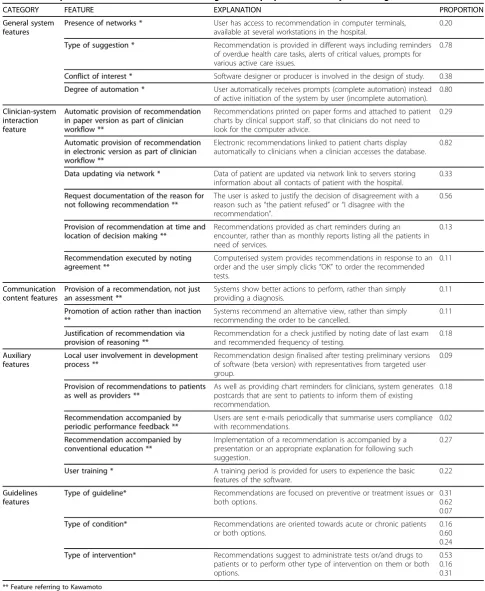
The description of each feature is reported in Table 1.
Quality assessment
Table 1 Description of 21 CCG’s features in five categories and proportion#of study containing each feature
CATEGORY FEATURE EXPLANATION PROPORTION
General system features
Presence of networks * User has access to recommendation in computer terminals, available at several workstations in the hospital.
0.20
Type of suggestion * Recommendation is provided in different ways including reminders of overdue health care tasks, alerts of critical values, prompts for various active care issues.
0.78
Conflict of interest * Software designer or producer is involved in the design of study. 0.38
Degree of automation * User automatically receives prompts (complete automation) instead of active initiation of the system by user (incomplete automation).
0.80
Clinician-system interaction feature
Automatic provision of recommendation in paper version as part of clinician workflow **
Recommendations printed on paper forms and attached to patient charts by clinical support staff, so that clinicians do not need to look for the computer advice.
0.29
Automatic provision of recommendation in electronic version as part of clinician workflow **
Electronic recommendations linked to patient charts display automatically to clinicians when a clinician accesses the database.
0.82
Data updating via network * Data of patient are updated via network link to servers storing information about all contacts of patient with the hospital.
0.33
Request documentation of the reason for not following recommendation **
The user is asked to justify the decision of disagreement with a reason such as“the patient refused”or“I disagree with the recommendation”.
0.56
Provision of recommendation at time and location of decision making **
Recommendations provided as chart reminders during an encounter, rather than as monthly reports listing all the patients in need of services.
0.13
Recommendation executed by noting agreement **
Computerised system provides recommendations in response to an order and the user simply clicks“OK”to order the recommended tests.
0.11
Communication content features
Provision of a recommendation, not just an assessment **
Systems show better actions to perform, rather than simply providing a diagnosis.
0.11
Promotion of action rather than inaction **
Systems recommend an alternative view, rather than simply recommending the order to be cancelled.
0.11
Justification of recommendation via provision of reasoning **
Recommendation for a check justified by noting date of last exam and recommended frequency of testing.
0.18
Auxiliary features
Local user involvement in development process **
Recommendation design finalised after testing preliminary versions of software (beta version) with representatives from targeted user group.
0.09
Provision of recommendations to patients as well as providers **
As well as providing chart reminders for clinicians, system generates postcards that are sent to patients to inform them of existing recommendation.
0.18
Recommendation accompanied by periodic performance feedback **
Users are sent e-mails periodically that summarise users compliance with recommendations.
0.02
Recommendation accompanied by conventional education **
Implementation of a recommendation is accompanied by a presentation or an appropriate explanation for following such suggestion.
0.27
User training * A training period is provided for users to experience the basic features of the software.
0.22
Guidelines features
Type of guideline* Recommendations are focused on preventive or treatment issues or both options.
0.31 0.62 0.07
Type of condition* Recommendations are oriented towards acute or chronic patients or both options.
0.16 0.60 0.24
Type of intervention* Recommendations suggest to administrate tests or/and drugs to patients or to perform other type of intervention on them or both options.
0.53 0.16 0.31
- allocation to study groups (random, 2; quasi-random, 1; selected concurrent controls, 0);
- data analysis and presentation of results (appropriate statistical analysis and clear presentation of results, 2; inappropriate statistical analysis or unclear presentation of results, 1; inappropriate statistical analysis and unclear presentation of results, 0);
- presence of baseline differences between the groups that were potentially linked to study outcomes (no base-line differences present or appropriate statistical adjust-ments made for differences, 2; baseline differences present and no statistical adjustments made, 1; baseline characteristics not reported, 0);
- objectivity of the outcome (objective outcomes or subjective outcomes with blinded assessment, 2; subjec-tive outcomes with no blinding but clearly defined assessment criteria, 1; subjective outcomes with no blinding and poorly defined, 0);
- completeness of follow-up for the appropriate unit of analysis (> 90%, 2; from 80% to 90%, 1; < 80% or not described, 0).
The cut-off value for including an article in our paper was 5/10.
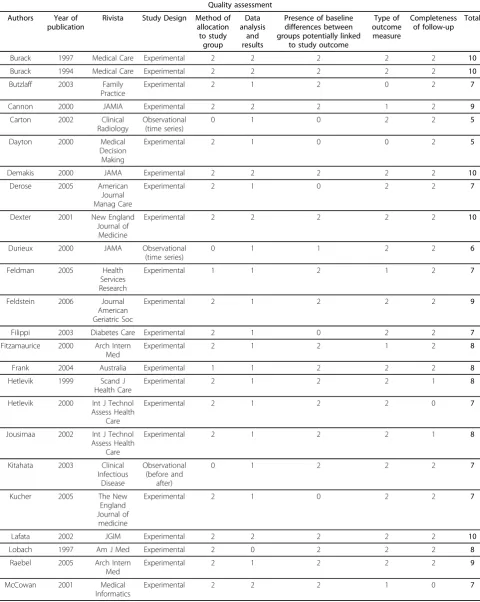
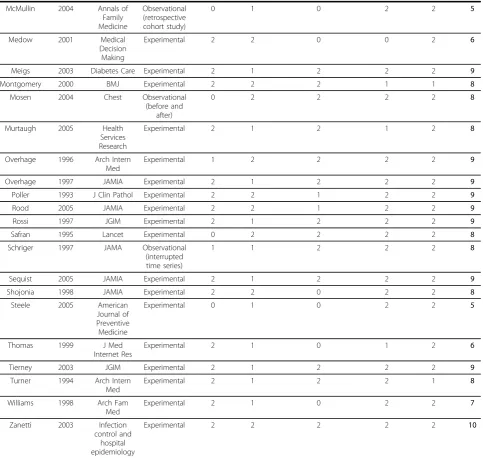
The quality assessment of each study is reported in Table 2.
Statistical Analysis
Each study, comparing the impact of CCG versus NCCG, was considered as a unit of analysis.
We estimated, within 95% confidence interval:
- Positive Effect Prevalence, calculated as the pro-portion of studies showing a positive effect of CCG on the total of selected studies.
- Negative Effect Prevalence, calculated as the pro-portion of studies not showing any or negative effect of CCG on the total of selected studies.
Chi-square test was performed in order to identify whether the differences between the proportions of the studies’ positive and negative effects were statisti-cally significant. The significance level was set at 5% (a = 0.05).
The effect of each specific feature on the process of care was also analysed in a backward logistic regression analysis which was carried out to evaluate the associa-tion of features with the positive effect of CCG, adjust-ing for the followadjust-ing variables:
• publication year, using 1999 (after publication of Shifman’s article) as a cut-off year (1994-1999; 2000-2006);
•design of the study: observational and experimental studies;
•quality of the study, using 7 as cut-off score (5-7; 8-10)
Hosmer-Lemeshow test was applied to evaluate the goodness of fit of model. All analyses were carried out using SPSS package, version 13.0.
Results
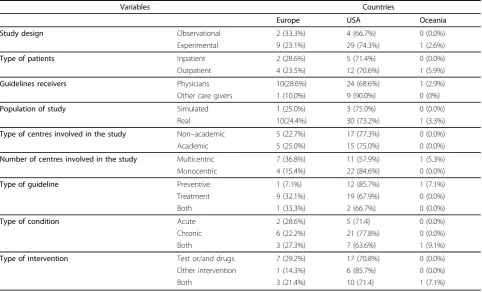
A total number of 2,996 articles out of 3,502 was excluded because of the title and the content of abstract. Then, 191 out of 506 studies met the inclusion criteria. Forty-five articles were included in the final selection [14,15,22-64]. (Figure 1). Some of the articles included in Garg’s and Kawamoto reviews [6,12] were excluded by our selection [see Additional file 1]. The characteris-tics of selected studies are shown in Table 3.
Automatic provision of recommendation in electronic version as part of clinician workflow(proportion = 0.82)
andDegree of automation (proportion = 0.80) were the
most frequent features used in the CCG software described in the selected articles. On the contrary, the least frequent features were Recommendation executed
by noting agreement, Provision of a recommendation not
just an assessment, Promotion of action rather than
inaction(proportion = 0.11) as shown in Table 1.
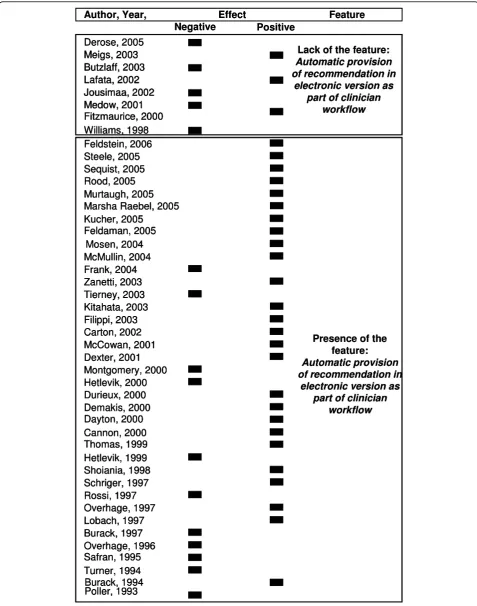
Proportions of studies with Positive and Negative Effect of CCG versus NCCG are shown in Figure 2. In the selected 45 articles the positive effect proportion of CCG was 0.64 (p = 0.053) [see Additional file 2]. The multivariable analysis highlighted two variables as statistically significant predictors of CCG positive impact on the process of care: Automatic provision of recom-mendation in electronic version as part of clinician work-flow (Odds Ratio [OR]= 17.5; 95% confidence interval [CI]: 1.6-193.7) andPublication Year (OR = 6.7; 95%CI: 1.3-34.3). Besides, the feature Justification of
recommen-dation via provision of reasoning (OR = 14.8; 95%CI:
0.9-224.2) resulted marginally significant in logistic analysis.
The goodness of fit of the logistic model was con-firmed in the Hosmer-Lemeshow test (p = 0.905).
Discussion
Previous researches [6,10,11] reviewed controlled clinical trials classified within different categories (e.g. drug dose determination, diagnosis, prevention) in order to assess the effects of CDSS on physician’s performance and patient’s outcomes. Enhancements on clinical perfor-mance were reported after the use of these tools. Furthermore, role of specific features of CDSS affecting clinical practice were identified by Kawamoto et al [12].
Table 2 Study design and quality assessment of selected articles
Quality assessment Authors Year of
publication
Rivista Study Design Method of allocation
to study group
Data analysis
and results
Presence of baseline differences between groups potentially linked
to study outcome
Type of outcome measure
Completeness of follow-up
Total
Burack 1997 Medical Care Experimental 2 2 2 2 2 10
Burack 1994 Medical Care Experimental 2 2 2 2 2 10
Butzlaff 2003 Family
Practice
Experimental 2 1 2 0 2 7
Cannon 2000 JAMIA Experimental 2 2 2 1 2 9
Carton 2002 Clinical
Radiology
Observational (time series)
0 1 0 2 2 5
Dayton 2000 Medical
Decision Making
Experimental 2 1 0 0 2 5
Demakis 2000 JAMA Experimental 2 2 2 2 2 10
Derose 2005 American
Journal Manag Care
Experimental 2 1 0 2 2 7
Dexter 2001 New England
Journal of Medicine
Experimental 2 2 2 2 2 10
Durieux 2000 JAMA Observational
(time series)
0 1 1 2 2 6
Feldman 2005 Health
Services Research
Experimental 1 1 2 1 2 7
Feldstein 2006 Journal
American Geriatric Soc
Experimental 2 1 2 2 2 9
Filippi 2003 Diabetes Care Experimental 2 1 0 2 2 7
Fitzamaurice 2000 Arch Intern Med
Experimental 2 1 2 1 2 8
Frank 2004 Australia Experimental 1 1 2 2 2 8
Hetlevik 1999 Scand J
Health Care
Experimental 2 1 2 2 1 8
Hetlevik 2000 Int J Technol Assess Health
Care
Experimental 2 1 2 2 0 7
Jousimaa 2002 Int J Technol Assess Health
Care
Experimental 2 1 2 2 1 8
Kitahata 2003 Clinical
Infectious Disease
Observational (before and
after)
0 1 2 2 2 7
Kucher 2005 The New
England Journal of
medicine
Experimental 2 1 0 2 2 7
Lafata 2002 JGIM Experimental 2 2 2 2 2 10
Lobach 1997 Am J Med Experimental 2 0 2 2 2 8
Raebel 2005 Arch Intern
Med
Experimental 2 1 2 2 2 9
McCowan 2001 Medical
Informatics
analysis were carried out. Our contribution provides an updated, systematic and quantitative analysis aiming to understand the design factors which are responsible for the success or the failure of computer-based guidelines compared with NCCG.
The resulting evidence showed that the use of CCG seems to have a significant impact on the process of care. In addition to qualitative evidence reported by Shiffman [13], the multivariable analysis highlighted the positive effect of the presence of an operating CCG sys-tem, characterized by the automatic provision of recom-mendation in electronic form as part of clinician
[image:6.595.57.541.101.559.2]workflow. This system is designed for providing auto-matic support to clinicians so that they don’t need to look for computer advices. The system automatically provides support on clinical or administrative task and recommends execution or avoiding of it during the clin-ical process, (e.g. automatic recommendation of execut-ing prophylaxis in patients at risk of deep-vein thrombosis [48]), and in decisions, such as the selection from a set of potential alternatives based on predefined criteria (e.g. automatic prompt of further assessment for potential Latent Tuberculosis Infection in patients selected according to specific criteria [38]) [65].
Table 2: Study design and quality assessment of selected articles(Continued)
McMullin 2004 Annals of
Family Medicine
Observational (retrospective cohort study)
0 1 0 2 2 5
Medow 2001 Medical
Decision Making
Experimental 2 2 0 0 2 6
Meigs 2003 Diabetes Care Experimental 2 1 2 2 2 9
Montgomery 2000 BMJ Experimental 2 2 2 1 1 8
Mosen 2004 Chest Observational
(before and after)
0 2 2 2 2 8
Murtaugh 2005 Health
Services Research
Experimental 2 1 2 1 2 8
Overhage 1996 Arch Intern Med
Experimental 1 2 2 2 2 9
Overhage 1997 JAMIA Experimental 2 1 2 2 2 9
Poller 1993 J Clin Pathol Experimental 2 2 1 2 2 9
Rood 2005 JAMIA Experimental 2 2 1 2 2 9
Rossi 1997 JGIM Experimental 2 1 2 2 2 9
Safran 1995 Lancet Experimental 0 2 2 2 2 8
Schriger 1997 JAMA Observational
(interrupted time series)
1 1 2 2 2 8
Sequist 2005 JAMIA Experimental 2 1 2 2 2 9
Shojonia 1998 JAMIA Experimental 2 2 0 2 2 8
Steele 2005 American
Journal of Preventive Medicine
Experimental 0 1 0 2 2 5
Thomas 1999 J Med
Internet Res
Experimental 2 1 0 1 2 6
Tierney 2003 JGIM Experimental 2 1 2 2 2 9
Turner 1994 Arch Intern
Med
Experimental 2 1 2 2 1 8
Williams 1998 Arch Fam
Med
Experimental 2 1 0 2 2 7
Zanetti 2003 Infection
control and hospital epidemiology
Figure 1Selection process of studies on computerized guidelines.
Table 3 Characteristics of selected studies
Variables Countries
Europe USA Oceania
Study design Observational 2 (33.3%) 4 (66.7%) 0 (0.0%)
Experimental 9 (23.1%) 29 (74.3%) 1 (2.6%)
Type of patients Inpatient 2 (28.6%) 5 (71.4%) 0 (0.0%)
Outpatient 4 (23.5%) 12 (70.6%) 1 (5.9%)
Guidelines receivers Physicians 10(28.6%) 24 (68.6%) 1 (2.9%)
Other care givers 1 (10.0%) 9 (90.0%) 0 (0%)
Population of study Simulated 1 (25.0%) 3 (75.0%) 0 (0.0%)
Real 10(24.4%) 30 (73.2%) 1 (3.3%)
Type of centres involved in the study Non–academic 5 (22.7%) 17 (77.3%) 0 (0.0%)
Academic 5 (25.0%) 15 (75.0%) 0 (0.0%)
Number of centres involved in the study Multicentric 7 (36.8%) 11 (57.9%) 1 (5.3%)
Monocentric 4 (15.4%) 22 (84.6%) 0 (0.0%)
Type of guideline Preventive 1 (7.1%) 12 (85.7%) 1 (7.1%)
Treatment 9 (32.1%) 19 (67.9%) 0 (0.0%)
Both 1 (33.3%) 2 (66.7%) 0 (0.0%)
Type of condition Acute 2 (28.6%) 5 (71.4) 0 (0.0%)
Chronic 6 (22.2%) 21 (77.8%) 0 (0.0%)
Both 3 (27.3%) 7 (63.6%) 1 (9.1%)
Type of intervention Test or/and drugs 7 (29.2%) 17 (70.8%) 0 (0.0%)
Other intervention 1 (14.3%) 6 (85.7%) 0 (0.0%)
[image:7.595.57.540.440.732.2]The positive effect might be related to time saving for clinicians, facilitation of the information retrieval and integration among different users.
The evidence of increased probability of positive effect for CCG, showed after 1999, might suggest that the improvement of the process of care may be related to the development of more automated CCG systems [66,67].
The physicians’involvement in decisions regarding clinical recommendations, even though marginally sig-nificant in the multivariable analysis, might be a key ele-ment for the effective organization of the whole process of care, relating to the improvement of the adherence of physicians to guidelines. This aspect is coherent to the active roles that physicians should play in Clinical Gov-ernance context [68,69].
Some limits of our study might be related to the lack of quantitative estimate of specific outcomes linked to clinical conditions. However, the evaluation of syn-thetic quantitative measures of CCG effect was unfea-sible because of the high heterogeneity of analysed guidelines, population and outcomes. However, our work presents the synthetic result on the effectiveness of CCG, providing a quantitative and reproducible evaluation.
Conclusions
Findings of this paper suggest clinicians, managers and other health care decision makers which features of CCG might improve the structure of an electronic sys-tem in health care settings. At the same time, the imple-mentation of CCG may be integrated with more training and investment in user friendly hardware and software. Therefore, specific studies should be carried out to eval-uate the cost-effectiveness of implementing CCG systems.
Additional file 1: Appendix 1. Articles included in Garg and Kawamoto reviews and excluded in our review.
Click here for file
[ http://www.biomedcentral.com/content/supplementary/1472-6963-10-2-S1.DOC ]
Additional file 2: Appendix 2. List of outcomes of selected articles. Click here for file
[ http://www.biomedcentral.com/content/supplementary/1472-6963-10-2-S2.XLS ]
Abbreviations
CCG: computerized clinical guidelines; CDSSs: computerized clinical decision support systems; NCCG: non-computerized clinical guidelines.
Acknowledgements
Funding for this project“Development, application and effectiveness valuation of an informative system to support the clinical research”was provided by the Italian Ministry of Health.
Author details
1Department of Public Health-Università Cattolica Sacro Cuore-Rome, Largo
Francesco Vito 1, 00168, Rome, Italy.2San Filippo Neri-Hospital Trust-Rome, Italy, Piazza di Santa Maria della Pietà 5, 00135, Rome, Italy.3Oncological Referral Center of Basilicata (IRCCS CROB), Via Padre Pio 1, 85028, Rionero in Vulture, Potenza, Italy.
Authors’contributions
GD, LP and WR contributed to the conception of this paper; GD, LP RG, LoS designed the study. SCC and RA selected articles that met the inclusion criteria and extracted data. LS, LP conducted the statistical analysis. All authors made substantial contributions to the interpretation of results and have seen and approved the final version.
Competing interests
The authors declare that they have no competing interests.
Received: 4 March 2009
Accepted: 4 January 2010 Published: 4 January 2010
References
1. Field MJ, Lohr KN, eds:Clinical practice guidelines: directions for a new program.Washington, DC: National Academy Press 1990.
2. Shekelle P, Eccles MP, Grimshaw JM, Woolf SH:When should clinical guidelines be updated?.BMJ2001,323(7305):155-7.
3. Shekelle PG, Woolf SH, Eccles M, Grimshaw J:Clinical guidelines: developing guidelines.BMJ1999,318(7183):593-6.
4. Steinbrook R:Guidance for guidelines.N Engl J Med2007,356(4):331-3. 5. Wyatt J, Spiegelhalter D:Field trials of medical decision-aids: potential
problems and solutions.Proceedings of the Annual Symposium on Computer Application in Medical Care: 17-20 November 1991; Washington
Clayton P 1991, 3-7.
6. Garg AX, Adhikari NKJ, McDonald H, Rosas-Arellano MP, Devereaux PJ, Beyene J, Sam J, Haynes B:Effects of Computerized Clinical Decision Support Systems on practitioner performance and patient outcomes.
JAMA2005,293:1223-1238.
7. Shortliffe EH:Computer programs to support clinical decision making.
JAMA1987,258(1):61-6.
8. Waitman LR, Miller RA:Pragmatics of implementing guidelines on the front lines.J Am Med Inform Assoc2004,11(5):436-8.
9. Wang D, Peleg M, Tu SW, Shortliffe EH, Greenes RA:Representation of clinical practice guidelines for computer-based implementations.Stud Health Technol Inform2001,84(Pt 1):285-9.
10. Hunt DL, Haynes RB, Hanna SE, Smith K:Effects of computer-based clinical decision support systems on physicians performance and patient outcomes.J Am Med Assoc1998,280:1339-1346.
11. Johnston ME, Langton KB, Haynes RB, Mathieu A:Effects of computer-based clinical decision support systems on clinician performance and patient outcome. A critical appraisal of research.Ann Intern Med1994,
120(2):135-42.
12. Kawamoto K, Houlihan CA, Balas EA, Lobach DF:Improving clinical practice using clinical decision support systems: a systematic review of trials to identify features critical to success.BMJ2005,330:765-773. 13. Shiffman RN, Liaw Y, Brandt CA, Corb GJ:Computer-based guideline
implementation system: a systematic review of functionality and effectiveness.JAMIA1999,6:104-114.
14. Overhage JM, Tierney WM, McDonald CJ:Computer reminders to implement preventive care guidelines for hospitalized patients.Arch Intern Med1996,156:1551-1556.
15. Raebel MA, Lyons EE, Chester EA, Bodily MA, Kelleher JA, Long CL, Miller C, Magid DJ:Improving laboratory monitoring at initiation of drug therapy in ambulatory care.Arch Intern Med2005,165:2395-2401.
16. Cabana MD, Rand CS, Becher OJ, Rubin HR:Reasons for pediatrician nonadherence to asthma guidelines.Arch Pediatr Adolesc Med2001,
155(9):1057-62.
17. Cabana MD, Ebel BE, Cooper-Patrick L, Powe NR, Rubin HR, Rand CS:
Barriers pediatricians face when using asthma practice guidelines.Arch Pediatr Adolesc Med2000,54(7):685-93.
19. Haynes RB, Walker C:Computer-aided quality assurance.Arch Intern Med
1987,147:1297-1301.
20. Damiani G, Pinnarelli L, Sammarco A, Sommella L, Francucci M, Ricciardi W:
Postoperative Pulmonary Function inOpen versus Laparoscopic Cholecystectomy: A Meta-Analysis of the Tiffenau Index Dig.Surg2008,
25:1-7.
21. Chalmers TC, Smith H Jr, Blackburn B, Silverman B, Schroeder B, Reitman D, Ambroz :A method for assessing the quality of a randomized control trial.A Control Clin Trials1981,2(1):31-49.
22. Jousimaa J, Makela M, Kunnamo I, MacLennan G, Grimsha JM:Primary care guidelines on consultation practices: the effectiveness of computerized versus paper-based versions.Int J Technol Assess Health Care2002,
18:586-596.
23. Rood E, Bossman RJ, Spoel Van Der JI, Taylor P, Zandstra DF:Use of a computerized guideline for glucose regulation in the intensive care unit improved both guideline adherence and glucose regulation.JAMIA2005,
12:172-180.
24. Butzlaff M, Vollmar HC, Floer B, Koneczny N, Isfort J, Lange S:Learning with computerized guidelines in general practice? A randomized controlled trial.Fam Pract2003,21:183-188.
25. Medow MA, Wilt TJ, Dysken S, Hillson SD, Woods S, Borowsky SJ:Effect of written and computerized decision support aids for the U.S. Agency for Health Care Policy and Research depression guidelines on the evaluation of hypothetical clinical scenarious.Med Decis Making2001,
21:344-356.
26. Durieux P, Nizard R, Ravaud P, Mounier N, Lepage E:A Clinical Decision Support System for prevention of venous thromboembolism. Effect on physician behaviour.JAMA2000,283:2816-2821.
27. Rossi RA, Every NR:A computerized intervention to decrease the use of calcium channel blockers in hypertension.J Gen Intern Med1997,
12:672-678.
28. Safran C, Rind DM, Davis RB, Ives D, Sands DZ, Currier J, Slack WV, Makadon HJ, Cotton DJ:Guidelines for management of HIV infection with compute-based patient’s record.Lancet1995,346:341-346. 29. Dexter PR, Perkins S, Overhage M, Maharry K, Kohler RB, McDonald CJ:A
computerized reminder system to increase the use of preventive care for hospitalized patients.N Engl J Med2001,345:965-970.
30. Mosen D, Elliott CG, Egger MJ, Mundorff M, Hopkins J, Patterson R, Gardner RM:The effect of a computerized reminder system on the prevention of postoperative venous thromboembolism.Chest2004,
125:1635-1641.
31. Shojania KG, Yokoe D, Platt R, Fiskio J, Ma’luf N, Bates DW:Reducing vancomycin use utilizing a computer guideline: results of a randomized controlled trial.JAMIA1998,5:554-562.
32. Schriger DL, Baraff LJ, Rogers WH, Cretin S:Implementing of clinical guidelines using a computer charting system. Effect on the initial care of health care workers exposed to body fluids.JAMA1997,
278:1585-1590.
33. Thomas KW, Dayton CS, Peterson MW:Evaluation of internet-based clinical decision support systems.JMIR1999,1:6-36.
34. Carton M, Auvert B, Guerini H, Boulard JC, Heautot JF, Landre MF, Beauchet A, Sznajderi M, Brun-Ney D, Chagnon S:Assessment of radiological referral practice and effect of computer-based guidelines on radiological requests in two emergency departments.Clin Radiol2002,
57:123-128.
35. Lobach DF, Hammond WE:Computerized decision support based on a clinical practice guideline improves compliance with care standards.Am J Med1997,102:89-98.
36. Tierney WM, Overhage JM, Murray MD, Harris LE, Zhou XH, Eckert GJ, Smith FE, Nienaber N, McDonald CJ, Wolinsky FD:Effects of computerized guidelines for managing heart disease in primary care.J Gen Intern Med
2003,18:967-976.
37. McMullin ST, Lonergan TP, Rynearson CS, Doerr TD, Veregge PA, Scanlan ES:
Impact of an evidence-based computerized decision support system on primary care prescription costs.Ann Fam Med2004,2:494-498. 38. Steele AW, Eisert S, Davidson A, Sandison T, Lyons P, Garrett N, Gabow P,
Ortiz E:Using computerized clinical decision support for latent tuberculosis infection screening.Am J Prev Med2005,28:281-284. 39. Dayton CS, Ferguson S, Hornick DB, Peterson MW:Evaluation of an
internet-based decision-support system for applying the ATS/CDC
guidelines for tuberculosis preventive therapy.Med Decis Making2000,
20:1-6.
40. Overhage JM, Tierney WM, Zhou XA, McDonald CJ:A randomized trial of
“corollary orders”to prevent errors of omission.JAMIA1997,4:364-375. 41. Filippi A, Sabatini A, Badioli L, Samani F, Mazzaglia G, Catapano A, Cricelli C:
Effects of an automated electronic reminder in changing the antiplatelet drug-prescribing behavior among italian general practitioners in diabetic patients.Diabetes Care2003,26:1497-1500.
42. Turner RC, Peden JG, O’Brien K:Patient-carried card prompts vs computer-generated prompts to remind private practice physicians to perform health maintenance measures.Arch Intern Med1994,
154:1957-1960.
43. Burack RC, Phyllis AG:Promoting screening mammography in inner-city settings. The sustained effectiveness of computerized reminders in a randomized controlled trial.Med Care1997,35:921-931.
44. Burack RC, Phyllis AG, George J, Stengle W, Warbasse L, Moncrease A:
Promoting screening mammography in inner-city settings: a
randomized controlled trial of computerized reminders as a component of a program to facilitate mammography.Med Care1994,32:609-624. 45. Sequist TD, Gandhi TK, Karson AS, Fiskio JM, Bugbee D, Sperling M,
Cook EF, Orav EJ, Fairchild DJ, Bates DW:A randomized trial of electronic clinical reminders to improve quality of care for diabetes and coronary artery disease.JAMIA2005,12:431-437.
46. Derose SF, Dudl JR, Benson VM, Contreas R, Nakahiro RK, Ziel FH: Point-of-service reminders for prescribing cardiovascular medications.Am J Manag Care2005,11:298-304.
47. Kitahata MM, Dillingham PW, Chaiyakunapruk N, Buskin SE, Jones JL, Harrington RD, Hooton TM, Holmes KK:Electronic human immunodeficiency virus (HIV) clinical reminder system improves adherence to practice guidelines among the University of Washington HIV study cohort.Clin Infect Dis2003,36:803-811.
48. Kucher N, Koo S, Quiroz R, Cooper JM, Paterno MD, Soukonnikov B, Goldhaber SZ:Electronic alerts to prevent venous thromboembolism among hospitalized patients.N Engl J Med2005,352:969-977.
49. Feldman PH, Murtaugh CM, Pezzin LE, McDonald MV, Peng TR:Just-in-time evidence-based e-mail“reminders”in home health care: impact on patient outcomes.Health Serv Res2005,40:865-885.
50. Frank O, Litt J, Beilby J:Opportunistic electronic reminders.Aust Fam Physician2004,33:87-90.
51. Feldstein A, Elmer PJ, Smith DH, Herson M, Orwoll E, Chen C, Aickin M, Swain MC:Electronic medical record reminder improves osteoporosis management after a fracture: a randomized, controlled trial.J Am Geriatr Soc2006,54:450-457.
52. Williams RB, Boles M, Johnson RE:A patient-initiated system for preventive health care.Arch Fam Med1998,7:338-345.
53. Zanetti G, Flanagan HL, Cohn LH, Giardina R, Platt R:Improvement of intraoperative antibiotic prophylaxis in prolonged cardiac surgery by automated alerts in the operating room.Infect Control Hosp Epidemiol
2003,24:13-16.
54. Demakis JG, Beauchamp C, Cull WL, Denwood R, Eisen SA, Lofgren R, Nichol K, Woolliscroft J, Henderson WG:Improving residents’compliance with standards of ambulatory care.JAMA2000,284:1411-1416. 55. Hetlevik I, Holmen J, Kruger O:Implementing clinical guidelines in the
treatment of hypertension in general practice.Scand J Prim Health Care
1999,17:35-40.
56. Hetlevik I, Holmen J, Kruger O, Kristensen P, Iversen H, Furuseth K:
Implementing clinical guidelines in the treatment of diabetes mellitus in general practice.Int J Technol Assess Health Care2000,16:210-227. 57. Murtaugh CM, Pezzin LE, McDonald MV, Feldman PH, Peng TR:Just-in-time
evidence-based e-mail“reminders”in home health care: impact on nurse practices.Health Serv Res2005,40:849-864.
58. Lafata JE, Baker AM, Divine GW, McCarthy BD, Xi H:The use of computerized birthday greeting reminders in the management of diabetes.J Gen Intern Med2002,17:521-530.
59. Fitzmaurice DA, Hobbs FDR, Murray ET, Holder RL, Allan TF, Rose PE:Oral anticoagulation management in primary care with the use of computerized decision support and near-patient testing.Arch Intern Med
2000,160:2343-2348.
60. Poller L, Wright D, Rowlands M:rospective comparative study of computer programs used for management of warfarin.J Clin Pathol1993,
61. Meigs JB, Cagliero E, Dubey A, Murphy-Sheehy P, Gildesgame C, Chueh H, Barry M, Singer DE, Nathan MD:A controlled trial of web-based diabetes disease management.Diabetes Care2003,26:750-757.
62. Montgomery AA, Fahey T, Peters TJ, MacIntosh C, Sharp DJ:Evaluation of computer based clinical decision support system and risk chart for management of hypertension in primary care: randomised controlled trial.BMJ2000,320:686-690.
63. Cannon DS, Allen SN:A comparison of the effects of computer and manual reminders on compliance with a mental health clinical practice guideline.JAMIA2000,7:196-203.
64. McCowan C, Neville RG, Ricketts W, Warner FC, Hoskins G, Thomas GE:
Lessons from a randomized controlled trial designed to evaluate computer decision support software to improve the management of asthma.Med Inform2001,26(3):191-201.
65. Wang D, Peleg M, Tu SW, Boxwala AA, Greenes RA, Patel VL, Shortliffe EH:
Representation primitives, process models and patient data in computer-interpretable clinical practice guidelines: a literature review of guideline representation models.Int J Med Inform2002,68(1-3):59-70. 66. Isern D, Moreno A:Computer-based execution of clinical guidelines: a
review.Int J Med Inform2008,77(12):787-808.
67. Goldstein MK:Using health information technology to improve hypertension management.Curr Hypertens Rep2008,10(3):201-7. 68. Scally G, Donaldson LJ:Clinical governance and the drive for quality
improvement in the new NHS in England.BMJ1998,317:61-65. 69. Halligan A, Donaldson LJ:Implementing clinical governance: turning
vision into reality.BMJ2001,322:1413-1417.
Pre-publication history
The pre-publication history for this paper can be accessed here:http://www. biomedcentral.com/1472-6963/10/2/prepub
doi:10.1186/1472-6963-10-2
Cite this article as:Damianiet al.:The effectiveness of computerized
clinical guidelines in the process of care: a systematic review.BMC Health Services Research201010:2.
Submit your next manuscript to BioMed Central and take full advantage of:
• Convenient online submission
• Thorough peer review
• No space constraints or color figure charges
• Immediate publication on acceptance
• Inclusion in PubMed, CAS, Scopus and Google Scholar • Research which is freely available for redistribution