DESIGN AND ANALYSIS OF HYDRAULIC SYSTEM FOR FIRE FIGHTING MACHINE
RODDY ANAK RANGGAU
DESIGN AND ANALYSIS OF HYDRAULIC SYSTEM FOR FIRE FIGHTING MACHINE
RODDY ANAK RANGGAU
This thesis is submitted to the Faculty of Mechanical Engineering, in partial fulfillment of the partial requirement for the
Bachelor of Mechanical Engineering (Thermal Fluid)
FACULTY OF MECHANICAL ENGINEERING UNIVERSITI TEKNIKAL MALAYSIA MELAKA (UTeM)
ii
DECLARATION
“I hereby declaration that I have read through this thesis and found that it has comply the partial fulfillment for awarding the degree of Bachelor Mechanical Engineering
(Thermal Fluid)
iii
DECLARATION
“I hereby declaration that this thesis is my original work except for questions and citations, which have been duly acknowledgement
iv
ACKNOWLEDGEMENT
v
ABSTRACT
vi
ABSTRAK
vii
TABLE OF CONTENTS
CHAPTER CONTENT PAGE
DECLARATION ii.
ACKNOWLEDGEMENT iv.
ABSTRACT v.
ABSTRAK vi.
TABLE OF CONTENT Vii
LIST OF TABLE xi.
LIST OF FIGURE xii.
LIST OF SYMBOL xiv.
ANNOTATION xv.
LIST OF APPENDIXES xvi.
CHAPTER 1 INTRODUCTION
1.1 Background Study 1
1.2 Problem Statement 2
1.3 Objectives of Project 3
viii
CHAPTER 2 LITERATURE REVIEW
2.1 Development in Technology of Firefighting
Machine
4
2.2 Product Review
2.2.1 The Washremote
2.2.2 The Firemote
2.2.3 The Luf 60
2.2.4 The Jelka-4
2.2.5 The Firefighting Robot
2.2.6 The Firefighting Machine 5 6 7 8 9 10 11
2.4 Comparison of Firefighting Machines 12
CHAPTER 3 CONCEPTUAL DESIGN AND DEVELOPMENT
3.1 The Design
3.1.1 Problem Formulation
3.1.2 Concept Design
3.1.3 Design Configuration
3.1.4 Design Parameter
14
16
17
18
19
3.2 Product Design Specification (PDS) 20
3.3 Conceptual Design Development
3.3.1 Morphological Chart
3.3.2 Concept Screening and Scoring
23
24
24
ix
3.4.1 Morphological Chart for Dozer Blade
Design Structure
3.4.2 Concept Idea Generation for Dozer Blade
Design Structure
3.4.3 Concept Scoring for Dozer Blade Design
Structure
26
28
33
CHAPTER 4 DOZER BLADE STRUCTURE
4.1 Hydraulic Cylinders 35
4.2 Hydraulic Pumps 37
4.3 Electric Motors 39
4.4 Control Valves 40
4.5 Hydraulic Accessories
4.5.1 Hydraulic Reservoirs
4.5.2 Filters
4.5.3 Hydraulic Pipes, Hoses and Fitting
4.5.3.1 Hydraulic Pipes and Tubes
4.5.3.2 Hydraulic Hoses
4.5.3.3 Hydraulic Fitting
41 41 42 43 44 44 46
4.6 Concept for the hydraulic system 47
CHAPTER 5 HYDRAULIC ANALYSIS
x
5.1 Procedure to Design a Hydraulic System
5.1.1 Procedure to Design a Hydraulic System using
Individual Selected Part
5.1.2 Procedure to Design a Hydraulic System using
Hydraulic Power Packs
49
49
51
5.2 Calculation
5.2.1 Calculation (Individual Part Selections)
5.2.2 Calculation (Hydraulic Power Packs)
53
53
66
5.3 Hydraulic Circuit
5.3.1 Hydraulic Circuit Components for Dozer
Blade
5.3.2 Hydraulic Circuits System Process of
Dozer Blade
5.3.3 Hydraulic Circuit Component for
Telescopic Scissors
5.3.4 Hydraulic Improvement Circuits
(Telescopic Scissors) 69 70 72 74 78
CHAPTER 6 ANALYSIS OF FIRE FIGHTING MACHINE 6.0 Fire Fighting Machine
6.1 Mobility
80
82
xi
6.2 Dozer Blade
6.2.1 Dozer Blade Gruebler’s Equation
6.2.2 Dozer Blade Positioning
84
84
85
6.3 Telescopic Scissors
6.3.1 Telescopic Scissors Gruebler’s Equation
6.3.2 Telescopic Scissors Positioning
88
88
90
CHAPTER 7 CONCLUSION AND RECOMMENDATION
7.1 Recommendation 94
7.2 Conclusion 95
REFERANCES 96
BIBLIOGRAPHY 98
xi
LIST OF TABLE
NO TABLE PAGE
Table 2.1 Comparison of Firefighting Machines 12
Table 3.1 Product Design Specification (PDS) for Dozer Blade of Fire fighting Machine
22
Table 3.2 Morphological Chart for Dozer Blade Design Structure
26
Table 3.3 Table of Concept Idea Generation for Dozer Blade Structure
28
Table 3.4 The concept scoring matrix for dozer blade structure 34
Table 4.1 Criteria estimation for some types of pump 38
xii
LIST OF FIGURE
NO TABLE PAGE
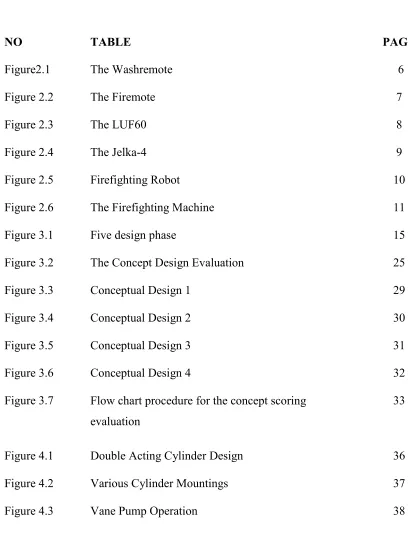
Figure2.1 The Washremote 6
Figure 2.2 The Firemote 7
Figure 2.3 The LUF60 8
Figure 2.4 The Jelka-4 9
Figure 2.5 Firefighting Robot 10
Figure 2.6 The Firefighting Machine 11
Figure 3.1 Five design phase 15
Figure 3.2 The Concept Design Evaluation 25
Figure 3.3 Conceptual Design 1 29
Figure 3.4 Conceptual Design 2 30
Figure 3.5 Conceptual Design 3 31
Figure 3.6 Conceptual Design 4 32
Figure 3.7 Flow chart procedure for the concept scoring evaluation
33
Figure 4.1 Double Acting Cylinder Design 36
[image:14.612.109.517.188.722.2]Figure 4.2 Various Cylinder Mountings 37
xiii
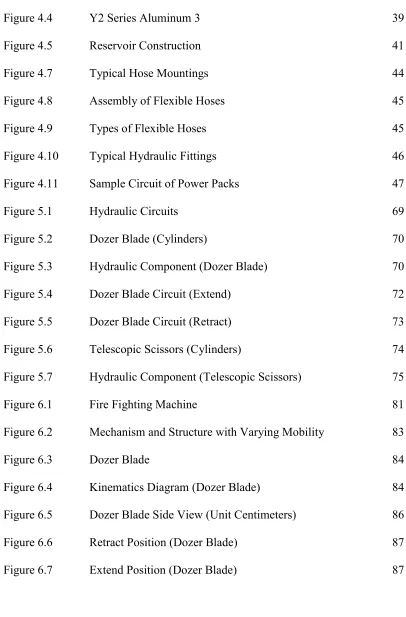
Figure 4.4 Y2 Series Aluminum 3 39
Figure 4.5 Reservoir Construction 41
Figure 4.7 Typical Hose Mountings 44
Figure 4.8 Assembly of Flexible Hoses 45
Figure 4.9 Types of Flexible Hoses 45
Figure 4.10 Typical Hydraulic Fittings 46
Figure 4.11 Sample Circuit of Power Packs 47
Figure 5.1 Hydraulic Circuits 69
Figure 5.2 Dozer Blade (Cylinders) 70
Figure 5.3 Hydraulic Component (Dozer Blade) 70
Figure 5.4 Dozer Blade Circuit (Extend) 72
Figure 5.5 Dozer Blade Circuit (Retract) 73
Figure 5.6 Telescopic Scissors (Cylinders) 74
Figure 5.7 Hydraulic Component (Telescopic Scissors) 75
Figure 6.1 Fire Fighting Machine 81
Figure 6.2 Mechanism and Structure with Varying Mobility 83
Figure 6.3 Dozer Blade 84
Figure 6.4 Kinematics Diagram (Dozer Blade) 84
[image:15.612.110.516.60.677.2]Figure 6.5 Dozer Blade Side View (Unit Centimeters) 86
Figure 6.6 Retract Position (Dozer Blade) 87
xiv
Figure 6.8 Telescopic Scissors 88
Figure 6.9 Kinematics Diagram (Telescopic Scissors) 89
Figure 6.10 Telescopic Scissors Side View (Unit Centimeters) 90
Figure 6.11 Retract Position of Cylinder 3 (Telescopic Scissors) 91
Figure 6.12 Extend Position of Cylinder 3 (Telescopic Scissors) 91
Figure 6.13 Retract Position of Cylinder 1 (Telescopic Scissors) 92
Figure 6.14 Extend Position of Cylinder 1 (Telescopic Scissors) 92
Figure 6.15 Retract Position of Cylinder 2 (Telescopic Scissors) 93
LIST OF SYMBOL
AD Assembly Design
CAE Computer Aided Engineering
PDS Product Design Specification
UTeM Universiti Teknikal Malaysia Melaka
SINTEF The Foundation for Industrial and Scientific Research
xv
ANNOTATION
Q = Flow
n = revs per second V stroke = swept volume in m3 η vol = volumetric efficiency P = Power in Watt (Nm/s)
Δ p = pressure difference over pump in N/m2 η mech, hydr = mechanical/hydraulic efficiency Fe = Extension Force
Pp = Pressure Piston Ap = Piston Area Ar = Rod Area
Fr = Retraction Force
Pa = Pressure on Annular Side Tt = Theoretical Torque Qt = Theoretical flow rate
TT = Actual torque delivery by motor
TA = Torque motor should theoretical deliver
o
= actual power delivery by motor / actual power delivery to motor HL = Head loss
Le = Equivalent length
ext
F = Cylinder Extending Force
pr
xvi
K = Buckling load
K
S = Free buckling length
E = Elasticity Module J = Moment of Inertia S = Safety Factor
p
n np = Pump Rotation Speed
vol
xvi
LIST OF APPENDIXES
NO CONTENT PAGE
A Individual Selection Part (Double Acting Cylinders) 99
B Individual Selection Part (Vane Pump) 100
C Individual selection part (Electric Motor) 101
D Hydraulic Power Packs (Double Acting Cylinders) 102
E Hydraulic Power Packs (Power Packs) 103
F Fire Fighting Machine-Solid Works 2005 (Assembly Drawing)
104
1
CHAPTER 1
INTRODUCTION
1.1 Background Study
Firefighting is a process of act to avoid from destroying property, danger human life and environment. A fireman jobs is to fights these fires to prevent destruction of life, property and the environment. Fireman usually used fire engines, tools and equipments to fights these fires. Most of the tools and equipment are manually operated. The new era of technology, the fireman have an efficient way to fight fire with the new design of improvement on tools and equipment.
Remote firefighting machine is a newly design machine that is creates to reduce risk for human especially the fireman who rescuing in fights fire. It used to help fireman to carry the hose without fireman having to set up or operate monitors in danger areas. The main function for this design is a remotely control the machine and replace the fireman in the dangerous place. It used same concept with fire fighting engine using the fireman hydrant. The remote firefighting machine is connecting with the fireman hose to operate and the machine carries the hose and sprays it onto the fire area by using remote to control it. This machine is useful in the emergency situation, in the jungle and small building or spaces.
2
less disruption and crowd control in civil disturbance situations. The ex rated electrical system for operation in Zone 1 hazardous areas. Zone 1 is a place of thing easy to explode for example the power plant. The job needs a lot of number fireman to do. The new design of tools or machine is important to dealing of this kind of problems and it can reduce the number of people. The machine design can enter the refineries areas and the small spaces. For example, a version that can fit through aircraft emergency exits in the event of a passenger airliner fire or buildings which is not suitable for human to do the jobs.
1.2 Problem Statement:
Mostly, people doesn‟t know the danger of being fireman, their risk their own life to saving people life who are their even don know or meet before. Most of the job of the fireman are danger and can sacrifice their own life. The problem that always encounters are entering the exclusion zones which is cooling acetylenes and other flammable cylinders which might be dangerous, decontamination in Chemical, Biological, Radiation or Nuclear Incidents. The fireman needs to fast response to the situation without danger they own life.
3
1.3 Objectives of Project:
The objectives of the project are:
1. To improve the current design of hydraulic system of fire fighting machine. 2. To design a dozer blade for obstacle removal and rescuing
3. To design a hydraulic system to be used in rescuing process related to the fire fighting machine.
.
1.4 Scopes of Project:
The scopes of the project are:
a. To conduct literature review on current fire fighting technology. b. To identify current problems in fire fighting process.
c. To identify current problems in existing design. d. To analyze the proposed design.
e. To analyze the hydraulic circuit of dozer blade and telescopic scissor.
4
CHAPTER 2
LITERATURE REVIEW
2.1 Development of Technology in Firefighting Machine:
In the research, the development of technology on firefighting is in progress around the world. Most of the tools and equipments are manually operated by the fireman. In the new era of technology, the advances technology of firefighting machines is most conquered by the Western Country.
They had created a machine to reduce a number of firemen to fight fire in dangerous situations. Besides, the machine also reduce the fireman risk, which are involve in cooling acetylene, flammable cylinders and exclusion zone. It helps the fireman with water or foam without fireman has to set up or operate monitors in danger areas. This kind of machine really helps a lot in the rescuing and to fight fire in the building or in the jungle difficult for fireman.