This is a repository copy of Measuring academic research impact: creating a citation
profile using the conceptual framework for implementation fidelity as a case study
.
White Rose Research Online URL for this paper:
http://eprints.whiterose.ac.uk/106977/
Version: Accepted Version
Article:
Carroll, C. (2016) Measuring academic research impact: creating a citation profile using
the conceptual framework for implementation fidelity as a case study. Scientometrics, 109
(2). pp. 1329-1340. ISSN 0138-9130
https://doi.org/10.1007/s11192-016-2085-0
[email protected] https://eprints.whiterose.ac.uk/ Reuse
Unless indicated otherwise, fulltext items are protected by copyright with all rights reserved. The copyright exception in section 29 of the Copyright, Designs and Patents Act 1988 allows the making of a single copy solely for the purpose of non-commercial research or private study within the limits of fair dealing. The publisher or other rights-holder may allow further reproduction and re-use of this version - refer to the White Rose Research Online record for this item. Where records identify the publisher as the copyright holder, users can verify any specific terms of use on the publisher’s website.
Takedown
If you consider content in White Rose Research Online to be in breach of UK law, please notify us by
1
Title:
Measuring academic research impact: Creating a citation profile using the conceptual framework for
implementation fidelity as a case study
Author:
Christopher Carroll, PhD, University of Sheffield
Corresponding author:
Christopher Carroll
Health Economics and Decision Science (HEDS), School of Health and Related Research (ScHARR),
University of Sheffield, Regent Court, Regent Street, Sheffield, S1 4DA
Email: [email protected]
Tel: +44 (0)114 22 20864
Fax: +44 (0)114 22 20749
Acknowledgements:
This project received a small amount of departmental financial support to source a number of inter-library loans.
The author would like to thank Andrew Tattersall for some key references.
Keywords:
2
Abstract:
The “citation score” remains the most commonly used measure of academic impact, but is also viewed as
practically and conceptually limited. The aim of this case study was to test the feasibility of creating a “citation
profile” for a single, frequently-cited methods paper, the author’s own publication on the conceptual framework
for implementation fidelity. This was a proof-of-concept study that involved an analysis of the citations of a
single publication. This analysis involved identifying all citing publications and recording, not only how many
times the key paper was cited within each citing publication, but also within which sections of that publication
(e.g. Background, Methods, Results etc.). Level of impact could be categorised as high, moderate or low. The
key paper had been cited more than 400 times and had a high impact in 25% of publications based on citation
frequency within publications, i.e. the key paper was cited three or more times; and a low impact in 58% of
citing publications, i.e. the key paper was cited just once. There were 41 “high impact” publications based on
location of the citations, of which 35 (85%) were also categorised as high impact by frequency. These results
suggest that it is both possible and straightforward to categorise the level of impact of a key paper based on its
“citation profile”, i.e, the frequency with which the paper is cited within citing publications, thus adding depth
3
Introduction
The academic research and policy agenda increasingly seeks to measure and use “impact” as a means of
determining the value of different items of published research (Wilsdon et al. 2015; Chandler 2014). However,
there is much debate about how best to define and quantify impact, and it is now also acknowledged that any
assessment of impact must take into account influence beyond the limited bounds of academia, in areas such as
public policy(Chandler 2014; Wilsdon et al. 2015; REF 2014).Within academia, it is generally accepted that the
number of times a paper is cited, the so-called citation statistic, count or score, offers the most useful and
easily-measured guide to its impact(Sarli et al. 2010; Bjork and Solomon 2015; Wilsdon et al. 2015). The underlying
assumption is that the cited work has influenced the citing work in some way. Such citation analysis has been
more easily conducted since the early 2000s when bibliographic databases such as Web of Science and Scopus
started to make available citation statistics for individual publications(Wilsdon et al. 2015). In recent years there
have been attempts to understand this metric more fully, by seeking to identify factors that might predict which
publications have greatest impact using this metric(Sarli et al. 2010; Ravallion and Wagstaff 2011; Royle et al.
2013). However, this metric is also viewed as practically and conceptually limited due to issues such as
self-citing or reciprocal self-citing by colleagues(Sarli et al. 2010) and the failure to distinguish between negative or
positive citation: highly-cited literature might attract attention due to controversy or even error(Wilsdon et al.
2015; Lortie et al. 2013). Nevertheless, it remains an accepted, albeit limited, measure of academic impact. Such
citation scores also do not tell us how a piece of research has actually been used in practice, only that it is known
and cited. The aim of this case study was to address this latter issue: to test the feasibility of creating a “citation
profile” for a single, frequently-cited paper by exploring and quantifying “academic impact” based on how the
key paper was being used, rather than simply whether it was cited.
Methods
This was a proof-of-concept study that involved an analysis of the citations of a single publication, the so-called
“key paper”. The key paper was the author’s own publication on the conceptual framework for implementation
fidelity(Carroll et al. 2007). This publication was chosen because it is one of the most highly-accessed articles in
the journal Implementation Science and has been frequently-cited (more than 400 citations in Google Scholar).
This high “citation score” might be due in part to its being a methodological publication, which was
4
publication. A systematic search was conducted to identify all citations of this key paper. This involved
interrogating the three most important multidisciplinary bibliographic databases reporting citation statistics:
Web of Science, Scopus and Google Scholar(Wilsdon et al. 2015; Harzing and Van der Wal 2008). These
databases were selected because their coverage included some so-called “grey literature”(Rothstein and
Hopewell 2009), including book chapters and academic dissertations, as well as standard peer-reviewed
journals. There was no search of specific conference abstract or dissertation databases. Altmetrics were also
noted. The search was conducted on 3rd November 2015. All citations were imported into EndNote reference
management software and duplicates were deleted. The author then retrieved the full text of each citation.
Impact was explored by recording the frequency with which the key paper was cited within a citing publication.
This was an extension of the basic “Number of times cited” metric, and represented a simple statistic, which in
most cases was verified by utilising the search function to scrutinise electronic text for all instances of the
citation (only 13 full-text articles were acquired in hard-copy, electronic versions were available for the
remainder). Despite being conducted by a single researcher, this feature reduced the chance of errors in these
data. The assumption was that the greater the number of times the key paper was cited within the citing
publication, the greater its “impact”. A scoping process conducted on the 50 most recent publications citing the
key paper identified a citation frequency within the publications ranging from 1 to 13. For the purposes of this
study, impact was categorised by simple frequency, so that a single citation of the key paper within the citing
publication was considered to represent low impact (likely to be just a reference “in passing” to the key
paper(Field et al. 2014)); two citations represented moderate impact; and three or more citations represented
high impact (see Table 1). The result would be a “citation profile” for the key paper, which indicated the number
of publications on which it had had a “high impact” and what percentage this represented as a proportion of all
citing publications.
An assessment was also made to determine whether this metric was “contextually robust”(Wilsdon et al. 2015)
by taking into account the location of key paper citations within the citing publications. The assumption was that
citation in the Methods section is qualitatively different from citation in the Background section: the former
suggests real potential influence on the design and conduct of another study, the latter suggests simple
referencing “in passing”. In the same way, the citation of the key paper across more than one section within a
publication also suggests potentially greater impact than citation within a single section, such as the Background
5
the key paper was defined as “high” if it was cited within the Methods section and one or more other sections of
citing publication; “moderate”, if it was cited in two or more sections (excluding a Methods section); and “low”
if it was cited in only one section. See Table 1. The aim was to explore whether the findings for frequency were
robust when considering this additional, contextual variable.
<insert Table 1 here>
Different types of publication are structured in different ways: published primary research, technical reports and
systematic reviews have a standard structure (e.g. Background, Methods, Results, Discussion, Conclusion),
while study protocols do not have Results or Conclusion sections, and editorials, non-systematic literature
reviews (narrative reviews) and book chapters often do not have explicit Methods sections. Assigning a location
to citations in these last-named publications was sometimes difficult. Consequently, the key paper might not
achieve a “high impact” in these particular publication types based on location of the citation(s). Publication
type was therefore recorded. This not only enabled an assessment of whether impact differed between
publication types, but also enabled further detail to be added to the key paper’s “citation profile”. The
publication types were based on a modified version of the National Library of Medicine thesaurus (2016) (see
Table 2).
<insert Table 2 here>
When full-text versions of all citing publications had been acquired, the author recorded the following data:
date; publication type; the number of times the key paper was cited within the citing publication, by section
(Background, Methods, Results, Discussion, Conclusion); non-English language; and whether there was
self-citation. These data were recorded in Excel (the dataset is available as a supplementary file). The collected data
were then tabulated and summarised. These data permitted an assessment of impact, i.e. whether simple
frequency of the citations within citing publications offered a measureable metric of academic impact, and
6
into account the location of the citation(s) within a citing paper. The aim was to present a “citation profile” for
the key paper. The study also considered how the citation profile changed over time and by type of citing
publication.
Results
The key paper had been cited more than 400 times by 3rd November 2015. Following deduplication of results
from across the three databases, efforts were made to acquire the full text of all 416 unique publications. Twelve
publications were unavailable to the author and 11 publications listed the key paper in their references but did
not actually cite the paper within their text; these publications were therefore excluded from this study. The final
total of unique publications citing the key paper one or more times within their text was 393. For details of the
search process and its results, see the flowchart in the Figure. There was only 2/393 instances of self-citation
(Carroll et al. 2010; Booth 2008) and one of citation by an author’s colleague (Leaviss and Uttley 2015).
<Insert Figure here>
Publication type
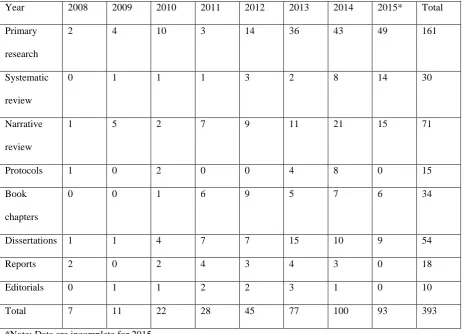
The break-down of these citing publications by publication type is reported in Table 3. The citing publications
mostly appeared in peer-reviewed journals (68%) rather than non-peer-reviewed literature (32%). The most
frequent type of publication citing the key paper was primary research (41%), followed by narrative reviews
(18%) and academic dissertations (14%).
<insert Table 3 here>
With the exception of a “blip” in 2011, the nature of the citation profile is as might be expected for standard
7
increases in primary research four or five years after the publication of the key paper (see Table 4). This perhaps
reflects a typical time-lag between a publication and its demonstrable impact on the published research of others
(Hopewell et al. 2007).
<insert Table 4 here>
Grey literature publications, by contrast, and despite representing a smaller percentage of citing publications,
achieved peaks by four or five years with comparable numbers to peer-reviewed publications, e.g. in 2011 and
2012, the numbers of citing book chapters (6 and 9, respectively) and academic dissertations (7 and 7), were
similar to those for primary research (3 and 14) and narrative reviews (7 and 9). However, citations by
peer-reviewed journal articles continued to increase, while grey literature citations declined or plateaued at a certain
level. This might reflect the nature of research: non-peer-reviewed work is published faster, but is also more
limited in distribution than peer-reviewed work (Rothstein and Hopewell 2009; Last 1995).
Impact based on frequency of citation of the key paper within citing papers
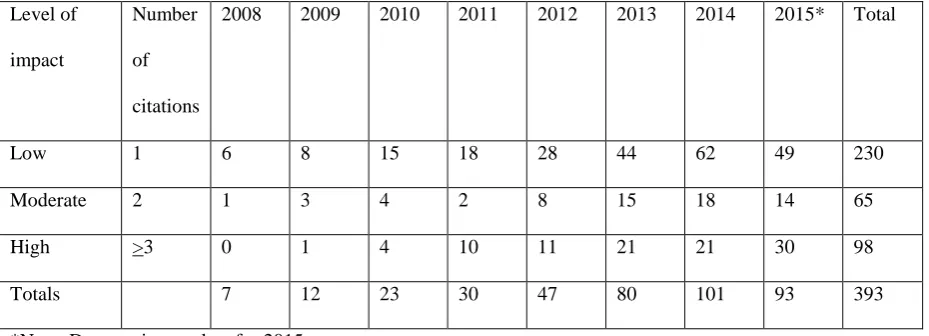
The majority of publications cited the key paper only once (58%), suggesting low impact (see Table 5).
However, 25% (98/393) cited it three or more times suggesting that the key paper was having a high reported
impact on those studies. The citation frequency within these studies, which might be considered to demonstrate
high impact of the key paper, ranged from three to as many as 14 in peer-reviewed studies (Hasson et al. 2012)
and 17 in academic dissertations (with their longer word count) (Rice 2011). Primary research studies published
in peer-reviewed journals were the principal publication type across all levels of impact.
<insert Table 5 here>
It is also apparent that the key paper had its greatest academic impact on primary research studies and academic
dissertations: as the citation frequency increases within publications, so the proportion of primary research
8
publications with three or more such citations). Academic dissertations demonstrate a similar trend (increasing
from 11% to 16%). Based on citation frequency of the key paper within a publication, all levels of impact
increase over time (with the exception of 2015, but the data are incomplete for this year) and, in any given year,
the key paper only had a low impact on the majority of the citing publications, ranging between 53% (49/93 in
2015) and 65% (8/12 in 2009) of all citing publications in a given year. Full details are reported in Table 6.
< insert Table 6 here>
Impact based on location of citations of the key paper within citing papers
Based on the location of citations, the academic impact of the key paper was categorised as low in 79%
(310/393) of the citing publications; moderate in 11% (42/393); and high only in 10% (41/393) (see Table 7).
This compares with 58%, 17% and 25% for low, moderate and high impact, respectively, based on frequency of
citation alone (see Table 4). The metric based on frequency of within-publication citations suggested a higher
impact for the key paper than that suggested by the location of those citations.
<insert Table 7 here>
The data on the principal publication types were largely similar for the location of citations as for the frequency
of citations (see Table 4), with the exception of the high impact publications, which had a much higher
percentage of primary research (63%), and also included study protocols.
Frequencies and location of citations of the key paper within citing publications
There was a large degree of consistency between the data on the frequency of citations within citing papers and
the data on the location of these citations, especially publications categorised as “low impact”. There were 310
“low impact” publications based on location of the citations, of which 230 (74%) were also categorised as low
impact based on frequency (cited only once in the publication) (see Table 8). No publication categorised as low
9
impact” publications based on location of the citations, of which 35 (85%) were also categorised as high impact
based on frequency (cited three or more times in the publication). These results suggest there is a relationship
between the frequency of citations of the key paper and their location within the citing paper.
<insert Table 8 here>
The location-based data therefore confirms that the frequency with which the key paper is cited within a
publication is a good indicator of “low” or “high” impact: it represents a “contextually robust” metric (Wilsdon
et al. 2015). If “high impact” was re-defined as two or more citations of the key paper within two or more
sections within a publication, rather than just three or more citations in two or more sections, which must
include the Methods, then there would be even higher consistency between the metrics in terms of “high
impact”. There were 83 “high impact” publications based on location of the citations, of which 83 (100%)
would also be categorised as high impact based on a frequency of two or more.
Other variables
Two additional metrics indicative of academic impact might be the citation of a key paper in publications in
languages other than English, the principal language of scholarly publication (Van Leeuwen et al. 2001), and
cross-disciplinary citation. Twenty-seven of the 393 publications (7%) citing the key paper were in languages
other than English: Spanish (n=8); Dutch (n=6); French (n=4); Swedish and German (n=3 each) and Czech,
Flemish and Portuguese (one each). The principal publication type for these non-English language publications
were academic dissertations (n=10), followed by narrative reviews (n=6) and primary research (n=5).
Cross-disciplinary citation is perhaps less relevant to this case study, given that the key paper is not discipline-specific,
and this is reflected in the range of journals publishing primary research in this sample: the disciplines covered
include programme evaluation (e.g. Implementation Science, Evaluation and Program Planning); medicine (e.g.
British Medical Journal, Journal of Clinical Epidemiology); health services research (e.g. Health Policy and
Planning, Milbank Quarterly, Trials); psychology (Applied Psychology, Contemporary School Psychology); and
education (e.g. Children and Youth Services Review, Topics in Early Childhood Education); etc.. Altmetrics
10
six tweets in terms of Altmetrics, which is low. This arguably reflects the paper’s publication almost 10 years
ago. However, the key paper also had almost 300 readers on the social reference-sharing site, Mendeley, and
there is a possible relationship between trends on this site and future citations (Fairclough and Thelwall 2015).
Discussion
This small study aimed to provide some insight into the story behind the basic “citation score”, the number of
times a key paper is cited. It focused on the author’s own frequently-cited methods paper to test the hypothesis
that the frequency with which the key paper is cited within the citing publications, the “citation profile”, might
offer an easily measurable, unambiguous metric of academic impact, providing greater depth and context than
the simple “citation score”. It demonstrated that this generally held true for the categories of “high” and “low”
impact, regardless of where the citations appeared in the citing publication and regardless of publication type.
This is the first citation analysis of its kind to be published and the data suggests that frequency of citation
within a publication is a potentially useful and viable measure of academic impact.
Of the 41 publications that were categorised as “high impact” based on location, 35 (85%) were also categorised
as high impact based on frequency. This suggests that a within-publication citation frequency of three or more
will identify the vast majority of publications in which there is clear impact on the conduct and design of
another study. Of those publications with three or more citations of the key paper, approximately one third
(32/98) were “moderate impact” based on location of the citations (citations in at least two sections, other than
the Methods), and one third (31/98) were “low impact” (citations only in a single section (see Table 8). The
location of the citations might not indicate quite the same level of impact as when the citations appear in the
Methods as well as other sections, but they do still indicate high impact; the impact might simply be different.
Three or more citations of the key paper appearing in the Background and/or the Discussion, for example,
indicates much more than an influence "in passing"; rather they might indicate some real influence on the
justification of a study or on the interpretation of its results. This consideration of the location of citations
therefore supports the hypothesis that frequency of citation offers an easily measureable, potentially useful
11
The a priori categorisation of “moderate impact” based on the citation of the key paper two times in the citing
publication, or within at least two sections, was less robust than the categories of “high” and “low” impact: only
a small percentage of publications (17%) cited the key paper twice compared with those which cited it once
(58%) or three or more times (25%), and more than 75% of publications (32/42) that cited the key paper in two
or more sections (not including the Methods) actually cited it three or more times, which is indicative of “high
impact” based on simple frequency of citation. This suggests that a binary “citation profile” based simply on
low impact (single citation or citation in a single section) and high impact (more than one citation across more
than one section), might offer a more useful metric. By not specifying the need for citations to appear in a
Methods section for “high impact” to have been achieved, this allows for a key paper to be important in another
publication’s rationale, and the interpretations of its results, as well as its actual study design and conduct.
According to this binary “citation profile”, the implementation fidelity key paper would be judged to have had a
high impact on 21% of citing publications (83/393) and a low impact on 79% of citing publications (310/393).
A still simpler, binary metric might be single citation vs two or more citations of the key paper within a
publication: this would have generated a citation profile for the key paper of high impact on 41% of citing
publications (163/393) and low impact on 59% of citing publications (230/393). However, this might exaggerate
the number of publications that represent “high impact” for a key paper. Consequently, perhaps the most
easy-to-measure “profile”, reflecting the most robust data, as discussed above, is the figure of three or more citations
within a publication. These data indicate that the key paper in this study had a high impact on 98/393 (25%) of
citing publications.
The approach taken by this study addresses published requirements for responsible metrics, according to which
metrics should be “robust”: they should be based on the best possible data in terms of accuracy and scope, and
give “breadth and depth to the otherwise narrow indicator of citation counts”(Wilsdon et al. 2015). A metric
based on within-publication citation frequency is unambiguous and thus capable of accuracy, as well as being
potentially more “contextually robust” than a simple metric reporting how many publications have cited a
particular key paper. The assessment of where the citations appeared in the citing publications provided further
contextual information and confirmed the viability of within-publication citation frequency as a metric. The
reported method is reproducible and transparent (Supplementary data sheet provided) and data can be verified
12
accounting for variation by location of the citation within a publication, but also by publication type, to
understand how a piece of research might be used differently in different types of publication. The result is a
proposed metric of academic impact: the “citation profile”. It is not a measure of research quality, nor does it
seek to measure other forms of impact or to address issues such as negative findings producing relatively lower
citation scores (Lortie et al. 2013). The study merely seeks to contribute to the debate about how citation metrics
might be used to give a more “contextually robust” picture of a paper’s academic impact.
Limitations
It is a single small case study and a single researcher conducted the searching, screening and extraction.
However, the simplicity of the metric, the counting and location of a key paper’s citations, minimises the risk of
interpretation or error (the chance of missing one or more citations and their location in a publication). However,
it is a case study of a single key paper, which had cross-disciplinary appeal – so has the potential to be cited in
more than one discipline – and was also published in an Article Processing Charge (APC) open access journal;
these types of journals are increasingly having the same impact as subscription journals and are certainly more
visible (Bjork and Solomon 2015). There are therefore questions concerning the generalisability of the findings
relating to this particular case study paper. Future research should look at three different publication types on a
single topic: a methods paper, a primary research paper and a secondary research paper (e.g. systematic review),
to test whether the “citation profiles” of methods papers are consistent, and to determine whether different types
of publication possibly have different citation profiles. As with other bibliometrics, publications in different
disciplines are also likely to have different citation profiles.
Conclusion
These results suggest that it is both possible and straightforward to categorise the academic impact of research
by simply counting the number of citations achieved by a key paper within its citing publications, thus adding
depth and value to the basic metric of “citation score” or the number of publications to cite a paper. It represents
13
References:
Bjork, B.-C. & Solomon, D. 2015. Article processing charges in OA journals: relationship between price and
quality. Scientometrics, 103, 373-85.
Booth, A. 2008. Implementing EBLIP: if it works in Edmonton will it work in Newcastle? Health Information
and Libraries Journal, 25, 154-157.
Carroll, C., Patterson, M., Wood, S., Booth, A., Rick, J. & Balain, S. 2007. A conceptual framework for
implementation fidelity. Implementation Science, 2.
Carroll, C., Rick, J., Pilgrim, H., Cameron, J. & Hillage, J. 2010. Workplace involvement improves return to
work rates among employees with back pain on long-term sick leave: a systematic review of the
effectiveness and cost-effectiveness of interventions. Disability and rehabilitation, 32, 607-621.
Chandler, C. 2014. What is the meaning of impact in relation to research and why does it matter? A view from
inside academia. In: DENICOLO, P. (ed.) Achieving Impact in Research. New York: Sage.
Fairclough, R. & Thelwall, M. 2015. National research impact indicators from Mendeley readers. Journal of
Informetrics, 9, 845-859.
Field, B., Booth, A., Illott, I. & Gerrish, K. 2014. Using the Knowledge to Action Framework in practice: a
citation analysis and systematic review. Implementation Science, 9.
Harzing, A. & Van Der Wal, R. 2008. Google Scholar as a new source for citation analysis. Ethics in Science
and Enviornmental Politics, 8, 61-73.
Hasson, H., Blomberg, S. & Duner, A. 2012. Fidelity and moderating factors in complex interventions: a case
study of a continuum of care program for frail elderly people in health and social care. Implementation
Science, 7.
Hopewell, S., Clarke, M., Stewart, L. & Tierney, J. 2007. Time to publication for results of clinical trials.
Cochrane Database of Systematic Reviews, Issue 2. Art. No.: MR000011.
Last, J. 1995. A Dictionary of Epidemiology, Oxford, Oxford University Press.
Leaviss, J. & Uttley, L. 2015. Psychotherapeutic benefits of compassion-focused therapy: an early systematic
review. Psychological medicine, 45, 927-945.
Lortie, C., Aarssen, L., Budden, A. & Leimu, R. 2013. Do citations and impact factors relate to the real numbers
in publications? A case study of citation rates, impact, and effect sizes in ecology and evolutionary
14
National Library of Medicine (NLM). 2016. Medical Subject Headings (MeSH) [Online]. Available:
https://www.nlm.nih.gov/mesh/ [Accessed 29 April 2016].
Ravallion, M. & Wagstaff, A. 2011. On measuring scholarly influence by citations. Scientometrics, 88, 321-37.
R. E. F. 2014. REF 2014 [Online]. Available: http://www.ref.ac.uk/ [Accessed 26 April 2016].
Rice, K. 2011. Change over time in implementation fidelity of a child welfare practice model.
Rothstein, H. & Hopewell, S. 2009. Grey Literature. In: COOPER, H., HEDGES, L. & VALENTINE, J. (eds.)
The Handbook of Research Synthesis and Meta-Analysis. New York: Sage.
Royle, P., Kandala, N.-B., Barnard, K. & Waugh, N. 2013. Bibliometrics of systematic reviews: analysis of
citation rates and journal impact factors. Systematic Reviews, 2.
Sarli, C., Dubinsky, E. & Holmes, K. 2010. Beyond citation analysis: a model for assessment of research
impact. Journal of the Medical Library Association, 98, 17-23.
Van Leeuwen, T., Moed, H., Tijssen, R., Visser, N. & Cvan Raan, A. 2001. Language biases in the coverage of
the Science Citation Index and its consequences for international comparisons of national research
performance. Scientometrics, 51, 335-46.
Wilsdon, J., Allen, L., Belfiore, E., Campbell, P., Curry, S., Hill, S., Jones, R. & Kain, R. 2015. The Metric
Tide. Report of the Independent Review of the Role of Metrics in Research Assessment and
15
Figure: Search results
Google Scholar = 423
Web of Science =177
Scopus = 218
n=818
After de-duplication
n=416
Final included citing publications
n=393
Unavailable n=12
(7 book chapters, 2 narrative reviews, 2 dissertations, 1 report)
Citations in reference list but not text n=11
(5 narrative reviews; 3 reports; 1 primary research;
16
Table 1: Research impact based on frequency and location of key paper citations with citing publications:
Impact Frequency of citation within citing publication Citation location with citing publication
High 3 or more Methods and other sections
Moderate 2 Two or more sections (excluding Methods)
17
Table 2: Publication types
Publication type Definition
Journal article: primary research Original research following standard reporting
structures, e.g. Background, Methods, Results,
Discussion and Conclusion
Journal article: systematic review/meta-analysis Works consisting of studies using an established
method of combining the results of independent
studies (usually drawn from the published literature)
and synthesizing summaries and conclusions using
published systematic review methods. It should be
differentiated from narrative reviews of literature.
Journal article: literature / narrative review An article published after examination of published
material on a subject. It may be comprehensive to
various degrees and the time range of material
scrutinized may be broad or narrow, but generally is a
review of the current literature.
Study protocol A document detailing the design of a study
Editorial or letter Work consisting of a statement of the opinions,
beliefs, or policy of the editor or publisher of a
journal, or other academic author
Technical report Work consisting of a formal report giving details of
the investigation and results of a … scientific problem
… issued by a government agency or other official
body (academic or non-academic)
Academic dissertation Works consisting of formal presentations made
usually to fulfil requirements for an academic degree
Book / Book chapter A main division of a book, typically with a number or
18
Table 3: Publication types
Publication type (peer-reviewed) Number Publication type (grey literature) Number
Primary research 161 Editorial / Letter 10
Systematic review/meta-analysis 30 Technical report 18
Literature / narrative review 71 Academic dissertation 54
Study protocol 15 Book chapter 34
Table 4: By publication type: standard peer-reviewed journal article publication types
Year 2008 2009 2010 2011 2012 2013 2014 2015* Total
Primary
research
2 4 10 3 14 36 43 49 161
Systematic
review
0 1 1 1 3 2 8 14 30
Narrative
review
1 5 2 7 9 11 21 15 71
Protocols 1 0 2 0 0 4 8 0 15
Book
chapters
0 0 1 6 9 5 7 6 34
Dissertations 1 1 4 7 7 15 10 9 54
Reports 2 0 2 4 3 4 3 0 18
Editorials 0 1 1 2 2 3 1 0 10
Total 7 11 22 28 45 77 100 93 393
[image:19.595.67.533.366.700.2]19
Table 5: Impact by publication type based on frequency of citation of key paper within citing publication
*Rounding to the nearest whole number
Table 6: Impact over time based on frequency of citation of key paper within publications
Level of
impact
Number
of
citations
2008 2009 2010 2011 2012 2013 2014 2015* Total
Low 1 6 8 15 18 28 44 62 49 230
Moderate 2 1 3 4 2 8 15 18 14 65
High >3 0 1 4 10 11 21 21 30 98
Totals 7 12 23 30 47 80 101 93 393
*Note: Data are incomplete for 2015 Level of impact Frequency of citations Number
(% of total*)
Principal publication types
n (%)
Low 1 230 (59%) Primary research
71 (31)
Narrative review
32 (14)
Dissertations
26 (11)
Moderate 2 65 (17%) Primary research
28 (43)
Narrative review
13 (20)
Dissertations
9 (14)
High >3 98 (25%) Primary research
44 (45)
Dissertations
19 (19)
Narrative review
16 (16)
[image:20.595.67.532.464.632.2]20
Table 7: Impact by location of citation(s) of citation of key paper within citing publications
Table 8: Impact by frequency and location of citation(s) of the key paper within citing publications
*Rounding to the nearest whole number Level of
impact
Location of
citations
Number
(% of total)
Principal publication types
n (%)
Low One section only 310
(79%) Primary research 119 (38) Narrative review 59 (19) Dissertations 41 (10)
Moderate Two or more
sections (not Methods) 42 (11%) Primary research 16 (38) Narrative reviews 11 (26) Dissertations / Systematic reviews
6 (14)
High Methods + other
sections 41 (10%) Primary research 26 (63) Dissertations 7 (17) Study protocols 3 (7)
Total 393 (100%)
Totals
(n)
Level of
impact by
frequency
Level of impact by location
Number (% as a proportion of total*)
Low Moderate High
230 Low 230 (74%) 0 (0%) 0 (0%)
65 Moderate 49 (16%) 10 (24%) 6 (15%)
98 High 31 (10%) 32 (76%) 35 (85%)
[image:21.595.66.522.430.621.2]